
In short
Empty hard gelatin capsule shells are received, sampled and tested like any other drug component. QC samples each lot against an acceptance quality limit agreed with the supplier, sorts what it finds into critical, major and minor defects, measures the shells, and tests loss on drying, disintegration and microbial quality before the lot is released to the capsule-filling floor.
This SOP for hard gelatin capsules sets out those steps as a document you can adapt. It keeps the two pharmacopoeial moisture limits that disagree side by side instead of merging them into one number: the Japanese Pharmacopoeia’s 13–16 % and the USP monograph’s 9.0–16.0 %.
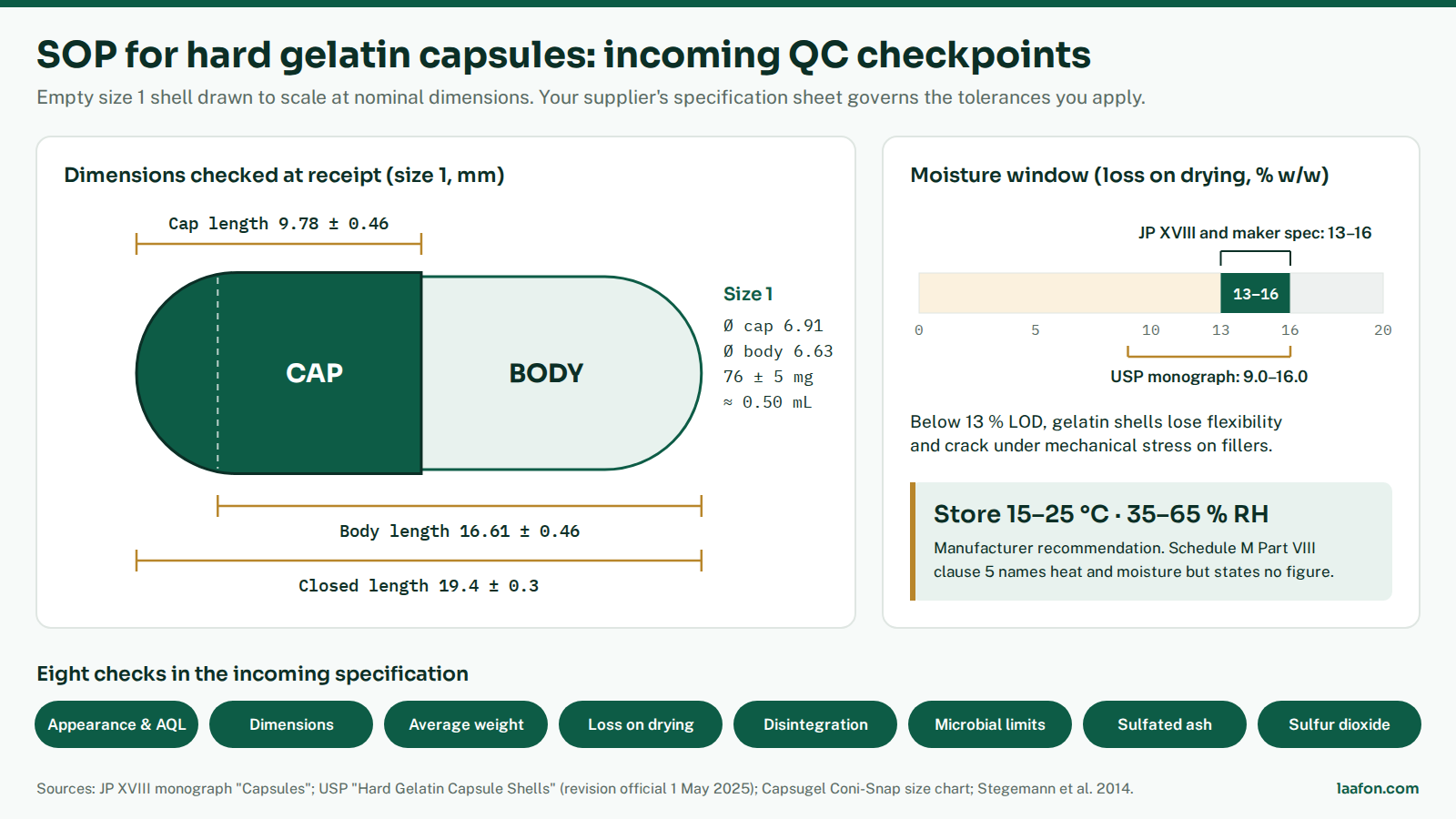
- Storage: 15–25 °C and 35–65 % RH is the capsule maker’s recommendation. Schedule M gives no number.[2][3]
- Brittleness: below 13 % loss on drying, gelatin shells lose flexibility and crack under mechanical stress.[3]
- Legal status in India: empty gelatin capsules are named in the definition of a drug.[1]
SOP for Hard Gelatin Capsules
Empty hard gelatin capsules are a sensitive material. The gelatin film holds water, and that water is what keeps it flexible. A capsule manufacturer’s specification typically sets the shell’s water content, measured as loss on drying, at 13–16 %. Shells are not fixed at that figure: they take up or give off moisture until they match the air around them. Capsugel’s authors report that, stored at 15–25 °C and 35–65 % RH, shells stay inside that range. Below 13 %, the shells lose flexibility and tend to break under mechanical stress.[3]
The dimensions matter as much as the moisture. High-speed filling machines run at up to 250,000 capsules an hour, and dimensional variation causes problems in rectifying, feeding, opening and closing. The result is machine stops and damaged capsules.[3] For that reason this SOP treats the shell as a controlled component, not as packaging.
Indian law takes the same view. Section 3(b)(iii) of the Drugs and Cosmetics Act, 1940 defines a drug to include substances intended for use as components of a drug, “including empty gelatin capsules”.[1] Revised Schedule M (G.S.R. 922(E), 28 December 2023) repeats this in Part VIII, the part for oral solid dosage forms. Clause 5 says empty capsule shells shall be regarded as a drug component and stored where they are safe from excessive heat and moisture.[2]
What Schedule M does not say
We searched the extracted text of Schedule M Part VIII for any percentage or degree figure and found none. Clauses 1.27 and 1.28 require temperature and relative humidity to be controlled, monitored and recorded, with alert and action limits set as appropriate. They do not set the band.[2] The numbers you put in your storage SOP come from your capsule supplier and your own data. They are not a Schedule M requirement, and an auditor will expect you to know that. For a clause-by-clause self-check, see the Revised Schedule M gap assessment toolkit.
SOP for Hard Gelatin Capsules: Sampling, Inspection and Testing of Empty Shells
SOP for Hard Gelatin Capsules for Sampling and Testing
1.0 Objective. This SOP for hard gelatin capsules lays down the procedure for receipt, storage, sampling, inspection, testing and release of empty hard gelatin capsule shells.
2.0 Scope. The procedure applies to the Quality Control department and to Stores, for every lot of empty hard gelatin capsule shells received for capsule manufacture at [site name]. It excludes hypromellose (HPMC) and pullulan shells, which have their own monographs and very different moisture limits: the Japanese Pharmacopoeia sets 2–7 % loss on drying for Hypromellose Capsules.[4] It also excludes soft gelatin capsules and filled-capsule testing.
3.0 Responsibility. Stores Officer: receipt, quarantine and storage conditions. QC Chemist: sampling, inspection and testing. Officer QC: review of data and release. Production: machine trial, when one is required.
4.0 Accountability. Head, Quality Control. Head, Quality Assurance approves this SOP and any deviation from it.
5.0 Abbreviations. SOP: Standard Operating Procedure. QC: Quality Control. QA: Quality Assurance. AQL: acceptance quality limit. LOD: loss on drying. RH: relative humidity. COA: certificate of analysis. TAMC / TYMC: total aerobic microbial count / total combined yeasts and moulds count.
6.0 Materials and equipment. Approved reference sample and shade card from the supplier. Calibrated vernier caliper or micrometer (0.01 mm), or an optical dimension system. Analytical balance (0.1 mg). Hot-air oven qualified at 105 °C. Disintegration apparatus (Ph. Eur. 2.9.1 / USP <701> type). Sampling tools, clean polyethylene bags and “Sampled” labels.
Procedure for Hard Gelatin Capsules for Sampling and Testing
The procedure runs in three stages: sampling of the hard gelatin capsules, inspection, and testing. Stores receipt and storage come first, because moisture damage starts on the receiving dock and not in the laboratory.
7.1 Receipt and storage
Check that each carton is intact and sealed. Check it is labelled with the supplier, capsule size, colour or print code, lot number and quantity, and that the supplier is on the approved-vendor list for this item.
Confirm that the supplier’s COA and a TSE/BSE compliance statement for the gelatin source come with the consignment. The European reference for gelatin TSE risk is EMA/410/01 rev.3.[11]
Open no carton at receipt. Reject any carton whose inner polyethylene liner is torn, wet or crushed.
Keep cartons on pallets, clear of walls, direct sunlight and heat sources such as dryers or steam lines.
Sampling of Hard Gelatin Capsules
Sampling is done by the Quality Control department. The number of capsules drawn for visual inspection depends on the acceptance quality limits for critical, major and minor defects that you have worked out and agreed with the supplier. The general logic follows the raw-material rules in the SOP for sampling of raw materials, but the plan for defects is an attribute plan and not a square-root rule.
Take the sample size and the accept/reject numbers for each defect class from the attribute sampling plan in your supplier quality agreement. Work from lot size, then inspection level, then code letter.
Cite the current standard. ISO 2859-1:2026 (third edition, published 22 January 2026) replaced ISO 2859-1:1999 and its amendment.[10] An SOP that still cites the 1999 edition cites a withdrawn standard. Update the reference, and re-check the tables against the edition you hold before changing any sample size.
Pick cartons at random. Draw from the top, middle and bottom of each liner, and reseal the liner at once. Shell moisture changes with exposure, so an open liner can change the loss on drying result.[3]
Set aside a retained sample, following the control and retention sample SOP. Put a “Sampled” label on each sampled carton.
Inspection of Hard Gelatin Capsules
Inspect the samples for the following, against the approved reference sample.
Appearance: cracks, dents, distortion, holes and rough or uneven cut edges.
Colour: against the standard specification and the approved shade card, under a defined light source.
Print, if any: legibility, registration and smudging, against the approved reference sample.
Self-locking: close the two halves and confirm they lock. In pre-locked supply, confirm the cap and body separate smoothly.
Dimensions: measure body length, cap length, body diameter, cap diameter and closed joined length. Compare each with the supplier’s specification. The table below shows one manufacturer’s nominal range.
| Size | Volume (mL) | Shell weight (mg) | Cap length (mm) | Body length (mm) | Closed length (mm) |
|---|---|---|---|---|---|
| 000 | 1.37 | 163 ± 10 | 12.95 ± 0.46 | 22.20 ± 0.46 | 26.1 ± 0.3 |
| 00 | 0.91 | 118 ± 7 | 11.74 ± 0.46 | 20.22 ± 0.46 | 23.3 ± 0.3 |
| 0 | 0.68 | 96 ± 6 | 10.72 ± 0.46 | 18.44 ± 0.46 | 21.7 ± 0.3 |
| 1 | 0.50 | 76 ± 5 | 9.78 ± 0.46 | 16.61 ± 0.46 | 19.4 ± 0.3 |
| 2 | 0.37 | 61 ± 4 | 8.94 ± 0.46 | 15.27 ± 0.46 | 18.0 ± 0.3 |
| 3 | 0.30 | 48 ± 3 | 8.08 ± 0.46 | 13.59 ± 0.46 | 15.9 ± 0.3 |
| 4 | 0.21 | 38 ± 3 | 7.21 ± 0.46 | 12.19 ± 0.46 | 14.3 ± 0.3 |
| 5 | 0.13 | 28 ± 2 | 6.20 ± 0.40 | 9.30 ± 0.40 | 11.1 ± 0.4 |
Capsugel Coni-Snap nominal values.[9] manufacturer spec Other makers’ figures differ slightly. Use your supplier’s specification sheet, not this table, as the acceptance limit. Swipe sideways on a phone.
Classification of Defects
Sort every defect found into one of three classes. Enter the AQL agreed with your supplier for each class; no pharmacopoeia sets these values.
| Class | Examples | AQL (%) |
|---|---|---|
| Critical | Uncut cap or body, split cap or body, holes, uneven cuts, rough edges. A foreign capsule of the wrong size, colour or print is also treated as critical, because it is a mix-up hazard. | ___ site policy |
| Major | Dimensions outside the specified limits. | ___ site policy |
| Minor | Slightly dented ends, loose cap or body, small bubbles, specks, locked capsules. | ___ site policy |
The AQL values are a commercial agreement between you and the supplier, written into the quality agreement. They are not a compendial limit.
Testing of Hard Gelatin Capsules
Test the samples as follows. Where your specification allows a test to be covered by the supplier’s COA, say so in the specification and verify it in-house at a frequency QA has approved.
Average weight. Weigh 100 capsules and calculate the mean. Record the lightest and heaviest individual shells. For reference, the size 1 specification in the published Capsugel data is 76 ± 5 mg.[3]
Disintegration or solubility. JP: place one pair in 50 mL of water at 37 ± 2 °C and shake often. Do this 5 times; all must dissolve within 10 minutes, giving an odourless, neutral or slightly acidic solution.[4] IP and USP: not more than 15 minutes, with discs.[8] Use a dry basket and dry discs. Wet surfaces make gelatin stick and slow the end-point.[3] The apparatus itself is calibrated under the disintegration test apparatus SOP.
Microbial limits. Run the total counts and the tests for specified microorganisms against the limits in the acceptance criteria table below.
Sulfated ash and sulfur dioxide. Usually covered by the supplier’s COA, with in-house verification at a set frequency. Sulfated ash depends on the colourants in the shell, so the limit differs for transparent, part-coloured and fully coloured capsules.[3]
Machine trial. For a new supplier, a new size or a change in shell formulation, run at least 1,000 capsules on the production filler. Record separation failures, splits, telescoping and machine stops. site practice The machines this applies to are listed in the capsule section machinery list.
Tests not listed here that appear in the monograph of the pharmacopoeia your specification cites still apply. This SOP does not replace the monograph.
Acceptance Criteria for Empty Hard Gelatin Capsules: JP vs USP vs IP
Three pharmacopoeias and one capsule manufacturer do not agree on moisture. Each column below comes from its own source. Where we could not read the full text of a paywalled monograph, the cell says so rather than guessing.
| Parameter | JP XVIII “Capsules” | USP “Hard Gelatin Capsule Shells” | IP 2022 “Hard Gelatin Capsule Shells” | Manufacturer spec (Capsugel, size 1) |
|---|---|---|---|---|
| Loss on drying | 13–16 % (1 g, 105 °C, 2 h)[4] compendial | 9.0–16.0 %[6] compendial | Within the 12–17 % span reported across IP, ChP and Belarus[8] check source | 13–16 % w/w[3] |
| Disintegration / solubility | 1 pair in 50 mL water, 37 ± 2 °C; 5 of 5 dissolve within 10 min[4] | NMT 15 min, with discs[8] | NMT 15 min, with discs[8] | Less than 15 min (Ph. Eur. 2.9.1, water, disc)[3] |
| Microbial limits | TAMC 103 CFU/g; TYMC 102 CFU/g[4] | Tests <61> and <62> required; limits not read check source[6] | Required; limits not read check source[8] | TAMC ≤ 1,000/g; TYMC ≤ 100/g; E. coli, S. aureus, P. aeruginosa absent in 1 g; Salmonella absent in 10 g[3] |
| Average weight | Not a JP requirement | check source | check source | 76 ± 5 mg[3] |
| Dimensions | Not a JP requirement | Supplier specification | Supplier specification | Cap 9.78 ± 0.46; body 16.61 ± 0.46; closed 19.4 ± 0.3 mm[3] |
| Sulfated ash | Not a JP requirement | check source | check source | Transparent < 2 %; combined < 5 %; coloured < 7 %[3] |
| Sulfur dioxide | Not a JP requirement | check source | check source | < 50 ppm[3] |
| Storage | Well-closed containers[4] | Other conditions allowed where stability studies support them[6] | check source | 15–25 °C, 35–65 % RH[3] |
JP XVIII main text, not amended in Supplements I (2022) or II (2024) for this monograph. The USP revision became official on 1 May 2025.[5][7] IP and USP cells marked check source must be completed from the current official text before this table is used as a specification.
One lot, two verdicts
The JP monograph contains four requirements and nothing else: method of preparation, solubility with acidity or alkalinity, loss on drying and microbial limit, plus a storage line.[4] A shell lot at 11 % loss on drying passes the USP monograph and fails both JP and the manufacturer’s own 13–16 % specification. During the USP revision, a commenter asked for 13–16 % to protect elasticity. USP kept 9.0–16.0 % so the range would cover low-moisture shells as well as conventional ones.[6] The limit that governs is the one in your approved specification. If your product goes to more than one market, write the tighter range.
Deviation Handling and Release
If critical defects reach the reject number, reject the lot and raise a supplier complaint with photographs and the sample retained. Do not sort or screen a lot to release it without a QA-approved deviation.
If a laboratory result is out of specification, investigate under the site OOS SOP. Check sample handling first when loss on drying fails: how long the liner was open and the conditions in the sampling room. Loss on drying is a dynamic property of the shell.[3]
Do not re-condition shells to bring loss on drying back into range without a QA-approved change. Deliberately lower-moisture shells for moisture-sensitive products are a design decision, and they need product-specific studies of brittleness and performance.[3]
If a lot passes testing but fails the machine trial, investigate dimensions and weight distribution. Inform the supplier and hold the lot until QA decides.
When the lot complies, QC affixes “Approved” labels and records the release. Stores issues first-expiry, first-out. Reseal part-used cartons and return them to controlled storage.
Annexure-I: Incoming Inspection Record for Empty Hard Gelatin Capsules
Annexure-I to the SOP for hard gelatin capsules. Copy the format into your controlled-document template. The header fields are left blank on purpose.
| Test | Specification | Result | Complies (Y/N) | Analyst / date | Checked by |
|---|---|---|---|---|---|
| Appearance and defects (critical / major / minor found) | Per AQL plan | ||||
| Colour and print vs reference sample | Matches | ||||
| Dimensions (cap, body, closed length) | Supplier spec | ||||
| Average weight of 100 capsules | Supplier spec | ||||
| Loss on drying | Per cited pharmacopoeia | ||||
| Disintegration / solubility | Per cited pharmacopoeia | ||||
| Microbial limits | Per cited pharmacopoeia | ||||
| Sulfated ash / sulfur dioxide (COA or in-house) | Supplier spec | ||||
| Machine trial (when required) | No abnormal stops |
Revision history
| Version | Effective date | Change | Approved by |
|---|---|---|---|
| 00 | DD-MMM-YYYY | New SOP | Head QA |
| 01 | DD-MMM-YYYY | ISO 2859-1 reference updated to the 2026 edition; USP 2025 moisture range added | Head QA |
Want capsules made under your brand without building a plant?
A loan licence lets you manufacture at an approved unit under your own licence. Laafon Galaxy handles loan licence applications on Form 24A/25A and 27A/28A for units in Haryana, Punjab, Himachal Pradesh and Uttarakhand.
Frequently Asked Questions
Yes. USP–NF carries a monograph titled Hard Gelatin Capsule Shells. A revision proposed in Pharmacopeial Forum 49(5) became official on 1 May 2025 and sets loss on drying at 9.0–16.0 %. A 2024 survey also found shell monographs in the Belarus, Indian, Chinese, Korean and Japanese pharmacopoeias. It listed none in the European Pharmacopoeia.
The Japanese Pharmacopoeia sets 13–16 % loss on drying (1 g, 105 °C, 2 hours), and capsule manufacturers specify the same range. The USP monograph accepts 9.0–16.0 %. Below 13 %, gelatin shells lose flexibility and crack on filling machines, so most plants specify 13–16 % unless the product needs low-moisture shells.
At 15–25 °C and 35–65 % relative humidity, in the sealed liner, off the floor and away from heat. That band is the capsule maker’s recommendation. Schedule M Part VIII only requires protection from excessive heat and moisture, with temperature and humidity controlled, monitored and recorded against alert and action limits.
Yes. Section 3(b)(iii) of the Drugs and Cosmetics Act, 1940 includes substances intended for use as components of a drug, naming empty gelatin capsules. Revised Schedule M Part VIII clause 5 says empty capsule shells shall be regarded as a drug component and treated accordingly.
No. Hypromellose shells have a separate JP monograph, with loss on drying of 2–7 % and dissolution within 15 minutes. Applying gelatin moisture limits to HPMC shells would fail every lot. Write a separate specification, or a separate annexure, for each shell polymer.
Gelatin is dissolved in warm water with any colourants, opacifiers and preservatives to make a viscous solution. Lubricated pins are dipped into it. The film is dried on the pins, stripped off, trimmed to length, and the caps and bodies are joined into pairs. Water falls from about 40 % in the solution to 13–16 % in the finished shell.
Related on laafon.com
References
- Government of India. The Drugs and Cosmetics Act, 1940 (Act 23 of 1940), Section 3(b)(iii). Available from: https://indiankanoon.org/doc/999516/. Accessed September 2026.
- Ministry of Health and Family Welfare. G.S.R. 922(E): Drugs (Amendment) Rules, 2023, Schedule M, Part VIII (Specific requirements for manufacture of oral solid dosage forms), clauses 1.27–1.30 and 5. Gazette of India, Extraordinary; 28 December 2023. Available from: https://cdsco.gov.in/opencms/opencms/system/modules/CDSCO.WEB/elements/download_file_division.jsp?num_id=MTA4MTU=. Accessed September 2026.
- Stegemann S, Connolly P, Matthews W, Barnett R, Aylott M, Schrooten K, et al. Application of QbD principles for the evaluation of empty hard capsules as an input parameter in formulation development and manufacturing. AAPS PharmSciTech. 2014;15(3):542–9. doi:10.1208/s12249-014-0094-y. Available from: https://pmc.ncbi.nlm.nih.gov/articles/PMC4037476/. Accessed September 2026.
- Ministry of Health, Labour and Welfare. The Japanese Pharmacopoeia, 18th ed. (English version). Official Monographs: Capsules; Hypromellose Capsules. Tokyo: MHLW; 2021. p. 622. Available from: https://www.mhlw.go.jp/content/11120000/000904440.pdf. Accessed September 2026.
- United States Pharmacopeial Convention. Hard Gelatin Capsule Shells [monograph]. USP–NF. Rockville (MD): USP. doi:10.31003/USPNF_M9475_02_01. Available from: https://doi.usp.org/USPNF/USPNF_M9475_02_01.html. Accessed September 2026.
- United States Pharmacopeial Convention. Commentary for USP–NF 2025, Issue 1: Hard Gelatin Capsule Shells. Rockville (MD): USP; 1 November 2024, revised 23 January 2025. Available from: https://www.uspnf.com/sites/default/files/usp_pdf/EN/USPNF/usp-nf-commentary/usp-nf-2025-issue-1-commentary-rev-20250123.pdf. Accessed September 2026.
- United States Pharmacopeial Convention. USP–NF publication and comment schedule (USP–NF 2025, Issue 1: official 1 May 2025). Available from: https://www.uspnf.com/print/pdf/node/16296. Accessed September 2026.
- Kovaleva EL, Matveeva OA, Shelestova VV, Balatskaya KA. Pharmacopoeias’ and manufacturers’ requirements for the quality of hard gelatin capsule shells. Regulatory Research and Medicine Evaluation. 2024;14(6):620–33. doi:10.30895/1991-2919-2024-14-6-620-633. Available from: https://doi.org/10.30895/1991-2919-2024-14-6-620-633. Accessed September 2026.
- Capsugel (Lonza). Coni-Snap capsule sizes chart. Distributed by MEDISCA. Available from: https://files.medisca.com/NDCSpecs/MUS/2711/Downloads/Coni-Snap%20Capsule%20Sizes%20Chart.pdf. Accessed September 2026.
- International Organization for Standardization. ISO 2859-1:2026. Sampling procedures for inspection by attributes, Part 1: Sampling schemes indexed by acceptance quality limit (AQL) for lot-by-lot inspection. 3rd ed. Geneva: ISO; 2026. Available from: https://www.iso.org/standard/85464.html. Accessed September 2026.
- European Medicines Agency. Note for guidance on minimising the risk of transmitting animal spongiform encephalopathy agents via human and veterinary medicinal products (EMA/410/01 rev.3). Official Journal of the European Union. 2011;C 73:1–18. Available from: https://eur-lex.europa.eu/legal-content/EN/TXT/?uri=CELEX:52011XC0305(04). Accessed September 2026.
This SOP for hard gelatin capsules is a template for adaptation. It needs local qualification, validation and Quality Assurance approval before use. Check every acceptance criterion against the current edition of the pharmacopoeia your specification cites: pharmacopoeial texts and Indian statutory instruments change between editions, and the IP and USP cells marked check source were not read in full. Technical and educational content only, not medical, legal or investment advice.