
Short answer
Under India’s revised Schedule M, every container of a starting material gets an identity test on its own sample. Clause 19.7.2 of Part I says so, and a smaller proportion may be sampled only where a validated procedure shows that no container can be mislabelled [1]. The familiar √N+1 formula is WHO’s “n plan”, and WHO itself says it is not statistically based and not recommended for a manufacturer’s QC release of incoming consignments [2].
This page sets out how sampling of raw materials in pharmaceutical industry warehouses is actually governed: what Schedule M, EU GMP, 21 CFR 211.84, Health Canada, ICH Q7 and WHO each require, where √N+1 is and is not acceptable, a sampling-plan calculator, and a complete SOP you can adapt, with the sampling record as a copyable annexure. EU GMP Annex 8 carries the same each-container rule as Schedule M, word for word in places [3].
Sampling of raw materials in pharmaceutical industry: what six GMP texts require
Most published SOPs for sampling of raw materials in pharmaceutical industry QC departments treat it as one question: how many containers do I open? The texts that govern it separate two questions. The first is identity: is every container what its label says? The second is quality: does the batch meet its specification? The first is where mix-ups and substitution happen, which is why the strictest rules attach to it. The second is where a statistical sampling plan belongs.
Schedule M and EU GMP both default to an identity test on every container. The US regulation asks for at least one identity test per component lot, on samples drawn to a statistically justified plan. Health Canada sits between the two: it lets you pool up to ten containers into one composite, but only if you also run a potency test on each composite.
| Text | Identity testing | Sampling fewer containers | Where to sample | √N+1 in the text? |
|---|---|---|---|---|
| Schedule M, Part I (G.S.R. 922(E), 28 Dec 2023) [1] | Identity test on a sample from each container (19.7.2); measures to assure the identity of each container’s contents (14.16) | Only with a validated procedure (19.7.2.1–19.7.2.2); “improbable” to validate for broker-sourced or parenteral materials (19.7.2.3) | Normally a separate sampling area; if sampled in the store, prevent contamination (12.4.8) | No. Full notified text searched for “square root”, “√” and “n+1”: no hits |
| EU GMP Annex 8; Part I Ch. 5 and Ch. 3 [3] [4] [5] | Batch identity “can normally only be ensured” by testing a sample from all containers (Annex 8 §2); identity testing of each batch is the minimum even when relying on supplier data (5.35) | Same validated exception and same broker/parenteral exclusions (Annex 8 §2–3) | Normally a separate sampling area (3.22) | No |
| US FDA 21 CFR 211.84 [6] | At least one test to verify the identity of each component (d)(1) | Representative samples of each shipment of each lot, using statistical criteria (b); top/middle/bottom sub-samples not composited (c)(4) | Not specified in 211.84; the section prescribes procedures, not a room | No |
| Health Canada GUI-0001 (2020), C.02.009 [7] | Each container, with a specifically discriminating identity test; or composites of not more than 10 containers, with a potency test on each composite | A proportion only with audit evidence that no container is mislabelled; does not apply to parenterals or broker-supplied material | Not reviewed for this page | Yes, in the Q&A: “may be acceptable” for a large number of containers, but carries “significant risk” for a small number |
| ICH Q7 (APIs), section 7.3 [8] | At least one identity test on each batch of incoming material (7.30) | Number of containers per a sampling plan weighing criticality, variability, supplier history and the quantity needed (7.33) | Defined locations, procedures that prevent contamination (7.34) | No |
| WHO TRS 929, Annex 4 (2005) [2] | Ideally every sampling unit is examined and tested for identity; the plans are “not recommended” for identity sampling of starting materials | n, p and r plans, written primarily for regulators and procurement agencies | An area or booth designed and dedicated for sampling, where possible (1.5) | Yes: n = 1 + √N, the one plan WHO calls “not statistically based” |
Swipe the table sideways on a phone. Clause numbers are from the texts as opened in September 2026.
The √N+1 formula: WHO’s n plan, and the two plans most SOPs leave out
WHO’s sampling guideline gives three plans, not one. N is the number of containers (sampling units) in the consignment [2]. The plans differ in what they assume about the material and in what they do with the samples. Only the n plan reduces the number of containers you open. The p and r plans still sample every container. What they reduce is the number of samples carried forward to full testing.
| Plan | Formula | WHO’s condition for use | What is sampled and tested |
|---|---|---|---|
| n plan | n = 1 + √N simple rounding | Material considered uniform, from a recognised source; “used with great caution”. Not recommended for manufacturers’ control laboratories releasing each consignment | n containers chosen at random; each original sample identity-tested; concordant samples combined into one composite |
| p plan | p = 0.4√N round up | Uniform material from a recognised source, where the main purpose is identity | All N containers sampled and identity-tested; if concordant, pooled into p final samples |
| r plan | r = 1.5√N round up | Material suspected to be non-uniform, or from a source that is not well known; also herbal starting materials | All N containers sampled and identity-tested; r samples then chosen at random and tested individually |
WHO’s published table does not always match its own formulae. The rounding rule for each plan is stated in the text. Applying it, Table 1 of Annex 4 differs from the formula at N = 3, 4 and 13 for the n plan, and at N = 22 for the r plan. For N = 3 and 4, the table also contradicts the text’s own instruction to sample every container when N is 4 or fewer. The table also puts a floor of 2 on the p plan for N ≤ 6, where the formula gives 1. The calculator below shows both values and uses the higher one. That is a conservative choice, not a WHO instruction.
Raw material sampling plan calculator
20 containers
Open and identity-test all 20 containers.
Schedule M Part I 19.7.2 and EU GMP Annex 8 paragraph 2.
The calculator reproduces WHO TRS 929 Annex 4, section 5.1 and Table 1 [2]. It does not validate a reduced-sampling procedure for you. Under Schedule M, any plan that opens fewer than N containers for identity needs the validation described in 19.7.2.1.
Health Canada’s answer on √N+1 is the most useful single sentence on the subject. The plan “may be acceptable” for a large number of containers, but it “may present a significant risk of accepting defective goods” when sampling a small number, and like every plan it needs documented justification [7]. For packaging materials, WHO points to attribute sampling standards: BS 6001-1, ISO 2859 or ANSI/ASQC Z1.4 [2].
Every container or a proportion? The identity-testing decision
The answer depends on two things: which regulator’s GMP you manufacture under, and where the material came from. Pick one of each.
1. GMP you manufacture under
2. The material and its source
Choose one option from each group
The verdict and the clause it rests on appear here.
For the DEG/EG-risk excipients, the only primary text found that names them is FDA’s May 2023 guidance. It recommends that identity testing include a DEG and EG limit test on samples from all containers of all lots, against a safety limit of not more than 0.10 % [9]. For an Indian manufacturer of oral liquids, that is the defensible standard whatever the market. Schedule M’s each-container default already gets you most of the way. If your reduced-testing validation covers these materials, expect an inspector to ask about it first. Laafon’s CDSCO Schedule M compliance dashboard tracks the wider revised-Schedule M obligations.
Raw material sampling process flow, from receipt to release
The flow below follows one consignment through the warehouse and QC. It shows the status label each container carries at each step and the clause behind the step. Container status is what an auditor checks first on a walk-through: an UNDER TEST container with no SAMPLED label, sitting in the booth queue for three days, tells its own story.
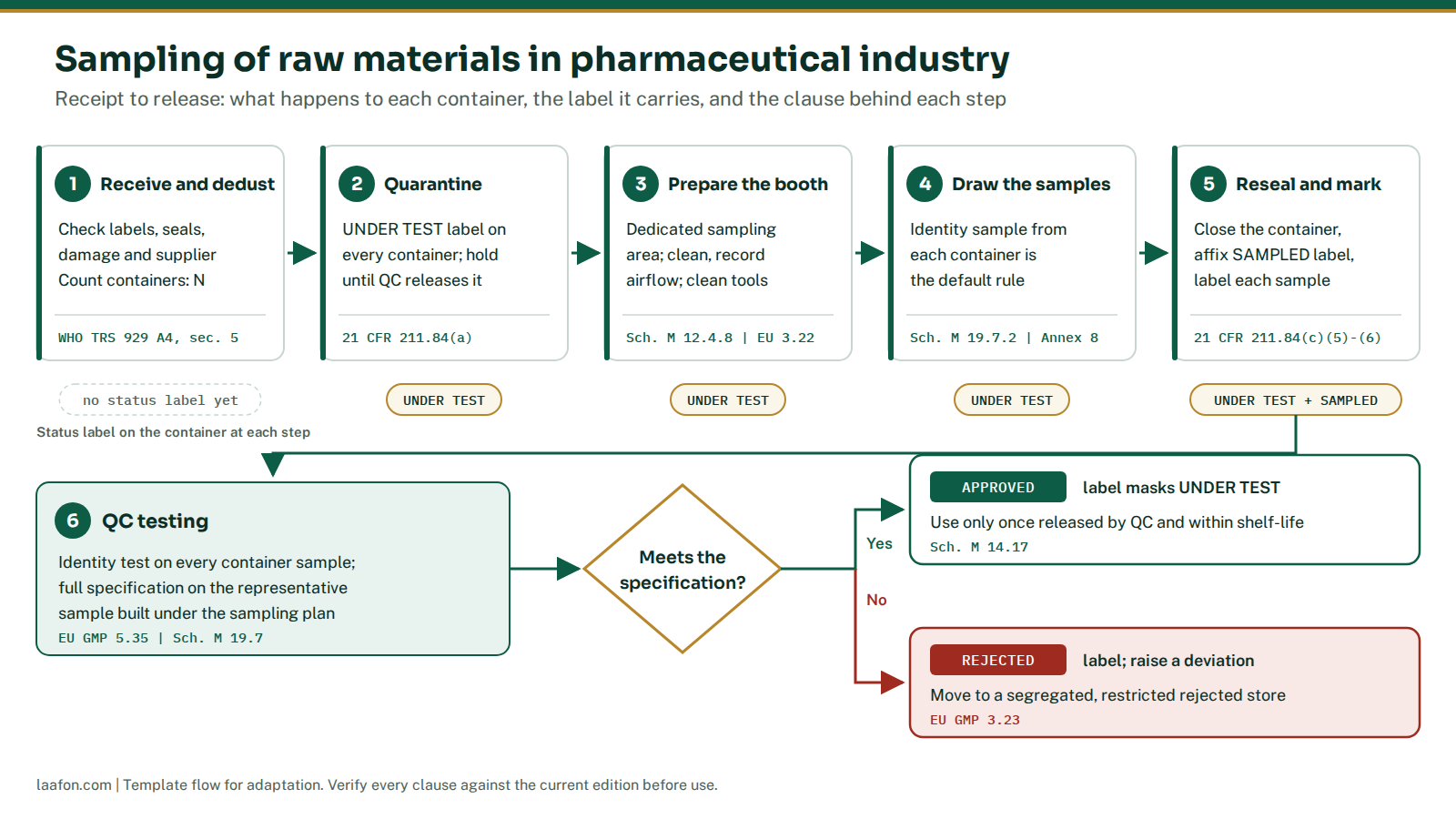
Two points in the flow are routinely got wrong. First, the sampling area: Schedule M 12.4.8 and EU GMP 3.22 both say there should “normally” be a separate sampling area for starting materials. Where sampling happens inside the store, it must be done so as to prevent contamination and cross-contamination [1] [5]. Neither text says “reverse laminar airflow booth”. The booth is the usual engineering answer, and its air-handling design is covered in the HVAC system guide, but the booth’s operating limits come from its own qualification, not from a GMP clause. The space requirement for the area is covered in the Schedule M plant area guide.
Second, the retention sample drawn at step 4 feeds a separate register with its own retention periods, set out in the control sample guidelines.
SOP for sampling of raw materials: adaptable template
The document below follows the content list Schedule M Part I 17.3.10.7 sets for sampling instructions. That list covers the method and the sampling plan, the equipment, contamination precautions, sample quantity, sub-division, sample containers, and precautions for sterile or noxious materials [1]. Replace the blanks with your own document numbers. Keep the step numbers stable, because deviation reports will cite them.
1. Purpose
To lay down the procedure for receipt, quarantine, sampling, labelling and status control of raw materials (active ingredients and excipients) so that every container is identified and each lot is tested on representative samples before release.
2. Scope
Applies to all raw materials received at the warehouse of ________ for use in manufacturing. It does not cover primary and printed packaging materials (separate SOP, sampled to an attribute plan), in-process or finished-product sampling, sterile raw materials that must be sampled aseptically (separate SOP), or retention sample storage (see the control sample SOP).
3. Responsibility
- Warehouse officer: receipt checks, dedusting, quarantine, UNDER TEST labelling, sampling intimation, moving containers to and from the booth.
- QC officer (trained, authorised sampler): sampling-plan selection, booth checks, sampling, SAMPLED labelling, sample labelling and hand-over to the laboratory.
- Head, QC: release or rejection decision; approval of any reduced-sampling plan.
- Head, QA: approval of this SOP and of the validation behind any reduced identity sampling; periodic review.
4. Materials and equipment
- Sampling booth or dedicated sampling area, qualified, with status board and airflow indicators.
- Sampling tools of inert material (stainless steel scoops, spatulas, thief samplers; pipettes or dip tubes for liquids). Avoid glass. Use one clean set per material and batch, or disposable tools.
- Sample containers suited to the material (amber glass or HDPE bottles, double polyethylene bags with a closure), pre-labelled.
- UNDER TEST, SAMPLED, APPROVED and REJECTED labels; tamper-evident sealing tape; PPE per the material safety data sheet.
- Annexure-I sampling record; booth log.
5. Procedure
Receipt and quarantine (warehouse)
Preparation (QC)
Sampling (QC, in the booth)
Testing and status (QC)
6. Acceptance criteria
| Item | Criterion | Basis |
|---|---|---|
| Containers identity-tested | All N, unless a QA-approved validated procedure allows a proportion. Never reduced for broker-sourced or parenteral materials | regulation Schedule M 19.7.2–19.7.2.3 [1] |
| Identity results | All concordant before any composite is prepared | guidance WHO TRS 929 Annex 4, 5.1 [2] |
| Containers per composite | Defined in the plan for the material. Health Canada caps it at 10, with a potency test on each composite | guidance Annex 8 §4 [3]; GUI-0001 [7] |
| Top/middle/bottom sub-samples | Not composited for testing | regulation 21 CFR 211.84(c)(4) [6] |
| Sampled containers | 100 % carry a SAMPLED label | regulation 21 CFR 211.84(c)(6) [6]; Schedule M 14.16 [1] |
| DEG/EG-risk excipients | DEG and EG not more than 0.10 %, on samples from all containers | guidance FDA 2023 [9] check source IP monograph for your edition |
| Booth airflow / pressure differential | Within the range stated in the booth’s qualification (OQ) report | site policy equipment qualification, not a GMP limit |
| Sample quantity | Enough for the full specification, a repeat, and retention | site policy set the multiple per material |
| Receipt to sampling | Within ___ working days | site policy no GMP time limit found |
Swipe sideways on a phone. Regulation and guidance rows cite the text; site policy rows are your own conventions.
7. Frequency
Every shipment of every lot, on receipt [6]. Re-sample on reaching the retest date, and after any storage excursion that could affect quality. Re-sampling at retest is site policy, set per material.
8. Precautions
- One material, one batch in the booth at a time. Cross-contamination at the booth is an audit finding on its own.
- Sample potent, hormonal, penicillin or cytotoxic materials only in a dedicated area or under containment. WHO names hormones and penicillins among the materials needing special or dedicated sampling environments [2].
- Hygroscopic materials: minimise the time the container stays open, and reseal immediately.
- Do not pool samples from portions that look different. Pooling can mask contamination or low potency [2].
- UV lamps in the booth, if fitted, are a site practice. None of the sampling texts reviewed for this page requires them.
9. Deviation handling
- Damaged container: sample it separately and test it on its own, or reject it. Unlabelled container: reject it [2].
- Non-uniform contents: sample and test the odd portion separately. Record it and inform the Head, QC.
- Identity failure in any one container: hold the whole lot, raise an OOS or deviation, and check the supplier and label chain before retesting.
- Booth out of qualified range: stop sampling, tag the booth out of use, raise a deviation, and resume only after correction and QA clearance.
- Material returned to a container, or a wrong container sampled: raise a deviation and assess the affected container before release.
10. Annexure-I: Raw material sampling record
| Date | Material / item code | Batch / lot no. | GRN no. | Containers received (N) | Plan used | Containers sampled (nos.) | Qty per container | Booth reading | Sampled by | Checked by (QA) |
|---|---|---|---|---|---|---|---|---|---|---|
Annexure-II: SAMPLED label
Material name · Item code · Batch/lot no. · Container no. __ of __ · Quantity removed · Date sampled · Sampled by (sign) · SOP No. QC/SOP/___
11. Revision history
| Version | Effective | Change |
|---|---|---|
| 00 | DD-MMM-YYYY | New SOP |
| 01 | DD-MMM-YYYY | Sampling moved from stores to QC; each-container identity default per revised Schedule M 19.7.2; booth limits tied to qualification report |
This SOP is a template. Before use it needs local qualification, validation and QA approval, and every criterion must be checked against the current edition of each text. Schedule M, EU GMP and pharmacopoeial texts change between editions.
What changed from the earlier version of this page
- Responsibility. The old SOP made the Store Incharge responsible for sampling. Schedule M 17.3.10.6 requires the SOP to name the persons authorised to take samples [1], and Annex 8 requires samplers to be trained in sampling plans, techniques and cross-contamination risk [3]. This template gives sampling to trained QC staff and keeps stores on receipt and movement.
- The √N+1 plan. The old page presented √N+1 as the plan to follow for a large number of containers, citing Health Canada. The Health Canada text is more qualified than that: it adds the small-lot risk and the need for documented justification. WHO’s own restriction on the n plan was missing altogether. Both are now stated.
- Booth limits. The old figures of “2 to 15 mm” and “1 to 6 mm” had no unit and no source. They have been replaced with the booth’s own qualified range, which is where such limits come from.
- UV exposure. Thirty minutes of UV before sampling is now shown as optional site practice, not a requirement.
- Prefilter cleaning. The old step read “rinse thoroughly with raw material”, a typing error for raw water. Booth maintenance now belongs in the booth’s own cleaning SOP, referenced from step 5.15.
Preparing the warehouse and QC for a revised Schedule M inspection?
Laafon Galaxy reviews sampling SOPs, sampling-plan justifications, reduced-testing validations and material status control against revised Schedule M. The review is for manufacturers ahead of a CDSCO or state inspection. Book a regulatory compliance consultation.
Raw material sampling FAQ
It is the n plan in WHO TRS 929 Annex 4: n = 1 + √N, rounded, where N is the number of containers. For example, 20 containers gives 5. WHO says the n plan is not statistically based, should be used with great caution and only for uniform material from a recognised source, and is not recommended for manufacturers’ control laboratories releasing incoming consignments.
For identity, yes, by default. Revised Schedule M Part I clause 19.7.2 requires an identity test on a sample from each container of starting material. A proportion may be sampled only under a validated procedure that ensures no container is mislabelled, and clause 19.7.2.3 says such validation is improbable for broker-sourced materials and for materials used in parenteral products.
Schedule M 17.3.10.6 requires the sampling SOP to specify the persons authorised to take samples, and EU GMP Annex 8 requires samplers to be trained in sampling plans, techniques and cross-contamination risk. In practice, and in this template, trained QC staff sample and the warehouse handles receipt, quarantine and movement.
Schedule M 12.4.8 and EU GMP 3.22 say there should normally be a separate sampling area for starting materials, and that sampling in the storage area must prevent contamination and cross-contamination. WHO recommends a booth designed and dedicated for sampling where possible. A reverse laminar airflow booth is the common way to meet this, but no text reviewed names that design.
For full testing, yes, once each container’s identity sample has passed. EU GMP Annex 8 says the number of samples that may be blended must be defined for the material, and Health Canada caps a composite at 10 containers with a potency test on each composite. WHO warns against pooling portions that look different, because it can mask contamination.
With an attribute sampling plan rather than √N+1. WHO names BS 6001-1, ISO 2859 and ANSI/ASQC Z1.4. EU GMP Annex 8 says the plan should account for the quantity received, the quality required and the nature of the material. Schedule M 19.7.3 requires each batch of printed packaging material to be examined on receipt.
Not in the texts reviewed here. WHO TRS 929 Annex 4, EU GMP Annex 8 and ICH Q7 were searched in full and contain no mention of UV or ultraviolet. Schedule M mentions ultraviolet only to say it is not normally an acceptable sterilisation method, and in analytical techniques. Running UV before sampling is a site practice.
Related on laafon.com
References
- Ministry of Health and Family Welfare, Government of India. G.S.R. 922(E): Drugs (Second Amendment) Rules, 2023, Schedule M, Good manufacturing practices and requirements of premises, plant and equipment for pharmaceutical products. Gazette of India, Extraordinary, Part II, Section 3(i); 28 Dec 2023 (short title corrected by G.S.R. 666(E), 25 Oct 2024). Available from: cdsco.gov.in. Accessed Sep 2026.
- World Health Organization. Annex 4: WHO guidelines for sampling of pharmaceutical products and related materials. In: WHO Expert Committee on Specifications for Pharmaceutical Preparations, Thirty-ninth report. WHO Technical Report Series No. 929. Geneva: WHO; 2005. p. 59–93. Available from: who.int. Accessed Sep 2026.
- European Commission. EudraLex Volume 4, EU Guidelines for Good Manufacturing Practice, Annex 8: Sampling of starting and packaging materials. Brussels: European Commission. Available from: health.ec.europa.eu. Accessed Sep 2026.
- European Commission. EudraLex Volume 4, Part I, Chapter 5: Production. Brussels: European Commission; in operation from 1 Mar 2015. Available from: health.ec.europa.eu. Accessed Sep 2026.
- European Commission. EudraLex Volume 4, Part I, Chapter 3: Premises and equipment. Brussels: European Commission; in operation from 1 Mar 2015. Available from: health.ec.europa.eu. Accessed Sep 2026.
- US Food and Drug Administration. 21 CFR 211.84: Testing and approval or rejection of components, drug product containers, and closures. Electronic Code of Federal Regulations, current as of 15 Sep 2026. Available from: ecfr.gov. Accessed Sep 2026.
- Health Canada. Good manufacturing practices guide for drug products (GUI-0001), section C.02.009 Raw material testing and questions and answers. Ottawa: Health Canada; 2020. Available from: canada.ca. Accessed Sep 2026.
- International Council for Harmonisation. ICH Q7: Good manufacturing practice guide for active pharmaceutical ingredients. Step 4; 10 Nov 2000. Section 7.3. Available from: database.ich.org. Accessed Sep 2026.
- US Food and Drug Administration, CDER. Testing of glycerin, propylene glycol, maltitol solution, hydrogenated starch hydrolysate, sorbitol solution, and other high-risk drug components for diethylene glycol and ethylene glycol: guidance for industry. Silver Spring: FDA; May 2023 (Compliance, Revision 1). Available from: fda.gov. Accessed Sep 2026.
Technical and educational content only, not legal, medical or investment advice. The SOP on this page is a template for adaptation. It requires local qualification, validation and Quality Assurance approval before use, and every criterion must be verified against the current edition of each text. Schedule M, EU GMP, pharmacopoeial texts and Indian statutory instruments change between editions.