
Short answer
Validation is documented evidence that premises, utilities, equipment, processes, cleaning procedures, test methods and computerised systems do what they are supposed to do, every time. In India it is a legal requirement under Schedule M, Part I, clause 5, which says the key elements of a company’s qualification and validation programme “shall be clearly defined and documented in a validation master plan”.[1]
Validation in pharmaceutical industry practice follows one sequence everywhere: user requirements, design qualification, installation, operational and performance qualification, process validation, then ongoing verification. EU GMP Annex 15,[2] the US FDA’s 2011 guidance[3] and WHO[4] agree on the sequence and disagree on vocabulary, on batch numbers and on retrospective validation. This page sets those differences out clause by clause and ends with a ready-to-adapt SOP for the validation master plan.
What validation in pharmaceutical industry means, and how it differs from qualification
Each of the four main texts defines the idea slightly differently, and the differences matter when you write a protocol that will be read by more than one regulator.
- Schedule M (India) defines the outcome, not the word. Clause 5.3 says qualification and validation “shall establish and provide documentary evidence” that premises, utilities, equipment and processes were designed to GMP (DQ), installed to specification (IQ), operate to specification (OQ), and that “a specific process shall consistently produce a product meeting its predetermined specifications and quality attributes” (process validation).[1]
- EU GMP Annex 15 defines process validation as “the documented evidence that the process, operated within established parameters, can perform effectively and reproducibly to produce a medicinal product meeting its predetermined specifications and quality attributes.”[2]
- US FDA (2011) defines process validation as “the collection and evaluation of data, from the process design stage through commercial production, which establishes scientific evidence that a process is capable of consistently delivering quality product.” The emphasis moved from a one-time demonstration to a lifecycle.[3]
- WHO TRS 1019, Annex 3 draws the line between the two words: “qualification” is normally used for equipment and utilities, “validation” for systems, methods and processes, and “qualification normally precedes validation”.[4]
So the practical rule is simple. You qualify a thing (a tablet press, an HVAC unit, a purified water loop, an HPLC). You validate what the qualified things do together (a granulation process, a cleaning procedure, an assay method, a LIMS workflow). A process cannot be validated on equipment that has not been qualified, which is why every inspector asks for the equipment qualification status before looking at a process validation report.
Importance of validation: what an inspector actually checks
The old version of this page listed ten benefits of validation: fewer faults, fewer deviations, less rework, less waste, less batch-to-batch variation, easier audits. All of that is true, and all of it follows from one thing. A validated process is one whose critical parameters are known, controlled and proven, so the result no longer depends on end-product testing alone. That is the real importance of validation: testing samples a batch, validation vouches for the batches you did not sample.
Under Schedule M the question is not whether validation is useful but whether it is complete. The clauses an inspector can cite are specific:
| Schedule M, Part I | What it requires | What an inspector asks for |
|---|---|---|
| 5.1 | Each company identifies what qualification and validation work is needed to prove its critical operations are controlled | The risk assessment behind the validation scope |
| 5.2 | Key elements documented in a validation master plan | The approved, current VMP |
| 5.3 | Documentary evidence of DQ, IQ, OQ and process validation | Protocols and reports for each item |
| 5.4 | Significant changes to premises, facilities, equipment or processes qualified and validated | Change controls with their validation assessment |
| 5.5, 5.6 | Not a one-off exercise; an on-going programme based on periodic review, with the commitment stated in the quality manual or VMP | The requalification schedule and whether anything is overdue |
| 5.7 to 5.10 | Responsibility defined; studies to predefined, approved protocols; a written report; procedures set from the results | Protocol approval dates earlier than execution dates |
| 5.11 | Particular attention to analytical test methods, automated systems and cleaning procedures | Method validation, computerised system validation and cleaning validation files |
Clause text from Schedule M as notified by G.S.R. 922(E), 28 December 2023.[1] Swipe sideways on a phone.
Validation also appears in two places people forget. Clause 2.3.3 asks whether revalidation is needed as an outcome of the product quality review, and clause 10.2(j) lists “validation and revalidation programmes” among the minimum items for self-inspection.[1] If your self-inspection checklist has no validation section, it does not meet 10.2. For a clause-by-clause check of your site, the Revised Schedule M gap assessment toolkit covers the whole schedule.
The validation lifecycle, clause by clause
Annex 15 says qualification “should consider all stages from initial development of the user requirements specification through to the end of use of the equipment, facility, utility or system”.[2] The diagram maps that sequence against the FDA stages and the Schedule M terms.
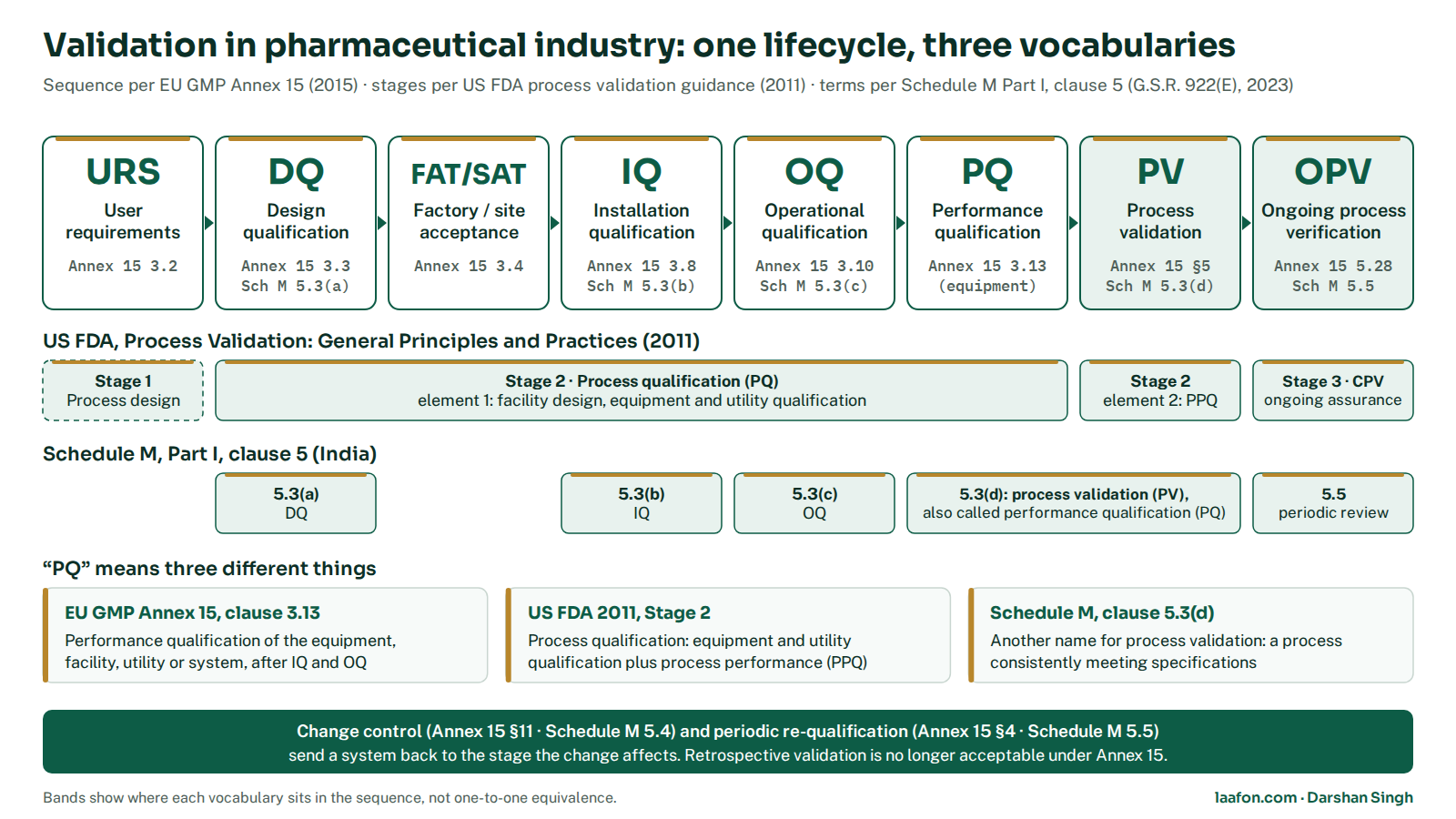
| Step | What it proves | EU GMP Annex 15 | Schedule M, Part I | US FDA 2011 |
|---|---|---|---|---|
| URS | What the user needs the equipment or system to do | 3.2 | Not named | Precedes Stage 2 (Stage 1 is process design) |
| DQ | The design complies with GMP and the URS | 3.3 | 5.3(a) | Stage 2, element 1 |
| FAT / SAT | The equipment works at the vendor and again on site | 3.4 onward | Not named | Stage 2, element 1 |
| IQ | Installed as designed, with drawings, utilities, calibration | 3.8 | 5.3(b) | Stage 2, element 1 |
| OQ | Operates as designed across its operating ranges | 3.10 | 5.3(c) | Stage 2, element 1 |
| PQ | Performs consistently under routine conditions | 3.13 (equipment) | 5.3(d), as another name for PV | Stage 2 is itself called “process qualification (PQ)” |
| Process validation | The process consistently delivers product to specification | Section 5 | 5.3(d) | Stage 2, element 2: PPQ |
| Ongoing verification | The process stays in a state of control | 5.28 to 5.32 | 5.5 on-going programme | Stage 3: continued process verification |
Sources: Annex 15 (2015),[2] Schedule M (2023),[1] FDA guidance (2011).[3]
The FDA guidance describes Stage 2 as having “two elements: (1) design of the facility and qualification of the equipment and utilities and (2) process performance qualification (PPQ)”, and states that successful completion of Stage 2 is necessary before commercial distribution.[3] Annex 15 lets documents be combined where appropriate (IQ with OQ, for example) and allows PQ to be performed “in conjunction with OQ or Process Validation” in some cases.[2]
“PQ” means three different things
This is the single most common source of confusion in Indian validation files, and it comes straight from the source texts.
| Document | What “PQ” stands for | What it covers |
|---|---|---|
| EU GMP Annex 15, 3.13 | Performance qualification | Equipment, facility, utility or system, normally after IQ and OQ[2] |
| US FDA 2011, Stage 2 | Process qualification | Facility design, equipment and utility qualification, plus PPQ[3] |
| Schedule M, 5.3(d) | Performance qualification | Used as another name for process validation: “process validation (PV), also called performance qualification (PQ)”[1] |
Define every abbreviation in your VMP glossary, and say which meaning of PQ your site uses. A site exporting to the EU that follows Schedule M wording literally can end up with no separate equipment PQ at all, which an EU or PIC/S inspector will read as a missing stage rather than a naming choice.
Types of validation in pharmaceutical industry
Annex 15 organises the subject into qualification, process validation, verification of transportation, validation of packaging, qualification of utilities, validation of test methods, cleaning validation and change control.[2] WHO covers HVAC, water systems, cleaning, analytical procedures, computerised systems, qualification and non-sterile process validation in seven appendices.[4] In practice, a validation master plan groups them like this:
| Type | Typical scope | Key clauses | Worked example on laafon.com |
|---|---|---|---|
| Equipment and instrument qualification | Process equipment, QC instruments | Annex 15 section 3; Sch M 5.3(a) to (c) | Qualification of a UV-visible spectrophotometer; liquid filling machine validation parameters |
| Utility qualification | HVAC, purified water, WFI, steam, compressed air, gases | Annex 15 8.1; WHO Appendices 1 and 2 | HVAC system qualification tests |
| Process validation | Each product and process, including scale changes | Annex 15 section 5; Sch M 5.3(d); FDA 2011 | Basic requirements for process validation exercises |
| Sterilisation and depyrogenation | Autoclaves, dry-heat tunnels, aseptic processes | 21 CFR 211.113(b)[5] | Autoclave validation and F0; depyrogenation validation |
| Cleaning validation | All product-contact equipment | Annex 15 section 10; Sch M 5.11 | Covered below |
| Analytical method validation | Assay, impurities, dissolution, cleaning-residue methods | Annex 15 9.1; Sch M 5.11; 21 CFR 211.165(e); ICH Q2(R2)[6] | Pharmaceutical method validation under ICH Q2(R2) |
| Computerised system validation | LIMS, SCADA, PLC-controlled equipment, spreadsheets used for GMP decisions | Sch M 20.1; Annex 11 via Annex 15; 21 CFR 211.68 | Not yet covered |
| Transport verification and packaging validation | Shipping lanes, primary packaging integrity | Annex 15 sections 6 and 7 | Not yet covered |
| Reference standard qualification | In-house working standards | See the linked SOP | Working standard qualification SOP |
Clause references verified against the source texts listed in the references; the laafon.com pages are worked examples, not additional requirements.
Cleaning validation: four statements Annex 15 makes plainly
- A visual check alone is not enough. It is “an important part of the acceptance criteria” but “it is not generally acceptable for this criterion alone to be used” (10.2).[2]
- Test-until-clean is not validation. “Repeated cleaning and retesting until acceptable residue results are obtained is not considered an acceptable approach” (10.2).[2]
- Carryover limits start from toxicology. Limits “should be based on a toxicological evaluation”, justified in a documented risk assessment (10.6).[2]
- There is no fixed number of cleaning runs. The procedure is performed “an appropriate number of times based on a risk assessment” (10.13). A search of the whole of section 10 finds no mention of three runs or consecutive runs; “three consecutive cleaning runs” is an industry convention, not an Annex 15 requirement.[2]
In the US, 21 CFR 211.67 requires equipment and utensils to be cleaned and maintained at appropriate intervals,[5] and FDA’s inspection guide on the validation of cleaning processes (7/93) sets out what investigators look for.[7] Schedule M Part I sets no residue limit and no run count, and asks only for “particular attention” to the validation of cleaning procedures (5.11).[1]
Where the three-batch rule actually comes from
Almost every Indian validation protocol says “three consecutive batches”. Here is what each text actually says, checked by searching the full documents.
| Text | Batch number stated | Exact position |
|---|---|---|
| Schedule M, Part I (finished products) | None | verified negativeClause 5 defines process validation but states no batch count. A search of the full notified text for “three batches” and “consecutive batch” returns only stability, supplier testing and API clauses.[1] |
| Schedule M, Part XII (APIs), 12.5.1 | Three, as a guide | “For prospective and concurrent validation, three consecutive successful production batches shall be used as a guide”, with more runs where needed.[1] |
| ICH Q7, 12.50 (APIs) | Three, as a guide | The same wording; Schedule M Part XII follows ICH Q7 here.[8] |
| EU GMP Annex 15, 5.19 and 5.20 | Three, generally acceptable, but only after justification | 5.19: “Each manufacturer must determine and justify the number of batches necessary”. 5.20: “Without prejudice to 5.19, it is generally considered acceptable that a minimum of three consecutive batches manufactured under routine conditions could constitute a validation of the process.”[2] |
| US FDA 2011 guidance | None | verified negativeThe words “consecutive” and “three batches” do not appear. The guidance asks for a number of samples “adequate to provide sufficient statistical confidence of quality both within a batch and between batches”.[3] |
Annex 15 says “Retrospective validation is no longer considered an acceptable approach” and repeats it in 5.3.[2] Schedule M Part XII 12.5.1, following ICH Q7 12.50, still describes retrospective validation of API processes, with data “from ten to thirty consecutive batches” examined.[1][8] The FDA 2011 guidance does not use the word at all.[3] A finished-product manufacturer exporting to the EU or a PIC/S market should plan prospective validation only.
The practical conclusion: three batches is a defensible default, not a legal minimum. Write the justification into the protocol (process complexity, variability seen in development, number of strengths and pack sizes) so the number is yours rather than a habit. For how the protocol itself is structured, see process validation stages and requirements, and for how executed batches are reviewed, see batch record review.
Schedule M vs EU GMP Annex 15 vs US FDA vs WHO
| Point | Schedule M (India, 2023) | EU GMP Annex 15 (2015) | US FDA (2011 guidance, 21 CFR 211) | WHO TRS 1019, Annex 3 (2019) |
|---|---|---|---|---|
| Validation master plan | Required: key elements “shall be clearly defined and documented in a validation master plan” (5.2) | VMP “or equivalent document” (1.4), with seven minimum contents (1.5) | The term does not appear in the 2011 guidance | “A manufacturer should have a validation master plan” (7.1), reviewed at regular intervals (7.2) |
| Qualification stages named | DQ, IQ, OQ; PQ used as another name for PV (5.3) | URS, DQ, FAT/SAT, IQ, OQ, PQ (3.2 to 3.13) | Folded into Stage 2, element 1 | Section 10 and Appendix 6 |
| Batch number for process validation | None in Part I; three “as a guide” for APIs (XII 12.5.1) | Justified by risk; three generally acceptable (5.19, 5.20) | None stated | Not assessed here (see Appendix 7) |
| Retrospective validation | Described for APIs only (XII 12.5.1) | No longer acceptable (principle; 5.3) | Not mentioned | Not assessed here |
| After validation | On-going programme with periodic review (5.5); PQR may trigger revalidation (2.3.3) | Ongoing process verification (5.28 to 5.32); requalification at a justified frequency (4.1, 4.2) | Stage 3: continued process verification | Revalidation based on need and risk (11.1 to 11.3) |
| Computerised systems | “GMP-related computerised systems shall be validated” (20.1) | Validated to Annex 11 (principle) | 211.68; the 2011 guidance does not specifically discuss automated control systems | Appendix 5 |
Swipe sideways on a phone. “Not assessed here” means the full appendix was not read for this page, not that the text is silent.
EMA and PIC/S published a concept paper on revising Annex 15 for public consultation from 9 February to 9 April 2026, to extend it to active substance manufacturers and to reflect ICH Q9(R1). It is a concept paper, not a draft text, so the 2015 Annex 15 remains the version to follow. Check the PIC/S news page before relying on this table.[9]
Which clause governs your validation?
Pick what you are validating and the market you are filing or supplying to. The answer names the governing clauses, so you can quote them in the protocol’s regulatory basis section.
1. What are you validating?
2. Which regulator’s rules apply?
Choose one option from each group
The governing clauses will appear here.
SOP: preparation and maintenance of the Validation Master Plan
The document below is the one Schedule M 5.2 asks for and the one every inspection opens with. Adapt the header fields, departments and intervals to your site; keep the step numbers stable, because deviation reports will cite them.
1. Purpose
To describe how the site prepares, approves, maintains and periodically reviews its Validation Master Plan, so that the qualification and validation programme is defined, documented and kept current as required by Schedule M Part I clauses 5.2 and 5.5.
2. Scope
Applies to all GMP-relevant premises, utilities, equipment, instruments, manufacturing processes, cleaning procedures, analytical methods and computerised systems at the site, and to outsourced qualification or validation services.
Excludes: the content of individual protocols and reports (governed by their own SOPs), vendor-site execution of factory acceptance tests, and validation data prepared only for regulatory dossiers.
3. Responsibility
- Validation Officer / Executive (QA): compiles the VMP and the validation status matrix, tracks due dates.
- Heads of Production, Engineering and Quality Control: supply inventories, confirm status, nominate protocol owners.
- System owner, computerised systems: supplies the computerised system inventory and its validation status.
- Head, Quality Assurance: reviews and approves the VMP and every revision; owns periodic review.
4. Inputs and reference documents
- Site master file, equipment and instrument list, utility list, product list, list of computerised systems.
- Change control log, deviation log, previous VMP and validation status matrix.
- Schedule M Part I clause 5 and 20.1;[1] EU GMP Annex 15 clauses 1.4 to 1.8;[2] WHO TRS 1019 Annex 3 section 7.[4]
5. Procedure
6. Acceptance criteria
| No. | Criterion | Basis |
|---|---|---|
| 6.1 | A current, approved VMP documents the key elements of the qualification and validation programme | regulatorySchedule M 5.2; Annex 15 1.4 |
| 6.2 | The VMP includes or references all seven Annex 15 elements: policy; organisation and roles; summary of facilities, equipment, systems and processes with their status; change control and deviation management; guidance on acceptance criteria; references to existing documents; strategy including requalification | regulatoryAnnex 15 1.5 (i) to (vii) |
| 6.3 | The VMP also covers the WHO items not in Annex 15, including outsourced services, life-cycle management with retirement policy, a validation matrix, retention of documentation and training | regulatoryWHO TRS 1019 Annex 3, 7.1 |
| 6.4 | The commitment to maintain continued validation status is stated | regulatorySchedule M 5.6 |
| 6.5 | Every requalification period is justified, with evaluation criteria defined | regulatoryAnnex 15 4.2 |
| 6.6 | Every listed study has a protocol approved before execution and a written report with conclusions | regulatorySchedule M 5.8, 5.9 |
| 6.7 | No finished-product process for an EU or PIC/S market relies on retrospective validation | regulatoryAnnex 15 principle and 5.3 |
| 6.8 | No item in the matrix is past its requalification date without an open deviation and documented risk assessment | site policyinternal control, not a stated regulatory limit |
| 6.9 | Matrix entries agree with equipment logbooks and change control records on the day of review | site policyinternal control |
Rows marked site policy are good practice this template recommends; they are not stated in Schedule M, Annex 15 or the WHO guideline.
7. Frequency
- Full VMP review: at least once a year, and after any major change (new product, new line, new building, significant regulatory finding). site policy WHO asks for review “at regular intervals” (7.2) and sets no number.[4]
- Validation status matrix: updated on every event in step 5.15, and reconciled monthly. site policy
- Requalification intervals: set per item and justified in the VMP. Annex 15 requires the period to be justified (4.2) but gives no interval.[2] site policy
8. Precautions: the findings that fail an audit
- A VMP that lists equipment the site no longer has, or omits equipment it does have. Reconcile against the asset register before every review.
- “Validated” shown in the matrix for an item whose requalification date has passed.
- Protocols signed after the execution dates they cover.
- Three batches used as an unexplained default, with no justification of the number.
- Cleaning “validated” by repeating the cleaning until swabs pass.
- PQ used with two meanings in the same file.
- Computerised systems left out of the VMP because they belong to IT.
9. Deviation handling
- Requalification overdue: raise a deviation, assess the impact on every batch made since the due date, apply interim controls, complete the requalification, and record CAPA.
- Change made without a validation assessment: raise a deviation, perform the assessment retrospectively, and qualify or validate before further GMP use if the assessment requires it. Do not use the batches made meanwhile as retrospective validation evidence for an EU or PIC/S market.
- Protocol acceptance criterion not met: investigate before any repeat run; record the root cause in the report. A repeated run without investigation is itself a finding.
10. Annexures
- Annexure-I: Validation status matrix (format below)
- Annexure-II: VMP review checklist (section 6 criteria)
- Annexure-III: Requalification and revalidation schedule
- Annexure-IV: Glossary, including the site’s definition of DQ, IQ, OQ, PQ, PV, PPQ and ongoing process verification
Annexure-I: Validation status matrix
| ID / Tag No. | Item | Category | GMP impact | Activity (DQ/IQ/OQ/PQ/PV/CV/AMV/CSV) | Protocol No. | Report No. | Completed on | Requalification due | Status | Change control ref. |
|---|---|---|---|---|---|---|---|---|---|---|
11. Revision history
| Version | Effective date | Change | Change control ref. |
|---|---|---|---|
| 00 | DD-MMM-YYYY | New SOP | ___ |
| 01 | DD-MMM-YYYY | Aligned with revised Schedule M (G.S.R. 922(E)); WHO 7.1 items added | ___ |
This SOP is a template for adaptation. It requires local qualification, validation and Quality Assurance approval before use. Regulatory texts change between editions: verify every clause reference against the current notified Schedule M, the current EU GMP Annex 15 and any national text that applies to your site before adoption.
Preparing for a Schedule M or export inspection?
Laafon Galaxy reviews validation master plans, protocols and reports against Schedule M, EU GMP and WHO expectations, and identifies the gaps an inspector is likely to cite before the inspection does.
Frequently asked questions
WHO uses “qualification” for equipment and utilities and “validation” for systems, methods and processes, and says qualification normally precedes validation. You qualify a tablet press; you validate the compression process that runs on it.
Yes. Schedule M Part I clause 5.2 says the key elements of a company’s qualification and validation programme shall be clearly defined and documented in a validation master plan, and clause 5.6 expects the commitment to continued validation status to be stated in the quality manual or the VMP.
No text makes three a fixed legal minimum for finished products. Annex 15 requires the number to be justified by risk and calls three consecutive routine batches generally acceptable; the FDA 2011 guidance states no number; Schedule M Part I states none. Only the API texts, Schedule M Part XII 12.5.1 and ICH Q7 12.50, give three batches as a guide.
Not in the EU: Annex 15 says it is no longer an acceptable approach. Schedule M Part XII still describes it for APIs, reviewing ten to thirty consecutive batches, as ICH Q7 does. For a finished-product site exporting to regulated markets, plan prospective validation.
It depends on the document. In Annex 15 it is performance qualification of equipment or systems after IQ and OQ. In the FDA 2011 guidance, Stage 2 is called process qualification. Schedule M 5.3(d) uses performance qualification as another name for process validation. Define the term in your VMP glossary.
None of the texts reviewed fixes an interval. Annex 15 asks for evaluation at an appropriate frequency, with any fixed period justified and its criteria defined; Schedule M asks for an on-going programme based on periodic review. The interval is a site decision that must be justified in the VMP.
References
- Ministry of Health and Family Welfare, Government of India. G.S.R. 922(E): Drugs (Amendment) Rules, 2023, substituting Schedule M (Good Manufacturing Practices and Requirements of Premises, Plant and Equipment for Pharmaceutical Products). Gazette of India, Extraordinary, Part II, Section 3(i). New Delhi; 28 December 2023. Available from: https://cdsco.gov.in/opencms/opencms/en/Notifications/Gazette-Notifications/. Accessed September 2026.
- European Commission. EudraLex Volume 4, EU Guidelines for Good Manufacturing Practice for Medicinal Products for Human and Veterinary Use. Annex 15: Qualification and Validation. Brussels; 2015 (in operation from 1 October 2015). Available from: https://health.ec.europa.eu/system/files/2016-11/2015-10_annex15_0.pdf. Accessed September 2026.
- US Food and Drug Administration. Guidance for Industry. Process Validation: General Principles and Practices. Revision 1. Silver Spring (MD): FDA; January 2011. Available from: https://www.fda.gov/media/71021/download. Accessed September 2026.
- WHO Expert Committee on Specifications for Pharmaceutical Preparations. Annex 3: Good manufacturing practices: guidelines on validation. WHO Technical Report Series, No. 1019. Geneva: World Health Organization; 2019. Available from: https://cdn.who.int/media/docs/default-source/medicines/norms-and-standards/guidelines/production/trs1019-annex3-gmp-validation.pdf. Accessed September 2026.
- Code of Federal Regulations. Title 21, Part 211: Current Good Manufacturing Practice for Finished Pharmaceuticals (sections 211.63, 211.67, 211.68, 211.100, 211.110, 211.113, 211.165, 211.194). Washington (DC): National Archives, eCFR. Available from: https://www.ecfr.gov/current/title-21/chapter-I/subchapter-C/part-211. Accessed September 2026.
- International Council for Harmonisation. ICH Q2(R2): Validation of Analytical Procedures. Geneva: ICH; 2023. Available from: https://database.ich.org/sites/default/files/ICH_Q2(R2)_Guideline_2023_1130.pdf. Accessed September 2026.
- US Food and Drug Administration. Guide to Inspections: Validation of Cleaning Processes (7/93). Rockville (MD): FDA; 1993. Available from: https://www.fda.gov/inspections-compliance-enforcement-and-criminal-investigations/inspection-guides/validation-cleaning-processes-793. Accessed September 2026.
- International Council for Harmonisation. ICH Q7: Good Manufacturing Practice Guide for Active Pharmaceutical Ingredients. Step 4 version, 10 November 2000. Geneva: ICH; 2000. Available from: https://database.ich.org/sites/default/files/Q7%20Guideline.pdf. Accessed September 2026.
- Pharmaceutical Inspection Co-operation Scheme. Concept paper on the revision of EU-PIC/S GMP Annex 15 (Qualification and validation). Geneva: PIC/S; 10 February 2026. Available from: https://picscheme.org/en/news/concept-paper-on-the-revision-of-eu-pics-gmp-annex-15-qualif. Accessed September 2026.
Technical and educational content for pharmaceutical professionals, not legal advice. Clause numbers and quotations were checked against the source documents listed above on 29 September 2026. Schedule M, EU GMP annexes, FDA guidance and WHO guidelines are revised between editions; confirm the current text before relying on any clause in a regulatory submission or inspection response.