
Short answer
Pest control in a pharmaceutical plant is a written GMP obligation. Revised Schedule M requires premises that keep out insects, birds and other animals, plus a written rodent and pest control procedure (Part I, clause 12.2.9)[1].
For pest control in pharmaceutical industry practice, the regulation sets the outcome but not the method. It says that no pest-control material may touch or contaminate the product (14.3, 16.5) and that SOPs and records must exist (17.3.10.1(f))[1]. It does not set a visit frequency, a bait-station spacing or, for most dosage forms, a device type. Those are your risk-based decisions, so this page marks each one as site policy.
- Toxic rodenticide goes in locked exterior stations only. That is site policy, and it follows from 14.3 and 16.5.
- Inside the building, use non-toxic monitors and glue-board insect light traps, and never place a trap above open product.
- The contractor and the chemicals fall under the Insecticides Act, 1968. Each product must be registered (section 9), and commercial pest control operations need a licence (section 13)[2].
- The evidence an inspector reads is the device map, the inspection records, the monthly trend review and the deviations raised from them.
What Schedule M requires for pest control in pharmaceutical industry
The table maps each clause that mentions pests in the notified Revised Schedule M (G.S.R. 922(E), 28 December 2023), with the international texts it mirrors. The right-hand column shows what each clause leaves to you. For the wider premises chapter, see the key points of Revised Schedule M.
| Source | Clause | What it requires | What it leaves to the site |
|---|---|---|---|
| Schedule M, Part I | 12.2.9 | Premises designed and equipped to give maximum protection against the entry of insects, birds or other animals, and a procedure for rodent and pest control[1]. | Device types, numbers, positions and frequency |
| Schedule M, Part I | 14.3 | Materials used for cleaning, lubrication and pest control must not come into direct contact with the product, and should be of suitable (for example food) grade where possible[1]. | Which products, where they may be used |
| Schedule M, Part I | 16.5 | Rodenticides, insecticides, fumigating agents and sanitising materials must not contaminate equipment, starting materials, packaging materials, in-process materials or finished products[1]. | How contamination is prevented (zoning, permits) |
| Schedule M, Part I | 17.3.10.1(f) | SOPs and associated records for pest control[1]. | Record format, review and trending |
| Schedule M, Part I | 18.3.2 | Names intruding insects as a source of cross-contamination[1]. | Risk assessment by area |
| Schedule M, Part IX (oral liquids) | 2.3 | Entry to the manufacturing area through a double-door airlock, made fly-proof by a fly catcher or an air curtain[1]. | Choice between the two |
| Schedule M, Part X (topicals) | req. (1) | Entry through a suitable airlock, with insectocutors installed outside the airlock[1]. | Insectocutor type and service |
| Schedule M, Part XII (APIs) | 4.7.3 | When necessary, written procedures for suitable rodenticides, insecticides, fungicides, fumigating agents and cleaning agents to prevent contamination[1]. | When a chemical is necessary |
| Schedule M, Part VI (phytopharmaceuticals) | 13.3.6 | Bulk plant-material stores equipped to protect against insects or animals, especially rodents[1]. | Store design |
| WHO GMP main principles (TRS 986, Annex 2) | 12.9, 14.46 | The same premises requirement as Schedule M 12.2.9 (in should rather than shall wording), and the same contamination prohibition for rodenticides and insecticides[3]. | Same as Schedule M |
| EU GMP Part I, Chapter 3 | 3.4 | Premises designed and equipped to give maximum protection against the entry of insects or other animals[4]. | Everything below the design principle |
| US 21 CFR Part 211 | 211.56(a), (c) | Buildings free of infestation by rodents, birds, insects and other vermin; written procedures for rodenticides, insecticides, fungicides and fumigating agents; products registered under US federal pesticide law[5]. | Frequency and device design |
| ICH Q7 (APIs) | 4.72 | The API-site wording that Schedule M Part XII 4.7.3 adopts[6]. | As Part XII |
On a phone, swipe the table sideways. Clause wording is condensed here; read the source before quoting it in an SOP.
What Schedule M does not say: checked in the full text
We searched every one of the 124 pages of the notified Schedule M reprint for specific words. Bait, glue, pest control operator, Insecticides Act and fortnight each return zero hits, and trap appears only in the drainage clause. The only devices it names are the fly catcher and air curtain (Part IX, 2.3) and insectocutors outside the airlock (Part X). So an SOP that cites a “Schedule M” bait-station spacing or visit frequency is quoting something else.
The Indian statutory layer that sits beside Schedule M
Schedule M does not cite the Insecticides Act, but the Act applies on its own terms to the chemicals and to the contractor. Every insecticide must be registered by the Registration Committee (section 9). Anyone undertaking commercial pest control operations with an insecticide needs a licence (section 13)[2]. Under rule 10(3A) of the Insecticides Rules, 1971, operations using aluminium phosphide, methyl bromide, ethylene dibromide or other notified fumigants need a separate pest-control-operator licence, with qualification and training conditions[7]. The published texts disagree on that licence’s form number, so check it with your state agriculture department.
The timing matters. As of October 2026, Revised Schedule M is being enforced, not waiting on a deadline. The extended deadline for MSMEs that applied passed on 31 December 2025, and in November 2025 CDSCO asked state regulators to plan inspections of manufacturing units[8]. Pest control is one of the easiest premises findings to evidence, and one of the easiest to get wrong on paper.
The 5-zone device plan for rodents, insects and birds
Because the regulation sets an outcome, the defensible way to write an SOP for pest control in pharmaceutical industry premises is by zone. Device type and chemical use change as you move from the fence line towards open product. The plan below is a schematic. Your own plan must be drawn on your site layout and approved by QA.
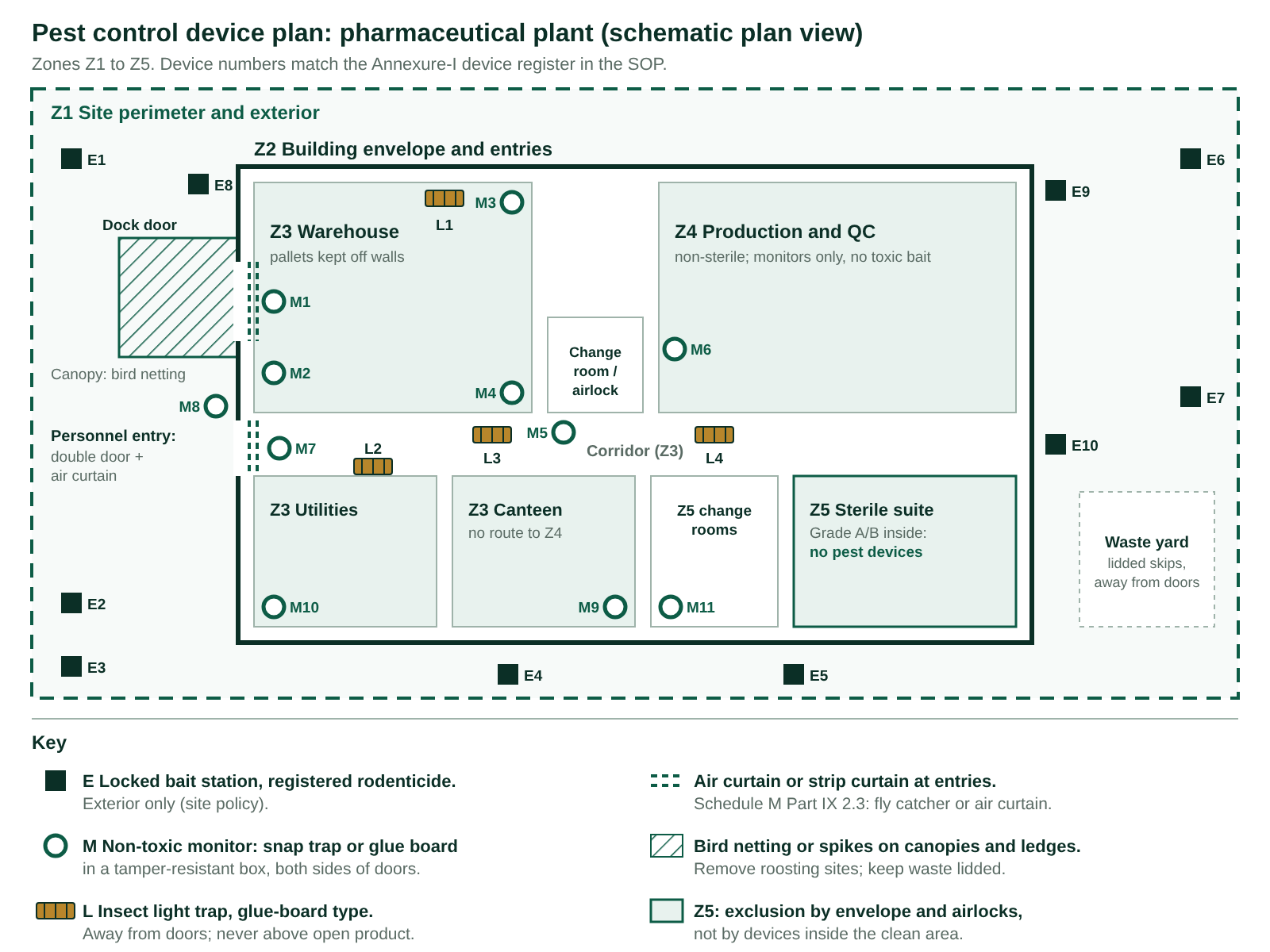
| Zone | Rodents | Crawling insects | Flying insects | Birds |
|---|---|---|---|---|
| Z1 Site perimeter and exterior | Locked, fixed, tamper-resistant bait stations with a registered rodenticide | Licensed treatment of external surfaces per label; vegetation-free strip at walls | Remove breeding sites: drains, standing water, open waste | Netting or spikes on canopies and ledges |
| Z2 Building envelope and entries | Proofing first: self-closing doors, sealed gaps and penetrations; monitors both sides of each door | Sealed joints; monitors at thresholds | Air curtain or strip curtain; light trap inside, out of line of sight of the door | Dock doors kept closed; strip curtains |
| Z3 Warehouse, corridors, utilities, canteen | Non-toxic monitors along walls; pallets kept off walls | Glue-board monitors; spot treatment only under QA permit | Glue-board light traps | Any bird inside is an action-level event |
| Z4 Production and QC (non-sterile) | Monitors at airlocks only; no rodenticide | Monitoring only; chemical treatment only at shutdown, with a permit and cleaning afterwards | Light trap outside the airlock, never above open product | Action-level event; impact assessment of exposed product |
| Z5 Sterile / aseptic suite | No devices inside Grade A/B; monitors at the outer change room | Exclusion only; any find goes through the deviation route | Light trap in the corridor before the first change room | Not a credible route if the envelope is intact; any find triggers an integrity investigation |
Every entry in this matrix is site policy built on Schedule M 12.2.9, 14.3 and 16.5 and on industry guidance. It is not compendial text.
Two placement rules come from industry guidance, not regulation, and are worth writing into the SOP as stated reasons. Light traps belong away from external doors and windows, so they do not draw insects into the building. And grid-type electric fly killers can throw insect fragments out of the unit, so their position must not put open product at risk[9]. The same guidance discourages “one per x metres” formulas for bait and monitor numbers: numbers should come from a risk assessment[9].
Which control fits which zone and pest
Choose a zone and a pest to see the control the SOP below expects, and the clause or guidance behind it.
1. Zone
2. Pest
Choose one zone and one pest
The verdict shows the device, whether any chemical is allowed, and what to record.
Basis: Schedule M Part I 12.2.9, 14.3, 16.5 and 17.3.10.1(f).
SOP for rodents, insects and birds control in production
This is the adaptable document. Every step is numbered so a deviation report can cite it. Each frequency and limit is badged by source: regulatory for statutory or GMP text, industry guidance for published good practice, and site policy for choices your QA must own.
Pest control: prevention, monitoring and response for rodents, insects and birds
1. Purpose
To define how the site keeps rodents, insects and birds out of every zone and monitors for them. The procedure also covers the response when a pest is found, so that no pest and no pest-control material contaminates materials, equipment or product.
2. Scope
This SOP covers all buildings and the site perimeter: warehouse, production, QC laboratory, utilities, canteen and the outside of the sterile suite. It excludes fumigation and disinfection of the microbiology laboratory and cleanrooms, and routine cleaning and sanitisation, which each have their own SOP. Note that fumigation of a microbiology laboratory is a disinfection process, not pest control.
3. Responsibility
- Pest control contractor (licensed): service visits, treatments from the approved list only, service reports.
- Pest control coordinator (Engineering or Administration): escorts the contractor, carries out internal inspections, maintains the device map, raises proofing repairs.
- Heads of Production, Warehouse and QC: keep their areas free of food and waste, and report sightings at once.
- Quality Assurance: approves the contractor, the pesticide list and the device map; reviews records and trends monthly; manages deviations and CAPA.
- Head QA: approves this SOP and its periodic review.
4. Definitions
- Bait station (E): a locked, fixed, tamper-resistant box holding a registered rodenticide. Used in Zone 1 only.
- Monitor (M): a non-toxic snap trap or glue board, in a tamper-resistant box.
- Insect light trap (L): a UV unit that catches flying insects on a glue board.
- Alert level: a count that triggers closer watch and a check of proofing.
- Action level: a finding that triggers a deviation, an investigation and corrective action.
5. Materials and documents
- The approved site device map (Annexure-I), with keys to the bait stations held by the contractor and the coordinator.
- Monitors, glue-board light traps, spare glue boards and spare UV tubes.
- The approved pesticide list (Annexure-III), with label, safety data sheet and registration details for each product.
- The inspection record (Annexure-II), the sighting log, and PPE as each product label specifies.
6. Procedure
Qualify the contractor. Before the contract is awarded, QA confirms that the contractor holds a licence for commercial pest control operations under section 13 of the Insecticides Act, 1968[2]. Where fumigants are in scope, QA also confirms the rule 10(3A) operator licence[7]. File the technicians’ training records. The agreement must define the scope, visit frequency, reporting format and emergency call-out time.
Approve the pesticide list. Every product is registered under section 9 of the Act for the intended use[2]. For each one, Annexure-III records the active ingredient, registration number, dilution and the zones where it may be used. The contractor brings nothing on site that is not on the list.
Draw the device map. Mark every device on the site plan with a unique number (E, M or L) and record it in Annexure-I. Number and position come from a documented risk assessment, not a spacing formula[9]. Toxic bait is placed in Zone 1 only. Any change to the map goes through change control.
Maintain proofing. Doors close by themselves and seal at the threshold. Pipe and cable penetrations are sealed. Openable windows and vents carry fly-proof mesh, and drains are covered or trapped. Air curtains or strip curtains are fitted at the dock and personnel entries. For oral liquids, the airlock is fly-proofed by a fly catcher or an air curtain (Schedule M Part IX, 2.3). For topicals, insectocutors are installed outside the airlock (Part X)[1].
Remove attractants. No food or drink outside the canteen. Waste goes in lidded bins and is removed at a defined frequency. Pallets and stock stay off walls so walls can be inspected. Drains are cleaned to the cleaning schedule.
Inspect internally. The coordinator checks every M and L device at the frequency in section 8 and records each one on Annexure-II. The record shows whether the device is present, intact and in its mapped position, plus the catch (type and count) and the action taken. Change light-trap glue boards to the manufacturer’s instructions, and count the catch before you change the board.
Hold the contractor service visit. The coordinator escorts the contractor, who services each E station and records bait take per station. Treatments use only products from the approved list, in the zones the list permits.
Treat inside the building only under permit. Any chemical treatment in Zones 3 to 5 needs a written QA permit and is done outside production hours. Materials and open equipment are removed or covered first. Treated areas are cleaned, and line clearance is given, before work restarts (14.3, 16.5)[1].
Respond to a sighting. Anyone who sees a pest or its signs (droppings, gnawing, nesting, live insects) in Zones 3 to 5 informs the area supervisor and QA at once. If product or open materials are exposed, the area is isolated. The sighting is entered in the sighting log and handled under section 10.
Control birds. Fit netting or spikes on canopies, ledges and dock roofs, and keep waste lidded. Remove a bird found inside the building humanely, find its entry point, and assess any exposed materials. Check local wildlife law before removing nests.
Replace UV tubes at least every 12 months, or sooner if the manufacturer requires it, and write the replacement date on the unit record[9].
Review trends monthly. QA plots counts per device and per zone against the alert and action levels in section 7, and reviews bait take per station. Repeat activity at one device is investigated as a proofing failure, not just logged.
Review annually. Repeat the pest risk assessment, re-verify the device map against the site, audit the contractor, and re-approve the pesticide list.
7. Acceptance criteria
| Parameter | Criterion | Basis |
|---|---|---|
| Live rodent, bird or rodent evidence in Zones 4 to 5 | None. Any single finding is action level | regulatory 12.2.9; 211.56(a)[5] site policy zero tolerance as a number |
| Pest-control material in contact with product, materials or equipment | None | regulatory 14.3, 16.5[1] |
| Products used | Registered for the use and on the approved list; applied as the label directs | regulatory Insecticides Act s. 9, s. 13[2] |
| Device integrity | Every mapped device present, intact, labelled and in position at each inspection | site policy |
| Light-trap catch per unit per inspection | Alert and action levels set from at least 12 months of the unit’s own data, re-set at the annual review | site policy no published limit exists |
| Bait take at an exterior station | Alert on any take; action on take at the same station over consecutive visits, or on take near an entry | site policy |
| Records | Complete, reviewed by QA monthly, trends documented | regulatory 17.3.10.1(f)[1] |
8. Frequency
| Activity | Frequency (example) | Basis |
|---|---|---|
| Contractor service visit | Monthly, plus call-out within the contracted time | site policy set from the risk assessment[9] |
| Internal check of M and L devices | Weekly in Zones 3 to 4; at each use of the outer change room in Zone 5 | site policy |
| Light-trap glue board change | As the manufacturer directs, or when the board is dusty or full | site policy manufacturer |
| UV tube replacement | At least every 12 months | industry guidance[9] |
| QA trend review | Monthly | site policy |
| Risk assessment, map re-verification, contractor audit | Annually, and after any layout change | site policy |
No pharmacopoeia, Schedule M, WHO or 21 CFR text sets any of these frequencies. Write your own basis next to each one, because an auditor will ask for it.
9. Precautions
- Never place a light trap above, or in line of sight of, open product or a process line.
- No toxic bait inside the building, including at “temporary” infestations, without a QA-approved deviation.
- No pesticide is stored on site unless the site has an approved, locked store. Otherwise the contractor brings and removes product at each visit.
- Never move a device without updating the map. An unrecorded move makes the trend data meaningless.
- Wear PPE as each product label requires, and keep the antidote details from the label with the safety data sheet.
10. Deviation handling
- For any action-level finding, raise a deviation the same day. Record the zone, device number, finding and photographs.
- Isolate the affected area. QA assesses every batch, material or piece of equipment that was exposed, and decides whether product is held.
- Find the route of entry: proofing, door discipline, deliveries, drains or waste.
- Correct the route, increase monitoring at that location, and verify effectiveness over the next inspection cycles.
- Close the deviation with CAPA. Where a sterile-area finding is involved, link it to the environmental monitoring investigation.
11. Annexures
Annexure-I: Device register (format)
| Device No. | Type | Zone | Location | Installed on | Status |
|---|---|---|---|---|---|
| E1 | Bait station, locked | Z1 | North-west fence corner | Active | |
| M1 | Monitor, glue board | Z2 | Dock door, inside, left | Active | |
| L3 | Light trap, glue board | Z3 | Corridor outside production airlock | Active |
Annexure-II: Pest control inspection record (format)
| Date | Device No. | Zone | Present and intact (Y/N) | Catch: type and count | Bait take (E only) | Level (none/alert/action) | Action taken | Done by | Checked by (QA) |
|---|---|---|---|---|---|---|---|---|---|
Annexure-III: Approved pesticide list (format)
| Product | Active ingredient | Registration No. | Use and dilution | Permitted zones | Approved by QA, date |
|---|---|---|---|---|---|
12. Revision history
| Version | Date | Change | Reason |
|---|---|---|---|
| 00 | DD-MMM-YYYY | New SOP | Not applicable |
| 01 | DD-MMM-YYYY | Zone-based device plan; alert and action levels; Revised Schedule M references | Revised Schedule M (G.S.R. 922(E)) |
This SOP is a template. It needs local qualification, risk assessment and QA approval before use, and every limit and frequency marked site policy must be justified for your site. Statutory texts, including Schedule M, the Insecticides Act and Rules, and pesticide registrations, change between editions. Verify them against the current official text before you adopt this procedure.
What this page used to say, and why it changed
Until October 2026 this page carried a short SOP of the kind still common on Indian pharma sites. We have kept its core, a contractor-led programme with physical barriers at entries, and corrected five points that do not survive an audit.
- “UV light repellent.” Insect light traps attract flying insects. They repel nothing. That is exactly why one placed in line of sight of an open door pulls insects into the building[9].
- “The contractor visits twice a month.” That can be a reasonable site policy, but no regulation sets it, and the old text gave no reason for it. A frequency without a recorded basis is what an auditor challenges first.
- Phenyl, Savlon and Dettol mopping inside a pest SOP. Cleaning and disinfection belong in the sanitation procedure with validated agents and rotation, as in our SOP for preparation of sanitizing solution. Brand names tie a GMP document to a retail product.
- No device map, records, trend review or deviation route. Schedule M 17.3.10.1(f) asks for SOPs and records of pest control[1]. Records are only useful if every device has a number, every finding has a level, and every action-level finding has a deviation.
- “Regular fumigation” as pest prevention. Fumigation with aluminium phosphide, methyl bromide or other notified fumigants is a licensed operation under rule 10(3A)[7], and it does not replace exclusion. Formaldehyde fumigation of a microbiology laboratory is a disinfection process with its own controls. See the SOP for fumigation of microbiology lab.
Pest control audit questions
Yes. Part I clause 12.2.9 requires a procedure for rodent and pest control, and clause 17.3.10.1(f) requires SOPs and associated records for pest control. Clauses 14.3 and 16.5 add that pest-control materials must not contact or contaminate product, materials or equipment.
Schedule M does not name bait at all, but clauses 14.3 and 16.5 prohibit contamination by rodenticides. A common way to meet that is to keep toxic bait in locked exterior stations and use non-toxic monitors indoors. That is a site policy and should be written as one.
For topical products, Schedule M Part X puts insectocutors outside the airlock. For oral liquids, Part IX 2.3 requires the double-door airlock to be fly-proofed by a fly catcher or an air curtain. Industry guidance adds three placement rules. Keep units away from external doors and windows, keep them out of line of sight of outside, and never place them above open product.
No regulation sets a frequency. Schedule M, WHO GMP, EU GMP and 21 CFR 211.56 are all silent on it. Set it from a documented risk assessment. The example in section 8 of the SOP (monthly contractor visit, weekly internal checks) is a starting point only. State your basis in the SOP and re-assess it from the trend data each year.
Yes. Section 13 of the Insecticides Act, 1968 requires a licence to undertake commercial pest control operations with an insecticide. Rule 10(3A) of the Insecticides Rules, 1971 adds a separate licence for operations using aluminium phosphide, methyl bromide, ethylene dibromide or other notified fumigants. Keep copies of both in the contractor file.
The approved SOP and device map, the inspection records per device, and the contractor service reports. Also the approved pesticide list with registration and safety data, the contractor licence and agreement, monthly trend reviews, and any deviations and CAPA raised from action-level findings.
Treat it as an action-level deviation with a sterility assurance impact assessment. It is evidence that the cleanroom envelope, airlock or gowning discipline has failed. Investigate it alongside environmental monitoring data, as in our SOP for OOS in environment monitoring.
Check the rest of your premises against the same text
Pest control findings usually appear in the same inspection report as proofing, HVAC and layout findings. The Schedule M compliance dashboard maps the premises requirements clause by clause, so you can check the whole building against the notified text this SOP is built on.
Open the Schedule M compliance dashboardRelated on laafon.com
References
- Ministry of Health and Family Welfare (India). Drugs Rules, 1945, Schedule M: Good manufacturing practices and requirements of premises, plant and equipment for pharmaceutical products. G.S.R. 922(E). Gazette of India, Extraordinary, Part II, Section 3(i); 28 Dec 2023. Available from: https://drugscontrol.py.gov.in/revised-schedule-m-gsr-922e. Accessed Oct 2026.
- Government of India. The Insecticides Act, 1968 (Act No. 46 of 1968), sections 9 and 13. New Delhi: Legislative Department; 1968. Available from: https://www.indiacode.nic.in/bitstream/123456789/13595/1/the_insecticides_act,1968.pdf. Accessed Oct 2026.
- World Health Organization. WHO good manufacturing practices for pharmaceutical products: main principles. Annex 2. WHO Technical Report Series, No. 986. Geneva: WHO; 2014. Available from: https://cdn.who.int/media/docs/default-source/medicines/norms-and-standards/guidelines/inspections/trs986annex2.pdf. Accessed Oct 2026.
- European Commission. EudraLex Volume 4, EU GMP Part I, Chapter 3: Premises and equipment. Brussels: European Commission; 2014 (in operation 1 Mar 2015). Available from: https://health.ec.europa.eu/system/files/2016-11/chapter_3_0.pdf. Accessed Oct 2026.
- US Food and Drug Administration. 21 CFR 211.56: Sanitation. Electronic Code of Federal Regulations. Washington DC: Office of the Federal Register; current text. Available from: https://www.ecfr.gov/current/title-21/chapter-I/subchapter-C/part-211/subpart-C/section-211.56. Accessed Oct 2026.
- International Council for Harmonisation. ICH Q7: Good manufacturing practice guide for active pharmaceutical ingredients, section 4.7. Geneva: ICH; 2000. Available from: https://database.ich.org/sites/default/files/Q7%20Guideline.pdf. Accessed Oct 2026.
- Government of India. The Insecticides Rules, 1971, rule 10(3A): pest control operators. Text as consolidated by Indian Kanoon. Available from: https://indiankanoon.org/doc/146814531/. Accessed Oct 2026.
- Business Standard. Pharma units likely to face action for Schedule M violations: experts. New Delhi; 8 Nov 2025. Available from: https://www.business-standard.com/industry/news/cdsco-asks-state-units-to-start-inspections-under-schedule-m-norms-125110801170_1.html. Accessed Oct 2026.
- British Retail Consortium. Pest control best practice guideline. London: BRC; July 2008. Sections 10.1, 10.2 and 12. Available from: https://www.brcgs.com/media/638461/brc-bpg-pest-control-english-text.pdf. Accessed Oct 2026.
Technical and educational content for pharmaceutical quality professionals. The SOP is a template and requires local adaptation, risk assessment and QA approval before use. It is not legal advice. Regulatory texts quoted here were checked against the sources listed on 3 October 2026, and they change between editions.