
Short answer
A sanitizing solution is a disinfectant concentrate diluted to a fixed, validated in-use strength. A common error in published SOPs is writing the dilution as a volume of stock without stating the stock’s strength. Forty millilitres of hydrogen peroxide per litre gives 1.2 % w/v from a 30 % stock and 0.24 % from a 6 % stock, not the 4 % the label promises.
Sanitizing solution in pharma is therefore prepared in five controlled steps: read the strength from the supplier’s CoA, calculate the stock volume with V1 = C2 × V2 ÷ C1, dilute in a pre-cleaned container, make it sterile before use in Grade A and B areas, and label it with a use-by time. Revised Schedule M Part II adds that a plant must use more than one type of disinfectant, include a sporicidal agent and monitor its dilutions for microbial contamination.
What changed from the earlier version of this SOP
- Stock strength is now part of every dilution. The earlier version gave volumes such as “40 ml hydrogen peroxide to 1 litre” without saying what strength of peroxide. Those volumes only produce the stated percentage if the stock is 100 %, which no supplied peroxide is.
- Benzalkonium chloride: it is usually supplied as a concentrate of about 50 %, so 20 mL per litre gives about 1 %, not 2 %. Check your CoA.
- “Glyceraldehyde” corrected to glutaraldehyde. Glyceraldehyde is a simple sugar, not a disinfectant. Glutaraldehyde is only sporicidal after it has been activated (made alkaline).
- Phenol is now weighed, not measured. 50 mL of melted phenol is not 50 g, because melted phenol is denser than water.
- Grade A and B sterility, labelling, use-by time and a sporicide have been added, because Revised Schedule M Part II requires them.
SOP for Preparation of Sanitizing Solution
The document below is written so a QA department can lift it into its own format. Header fields are deliberately left blank: a document number belongs to your quality management system, not to a website.
1. Purpose
To lay down the procedure for preparing, labelling, storing and discarding sanitizing and disinfectant solutions so that each solution is used at its validated strength and within its validated in-use period.
2. Scope
Applies to all disinfectant and sanitizing solutions prepared in-house for cleaning and disinfection of production, packing, warehouse and laboratory areas, including Grade A and B areas of sterile manufacturing where applicable.
Excludes: fumigation and vapour-phase decontamination (covered by the fumigation SOP), hand antiseptics used at personnel entry, cleaning agents used for equipment cleaning validation, and ready-to-use sterile disinfectants used straight from a qualified supplier’s container (these follow the receipt and use SOP).
3. Responsibility and accountability
- Operator, Production: prepares the solution, labels it and records the preparation.
- Officer / Executive, Production: checks the calculation, the label and the record before the solution is released for use.
- Microbiologist, Quality Control: monitors prepared dilutions and the areas they are used in, and runs disinfectant efficacy studies.
- Head, Quality Assurance: approves this SOP, the disinfectant list and schedule, and the in-use periods.
- Accountability: Head, Production.
4. Materials and equipment
- Approved disinfectant concentrates with a CoA showing strength and its basis (% w/v, % w/w or % v/v), lot number and expiry.
- Water of the grade fixed by your site for disinfectant preparation (for example purified water). The earlier version used both “DM water” and “distilled water”; pick one grade and write it down.
- Calibrated measuring cylinders and a calibrated balance (for phenol).
- Pre-cleaned containers of a compatible material; sterilised containers where the solution will be used in Grade A or B areas.
- For Grade A and B use: a sterile 0.22 µm filter assembly compatible with the solution, or a qualified sterile ready-to-use product.
- Personal protective equipment as stated on each disinfectant’s safety data sheet: gloves, goggles, mask and apron.
Procedure for Preparation of Sanitizing Solution
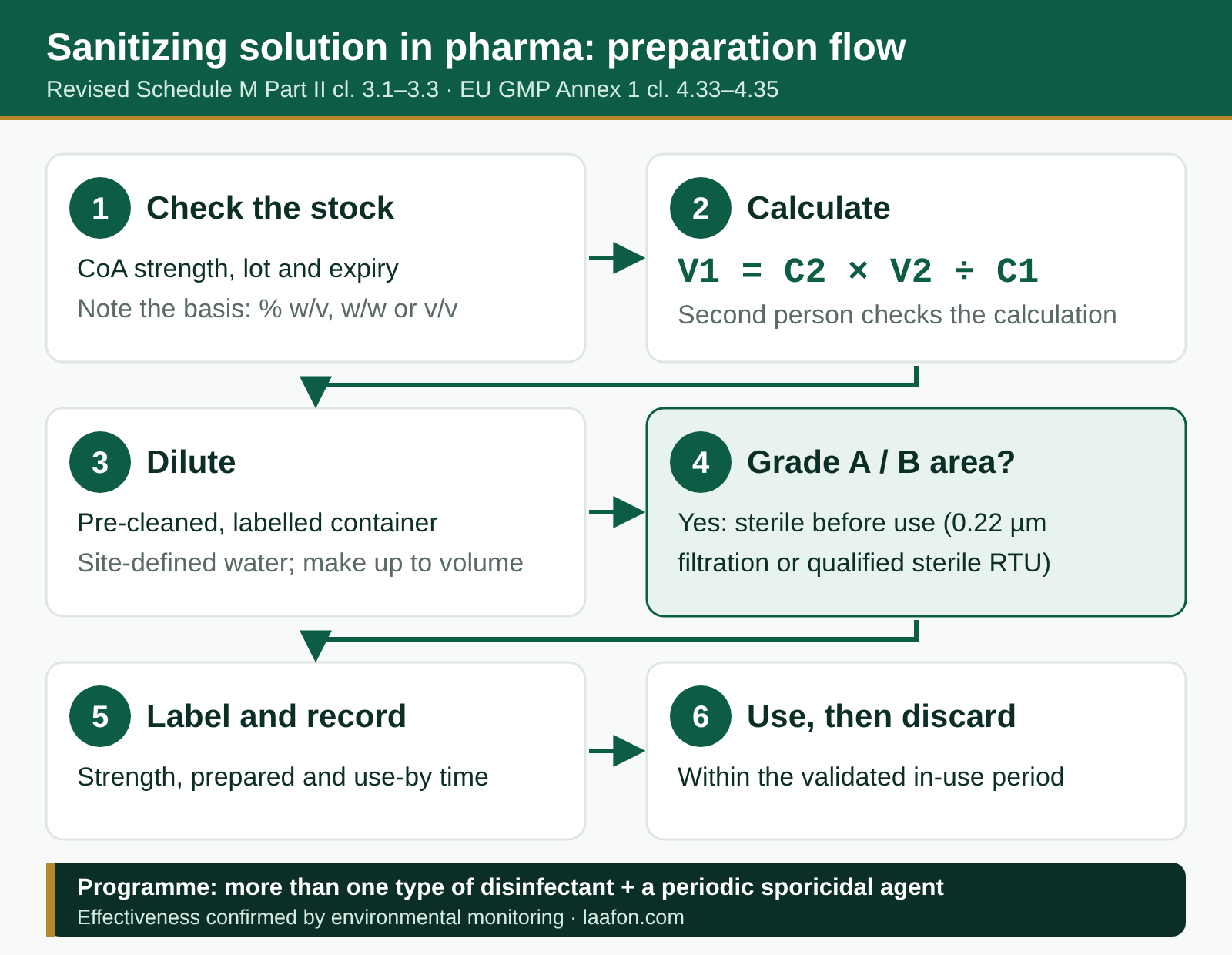
5. Procedure
Prepare solutions only in the disinfectant preparation area defined by your site. (The earlier version named “the third airlock”; the location is a site decision, not a requirement.) Wear the PPE listed on the safety data sheet.
Check the concentrate: name, lot number, expiry date, and strength with its basis from the CoA. Do not use a concentrate that is expired or whose strength is not known.
Calculate the volume of concentrate: V1 = C2 × V2 ÷ C1, where C1 is the stock strength, C2 the target strength (same basis) and V2 the final volume. Record the calculation. A second person checks it before preparation starts.
Take a pre-cleaned container (sterilised where step 5.8 applies). Label it before filling so an unlabelled container never holds a solution.
Add about half the final volume of water, then the measured concentrate, then make up to the final volume with water and mix. For v/v solutions such as alcohol, always make up to volume; do not add two volumes together.
Prepare each solution as below (per 1,000 mL final volume, using the example stock strengths; recalculate for your CoA value):
5.6.1 Isopropyl alcohol 70 % v/v. 707 mL of 99 % v/v IPA made up to 1,000 mL with water. (700 mL is correct only if the stock is treated as 100 %.)
5.6.2 Hydrogen peroxide 4 % w/v. 133 mL of 30 % w/v peroxide made up to 1,000 mL. From a 6 % w/v stock the same target needs 667 mL.
5.6.3 Benzalkonium chloride 2 % w/v. 40 mL of a 50 % w/v concentrate made up to 1,000 mL.
5.6.4 Glutaraldehyde 2 % w/v, activated. 80 mL of 25 % w/v (or 40 mL of 50 % w/v) made up to 1,000 mL, then activate with the supplier’s activator to pH 7.5 to 8.5 and record the pH and the activation date.
5.6.5 Phenol 5 % w/v. Weigh 50 g of phenol (melt the container in a water bath only to make it pourable), dissolve and make up to 1,000 mL.
5.6.6 Savlon 2 % v/v and 5.6.7 Dettol 2 % v/v. 20 mL of the branded product made up to 1,000 mL. These percentages are of the product as supplied, not of its active ingredient; follow the label and your efficacy data.
Target strengths in 5.6 are those carried by the earlier version of this SOP. They are site choices, not compendial values. Confirm each against your disinfectant efficacy validation before adopting this SOP.
Grade A and B areas: the solution must be sterile before use. Filter it through a sterile 0.22 µm filter into a sterile container under controlled conditions, or use a qualified sterile ready-to-use product backed by a certificate of analysis or conformance.
Label the container (Annexure-III): solution name and strength, stock lot, date and time of preparation, use-by date and time, prepared by and checked by.
Record the preparation in Annexure-I.
Use the solution within its validated in-use period. Do not top up a part-used container with fresh solution. Discard any solution past its use-by time, then return the container for cleaning.
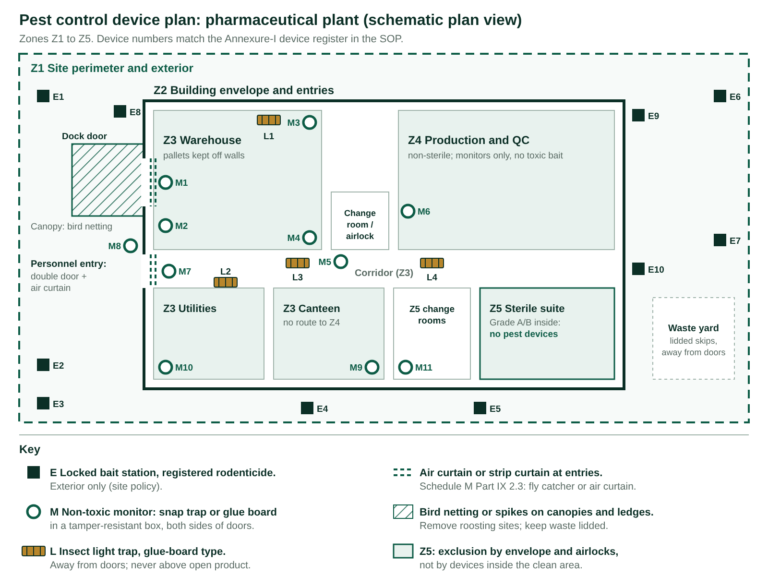
Apply solutions according to the disinfection SOP and the schedule in Annexure-II, which must include more than one type of disinfectant and a sporicidal agent.
Preparation of Disinfectant Solution: Dilution Table by Stock Strength
This table puts the calculation in one place. The example stock strengths are common supply strengths, not a recommendation; your CoA value replaces them. The last column shows what the earlier version of this SOP would have produced.
| Solution | Target strength | Example stock | Stock per 1,000 mL | Spectrum note (class data, CDC) | Earlier version gave |
|---|---|---|---|---|---|
| Isopropyl alcohol | 70 % v/v | 99 % v/v | 707 mL | Effective at 60 to 90 % v/v in water; does not destroy bacterial spores [5] | 700 mL: correct if stock taken as 100 % |
| Hydrogen peroxide | 4 % w/v | 30 % w/v | 133 mL | Sporicidal only at a validated concentration and contact time [5] | 40 mL: gives 1.2 % w/v |
| Hydrogen peroxide | 4 % w/v | 6 % w/v | 667 mL | As above | 40 mL: gives 0.24 % w/v |
| Benzalkonium chloride | 2 % w/v | 50 % w/v | 40 mL | Quaternary ammonium: not sporicidal [5] | 20 mL: gives 1 % w/v |
| Glutaraldehyde (activated) | 2 % w/v | 25 % w/v | 80 mL | Sporicidal only after activation to pH 7.5 to 8.5 [5] | “Glyceraldehyde” 20 mL: 0.5 % if 25 % stock |
| Glutaraldehyde (activated) | 2 % w/v | 50 % w/v | 40 mL | As above | 20 mL: gives 1 % w/v |
| Phenol | 5 % w/v | Phenol, solid | 50 g | Phenolic: not sporicidal [5] | 50 mL melted: slightly above 5 % |
| Savlon (chlorhexidine + cetrimide) | 2 % v/v of product | Product as supplied | 20 mL | Cetrimide is a quaternary ammonium compound: not sporicidal [5] | 20 mL: consistent |
| Dettol (chloroxylenol) | 2 % v/v of product | Product as supplied | 20 mL | Chloroxylenol is a phenolic: not sporicidal [5] | 20 mL: consistent |
Swipe the table sideways on a phone. “Not sporicidal” refers to the chemical class as recorded by CDC; a specific branded formulation may carry its own claim, which your efficacy study must confirm.
Worked example: 5 litres of 4 % hydrogen peroxide
Stock on the CoA: 30 % w/v. Target: 4 % w/v. Final volume: 5,000 mL.
Measure 667 mL of the 30 % stock into about 2.5 L of water and make up to 5,000 mL. If the CoA states the strength as % w/w, convert it to w/v first by multiplying by the solution’s density from the CoA or safety data sheet (for 30 % w/w peroxide this is roughly 1.11 g/mL, giving about 33 % w/v). Mixing bases is the other easy calculation error to make, after leaving the stock strength out altogether.
Sanitizing Solution in Pharma: What Schedule M, Annex 1 and FDA Require
Three documents govern how a sanitizing solution in pharma manufacturing is prepared and used in a sterile plant serving India and export markets. They agree more than most SOPs suggest, and none of them contains several of the “requirements” Indian SOPs routinely attribute to them.
| Requirement | Revised Schedule M, Part II (sterile) [1] | EU GMP Annex 1 (2022) [2] | US FDA aseptic guidance (2004) [3] |
|---|---|---|---|
| Written programme | 3.1: approved written programme | 4.33: written programme | X.A.3: procedures detailed enough to reproduce (preparation, sequence, contact time) |
| More than one disinfectant | 3.1: “more than one type shall be employed” | 4.33: more than one type, with different modes of action | Not stated in these words |
| Sporicidal agent | 3.3: programme shall include a sporicidal agent | 4.33: periodic use of a sporicidal agent | X.A.3: on a written schedule and when monitoring suggests spore-formers |
| Sterile before use | 3.2: in Grade A and B areas | 4.35: in Grade A and B; Grade C and D where the contamination control strategy requires | X.A.3: disinfectants should be sterile |
| Storage of dilutions | 3.2: previously cleaned containers; defined periods unless sterilised | 4.35: previously cleaned (sterilised where applicable) containers; defined period | X.A.3: suitable (e.g. sterile) containers; no longer than the predefined period |
| Microbial monitoring of disinfectants | 3.2: disinfectants and detergents shall be monitored | 4.35: when diluted or prepared in-house | Not stated in these words |
| Efficacy and residues | 3.1 and 3.3: effectiveness demonstrated; residues detected and removed by cleaning | 4.33 and 4.34: validated on the surfaces used; supports in-use expiry; residues removed | X.A.3: suitability, efficacy and limitations assessed |
| The word “rotation” | Not used for disinfectants | Not used | Not used |
| A named agent or a hold-time number | None | None | Only 70 % IPA, named as ineffective against Bacillus spores |
Clause numbers checked by full-text search of each document in October 2026. “Not used” means the string does not occur anywhere in the document.
Disinfectant rotation is industry vocabulary, not regulatory text. A character search of the notified Schedule M, of Annex 1 and of the FDA guidance found the word “rotation” only in stock-rotation and machinery contexts in Schedule M, and not at all in the other two. What the regulators actually require is narrower and easier to defend at inspection: more than one type of disinfectant, a sporicidal agent used periodically, and evidence from environmental monitoring that the programme works. An SOP that alternates two quaternary ammonium products month by month “rotates” but still has no sporicide, and fails both Schedule M 3.3 and Annex 1 4.33.
For oral solid and liquid plants (Schedule M Part I), the obligations are lighter but still written. Clause 4 puts “products for cleaning and disinfection” inside the scope of the sanitation programme, clause 11.5.2 requires personnel to wash and sanitise their hands before entering production, and clause 16.5 states that sanitising materials shall not contaminate equipment, materials or products. The US equivalent is 21 CFR 211.56(c), which requires written procedures for the use of cleaning and sanitizing agents [4]. Revised Schedule M is now in its enforcement phase: the extended date for eligible small and medium manufacturers that applied was 31 December 2025 [6], and CDSCO asked state regulators to begin inspections in November 2025 [7].
Acceptance Criteria and Frequency
Badges show where each criterion comes from. regulatory means a requirement in the cited document; site policy means your QMS sets the value; check source means a figure exists in a paywalled standard that could not be read for this page, so no number is published here.
| Check | Criterion | Basis |
|---|---|---|
| Concentrate | Within expiry; CoA strength and basis recorded | site policy good documentation practice |
| Calculation | V1 = C2 × V2 ÷ C1 recorded and checked by a second person | site policy |
| Alcohol strength | Target 70 % v/v; the effective range is 60 to 90 % v/v in water | CDC effective range, not a compendial limit [5] |
| Glutaraldehyde activation | pH 7.5 to 8.5 after activation; used within the activated shelf life on the label (CDC: at least 14 days) | CDC plus supplier label [5] |
| Sterility (Grade A and B) | Sterile before use: filtered through a sterile 0.22 µm filter with integrity confirmed, or qualified sterile ready-to-use product with CoA | regulatory Schedule M Part II 3.2; Annex 1 4.35 [1,2] |
| Microbial quality of in-house dilutions | Monitored at a defined frequency; limits set by QA | regulatory duty to monitor (Schedule M 3.2) site policy limit |
| In-use period | Validated period; discard at expiry; no topping up | regulatory Annex 1 4.34 and 4.35; Schedule M 3.2 site policy the number of hours or days |
| Disinfectant efficacy | Log reduction against facility isolates on representative surfaces, by a validated method | check source USP general chapter on disinfectants and antiseptics, or the EN surface-test standard your site follows |
Frequency
| Activity | Frequency | Basis |
|---|---|---|
| Preparation of each dilution | Fresh for each validated in-use period | site policy |
| Sporicidal agent | On a written schedule, plus whenever monitoring recovers spore-formers | regulatory FDA X.A.3; Annex 1 4.33 says “periodic” [2,3] |
| Microbial monitoring of dilutions | Defined by QA (for example, per new concentrate lot and periodically) | site policy |
| Efficacy revalidation | On any change of agent, supplier, surface material or contact time | regulatory validation duty in Annex 1 4.34 site policy trigger list |
| SOP review | As per your document control procedure | site policy |
Precautions
For the person preparing the solution
- Wear the gloves, goggles, mask and apron the safety data sheet specifies before opening any concentrate.
- Isopropyl alcohol is flammable: prepare it away from ignition sources, in a ventilated area, and keep only the volume needed.
- Phenol and glutaraldehyde are hazardous chemicals: follow the safety data sheet for each, including any requirement for local exhaust ventilation.
- Never mix two disinfectants in one container, and never pour a solution back into the concentrate container.
The ones that fail an audit
- A container with no use-by time, or a solution in use past it.
- A dilution written as “X mL to 1 litre” with no stock strength anywhere in the SOP or the record.
- Non-sterile alcohol or disinfectant carried into a Grade A or B area.
- A disinfectant list with no sporicidal agent, or two agents of the same chemical class.
- Part-used containers topped up with fresh solution, which resets the label but not the contamination.
Deviation Handling
| Event | Immediate action | Follow-up |
|---|---|---|
| Wrong strength prepared, found before use | Discard; prepare again; record | Retrain; review the calculation check |
| Wrong strength or expired solution already used | Raise a deviation; re-disinfect the affected area with a correct solution | Impact assessment on batches and environmental monitoring results for the period |
| Microbial growth found in a prepared dilution | Quarantine the remaining solution and the concentrate lot | Investigate the water, the container cleaning and the concentrate; review EM data from areas where it was used |
| Filter integrity test failure (Grade A and B solution) | Do not use; re-filter through a new tested filter or discard | Investigate the filter and the procedure |
| Environmental monitoring excursion after disinfection | Follow the OOS procedure for environmental monitoring | Identify the isolate; test its sensitivity to the agents in use; consider the sporicide schedule |
Annexures and Record Formats
Annexure-I: Disinfectant Solution Preparation Record
| Date | Time | Solution and target strength | Concentrate, lot, CoA strength | Stock volume (mL) | Final volume (mL) | Water grade | Filtered? Filter ID | Use-by date and time | Prepared by | Checked by |
|---|---|---|---|---|---|---|---|---|---|---|
Annexure-II: Disinfectant Schedule by Area Grade
| Area | Grade | Disinfectant A (days) | Disinfectant B, different class (days) | Sporicidal agent (frequency) | Sterile before use? |
|---|---|---|---|---|---|
| A / B | Yes (Schedule M Part II 3.2) | ||||
| C / D | Where your contamination control strategy requires | ||||
| Non-classified | Site policy |
Annexure-III: Container Label
| Solution and strength | Concentrate lot | ||
| Prepared on (date, time) | Use before (date, time) | ||
| Sterile-filtered | Yes / No | Prepared by / Checked by |
Revision history
| Version | Effective date | Change |
|---|---|---|
| 00 | DD-MMM-YYYY | New SOP |
| 01 | DD-MMM-YYYY | Stock-strength calculation added; benzalkonium, peroxide and glutaraldehyde volumes corrected; Grade A and B sterility, labelling, in-use period and sporicide added |
FAQ
On Indian shop floors the two words are used interchangeably. Regulatory text mostly says disinfectant: Revised Schedule M Part II and EU GMP Annex 1 both use it, while Schedule M Part I clause 16.5 speaks of sanitising materials. What matters at inspection is not the label but whether the solution’s efficacy against your facility isolates has been demonstrated.
Use V1 = C2 × V2 ÷ C1. C1 is the strength on the concentrate’s CoA, C2 is your target strength, and V2 is the final volume. Both strengths must be on the same basis (w/v, w/w or v/v). For example, 1 litre of 2 % benzalkonium chloride from a 50 % concentrate needs 2 × 1,000 ÷ 50 = 40 mL.
Alcohol kills microorganisms by denaturing proteins, and that happens faster in the presence of water. CDC records the optimum bactericidal range as 60 to 90 % in water (v/v) and notes that absolute alcohol is less bactericidal. Alcohol at any strength does not destroy bacterial spores, which is why it cannot be your sporicidal agent.
The word does not appear in Revised Schedule M for disinfectants. Part II clause 3.1 requires that more than one type of disinfectant be employed where disinfectants are used, and clause 3.3 requires a sporicidal agent in the programme. A schedule that alternates two agents of different chemical classes and adds a periodic sporicide satisfies both clauses.
For the period your validation supports. Revised Schedule M allows dilutions to be stored only for defined periods unless sterilised, and Annex 1 clause 4.34 requires validation studies to support the in-use expiry of prepared solutions. Neither document gives a number of hours or days, so any figure in your SOP is site policy and needs data behind it.
Yes. Revised Schedule M Part II clause 3.2 and EU GMP Annex 1 clause 4.35 both state it, and the FDA 2004 aseptic guidance says disinfectants should be sterile. In practice a site either filters the solution through a sterile 0.22 µm filter into a sterile container or buys a qualified sterile ready-to-use product with a certificate of analysis.
By CDC’s class data, alcohols, quaternary ammonium compounds such as benzalkonium chloride and cetrimide, and phenolics such as chloroxylenol are not sporicidal. Glutaraldehyde becomes sporicidal only after alkaline activation, and hydrogen peroxide is sporicidal only at a validated concentration and contact time. Your sporicide’s claim must be confirmed against your own isolates.
Getting a sterile area ready for a Revised Schedule M inspection?
Disinfection sits in Part II of Revised Schedule M, and state inspections against it are under way. Laafon’s live Schedule M dashboard tracks enforcement status, key dates and the major changes, and links to paid consultation if you want your disinfection programme reviewed against the clauses above.
Related on laafon.com
References
- Ministry of Health and Family Welfare (India). Drugs Rules, 1945: Schedule M, Good Manufacturing Practices and Requirements of Premises, Plant and Equipment for Pharmaceutical Products (revised), G.S.R. 922(E). Gazette of India, Extraordinary; 28 Dec 2023. Part I clauses 4, 11.5.2 and 16.5; Part II clauses 3.1 to 3.4. Gazette reprint available from: pharmadocx.com; notification summary: Drugs Control Department, Puducherry. Accessed Oct 2026.
- European Commission. EudraLex Volume 4, Annex 1: Manufacture of Sterile Medicinal Products. C(2022) 5938 final; 22 Aug 2022, in operation from 25 Aug 2023. Clauses 4.33 to 4.36. Available from: health.ec.europa.eu. Accessed Oct 2026.
- US Food and Drug Administration. Guidance for Industry: Sterile Drug Products Produced by Aseptic Processing, Current Good Manufacturing Practice. Sep 2004. Section X.A.3, Disinfection Efficacy. Available from: fda.gov. Accessed Oct 2026.
- Code of Federal Regulations. 21 CFR 211.56, Sanitation. Available from: ecfr.gov. Accessed Oct 2026.
- Rutala WA, Weber DJ; Healthcare Infection Control Practices Advisory Committee. Guideline for Disinfection and Sterilization in Healthcare Facilities, 2008: Chemical Disinfectants. Centers for Disease Control and Prevention. Available from: cdc.gov. Accessed Oct 2026.
- Business Standard. MSME pharma units get breather as govt extends Schedule M deadline. 4 Jan 2025. Available from: business-standard.com. Accessed Oct 2026.
- Business Standard. CDSCO asks state units to start inspections under Schedule M norms. Nov 2025. Available from: business-standard.com. Accessed Oct 2026.
This procedure is a template for adaptation. It requires local qualification, validation and Quality Assurance approval before use, and every target strength, in-use period and acceptance criterion must be confirmed by your own disinfectant efficacy data and checked against the current edition of the applicable regulations. Pharmacopoeial texts and Indian statutory instruments change between editions. Branded products are named only because the earlier version of this SOP named them; follow each manufacturer’s label. Technical and educational content only, not medical, legal or investment advice.