Category SOP

ALCOA Principles in Pharma: Definition, Examples & FDA Requirements

ALCOA principles comparison chart for pharmaceutical data integrity

ALCOA stands for Attributable, Legible, Contemporaneous, Original, and Accurate—the five fundamental data integrity principles established by the FDA in the 1990s to ensure pharmaceutical data quality and regulatory compliance. These principles form the cornerstone of Good Documentation Practices (GDP) and…

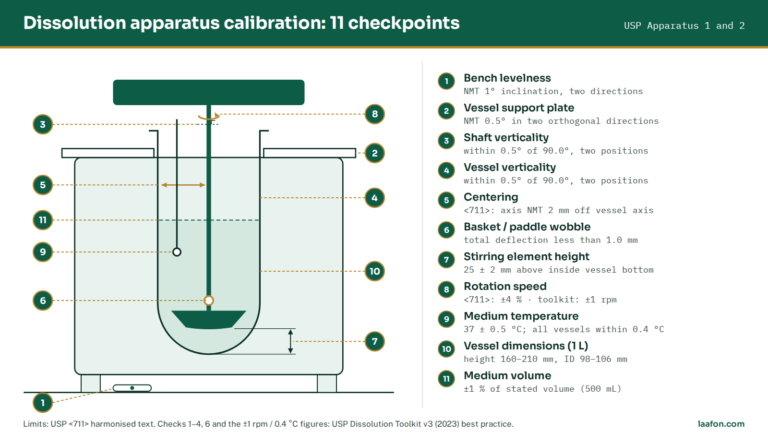
SOP for Calibration of Dissolution test appratus

Gas Chromatography GC Principle

Principle of Dissolution Test Apparatus Dissolution is the analysis process in which the analyzed substance forms a solution. In this testing measurement of the content and rate of dissolving in the solution from a dosage form, such as a tablet,…

UV-Visible Spectrophotometer SOP, Calibration and Advantages

UV-Visible Spectrophotometer SOP

SOP, Calibration, and features of UV-visible spectrophotometer UV-Visible Spectrophotometry is an analytical technique that is widely used in the pharmaceutical industry for qualitative and quantitative analysis of substances. It works by measuring the intensity of light passing through the prepared…

Karl Fischer titration and calibration Procedure

Karl Fischer

In the quality control department Instrument section is an essential part because every test requires a specific instrument to perform a valid analysis. Karl Fischer titration is very essential in many analyses including finding the water content in any substance.…

Calibration of FTIR

The principle of Fourier-transform infrared spectroscopy (FTIR) is a technique used to attain an infrared spectrum of absorption of a substance (solid, liquid, or gas)  the technology simultaneously collects high-spectral-resolution data over a wide spectral range. This confers a significant…