
Short answer
Batch record review is the check, made for every batch before it is released, that the executed batch processing record, batch packaging record and quality control records prove the batch was made, packed and tested exactly as the master formula and approved procedures require, and that every deviation, out-of-specification result and change touching the batch has been investigated. It is not a periodic exercise. The periodic one is the product quality review.
For batch record review in pharmaceutical industry practice, three texts set the rules: revised Schedule M in India (production records clause 18.5.12, QC records 19.8.1, the authorised person 11.3.8 to 11.3.9), 21 CFR 211.192 in the US, and EU GMP Annex 16 for the Qualified Person. This page compares them clause by clause, maps the five review stages, and gives an adaptable SOP with a 20-point reviewer checklist.
What the regulations actually say: six points most batch record SOPs get wrong
The earlier version of this page, like many Indian pharma blogs, described batch record review as “a periodical process that should be performed within a fixed time interval”. That is the first thing to correct. Each point below was checked against the primary text, and the clause is given so it can be quoted in an audit response.
-
It happens batch by batch, before release. It is not periodic.
21 CFR 211.192 requires the quality control unit to review and approve production and control records “before a batch is released or distributed”[1]. Revised Schedule M says no batch “is to be released for sale or supply prior to certification by the authorised persons” (Part I, 11.3.8)[2]. The review that runs on a calendar is the product quality review: “normally” annual under Schedule M 2.3.2 and EU GMP Chapter 1 clause 1.10, and “at least annually” under 21 CFR 211.180(e)[1][2][3].
-
Schedule M’s own words are “batch processing record” and “batch packaging record”.
Part I clause 17.3.8 is headed Batch processing records and 17.3.9 Batch packaging records[2]. A search of the full notified text (124 gazette pages) found the phrase “Batch Manufacturing Record” once, in Part VIII clause 3.7 on rejected tablets, and the acronyms BMR and BPR not at all. Calling your document a BMR is a site convention and is fine. When you cite Schedule M to an inspector, use its terms.
-
Schedule M splits the review; 21 CFR 211 does not.
Schedule M has production records reviewed (18.5.12) and quality control records reviewed (19.8.1), each “as part of the approval process of batch release before transfer to the authorised person”[2]. The authorised person then works through a ten-item list, 11.3.9 (a) to (j), which includes approval by the head of quality control.
In the US, 211.192 places the whole review on the quality control unit[1]. In the EU, the Qualified Person certifies, may delegate review tasks, and is expected to rely on the quality system with “on-going assurance that this reliance is well founded” (Annex 16, 1.7)[4]. For APIs, ICH Q7 6.71 and Schedule M Part XII 6.7.2 let qualified production staff review the records of non-critical steps under procedures the quality unit approves[5].
-
The investigation reaches beyond the batch, and the US wording is stricter.
Under 211.192 an unexplained discrepancy “shall be thoroughly investigated, whether or not the batch has already been distributed”, and the investigation “shall extend to other batches of the same drug product and other drug products” that may be involved[1]. Schedule M 18.5.12 and 19.8.1 say the investigation “shall, if necessary, extend”[2]. A site that exports to the US works to the unconditional version.
-
Audit trails are part of the batch record.
FDA’s December 2018 data integrity guidance says the people responsible for record review “should review the audit trails that capture changes to data associated with the record as they review the rest of the record”, and that the records the quality unit must approve under 211.192 include audit trails (Q7). On frequency, it points to 211.22, which requires data review before batch release (Q8)[6].
-
Schedule M asks for one field the EU template does not.
Schedule M 17.3.8.3(h) requires the batch processing record to show “the hold time permitted for intermediate and in process material”[2]. EU GMP Chapter 4 clause 4.20 lists items (a) to (i) for the batch processing record, and none of them is a hold time[7]. An imported EU-style template therefore needs this field added before it is Schedule M compliant.
Batch record review in pharmaceutical industry: Schedule M, 21 CFR 211, EU GMP and ICH Q7 compared
The table puts the four texts side by side. The clause numbers are the ones to cite; the wording is summarised, and quotation marks mark exact words.
| Point | India: revised Schedule M (G.S.R. 922(E)) | US: 21 CFR Part 211 | EU: EudraLex Vol. 4 | APIs: ICH Q7 |
|---|---|---|---|---|
| Record names | Batch processing record 17.3.8; batch packaging record 17.3.9 | Batch production and control records 211.188 | Batch Processing Record 4.20; Batch Packaging Record 4.21 | Batch production records 6.50-6.52 |
| Who reviews | Production records 18.5.12 and QC records 19.8.1, then the authorised person 11.3.9 | The quality control unit 211.192, 211.22(a) | The QP certifies; tasks may be delegated and the QP relies on the quality system Annex 16 1.7 | Quality unit for critical steps; qualified production staff may review non-critical steps 6.71 |
| When | Before transfer to the authorised person; no release before certification 11.3.8 | “before a batch is released or distributed” 211.192 | Before QP certification Annex 16 1.7 | Before an API batch is released or distributed 6.70-6.71 |
| Deviations and OOS | Planned changes or deviations notified before release 11.3.9(e); signed authorisation for any deviation from the master formula 17.3.8.3(k) | Deviations recorded and justified 211.100(b); investigation recorded in the batch record 211.188(b)(12) | All investigations, including OOS and OOT, complete enough to support certification Annex 16 1.7.16 | All deviation, investigation and OOS reports reviewed before release 6.72 |
| Investigation scope | “shall, if necessary, extend” to other batches and products 18.5.12, 19.8.1 | “shall extend” to other batches and products, whether or not distributed 211.192 | Complete to a level that supports certification Annex 16 1.7.16 | Critical deviations investigated and resolved 2.22 |
| Retention | At least 1 year after expiry 17.2.7 | At least 1 year after expiry; certain OTC products 3 years after distribution 211.180(a) | 1 year after expiry or at least 5 years after QP certification, whichever is longer Ch. 4 4.11 | At least 1 year after expiry 6.13 |
| Periodic review | Product quality review, normally annual 2.3.2 | At least annually 211.180(e) | Product quality review, normally annual Ch. 1 1.10 | Normally annual 2.50 |
Scroll sideways on a phone to see all four columns. Sources: 21 CFR Part 211 [1], Schedule M [2], EU GMP Chapter 1 [3], Annex 16 [4], ICH Q7 [5], EU GMP Chapter 4 [7].
Schedule M Part XII repeats ICH Q7’s section 6.7 for API manufacturers almost word for word, but with “shall” where ICH Q7 says “should”. If your site makes APIs in India, the review is a legal requirement and not guidance.
The five review stages, from executed record to release
Most review failures happen because stages are merged: QA ends up re-checking arithmetic that production should have caught, and the authorised person signs without seeing an open deviation. The flow below keeps each stage’s job separate, and shows where the discrepancy path leaves the main line.
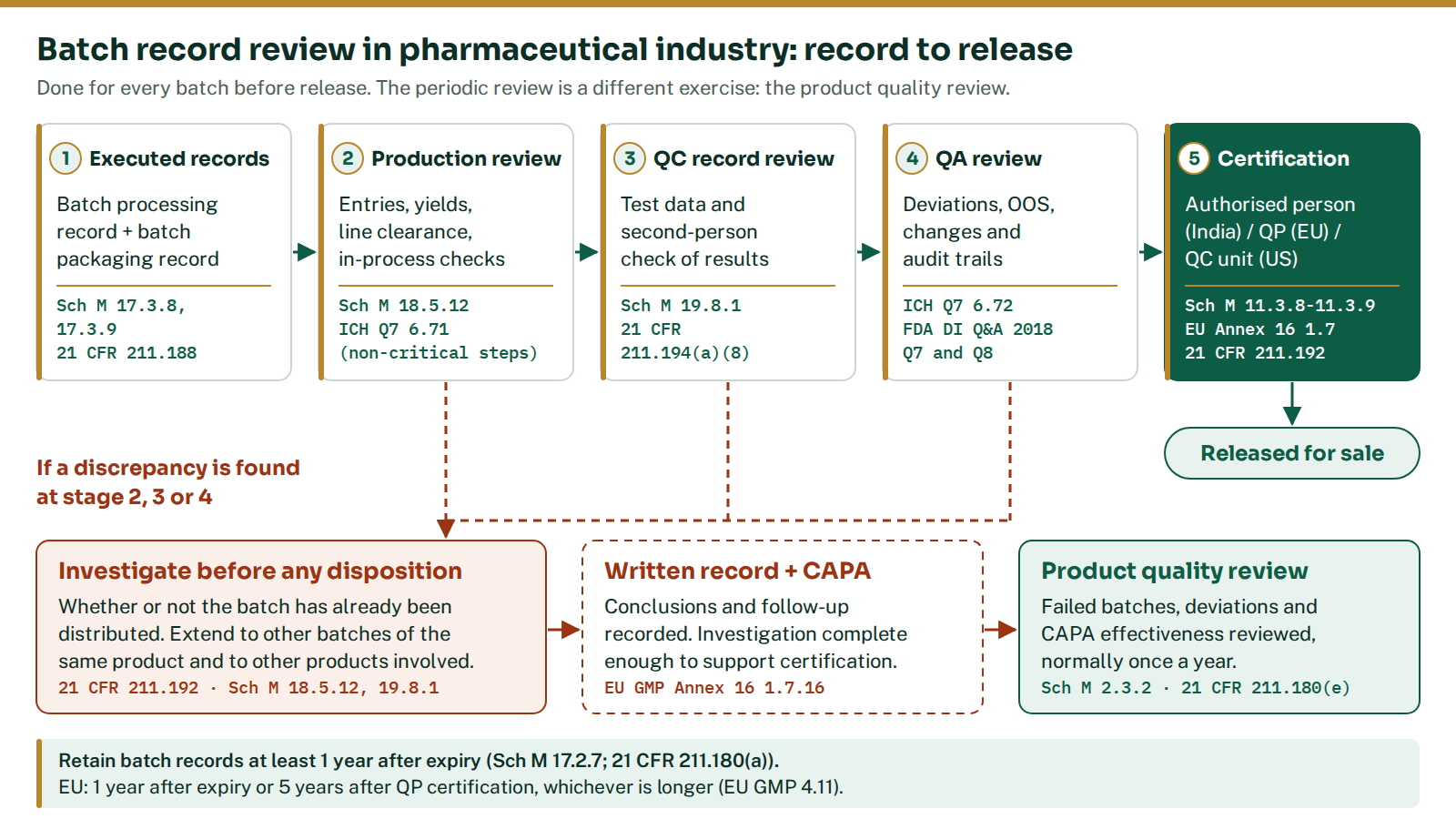
| Stage | Who | What it must establish | Common failure |
|---|---|---|---|
| 1. Executed records | Production officer | The record issued is the current master version and every page is present (21 CFR 211.188(a); Schedule M 17.3.8.1) | Old template issued after a master formula change |
| 2. Production review | Head of production | Every significant step has a performer and a checker; line clearance, hold times, yields and reconciliation are within limits (17.3.8.2 to 17.3.9.3) | Checker signs steps he did not witness |
| 3. QC record review | QC reviewer, then head of QC | All tests complete against the current specification; second-person check of raw data (21 CFR 211.194(a)(8); Schedule M 19.8.1) | Reviewing the certificate of analysis, not the raw data |
| 4. QA review | QA officer | Every deviation, OOS, change control and audit trail linked to the batch is reviewed (ICH Q7 6.72; FDA Q7) | Deviation raised but not referenced in the batch record |
| 5. Certification | Authorised person or designee | The ten conditions of Schedule M 11.3.9 are met; release decision recorded | Release on a provisional CoA “pending” one test |
The roles are typical for an Indian formulation plant. Your SOP may assign them differently, provided each stage has a named owner.
Where the reviewer finds something, the next step depends on what it is and whether the batch has already left the site. The selector below gives the route and the clause that governs it. For how QA and QC divide this work more generally, see the difference between the QA and QC departments.
Discrepancy found at review: what happens next
1. What did the reviewer find?
2. Where is the batch?
Choose one option from each group
The route and the governing clause will appear here.
Clauses: Schedule M Part I, 21 CFR 211, ICH Q7, EU GMP.
The selector is a triage aid, not a substitute for your deviation SOP. The classification of any finding, and whether it needs a formal deviation, is decided by QA under your own procedure. For environmental monitoring excursions on sterile batches, see the SOP for OOS in environmental monitoring.
SOP: batch record review and batch release
The document below is written for a finished-dosage-form plant working to revised Schedule M, with the 21 CFR 211 and EU GMP points an exporting site also needs. Copy the structure, then replace the site-specific blanks.
Review of batch records and release of finished product batches
1. Purpose
To lay down the procedure for review of the executed batch processing record, batch packaging record and quality control records of every batch, and for their approval before the batch is transferred to the authorised person for certification and release.
2. Scope
Applies to all finished-product batches manufactured, packed or tested at the site, including batches made under loan licence or contract. Excludes active pharmaceutical ingredients and intermediates (covered by a separate procedure under Schedule M Part XII), investigational products (Part VII), and the annual product quality review, which has its own SOP.
3. Responsibility
- Production officer: compiles the executed record and performs the first completeness check.
- Head of production: reviews and signs the production records (Schedule M 18.5.12).
- QC reviewer and head of QC: review QC records (19.8.1); head of QC gives the approval required by 11.3.9(i).
- QA officer: performs the full review, including deviations, OOS results, change controls and audit trails, and completes Annexure-I.
- Authorised person (head of QA or a designee under 11.3.10): certifies and releases, or rejects.
4. Documents and records required
- Current approved master formula and the executed batch processing and batch packaging records.
- Dispensing, line clearance, in-process control, equipment usage and cleaning records for the batch.
- Raw data, chromatograms, spectra and calculations for all QC tests; the certificate of analysis.
- Deviation, OOS, change control and incident logs, filtered for the batch number.
- Audit trail reports from the computerised systems that generated batch data.
- For sterile products: environmental monitoring and utility results for the batch period (Schedule M Part II).
5. Procedure
5.1 Receipt and completeness
5.1.1Production hands the executed record to QA through the document transfer log within the time set by site policy after completion of packing.
5.1.2Confirm the record is a copy of the current master version, with the correct issuance number and batch number on every page (21 CFR 211.188(a); Schedule M 17.3.8.1).
5.1.3Confirm page count against the issuance record. A missing page stops the review and is raised as a deviation.
5.2 Production review
5.2.1Check that every significant step carries the initials of the operator and of the person who checked it (211.188(b)(11); Schedule M 17.3.8.3(e)).
5.2.2Match starting-material batch or AR numbers and weighed quantities against the dispensing record (17.3.8.3(f)).
5.2.3Confirm line clearance was recorded before processing and before packaging (17.3.8.2; 17.3.9.2).
5.2.4Check process parameters against master formula limits, and actual hold times against the permitted hold time (17.3.8.3(h)).
5.2.5Verify stage yields and packaging reconciliation. A yield outside the master record’s limits is investigated, and any significant deviation from expected yield carries a written explanation (211.186(b)(7); 211.192; 17.3.8.3(j)).
5.2.6Check printed packaging specimens for batch number, expiry and overprint, and the reconciliation of printed materials (17.3.9.3(a) and (g)).
5.2.7Head of production signs and dates the production review.
5.3 QC record review
5.3.1Confirm every in-process and finished-product test in the current specification is complete, with a second-person review of the original records (211.194(a)(8); Schedule M 19.7.5 and 19.8.1).
5.3.2Trace each reported result to its raw data and calculation. Review the audit trail for changes to that data at the same time (FDA data integrity guidance, Q7).
5.3.3Head of QC signs the QC approval (11.3.9(i)).
5.4 QA review
5.4.1Check good documentation practice: entries made at the time of the action, and every alteration signed, dated, legible underneath and, where appropriate, explained (Schedule M 17.2.6 and 17.2.7; EU GMP 4.8 and 4.9).
5.4.2List every deviation, OOS, change control and incident linked to the batch number. Each must be closed, or assessed as complete enough to support certification (ICH Q7 6.72; EU Annex 16 1.7.16).
5.4.3For sterile products, confirm environmental monitoring results for the batch period have been considered.
5.4.4Complete Annexure-I. Record each observation in Annexure-II with its category from section 9.
5.4.5Return observations to the originating department. Corrections follow 5.4.1, and the corrected pages are re-reviewed.
5.5 Certification and release
5.5.1The authorised person confirms each of the conditions in Schedule M 11.3.9 (a) to (j) and signs the batch release certificate (Annexure-III).
5.5.2Record the decision as Released, Rejected or Quarantine pending investigation, and update the status label and the ERP or inventory system the same day.
5.5.3No batch is dispatched before certification (11.3.8).
5.6 After release
5.6.1Archive the original record. Retain it for at least one year after expiry (Schedule M 17.2.7), or five years after certification where the batch is certified for the EU and that is longer (EU GMP 4.11).
5.6.2Trend Annexure-II observations by category at the frequency set by site policy, and feed the results into the product quality review (Schedule M 2.3.2).
6. Acceptance criteria
| Criterion | Requirement | Basis | Source type |
|---|---|---|---|
| Performer and checker | Every significant step shows who did it and who checked it | 21 CFR 211.188(b)(11); Sch. M 17.3.8.3(e) | regulation |
| Contemporaneous entry | Recorded at the time each action is taken | Sch. M 17.2.7, 17.3.8.3; EU GMP 4.8 | regulation |
| Corrections | Signed, dated, original still readable, reason where appropriate | Sch. M 17.2.6; EU GMP 4.9 | regulation |
| Yield | Within the minimum and maximum percentage of theoretical yield in the master record; outside it, an investigation | 21 CFR 211.186(b)(7), 211.192 | regulation limit: site value |
| Hold time | Actual hold time within the permitted hold time recorded in the batch processing record | Sch. M 17.3.8.3(h) | regulation limit: validated value |
| Specification | All results conform to the finished product specification before release | Sch. M 19.7.6; EU Annex 16 1.7.13 | regulation |
| Investigations | All deviation, investigation and OOS reports reviewed before release | ICH Q7 6.72; Sch. M Part XII 6.7.3 | regulation |
| Audit trail | Changes to data associated with the record reviewed with the record | FDA data integrity Q and A (2018), Q7 | guidance |
| Review turnaround | Completed within ___ working days of packing completion | None of the clauses cited sets a time limit | site policy |
Yield limits and hold times are product-specific and come from your own validation data, not from any pharmacopoeia or regulation. The regulation requires that limits exist and are met.
7. Frequency
Every batch, before release. Trending of review observations: at the frequency set by site policy. Product quality review: normally annually (Schedule M 2.3.2).
8. Precautions
- No pencil, correction fluid, overwriting or “ditto” marks. Strike unused spaces with a single line, signed and dated.
- Never pre-sign, back-date or complete an entry from memory after the event. A missing contemporaneous record cannot be recreated; it becomes a deviation.
- A reviewer does not review his or her own entries.
- Review electronic data in the system, not only on printouts. FDA notes that a printout does not preserve a dynamic record such as an FT-IR file (2018 guidance, Q10).
- Do not release against a provisional certificate of analysis with a test still pending.
9. Handling of review observations
- Category A, documentation error: corrected under 5.4.1 by the person who made the entry, or as the site SOP directs; logged and trended.
- Category B, missing record of a significant step: deviation raised, impact assessed; the batch stays in quarantine.
- Category C, yield, reconciliation or specification failure: investigation under 21 CFR 211.192 and Schedule M 18.5.12 or 19.8.1, extended to other batches and products where they may be affected.
- Category D, unrecorded departure from the master formula: deviation with impact assessment; notified to the authorised person before release (11.3.9(e)).
10. Annexures
Annexure-I: Batch record review checklist (below). Annexure-II: Review observation log. Annexure-III: Batch release certificate.
| No. | Check point | Reference | Yes / No / NA | Remarks |
|---|---|---|---|---|
| 1 | Record is a copy of the current master version; issuance number recorded | 211.188(a); Sch. M 17.3.8.1 | ||
| 2 | All pages present; batch number on every page | Site SOP | ||
| 3 | Line clearance before processing recorded and signed | Sch. M 17.3.8.2 | ||
| 4 | Starting-material batch or AR numbers and quantities match dispensing | Sch. M 17.3.8.3(f) | ||
| 5 | Performer and checker initials on every significant step | 211.188(b)(11); Sch. M 17.3.8.3(e) | ||
| 6 | Start and completion dates and times of significant stages recorded | Sch. M 17.3.8.3(c) | ||
| 7 | Equipment identity recorded; equipment status and cleaning records checked | 211.188(b)(2); Sch. M 17.3.8.3(g) | ||
| 8 | Process parameters within master formula limits | Master formula | ||
| 9 | Hold times within the permitted hold time | Sch. M 17.3.8.3(h) | ||
| 10 | In-process control results recorded, initialled and within limits | 211.188(b)(5); Sch. M 17.3.8.3(i) | ||
| 11 | Stage yields within limits, or explained and investigated | 211.186(b)(7); Sch. M 17.3.8.3(j) | ||
| 12 | Line clearance before packaging recorded | Sch. M 17.3.9.2 | ||
| 13 | Printed packaging specimens attached; batch number and expiry correct | 211.188(b)(8); Sch. M 17.3.9.3(g) | ||
| 14 | Packaging and printed-material reconciliation within limits | Sch. M 17.3.9.3(a) | ||
| 15 | Every alteration signed, dated, legible underneath, reason where appropriate | Sch. M 17.2.6; EU GMP 4.9 | ||
| 16 | All QC tests complete against current specification; second-person check done | 211.194(a)(8); Sch. M 19.8.1 | ||
| 17 | Audit trails for batch data reviewed with the record | FDA DI guidance Q7 | ||
| 18 | All deviations, OOS results and change controls for the batch listed and closed or assessed | ICH Q7 6.72; Annex 16 1.7.16 | ||
| 19 | Sterile products: environmental monitoring results for the batch period considered | Sch. M Part II | ||
| 20 | Head of QC approval present; conditions of Sch. M 11.3.9 met | Sch. M 11.3.9 |
11. Revision history
| Version | Effective date | Change | Reason |
|---|---|---|---|
| 00 | DD-MMM-YYYY | New SOP | Initial issue |
| 01 | DD-MMM-YYYY | Split production and QC review; hold-time check added | Alignment with revised Schedule M 17.3.8.3(h), 18.5.12, 19.8.1 |
12. References
As listed at the end of this page, numbers [1] to [7].
Use of this template. This SOP is a template for adaptation. It requires local qualification, validation and Quality Assurance approval before use. Clause numbers were checked against the texts named in the references on 27 Sep 2026; statutory instruments and GMP guides are amended, so verify against the current version before approval.
Seven findings that fail batch record review audits
These come from the author’s own audits of Indian formulation plants rather than from a regulatory list. They are the findings that recur in batch record review in pharmaceutical industry inspections, and each maps to a clause above.
- Entries completed at shift end. Times that are all rounded, or a whole page in one pen, suggest the record was not made “at the time each action is taken” (Schedule M 17.3.8.3).
- A checker who was not there. The second signature on a dispensing step belongs to someone whose attendance record puts him elsewhere.
- Yield “within limits” with no calculation. The reviewer ticked it without the arithmetic or the theoretical figure on the page.
- Unsigned corrections, overwriting, or correction fluid on a batch record.
- A deviation that is not in the batch record. The deviation log shows an event, but the record carries no reference to it, so the authorised person never saw it.
- Printouts only. Chromatograms reviewed on paper with no look at the processing history or audit trail in the software.
- Review signatures in bulk. Twenty batch records signed by one reviewer on one afternoon is a workload problem an inspector will read as a review that did not happen.
The data integrity principles behind findings 1, 4 and 6 are set out in ALCOA vs ALCOA+ vs ALCOA++: which regulator says what. For how inspectors turn such findings into Form 483 observations, see the USFDA Form 483 response strategy.
Electronic batch records and audit trail review
An electronic batch record changes how the review is done, not what it must establish. A validated system can enforce sequence, block out-of-limit entries and flag exceptions, so the reviewer spends time on what the system flagged. It does not remove the audit trail review. Under FDA’s 2018 guidance the audit trail is part of the record the quality unit approves under 211.192, and its review follows the same timing: before batch release[6]. Schedule M 17.3.8.1 recommends “copying or validated computer programmes” for preparing records, and says transcription from approved documents should be avoided[2].
For the US rules on electronic records and signatures themselves, see the 21 CFR Part 11 compliance manual.
Preparing for a Schedule M or USFDA inspection? Laafon Galaxy reviews batch documentation systems for Indian manufacturers: batch processing and packaging record templates, review and release SOPs, and how deviations and OOS reports link into the batch record, against revised Schedule M, WHO-GMP and 21 CFR 211.
Request a compliance assessmentFrequently asked questions
In India, revised Schedule M has production records and quality control records reviewed before the batch is transferred to the authorised person (clauses 18.5.12 and 19.8.1), and the authorised person certifies release (11.3.8 to 11.3.9). In the US, 21 CFR 211.192 gives the review to the quality control unit. In the EU, the Qualified Person certifies under Annex 16 and may delegate tasks while relying on the quality system.
No. It is done for each batch before release: 21 CFR 211.192 says “before a batch is released or distributed”, and Schedule M 11.3.8 bars release before certification. The periodic review is the product quality review, normally annual under Schedule M 2.3.2 and EU GMP 1.10, and at least annual under 21 CFR 211.180(e).
In Indian plants, BMR usually means the batch manufacturing record, covering dispensing to bulk, and BPR the batch packing or packaging record. Revised Schedule M calls them the batch processing record (17.3.8) and the batch packaging record (17.3.9), and does not use either acronym. Both are reviewed before release.
At least one year after the expiry date of the finished product under Schedule M 17.2.7, and under 21 CFR 211.180(a) for most products. EU GMP Chapter 4 clause 4.11 requires one year after expiry or at least five years after QP certification, whichever is longer, so a batch certified for the EU is kept to the longer period.
For finished products, production reviews its own records under Schedule M 18.5.12, but that is a stage before QA and the authorised person, not a replacement. For APIs, ICH Q7 6.71 and Schedule M Part XII 6.7.2 allow qualified production personnel to review records of non-critical process steps under procedures approved by the quality unit; critical steps stay with the quality unit.
It is still investigated. 21 CFR 211.192 requires a thorough investigation “whether or not the batch has already been distributed”, extended to other batches and other products that may be involved, with a written record of conclusions and follow-up. Whether a recall is needed is then decided under the site’s recall procedure (Schedule M Part I, section 7).
Yes, for data from computerised systems. FDA’s December 2018 data integrity guidance says reviewers should review the audit trails that capture changes to data associated with the record as they review the rest of it, and that production and control records approved under 211.192 include audit trails.
None of the clauses compared on this page sets one. The legal condition is that the review is complete before release. Sites set their own turnaround, commonly a few working days after packing, in the review SOP, and should monitor it because a backlog puts pressure on reviewers to sign in bulk.
Related on laafon.com
References
- U.S. Food and Drug Administration. 21 CFR Part 211: Current good manufacturing practice for finished pharmaceuticals, sections 211.22, 211.100, 211.180, 211.186, 211.188, 211.192 and 211.194. Electronic Code of Federal Regulations, current as of 24 Sep 2026. Available from: https://www.ecfr.gov/current/title-21/chapter-I/subchapter-C/part-211. Accessed September 2026.
- Ministry of Health and Family Welfare, Government of India. G.S.R. 922(E): Drugs (Amendment) Rules, 2023, Schedule M, Good manufacturing practices and requirements of premises, plant and equipment for pharmaceutical products. Gazette of India, Extraordinary, Part II, Section 3(i); 28 Dec 2023. Available from: https://cdsco.gov.in/opencms/opencms/en/Notifications/Gazette-Notifications/. Accessed September 2026.
- European Commission. EudraLex Volume 4, Chapter 1: Pharmaceutical Quality System. Effective 31 Jan 2013. Available from: https://health.ec.europa.eu/system/files/2016-11/vol4-chap1_2013-01_en_0.pdf. Accessed September 2026.
- European Commission. EudraLex Volume 4, Annex 16: Certification by a Qualified Person and batch release. In operation 15 Apr 2016. Available from: https://health.ec.europa.eu/system/files/2016-11/v4_an16_201510_en_0.pdf. Accessed September 2026.
- International Council for Harmonisation. ICH Q7: Good manufacturing practice guide for active pharmaceutical ingredients. Step 4, 10 Nov 2000. Available from: https://database.ich.org/sites/default/files/Q7%20Guideline.pdf. Accessed September 2026.
- U.S. Food and Drug Administration. Data integrity and compliance with drug CGMP: questions and answers. Guidance for industry. Silver Spring (MD): FDA; December 2018. Available from: https://www.fda.gov/media/119267/download. Accessed September 2026.
- European Commission. EudraLex Volume 4, EU Guidelines for Good Manufacturing Practice, Chapter 4: Documentation. In operation 30 Jun 2011. Available from: https://health.ec.europa.eu/system/files/2016-11/chapter4_01-2011_en_0.pdf. Accessed September 2026.
Technical and educational content for pharmaceutical professionals, not legal advice. Schedule M, 21 CFR, EU GMP and ICH texts are amended from time to time; confirm every clause against the current official version before relying on it in a regulated procedure or an inspection response.