
Short answer
Liquid filling machine validation is the documented evidence, built through design, installation, operational and performance qualification and then process validation, that a filling line puts at least the declared quantity into every container, at every qualified speed, on every filling head, for every product it is qualified to run.
The number most liquid filling machine validation protocols get wrong is the fill limit itself. No pharmacopoeia sets a ±1–2% fill tolerance. Compendial fill tests are either one-sided floors (an injection must yield not less than its nominal volume [1]) or spread-around-the-mean rules (for 20 single-dose oral liquid containers, not more than 2 may deviate from the average mass by more than 10% and none by more than 20% [2]). The plus-or-minus band in your OQ and in-process checks is a site control limit. Derive it and write the derivation down; do not cite it as a pharmacopoeial requirement.
- InjectionsExtractable volume sets a floor: each container not less than nominal [1]. Ph. Eur. 2.9.17, JP 6.05 and USP <1> are interchangeable under ICH Q4B [3].
- US injectablesOverfill must follow USP <1151> excess-volume recommendations, made binding by 21 CFR 201.51(g) [4][5].
- PQ batches“Three consecutive batches” is EU Annex 15’s generally acceptable position, with alternatives justifiable. FDA’s 2011 guidance sets no number [6][7].
- IndiaRevised Schedule M Part I 5.3 uses PQ to mean process validation, not the equipment PQ of Annex 15. Define it in your VMP [8].
What is Liquid Filling Machine Validation?
Liquid filling machine validation is the documented process of proving that a filling line, alone or as part of an integrated liquid manufacturing system, consistently fills containers within predefined specifications and protects the product’s quality attributes, including sterility and container closure integrity where they apply, throughout routine production. The objective is to show that the equipment, operated under defined conditions, repeatedly delivers conforming product over time.
Every major GMP framework asks for the same thing in different words. WHO’s guidelines on validation (TRS 1019, Annex 3) set out qualification and validation as a lifecycle, with a dedicated appendix on qualification [9]. In the US, 21 CFR 211.68(a) requires automatic and mechanical equipment to be “routinely calibrated, inspected, or checked according to a written program” [10], and FDA’s process validation guidance describes the three-stage lifecycle of process design, process qualification and continued process verification [7]. For sterile lines, the revised EU GMP Annex 1, published in August 2022 and in operation from 25 August 2023, adds the contamination control strategy (CCS) as the frame around every filling decision [11].
Qualification vs validation
- Equipment qualification (DQ, IQ, OQ, PQ) is about the machine and its utilities: that the design meets GMP, that it is installed as designed, that it operates across its specified ranges, and that it performs with production materials or qualified substitutes under normal operating conditions [6].
- Process validation is about the whole manufacturing process, including equipment, utilities, methods and people, and whether it consistently produces product meeting its predetermined quality attributes [7].
For a liquid filling line the two overlap. Equipment qualification feeds process validation, and inspectors expect both to be tied together in the site’s validation master plan. Explore the basic requirements for process validation exercises if you are writing the process side of that plan.
Terminology trap
“PQ” means two different things depending on which rulebook you read
EU GMP Annex 15 treats PQ as an equipment stage: tests “using production materials, qualified substitutes or simulated product” under normal operating conditions with worst-case batch sizes, normally after IQ and OQ [6]. India’s revised Schedule M, Part I clause 5.3(d), defines the fourth element as documentary evidence that a process will consistently produce a product meeting its specifications, labelled “process validation (PV), also called performance qualification (PQ)” [8].
So a report that says “PQ complete” can mean a water or placebo challenge of the filler to one reader and three commercial batches to another. Define PQ in your VMP glossary, and keep the equipment performance runs and the process validation batches as separately numbered protocols.
Types of Liquid Filling Machines Used in Pharma
The dosing principle decides what the worst case is, which parts drift, and therefore which challenges an OQ must contain. A peristaltic filler and a piston filler can both hit the same target volume and still need quite different qualification protocols.
| Technology | Typical use | Worst case to challenge in OQ | Wear or drift item to trend |
|---|---|---|---|
| Piston (volumetric) fillers | Syrups, suspensions and other moderate to high viscosity oral liquids | Most viscous product, maximum speed, smallest fill on the largest cylinder | Piston seals and valve wear, visible as a per-head bias that grows over time |
| Peristaltic pump fillers | Sterile injectables and small-volume fills where low hold-up and quick changeover matter | Smallest fill volume, longest continuous run, product temperature | Tubing lot and hours in use; re-verify fill weight after every tubing change |
| Gravity, time-pressure and overflow (level) fillers | Low-viscosity oral solutions, mouthwashes, topical liquids | Container dimensional variation, because a level fill delivers a constant height, not a constant volume | Nozzle seals, and any change of container supplier or mould |
| Mass-flow or net-weigh fillers | Lines that dose by weight or flow meter | Density and temperature change across the batch | Flow meter or load-cell calibration, as-found and as-left |
| Rotary and monoblock (fill-cap) machines | High-speed bottle and vial lines, common in contract manufacturing | Maximum speed, every format change part | Star-wheel timing, closure torque |
| Aseptic systems (vials, ampoules, BFS, prefilled syringes) in RABS or isolators | Sterile products filled in Grade A | Interventions, stoppages and restarts, aseptic process simulation | Glove integrity, decontamination cycle performance |
Swipe tables sideways on a phone.
If you are specifying a new oral liquid section rather than qualifying an existing one, the pharma machinery list for tablet, capsule and liquid sections covers the equipment set around the filler.
Critical Validation Parameters for Liquid Filling Machines
A liquid line is a chain of stations, and each one can make or break a container. The diagram numbers the stations of a typical oral liquid or small-volume parenteral line; the explorer below it shows what to verify at each station, and the table after that is the full parameter list with the basis of each acceptance criterion, which is the column most protocols leave out.
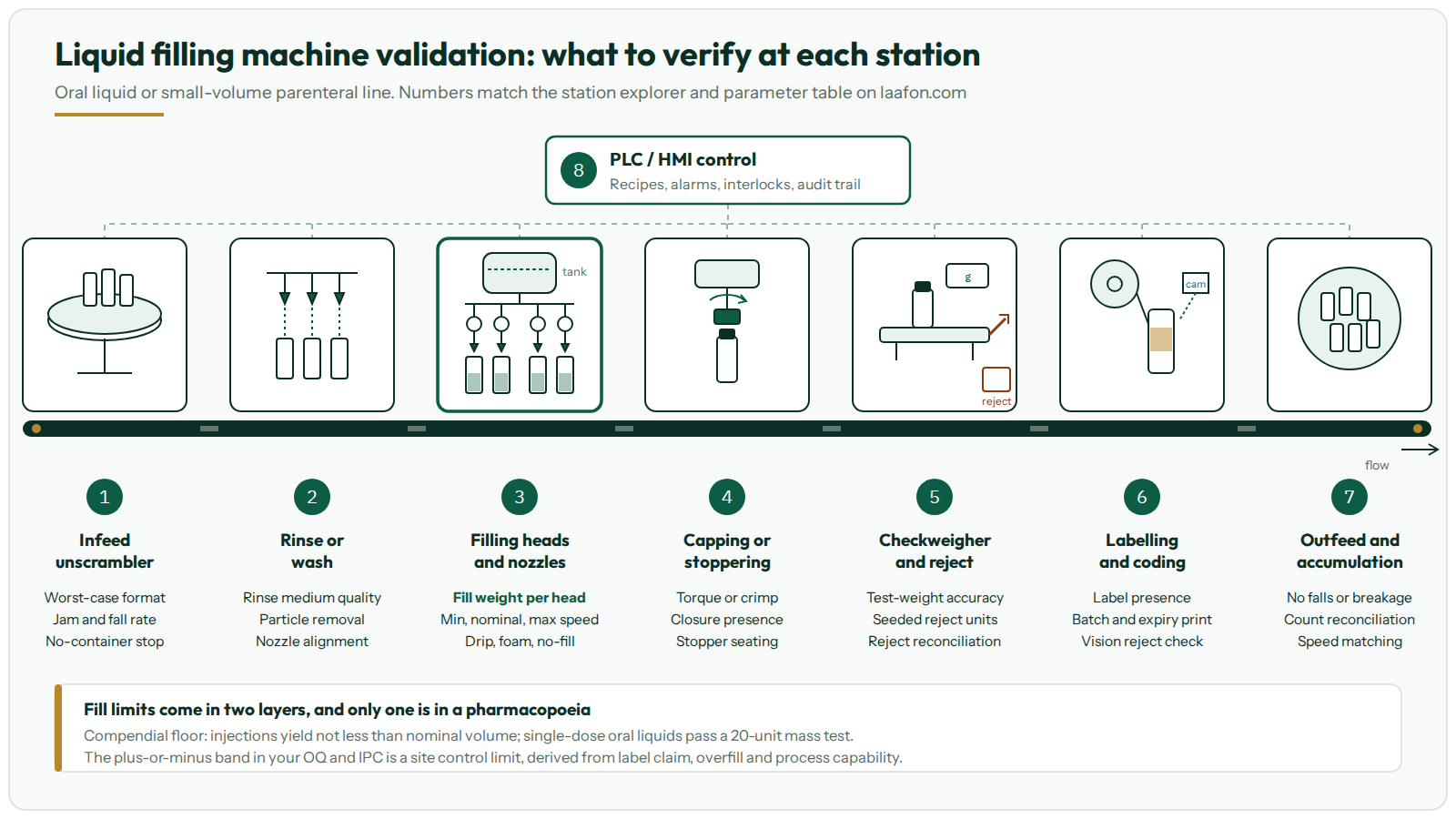
3. Filling heads and nozzles
- What it does
- Doses product from the buffer tank through the manifold, pumps or pistons and nozzles into each container.
- What to validate
- Net fill weight per head at minimum, nominal and maximum qualified speed; fill after a stoppage and restart; drip, stringing and foaming; no-container-no-fill function; the full viscosity range the URS claims.
- Acceptance basis
- Compendial floor for the finished unit, plus a site-defined in-process band derived from label claim, overfill policy and measured head-to-head variation.
The 17 parameters, with the basis of each acceptance criterion
Every limit in a qualification protocol comes from somewhere: a pharmacopoeia, a regulation, the machine’s own design specification, or a decision the site made. Auditors ask which. The badges answer that question before it is asked: compendial regulatory design spec site-defined
| # | Parameter | What to test | Acceptance basis | When |
|---|---|---|---|---|
| 1 | Fill volume or weight accuracy | Net weight converted to volume with density at fill temperature, per head, at minimum, nominal and maximum speed | compendial floor for the finished unit, plus site-defined in-process band (see fill limits) | OQ, PQ, every batch |
| 2 | Fill repeatability per head | Mean, standard deviation, CV and head-to-head bias from consecutive fills | site-defined capability target such as a minimum Cpk; a convention, not a compendial limit | OQ, PQ, requalification |
| 3 | Line speed | Run at each qualified setpoint with full in-process and reject checks | design spec URS speed range, with every quality attribute met at each setpoint | OQ, PQ |
| 4 | Nozzle behaviour: drip, stringing, foaming | Visual check, high-speed video where needed, fill weight on foaming products | site-defined no product on neck, finish or conveyor | OQ, product or format change |
| 5 | Leak tightness of the product path | Pressure hold and visual inspection, static and running | design spec limits from URS and FAT | IQ, OQ, after maintenance |
| 6 | CIP and SIP | Riboflavin coverage, rinse, swab and TOC; SIP temperature mapping and biological indicators where applicable | site-defined residue limits from cleaning validation; SIP to the validated exposure | Initial, periodic, after change |
| 7 | Filter integrity (sterilising and vent filters) | Bubble point, diffusion or pressure hold | regulatory validated limits for the filter and product; testing regime per Annex 1 section 8 [11] | Every sterile batch |
| 8 | Room grade during filling | Non-viable and viable monitoring in operation | regulatory Grade A for aseptic filling and sealing (Annex 1, Table 4); Grade C for filling of products that are terminally sterilised, Grade A when unusually at risk (Table 3) [11] | OQ, PQ, routine |
| 9 | Differential pressure | BMS trend and alarm challenge | design spec qualified pressure cascade | OQ, routine |
| 10 | Product temperature and room humidity | Calibrated probes; product temperature recorded at the time of every fill check | site-defined range over which the density used for fill checks is valid | OQ, PQ, routine |
| 11 | Alarms | Simulated faults, utility failures, power failure and restart | design spec response defined in the functional specification, with an audit-trail entry | OQ, after software change |
| 12 | PLC, HMI and data integrity | Recipes, access levels, audit trail, time sync, backup and restore | regulatory 21 CFR Part 11 and EU GMP Annex 11 expectations | OQ, after change, periodic review |
| 13 | Sensor and checkweigher calibration | As-found and as-left results against traceable standards | regulatory a written calibration programme, 21 CFR 211.68(a) [10]; tolerances site-defined | IQ, then per schedule |
| 14 | Interlocks and guards | Challenge each door, guard and emergency stop | design spec machine stops and cannot restart until safe | OQ, after modification |
| 15 | Reject system | Seed under-filled, uncapped or unstoppered containers at maximum speed | site-defined every seeded unit rejected and reconciled | OQ, PQ, periodic |
| 16 | Conveyor and star-wheel synchronisation | Worst-case formats, jam simulation | design spec transfer without falls, jams or breakage | OQ, after reconfiguration |
| 17 | Viscosity range | Highest and lowest viscosity product in the family | design spec URS range, with parameters 1 and 2 met at both ends | OQ, portfolio change |
Where a row says site-defined, the protocol must state how the number was derived. That derivation is what an inspector reads.
Fill Volume Acceptance Criteria: Pharmacopoeia vs Your OQ Limit
Fill limits come in layers, and mixing them up is the most common error on this topic, in published articles as well as in protocols. The graphic below separates them.
Schematic, not to scale. The overfill zone applies where a pharmacopoeia or regulation prescribes excess volume, as it does for US injectables.
Layer 1: the compendial tests, by dosage form
The table quotes The International Pharmacopoeia (WHO) because its text is free to verify from the primary source. For injections, ICH Q4B Annex 2(R1) declares the Ph. Eur. 2.9.17, JP 6.05 and USP <1> “Volume in container” texts interchangeable in the ICH regions and states that their acceptance criteria are the same [3]; confirm the Ph. Eur. or USP wording against your licensed edition before citing it. Where a national pharmacopoeia text could not be retrieved from a primary source, the row says so instead of carrying a number.
| Dosage form | Test | Sample | Acceptance | Source |
|---|---|---|---|---|
| Injection, single-dose | Extractable volume | 1 container if nominal is 10 mL or more; 3 if more than 3 mL and less than 10 mL; 5 if 3 mL or less. Containers of 2 mL or less may be pooled, each with its own dry syringe | Each container not less than the nominal volume | compendial Ph. Int. 5.6 [1] |
| Injection, multidose | Extractable volume | As specified | Each syringe delivers not less than the stated dose | compendial Ph. Int. 5.6 [1] |
| Cartridges and prefilled syringes | Extractable volume | As specified | Each container not less than the nominal volume | compendial Ph. Int. 5.6 [1] |
| Parenteral infusions | Extractable volume | As specified | Not less than the nominal volume | compendial Ph. Int. 5.6 [1] |
| Oral liquid, single-dose | Uniformity of mass | Contents of 20 containers, emptied as completely as possible | Not more than 2 deviate from the average mass by more than 10%; none by more than 20% | compendial Ph. Int. liquid preparations for oral use [2] |
| Oral liquid, multidose with measuring device | Uniformity of mass of delivered doses | 20 doses taken at random with the device provided | Not more than 2 deviate from the average mass by more than 10%; none by more than 20% | compendial Ph. Int. [2] |
| Oral liquid, US market | USP <698> Deliverable Volume | Per current USP–NF | Not reproduced here | check source USP text is subscription-only; verify against the official edition |
| Injection, US market | Excess volume (overfill) per USP <1151> | Applies to the fill target, not a sample test | Not reproduced here | regulatory binding via 21 CFR 201.51(g) [4][5] check source for the values |
| Oral liquids and injections, India | Indian Pharmacopoeia general requirements for the dosage form | Per current IP edition | Not reproduced here | check source IP text is not freely available; verify against the edition in force |
Two further Ph. Int. statements belong in every oral liquid filling protocol. In-process controls during the manufacture of oral liquids “should include pH and fill volume”, and for a single-dose oral liquid, development must demonstrate that the nominal content can be withdrawn from the container [2]. For injections, Ph. Int. allows the volume to be calculated as mass divided by density, which is how most lines run their fill checks [1].
Correction
“±1–2% fill accuracy” is not a pharmacopoeial limit. It is a widely copied internal target, and for many lines it is a reasonable one. It becomes a problem when a protocol cites it as compendial, because an inspector will ask for the chapter. The injection tests above are one-sided: they set a floor and say nothing about an upper limit. The upper limit is set by the site, by container brimful capacity, by headspace and, for US injectables, by the excess-volume recommendations that 21 CFR 201.51(g) makes binding [4].
Layer 2: regulatory overfill
For injectables in vials and ampoules sold in the US, 21 CFR 201.51(g) treats the declared quantity as the minimum and requires the variation above it to comply with the excess volume prescribed by the USP [4]. FDA’s manual of policies and procedures for reviewers states that, because of that regulation, the USP <1151> excess-volume recommendations “are considered requirements” [5]. The excess-volume table itself is USP text; take the values from the official edition.
Layer 3: the site in-process band, and how to derive yours
- Start from the floor. The label claim, or the compendial minimum for the dosage form, plus any required overfill.
- Measure your own process. From OQ data, estimate the standard deviation of each head separately. A 12-head filler is 12 processes, not one.
- Set the target from the floor and the spread. Place the target far enough above the floor that the one-sided capability against the floor meets the minimum your quality system has set. The calculator below does the arithmetic.
- Set the upper limit from container capacity, headspace, cost of giveaway and, for US injectables, the excess-volume recommendations.
- Write the derivation into the protocol, with the data it came from. A band that can be traced to the floor, the spread and the target is a defensible band; a band copied from an article is not.
Which compendial fill test applies to your line?
Dosage form
Market
Choose one option from each group
The verdict names the compendial fill test for the finished unit, its acceptance rule, and what the market adds.
SQC of the Filling Process: Sampling, Control Charts and Cpk
Statistical quality control (SQC) of a filling process answers two questions with the same data: is the line stable, and is it capable of staying clear of the floor? Stability is a control-chart question; capability is a Cp and Cpk question. Both are answered per head.
- Sample by head, not by line. Pooling heads hides a single drifting piston behind eleven good ones. Label every sample with its head number.
- Individuals and moving-range chart. For one result at a time, NIST gives the individuals chart limits as the mean plus or minus 3 × (average moving range ÷ 1.128) [12]. A point outside those limits is a signal to investigate before it becomes an under-filled container.
- Capability. Cp = (USL − LSL) ÷ 6σ and Cpk = the smaller of (USL − mean) and (mean − LSL), each divided by 3σ [13]. Both assume the data are normally distributed [13]; check that before quoting either.
- Use the one-sided index against the floor. Because the compendial requirement for injections is a floor, the capability that matters for patient-facing compliance is Cpl = (mean − floor) ÷ 3σ. Cp and Cpk against your site band describe cost and control, not compliance.
- What Cpk to require. No pharmacopoeia sets one. NIST notes that Cpk should be at least 1.0 [13]; 1.33 is a common industry convention. Whichever you choose, it is site-defined and must be written into the VMP.
Process parameters for a bottle filling machine: monitoring and measurement
| Parameter | Measured by | Control applied | Where it is recorded |
|---|---|---|---|
| Net fill weight, converted to volume | Calibrated balance or in-line checkweigher | Per-head samples at defined intervals, at start-up and after every stoppage | Fill-weight record (Annexure-I below) |
| Product density and temperature | Density meter or pycnometer; calibrated probe | Density measured at the filling temperature and re-checked if temperature moves outside its range | Batch record |
| Line speed | HMI and encoder | Within the qualified range only | Batch record and audit trail |
| Closure torque, crimp or stopper seating | Torque tester, crimp gauge, visual | Per closure specification | In-process record |
| Rejects and counts | Checkweigher and HMI counters | Reconciliation of filled, rejected and packed units | Batch reconciliation |
| Wear items | Maintenance log: tubing hours, seal changes | Change interval set from trend data; fill re-verified after each change | Preventive maintenance record |
| Environment (sterile lines) | Environmental monitoring system | Grade limits during operation | EM record |
Fill-weight SQC and Cpk calculator
Paste net fill weights for one head. The calculator converts them to volume, reports mean, standard deviation and CV, individuals-chart limits, Cp, Cpk and the one-sided Cpl against the label claim, and, when you enter exactly 20 results, applies the Ph. Int. uniformity-of-mass rule for single-dose oral liquids. The pre-filled example is a 100 mL syrup at 1.300 g/mL.
| Statistic | Value | Reading |
|---|---|---|
| Results | — | Enter data and calculate |
The site limits in the example are illustrative, not recommended values. Capability indices from fewer than about 20 results are indicative only, and all indices assume normally distributed data. Nothing you enter leaves your browser.
Design Qualification (DQ)
Annex 15 describes DQ as the stage where “the compliance of the design with GMP should be demonstrated and documented”, following a user requirements specification [6]. For a liquid filler, the URS is where most later OQ failures are either prevented or baked in.
- URS content that drives validation: product range (sterile or non-sterile, viscosity and foaming range), fill volumes and container formats, required fill accuracy and how it will be measured, speed range, cleaning concept (manual, CIP, SIP), automation level and data integrity requirements.
- Materials and hygienic design: product-contact materials specified and certified, surface finish suitable for cleaning, elastomers suitable for the product, no dead legs, full drainability.
- Sterile lines: compatibility with the RABS or isolator concept and with Grade A operation for filling and sealing [11]; connections for WFI, clean steam and process gases.
- Automation: role-based access, audit trail and secure data storage where electronic records will be used.
- FAT and SAT scope: Annex 15 expects equipment to be confirmed against the URS at the vendor site before installation where applicable [6]. Write the fill-accuracy test into the FAT, using your own containers.
| Area | DQ check item | Evidence that closes it |
|---|---|---|
| URS coverage | Every URS point traceable to a design document | Requirements traceability matrix with no unmapped rows |
| Product-contact materials | Material and surface finish specified; elastomers suitable for the product | Material certificates and surface-finish records |
| Cleaning concept | Design supports the cleaning or CIP/SIP concept without dead legs | Vendor P&ID and layout review recorded in the DQ report |
| Aseptic design, where applicable | Compatible with RABS or isolator and Grade A airflow | Airflow study or documented vendor experience |
| Fill measurement | How fill will be verified at speed: checkweigher, sampling port, per-head identification | Functional specification section and FAT test |
Installation Qualification (IQ)
IQ confirms that the filler and its utilities are installed as designed [6]. Typical content:
- Equipment identification: model, serial number, tag numbers, location, matched to purchase documents and URS.
- Mechanical installation: levelling, anchoring, orientation, completeness; change parts identified and listed.
- Utilities: electrical supply, compressed air quality, nitrogen, vacuum, and for sterile lines WFI and clean steam, each verified against specification. The high-purity water system guide covers the WFI side.
- Instruments: every critical instrument installed with a valid calibration certificate and a place in the calibration programme [10].
- Drawings: as-built P&ID, general arrangement and wiring diagrams reconciled with the installation.
- Documents: manuals, material certificates, FAT and SAT reports, software version records, and draft SOPs for operation, cleaning and maintenance before OQ starts.
Common IQ deviations are missing as-built drawings, mislabelled utilities, uncalibrated instruments at hand-over and undocumented changes made during erection. Record each as a deviation, assess it, correct it and close it before OQ.
Operational Qualification (OQ)
Annex 15 asks OQ to include tests developed from knowledge of the process and equipment, and “tests to confirm upper and lower operating limits, and/or worst case conditions”. It also says a successful OQ should allow the operating and cleaning procedures, operator training and preventive maintenance requirements to be finalised [6]. For a liquid filler that means a test matrix, not a single run.
| OQ test | Conditions | Acceptance basis |
|---|---|---|
| Dry run | Empty containers at each qualified speed; all format parts | design spec no jams, falls or mis-feeds |
| Fill accuracy and repeatability | Per head at minimum, nominal and maximum speed; smallest and largest fill volume; water or placebo, then worst-case viscosity | site-defined derived band and capability target |
| Stoppage and restart | Stop mid-run for a defined time, restart, check the first containers | site-defined first fills within band; no drip |
| No-container-no-fill | Remove containers from the infeed at speed | design spec no dispense without a container |
| Reject challenge | Seeded under-fills, missing closures, missing labels | site-defined every seeded unit rejected and reconciled |
| Alarms and interlocks | Utility failure, guard open, emergency stop, power failure | design spec response per functional specification, logged in the audit trail |
| Recipes and data integrity | Recipe change, user levels, audit trail review, backup and restore | regulatory Part 11 and Annex 11 expectations |
| CIP/SIP cycles, where fitted | Cycle run with coverage and temperature mapping | site-defined validated cycle parameters |
Record raw data at the point of measurement, individual fills and not just averages, with pass or fail against the stated criterion and a reference to any deviation. These records are read against ALCOA+ principles: attributable, legible, contemporaneous, original, accurate, plus complete, consistent, enduring and available.
Performance Qualification (PQ)
Annex 15 describes PQ as tests using production materials, qualified substitutes or simulated product with equivalent behaviour, under normal operating conditions with worst-case batch sizes, with the sampling frequency justified [6]. In practice a liquid filler PQ adds what OQ cannot show: long runs, shift and operator changes, real product at real temperature, and the drift that only appears after hours of operation.
- Long-duration runs to capture pump or seal wear, tubing fatigue and thermal effects.
- Sampling at start, middle and end and after every stoppage or intervention, per head.
- Operator and shift variation across the PQ runs.
- Environmental monitoring integration on sterile lines, with aseptic process simulation handled in its own protocol. The aseptic processing control guide covers media fills.
How many batches? What each rulebook actually says
| Source | Position on the number of validation batches |
|---|---|
| EU GMP Annex 15, clause 5.20 | “Generally considered acceptable” that a minimum of three consecutive batches under routine conditions could constitute validation; an alternative number may be justified, taking into account standard methods and existing similar products or processes at the site [6] |
| FDA, Process Validation guidance (2011) | No number prescribed. The number of samples should give sufficient statistical confidence of quality within and between batches, and PPQ normally carries heightened sampling [7] |
| WHO TRS 1019, Annex 3 | No number set in the main text; it refers to separate WHO process validation guidance [9] |
| Revised Schedule M, Part I section 5 | Requires qualification and validation of any significant change that may affect quality (5.4) and states they are not one-off exercises (5.5) [8]; check the dosage-form Parts for any product-specific requirement |
So “three batches” is a defensible default in an EU-facing file, and a number that must be justified by data in an FDA-facing one. For a multi-product syrup line, a bracketing or matrix approach that qualifies the worst-case viscosity and fill sizes for a product family can be justified; write the rationale into the protocol before the runs, not after.
Real-world PQ scenarios
- Sterile injectable line: PQ runs of vials on peristaltic heads in Grade A under RABS, with media fills qualified separately under the aseptic process simulation programme. Vial preparation upstream depends on a validated tunnel; see depyrogenation validation.
- Syrup filling machine validation: PQ of a high-viscosity oral syrup on a monoblock filler, covering fill weight per head at commercial speed, closure torque and label reconciliation. The syrup vs suspension QC guide explains why suspensions are the harder case for dose uniformity.
- Multi-product oral liquid line: worst-case products chosen by viscosity, foaming and fill size, with the bracketing logic documented and approved in advance.
Validation Documentation Requirements
Revised Schedule M requires the key elements of the qualification and validation programme to be “clearly defined and documented in a validation master plan” (Part I, 5.2) [8]. The document set for a filling line:
- Validation master plan, including the definition of PQ used at the site.
- URS, functional specification and traceability matrix linking every requirement to a DQ, FAT, SAT, IQ, OQ or PQ test.
- Approved DQ, IQ, OQ and PQ protocols with acceptance criteria and their basis, written before execution.
- Raw data: individual fill weights, calibration certificates of the balance and checkweigher, density and temperature records.
- Deviation and CAPA records linked to the tests that raised them.
- Final report with a clear statement of the qualified ranges: speeds, fill volumes, formats and products.
- Change control and requalification triggers: product, volume, speed, software, format parts, wear-part specifications. Annex 15 expects periodic evaluation at an appropriate frequency, with any fixed requalification period justified [6].
For why validation carries this weight in an inspection, see the importance of validation in a pharmaceutical company.
Regulatory Expectations and GMP Compliance
The frameworks converge on the lifecycle and differ on the details that end up in a protocol. Select a region.
- Revised Schedule M, notified as G.S.R. 922(E) on 28 December 2023, Part I section 5: validation master plan (5.2), DQ, IQ, OQ and PV/PQ definitions (5.3), qualification of significant changes (5.4), and an ongoing programme based on periodic review (5.5) [8].
- Fill tests for the finished unit follow the Indian Pharmacopoeia edition in force check source.
- Track implementation status and gap closure on the CDSCO Schedule M compliance dashboard.
- EU GMP Annex 15 (in operation since 1 October 2015): URS, DQ, FAT/SAT, IQ, OQ and PQ (section 3), requalification (section 4), process validation including the three-batch position (5.20) [6].
- EU GMP Annex 1 (published August 2022, in operation 25 August 2023): Grade A for aseptic filling and sealing, Grade C for filling of terminally sterilised products, contamination control strategy [11].
- Ph. Eur. 2.9.17 extractable volume, declared interchangeable with JP 6.05 and USP <1> under ICH Q4B Annex 2(R1) [3].
- 21 CFR 211.68(a): automatic, mechanical and electronic equipment routinely calibrated, inspected or checked under a written programme, with records [10].
- 21 CFR 201.51(g) and USP <1151>: excess volume for injectables in vials and ampoules [4][5].
- Process Validation: General Principles and Practices (2011): three stages, heightened PPQ sampling, no fixed batch number [7].
- Aseptic processing guidance (2004) for sterile filling lines [14].
- WHO TRS 1019, Annex 3 (2019), guidelines on validation, with appendices on qualification and non-sterile process validation; periodic requalification “where appropriate” [9].
- WHO TRS 1044, Annex 2 (2022), GMP for sterile pharmaceutical products [15].
- The International Pharmacopoeia: extractable volume for parenteral preparations and the oral liquid uniformity tests used in the tables above [1][2].
Data integrity runs across all four: secure electronic and paper records, audit trails, access control and validated computerised systems. If the plant is preparing for a US inspection, the USFDA approval roadmap for Indian formulation plants sets the filling line in the wider programme.
Common Validation Failures and Industry Mistakes
- A fill limit cited to a pharmacopoeia that does not contain it. The ±% band is site-defined; say so and show the derivation.
- Sampling by line instead of by head. One worn piston averages away across a 12-head filler.
- Density taken at the wrong temperature, or a single density value used for the whole batch while product temperature changes, which shifts every calculated volume.
- OQ with water only, PQ with viscous product, and nothing in between. Bridge the two with a worst-case viscosity challenge or a documented rationale.
- Improper sampling plans: too few samples, no stratification across start, middle and end, no samples after stoppages.
- Inadequate challenge testing of alarms, interlocks and rejects, leaving robustness unproven.
- Missing or overdue calibration of the balance, checkweigher or load cells used to generate validation data.
- SOPs that do not match validated settings, so routine practice drifts from what was qualified.
- Vendor CIP/SIP cycles accepted without site studies on the actual manifold and product.
Risk-Based Validation Approach
ICH Q9(R1), adopted on 18 January 2023, lists failure mode and effects analysis among its risk management tools and adds a direct caution for anyone scoring an FMEA: risk scores, ratings and assessments should be based on an appropriate use of evidence, science and knowledge [16]. Use it to decide where validation effort goes: critical parameters get worst-case challenges and heavier sampling; low-risk functions get proportionate testing.
Apply the worst case to the highest and lowest fill volumes, the most viscous and most foaming products, the smallest and largest containers, and the minimum and maximum qualified speeds.
| Severity (S) | Occurrence (O) | Detectability (D) | RPN = S × O × D | Risk band |
|---|---|---|---|---|
| 1–3: minor rework | 1–3: rare | 1–3: easily detected | up to 27 | Low |
| 4–7: batch rejection possible | 4–7: occasional | 4–7: moderate | 28–343 | Medium |
| 8–10: patient safety or sterility | 8–10: frequent | 8–10: hard to detect | 344 and above | High |
Example banding only. RPN bands are a site-defined convention, not an ICH requirement.
Two cautions. First, multiplying ordinal scores can hide a severity-10 failure mode behind a low RPN, so many quality systems add a rule that any high-severity item is treated as high risk regardless of RPN. Second, read detectability carefully: fill-volume errors are highly detectable by in-line checkweighing and in-process checks, which keeps their D score low, while failures such as a breached sterilising filter or a Grade A excursion are hard to detect in the finished unit, which is exactly why they need intensive validation.
Validation Checklist for Liquid Filling Machines
| Category | Key checklist items |
|---|---|
| Mechanical | Product-contact parts per URS and material certificates; nozzles, pistons or pumps, valves and hoses correctly installed; change parts identified; guards in place |
| Electrical and controls | Wiring per drawings; earthing checked; approved PLC and HMI software version loaded; emergency stops and mode selectors tested; power-failure behaviour verified |
| Process parameters | Qualified ranges for fill volume, speed, viscosity and product temperature documented; in-process fill-check plan per head; recipes locked |
| Fill limits | Compendial test identified for the dosage form and market; site band derived and documented; capability target defined in the VMP |
| Automation and data integrity | User roles defined; audit trail active and reviewed; time synchronisation; backup and restore verified |
| Cleaning | Cleaning validation strategy approved; coverage tests done; residue limits justified; cleaned-equipment hold time defined |
| Calibration | Balance, checkweigher, load cells, flow meters, temperature and pressure sensors in the programme with as-found and as-left data |
| Environment | Room grade qualified; HVAC performance confirmed; EM programme aligned with the CCS on sterile lines |
| Documentation | Protocols and reports approved; traceability matrix complete; deviations and CAPA closed; SOPs released; training recorded |
SOP: Liquid Filling Machine Qualification and Fill-Weight Verification
A template you can adapt. Header fields are left blank on purpose: a document number belongs to your quality system, not to this page.
Operational and performance qualification of a liquid filling machine, and routine fill-weight verification
1.0 Purpose
To lay down the procedure for qualifying a liquid filling machine across its operating ranges and for verifying fill weight in routine production, so that every container receives not less than the declared quantity and stays within the site’s validated in-process limits.
2.0 Scope
Applies to piston, peristaltic, mass-flow, gravity and overflow liquid filling machines used for oral liquids and small-volume parenterals at ___ (site). Excludes: aseptic process simulation (media fill), sterilising-filter validation, CIP and SIP cycle development, and container closure integrity testing, each of which is covered by its own protocol.
3.0 Responsibility
- Operator, Production: sets up the machine to the approved recipe, collects samples as instructed, records results contemporaneously.
- Engineer: confirms calibration status, change parts and machine settings; executes alarm, interlock and reject challenges.
- Officer, IPQA: witnesses sampling, verifies calculations, reviews records.
- Validation / QA: prepares and executes the protocol, compiles the report, raises deviations.
- Head, Quality Assurance: approves protocol, report and any change to acceptance criteria.
4.0 Materials and equipment
- Calibrated balance with readability appropriate to the smallest net fill (justify the choice in the protocol); traceable check weights.
- Density meter or pycnometer; calibrated thermometer or probe.
- Containers and closures from the lot in use, for tare determination.
- Product, or purified water or placebo for OQ runs as the protocol specifies.
- Seeded defect units for the reject challenge, each identified and counted.
- Annexure-I fill-weight record; calculator or validated spreadsheet.
5.0 Procedure
6.0 Acceptance criteria
| Parameter | Criterion | Basis |
|---|---|---|
| Extractable volume, single-dose injection | Each container not less than nominal volume | compendial Ph. Int. 5.6 [1]; Ph. Eur. 2.9.17, JP 6.05 and USP <1> interchangeable under ICH Q4B [3] |
| Uniformity of mass, single-dose oral liquid | 20 containers: not more than 2 outside ±10% of average mass, none outside ±20% | compendial Ph. Int. [2] |
| Deliverable volume, oral liquid (US market) | Per USP <698> | check source verify against the official USP–NF |
| Overfill, US injectables | Per USP <1151> excess-volume table | regulatory 21 CFR 201.51(g) [4] check source |
| In-process fill band | LCL ___ mL to UCL ___ mL, per head | site-defined derived from floor, overfill and OQ standard deviation; derivation attached |
| No unit below the floor | Zero containers below label claim or compendial minimum in any run | site-defined release condition for the machine |
| Capability per head | Cpl against the floor not less than ___; Cpk against the site band not less than ___ | site-defined set in the VMP; 1.33 is a common convention, not a compendial limit [13] |
| Reject challenge | All seeded units rejected; count reconciled | site-defined |
| Alarms and interlocks | Response as per functional specification; audit-trail entry present | design spec |
7.0 Frequency
- OQ and PQ: at installation, after relocation, and after any change assessed under change control as affecting the validated state. Revised Schedule M requires significant changes that may affect quality to be qualified and validated (Part I, 5.4) [8].
- Requalification: at a frequency justified in the VMP, with defined evaluation criteria (Annex 15, 4.1 and 4.2) [6]. The interval is site-defined.
- Routine fill-weight checks: at start-up, at the intervals in the batch record, and after every stoppage, tubing or seal change. Intervals are site-defined.
- Balance and checkweigher checks: under the written calibration programme [10].
8.0 Precautions
- Tare with the same container and closure lot as the fills; a closure change can shift tare more than the process spread.
- Measure density at the filling temperature and re-measure if product temperature moves outside the recorded range.
- Keep every sample identified by head; never pool heads into one result.
- Do not adjust the machine during a qualification run without recording the adjustment as an intervention.
- Re-verify fill weight after every tubing, seal, piston or nozzle change before releasing the line.
- On sterile lines, sampling from Grade A is an intervention and must follow the aseptic intervention procedure.
- Keep guards closed and follow lock-out/tag-out during adjustments.
9.0 Deviation handling
- Any unit below the floor: stop the line, segregate production back to the last acceptable check, 100% check-weigh the segregated units, and investigate root cause before restart.
- A head outside the site band but above the floor: adjust, record the adjustment, increase sampling frequency for that head, and trend.
- A trend signal on the individuals chart: investigate before the next scheduled check.
- OQ or PQ criterion not met: raise a deviation, establish root cause, assess impact, repeat the affected test under an approved addendum.
- Compendial test failure on finished units: handle under the OOS procedure.
10.0 Annexures
Annexure-I: Fill-weight verification record (below). Annexure-II: Reject challenge record. Annexure-III: Per-head summary and capability sheet.
| Sample no. | Head no. | Time | Gross (g) | Tare (g) | Net (g) | Volume (mL) = Net / density | Within band? (Y/N) | Done by | Checked by |
|---|---|---|---|---|---|---|---|---|---|
| 1 | |||||||||
| 2 | |||||||||
| 3 | |||||||||
| 4 | |||||||||
| 5 |
Header fields to complete on the printed record: product, batch no., machine ID, label claim, density and temperature, target net weight, LCL and UCL.
11.0 Revision history
| Version | Effective date | Change | Reason |
|---|---|---|---|
| 00 | DD-MMM-YYYY | New SOP | New filling line |
| 01 | DD-MMM-YYYY | Per-head sampling and stoppage test added; fill band derivation made mandatory | Change control no. ___ |
12.0 References
Ph. Int. 5.6 and liquid preparations for oral use [1][2]; EU GMP Annex 15 [6]; revised Schedule M, Part I section 5 [8]; 21 CFR 211.68 [10]; NIST/SEMATECH e-Handbook [13][12].
Use of this template. This SOP is a starting point, not an approved document. It requires local qualification, validation and Quality Assurance approval before use. Verify every acceptance criterion against the pharmacopoeial edition in force at your site, because pharmacopoeial texts and Indian statutory instruments change between editions.
Qualifying or re-qualifying a liquid line?
Laafon Galaxy reviews filling-line validation packages for oral liquid and injectable units: URS and protocol gaps, fill-limit derivations, Schedule M and Annex 1 alignment, and audit readiness before an inspection.
Request a validation gap reviewPrefer to write first? Contact us.
Future Trends in Filling Machine Validation
The direction of travel is from one-time qualification to continuous evidence. FDA’s third stage of process validation, continued process verification, asks for ongoing assurance that the process stays in a state of control during routine production [7], and a modern filler already produces the data to show it:
- 100% in-line checkweighing and per-head trending, turning the fill-weight record from periodic samples into a continuous control chart.
- SCADA and MES integration, with electronic batch records and automated trend review that must themselves be validated.
- Predictive maintenance on tubing, seals and pistons, driven by the same per-head drift data that the SQC section uses.
Frequently Asked Questions
Fill volume or weight accuracy and repeatability per head, line speed, nozzle behaviour, product-path leak tightness, CIP and SIP, filter integrity and room grade on sterile lines, product temperature, alarms, PLC and data integrity, calibration of sensors and checkweighers, interlocks, reject performance, conveyor synchronisation and viscosity range. The table on this page gives the basis of each acceptance criterion.
There is no single pharmacopoeial plus-or-minus figure. Injections must yield not less than their nominal volume in the extractable volume test. Single-dose oral liquids must pass a 20-container uniformity-of-mass test in which not more than 2 deviate by more than 10% from the average and none by more than 20%. The in-process band on the machine is set by the site from the label claim, any required overfill and the measured spread of each head.
No. It is a common internal target and often a reasonable one, but it is not stated in The International Pharmacopoeia tests quoted on this page, which set a floor for injections and a 10% and 20% spread rule for single-dose oral liquids. Cite it in a protocol as a site-defined limit, with the derivation, rather than as a compendial requirement.
EU GMP Annex 15 clause 5.20 says a minimum of three consecutive batches under routine conditions is generally considered acceptable, and that an alternative number may be justified. FDA’s 2011 process validation guidance prescribes no number and asks for enough samples to give statistical confidence within and between batches. Justify the number in the protocol for the market you file in.
OQ challenges the machine across its operating limits and worst-case conditions under controlled test conditions: speeds, fill volumes, viscosity, alarms, interlocks and rejects. PQ shows that it performs under normal operating conditions with production materials or qualified substitutes, over realistic run lengths, shifts and operators.
Not quite. Revised Schedule M Part I clause 5.3 describes process validation, also called performance qualification. EU Annex 15 uses PQ for an equipment stage that follows IQ and OQ. Define the term in your validation master plan and keep equipment performance runs and process validation batches in separate protocols.
Divide the net mass in grams by the product density in grams per millilitre, measured at the filling temperature. The International Pharmacopoeia permits this calculation in its extractable volume test. Use tare from the same container and closure lot, and record the temperature at which density was measured.
In The International Pharmacopoeia test for single-dose containers: one container if the nominal volume is 10 mL or more, three if it is more than 3 mL and less than 10 mL, and five if it is 3 mL or less. Containers of 2 mL or less may be pooled, using a separate dry syringe for each. Each container must yield not less than its nominal volume.
Statistical quality control of filling uses per-head samples to answer two questions: whether the process is stable, using a control chart such as the individuals and moving-range chart, and whether it is capable, using Cp, Cpk and the one-sided Cpl against the fill floor. It is run per filling head, because pooling heads hides drift.
No pharmacopoeia sets one. The NIST/SEMATECH handbook notes that Cpk should be at least 1.0, and 1.33 is a common industry convention. Set the minimum in your validation master plan, apply it per head, and prefer the one-sided Cpl against the fill floor for compliance decisions.
After any change assessed as affecting the validated state, and otherwise at a frequency your quality system justifies. EU Annex 15 asks for evaluation at an appropriate frequency with any fixed period justified, and revised Schedule M requires an ongoing programme based on periodic review rather than a one-off exercise.
21 CFR 201.51(g) treats the declared quantity of an injectable in an ampoule or vial as a minimum and requires the excess above it to follow the USP. FDA reviewers treat the USP chapter 1151 excess-volume recommendations as requirements for that reason. Take the actual values from the official USP edition.
A test that deliberately stresses the system to prove its controls work under worst-case conditions: maximum speed, most viscous or foaming product, stoppage and restart, seeded under-filled or unclosed containers for the reject system, and simulated alarms and guard openings.
Syrup lines centre on fill accuracy across a wide viscosity range, closure torque, cleaning validation and line clearance in a non-sterile area. Injectable lines add sterility assurance: Grade A filling, sterilising-filter integrity, environmental monitoring, aseptic process simulation and the extractable volume floor, plus overfill rules for the US market.
References
- World Health Organization. The International Pharmacopoeia. 13th ed. Geneva: WHO; 2025. 5.6 Extractable volume for parenteral preparations. Available from: https://digicollections.net/phint/pdf/b/7.5.7.5.6-Extractable-volume-for-parenteral-preparations.pdf. Accessed September 2026.
- World Health Organization. The International Pharmacopoeia. 13th ed. Geneva: WHO; 2025. Liquid preparations for oral use. Available from: https://digicollections.net/phint/pdf/b/6.2.1.2.Liquid-preparation-for-oral-use.pdf. Accessed September 2026.
- International Council for Harmonisation. Q4B Evaluation and recommendation of pharmacopoeial texts for use in the ICH regions. Annex 2(R1): Test for extractable volume of parenteral preparations general chapter. Silver Spring (MD): US Food and Drug Administration; September 2017. Available from: https://www.hhs.gov/guidance/sites/default/files/hhs-guidance-documents/FDA/Q4B-Annex-2–Test-for-Extractable-Volume-of-Parenteral-Preparations-General-Chapter.pdf. Accessed September 2026.
- Code of Federal Regulations. Title 21, Section 201.51: Declaration of net quantity of contents, paragraph (g). Washington (DC): Office of the Federal Register. Available from: https://www.ecfr.gov/current/title-21/chapter-I/subchapter-C/part-201/subpart-B/section-201.51. Accessed September 2026.
- US Food and Drug Administration, Center for Drug Evaluation and Research, Office of Pharmaceutical Quality. MAPP 5019.1 Rev. 1: Allowable excess volume/content in injectable drug and biological products. Effective 28 January 2022. Available from: https://www.fda.gov/media/155066/download. Accessed September 2026.
- European Commission. EudraLex Volume 4, EU Guidelines for Good Manufacturing Practice for Medicinal Products for Human and Veterinary Use. Annex 15: Qualification and validation. Brussels; 2015 (in operation 1 October 2015). Available from: https://health.ec.europa.eu/system/files/2016-11/2015-10_annex15_0.pdf. Accessed September 2026.
- US Food and Drug Administration. Guidance for industry. Process validation: general principles and practices. Revision 1. Silver Spring (MD): FDA; January 2011. Available from: https://www.fda.gov/media/71021/download. Accessed September 2026.
- Ministry of Health and Family Welfare, Government of India. Drugs Rules, 1945: Schedule M (revised), Good manufacturing practices and requirements of premises, plant and equipment for pharmaceutical products. G.S.R. 922(E), 28 December 2023. The Gazette of India: Extraordinary. Available from: https://cdsco.gov.in/opencms/opencms/en/Notifications/Gazette-Notifications/. Accessed September 2026.
- World Health Organization. Good manufacturing practices: guidelines on validation. WHO Technical Report Series, No. 1019, Annex 3. Geneva: WHO; 2019. Available from: https://www.who.int/docs/default-source/medicines/norms-and-standards/guidelines/production/trs1019-annex3-gmp-validation.pdf. Accessed September 2026.
- Code of Federal Regulations. Title 21, Section 211.68: Automatic, mechanical, and electronic equipment. Washington (DC): Office of the Federal Register. Available from: https://www.ecfr.gov/current/title-21/chapter-I/subchapter-C/part-211/subpart-D/section-211.68. Accessed September 2026.
- European Commission. EudraLex Volume 4, EU Guidelines for Good Manufacturing Practice. Annex 1: Manufacture of sterile medicinal products. Brussels; 22 August 2022 (in operation 25 August 2023; point 8.123 from 25 August 2024). Available from: https://health.ec.europa.eu/system/files/2022-08/20220825_gmp-an1_en_0.pdf. Accessed September 2026.
- National Institute of Standards and Technology. NIST/SEMATECH e-Handbook of Statistical Methods. Section 6.3.2.2: Individuals control charts. Gaithersburg (MD): NIST. Available from: https://www.itl.nist.gov/div898/handbook/pmc/section3/pmc322.htm. Accessed September 2026.
- National Institute of Standards and Technology. NIST/SEMATECH e-Handbook of Statistical Methods. Section 6.1.6: What is process capability? Gaithersburg (MD): NIST. Available from: https://www.itl.nist.gov/div898/handbook/pmc/section1/pmc16.htm. Accessed September 2026.
- US Food and Drug Administration. Guidance for industry. Sterile drug products produced by aseptic processing: current good manufacturing practice. Rockville (MD): FDA; September 2004. Available from: https://www.fda.gov/media/71026/download. Accessed September 2026.
- World Health Organization. WHO good manufacturing practices for sterile pharmaceutical products. WHO Technical Report Series, No. 1044, Annex 2. Geneva: WHO; 2022. Available from: https://cdn.who.int/media/docs/default-source/medicines/norms-and-standards/guidelines/production/trs1044-annex-2-gmp-for-sterile-pharmaceutical-products.pdf. Accessed September 2026.
- International Council for Harmonisation. ICH guideline Q9(R1): Quality risk management. Adopted 18 January 2023. Geneva: ICH; 2023. Available from: https://database.ich.org/sites/default/files/ICH_Q9(R1)_Guideline_Step4_2022_1219.pdf. Accessed September 2026.
Technical and educational content only; not legal, medical or investment advice. Pharmacopoeial texts, GMP guidelines and Indian statutory instruments change between editions. Verify every limit against the edition in force for your product and market before use. Values marked “check source” are deliberately not reproduced because the primary text could not be verified from a freely available official source.