
Short answer
An autoclave sterilises by holding a load in saturated steam under pressure, so that condensing steam gives up its latent heat directly on every surface it touches and irreversibly denatures microbial protein. Pressure is only the means of raising the steam temperature above 100 °C; it does no killing of its own.
Autoclave validation is the exercise that proves the cycle actually delivers that lethality to the worst point in a defined load. Under the EMA sterilisation guideline every steam sterilisation process must deliver a minimum lethality of F0 ≥ 8 minutes at a minimum process hold temperature of 110 °C, and reach a sterility assurance level of 10−6 or better.[1] The Ph. Eur. reference cycle is 121 °C for 15 minutes; use it unchanged and validation data need not be submitted with the dossier.[1]
On this page
What autoclave validation actually has to demonstrate
A steriliser that reaches 121 °C on its chamber gauge has proved nothing. The gauge reads the chamber; the product sits inside a wrapped pack, a sealed ampoule or a stacked tray, and the point that matters is the slowest-heating point of that load. Validation is the documented exercise that closes the gap between the two.
Three things have to be shown, and they are shown by different measurements:
- Heat distribution — that the empty chamber, and then the loaded chamber, reach and hold the set temperature without a cold zone.
- Heat penetration — that the slowest-heating point inside the load itself receives the required lethality, expressed as F0.
- Microbiological challenge — that a resistant spore population placed at that point is inactivated.
US regulation states the obligation in a single sentence. 21 CFR 211.113(b) requires written procedures designed to prevent microbiological contamination of products purporting to be sterile, and says those procedures “shall include validation of all aseptic and sterilization processes”.[6] Everything below is the detail that sentence implies.
The principle of the autoclave, stated precisely
Moist heat kills by hydrolysing and coagulating protein. Dry heat kills by oxidation, which is far slower — that is why a dry heat process needs roughly 160–250 °C and hours, while a steam process needs 121 °C and minutes. The whole advantage of the autoclave comes from one physical fact: when saturated steam meets a cooler surface it condenses, and condensation releases the latent heat of vaporisation instantly at that surface.
Three consequences follow, and each of them turns into a validation requirement:
- Steam must reach the surface. Trapped air is the classic failure. Air is a poor conductor, it does not condense, and a pocket of it inside a wrapped pack will sit at chamber pressure while remaining far below chamber temperature. This is why porous-load cycles use vacuum pulses, and why an air removal test or an air detector is required.
- Steam must be saturated, not superheated and not wet. Superheated steam behaves like hot air and does not condense usefully. Wet steam carries water droplets that wet the load and shield surfaces.
- Pressure is a means, not a mechanism. Raising pressure raises the boiling point, which is how steam reaches 121 °C. Pressure itself contributes nothing to lethality — a claim still repeated in a great deal of teaching material.
The counterpart process for glass and metal, where the target is destroying endotoxin rather than organisms, is dry heat. The difference in what each process is validated against is set out in depyrogenation versus sterilization.
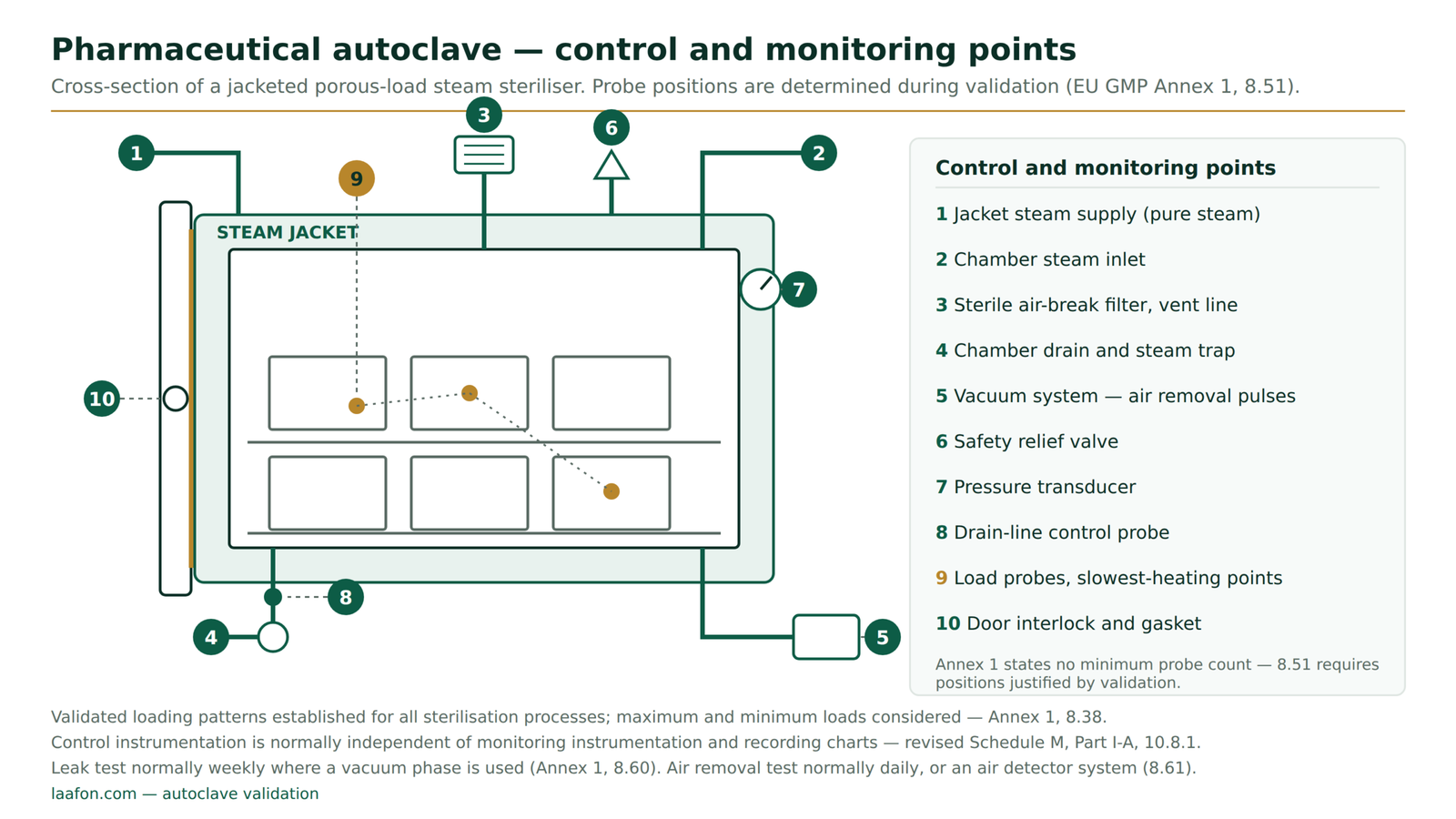
Inside a pharmaceutical steriliser: what each control point does
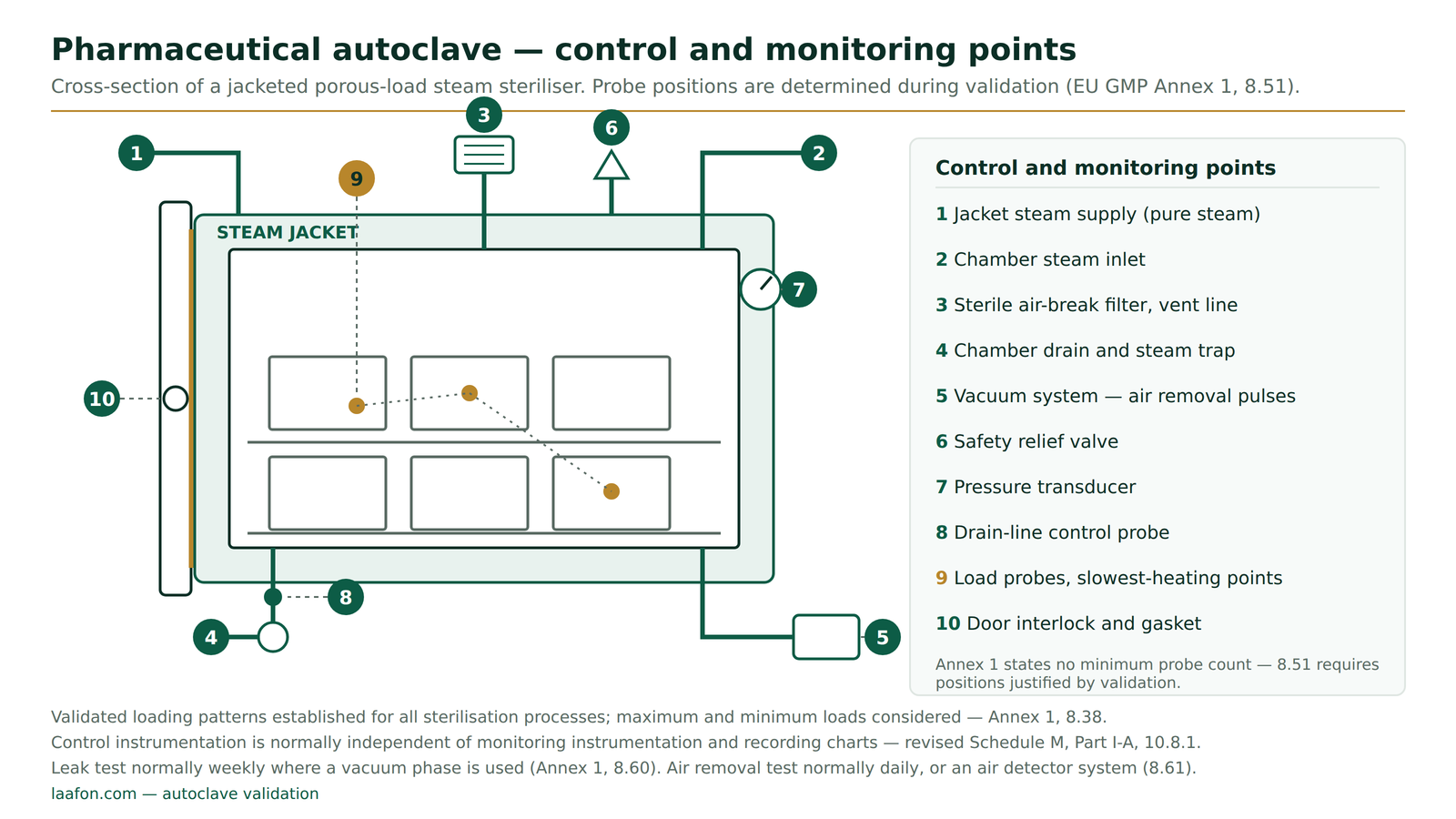
| Point | What it does | Why validation cares |
|---|---|---|
| 1. Jacket steam supply | Heats the chamber wall so condensate does not form on it | A cold jacket produces chamber wall condensation and a wet load at the end of the cycle |
| 2. Chamber steam inlet | Admits saturated steam to the chamber | Steam quality at this point governs whether the process is moist heat at all |
| 3. Sterile air-break filter | Filters air admitted on venting and drying | An unintegral filter recontaminates a sterilised load at the last step |
| 4. Drain and steam trap | Removes condensate and non-condensable gas | A blocked trap floods the chamber floor and masks the coolest point |
| 5. Vacuum system | Pulls air out of porous loads before steam admission | The whole air-removal case rests on it; tested daily or by air detector |
| 6. Safety relief valve | Protects the pressure vessel | Safety qualification, not lethality, but it fails audits when uncalibrated |
| 7. Pressure transducer | Measures chamber pressure | Pressure and temperature must correlate; a divergence means air or superheat |
| 8. Drain-line control probe | Conventional control location, historically the coolest chamber point | Control instrumentation is normally kept independent of the recording chart |
| 9. Load probes | Measure the slowest-heating point in the actual load | This is where F0 is calculated and where the biological indicator sits |
| 10. Door interlock and gasket | Seals the vessel and prevents opening under pressure | A leaking gasket shows up as a failed leak test, not as a failed temperature |
Swipe the table sideways on a phone.
F0: the single number autoclave validation turns on
F0 converts a whole temperature-versus-time curve into one figure. The EMA guideline defines it as “the lethality expressed in terms of the equivalent time in minutes at a temperature of 121 °C delivered by the process to the load in its container with reference to micro-organisms possessing a theoretical Z-value of 10”, where the z-value is the temperature change needed to alter the D-value by a factor of ten.[1]
Read that definition carefully, because two phrases in it are the ones people skip. Delivered to the load in its container — not to the chamber. And equivalent time — the ramp and the cool-down contribute lethality too, which is why a cycle holding 121 °C for only 12 minutes can still clear F0 = 15 once the whole profile is integrated.
Where the F0 ≥ 8 rule actually comes from. It is stated in the EMA guideline on sterilisation (EMA/CHMP/CVMP/QWP/850374/2015, effective 1 October 2019), which requires that “all steam sterilisation processes require a minimum lethality of F0 ≥ 8 minutes and a minimum process hold temperature of 110 °C”.[1] It is not in EU GMP Annex 1, and it is not a pharmacopoeial limit — a misattribution worth correcting in your own protocol, because an assessor will check the citation.
The US compendial treatment sits in the USP <1229> family, Sterilization of Compendial Articles, which splits into eleven subordinate chapters — <1229.1> Steam Sterilization by Direct Contact for hard goods and <1229.2> Moist Heat Sterilization of Aqueous Liquids for filled containers, with indicators in <1229.5>.[5] Worth checking against your own protocol: <1229.2> is frequently miscited as “Moist Heat Sterilization of Aqueous Loads“, and the two chapters are not interchangeable — a filled ampoule and a wrapped change part are validated differently.
Two routes are available for justifying the cycle. The overkill route ignores the product bioburden and demonstrates inactivation of a defined resistant spore population, which is why it dominates in practice for heat-stable items. The bioburden-based route uses the measured resistance and count of the organisms actually present, and needs a routine bioburden monitoring programme behind it — the general framework for which sits in the basic requirements for process validation exercises.
Eight EU GMP Annex 1 clauses that govern a steam cycle
Annex 1 of EudraLex Volume 4 was revised in August 2022 and became effective on 25 August 2023, with point 8.123 applying from 25 August 2024.[2] These are the clauses a steam steriliser protocol has to answer to, quoted by number so you can cite them directly in your own document.
| Clause | What it requires |
|---|---|
| 6.17 | Pure steam condensate used for direct sterilisation should meet the current WFI monograph of the relevant pharmacopoeia; non-condensable gases, dryness value and superheat should be assessed periodically against validated parameters |
| 8.36 | All sterilisation processes should be validated, taking account of product composition, storage conditions and the maximum time between preparation and sterilisation |
| 8.38 | Validated loading patterns should be established for all sterilisation processes and periodically revalidated; maximum and minimum loads should be considered |
| 8.39 | Heat sterilisation cycles should be revalidated at a minimum frequency of at least annually for worst-case load patterns; other load patterns at a frequency justified in the contamination control strategy |
| 8.42 | Biological indicators placed at appropriate locations should be considered as an additional method supporting validation; where used, positive controls should be tested for each cycle |
| 8.51 | The position of controlling and recording temperature probes should be determined during validation and selected on system design, so as to represent routine cycle conditions correctly |
| 8.59 | Validation of porous cycles should include calculation of equilibration time, exposure time, correlation of pressure and temperature, and the minimum and maximum temperature range during exposure |
| 8.60 / 8.61 | Leak tests periodically, normally weekly, where a vacuum phase is used; assurance of air removal by an air removal test cycle, normally daily, or by an air detector system |
The equivalent obligations for the filling line downstream of the steriliser are covered in aseptic processing control and contamination prevention, and the qualification sequence itself in DQ, IQ, OQ and PQ for filling equipment.
Five numbers people cite that the guidance does not contain
Each of the following appears constantly in Indian and international training material, protocol templates and blog posts as though it were a regulatory requirement. None of them is stated where it is usually attributed. Getting the attribution right costs nothing and is exactly the kind of detail an assessor tests.
| Commonly stated as a requirement | What the source actually says |
|---|---|
| “Annex 1 requires a minimum of 10 (or 12) thermocouples” | Annex 1 states no minimum probe count. Clause 8.51 requires that probe positions be determined during validation and justified by system design.[2] The number is yours to justify, and a small chamber may need fewer than a large one |
| “The chamber must hold the set point to +3 °C” | Annex 1 gives no numeric band; 8.59 asks only that the minimum and maximum range be established during validation. The +3 °C figure traces to ISO/TS 17665-2:2009, which was withdrawn when ISO 17665:2024 consolidated the series[3][9] |
| “Non-condensable gases must be below 3.5%” | EN 285:2015 expresses the limit as no more than 3.5 mL of gas per 100 mL of condensate — it is no longer written as a percentage[8] |
| “Biological indicators are mandatory in every steam cycle” | Annex 1 clause 8.42 says BIs “should be considered as an additional method” supporting validation of a heat process.[2] India’s revised Schedule M is stricter here, requiring validation by physical measurement and biological indicators[7] — so the honest answer is that it depends on your market |
| “Annex 1 sets F0 ≥ 8 minutes” | That limit is in the EMA sterilisation guideline, not Annex 1, and it comes paired with a minimum hold temperature of 110 °C that is almost always dropped when the figure is quoted[1] |
ISO 17665:2024 is worth a line of its own. Published in March 2024 as a single 154-page first edition, it cancels and replaces ISO 17665-1:2006 together with the two technical specifications ISO/TS 17665-2:2009 and ISO/TS 17665-3:2013.[3] A protocol still citing ISO 17665-1:2006 — as a great many templates in circulation do — is citing a withdrawn document.
Biological indicators: the numbers that are specified
Where the guidance gives no figures, the indicator standard does. Biological indicators for moist heat are governed by ISO 11138-3:2017, which specifies Geobacillus stearothermophilus and sets three limits: a viable count of at least 1.0 × 10⁵ spores per carrier, a D121 value of at least 1.5 minutes, and a z-value of at least 6 °C.[4]
Those three numbers are what make the half-cycle approach arithmetically defensible. Run the cycle at half the intended exposure time; if a population of 105 spores with D121 ≥ 1.5 minutes is completely inactivated, the half-cycle has delivered at least a 6-log reduction, and the full cycle therefore delivers at least 12 logs.[9] That is the origin of the “12-log overkill” phrase, and it is a consequence of the indicator specification rather than a rule handed down separately.
Annex 1 adds two practical obligations where BIs are used: positive controls tested for each sterilisation cycle, and verification of the population, purity and identity of every new indicator batch before use.[2]
Steam quality: where the numeric limits actually live
Annex 1 clause 6.17 names the three parameters — non-condensable gases, dryness value, superheat — and requires periodic assessment against validated parameters, but supplies no numbers.[2] The numbers come from EN 285:2015, Sterilization. Steam sterilizers. Large sterilizers, and they apply to large sterilisers rather than benchtop laboratory units.[8]
| Parameter | Limit | Basis |
|---|---|---|
| Non-condensable gases | ≤ 3.5 mL / 100 mL condensate | standard EN 285:2015 [8] |
| Dryness value (dryness fraction) | ≥ 0.95 | standard EN 285:2015 [8] |
| Superheat, expanded to atmospheric pressure | < 25 °C | standard EN 285:2015 [8] |
| Dryness value for metal-only loads | check source | check source a lower figure is widely quoted for metal loads but is not attributable to EN 285 itself — confirm against the edition you hold |
| Pure steam condensate chemistry | WFI monograph | GMP Annex 1, 6.17; microbial testing not mandatory for condensate [2] |
Because the condensate has to meet the WFI monograph, the pure steam generator sits inside the water system rather than beside it — the specifications are covered in the high-purity water system guide.
Which moist-heat cycle applies to your load?
Cycle type follows from the load, not from the steriliser. Choose one option in each group.
Load type
Heat tolerance
Choose one option from each group
The verdict names the cycle family and the control point that decides whether it passes.
SOP template: autoclave cycle validation protocol
An adaptable protocol skeleton. Fill the blanks against your own QMS numbering; nothing here should be issued without local qualification and QA approval.
1. Purpose
To define the method for validating the moist-heat sterilisation cycles of the autoclave installed at ___, so that each defined load receives the required lethality with documented evidence.
2. Scope
Applies to all saturated-steam sterilisation cycles run on autoclave ID ___ for the load patterns listed in Annexure-II. This procedure does not cover dry heat sterilisation or depyrogenation tunnels, sterilising-grade filtration, or the engineering qualification (DQ/IQ/OQ) of the vessel itself, which are covered by separate protocols.
3. Responsibility
- Validation Officer: executing the study, placing probes and indicators, compiling raw data
- Engineering: steriliser availability, utility supply, calibration of fixed instrumentation
- Microbiology: biological indicator handling, incubation, positive controls, result interpretation
- Head, Quality Assurance: protocol approval, deviation closure, report approval and periodic review
4. Materials and equipment
- Calibrated wireless or wired thermocouple system, with certificate traceable to a national standard
- Independent reference temperature indicator, separate from the steriliser’s own control instrumentation
- Biological indicators to ISO 11138-3:2017, with the batch certificate stating population, D121 and z-value
- Chemical indicators and, for porous cycles, an air removal test pack
- Steam quality test rig for non-condensable gases, dryness and superheat
- Approved load pattern drawings or photographs for each pattern under study
5. Procedure
6. Acceptance criteria
| Parameter | Limit | Basis |
|---|---|---|
| Minimum lethality at the slowest-heating point | F0 ≥ 8 min | EMA sterilisation guideline [1] |
| Minimum process hold temperature | ≥ 110 °C | EMA sterilisation guideline [1] |
| Reference cycle, aqueous preparations | 121 °C / 15 min | compendial Ph. Eur. 5.1.1, as cited by EMA [1] |
| Sterility assurance level | ≤ 10−6 | EMA sterilisation guideline [1] |
| Biological indicator viable count | ≥ 1.0 × 10⁵ | standard ISO 11138-3:2017 [4] |
| Biological indicator D121 value | ≥ 1.5 min | standard ISO 11138-3:2017 [4] |
| Biological indicator z-value | ≥ 6 °C | standard ISO 11138-3:2017 [4] |
| Biological indicator outcome | no growth | standard all challenge carriers negative, positive control shows growth [4] |
| Chamber temperature band during holding | check source | check source no band in Annex 1; the widely used set point to +3 °C traces to the withdrawn ISO/TS 17665-2:2009 — verify against ISO 17665:2024 [3] |
| Equilibration time | check source | check source Annex 1 8.59 requires it to be calculated but sets no limit; the numeric limit belongs to the steriliser standard applicable to your chamber size [2] |
| Thermocouple pre- and post-study deviation | site policy | site policy set in the protocol; not a compendial or Annex 1 requirement |
| Consecutive successful runs per load pattern | 3 | site policy industry convention, not a stated regulatory number |
Rows marked site policy are internal convention. Rows marked check source are values this page will not publish without a verifiable primary citation — confirm them against the edition of the standard held at your site.
7. Frequency
- Leak test — periodically, normally weekly, where a vacuum phase is used Annex 1, 8.60
- Air removal test — normally daily, or an air detector system in its place Annex 1, 8.61
- Revalidation of worst-case load patterns — at least annually Annex 1, 8.39
- Steam quality testing — periodically against validated parameters Annex 1, 6.17
- Thermocouple calibration — before and after each study site policy
8. Precautions
- Never open the door until the chamber has returned to atmospheric pressure and the load has cooled; sealed aqueous containers can fail violently on rapid decompression.
- Do not run a validation study on a chamber with an open deviation on its door interlock or safety valve.
- Never place a biological indicator without a matching positive control from the same batch — an all-negative result with no positive control proves nothing.
- Do not average F0 across probe positions. The acceptance criterion applies to the lowest value recorded, not the mean.
- Record the load pattern photographically. A load pattern described only in words cannot be reproduced by the next operator, and that is an audit finding in its own right.
9. Annexure-I: heat penetration record
| Date | Cycle / load pattern | Probe ID | Position | F0 (min) | BI result | Done by | Checked by |
|---|---|---|---|---|---|---|---|
Copies as tab-separated text; paste straight into a spreadsheet.
Other annexures to raise
- Annexure-II: approved load pattern drawings and photographs
- Annexure-III: thermocouple calibration certificates, pre- and post-study
- Annexure-IV: biological indicator batch certificate and incubation record
- Annexure-V: steam quality test report
- Annexure-VI: deviation log and closure
10. Revision history
| Version | Date | Change | Approved by |
|---|---|---|---|
| 00 | DD-MMM-YYYY | First issue | ___ |
| 01 | DD-MMM-YYYY | Reference updated from ISO 17665-1:2006 to ISO 17665:2024 | ___ |
Reviewing a sterilisation validation package before an audit
Laafon Galaxy reviews validation protocols, reports and their source attributions for Indian manufacturers preparing for a CDSCO, WHO-GMP or EU inspection — including whether the limits cited in a protocol are traceable to the documents named against them. See pharmaceutical regulatory compliance consultation for scope, or the Schedule M compliance dashboard to check where a facility currently stands.
What revised Schedule M requires in India
India’s revised Schedule M was notified as G.S.R. 922(E) on 28 December 2023. Moist heat sterilisation is dealt with in Part I-A, item 10.8, and it is short and prescriptive in a different way from Annex 1 — it specifies practice rather than numbers.[7]
- 10.8.1 — both temperature and pressure shall be used to monitor the process; control instrumentation shall normally be independent of monitoring instrumentation and recording charts; the independent temperature indicator shall be routinely checked against the chart recorder during the sterilisation period; frequent leak tests shall be done on the chamber during the vacuum phase.
- 10.8.2 — all parts of the load shall be in contact with the sterilising agent at the required temperature for the required time.
- 10.8.3 — no Large Volume Parenteral shall be subjected to a steam sterilisation cycle until it has been filled and sealed.
- 10.8.4 — steam used for sterilisation shall be of suitable quality and shall not contain additives.
Item 10.8 states no numeric value at all — no temperature, no time, no F0, no probe count, no pressure. Validation requirements sit in item 10.6, which requires validation by physical measurement together with biological indicators, again without numbers.[7] A protocol written for an Indian site therefore has to import its numeric acceptance criteria from the pharmacopoeia it works to and from the standards above, and say in writing where each one came from.
Frequently asked questions
An autoclave sterilises by exposing a load to saturated steam under pressure, so that steam condensing on every surface releases its latent heat there and denatures microbial protein; the pressure exists only to raise the steam above 100 °C and contributes no lethality of its own.
The EMA guideline on sterilisation requires all steam sterilisation processes to deliver a minimum lethality of F0 of at least 8 minutes, together with a minimum process hold temperature of 110 °C. The figure is often quoted without the accompanying hold temperature, and it is often misattributed to EU GMP Annex 1, which does not state it.
Annex 1 specifies no number. Clause 8.51 requires that the position of controlling and recording probes be determined during validation and selected on the basis of system design, so that routine cycle conditions are correctly represented. The count and the placement are for the manufacturer to justify in the protocol, and a justification based on chamber geometry is what an assessor will look for.
Geobacillus stearothermophilus, specified in ISO 11138-3:2017 with a viable count of at least 1.0 × 10⁵ spores, a D121 value of at least 1.5 minutes and a z-value of at least 6 °C. Older literature calls the same organism Bacillus stearothermophilus; the genus was reclassified, and both names refer to the same indicator.
Annex 1 clause 8.39 requires heat sterilisation cycles to be revalidated at a minimum frequency of at least annually for load patterns considered worst case, with other load patterns revalidated at a frequency justified in the contamination control strategy. Changes to the load, the packaging or the cycle programme trigger reassessment regardless of the calendar.
No. ISO 17665:2024, published in March 2024, cancels and replaces ISO 17665-1:2006 along with ISO/TS 17665-2:2009 and ISO/TS 17665-3:2013, consolidating the series into a single standard. Protocols and SOP templates still citing the 2006 part are citing a withdrawn document, and that includes several figures commonly quoted from the technical specifications.
Related on laafon.com
- Depyrogenation vs sterilization — the dry heat counterpart, and why the two processes are validated against different endpoints.
- Aseptic processing control — what applies when the product cannot be terminally sterilised at all.
- Basic requirements for process validation — the lifecycle framework this protocol sits inside.
- Liquid filling machine validation parameters — DQ, IQ, OQ and PQ worked through on filling equipment.
- Stability chamber working principle — the same mapping and worst-case-location logic applied to a controlled-environment chamber.
- All SOPs on laafon.com — the full QC and QA procedure library.
References
- European Medicines Agency. Guideline on the sterilisation of the medicinal product, active substance, excipient and primary container. EMA/CHMP/CVMP/QWP/850374/2015, effective 1 October 2019. Available from: ema.europa.eu. Accessed September 2026.
- European Commission. EudraLex Volume 4, Annex 1: Manufacture of Sterile Medicinal Products. C(2022) 5938 final, 22 August 2022. Available from: health.ec.europa.eu. Accessed September 2026.
- International Organization for Standardization. ISO 17665:2024 Sterilization of health care products — Moist heat — Requirements for the development, validation and routine control of a sterilization process for medical devices. Edition 1, March 2024. Available from: iso.org. Accessed September 2026.
- International Organization for Standardization. ISO 11138-3:2017 Sterilization of health care products — Biological indicators — Part 3: Biological indicators for moist heat sterilization processes. Available from: iso.org. Accessed September 2026.
- United States Pharmacopeia. General Chapter <1229> Sterilization of Compendial Articles, with subordinate chapters <1229.1> Steam Sterilization by Direct Contact and <1229.5> Biological Indicators for Sterilization. Available from: doi.usp.org. Accessed September 2026.
- US Food and Drug Administration. 21 CFR 211.113 Control of microbiological contamination. Electronic Code of Federal Regulations. Available from: ecfr.gov. Accessed September 2026.
- Ministry of Health and Family Welfare, Government of India. Revised Schedule M, Drugs Rules 1945. Notification G.S.R. 922(E), 28 December 2023. Available from: drugscontrol.py.gov.in. Accessed September 2026.
- International Society for Pharmaceutical Engineering. Introduction to Steam Quality and Testing. Pharmaceutical Engineering, July–August 2022, citing EN 285:2015. Available from: ispe.org. Accessed September 2026.
- Nelson Laboratories. Which parameters must be validated during a steam sterilization validation? Available from: nelsonlabs.com. Accessed September 2026.
This protocol is a template for adaptation. It requires local qualification, validation and Quality Assurance approval before use, and every acceptance criterion must be verified against the current edition of the pharmacopoeia and the standards applicable at your site. Pharmacopoeial texts, ISO standards and Indian statutory instruments change between editions, and figures reproduced here reflect the sources cited on the dates accessed. Technical and educational content only; not medical, legal or investment advice.