
Aseptic processing control is the set of facility, airflow, monitoring, sterilisation and behavioural controls that keeps a sterile product free of microorganisms when it cannot be sterilised in its final container. In India the legal baseline is Revised Schedule M Part II[1], but CDSCO’s circular of 7 Aug 2024 asks all manufacturers to gap-assess against WHO TRS 1044 Annex 2 as well[2][3].
The two texts differ on points an inspector will test: media-fill frequency, what a single positive vial means, Grade A particle and microbial limits, and whether a written contamination control strategy (CCS) exists. The tables below set them side by side with the FDA’s 2004 guidance.
Which rulebook governs aseptic processing control?
Aseptic processing is used when heat, radiation or another terminal method would damage the product, so sterility depends on sterilised components meeting in a protected Grade A zone. Four texts matter to an Indian sterile unit. Which one an inspector applies depends on where the product is sold.
Notified by G.S.R. 922(E) on 28 Dec 2023. Part II sets the specific requirements for sterile products, parenterals and sterile ophthalmics[1]. Its cleanroom and media-fill clauses follow the older WHO and EU structure.
WHO’s current sterile GMP text, a revision of TRS 961 Annex 6 (2011)[3]. CDSCO file QMS/38/Misc/2024 asks manufacturers to comply with it after a gap analysis[2].
Enforcement status (checked 22 Oct 2026): Revised Schedule M is in force for all manufacturers. The extended MSME window closed on 31 Dec 2025 and state drug controllers are inspecting. Live status, deadlines and inspection directions are tracked on our CDSCO Schedule M compliance dashboard.
Aseptic processing control limits compared
Shaded rows are where Revised Schedule M Part II and WHO TRS 1044 Annex 2 differ. Clause numbers are given so each figure can be checked against the source. For the clauses checked (2.3, 4.3, 4.14, 4.20, 4.30, 4.33, 7.4), EU Annex 1 uses the same numbers and wording as WHO TRS 1044[4].
Scroll the table sideways on a phone.
| Parameter | Revised Schedule M Part II | WHO TRS 1044 Annex 2 / EU Annex 1 | FDA 2004 guidance |
|---|---|---|---|
| Grade A air speed | 0.36–0.54 m/s at 15–30 cm below the terminal filter; not less than 0.36 m/s at working levelPart II 4.3 | 0.36–0.54 m/s (guidance value) at the working position4.30 | 0.45 m/s (90 ft/min) ± 20 %, measured 6 inches from the filter faceIV.A, footnote 5; IV.D.2 |
| Pressure differential | About 10–15 Pa between adjacent rooms of different grades (guidance value)Part II 8.9 | Minimum 10 Pa (guidance value)4.14 | At least 10–15 Pa between rooms of differing classificationIV.C |
| Grade A, ≥ 0.5 µm per m³ | 3,520 at rest and in operationTable 1 | 3,520 at rest and in operationTable 1 | 3,520 (ISO 5 / Class 100)Table 1 |
| Grade A, ≥ 5.0 µm per m³ | 20 at rest and in operationTable 1 | Not specified for classification; may be added where the CCS or trends indicateTable 1, note | Not part of the Table 1 classification |
| Grade B, ≥ 5.0 µm (rest / operation) | 29 / 2,900 | Not specified / 2,930 | Classes by ISO number, not grade |
| Grade C, ≥ 5.0 µm (rest / operation) | 2,900 / 29,000 | 2,930 / 29,300 | ISO 7 / ISO 8 at 0.5 µm only |
| Grade A particle monitoring | Full duration of critical processing, including equipment assembly, at a frequency and sample size that captures every intervention; similar system advised for Grade BPart II 4.7.1, 4.7.2 | Continuous, for ≥ 0.5 and ≥ 5 µm, at a sample flow of at least 28 L/min; similar system advised for Grade B9.17, 9.18 | Monitoring during operations under the environmental monitoring programme |
| HEPA filter leak test | Installed leak test to ISO standards, recommended every 6 months and not exceeding 12 monthsPart II 4.5 | Not compared here | Not compared here |
| Grade | Revised Schedule M Part II (recommended limits, Table 3) | WHO TRS 1044 Annex 2 (action limits, Table 6) | FDA 2004 (action levels, Table 1) |
|---|---|---|---|
| A | Air < 1 CFU/m³; settle plate < 1; contact < 1; glove < 1. Stated as for information, not specificationsPart II 4.9 | No growth on every method; any growth in Grade A must be investigatedTable 6, note c | ISO 5: air 1 CFU/m³, settle plate 1 CFU/4 h; samples should normally yield no contaminantsTable 1, note e |
| B | Air 10; settle 5; contact 5; glove 5 | Air 10; settle 5; contact 5; glove 5 | ISO 7 (Class 10,000): air 10; settle 5 |
| C | Air 100; settle 50; contact 25 | Air 100; settle 50; contact 25 | ISO 8 (Class 100,000): air 100; settle 50 |
| D | Air 200; settle 100; contact 50 | Air 200; settle 100; contact 50 | No row beyond ISO 8 |
Units: air CFU/m³; settle plates 90 mm, CFU per 4 hours; contact plates 55 mm, CFU per plate; glove print 5 fingers, CFU per glove. FDA classes are not mapped one-to-one onto EU grades.
| Point | Revised Schedule M Part II | WHO TRS 1044 Annex 2 | FDA 2004 guidance |
|---|---|---|---|
| Initial validation | Three consecutive satisfactory runsPart II 5.5 | At least three consecutive satisfactory runs covering every working shift9.38 | At least three consecutive successful runsIX.A.2 |
| Routine frequency | At defined intervals and after significant change to HVAC, equipment or process; runs representative of each shiftPart II 5.5 | Normally twice a year for each aseptic process, each filling line and each shift9.38 | Semi-annual for each line, with each shift’s activities and changeover representedIX.A.2 |
| Operators | No per-operator interval in 5.5–5.6 | Each operator in at least one successful APS a year9.38 | Everyone authorised to enter the aseptic room at least once a yearIX.A.2 |
| Units filled | Enough for a valid evaluation; small batches at least the batch sizePart II 5.6 | Typically at least 5,000–10,000; small batches at least the batch size9.40 | Covered in IX.A; not compared here |
| One contaminated unit | Graded: under 5,000 units, none allowed; 5,000–10,000 or above 10,000, one unit triggers investigation and two trigger revalidationPart II 5.6 | Target zero; any contaminated unit fails the APS, followed by root-cause investigation, CAPA and normally at least three successful repeat runs9.46 | Same graded scheme as Schedule MIX.A.9 |
| Point | Revised Schedule M Part II | WHO TRS 1044 Annex 2 / EU Annex 1 | FDA 2004 guidance |
|---|---|---|---|
| RABS background | No grade stated; restricted access barriers named as beneficial for cappingPart II 10.6 | Minimum Grade B4.20 | Not compared here |
| Isolator background | Depends on design; at least Grade D for aseptic processingPart II 6.11.3.3 | Open isolator generally minimum Grade C; closed isolator minimum Grade D4.20 | Isolators covered in Appendix 1 |
| Gowning requalification | No interval found in Part II | Assessment and reassessment at least annually7.4 | Annual requalification normally sufficient for automated operations with minimal personnel involvementV.A |
| Disinfectants | More than one type; programme includes a sporicidal agent; effectiveness demonstrated; Grade A and B disinfectants sterilePart II 3.1–3.3 | More than one type; periodic sporicidal agent; disinfection process validated4.33, 4.34 | Covered in X.A.3; not compared here |
| Contamination control strategy | The term does not appear in Part II | A CCS implemented across the facility, reviewed periodically2.3 | Not a defined term in the 2004 guidance |
Sources of contamination in the aseptic area
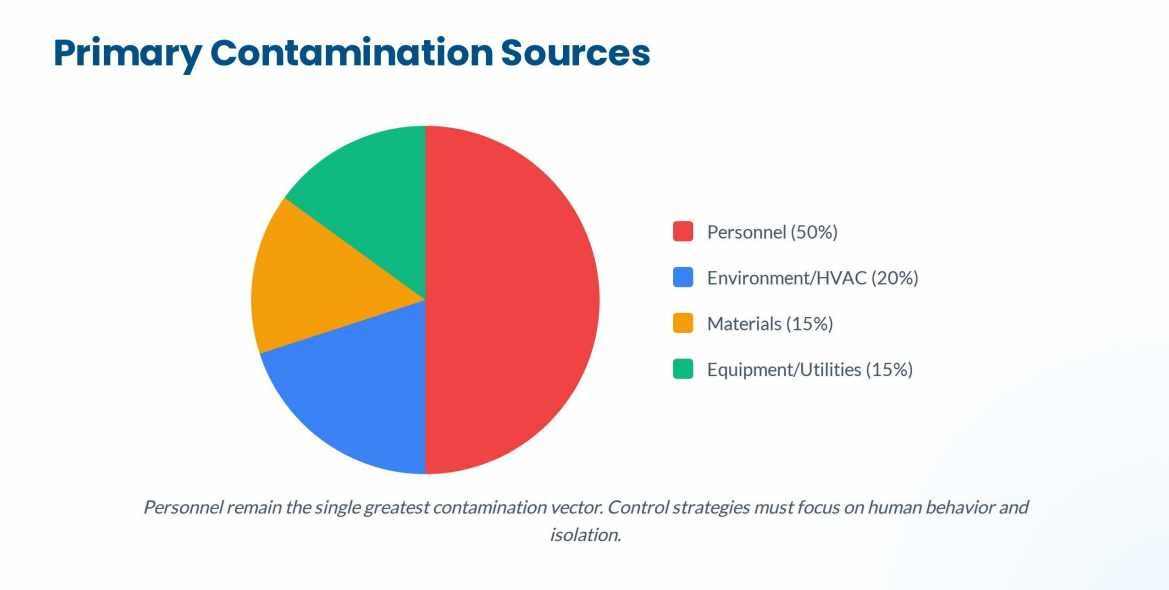
WHO TRS 1044 groups the contaminants a sterile unit has to keep out into microbial (including endotoxin and cellular debris) and particulate, such as glass and subvisible particles[3]. In practice they arrive through five routes.
| Source | How it reaches the product | Primary control |
|---|---|---|
| Personnel | Skin, hair and droplets shed through or around garments; hands and sleeves breaking first air during interventions | Gowning qualification, slow movement, intervention design, barriers that keep people out of Grade A |
| Air and HVAC | Lost pressure cascade, damaged HEPA filters, turbulent or reversed airflow at the critical zone | Pressure cascade, filter integrity testing, airflow visualisation, continuous Grade A particle monitoring |
| Materials and components | Vials, stoppers, tools and bags carried into Grade B and A without a validated transfer | Sterilisation, depyrogenation, sanitised transfer hatches and validated decontamination |
| Equipment and surfaces | Product-contact parts, filling needles and stopper bowls not sterilised or re-contaminated after sterilisation | Validated SIP or autoclave cycles, protected assembly, hold-time limits |
| Utilities | Water for injection, clean steam and process gases that carry biofilm, endotoxin or particles | Utility qualification, sterilising-grade gas filters, routine sampling and trending |
Airflow is the control that ties most of these together. Clean air moves from the highest grade outward, so one lost pressure step lets air from a dirtier room flow back towards the product. For HVAC qualification tests, see our guide to pharmaceutical HVAC system qualification.
Room sizes and the zoning a licensing authority expects for each dosage section are covered in Schedule M area requirements by dosage form.
RABS vs isolator: what the guidance actually says
Neither WHO TRS 1044 nor EU Annex 1 ranks one technology above the other. Both say RABS or isolators may help assure the required conditions and that their use should be considered in the CCS (clause 4.3)[3][4]. The practical difference is the room around them: a RABS needs at least a Grade B background, an open isolator generally Grade C and a closed isolator Grade D (clause 4.20).
That background grade drives cost. A Grade B suite carries the strictest gowning, monitoring and cleaning load in the plant, so an isolator often trades a higher equipment price for a cheaper room to run. Schedule M Part II asks only that an isolator’s background be at least Grade D for aseptic processing[1].
Media fill: what the run has to prove
An aseptic process simulation (APS) replaces the product with a sterile growth medium and runs the line as it really operates, with the longest durations, the most people allowed and every permitted intervention. It is the only test that challenges people, equipment and environment together.
The point most Indian units miss. Schedule M Part II and the FDA guidance allow one contaminated unit in a fill of 5,000 or more before revalidation, with investigation[1][6]. Under WHO TRS 1044, any contaminated unit is a failed APS, and the line normally needs at least three consecutive successful repeats[3]. A unit supplying WHO-prequalified or EU markets should write its acceptance criteria to the stricter rule.
Filling-line set-up that a media fill must reproduce, including fill-volume limits and speed qualification, is set out in liquid filling machine validation parameters.
Environmental monitoring and trending
Monitoring does not make a product sterile; it shows whether the controls are holding. WHO TRS 1044 asks for continuous total particle monitoring in Grade A at a sample flow of at least 28 L/min for the full duration of critical processing, with alarms when alert levels are exceeded (9.17)[3]. Organisms recovered from Grade A and B are identified to species level, so a recurring isolate can be traced to its source.
An excursion above an action limit is a deviation to investigate, not an out-of-specification result. Our SOP for environmental monitoring excursions sets out the investigation steps with Grade A–D limits.
Sterilisation, depyrogenation and disinfection
Every item that enters Grade A is sterilised by a validated cycle; glassware also needs depyrogenation. Sterilisation cycles are usually designed to a sterility assurance level of one in a million or better. Biological indicators show that a cycle ran, not that the product is sterile[3]. Cycle design and the Annex 1 clauses behind it are covered in our guides to autoclave validation and depyrogenation vs sterilisation.
For room surfaces, both Schedule M Part II and WHO TRS 1044 require more than one type of disinfectant and periodic use of a sporicide, because common agents do not kill spores[1][3]. Neither text uses the word “rotation”. What they require is a validated programme, with effectiveness shown on the facility’s own surfaces and against its environmental isolates.
The contamination control strategy (CCS)
The CCS is a single, facility-wide document that names every critical control point and shows how each control, monitor and investigation fits together (WHO TRS 1044 and EU Annex 1, clause 2.3)[3][4]. Clause 2.5 lists 16 elements it should cover:
- Plant and process design
- Premises and equipment
- Personnel
- Utilities
- Raw material and in-process controls
- Containers and closures
- Vendor approval
- Outsourced activities
- Process risk management
- Process validation
- Sterilisation validation
- Maintenance
- Cleaning and disinfection
- Monitoring systems
- Prevention: trending, root cause, CAPA
- Continuous improvement
Schedule M Part II does not use the term, so many Indian sterile units have the controls but not the document that links them. Writing it is usually the fastest way to close the gap CDSCO’s 2024 circular asks units to assess.
Check your unit: Schedule M Part II vs WHO TRS 1044
Answer four questions about current practice. The check covers the four differences an inspector working from WHO TRS 1044 is most likely to raise. It does not replace a full gap assessment.
Each answer is compared with the WHO TRS 1044 Annex 2 clause behind it.
The full Revised Schedule M self-audit, including the sterile and ophthalmic line items, is available as the Revised Schedule M gap assessment toolkit. If you are weighing an existing injectable unit against a new build, see the pharma plants for sale listings, which include sterile sections.
Frequently asked questions
Personnel, air and HVAC failures, materials and components entering Grade A and B, equipment and product-contact surfaces, and utilities such as water for injection, clean steam and gases. WHO TRS 1044 groups the contaminants themselves as microbial (including endotoxin) and particulate. People remain the largest variable, which is why barrier technology and intervention design matter.
Yes. When checked on 22 Oct 2026, fda.gov still served the September 2004 guidance on sterile drug products produced by aseptic processing. It sets 0.45 m/s ± 20 % for unidirectional air, at least 10–15 Pa between classified rooms and semi-annual media fills per line. US-bound products are also inspected against the binding cGMP rules in 21 CFR Parts 210 and 211.
Part II, the sterile products part, does not use the term. The CCS is a requirement of WHO TRS 1044 Annex 2 and EU Annex 1 (clause 2.3). CDSCO’s circular of 7 Aug 2024 asks manufacturers to comply with WHO TRS 1044 Annex 2 after a gap analysis, so a sterile unit should expect to be asked for one.
WHO TRS 1044 asks for twice a year for each aseptic process, filling line and shift, with each operator taking part in at least one successful run a year (9.38). The FDA guidance asks for semi-annual runs per line. Schedule M Part II says only at defined intervals and after significant changes, with every shift represented.
Either can be compliant. WHO TRS 1044 and EU Annex 1 do not prefer one; they ask that RABS or isolators be considered within the CCS. The difference is the background room: at least Grade B for a RABS, generally Grade C for an open isolator and Grade D for a closed isolator. Choose on product risk, changeover needs and the running cost of the background grade.
At least annually under WHO TRS 1044 and EU Annex 1 (clause 7.4), and unsupervised access to Grade A and B needs both a passed gowning assessment and a successful APS. The FDA guidance treats annual requalification as normally sufficient for automated operations with little personnel involvement. Requalify sooner after a monitoring failure or a long absence.
Track enforcement dates, CDSCO directions and inspection status in one place, then plan the CCS and media-fill gaps against them.
Open the Schedule M compliance dashboardRelated on Laafon
References
- Ministry of Health and Family Welfare. G.S.R. 922(E): Drugs Rules, Revised Schedule M. Part II: Specific requirements for manufacture of sterile products, parenteral preparations (small volume injectables and large volume parenterals) and sterile ophthalmic preparations. Gazette of India, Extraordinary, Part II, Sec. 3(i). New Delhi; 2023 Dec 28. Available from: https://cdsco.gov.in/opencms/opencms/en/Notifications/Gazette-Notifications. Accessed Oct 2026.
- Central Drugs Standard Control Organization (QMS Monitoring Division). Circular: Implementation of Schedule M and WHO Technical Report Series (TRS). File No. QMS/38/Misc/2024. New Delhi: CDSCO; 2024 Aug 7. Available from: https://cdsco.gov.in/opencms/opencms/system/modules/CDSCO.WEB/elements/download_file_division.jsp?num_id=MTE1ODE=. Accessed Oct 2026.
- World Health Organization. Annex 2: WHO good manufacturing practices for sterile pharmaceutical products. In: WHO Expert Committee on Specifications for Pharmaceutical Preparations: fifty-sixth report. WHO Technical Report Series, No. 1044. Geneva: WHO; 2022. Available from: https://www.who.int/publications/m/item/trs1044-annex2. Accessed Oct 2026.
- European Commission. EudraLex Volume 4, EU Guidelines for Good Manufacturing Practice. Annex 1: Manufacture of sterile medicinal products. C(2022) 5938 final. Brussels: European Commission; 2022 Aug 22. Available from: https://health.ec.europa.eu/system/files/2022-08/20220825_gmp-an1_en_0.pdf. Accessed Oct 2026.
- European Commission, Public Health. Révision de l’annexe 1 relative à la fabrication des médicaments stériles [Revision of Annex 1 on the manufacture of sterile medicinal products; latest-updates notice]. Brussels; 2022 Aug 25. Available from: https://health.ec.europa.eu/latest-updates/revision-manufacture-sterile-medicinal-products-2022-08-25_fr. Accessed Oct 2026.
- US Food and Drug Administration. Guidance for industry: Sterile drug products produced by aseptic processing — current good manufacturing practice. Rockville (MD): FDA; 2004 Sep. Available from: https://www.fda.gov/media/71026/download. Accessed Oct 2026.
- Health Canada. Publication of updated Annex 1 to the Good manufacturing practices guide – Manufacture of sterile drugs (GUI-0119). Drug Establishment Licensing Bulletin 148. Ottawa: Health Canada; 2023 Aug 24. Available from: https://www.canada.ca/en/health-canada/services/drugs-health-products/compliance-enforcement/establishment-licences/drug-establishment-licensing-bulletin/annex-1-good-manufacturing-practices-guide-manufacture-sterile-drugs-gui-0119.html. Accessed Oct 2026.
This page is technical and educational content for pharmaceutical professionals. It is not legal, regulatory or medical advice. Schedule M, CDSCO directions, WHO TRS texts and EU/FDA guidance change; confirm the current version of each instrument before relying on a figure. Clause numbers refer to the versions listed in the references.