
The short answer
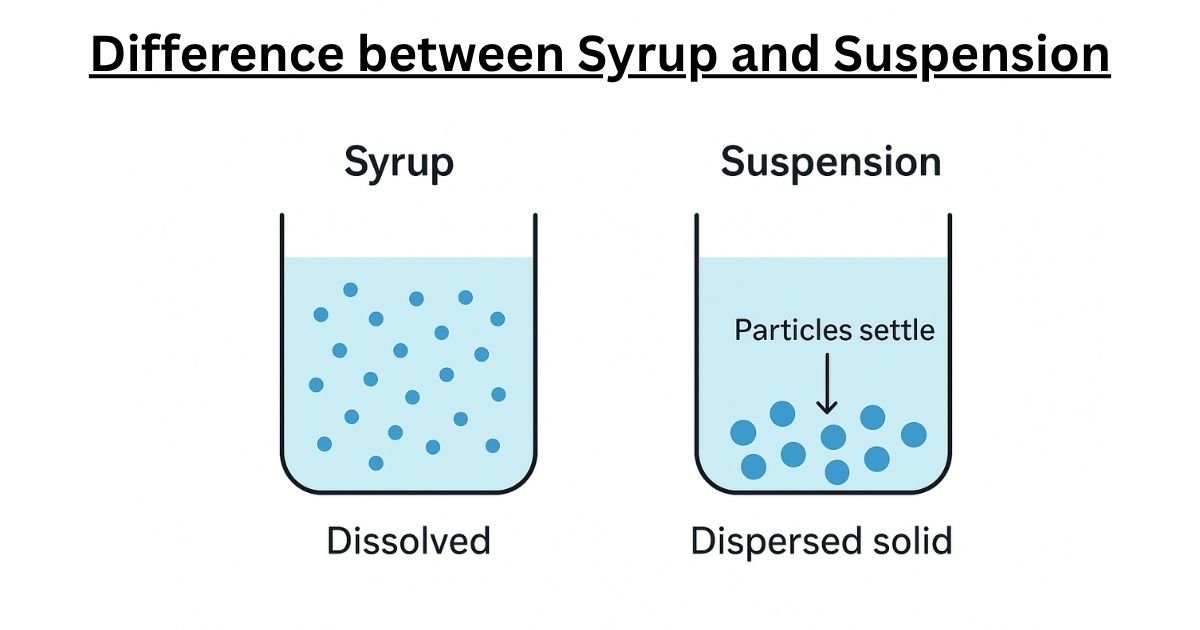
A syrup is a solution — the active is fully dissolved in a sweet, viscous, usually sucrose-based vehicle. A suspension is a two-phase system — undissolved solid particles are dispersed through a liquid vehicle and must be redispersed by shaking before every dose.
That single difference — dissolved versus dispersed — decides the entire quality control panel, the label text, the filling strategy and the stability risk profile of the product.
One point most articles get wrong: in pharmacopoeial language, “syrup” is a vehicle, not a dosage form. A medicated product you sell as a syrup is formally an oral solution.[1]
What the pharmacopoeias actually define
The International Pharmacopoeia groups solutions, emulsions and suspensions together under the general monograph Liquid preparation for oral use, and treats them as one family of dosage forms sharing a vehicle chosen for the nature of the active ingredient and the organoleptic profile required.[1] Within that family it draws a firm line on terminology.
The term syrup denotes a solution containing a high proportion of sucrose. Products such as lemon syrup or black currant syrup are used as vehicle ingredients for sweetening and flavouring — they contain no active ingredient, and the Pharmacopoeia states plainly that they are not dosage forms in the pharmacopoeial sense.[1] Traditional names such as elixir, linctus, mixture and syrup survive only in long-established titles; for new products the recommendation is to use the sub-monograph headings — oral solution, oral suspension, oral emulsion, oral drops.[1]
The European Pharmacopoeia and the British Pharmacopoeia do keep a Syrups sub-section, describing syrups as aqueous preparations with a sweet taste and viscous consistency that may contain sucrose at not less than 45 per cent m/m.[2] That number is the closest thing the industry has to a hard definition of “syrup”, and it is worth knowing when a regulator or a customer asks you to justify the label term.
Oral solution — the “syrup”
Clear liquid preparation containing one or more active ingredients dissolved in a suitable vehicle. It should be clear and free from any precipitate; cloudiness or a colour change points to chemical degradation or microbial contamination.[1]
Oral suspension
Liquid preparation containing one or more active ingredients suspended in a suitable vehicle. It may show a sediment, provided that sediment redisperses readily on shaking into a uniform suspension stable enough to deliver the correct dose.[1]
Note the asymmetry in what counts as failure. For a solution, any visible precipitate is a defect. For a suspension, sediment is expected — the defect is sediment that will not redisperse on gentle shaking, or the appearance of flocculants that stay put.[1] A QC analyst who applies solution logic to a suspension will reject good batches; one who applies suspension logic to a solution will release bad ones.
Which form should your product be?
Three questions decide it in most development projects. Answer them below.
Dosage form selector
Formulation decision aidAnswer all three questions
The tool will indicate the dosage form the formulation logic points to, and the control point that will decide whether it succeeds.
DECISION AID ONLY – NOT A SUBSTITUTE FOR PREFORMULATION DATA
Syrup vs suspension: full comparison
| Parameter | Syrup / oral solution | Oral suspension |
|---|---|---|
| Physical state of drug | Dissolved — single phase | Dispersed solid particles — two phases |
| Pharmacopoeial identity | Oral solution; “syrup” strictly denotes the sucrose vehicle[1] | Oral suspension — a dosage form in its own right[1] |
| Sucrose reference level | Ph. Eur. / BP: not less than 45 per cent m/m for syrups[2] | Not defined by sugar content |
| Visual release criterion | Clear, free from precipitate[1] | Sediment permitted if it redisperses on gentle shaking[1] |
| Mandatory label statement | None specific to phase behaviour | Direction to shake the bottle before use[1] |
| Dominant stability risk | Precipitation, crystallisation, microbial growth, colour change | Fast sedimentation, lump formation, caking, particle growth, polymorph conversion[1][3] |
| Solid-state risk | Lower — no crystalline phase present at equilibrium | Higher — suspensions carry greater polymorphism risk than solutions[3] |
| Particle control | Not applicable | Controlled particle size and, where relevant, crystal form must be assured in production[1] |
| Dissolution testing | Not applicable | Applies where the individual monograph prescribes it[1] |
| Filling behaviour | Straightforward; deaeration and foam control matter | Needs recirculation or gentle agitation to prevent stratification in the hopper |
| Dose accuracy depends on | Fill volume and the measuring device | Fill volume, the measuring device and the patient shaking correctly |
| Scale-up sensitivity | Moderate — thermal history drives viscosity and crystallisation | High — mixing energy, shear history and order of addition change particle distribution |
SCROLL THE TABLE SIDEWAYS ON MOBILE →
Why suspensions are the harder product to make
FDA’s Center for Drug Evaluation and Research sets out the critical quality attributes it expects sponsors to control for oral solutions and suspensions: physical stability, chemical stability, assay, content uniformity, container closure system, dosing accuracy, microbial limits, preservative content, leachables, and dissolution — with dissolution applying to oral suspensions only.[3]
Within physical stability, three of the sub-attributes are suspension-specific: solid state behaviour, sedimentation and particle size growth. FDA notes that a suspension of a drug exhibiting polymorphism carries greater risk than a solution of the same drug, and that the risk is lowest where no polymorphism exists, the most stable form is used, or the drug is highly soluble by BCS classification.[3] In one case study, a BCS Class II suspension with known crystalline polymorphs was controlled by adding polymorphic identification by XRD to both release and stability specifications, tightening particle size to a three-tier specification, and demonstrating polymorphic stability at six months accelerated and twenty-four months long term.[3]
The failure mode nobody puts in the risk assessment
A second FDA case study is worth committing to memory. An oral liquid failed accelerated stability on an unspecified impurity. Investigation showed 1N hydrochloric acid had been prepared and held in a stainless steel vessel; the extended contact leached elemental iron, the iron catalysed oxidation of the active during pH adjustment, and the resulting degradant — a diastereomer of the known oxidative degradant — exceeded the identification threshold at six months.[3]
Nothing in the formulation was wrong. The vessel and the hold time were. That is the kind of finding that separates a real liquid oral investigation from a paper one, and it applies equally to syrups and suspensions.
QC panel: what you actually test
The tests below are drawn from the pharmacopoeial general monograph for liquid preparations for oral use and from FDA’s stated critical attributes. Items marked suspension only do not apply to a solution.
- pH — named explicitly as an in-process control that should be applied during manufacture of oral liquids.[1]
- Fill volume — the second named in-process control.[1]
- Assay and content uniformity — both listed among FDA’s critical attributes for oral liquids.[3]
- Uniformity of mass, single-dose presentations — weigh the contents of 20 containers; not more than 2 may deviate by more than 10 per cent from the average, and none by more than 20 per cent.[1]
- Uniformity of dose delivered by the measuring device — weigh 20 doses taken with the supplied device; the same 10 per cent and 20 per cent limits apply.[1]
- Microbial limits and preservative content — preservative effectiveness must be demonstrated during development to the satisfaction of the regulator.[1]
- Container closure integrity and leachables — containers must not affect quality by leaching or sorption; light-sensitive actives require light-resistant containers.[1][3]
- DEG and EG — see the safety section below. Now a finished-product release test in India.[4]
- Visual inspection — the solution must be clear and free from any precipitate.[1]
- Colour and clarity change — treated as an indicator of chemical degradation or microbial contamination, not a cosmetic defect.[1]
- Viscosity and relative density — routine release parameters for sucrose-based vehicles; drift signals a change in sugar concentration or inversion.
- Crystallisation check on storage — measures must be taken so that oral solutions are not subject to precipitation under the labelled storage conditions.[1]
- Sucrose content justification — where the label says syrup, be able to support it against the not-less-than-45-per-cent m/m reference.[2]
- Redispersibility suspension only — sediment must disperse readily on gentle shaking; flocculants or sediment that will not disperse is evidence of physical instability.[1]
- Particle size distribution suspension only — production must assure suitable and controlled particle size and, where relevant, crystal structure including polymorphic or solvated forms.[1]
- Polymorph identification suspension only — XRD in release and stability specifications where the API has known crystalline forms.[3]
- Sedimentation and caking suspension only — the product must not be subject to fast sedimentation, lump formation or caking under labelled storage.[1]
- Dissolution suspension only — where prescribed in the individual monograph.[1]
- Uniformity of content suspension only — required for single-dose oral suspensions containing less than 5 mg of active per dose, or where the active is less than 5 per cent of the total weight per dose. Where this test applies, uniformity of mass is not required.[1]
- Assay after shaking suspension only — sample top, middle and bottom of the bulk and of the finished bottle; a suspension that passes on a homogenised composite may still fail the patient.
Shake before use is a dose-delivery requirement
The instruction to shake the bottle before use is not advisory copy. For oral suspensions the pharmacopoeia requires that the container label include a direction to shake before use.[1] The reason is mechanical: the suspension is allowed to sediment, so the concentration at the top of an undisturbed bottle is not the concentration at the bottom.
Doses from a multidose container are measured with a spoon or cup for 5 mL or multiples of it, or with an oral syringe for other volumes.[1] For a suspension, the accuracy of that device is only the second variable — the first is whether the caregiver shook the bottle properly. That is why counselling points for suspensions carry more weight than for syrups, and why dosing accuracy sits on FDA’s critical attribute list for oral liquids.[3]
The risk that ignores the syrup / suspension distinction
Diethylene glycol and ethylene glycol contamination is the most documented safety failure in oral liquids. It arises from excipients such as glycerol and propylene glycol that have been contaminated, adulterated or mixed up with the toxic glycols, and it has been responsible for hundreds of deaths worldwide, typically through acute kidney failure.[1] The International Pharmacopoeia carries a dedicated test for diethylene glycol and ethylene glycol in liquid preparations for oral use.[1]
In India the position tightened sharply after the 2025 paediatric fatalities. The Indian Pharmacopoeia Commission amended IP 2022 to mandate DEG and EG testing in oral liquids at the finished product stage before market release, in addition to the existing raw material testing requirement.[4] IPC also issued a consolidated toolkit including IPC/GD/11, a gas chromatography method for DEG and EG in liquid orals, alongside CDSCO advisories on pharma-grade excipients and on testing under the Drugs Rules, 1945.[5]
Whether your product is a solution or a suspension is irrelevant here. If it uses a polyol vehicle, the glycol test applies.
Two further Indian changes that affect anyone making oral liquids. The Drugs (Fifth Amendment) Rules, 2026, notified through G.S.R. 477(E) dated 9 June 2026, removed the over-the-counter route for certain cough, cold and fever preparations and moved them to prescription-only sale.[6] Separately, CDSCO set 1 January 2026 as the final deadline for manufacturers with turnover below Rs 250 crore to comply with the Revised Schedule M GMP standards, stating that no further extensions would be granted.[7]
Read next: why cough syrups are now prescription-only in India · the Revised Schedule M gap assessment toolkit · a WHO-GMP liquid oral unit in Una, Himachal Pradesh
Manufacturing and scale-up
For a solution the process is dissolution-led: controlled heating, sequence of addition, filtration where appropriate, deaeration, cooling profile, and protection against microbial ingress. The variables that bite are thermal history and holding temperature, because both drive sucrose inversion, viscosity drift and crystallisation on cooling.
For a suspension the process is particle-led. Size reduction, wetting of the solid, controlled addition of the suspending polymer, the shear regime during dispersion, and the final rheology all interact. A suspension that looked stable at pilot scale can behave differently at commercial scale because mixing geometry and shear distribution changed — not because the formula changed. Process development must therefore fix mixing speed, order of addition, hold time and the in-process sampling plan, and the validation must be documented alongside the in-process controls.[1]
Both routes carry a shared obligation: minimise the risk of microbial contamination and of cross-contamination, and ensure all incoming ingredients are of appropriate quality.[1]
Frequently asked questions
In a syrup the drug is dissolved, giving a single-phase clear solution in a sweet, viscous vehicle. In a suspension the drug is present as insoluble solid particles dispersed through the vehicle, forming a two-phase system that sediments on standing and must be shaken before each dose.
Strictly, a vehicle. The International Pharmacopoeia states that the term syrup denotes a solution containing a high proportion of sucrose, and that syrups used as sweetening and flavouring vehicles are not dosage forms in the pharmacopoeial sense because they contain no active ingredient. A medicated product marketed as a syrup is formally an oral solution.
The European and British Pharmacopoeia general monograph describes syrups as sweet, viscous aqueous preparations that may contain sucrose at a concentration of at least 45 per cent m/m. Sugar-free syrups substitute polyols or intense sweeteners, in which case the viscosity, mouthfeel and preservative strategy all have to be re-designed rather than simply swapped.
Because sedimentation is permitted in a suspension, the drug concentration is not uniform through an undisturbed bottle. Shaking redisperses the sediment so the measured volume carries the labelled dose. The pharmacopoeia requires the shake-before-use direction on the container label of every oral suspension.
Neither is inherently more stable, but they fail differently. Solutions fail by precipitation, crystallisation, colour change and microbial growth. Suspensions fail by fast sedimentation, lump formation, caking, particle growth and polymorphic conversion — and FDA notes that a suspension carries greater solid-state risk than a solution of the same drug because a crystalline phase is physically present.
Redispersibility, particle size distribution, sedimentation and caking assessment, polymorph identification where the API has known crystalline forms, dissolution where the individual monograph prescribes it, and uniformity of content for single-dose presentations containing less than 5 mg of active per dose or where the active is under 5 per cent of the dose weight.
Yes. The Indian Pharmacopoeia Commission amendment mandates diethylene glycol and ethylene glycol testing in oral liquids at the finished product stage before market release. The trigger is the polyol vehicle, not the phase behaviour of the product, so any oral liquid using glycerol or propylene glycol is in scope regardless of whether the active is dissolved or suspended.
Because the physical stability of a suspension is set by variables that change with vessel geometry — mixing energy, shear distribution, order of addition and shear history. These alter particle size distribution and rheology at commercial scale even when the formula and the raw materials are identical to the pilot batch.
Working on a liquid oral file?
Laafon Galaxy Pharmaceuticals supports liquid oral manufacturers on Revised Schedule M gap assessment, specification and IPC design for solutions and suspensions, and WHO-GMP audit readiness. 23 years in QA, QC and drug regulatory affairs.
Request a compliance consultationReferences
- World Health Organization. Liquid preparation for oral use. The International Pharmacopoeia, Thirteenth Edition. Geneva: WHO; 2025. Available from: digicollections.net. Accessed August 2026.
- European Pharmacopoeia Commission. Liquid preparations for oral use (general monograph 0672), Syrups sub-section, as reproduced in the British Pharmacopoeia. Strasbourg: EDQM. Accessed August 2026.
- Flynn M. Quality Considerations for First Generic Oral Liquids. Center for Drug Evaluation and Research, US Food and Drug Administration; 25 September 2024. Available from: fda.gov. Accessed August 2026.
- Ministry of Health and Family Welfare, Government of India. Reply in Parliament on cough syrup regulatory measures, citing the Indian Pharmacopoeia Commission amendment to IP 2022 mandating DEG and EG testing in oral liquids at finished product stage. 2025.
- Indian Pharmacopoeia Commission. Toolkit on prevention of DEG and EG contamination in liquid orals, including IPC/GD/11 Testing of Diethylene Glycol and Ethylene Glycol in Liquid Orals by Gas Chromatography. Ghaziabad: IPC; 2025.
- Ministry of Health and Family Welfare, Government of India. Drugs (Fifth Amendment) Rules, 2026. Gazette Notification G.S.R. 477(E), dated 9 June 2026.
- Central Drugs Standard Control Organisation. Order on Revised Schedule M GMP compliance deadline of 1 January 2026 for manufacturers with annual turnover below Rs 250 crore. New Delhi: CDSCO; November 2025.
This article is written for pharmaceutical manufacturing, QA and regulatory professionals. It is technical and educational content, not medical advice, and it is not a substitute for the current official text of the applicable pharmacopoeia or for the advice of your licensing authority. Pharmacopoeial texts and Indian statutory instruments are amended frequently — verify against the current edition and the latest gazette notification before applying anything here to a live product file.