
Reviewed against primary sources on 25 August 2026 · Darshan Singh, 23 years in pharmaceutical QC, QA and drug regulatory affairs (LinkedIn)
The short answer
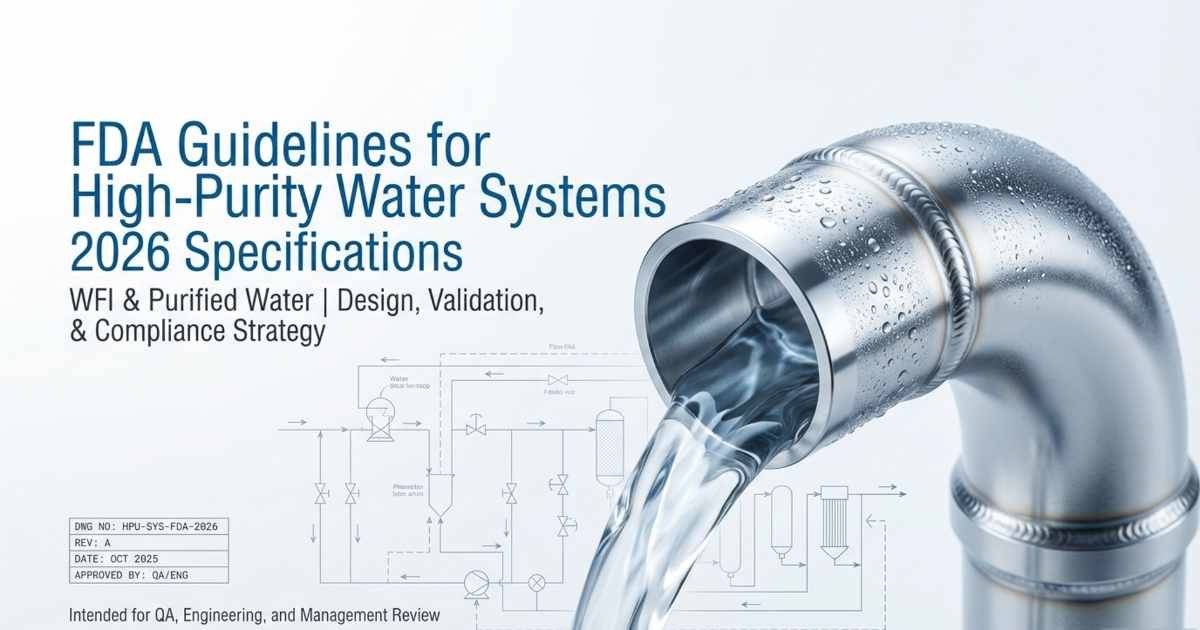
There is no single document called the FDA guidelines for purified water system operation. The requirements are spread across five separate texts, and the numeric limits come from the USP monographs rather than from FDA itself — which is why searching for one PDF never quite finds what you need.
Water for Injection (WFI) must meet a conductivity limit of 1.3 µS/cm at 25 °C (Stage 1 of USP <645>), total organic carbon not more than 500 µg C/L under USP <643>, and bacterial endotoxins not more than 0.25 USP EU/mL. Purified Water carries the same conductivity and TOC limits but has no endotoxin requirement.[3]
The microbial figures everyone quotes — 10 cfu/100 mL for WFI and 100 cfu/mL for Purified Water — are not monograph specifications. They are recommended action levels from the informational chapter USP <1231>, and FDA states plainly: “None of the limits for water are pass/fail limits. All limits are action limits.”[1][2]
Getting that distinction right is the difference between an investigation and a batch rejection.
This guide sets out what the compendia and the regulators actually require of a pharmaceutical water system — US FDA and USP, European Pharmacopoeia and EMA, WHO TRS 1033, and India’s revised Schedule M, which has been mandatory for every manufacturer since 1 January 2026. It also corrects several figures that circulate widely in the industry and do not survive a check against the source document.
FDA guidelines for purified water system: which document says what
Most of the confusion in this subject comes from treating it as one rulebook. It is five, and they carry different legal weight. Before quoting a limit in a protocol, know which of these it came from.
Scroll the table sideways on a phone.
| Document | What it actually covers | Legal weight |
|---|---|---|
| 21 CFR 211.48 Plumbing | Feed water only: potable, continuous positive pressure, meeting EPA Primary Drinking Water Regulations at 40 CFR 141. This is the sole CFR section that addresses water quality. | Binding regulation[5] |
| USP monographs — Water for Injection, Purified Water | The numeric limits themselves: conductivity, TOC, endotoxin, and the permitted production route. | Enforceable through the FD&C Act[3] |
| USP <645>, <643>, <85>, <86> | The test methods behind those limits — three-stage conductivity, TOC, and endotoxin by LAL or recombinant reagent. | Applicable general chapters |
| USP <1231> Water for Pharmaceutical Purposes | The microbial action levels everyone quotes, plus system design and monitoring guidance. | Informational only — chapters above 1000 are not mandatory[2] |
| FDA Guide to Inspections of High Purity Water Systems (7/93) | What an investigator actually looks at: dead legs, heat exchangers, sampling technique, and the action-limit principle. | Guidance, still published and still used[1] |
If you are exporting, add the market-specific layer on top — Ph. Eur. and the EMA guideline for the EU and UK, WHO TRS 1033 for WHO-GMP, and the Indian Pharmacopoeia with revised Schedule M at home. The four are compared further down this page.
All five documents distilled onto one page — USP, Ph. Eur., IP and WHO limits side by side, with the governing chapter named against every figure. No email required.
PDF · free · updated August 2026
Which water grade does your product need?
Water grade is decided by the dosage form and the market you file in, not by preference. Select both below.
The tool names the required water grade, the monograph that governs it, and the control point an inspector will go to first.
WFI and Purified Water compared
Scroll the table sideways on a phone.
| Attribute | Water for Injection | Purified Water | Governing text |
|---|---|---|---|
| Conductivity | 1.3 µS/cm at 25 °C (Stage 1) | 1.3 µS/cm at 25 °C (Stage 1) | USP <645>, three-stage procedure |
| Total organic carbon | NMT 500 µg C/L | NMT 500 µg C/L | USP <643> |
| Bacterial endotoxins | NMT 0.25 USP EU/mL | No requirement | USP <85> or <86> |
| Microbial action level | 10 cfu/100 mL | 100 cfu/mL | USP <1231> (informational) |
| Status of that action level | Not a monograph specification. A trigger for investigation and impact assessment, set in-house from the system’s own performance history. | FDA 7/93 guide; WHO TRS 1033 §12.8 | |
| Permitted production route | Distillation, or a process equivalent or superior to distillation in removing chemicals and microorganisms | Any validated route from potable feed water | USP WFI monograph |
| Typical use | Parenterals, biologics, ophthalmics, inhalation, final rinse of product-contact surfaces | Oral liquids, topicals, oral solids, general granulation and cleaning | Risk assessment per dosage form |
One consequence people miss: because Purified Water has no endotoxin limit, a system that produces chemically excellent PW tells you nothing about its suitability for parenteral use. Conductivity and TOC are chemical measurements. As FDA puts it, conductivity meters “monitor chemical quality and have no meaning regarding microbiological quality.”[1]
The same water, four rulebooks
Most Indian manufacturers file into more than one market. The limits converge; the legal instruments and the qualification expectations do not.
United States — FDA and USP
There is no CFR section that specifies pharmaceutical water quality. The regulation people cite most often, 21 CFR 211.113, is titled Control of microbiological contamination and requires written procedures to prevent objectionable organisms; it says nothing about water limits.[6] The section that does address water is 21 CFR 211.48 (Plumbing), which requires potable water under continuous positive pressure meeting EPA Primary Drinking Water Regulations at 40 CFR 141.[5]
- Quality limits come from the USP monographs for Water for Injection and Purified Water, which are enforceable through the FD&C Act.[3]
- USP <645> (conductivity) and USP <643> (TOC) are applicable general chapters. USP <1231> is numbered above 1000, which makes it informational — guidance you are expected to justify departing from, not a specification.[2]
- Endotoxin testing may follow <85> using LAL, or <86> using recombinant reagents, official since May 2025. Chapter <86> is an addition to <85>, not a replacement.[14]
- The Guide to Inspections of High Purity Water Systems (7/93) is still published on FDA’s site and still shapes what investigators ask for.[1]
EU and UK — Ph. Eur. and EMA
The European Pharmacopoeia revised monograph 0169 to permit Water for Injections by routes other than distillation. EMA’s Guideline on the quality of water for pharmaceutical use (EMA/CHMP/CVMP/QWP/496873/2018) was written to reflect that change and has applied since 1 February 2021.[8]
- Live change to plan for: Ph. Eur. 12.3 revises Water for Injections (0169), Purified Water (0008) and method 2.2.44. The oxidisable substances test is replaced by TOC, with a 0.50 mg/L limit, and the conductivity text is clarified. It came into force on 1 July 2026.[9]
- If your specifications, test methods or CoAs still reference oxidisable substances for WFI, they are now out of date for EU filings.
- Membrane-based WFI is accepted in principle, but expect the supervisory authority to want the design rationale, the continuous monitoring strategy and the biofilm control case in the dossier.[8]
India — Indian Pharmacopoeia and revised Schedule M
Revised Schedule M was notified by G.S.R. 922(E) on 28 December 2023.[10] Manufacturers with turnover below ₹250 crore were given until 31 December 2025 by G.S.R. 127(E) of 11 February 2025, on condition they applied within three months with an upgradation plan.[11]
- That extension has now expired. As of 1 January 2026 revised Schedule M applies to every licensed manufacturer regardless of turnover, and water system qualification is squarely inside the scope state drug inspectors are auditing.
- Product specifications follow the Indian Pharmacopoeia monographs for Purified Water and Water for Injection. The IP limits sit at the same numeric levels as USP and Ph. Eur. — harmonisation on water is genuine.
- If you also hold WHO-GMP certification for export, TRS 1033 Annex 3 is the document your auditor works from. See the WHO tab.
- Space and segregation for the utility block are governed by the revised Schedule M area requirements — a common gap in plant layouts drawn before 2024.
WHO — TRS 1033, Annex 3
WHO’s Good manufacturing practices: water for pharmaceutical use was revised in 2021 and published as Annex 3 to Technical Report Series 1033. It replaced the 2011 version in TRS 970, Annex 2.[4] Any document on your shelf citing TRS 970 for water is superseded.
- Distribution: continuous circulation maintaining turbulent flow, “evidenced by, for example, a Reynolds number of > 4000” (§8.6).[4]
- Dead legs: use zero-dead-leg diaphragm valves where possible and minimise dead legs elsewhere; areas of possible dead legs “should be measured and calculated” (§8.6). Notably, TRS 1033 sets no L/D ratio at all.[4]
- Temperature: systems held above 70 °C are “generally less susceptible to microbiological contamination” (§8.3).[4]
- Sanitisation: thermal above 70 °C, or chemical using ozone, hydrogen peroxide and/or peracetic acid (§4.3.7).[4]
- Alert and action levels are set from historically reported data, not copied from a textbook (§12.8).[4]
Figures that circulate widely and do not survive a source check
Every item below appears routinely in Indian and international training material, including in the earlier version of this article. Each was checked against the primary document in August 2026.
Scroll the table sideways on a phone.
| Commonly stated | What the source actually says |
|---|---|
| “Maintain 0.7 m/s minimum velocity in the loop.” | No pharmacopoeia or regulator sets a velocity figure. WHO TRS 1033 asks for turbulent flow, illustrated by Reynolds number above 4000.[4] At 80 °C in 25 mm OD tube, Re passes 4000 at roughly 0.07 m/s — ten times below the quoted rule. The number is a legacy rule of thumb, not a requirement. |
| “FDA requires a dead leg no longer than 6D.” | The 7/93 guide reports that “the proposed LVP Regulations defined dead-legs as not having an unused portion greater in length than six diameters”.[1] Those LVP regulations were proposed and never finalised. 6D was never an FDA requirement. |
| “WHO TRS 970 sets 3D.” | TRS 970 Annex 2 was superseded in 2021. The current text, TRS 1033 Annex 3, specifies no ratio — it requires dead legs to be minimised, measured and calculated.[4] |
| “Records must be retained for 10 years under 21 CFR 211.180.” | 211.180(a) requires retention “at least 1 year after the expiration date of the batch”, or 3 years after distribution for OTC products exempt from expiration dating under 211.137.[7] Ten years is an EU-derived figure, not a US one. |
| “Ozone sanitisation uses 3–5 ppm.” | Storage-tank residual dissolved ozone in more than 95% of installed systems sits between 0.02 and 0.2 mg/L.[15] A 3–5 ppm setpoint is one to two orders of magnitude high, and is a materials and destruct-capacity problem. |
| “PQ is Phase 1 months 1–3, Phase 2 months 4–9, Phase 3 months 10–12.” | WHO §11.3 sets Phase 1 at at least two weeks, Phase 2 at at least a further two weeks, and Phase 3 running so that all three phases together cover at least 12 months.[4] Phases 1 and 2 are weeks, not quarters. |
| “USP <1231> is a mandatory reference.” | USP general chapters numbered above 1000 are informational. USP states microbial guidance sits in “the informational chapter” and that the user establishes in-house fitness-for-use levels.[2] |
| “USP <2> is General Notices.” | USP <2> is Oral Drug Products — Product Quality Tests. The General Notices are not a numbered general chapter. |
| “WFI must be free of Pseudomonas, coliforms and E. coli.” | The USP water monographs contain no absence-of-specified-organisms test. Objectionable-organism control is a risk-based cGMP obligation under 21 CFR 211.113, judged against the product and route of administration.[6] |
| “Polished piping means Ra ≤ 0.6 µm.” | ASME BPE designates finishes explicitly: SF1 at 0.51 µm and SF4 at 0.38 µm electropolished are the grades actually specified for pharmaceutical water.[12] Write the SF designation on the drawing, not a loose Ra figure. |
Turbulent flow check — what your loop actually does
This is the calculation that replaces the 0.7 m/s rule. Enter your loop and see whether it is genuinely turbulent at operating temperature.
Internal diameters assume nominal hygienic tube with a 1.65 mm wall. Confirm against your own piping specification.
Run the default case: 20 L/min through 25 mm OD tube at 80 °C gives roughly 0.87 m/s and a Reynolds number near 53,000 — turbulent by a wide margin. Now drop the flow to 7.5 L/min. Velocity falls to about 0.33 m/s, well under the “required” 0.7 m/s, and Reynolds number is still around 20,000. Still turbulent. The loop was never the problem.
Turbulence is necessary but not sufficient. Biofilm establishes where water is not moving — dead legs, idle pump casings, closed point-of-use valves, instrument tees. Chasing a velocity figure in the main loop while leaving a 6D branch on a sample valve is optimising the wrong variable.
Design decisions that carry the compliance risk
Feed water is a regulated input, not a utility
The only water quality the US regulation actually mandates is at the inlet: potable water under continuous positive pressure, meeting EPA Primary Drinking Water Regulations at 40 CFR 141.[5] Municipal supply in most Indian industrial estates is not automatically compliant and varies seasonally. Feed water monitoring with a defined specification, not an assumption, is the first thing a competent auditor asks to see.
Production route for WFI
The USP monograph permits WFI “purified by distillation or a purification process that is equivalent or superior to distillation in the removal of chemicals and microorganisms”.[3] Ph. Eur. reached the same position through the revision of monograph 0169, and EMA’s guideline was issued to accompany it.[8]
Membrane-based generation (reverse osmosis with electrodeionisation, usually two-pass, with UV and hot-water sanitisation) is therefore acceptable in the US, EU and to WHO-GMP inspectors. What is not acceptable is presenting it as a like-for-like swap. Distillation removes endotoxin by phase change; membranes remove it by rejection, and rejection degrades with membrane age, fouling and integrity loss. The equivalence has to be demonstrated with data, and the monitoring strategy has to be able to detect a breach before product is affected.
Temperature
FDA observes that hot systems in the 65–80 °C range are self-sanitising, and that with colder systems in the 65–75 °C band “any drops or unused portion of any length of piping has the potential for the formation of a biofilm”.[1] WHO puts the practical threshold above 70 °C.[4] Continuous recording with alarms on the low side is the control; a spot reading in a logbook is not.
Heat exchangers and back-contamination
The 7/93 guide is specific about the failure mode: use “the double-tubesheet type of heat exchanger” so that a tube failure cannot pass service fluid into the product stream, and maintain the pressure relationship so that clean fluid pressure exceeds the contaminated side.[1] This remains one of the highest-consequence, lowest-visibility items in a water system, because a slow leak produces no alarm and no conductivity shift.
Piping, finish and dead legs
- 316L stainless is the default for hot loops. Specify the finish by ASME BPE designation — SF1 (0.51 µm) mechanically polished or SF4 (0.38 µm) electropolished — rather than a loose Ra number, so the fabricator and the inspector read the same requirement.[12]
- Design out dead legs. Zero-dead-leg diaphragm valves at every point of use, instruments mounted in the flow path rather than on a branch, and no capped spare tees left from a future expansion that never happened.
- Where a branch is unavoidable, measure and calculate it, document it in the IQ, and manage it with sampling frequency — which is exactly what WHO asks for.[4]
- Continuous fall to drain points, no low pockets, and a slope you can actually demonstrate on the as-built isometric.
It is an unexplained excursion with no investigation, or an investigation that closes on “sampling error” without evidence. Both FDA and WHO treat the limits as investigation triggers. A system that never exceeds an action level but also has no trend record, no seasonal data and no root-cause history is harder to defend than one with documented excursions and closed investigations.
Qualification, corrected
The three-phase approach is described in WHO TRS 1033 §11.3, and the durations are shorter at the front than most Indian SOPs state.[4]
Scroll the table sideways on a phone.
| Phase | Duration | Purpose | Water release |
|---|---|---|---|
| Phase 1 | At least 2 weeks | Intensive sampling at every point of use each working day. Establish operating ranges, prove SOPs and sanitisation work, set provisional alert levels. | Not for manufacturing use |
| Phase 2 | At least a further 2 weeks | Same intensive sampling under the routine SOPs written from Phase 1. Confirm consistent operation. | Water may be used, on a documented risk basis |
| Phase 3 | Balance of at least 12 months total | Reduced routine frequency across a full year, so seasonal variation in feed water and ambient temperature is captured. | Routine production use |
Design and installation qualification precede all of this. The one documentation point worth repeating is that a system without complete, current P&IDs and as-built isometrics cannot be qualified, because there is nothing to qualify against — every dead-leg measurement, slope claim and sample-point location traces back to that drawing set.
Records and retention
Water monitoring data is GMP data and carries the full ALCOA+ data integrity expectations — attributable, legible, contemporaneous, original, accurate, and complete, consistent, enduring and available. In practice that means chart recorder outputs and analyser trends are raw data, and the summary table typed into the monthly review is not.
US retention is at least one year past the batch expiry date under 21 CFR 211.180(a), or three years after distribution for OTC products exempt from expiry dating.[7] Many Indian manufacturers hold water records for longer because EU-facing customers ask for it — a commercial decision, worth making deliberately rather than assuming a rule exists.
Frequently asked questions
No, and this is the most common reason people cannot find what they are looking for. FDA publishes the Guide to Inspections of High Purity Water Systems, which describes what investigators examine but sets almost no numeric limits. The limits themselves live in the USP monographs for Water for Injection and Purified Water, with the test methods in general chapters 645, 643, 85 and 86, and the microbial action levels in the informational chapter 1231. The only binding CFR requirement, 21 CFR 211.48, covers feed water quality alone. The specification sheet linked near the top of this page consolidates all five into one document.
No. It is a recommended action level from the informational chapter USP 1231, not a monograph specification. FDA states that none of the limits for water are pass or fail limits and that all limits are action limits. Exceeding it obliges you to investigate, assess impact on every batch made since the last conforming result, and document the outcome. It does not automatically reject the water or the product, and a facility that treats it as an automatic rejection usually ends up with weaker investigation records, not stronger ones.
Yes. The USP monograph permits distillation or a purification process equivalent or superior to distillation in removing chemicals and microorganisms, and the European Pharmacopoeia revised monograph 0169 to the same effect, with EMA issuing an accompanying guideline that has applied since February 2021. Two-pass reverse osmosis with electrodeionisation, ultraviolet pretreatment and hot-water sanitisation is the usual configuration. The regulatory burden shifts from buying the right machine to proving equivalent endotoxin and microbial removal with your own data, and to monitoring that can detect membrane degradation before product is affected.
No pharmacopoeia or regulator specifies a velocity. WHO TRS 1033 asks for continuous circulation maintaining turbulent flow, illustrated by a Reynolds number above 4000. The widely quoted 0.7 metres per second figure is a legacy engineering rule of thumb with no compendial basis, and most hot pharmaceutical loops clear the turbulence threshold at a small fraction of it because viscosity falls sharply with temperature. Use the Reynolds check on this page against your own tube size and flow rate rather than defending a velocity number you cannot source.
The current WHO guidance sets no ratio at all. It requires zero-dead-leg diaphragm valves where possible, dead legs minimised elsewhere, and any areas of possible dead leg measured and calculated. The often-quoted 6D came from proposed US large volume parenteral regulations that were never finalised, and the 3D figure came from a WHO text superseded in 2021. Design them out; where a branch is genuinely unavoidable, measure it, record it in the installation qualification, and manage the residual risk through sampling frequency and sanitisation.
The water monographs contain no absence-of-specified-organisms test. Control of objectionable organisms is a risk-based obligation under 21 CFR 211.113, and what counts as objectionable depends on the product, its route of administration and the patient population. A Pseudomonas isolate in water feeding a topical or an inhalation product is a serious finding on its own merits, regardless of the total count. That is why routine identification of recovered isolates, not just enumeration, is worth building into the monitoring programme.
WHO TRS 1033 section 11.3 sets Phase 1 at a minimum of two weeks and Phase 2 at a minimum of a further two weeks, with Phase 3 continuing so that all three phases together span at least twelve months of operation across different seasons. Many Indian SOPs mistakenly schedule Phase 1 as three months and Phase 2 as six, which delays release of the system without adding regulatory value. The twelve-month element applies to the overall programme, not to the intensive sampling phases.
Ph. Eur. supplement 12.3 revised Water for Injections monograph 0169, Purified Water monograph 0008 and method 2.2.44, with effect from 1 July 2026. The principal change replaces the oxidisable substances test with total organic carbon at a limit of 0.50 milligrams per litre, and clarifies the conductivity text. If your product specifications, analytical methods or certificates of analysis for EU-bound material still reference oxidisable substances for water, they need revising, and the change should go through your normal change control with a documented assessment.
Revised Schedule M was notified by G.S.R. 922(E) on 28 December 2023, and small and medium manufacturers below 250 crore rupees turnover were given until 31 December 2025 to comply by G.S.R. 127(E) of 11 February 2025. That extension has expired, so the requirements now apply to every licensed manufacturer. For water systems the practical effect is that qualification documentation, continuous monitoring and periodic review move from good practice to inspectable requirement, and the utility block needs the space and segregation the revised area requirements assume.
Related on Laafon
Capital bands by dosage form, with purified water generation, storage and the distribution loop costed as a qualification-bearing line item.
Price the same facility at Schedule M, WHO-GMP, EU-GMP and US-market grade to see what the water and utility upgrade actually costs.
Space allocations by section, including the segregation the injectable and sterile lines now require.
Where utility qualification sits in the eighteen to thirty month path to a pre-approval inspection.
What the WFI system feeds into: contamination control strategy, facility design and personnel practice for sterile manufacture.
The four inspection types and what investigators examine, so you know which visit your water documentation has to survive.
Laafon Galaxy handles pharmaceutical plant projects end to end — design, utility sizing, equipment qualification and licensing — across India. Tell us the dosage forms and the markets you file in, and we will tell you what the water system has to do.
References
- US Food and Drug Administration. High Purity Water System (7/93) — Guide to Inspections. Rockville, MD: FDA Inspection Guides. Available from: fda.gov. Accessed August 2026.
- United States Pharmacopeia. Frequently Asked Questions: Water for Pharmaceutical and Analytical Purposes. Rockville, MD: USP. Available from: usp.org. Accessed August 2026.
- United States Pharmacopeia. Water for Injection monograph. USP–NF. Rockville, MD: USP Convention. Available from: doi.usp.org. Accessed August 2026.
- World Health Organization. Good manufacturing practices: water for pharmaceutical use. WHO Technical Report Series No. 1033, Annex 3. Geneva: WHO; 2021. Available from: who.int. Accessed August 2026.
- Electronic Code of Federal Regulations. 21 CFR 211.48 — Plumbing. Available from: ecfr.gov. Accessed August 2026.
- Electronic Code of Federal Regulations. 21 CFR 211.113 — Control of microbiological contamination. Available from: ecfr.gov. Accessed August 2026.
- Electronic Code of Federal Regulations. 21 CFR 211.180 — General requirements (records retention). Available from: ecfr.gov. Accessed August 2026.
- European Medicines Agency. Guideline on the quality of water for pharmaceutical use. EMA/CHMP/CVMP/QWP/496873/2018. Amsterdam: EMA; effective 1 February 2021. Available from: ema.europa.eu. Accessed August 2026.
- European Directorate for the Quality of Medicines. Revised monographs Water for Injections (0169), Purified Water (0008) and general method 2.2.44, published in Ph. Eur. Supplement 12.3, in force 1 July 2026.
- Ministry of Health and Family Welfare, Government of India. G.S.R. 922(E), dated 28 December 2023 — Drugs (Amendment) Rules, revised Schedule M.
- Ministry of Health and Family Welfare, Government of India. G.S.R. 127(E), dated 11 February 2025 — extension of revised Schedule M compliance timeline to 31 December 2025 for manufacturers below 250 crore rupees turnover.
- American Society of Mechanical Engineers. Bioprocessing Equipment (ASME BPE) surface finish designations SF1–SF6. Summarised at astropak.com. Accessed August 2026. Confirm values against the current purchased edition of ASME BPE.
- International Society for Pharmaceutical Engineering. ISPE Baseline Guide Volume 4: Water and Steam Systems, 3rd edition. Tampa, FL: ISPE; 2019. Available from: ispe.org.
- United States Pharmacopeia. General Chapter 86, Bacterial Endotoxins Test Using Recombinant Reagents. Published for early adoption November 2024; official May 2025. An addition to General Chapter 85, not a replacement.
- Pharmaceutical Technology. Dissolved ozone in pharmaceutical water systems: how and where to measure dissolved ozone. Available from: pharmtech.com. Accessed August 2026.
Scope and limitations. This article is technical and educational content for pharmaceutical professionals. It is not medical, legal or investment advice, and it does not substitute for the current text of any pharmacopoeia or statutory instrument. Pharmacopoeial monographs, WHO technical reports and Indian statutory instruments are revised frequently, and state-level interpretation varies. Verify every limit and every date against the current purchased or official edition before applying it to a filing, a specification or a qualification protocol. General engineering guidance from ISPE informed the design section.[13]