

Short answer. Under Ph. Eur. 2.9.5 a powder for parenteral administration with an average mass above 40 mg is tested by weighing 20 containers: not more than 2 may deviate from the average by more than 10%, and none by more than 20%. Below 40 mg the test is uniformity of content (2.9.6) instead.[1] USP applies a different framework entirely.[2]
This page sets out the SOP for dry powder filling operation in injectable vials: the cleanroom grades the line must hold, the line clearance that precedes it, a step-numbered procedure you can adapt, the in-process checks, and — the part most pages get wrong — the difference between the compendial finished-product limit and the in-process fill weight limit you set on the machine.
On this page
- Fill weight limits: what the pharmacopoeias actually require
- Which uniformity test applies to your product
- Line diagram and cleanroom grade zones
- Environmental grades for sterile powder filling
- SOP template: dry powder filling operation
- In-process checks, deviations and media fill
- Troubleshooting: what actually causes fill weight drift
- Annexure-I: fill weight record
- Frequently asked questions
- References
A note on terminology. This page uses dry powder injection and sterile powder filling rather than the bare abbreviation DPI. In regulatory writing DPI most commonly denotes a dry powder inhaler — it is the term FDA uses in its own inhalation quality guidance[6] — and it is also a printing-resolution unit. Using the qualified form avoids an ambiguity that matters in a document an auditor will read.
Fill weight limits for the dry powder filling operation
Two different numbers get called “the weight variation limit”, and confusing them is the most common error in this area.
- The compendial limit is a finished-product test applied to 20 units after filling. It is fixed by the pharmacopoeia and the product monograph.
- The in-process limit is the alert and action band you set on the filling machine and check-weigher during the run. It is set by your validated product specification, is normally much tighter than the compendial limit, and is site policy — no pharmacopoeia specifies it.
An SOP that quotes a compendial figure as the machine setting is a finding waiting to happen. State both, and state which is which.
| Control point | Requirement | Sample | Source |
|---|---|---|---|
| Uniformity of mass, powder for parenteral administration, average mass above 40 mg | NMT 2 of 20 outside ±10%; none outside ±20% |
20 containers | Ph. Eur. 2.9.5[1] |
| Powder for parenteral administration, average mass 40 mg or less | Not tested for uniformity of mass; uniformity of content (2.9.6) applies instead | per 2.9.6 | Ph. Eur. 2.9.5 footnote[1] |
| Solid in a single-unit container, single component | Weight Variation route; acceptance value L1 = 15.0 on 10 units, L2 = 25.0 at 30 units | 10, then 30 | USP 905[2] |
| Solid in a single-unit container, multiple components, solution freeze-dried in the final container | Weight Variation route | 10, then 30 | USP 905[2] |
| Solid in a single-unit container, multiple components, filled as powder | Content Uniformity route | 10, then 30 | USP 905[2] |
| In-process fill weight, alert and action band on the machine | Set from the validated product specification. Commonly tighter than the compendial limit. Not a compendial value. | Per SOP frequency below | site policy |
| Indian Pharmacopoeia uniformity of weight for powders for injection | Verify against the current IP monograph and general chapter before citing a figure | per IP | check source |
The IP row is deliberately left without a number. The Indian Pharmacopoeia is not freely published, and a figure carried over from a secondary blog into a controlled document is exactly the kind of citation that fails an audit. Verify it against your own copy of the current IP.
Which uniformity test applies to your product
The route depends on the compendium you file against, the average fill mass, and how the vial is made. Work through the three questions below.
1. Which compendium governs the specification?
2. What is the average fill mass per vial?
3. How is the vial content made?
Select one option in each of the three groups
The verdict names the governing test and the control point your SOP should reference.
Dry powder vial filling line: diagram and cleanroom grade zones
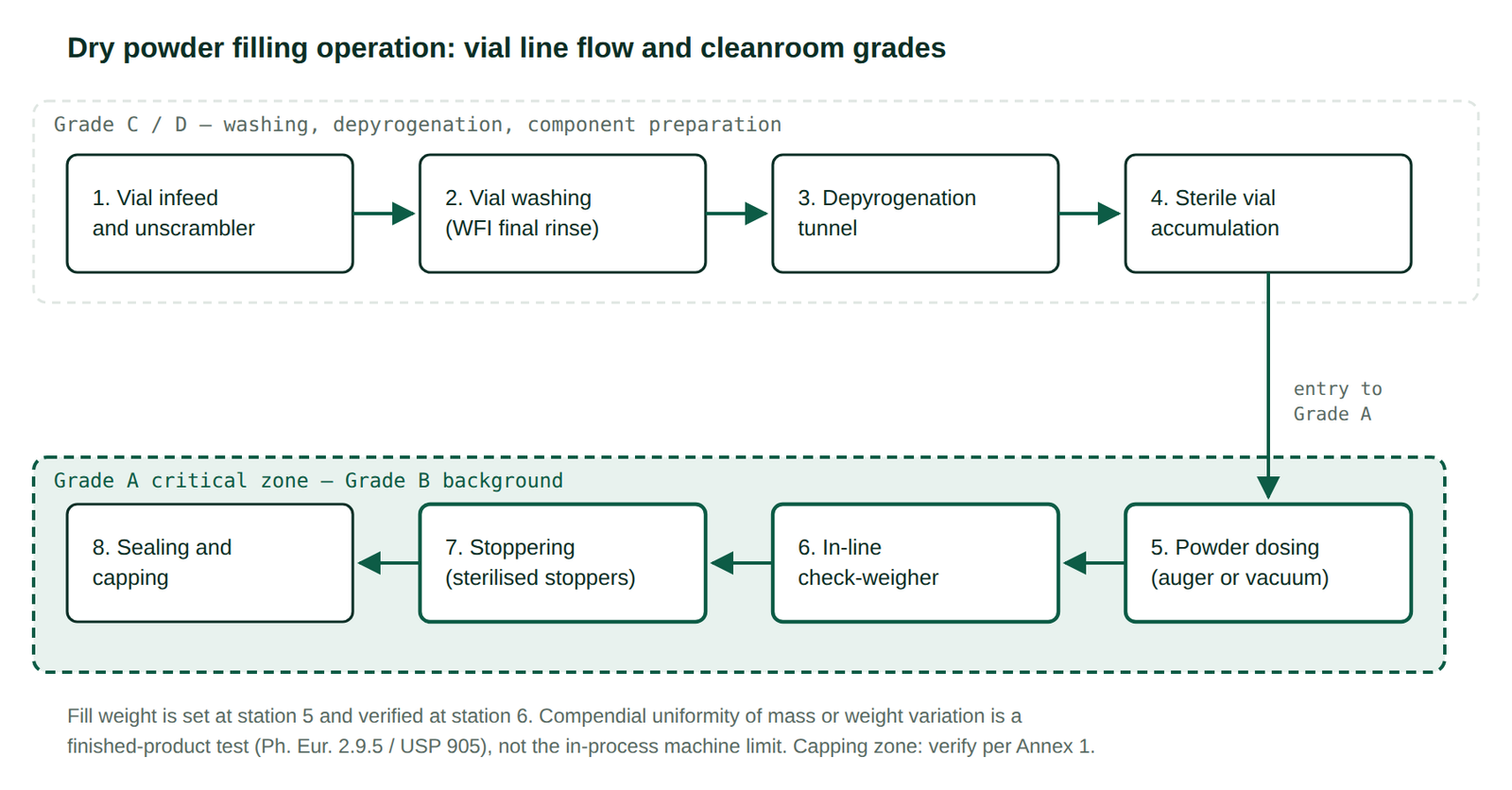
| Station | Function | Typical control | Common failure |
|---|---|---|---|
| 1–2 | Vial infeed, unscrambling and multi-stage washing with a Water for Injection final rinse | Rinse water quality and conductivity; machine cycle time | Carry-over of wash water into the tunnel, giving wet vials at fill |
| 3 | Depyrogenation tunnel: dry heat sterilisation and endotoxin destruction | Heat penetration and distribution studies are decisive here[4] | Belt speed drift shortening the hot-zone dwell time |
| 4 | Sterile vial accumulation at the Grade A boundary | Unidirectional airflow protection over exposed vials | Accumulation table backing up and breaking airflow |
| 5 | Powder dosing by auger screw or vacuum-and-tamp | Dosing disc or auger fill setting; powder bulk density | Powder bridging in the hopper, giving low weights that trend rather than scatter |
| 6 | In-line check-weigher, gross and tare | In-process alert and action bands site policy | Check-weigher not re-zeroed after a stoppage |
| 7 | Rubber stopper insertion using sterilised, siliconised stoppers | Stopper seating; vacuum or inert gas where the product requires it | Partially seated stoppers passing to capping |
| 8 | Aluminium seal application and crimping | Crimp tightness and seal integrity check source | Loose crimp producing container closure integrity failures |
The classification of the capping station depends on whether crimping is performed on a fully stoppered vial and on the justification in your contamination control strategy. Confirm it against Annex 1 for your own line rather than copying a grade from any template, this one included.[3]
Environmental grades for sterile powder filling
Aseptic filling and sealing of containers is a Grade A operation with a Grade B background.[3] FDA expresses the same requirement as ISO 5 for the critical area: air in the immediate proximity of exposed sterilised containers and closures should have no more than 3,520 particles per cubic metre at 0.5 µm and larger.[4]
| Grade | 0.5 µm at rest | 0.5 µm in operation | 5 µm at rest | 5 µm in operation |
|---|---|---|---|---|
| A | 3,520 | 3,520 | not specified | not specified |
| B | 3,520 | 352,000 | not specified | 2,930 |
| C | 352,000 | 3,520,000 | 2,930 | 29,300 |
| D | 3,520,000 | not predetermined | 29,300 | not predetermined |
Maximum permitted airborne particle concentration per cubic metre, EU GMP Annex 1, August 2022, Table 1.[3] Grade D in-operation limits are set by the manufacturer on a risk basis. Indian manufacturers should read this alongside the revised Schedule M notified as G.S.R. 922(E) on 28 December 2023.[5]
Room temperature and relative humidity are not compendial. Dry powders are usually filled under controlled low humidity because the powder is hygroscopic and because operators work gowned for long periods, but the set points and the alert limits come from your product stability data and your own qualification, not from Annex 1 or Schedule M. Any SOP quoting a specific RH range as a regulatory requirement is overstating it. See also our note on aseptic processing control and contamination prevention.
SOP template: dry powder filling operation
1. Purpose
To define the procedure for aseptic filling, stoppering and sealing of sterile dry powder into injection vials so that every vial receives the specified dose under validated aseptic conditions.
2. Scope
Applies to the automatic dry powder vial filling line in the sterile block, for all sterile powder-for-injection products manufactured at the site. This procedure does not cover lyophilisation cycle operation, terminal sterilisation, liquid vial filling, dry syrup bottle filling, or the sterilisation of the powder itself upstream of the line.
3. Responsibility
- Operator, Production: line set-up, running the machine, recording in-process weights on Annexure-I.
- Officer, Production: line clearance, fill weight setting, batch record entries, first-approval of deviations.
- Officer, Quality Assurance: line clearance countersign, in-process verification, environmental monitoring review.
- Head, Quality Assurance: approval, deviation closure and periodic review of this SOP.
4. Materials and equipment
- Automatic vial powder filling machine with auger or vacuum dosing head, and in-line check-weigher.
- Depyrogenated vials, sterilised rubber stoppers, aluminium flip-off seals.
- Calibrated analytical balance for the fill weight check, with a current calibration status label.
- Sterile Grade A gowning; sanitised change parts; validated cleaning agents.
5. Procedure
6. Acceptance criteria
Finished-product uniformity is governed by the tests in the table above: Ph. Eur. 2.9.5 or 2.9.6[1] or USP 905[2] according to the filed specification. In-process fill weight bands, appearance criteria and seal integrity criteria are set by the product specification and are site policy, not compendial values.
7. Frequency
- Fill weight: at start-up, after every machine adjustment or stoppage, and at a defined interval during the run. The interval itself is site policy and should be justified by your process capability data.
- Balance performance check: each shift, before use.
- Environmental monitoring: per the environmental monitoring SOP for the duration of the aseptic operation.
8. Precautions
- Do not correct a fill weight trend by adjusting the check-weigher. Adjust the dosing mechanism and record the change.
- Minimise interventions in the Grade A zone. Every intervention type must have been covered by an aseptic process simulation before it is performed on product.
- Do not return vials that have left the Grade A zone back into it.
- Record contemporaneously. A weight written down after the fact is a data integrity finding regardless of whether the value was correct.
9. Deviation handling
- Stop the line and quarantine vials filled since the last conforming check.
- Raise a deviation and notify QA before any adjustment.
- Bracket the affected period using check-weigher data and the Annexure-I record; define the quarantine boundary from the last conforming check, not from the point of detection.
- Investigate cause: hopper level and bridging, powder bulk density change, change part wear, balance drift, machine speed.
- QA determines disposition. Document the rationale in full.
10. Annexures
- Annexure-I: Fill weight record (rendered below)
- Annexure-II: Line clearance checklist
- Annexure-III: Vial, stopper and seal reconciliation
11. Revision history
| Version | Date | Change | Approved by |
|---|---|---|---|
| 00 | DD-MMM-YYYY | New document | Head QA |
| 01 | DD-MMM-YYYY | Fill weight check frequency revised after process capability review | Head QA |
In-process checks, deviations and media fill
The filling operation is qualified by aseptic process simulation before it is used for product, and re-qualified periodically. FDA states the acceptance criteria explicitly in section IX.A.9 of its aseptic processing guidance[4]:
| Units filled in the simulation | Acceptance criterion |
|---|---|
| Fewer than 5,000 | No contaminated units should be detected |
| 5,000 to 10,000 | One contaminated unit triggers an investigation including consideration of a repeat media fill; two are cause for revalidation |
| More than 10,000 | One contaminated unit triggers an investigation; two are cause for revalidation |
Source: FDA, Sterile Drug Products Produced by Aseptic Processing, October 2004, section IX.A.9.[4] EU GMP Annex 1 addresses aseptic process simulation in its own terms; where you file in both regions, satisfy the stricter of the two and say so in the protocol.
Troubleshooting: what actually causes fill weight drift
The pattern of the deviation usually identifies the cause faster than the magnitude does.
| Pattern | Most likely cause | First check |
|---|---|---|
| Steady downward trend across the run | Powder bridging or falling hopper level reducing head pressure on the auger | Hopper level control and powder flow at the outlet |
| Step change after a stoppage | Check-weigher not re-zeroed, or change part reseated differently | Re-zero and repeat the performance check |
| Wide scatter with no trend | Powder bulk density variation between drums, or inconsistent tamping | Compare drum-to-drum bulk density on the incoming material |
| Consistently high weights | Dosing disc or auger worn beyond its qualified dimension | Change part dimensional check against the drawing |
| Occasional very low weights | Missed dose from an intermittent vacuum or vial seating fault | Vial presence sensor and vacuum line integrity |
Annexure-I: fill weight record
| Time | Vial 1 | Vial 2 | Vial 3 | Vial 4 | Vial 5 | Average | Within band | Done by |
|---|---|---|---|---|---|---|---|---|
| Start-up | Yes / No | |||||||
| Interval 1 | Yes / No | |||||||
| Interval 2 | Yes / No | |||||||
| After stoppage | Yes / No | |||||||
| End of batch | Yes / No |
Getting a dry powder injection made under licence
If the reason you are writing this SOP is that you are taking a dry powder injection into commercial manufacture, the licensing route usually decides the documentation burden before the equipment does. Laafon Galaxy advises on the loan licence route and on placing dry powder injectables with a licensed manufacturer, including which documents the licence holder has to own versus which sit with the manufacturing site.
Frequently asked questions
Under Ph. Eur. 2.9.5, a powder for parenteral administration with an average mass above 40 mg is tested by weighing the contents of 20 containers. Not more than 2 individual masses may deviate from the average by more than 10 per cent, and none may deviate by more than 20 per cent. If the average mass is 40 mg or less, uniformity of mass does not apply and the product is tested for uniformity of content under 2.9.6 instead. USP does not use a percentage deviation of this kind; it routes solids in single-unit containers to either Weight Variation or Content Uniformity under USP 905, with an acceptance value limit of 15.0 at the first stage.
No, and treating them as the same is a common audit finding. The compendial limit is a finished-product test applied to a sample of units after filling. The in-process limit is the alert and action band you run the check-weigher against during the batch, and it is normally set considerably tighter so that the finished product has margin against the compendial test. The in-process band comes from your validated product specification and process capability data. No pharmacopoeia specifies it, so an SOP must not present it as a compendial requirement.
Aseptic filling and sealing of containers is a Grade A operation with a Grade B background under EU GMP Annex 1. Grade A permits a maximum of 3,520 particles per cubic metre at 0.5 micrometres and larger, both at rest and in operation. FDA expresses the same requirement as ISO 5 for the critical area, using the same 3,520 per cubic metre figure for air in the immediate proximity of exposed sterilised containers and closures. Indian manufacturers should read these alongside the revised Schedule M notified as G.S.R. 922(E) on 28 December 2023.
There is no compendial or statutory relative humidity value for a dry powder filling room. Low humidity is normally maintained because many sterile powders are hygroscopic and because powder flow through an auger degrades as the material picks up moisture, but the set point and the alert limits must come from your own product stability data, powder flow characterisation and area qualification. Any SOP or article quoting a specific percentage range as a regulatory requirement is overstating what the guidelines actually say.
FDA sets acceptance criteria by run size rather than mandating a single number of units. For runs of fewer than 5,000 units no contaminated units should be detected. For runs of 5,000 to 10,000 units, one contaminated unit should result in an investigation including consideration of a repeat media fill, and two are considered cause for revalidation. For runs above 10,000 units, one contaminated unit triggers an investigation and two are cause for revalidation. The run size itself should reflect your normal batch size and the interventions you need to simulate.
Because it is ambiguous in exactly the context where precision matters. In FDA guidance and in inhalation product development, DPI denotes a dry powder inhaler, which is a different dosage form with a different manufacturing route entirely. Outside pharmaceuticals it is a printing and imaging resolution unit. A controlled document, and a page an auditor or a regulatory reviewer may read, should use dry powder injection or sterile powder filling in full.
Related on laafon.com
- Aseptic processing control and contamination prevention — the contamination control strategy this filling SOP sits inside.
- Depyrogenation validation versus sterilisation — how station 3 of the line above is actually qualified.
- SOP for fumigation of a microbiology laboratory — the supporting lab that reads your media fill and environmental monitoring plates.
- CDSCO Schedule M compliance dashboard — where the revised Schedule M requirements sit against your current facility.
- Injectable dosage forms — the wider injectable range and what each format needs from the filling line.
- All SOPs on laafon.com — the full standard operating procedure library.
References
- European Pharmacopoeia. General chapter 2.9.5, Uniformity of mass of single-dose preparations. Available from: https://www.drugfuture.com/Pharmacopoeia/EP7/DATA/20905E.PDF. Accessed September 2026. Verify against the current Ph. Eur. edition in force for your filing.
- United States Pharmacopeia. General chapter 905, Uniformity of Dosage Units. Stage 4 harmonisation text, official 1 August 2023. Available from: https://www.usp.org/sites/default/files/usp/document/harmonization/excipients/m99694.pdf. Accessed September 2026.
- European Commission. EudraLex Volume 4, Annex 1: Manufacture of Sterile Medicinal Products. 25 August 2022. Available from: https://health.ec.europa.eu/system/files/2022-08/20220825_gmp-an1_en_0.pdf. Accessed September 2026.
- US Food and Drug Administration. Sterile Drug Products Produced by Aseptic Processing — Current Good Manufacturing Practice. Guidance for Industry, October 2004. Available from: https://www.fda.gov/media/71026/download. Accessed September 2026.
- Ministry of Health and Family Welfare, Government of India. Notification G.S.R. 922(E), 28 December 2023, revising Schedule M to the Drugs and Cosmetics Rules, 1945. Available from: https://pharmadocx.com/wp-content/uploads/2024/01/Notified-Schedule-M-dt-28.12.2023-1.pdf. Accessed September 2026. Confirm against the Gazette of India text before citing in a controlled document.
- US Food and Drug Administration. Metered Dose Inhaler (MDI) and Dry Powder Inhaler (DPI) Drug Products — Quality Considerations. Guidance for Industry. Available from: https://www.fda.gov/regulatory-information/search-fda-guidance-documents/metered-dose-inhaler-mdi-and-dry-powder-inhaler-dpi-drug-products-quality-considerations. Accessed September 2026. Cited only to evidence the meaning of DPI in FDA usage.
Template, not a controlled document. The SOP block on this page is a starting structure. It requires local qualification, validation and Quality Assurance approval before use in a regulated facility, and every acceptance criterion must be verified against the pharmacopoeial edition and the statutory instrument currently in force for your market. Pharmacopoeial texts and Indian statutory instruments change between editions, and figures reproduced here were accurate to the sources cited on the access dates shown. Values marked site policy are set by your own specification and are not regulatory requirements; values marked check source were deliberately left without a figure because the primary source could not be verified at the time of writing.