
Working principle in one paragraph
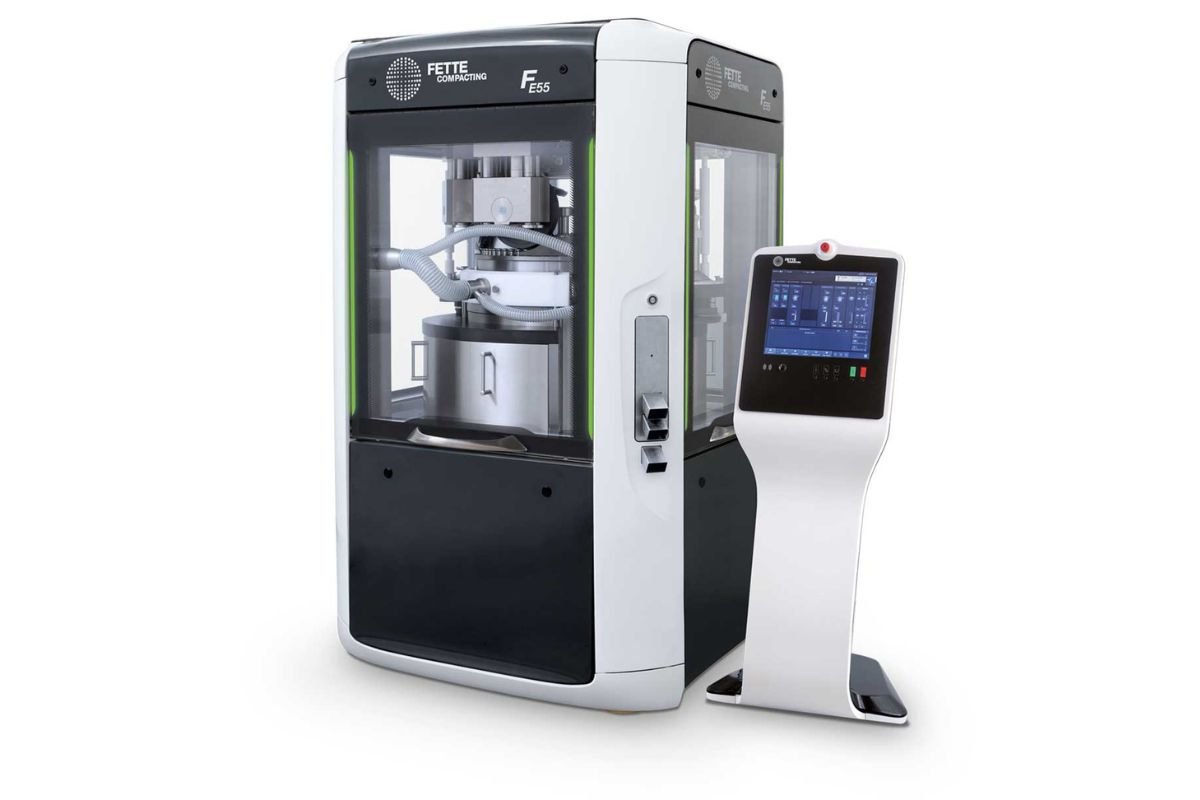
A tablet compression machine (tablet press) makes a tablet by squeezing a measured volume of powder or granules between an upper and a lower punch inside a die. On a rotary press the turret carries every punch-and-die set past fixed cams and rollers: the fill cam pulls the lower punch down so the die over-fills, the dosing (weight-control) cam pushes it back up to the set fill depth while a scraper removes the excess, pre-compression and then main-compression rollers press both punches together, and the ejection cam lifts the lower punch so a take-off blade sweeps the tablet off the die table.
The force comes from rollers acting mechanically on the punch heads, not from a hydraulic press. Fill depth sets weight; the main-roller gap sets thickness and hardness; turret speed sets output and dwell time.
How a tablet compression machine works: the compression cycle, stage by stage
Each station on the turret of a rotary tablet compression machine goes through the same cycle once per revolution (twice on a double-sided press with two compression points). Tap a stage to see where the punches are and which machine setting controls it.
Stage 1 — Die filling
As the station passes under the feed frame, the fill cam pulls the lower punch down and the die cavity fills with more powder than the tablet needs. Over-filling is deliberate: the excess is removed in the next stage so every die starts from the same level.
- Gravity feeder
- Powder falls from the hopper through an open feed frame. Adequate for free-flowing granules at moderate speed.
- Force (induced) feeder
- Rotating paddles push the blend into the dies. Used for poorer-flowing blends and higher turret speeds.
- Watch-out
- Paddle shear also mixes lubricant further into the blend. A compaction-simulator study found feed-frame shear caused more tensile-strength loss than raising the magnesium stearate level itself [1] — so paddle speed belongs on the list of settings you control, not just turret speed.
Stage 2 — Weight control (dosing) and scraping
The dosing cam (also called the weight-control or metering cam) raises the lower punch to the set fill depth, pushing surplus powder above the die table. A fixed scraper blade wipes the table flush, so the volume left in the die is the fill volume.
- What it controls
- Tablet weight, and therefore content per tablet. Raising the dosing cam reduces the volume and the weight; lowering it does the opposite.
- Why weight drifts
- The die is filled by volume, so any change in bulk density — segregation in the hopper, moisture pick-up, a different granule size — changes weight even when the setting has not moved.
Stage 3 — Pre-compression
The upper punch is lowered into the die and both punch heads pass between a pair of smaller pre-compression rollers. The powder is partly consolidated at a low force and air has a chance to escape before the main squeeze.
- Why it matters
- Entrapped air and a fast single compression are classic contributors to capping and lamination. Pre-compression spreads the densification over two events.
- Setting
- The pre-compression roller gap (or force set point on force-controlled presses).
- Upper punch penetration
- How far the upper punch enters the die during compression. It sets where in the die bore the tablet is formed, and is adjusted together with fill depth rather than on its own.
Stage 4 — Main compression
The punch heads now pass between the large main compression rollers. The distance between the punch tips at this point is the tablet’s thickness; the force needed to reach it is the compression force, which builds the bonds that give the tablet its hardness.
- Setting
- The gap between the upper and lower main rollers. Fix the thickness and the force follows the powder; change the powder and the force changes.
- What it moves
- Hardness (breaking force), thickness, porosity, friability, disintegration and dissolution. Across three formulations and three presses, pre-compression force, main compression force and press speed together predicted tensile strength, porosity and disintegration time [2].
- Where hydraulics come in
- Many presses mount the rollers on a hydraulic or pneumatic overload system that yields if force exceeds a safe limit. That protects the tooling; it is not how the tablet is formed.
Stage 5 — Ejection
The upper punch is lifted out of the die by the upper cam track, the ejection cam pushes the lower punch up until the tablet is level with the die table, and the take-off blade deflects it into the discharge chute. The lower punch then drops back to the fill cam and the cycle repeats.
- What goes wrong here
- As the tablet leaves the die it expands. Elastic energy stored during compression is a recognised driver of capping and lamination [3]; high die-wall friction shows up as high ejection force, scored tablet edges and sticking.
Parts of a tablet compression machine and what each one does
Hopper and feed frame
Hold the blend and deliver it to the dies, by gravity or by a paddle force feeder. Hopper design matters for segregation and bridging.
Turret
The rotating head: upper punch guides, the die table (holding the dies) and lower punch guides. The number of die bores is the number of stations.
Punches and dies
The tooling. The die bore sets tablet diameter and shape; the punch tips set the faces, embossing and break-lines.
Cam tracks
Fixed tracks that move the punches up and down as the turret turns: fill cam, dosing (weight) cam, upper and lower guide tracks, ejection cam.
Pre- and main compression rollers
Press the punch heads together. Their gaps set pre-compression and main compression; force sensors on instrumented presses read the result.
Scraper, take-off blade and chute
Remove excess powder after dosing and guide finished tablets out to the de-duster, metal detector or container.
Tooling standards: B and D, EU and TSM
Two families of standard tooling are in use: the American TSM standard and the European EU (Euronorm) standard, each in “B” and “D” sizes [4]. They are close but not identical — for example the TSM “B” punch has a 37° inside head angle against 30° for EU [4] — so tooling should be ordered to the standard the press’s cam tracks were built for.
Scroll the table sideways →
| Tooling | Nominal barrel diameter | Typical use | Note |
|---|---|---|---|
| EU19 / TSM “B” | 19 mm (¾ in) | Small and medium tablets | More stations on a given turret than D tooling |
| EU1″ / TSM “D” | 25.4 mm (1 in) | Larger tablets and higher forces | Fewer stations on the same turret size |
| Fette FS® punches (e.g. FS19, FS12) | Manufacturer-specific | Longer dwell or more stations on Fette presses | Fette states FS19 gives about 30% longer dwell time than EU19; FS12 has a 12 mm shaft and 19 mm head [5] |
Barrel sizes are the nominal values the standard names refer to (19 mm; 1 inch). For full dimensions use the TSM manual or your tooling supplier’s drawing.
Single-punch vs rotary tablet compression machine, output and what is different about a Fette press
Single-punch (eccentric) press
One die and one set of punches. The lower punch stays put during compression and the upper punch, driven by an eccentric cam, does the pressing — so the tablet is compressed from one side. Used for R&D, small batches and teaching.
Rotary (multi-station) press
Many stations on a rotating turret; both punches move between rollers, so the tablet is compressed from both sides. Single-sided presses have one compression point per revolution; double-sided (“double rotary”) presses have two.
Theoretical output from turret speed
Tablets per hour = stations × compression points per revolution × turret rpm × 60 × punch tips
Example: a 27-station double-sided press with single-tip tooling at 30 rpm gives 27 × 2 × 30 × 60 = 97,200 tablets/hour as a theoretical ceiling. Real output is lower once start-up, weight checks and stoppages are counted. At the top end, Fette announced its FE75 press at launch as capable of more than 1.6 million tablets per hour with up to 115 stations [6].
Fette compression machine working principle
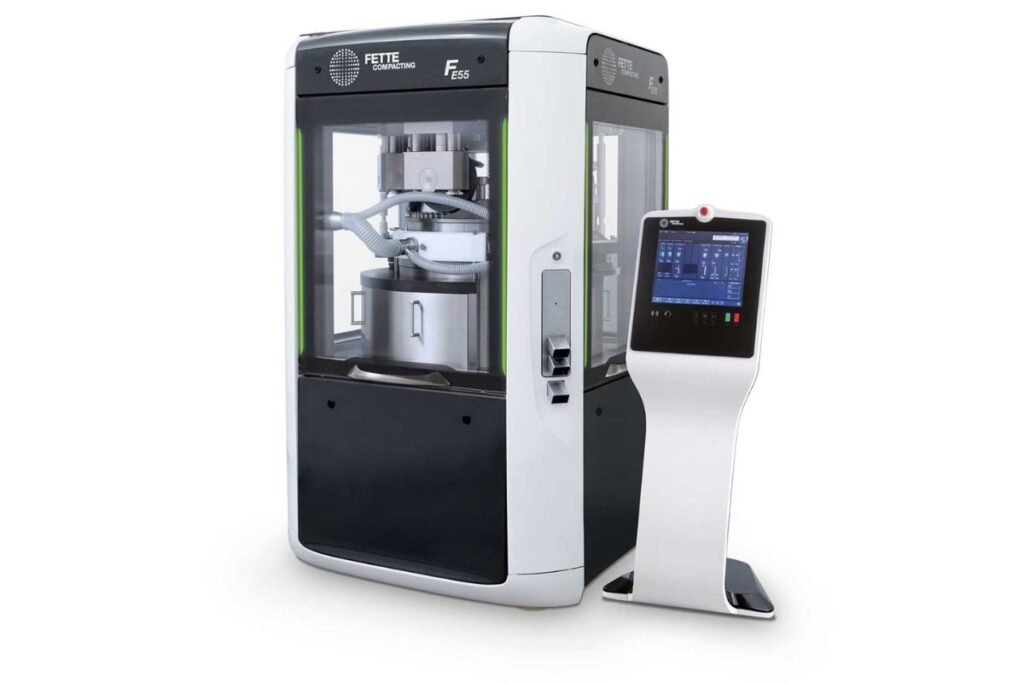
A Fette press works on exactly the same rotary cycle described above. What differs is engineering around it: proprietary FS® tooling for longer dwell or more stations [5], high-output turrets and automated force-based weight control. For a model-by-model comparison of Fette, Korsch, GEA, Syntegon and IMA production presses, see our comparison of tablet presses for USFDA and EU GMP facilities.
Critical process parameters (CPPs) of a tablet compression machine
ICH Q8(R2) defines a CPP as a process parameter whose variability has an impact on a critical quality attribute and therefore should be monitored or controlled [7]. Which press settings qualify is decided product by product during development and process validation — the table lists the usual candidates, not a fixed list.
Scroll the table sideways →
| Parameter | Machine adjustment | Quality attributes it moves | What to watch |
|---|---|---|---|
| Fill depth | Dosing (weight-control) cam / fill-depth setting | Weight, content uniformity | Bulk-density drift changes weight at a fixed setting |
| Main compression force / thickness | Main roller gap; force set point on force-controlled presses | Hardness, thickness, friability, disintegration, dissolution | Over-compression slows disintegration and dissolution |
| Pre-compression force | Pre-compression roller gap | Capping, lamination, hardness | Too little leaves air in the compact |
| Turret speed | Drive speed (rpm) | Output, dwell time, die-fill time | Higher speed shortens fill time and dwell time; weight variation and capping often appear first |
| Feeder paddle speed | Force-feeder drive | Die filling, tensile strength | Shear can over-lubricate the blend and soften tablets [1] |
| Upper punch penetration | Upper roller / penetration setting | Where the tablet forms in the die | Set together with fill depth |
Press settings are only half the picture. On a continuous direct-compression line, changing blend composition significantly altered tablet quality at the press [8] — incoming material attributes need the same control as machine settings.
Dwell time and turret speed on a tablet compression machine
Dwell time is the time the flat of the punch head is in contact with the compression roller — the period of peak force. Korsch gives the calculation as the flat diameter divided by the linear speed of the punch [9]:
Linear punch speed (mm/s) = π × pitch circle diameter (mm) × rpm ÷ 60
Dwell time (ms) = head flat (mm) ÷ linear punch speed (mm/s) × 1000
Worked example using Fette’s published punch-head flats — 9.6 mm for EU19 and 12.5 mm for its FS® version [5] — on an illustrative 300 mm pitch circle diameter (check your own press’s PCD):
Scroll the table sideways →
| Turret speed | Linear punch speed | Dwell time, EU19 (9.6 mm flat) | Dwell time, FS® (12.5 mm flat) |
|---|---|---|---|
| 30 rpm | 471 mm/s | 20.4 ms | 26.5 ms |
| 45 rpm | 707 mm/s | 13.6 ms | 17.7 ms |
| 60 rpm | 942 mm/s | 10.2 ms | 13.3 ms |
Doubling turret speed halves dwell time. A larger head flat buys it back: 12.5 ÷ 9.6 = 1.30, matching Fette’s “about 30% longer” claim.
Weight variation limits at the press: quick calculator
Ph. Eur. 2.9.5 (uniformity of mass) weighs 20 tablets individually: not more than 2 may deviate from the average mass by more than the band percentage, and none by more than twice that percentage [11]. Enter the target average mass to get the limits in milligrams.
Band: 250 mg or more — 5%
Not more than 2 of 20 outside: 237.5 – 262.5 mg
None outside: 225.0 – 275.0 mg
Bands: 80 mg or less — 10%; more than 80 mg and less than 250 mg — 7.5%; 250 mg or more — 5% (uncoated and film-coated tablets) [11]. For products registered in India, apply the current Indian Pharmacopoeia and your approved specification; the IP text was not available to check for this page.
This is a different test from uniformity of dosage units (Ph. Eur. 2.9.40, harmonised with USP <905>), which uses an acceptance value with L1 = 15.0 and allows mass variation in place of content uniformity only for tablets containing 25 mg or more of a drug that makes up 25% or more of the tablet mass [12]. The earlier version of this page stated a “USP limit of RSD under 5%”; no such limit exists in either text.
Troubleshooting common tablet compression machine defects
Scroll the table sideways →
| Defect | Machine-side checks | Formulation-side causes |
|---|---|---|
| Capping / lamination | Add or raise pre-compression; reduce turret speed; check worn or burred punch tips and die bores; consider tapered dies | High elastic recovery [3]; too many fines; granules too dry; entrapped air |
| Sticking / picking | Clean and polish punch faces; review embossing depth and design; check punch coating | Granule moisture too high; too little lubricant; low-melting ingredients warming during long runs |
| Weight variation | Feed-frame level and paddle speed; worn dosing cam or lower punches; reduce speed if dies under-fill | Poor flow; segregation in the hopper; wide particle-size distribution |
| Low hardness / high friability | Main roller gap; pre-compression; feeder shear [1] | Over-lubrication; binder level; granule moisture |
| Slow disintegration / dissolution | Compression force or thickness too tight | Over-compressed or over-granulated blend; disintegrant level |
| Black spots / oil marks | Excess punch lubrication; worn punch seals or dust cups; dirty upper punch guides | — |
Any change made to clear a defect on a validated product goes through change control and, where it moves a validated range, re-validation.
Compaction behaviour in one equation: the Heckel plot
Formulation scientists characterise how a powder densifies with the Heckel equation, written as ln(1/(1−SF)) = k·P + A, where SF is the solid fraction at compaction pressure P [3]. The yield pressure is the reciprocal of the slope, Py = 1/k [3].
Low yield pressure (steep slope) means the material deforms plastically easily; high yield pressure means it resists — typical of brittle fillers such as dibasic calcium phosphate. In the cited study, polymeric excipients gave yield pressures below 100 MPa, while brittle fillers gave the highest values [3]. The earlier version of this page had this relationship the wrong way round.
GMP requirements for a tablet compression machine in India
Revised Schedule M (Drugs Rules, 1945, as substituted by G.S.R. 922(E) of 28 December 2023) applies to every tablet compression machine in a licensed plant. Section 13 requires equipment to be located, designed, constructed, adapted and maintained to suit the operations, production equipment to be cleaned to a fixed schedule, and balances and measuring equipment to be calibrated to a fixed schedule; section 5.3 defines design, installation, operational and performance qualification [13]. In practice, for a press that means:
- DQ/IQ/OQ/PQ on installation and after major modification, with force sensors and speed readouts calibrated.
- Cleaning and line clearance records between products, and tooling issue, inspection and storage records for punches and dies.
- In-process checks at defined intervals in the batch record — weight, thickness, hardness, friability and disintegration. Friability is normally checked against not more than 1.0% loss of mass unless otherwise specified in the dossier [14]; see our friability test SOP and disintegration apparatus SOP.
- Process validation of the compression stage across the proven speed and force ranges — see basic requirements for process validation.
- Room and area: compression cubicles sit inside the tablet section’s minimum area — see Schedule M area requirements by dosage form.
Plants supplying the US market also work to 21 CFR 211 Subpart D, which requires equipment of appropriate design, adequate size and suitable location, and cleaning and maintenance at appropriate intervals [17]. For the full list of machines a tablet section needs before it can be licensed, see our pharma machinery list for tablet, capsule and liquid sections.
Need tablets made without installing your own compression line?
A loan-licence arrangement lets a brand owner manufacture under its own licence on another manufacturer’s qualified tablet section; Revised Schedule M has a dedicated section on production under loan licence. Our loan-licence consulting page explains the licence routes and how we support the liaison with the manufacturing site and the regulator.
See how pharma loan-licence manufacturing worksFrequently asked questions
Powder or granules are filled into a die by volume, the excess is scraped off, and an upper and a lower punch are pressed together by rollers to compress the powder into a tablet, which is then pushed out of the die. On a rotary press this cycle runs at every station on a rotating turret, guided by fixed cam tracks. The force is mechanical, from rollers acting on the punch heads.
Turret speed sets output (stations x compression points x rpm x 60 per hour) and also shortens both the time each die has to fill and the dwell time under the compression roller. Weight variation and capping are usually the first defects to appear when speed is raised, so the validated speed range should be stated in the batch record.
The usual candidates are fill depth, main compression force or thickness, pre-compression force, turret speed and force-feeder paddle speed. Under ICH Q8(R2) a parameter is a CPP only if its variability affects a critical quality attribute, so the final list is decided for each product during development and process validation.
Pre-compression partly consolidates the powder at low force so that air can escape and particles rearrange before the main squeeze. Spreading densification over two events helps against capping and lamination and can improve hardness at the same main compression force.
By fill depth. The die is over-filled, then the dosing (weight-control) cam raises the lower punch to the set height and a scraper removes the surplus, leaving a fixed volume. Because filling is volumetric, a change in the bulk density of the blend changes tablet weight even when the setting is unchanged.
Dwell time equals the punch head flat divided by the linear punch speed, where linear speed is pi x pitch circle diameter x rpm / 60. For a 9.6 mm head flat on a 300 mm pitch circle at 60 rpm, that is about 10 ms. This is geometric dwell time; the dwell time measured from the force curve differs and depends on force and formulation.
A single-punch press, also called an eccentric press, has one die; the lower punch stays still during compression and the upper punch does the pressing, so the tablet is compressed from one side. A rotary press carries many stations on a turret and moves both punches between rollers, compressing from both sides at production speed.
Related on Laafon
References
- Osman M, Reynolds G, Yates C, Markl D, Upadhyay PP, Pitt K, et al. Revisiting strain rate sensitivity: the role of feed frame-induced lubrication in tablet tensile strength loss during scale-up. Int J Pharm. 2026;697:126867. Available from: https://doi.org/10.1016/j.ijpharm.2026.126867. Accessed October 2026.
- Peddapatla RVG, Slevin C, Sheridan G, Beirne C, Swaminathan S, Browning I, et al. Modelling the compaction step of a platform direct compression process. Pharmaceutics. 2022;14(4):695. Available from: https://doi.org/10.3390/pharmaceutics14040695. Accessed October 2026.
- Schönfeld BV, Westedt U, Wagner KG. Compression modulus and apparent density of polymeric excipients during compression — impact on tabletability. Pharmaceutics. 2022;14(5):913. Available from: https://doi.org/10.3390/pharmaceutics14050913. Accessed October 2026.
- Natoli Engineering Company. Punches & dies: TSM/EU tooling specifications [Internet]. St. Charles (MO): Natoli Engineering. Available from: https://natoli.com/products/tablet-compression-tooling/punches-and-dies/tsm-eu-specs/. Accessed October 2026.
- Fette Compacting GmbH. FS Technology® tableting tools [brochure, ref. 241109 E]. Schwarzenbek: Fette Compacting; 2024. Distributor-hosted copy available from: https://europack.gr/wp-content/uploads/2025/07/FC_Tableting-Tools_241109_EN_screen.pdf. Accessed October 2026.
- Pharmaceutical Technology. Fette tablet press produces high volumes. PharmTech.com; 9 July 2014. Available from: https://www.pharmtech.com/view/fette-tablet-press-produces-high-volumes. Accessed October 2026.
- International Council for Harmonisation. ICH Q8(R2): Pharmaceutical development. Step 4. Geneva: ICH; August 2009. Available from: https://database.ich.org/sites/default/files/Q8_R2_Guideline.pdf. Accessed October 2026.
- Bekaert B, Van Snick B, Pandelaere K, Dhondt J, Di Pretoro G, De Beer T, et al. Continuous direct compression: development of an empirical predictive model and challenges regarding PAT implementation. Int J Pharm X. 2021;4:100110. Available from: https://doi.org/10.1016/j.ijpx.2021.100110. Accessed October 2026.
- Carlin B. Tableting rheology and quality by design [Internet]. Berlin: KORSCH AG; 18 February 2026. Available from: https://www.korsch.com/blog/tableting-rheology-and-quality-by-design/. Accessed October 2026.
- Mohylyuk V. Dwell time on tableting: dwell time according to force versus geometric dwell time. Pharm Dev Technol. 2024;29(7):719–726. Available from: https://doi.org/10.1080/10837450.2024.2384446. Accessed October 2026.
- European Pharmacopoeia. 2.9.5 Uniformity of mass of single-dose preparations. 7th ed. Strasbourg: Council of Europe (EDQM); 2010. Historical-edition reprint read via: http://www.drugfuture.com/Pharmacopoeia/EP7/DATA/20905E.PDF. Accessed October 2026.
- European Pharmacopoeia. 2.9.40 Uniformity of dosage units. 7th ed. Strasbourg: Council of Europe (EDQM); 2010. Historical-edition reprint read via: http://www.drugfuture.com/Pharmacopoeia/EP7/DATA/20940E.PDF. Accessed October 2026.
- Ministry of Health and Family Welfare (India). Drugs (Amendment) Rules, 2023 — Schedule M, Good Manufacturing Practices and requirements of premises, plant and equipment for pharmaceutical products. G.S.R. 922(E), Gazette of India, 28 December 2023. Gazette copy read via: https://pharmadocx.com/wp-content/uploads/2024/01/Notified-Schedule-M-dt-28.12.2023-1.pdf. Accessed October 2026.
- U.S. Food and Drug Administration; International Council for Harmonisation. Q4B evaluation and recommendation of pharmacopoeial texts for use in the ICH regions, Annex 9(R1): tablet friability general chapter. Silver Spring (MD): FDA; September 2017. Available from: https://www.fda.gov/media/77008/download. Accessed October 2026.
- CliniExperts. Extension of timeline for compliance with revised Schedule M for small and medium drug manufacturers (G.S.R. 10(E), 4 January 2025) [secondary summary]. Available from: https://cliniexperts.com/regulatory-update/extension-of-timeline-for-compliance-with-revised-schedule-m-for-small-and-medium-drug-manufacturers/. Accessed October 2026.
- Business Standard. Pharma units likely to face action for Schedule M violations: experts. 8 November 2025. Available from: https://www.business-standard.com/industry/news/cdsco-asks-state-units-to-start-inspections-under-schedule-m-norms-125110801170_1.html. Accessed October 2026.
- Code of Federal Regulations. Title 21, Part 211, Subpart D — Equipment (§§211.63–211.72). Washington (DC): National Archives, eCFR. Available from: https://www.ecfr.gov/current/title-21/chapter-I/subchapter-C/part-211/subpart-D. Accessed October 2026.
This page is technical and educational information for pharmaceutical professionals. It is not legal, medical or investment advice. Pharmacopoeial texts, Schedule M and other Indian statutory instruments are revised frequently; confirm every limit against the current official edition and your approved product specification before use.