
The short answer
The harmonised pharmacopoeial method specifies exactly one thing about how long a friability test runs: 100 revolutions of a drum turning at 25 ± 1 r/min. The “4 minutes” printed in most Indian SOPs is arithmetic (100 ÷ 25), not a compendial requirement. No unit of time appears anywhere in European Pharmacopoeia chapter 2.9.7 other than the r/min in that rotation speed.[1]
A defensible friability test procedure for tablets therefore rests on four numbers and one visual check: a sample of whole tablets corresponding as near as possible to 6.5 g when unit mass is 650 mg or less, or 10 whole tablets when it is more than 650 mg; 100 revolutions; a loss of mass not greater than 1.0 per cent, which the chapter calls “considered acceptable for most products” rather than a specification; and automatic failure if any obviously cracked, cleaved or broken tablet is present after tumbling, whatever the mass loss turns out to be.[1]
On this page
- What the harmonised method actually specifies
- Apparatus: drum dimensions and control points
- Sample size: the 650 mg rule
- Friability test procedure for tablets, step by step
- Friability calculator
- Acceptance criteria and the two failure modes
- Where the 1.0 per cent limit comes from
- Ph. Eur. 2.9.7, USP 1216 and JP compared
- Calibration: who sets the frequency
- SOP template for operation and calibration
- Frequently asked questions
- References
Seven things this page corrects
- “100 revolutions or 4 minutes” is not compendial wording. The chapter gives revolutions and a rotation speed, never a duration.
- “10 tablets or 6.5 g” is not a choice. Unit mass decides which of two mutually exclusive rules applies.
- 1.0 per cent is not a pharmacopoeial specification. It is a value “considered acceptable for most products” inside a chapter that calls itself guidelines.
- A cracked, cleaved or broken tablet fails the sample on its own — independent of the mass loss figure.
- No pharmacopoeia sets a calibration interval. “Once a month” is site policy, and it must be written as site policy.
- The method covers compressed, uncoated tablets. Coated tablets are not mentioned in the chapter at all.
- ICH Q4B interchangeability does not extend to India. The annex names the FDA, EU, MHLW and Health Canada regions.
What the harmonised friability method actually specifies
Three pharmacopoeias carry the same friability text because it went through pharmacopoeial harmonisation: European Pharmacopoeia general method 2.9.7 Friability of uncoated tablets (reference 01/2010:20907), USP General Chapter <1216> Tablet Friability, and JP General Information 26. Tablet Friability Test.[1][3] The USP chapter opens by stating that it “has been harmonized with the corresponding texts of the European Pharmacopoeia” and the Japanese Pharmacopoeia, that the three are “therefore interchangeable”, and that the pharmacopoeias “have undertaken not to make any unilateral change to this harmonized chapter”.[5]
Read against that text, the quantities an SOP is allowed to state are narrow. Ph. Eur. 2.9.7 instructs the analyst to “Rotate the drum 100 times, and remove the tablets”, with the drum “attached to the horizontal axis of a device that rotates at 25 ± 1 r/min”.[1] That is the whole of the timing requirement. The chapter contains no minutes, no seconds, and no elapsed-time window.
So where does “4 minutes” come from? It is the nominal time at the nominal speed, and once you treat it as derived rather than prescribed, the speed tolerance gives you something far more useful for a calibration record — a permissible elapsed-time window you can actually check with a stopwatch.
| Drum speed | Time for 100 revolutions | Status of the figure |
|---|---|---|
| 26 r/min (25 + 1) | 230.8 s | Fast limit of the tolerance. Derived, not stated in the chapter. |
| 25 r/min (nominal) | 240.0 s (4 min 00 s) | The origin of the “4 minutes” figure. Nominal only. |
| 24 r/min (25 − 1) | 250.0 s | Slow limit of the tolerance. Derived, not stated in the chapter. |
Swipe the table sideways on a phone. Arithmetic from the 25 ± 1 r/min tolerance in Ph. Eur. 2.9.7; the chapter itself publishes no time window.[1]
Why this matters in an audit. An SOP that writes “rotate for 100 revolutions or 4 minutes” has created an alternative acceptance route the pharmacopoeia never granted. On a drum running at the slow end of tolerance, stopping at 4 minutes delivers 96 revolutions, and the test is then non-compliant on its only mandatory quantity. Write the revolution count as the requirement and the 231–250 s window as the speed verification, not the other way round.
Friability test apparatus: drum dimensions and control points
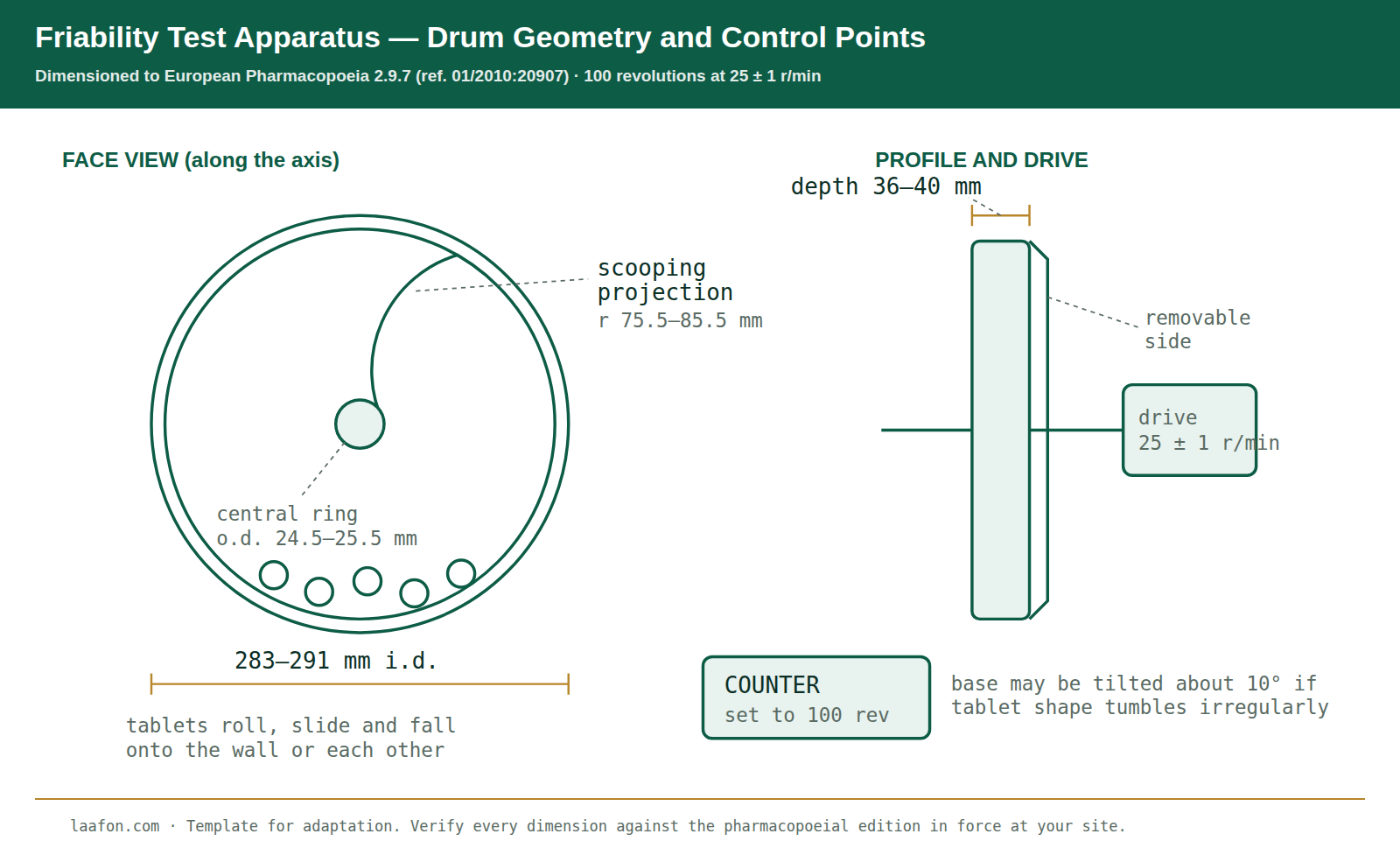
The friabilator is one of the few QC instruments whose entire specification is dimensional. There is no detector to drift and no reference standard to buy — the apparatus either conforms to the drum geometry and the speed, or it does not. Tap any component below to see its specification and the failure it produces.
Select a component
Specification appears here.
Every dimension below is quoted from Ph. Eur. 2.9.7 unless the panel says otherwise.
| Component | Specification | Why it is specified | Basis |
|---|---|---|---|
| Drum internal diameter | 283–291 mm | Fixes the distance a tablet falls, and therefore the impact energy per revolution | compendial 2.9.7 [1] |
| Drum depth | 36–40 mm | Keeps the tablet bed a single layer so tablets cannot cushion each other | compendial 2.9.7 [1] |
| Scooping projection, inside radius | 75.5–85.5 mm | Lifts the tablets once per revolution; a worn or wrong-radius scoop under-stresses the sample | compendial 2.9.7 [1] |
| Central ring, outer diameter | 24.5–25.5 mm | Anchors the projection at the drum centre | compendial 2.9.7 [1] |
| Drum material and surface | Transparent synthetic polymer, polished internal surfaces, minimum static build-up | Static charge retains dust on the wall and biases the recovered mass upward | compendial 2.9.7 [1] |
| Removable side | One side of the drum is removable | Loading and recovery without tipping the sample | compendial 2.9.7 [1] |
| Rotation speed | 25 ± 1 r/min | The only rate-controlling variable in the test | compendial 2.9.7 [1] |
| Revolutions per test | 100 | The actual dose of mechanical stress applied to the sample | compendial 2.9.7 [1] |
| Base angle for irregular tumbling | about 10° to horizontal | Stops elongated or flat tablets sliding instead of tumbling | compendial 2.9.7, conditional [1] |
| Drum variants | Dual scooping projections, or more than one drum on the axis for multiple samples | Throughput; both are expressly permitted | compendial 2.9.7 [1] |
| Tablet drop height | Not specified | Widely quoted as “six inches” in secondary sources; the chapter states no fall distance, only the drum dimensions that determine it | check source absent from 2.9.7 [1] |
Dimensions as published in Ph. Eur. 7.0, reference 01/2010:20907, and reproduced in the British Pharmacopoeia as Appendix XVII G.[2] Verify against the edition in force at your site before issuing an SOP.
Sample size: the 650 mg rule, and what most SOPs get wrong
This is the single most common error in Indian friability SOPs, including the earlier version of this page. The pharmacopoeia does not offer a choice between “10 tablets” and “6.5 g”. It gives two mutually exclusive rules, and the tablet’s unit mass decides which one applies:[1]
- Unit mass 650 mg or less — “take a sample of whole tablets corresponding as near as possible to 6.5 g”. Note as near as possible to, not not more than. Overshooting 6.5 g slightly is correct; undershooting by several tablets to stay under it is not.
- Unit mass more than 650 mg — “take a sample of 10 whole tablets”. The 6.5 g rule does not apply here at all, which matters because 10 tablets of 800 mg weigh 8 g.
A 6.5 g target is roughly 10 tablets only when the unit mass happens to be near 650 mg. For a 250 mg tablet the correct sample is about 26 tablets; for a 100 mg tablet it is about 65. An SOP that fixes the count at 10 tests a tenth of the mass the method intends on a low-weight tablet, and the per cent loss it reports is not comparable with anything.
Which sample rule and test conditions apply to your tablet?
Select a unit mass and a tablet type
The verdict names the sample rule from Ph. Eur. 2.9.7 and any condition the chapter attaches to that tablet type.
Friability test procedure for tablets, step by step
The friability test procedure for tablets below is the compendial method stated as discrete actions. It is deliberately shorter than most published versions, because everything in it is traceable to the chapter; the site-specific additions belong in the SOP block further down, labelled as site policy.
- Dedust the tablets. “The tablets are carefully dedusted prior to testing.” Surface dust carried into the drum is weighed as tablet mass at the start and lost at the end, inflating the result.[1]
- Select the sample by unit mass. As near as possible to 6.5 g of whole tablets at 650 mg or less; 10 whole tablets above 650 mg. Whole tablets only — no halves, no visibly chipped units.
- Weigh accurately. Record the initial mass. This is the denominator of the result, so the balance used must be within its own calibration status.
- Load the drum through the removable side and close it.
- Check the drum base if the tablet is elongated, oval or flat. Where shape causes irregular tumbling, the chapter permits adjusting the base to about 10° from horizontal so tablets tumble rather than slide.[1]
- Set the counter to 100 revolutions and start. Let the instrument complete the count; do not stop on a timer.
- Verify the elapsed time against 231–250 s as a running check on drum speed. A result outside that window means the speed is outside 25 ± 1 r/min and the test is invalid, not merely slow.
- Remove the tablets and inspect them before weighing. Any obviously cracked, cleaved or broken tablet fails the sample at this point, whatever the mass loss.[1]
- Dedust again — “Remove any loose dust from the tablets as before” — and weigh accurately.[1]
- Calculate the per cent loss of mass and compare it with the specification registered for the product, not with a remembered 1 per cent.
- Repeat only on the stated trigger. “Generally, the test is run once.” If the results are difficult to interpret, or the loss exceeds the targeted value, the chapter directs that the test is repeated twice and the mean of the three determined.[1]
The repeat rule is not a retest licence. Repeating twice and taking the mean of three is the chapter’s own provision for an ambiguous or failing single determination, and it is available only on those two triggers. It does not authorise discarding a failing result and reporting a fresh one. Whether a particular repeat is a valid application of 2.9.7 or a reportable out-of-specification investigation is a decision for Quality Assurance under the site OOS procedure, not for the analyst at the bench.
Friability calculator: per cent loss of mass against your specification
Per cent friability is the loss of mass expressed against the initial mass. Ph. Eur. 2.9.7 gives no formula or symbols — it states the criterion as a maximum loss of mass in per cent — so the expression below is the universal working form rather than a quoted equation.[1]
Friability (%) = (initial mass − final mass) ÷ initial mass × 100
Calculate and check against your registered limit
Enter an initial and a final mass.
A pass here is provisional: a sample containing an obviously cracked, cleaved or broken tablet fails regardless of this figure.
Acceptance criteria and the two independent ways a sample fails
Friability has two failure modes, and published SOPs routinely carry only one of them. The mass-loss criterion is quantitative and is the one everybody writes down. The visual criterion is categorical, sits in the same paragraph of the chapter, and is the one that gets missed.
| Criterion | Limit | Effect | Basis |
|---|---|---|---|
| Loss of mass, single determination | NMT 1.0% | “considered acceptable for most products” — a guideline value, not a registered specification | compendial 2.9.7 [1] |
| Loss of mass, interchangeability condition | NMT 1.0% | Single determination, “unless otherwise specified in the dossier” | ICH Q4B Annex 9(R1) [3] |
| Loss of mass, mean of three | NMT 1.0% | Mean of the three determinations, “unless otherwise specified in the dossier” | ICH Q4B Annex 9(R1) [3] |
| Physical integrity after tumbling | Zero tolerance | “If obviously cracked, cleaved, or broken tablets are present in the tablet sample after tumbling, the sample fails the test.” | compendial 2.9.7 [1] |
| Effervescent and chewable tablets | Product specific | “may have different specifications as far as friability is concerned” — the 1.0% guideline is not assumed to apply | compendial 2.9.7 [1] |
| Hygroscopic tablets | Humidity-controlled environment required for testing | A condition on the test, not on the limit | compendial 2.9.7 [1] |
| Coated tablets | Outside the scope of 2.9.7 | The chapter covers “compressed, uncoated tablets” and does not mention coated tablets anywhere | check source scope statement, 2.9.7 [1] |
| Calibration interval | Site defined | No interval appears in the chapter; monthly, quarterly or annual are all internal conventions | site policy not a compendial requirement |
NMT = not more than. Rows badged site policy are internal convention; rows badged check source are places where the figure an SOP usually carries is absent from the primary text.
Where the 1.0 per cent limit comes from, and what actually governs it
“NMT 1% as per USP” is the most repeated sentence in Indian friability documentation, and it compresses three different things into one claim. Unpacking it changes how the limit should be written in an SOP.
First, the pharmacopoeial status. USP <1216> is numbered above 1000 and describes itself as a general information chapter.[5] Its Ph. Eur. counterpart opens “This chapter provides guidelines for the friability determination of compressed, uncoated tablets”, and words the criterion as “A maximum loss of mass (obtained from a single test or from the mean of 3 tests) not greater than 1.0 per cent is considered acceptable for most products”.[1] Neither text issues 1.0 per cent as a specification. Both offer it as a value that is usually appropriate.
Second, the regulatory status. ICH Q4B Annex 9(R1) is where 1.0 per cent acquires teeth. The annex recommends that Ph. Eur. 2.9.7, JP General Information 26 and USP <1216> “can be used as interchangeable in the ICH regions”, and attaches an explicit condition: for interchangeability, “the loss of mass for a single determination should be not more than 1.0 percent, unless otherwise specified in the dossier”, with the same limit applied to the mean where three determinations are conducted.[3] In the EU the annex carries reference EMEA/CHMP/ICH/379801/2009 with a legal effective date of 1 May 2010.[4]
Third, and decisively: “unless otherwise specified in the dossier”. The limit that governs release of a specific product is the one in that product’s registered specification. If the dossier says 0.5 per cent, 0.5 per cent is the limit, and a result of 0.8 per cent is a failure no matter what any general chapter calls acceptable. If the dossier is silent, 1.0 per cent is the default the annex expects. An SOP should therefore point the analyst at the product specification and quote 1.0 per cent as the fallback, which is the opposite of how most are written.
An India-specific caveat worth writing down. ICH Q4B Annex 9(R1) states implementation for four regions — FDA, the EU, MHLW and Health Canada.[3] India is not among them. A domestic inspection is conducted against the pharmacopoeia your product is registered to comply with, so the interchangeability argument is available for an export dossier into those regions and is not a substitute for testing to the compendium named in your own specification.
Ph. Eur. 2.9.7, USP <1216> and JP General Information 26 compared
| Aspect | Ph. Eur. 2.9.7 | USP <1216> | JP |
|---|---|---|---|
| Chapter designation | General method 2.9.7, ref. 01/2010:20907 | General Chapter <1216> | General Information 26. Tablet Friability Test |
| Placement in the compendium | General methods, subject to pharmacopoeial harmonisation (see Ph. Eur. 5.8) | Above 1000, self-described as a general information chapter | General Information |
| Harmonised text | Yes — carries the harmonisation footnote | Yes — states the three are “therefore interchangeable” | Yes |
| Apparatus and procedure | Drum 283–291 mm i.d., 36–40 mm deep, 25 ± 1 r/min, 100 revolutions | Harmonised, therefore the same method | Harmonised, therefore the same method |
| Interchangeability in the ICH regions | Recommended by ICH Q4B Annex 9(R1), conditional on NMT 1.0 per cent loss of mass unless the dossier specifies otherwise [3] | ||
| Freely retrievable text | Official text is subscription only; the harmonised wording is reproduced in the British Pharmacopoeia [2] | Subscription only; the harmonisation statement is visible in the public preview [5] | Subscription or MHLW publication |
Because the three chapters are harmonised, the apparatus and procedure do not differ between them. What differs is where each pharmacopoeia files the chapter and what your dossier cites. The Indian Pharmacopoeia text is not freely retrievable and no IP chapter number is quoted on this page for that reason.
Calibration and qualification: no pharmacopoeia sets the frequency
A friabilator has three measurable attributes and nothing else: drum geometry, rotation speed and revolution count. That makes its periodic verification unusually simple and unusually easy to document badly.
- Rotation speed. Verify against 25 ± 1 r/min. The practical bench method is to time 100 revolutions and check the result falls in 231–250 s, which is the same tolerance expressed as elapsed time.
- Revolution count. Run the instrument at its 100-revolution setting and count the turns independently. A counter that stops at 98 is a silent, systematic low bias on every friability result the lab has reported.
- Drum dimensions. Measure internal diameter and depth against 283–291 mm and 36–40 mm at qualification and after any drum replacement. A replacement drum sourced on price rather than specification is the realistic failure here.
- Scoop and ring. Inspect the scooping projection for wear and confirm the inside radius and central-ring diameter at qualification.
- Balance. The result is a ratio of two weighings, so the analytical balance used must be inside its own calibration status. This is frequently the weakest link in a friability record.
On frequency, be exact about what you are claiming. Ph. Eur. 2.9.7 contains no interval, no periodic check and no equipment-qualification requirement — the words calibration, frequency and periodic do not occur in the chapter at all. By contrast, the neighbouring chapter on resistance to crushing does specify a calibration precision for its apparatus, which shows the omission in 2.9.7 is a drafting decision rather than an oversight in the reader’s copy.[1] A monthly interval — the convention on this site’s disintegration test apparatus SOP as well — is a defensible internal policy derived from instrument criticality and use. It is not a pharmacopoeial requirement, and an SOP that presents it as one has created a finding where none existed.
SOP for operation and calibration of the friability test apparatus
A template to adapt, not to issue as it stands. The header fields are intentionally blank: a document number belongs to your QMS, not to this page.
1.0 Purpose
To lay down the procedure for operation, periodic verification and recording of the friability test apparatus used for determining the friability of compressed, uncoated tablets.
2.0 Scope
Applicable to the friability test apparatus installed in the Quality Control laboratory, for in-process and finished-product friability testing of compressed, uncoated tablets. This procedure does not cover film-coated, sugar-coated or enteric-coated tablets, capsules, granules or spheroids; friability of granules and spheroids is a separate pharmacopoeial method. It does not cover the qualification of the analytical balance used for the weighings, which is governed by the balance SOP.
3.0 Responsibility
- Analyst / Chemist, Quality Control: performing the test, recording raw data, reporting results against the product specification.
- Officer / Executive, Quality Control: verification of entries, periodic speed and counter checks, instrument log upkeep.
- Head, Quality Assurance: approval of this SOP, periodic review, and decisions on any result that does not meet the registered specification.
4.0 Materials and equipment
- Friability test apparatus conforming to the drum geometry and speed of the applicable pharmacopoeial chapter.
- Analytical balance, within current calibration status, with a resolution appropriate to a 6.5 g sample.
- Soft brush or lint-free cloth for dedusting; stopwatch or calibrated timer; vernier caliper or depth gauge for drum dimension checks.
- Current product specification and the approved specimen test data sheet.
5.0 Procedure
6.0 Acceptance criteria
| Parameter | Limit | Basis |
|---|---|---|
| Per cent friability | As per registered specification; default NMT 1.0% | compendial + ICH 2.9.7; Q4B Annex 9(R1) dossier proviso [3] |
| Cracked, cleaved or broken tablets after tumbling | None | compendial 2.9.7 [1] |
| Drum rotation speed | 25 ± 1 r/min | compendial 2.9.7 [1] |
| Elapsed time for 100 revolutions | 231–250 s | derived arithmetic from 25 ± 1 r/min; not a compendial figure |
| Revolution count per test | 100 | compendial 2.9.7 [1] |
| Drum internal diameter / depth | 283–291 mm / 36–40 mm | compendial 2.9.7 [1] |
7.0 Frequency
- Friability testing: as required by the product specification and the in-process control plan for the batch.
- Speed and revolution-count verification: site policy once a month and after any maintenance. No pharmacopoeial interval exists; state the interval and its justification here rather than attributing it to a compendium.
- Drum dimensional check: site policy at qualification, on drum replacement, and annually.
8.0 Deviation and out-of-specification handling
- Result exceeding the registered specification, or difficult to interpret: do not repeat at the bench on the analyst’s initiative. Record the observation and refer to the QC Officer. The pharmacopoeial provision for repeating twice and taking the mean of three is applied only where it is justified and documented; otherwise the result is handled under the site out-of-specification procedure.
- Cracked, cleaved or broken tablets present: record as a failure of the sample and report, irrespective of the calculated loss of mass.
- Elapsed time outside the verification window: treat the run as invalid, raise an instrument deviation, and quarantine the instrument until speed is re-verified.
- Any drum dimension outside the stated range: stop use of the instrument and raise a deviation covering every result issued since the previous satisfactory dimensional check.
9.0 Precautions
- Weigh on a balance that is inside its calibration status. The friability figure is a ratio of two weighings and inherits the balance’s error twice.
- Dedust before and after with the same technique and the same tool, or the comparison between W1 and W2 is not valid.
- Do not substitute a drum of unverified geometry. Drum dimensions are the specification of this instrument.
- Do not dry, condition or otherwise treat tablets before a friability test unless the specification says so.
- Record raw weighings contemporaneously. A friability record that shows only the calculated percentage is an ALCOA finding waiting to happen.
10.0 Annexure-I: Friability test and instrument verification record
| Date | Product / batch | Unit mass (mg) | Sample rule applied | W1 (g) | W2 (g) | Friability (%) | Time for 100 rev (s) | Cracked / cleaved / broken | Specification (%) | Result | Done by | Checked by |
|---|---|---|---|---|---|---|---|---|---|---|---|---|
Copies as tab-separated text, so it pastes straight into a spreadsheet column layout.
11.0 Revision history
| Version | Effective date | Change | Reason |
|---|---|---|---|
| 00 | DD-MMM-YYYY | New document | Initial issue |
| 01 | DD-MMM-YYYY | Sample selection gated on 650 mg unit mass; elapsed-time window stated as derived; visual failure criterion added | Alignment with the harmonised pharmacopoeial text |
12.0 References
Cite the pharmacopoeial edition in force at your site. The primary texts used to build this template are listed in the references below.
Equipping or requalifying a QC laboratory
Friability is one line in an instrument package that also has to carry dissolution, disintegration, hardness, balances and an environment that passes inspection — and the QC laboratory is usually the section that gets under-budgeted in a plant project. Our pharma plant setup cost calculator lets you include or exclude the QC instrument package and see the capital effect against a Revised Schedule M, WHO-GMP or EU-GMP design basis. The figures are Laafon’s own project-rate basis and indicative for planning, not a quotation.
Related on Laafon
- SOP of disintegration test apparatus — the sister in-process test, with its own calibration limits for tube length, disc diameter and cycle rate.
- Working and principle of the tablet compression machine — where friability is actually decided: compression force, dwell time and tooling, not the QC bench.
- FBD vs FBP vs RMG — granule quality upstream is the usual root cause when friability drifts across batches.
- Qualification of the UV-visible spectrophotometer — the IQ/OQ/PQ pattern applied to an instrument that, unlike a friabilator, does need reference standards.
- Calibration of the melting point apparatus — another QC instrument whose published calibration frequency is site policy rather than compendial.
- SOP of working standard — the traceability chain behind every quantitative QC result.
- Quality assurance in the pharmaceutical industry — where SOP approval, deviation and OOS handling sit in the quality system.
- All SOPs on Laafon — the full QC and QA standard operating procedure library.
Frequently asked questions
100 revolutions. The friability test procedure for tablets in the harmonised pharmacopoeial text states 100 revolutions of a drum turning at 25 plus or minus 1 r/min, and states no duration at all. Four minutes is simply 100 divided by 25, the nominal time at the nominal speed. Because the speed carries a tolerance, 100 revolutions legitimately takes anywhere from about 231 to 250 seconds, so an SOP that permits stopping at 4 minutes can deliver as few as 96 revolutions on a slow instrument.
It depends on unit mass, and the two rules are mutually exclusive. For tablets with a unit mass of 650 mg or less, take whole tablets corresponding as near as possible to 6.5 g, which is about 26 tablets at 250 mg and about 65 at 100 mg. For tablets with a unit mass of more than 650 mg, take 10 whole tablets. The widely copied phrase 10 tablets or 6.5 g is wrong, because it presents a mass-gated rule as a free choice.
Not as a specification. The harmonised chapter words it as a maximum loss of mass not greater than 1.0 per cent being considered acceptable for most products, inside a chapter that describes itself as guidelines and which USP files as a general information chapter. ICH Q4B Annex 9(R1) makes 1.0 per cent a condition of interchangeability between the three pharmacopoeias, but qualifies it with the words unless otherwise specified in the dossier. The limit that governs release is the one in your registered product specification.
Yes, and this is the criterion most published SOPs omit. The chapter states that if obviously cracked, cleaved or broken tablets are present in the sample after tumbling, the sample fails the test. That is a categorical failure independent of the calculated percentage. A sample losing 0.2 per cent of its mass with one cleaved tablet has failed, so the procedure must require visual examination of the tablets before the final weighing, with the observation recorded.
No pharmacopoeia states an interval. The words calibration, frequency and periodic do not appear in the harmonised chapter at all, so monthly, quarterly and annual intervals are all internal conventions justified by instrument criticality and usage. A monthly speed and revolution-count check with dimensional verification at qualification and on drum replacement is a common and defensible policy. Write it in the SOP as site policy, not as a compendial requirement, because attributing an internal interval to a pharmacopoeia is the kind of claim an inspector will test.
The chapter’s own scope sentence limits it to compressed, uncoated tablets, and coated tablets are not mentioned anywhere in the text. In practice manufacturers do run friability on core tablets before coating, precisely because a core that sheds material will not coat cleanly. Where a friability test is performed on a coated tablet, treat it as an in-house test with an in-house limit and describe it that way in the specification, rather than citing the uncoated-tablet chapter as its basis.
References
- European Pharmacopoeia. 2.9.7. Friability of uncoated tablets. Reference 01/2010:20907. Strasbourg: Council of Europe. Text as published in Ph. Eur. 7.0. Available from: https://www.drugfuture.com/Pharmacopoeia/EP7/DATA/20907E.PDF. Accessed September 2026. The official current text is available to EDQM subscribers only.
- British Pharmacopoeia 2012. Appendix XVII G. Friability. 1. Uncoated Tablets (Ph. Eur. method 2.9.7). Available from: https://www.drugfuture.com/Pharmacopoeia/BP2012/data/859.html. Accessed September 2026.
- International Council for Harmonisation. Q4B Evaluation and Recommendation of Pharmacopoeial Texts for Use in the ICH Regions. Annex 9(R1): Tablet Friability General Chapter. Guidance for Industry. Silver Spring: US Food and Drug Administration, CDER/CBER; September 2017. ICH Step 4 endorsement September 2010. Available from: https://www.fda.gov/media/77008/download. Accessed September 2026.
- European Medicines Agency. ICH Q4B Annex 9 Tablet friability — Scientific guideline. Reference EMEA/CHMP/ICH/379801/2009. Legal effective date 1 May 2010. Available from: https://www.ema.europa.eu/en/ich-4-qb-annex-9-tablet-friability-scientific-guideline. Accessed September 2026.
- United States Pharmacopeia. General Chapter <1216> Tablet Friability. USP-NF. Rockville, MD: USP; 2022. DOI 10.31003/USPNF_M99935_02_01. Available from: https://doi.usp.org/USPNF/USPNF_M99935_02_01.html. Accessed September 2026. Chapter body is available to USP-NF subscribers only; the harmonisation statement is visible in the public preview.
This procedure is a template for adaptation. It requires local qualification, validation and Quality Assurance approval before use, and every acceptance criterion must be verified against the pharmacopoeial edition in force at your site and against the registered specification for the product concerned. Pharmacopoeial texts and Indian statutory instruments change between editions. Figures marked derived are arithmetic from a stated tolerance and are not themselves compendial values; figures marked site policy are internal convention. Technical and educational content only, not medical, legal or regulatory advice.