
Short answer
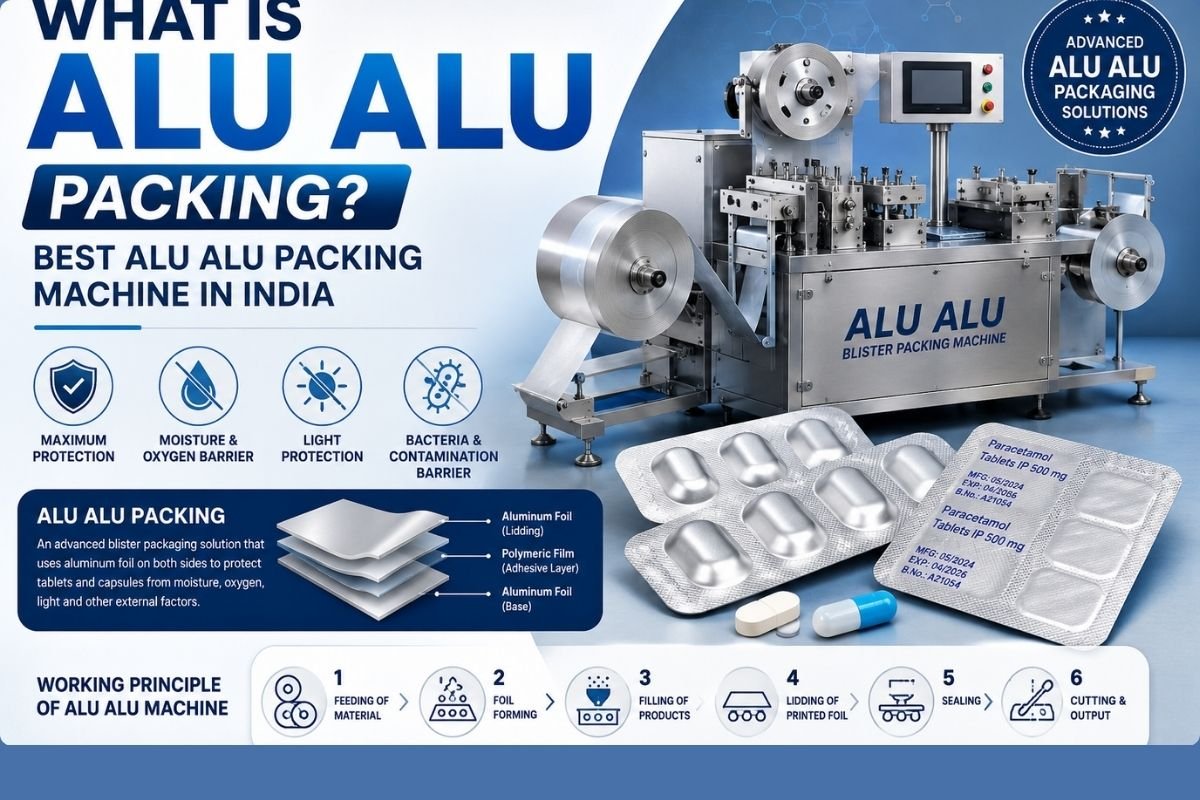
Alu Alu packing is a cold-form blister. A three-layer oPA/aluminium/PVC laminate is pressed cold into pockets, the tablets drop in, and an aluminium lidding foil is heat-sealed on top. With aluminium on both sides, moisture transmission is close to zero.[1]
There are three trade-offs. Packs cost more, the cards are bigger, and the machines run slower. On one ACG model, cold-form foil runs at 35 cycles/min against 45 for PVC film.[4] In India, Revised Schedule M also requires a periodic vacuum leak test on blisters and an independent recorded check of the machine before each new batch.[6]
What is Alu Alu packing?
“Alu Alu” is short for aluminium–aluminium. In Alu Alu packing, both the pocket (forming) web and the lidding web contain an aluminium layer, so the tablet or capsule is enclosed in aluminium on every side. The trade calls it cold-form foil (CFF) blistering, because the pockets are pressed into the laminate mechanically rather than formed from heat-softened plastic.[3]
Search engines see this term spelt many ways: “allu allu packing”, “aalu aalu packing”, “alu-alu” and “alu/alu”. They all mean the same pack. हिंदी में: एल्यु-एल्यु (Alu Alu) पैकिंग का मतलब है ऐसा ब्लिस्टर जिसमें नीचे की परत और ऊपर की ढक्कन-परत दोनों में एल्युमिनियम होता है, ताकि टैबलेट नमी, ऑक्सीजन और रोशनी से बची रहे।
The layers in Alu Alu packing
| Layer | Example thickness | Job in the pack |
|---|---|---|
| oPA (oriented polyamide, nylon) | 25 µm | Gives the aluminium the toughness to stretch into a pocket without tearing |
| Aluminium foil | 47–65 µm | The barrier layer against moisture, oxygen and light |
| PVC | 60 µm | Product-side layer; the heat-seal lacquer on the lidding foil bonds to it |
| Lidding foil | Supplier-specified | Printed aluminium with heat-seal lacquer, sealed over the filled pockets |
Scroll sideways to see the full table.
The thicknesses are one supplier’s published range (oPA 25 µm / Al 47–65 µm / PVC 60 µm).[2] Your foil specification and the vendor’s certificate of analysis are what your QC department releases against, not this table.
How an Alu Alu packing machine works: 6 stations
An Alu Alu packing machine is a blister machine fitted with cold-form tooling, so the same line can often run PVC/Alu blisters as well. The base web unwinds from a reel and passes through six stations before it leaves as finished blister cards. In a tablet plant, Alu Alu packing is the step after tablet compression and its in-process checks.

- FormingThe laminate indexes into the forming station, where a punch stretches it into the mould. Aluminium cannot be drawn into near-90° corners, so Alu Alu pockets and cards come out larger than PVC pockets for the same tablet.[1] Check pocket depth and look for cracks at the pocket shoulders after every tooling change.
- FeedingTablets or capsules fall into the pockets from a feeder, through channels or brushes. Check for empty and double-filled pockets at the frequency set in your batch packaging record.
- InspectionWhere a camera or sensor is fitted, it flags missing, broken or wrong-colour units and marks that section for rejection. Challenge it with seeded defects at line start, and record the result.
- SealingThe printed lidding foil comes down over the pockets and is sealed with heat, pressure and dwell time. Seal temperature, pressure and dwell are the critical process parameters for leak-tightness, so set them from your validated ranges, not by feel.
- Coding and perforationThe batch number, manufacturing and expiry dates are embossed or printed, and tear lines are added. Revised Schedule M requires printing to be checked and recorded, and printed or embossed information to be distinct and resistant to fading.[6]
- CuttingThe web is punched into cards. Marked rejects are diverted, and the skeleton waste is wound or chopped. Cards then go to visual inspection and cartoning.
Many web pages, including the earlier version of this one, say Alu Alu suits thermolabile products because “no heat is used in forming.” That reasoning does not hold. In thermoforming, the PVC film is heated before it is formed,[3] and the tablets are fed after forming, so they never meet the forming heat in either process. Both formats then heat-seal the lidding foil over the filled pockets. Choose Alu Alu packing for its moisture, oxygen and light barrier, not to keep heat away from the product.
Alu Alu packing vs blister (PVC/Alu) packing
On the shop floor, “blister” usually means a clear thermoformed PVC (or PVC/PVDC) pocket sealed with aluminium foil. Alu Alu is also a blister, just a cold-formed, opaque one. The real question is whether your product needs the barrier of Alu Alu packing or whether PVC/Alu is enough.
| Factor | Alu Alu (cold form) | PVC/Alu (thermoform) | Source |
|---|---|---|---|
| How pockets are made | Laminate stretched cold by a punch | PVC film heated, then formed in a mould | [3] |
| Water vapour transmission, 38 °C / 90% RH | ~0 g/m²/day | 3.1 g/m²/day (mono PVC) | [1] |
| Light protection | Opaque on both sides | Clear unless tinted or opaque film is used | Design |
| Pocket and card size | Larger; aluminium cannot form sharp corners | Tighter pockets, smaller cards | [1] |
| Speed on the same machine (ACG BQS) | up to 35 cycles/min | up to 45 cycles/min | [5] |
| Maximum forming depth (ACG BQS) | 9 mm | 12 mm | [5] |
| Cost per pack | About 50% higher (manufacturer estimate) | Baseline | [1] |
| Visual check of contents | Not possible through the pack | Possible through clear PVC | Design |
Scroll sideways to see all columns.
Between the two sit high-barrier thermoform films, such as PVC coated with PVDC. They cut moisture ingress well below plain PVC while keeping clear, compact pockets. How close they get to Alu Alu depends on the coat weight and film grade, so judge them, and Alu Alu packing, on stability data from the actual pack.
This is a starting point for a packaging trial, not a substitute for stability data on the proposed pack.
Your suggested pack and the control point that decides it will appear here.
Alu Alu packing under Revised Schedule M: what inspectors check
India’s Revised Schedule M (G.S.R. 922(E), 28 Dec 2023) has a clause written specifically for strip and blister packing, in Part VIII on oral solid dosage forms. It applies to Alu Alu packing exactly as it does to PVC/Alu blister and strip lines.[6]
| Clause | What it requires | What to show on the line |
|---|---|---|
| Part VIII, 7.1 | Remove all “rogue” tablets, capsules or foils before a new packaging operation; an independent recorded check of the equipment before a new batch | Line clearance checklist signed by a second person, covering feeder channels, pockets and reject bins |
| Part VIII, 7.2 | Pack uncoated tablets on equipment designed to minimise cross-contamination; pack potent or beta-lactam tablets in an isolated area | Dust extraction at the feeder; a dedicated or segregated room for beta-lactam and potent products |
| Part VIII, 7.3 | Inspect strips coming off the machine for misprint, cuts on the foil, missing tablets and improper sealing | On-line inspection record with defect counts per check |
| Part VIII, 7.4 | Subject strips and blisters to a vacuum test periodically to confirm every pocket is leak-proof, with records kept | Leak test SOP, frequency, sample size and results in the batch packaging record |
| Part I, 18.5.2 | Clean the line and clear previous materials before packaging; perform and record line clearance to a procedure and checklist | Line clearance before and after each batch |
| Part I, 18.5.8.1 | On-line control at a minimum: pack appearance, completeness, correct product and materials, correct overprinting, line monitors working | In-process check sheet with these five items |
| Part I, 18.5.10 to 18.5.11 | Investigate unusual reconciliation discrepancies before release; destroy unused batch-coded materials and record it | Foil and bulk reconciliation; destruction record for coded lidding foil |
| Part XIII, 3.1(c) | Recommends for the tablet packaging section: strip or blister machine, vacuum leak test apparatus, tablet counters, and air-conditioning and dehumidification where necessary | Leak tester qualified and on the equipment list |
Scroll sideways to see all columns.
Part XIII also requires the tablet department to be divided into separate sections, with packaging (strip or blister) as its own section.[6] That matters when you size a new block; the Schedule M area requirements by dosage form set out the floor-area side.
Revised Schedule M is in its enforcement phase. The extended deadline for MSME manufacturers ended on 31 Dec 2025. On 7 Nov 2025, the DCGI asked state regulators to plan inspections of units that had applied for the extension.[7] The live position is tracked on the CDSCO Schedule M compliance dashboard.
The same controls in US and EU GMP
For export lines, the clauses map closely. US 21 CFR 211.130 requires written procedures for packaging and labelling operations, including (e) “inspection of the packaging and labeling facilities immediately before use.” 21 CFR 211.125(c) requires labelling reconciliation, and 211.134 requires an examination of packaged and labelled product.[8] EU GMP Chapter 5 says line clearance should follow a checklist (5.50) and that different products should not be packed in close proximity unless physically segregated (5.49).[9] Discrepancies found during reconciliation feed straight into batch record review before release.
Costly Alu Alu packing mistakes: defects and first checks
Most rejects in Alu Alu packing trace back to forming, because aluminium tolerates far less stretch than PVC. Work through materials and settings before you touch the tooling.
| Defect | Usual causes | Check first |
|---|---|---|
| Cracks or pinholes at pocket corners | Pocket too deep for the laminate, tight tool radius, worn or misaligned forming tools, wrong foil grade | Foil grade against specification; forming depth against the drawing; a vacuum leak test on the suspect cards |
| Shallow or incomplete pockets | Low forming pressure, worn punches, wrong web tension | Forming pressure setting; punch wear; web tension |
| Weak or leaking seals | Low seal temperature, pressure or dwell; contaminated seal plates; lacquer not matched to the PVC layer | Seal settings against validated ranges; seal plate condition; lidding foil specification |
| Wrinkles or mis-registration | Uneven web tension, misaligned guide rollers, indexing faults | Unwind brakes and dancer; roller alignment; print-mark sensor |
| Crushed or chipped tablets | Pocket too tight for the tablet, sealing pressure on the product, low tablet hardness | Pocket drawing against tablet dimensions; tablet hardness and friability results |
Scroll sideways to see all columns.
In Alu Alu packing, any defect that could affect quality or labelling goes into a deviation, with an impact assessment covering cards already packed.
Best Alu Alu packing machine in India: how to choose
No single machine is the “best Alu Alu packing machine” for every plant. The right one matches your products, output and support needs. Write a user requirement specification (URS) first, then compare vendors against it and confirm at FAT and SAT. The criteria that separate Alu Alu machines in practice:
- Cold-form output, not the headline speed. Brochures often quote the thermoform figure. Ask for cycles per minute on cold-form foil, and for blisters per cycle with your tooling. Cycles × blisters per cycle gives your real cards per minute.
- Forming principle. In ACG’s current catalogue, every model that runs cold-form foil uses flat forming. Its rotary-forming models are listed for thermoform films only.[4] If a vendor offers rotary forming for Alu Alu, ask for trial data.
- Forming depth. Cold-form depth limits are lower than thermoform limits (9 mm vs 12 mm on ACG’s BQS).[5] Large or capsule-shaped products need the pocket drawing approved before you order.
- Dual-format change parts, if you will also run PVC/Alu on the same machine.
- Inspection and rejection: camera presence/absence checks and reject confirmation, which support the on-line checks Schedule M expects.
- Service, spares and qualification support in India: IQ/OQ documents, change-part lead times and engineer availability near your plant.
Alu Alu packing machine makers in India: published figures
The table below lists makers whose own websites offer an Alu Alu blister machine, with the cold-form figures each one publishes. It is an illustrative list, not a ranking or an endorsement. Laafon has not tested these machines.
| Maker | Model | Cold-form output stated | Principle stated | Source |
|---|---|---|---|---|
| ACG (Mumbai) | BQS / BQS E | up to 35 cycles/min | Flat forming, flat sealing; continuous motion | [4] [5] |
| ACG (Mumbai) | BMAX Plus | up to 45 cycles/min | Flat forming, flat sealing | [4] |
| ACG (Mumbai) | Blister X | up to 45 cycles/min | Flat forming, rotary sealing | [4] |
| Jicon Technologies | ALBLIS-350 | 25–35 cycles/min | Flat forming, flat sealing; intermittent motion | [11] |
| Adinath International (Ahmedabad) | Alu Alu blister packing machine | up to 30 cycles/min | Cold form; PVC/Alu option | [10] |
| Mak Engineers (Vadodara) | Single- and double-track Alu Alu machines | Not published | Not published | [12] |
Scroll sideways to see all columns.
For the full machine set behind a tablet line, see the pharma machinery list for tablet, capsule and liquid sections. For how packaging equipment fits into total project capex, see the pharma manufacturing plant cost breakdown.
Need Alu Alu packing without buying the line?
A cold-form line only pays for itself if it runs enough batches of Alu Alu packing. If you own the product but not the capacity, there are three routes:
Alu Alu packing FAQs
In Alu Alu packing, “Alu Alu” stands for aluminium–aluminium. Both the cold-formed pocket laminate (usually oPA/aluminium/PVC) and the lidding foil contain aluminium, so the tablet is sealed in aluminium on both sides. It is also called cold-form foil blistering.
A standard blister thermoforms clear PVC into pockets and seals it with aluminium foil. Alu Alu cold-forms an aluminium laminate instead. The result is opaque, with near-zero moisture transmission against 3.1 g/m²/day for mono PVC at 38 °C/90% RH. The cost is larger cards, roughly 50% higher pack cost and slower machine speeds.
Not for that reason. In both formats the tablets are fed after the pockets are formed, so they never meet the forming heat used for PVC. Both formats then heat-seal the lidding foil over the product. Alu Alu packing is chosen for its moisture, oxygen and light barrier.
Yes. Alu Alu packing and PVC/Alu can share flat-forming machines built for both, with the correct change parts and a separate validated parameter set for each format. ACG, for example, lists its BQS for thermoform films and cold-form foils, at up to 45 and 35 cycles per minute respectively.
For Alu Alu packing, Indian makers publish cold-form figures of roughly 25 to 45 cycles per minute, depending on the model. Real output in cards per minute is cycles multiplied by blisters per cycle, which depends on your tooling, so ask vendors for cold-form figures with your pack layout.
Revised Schedule M, Part VIII clause 7.4, requires strips and blisters to be vacuum tested periodically to confirm every pocket is leak-proof, with records kept. Part XIII recommends a leak test apparatus (vacuum system) for the tablet packaging section. Your SOP sets the frequency and sample size.
Alu Alu packing costs more for three reasons. The laminate itself costs more. Aluminium cannot be formed into tight corners, so each card uses more material per tablet. And cold forming runs slower than thermoforming on the same machine. One packaging-equipment maker puts the cost per pack at about 50% above PVC-based blisters.
Related on laafon.com
References
- Sepha Ltd. Is an Alu Alu blister the best choice for your product? Sepha blog (packaging-equipment manufacturer). Available from: https://blog.sepha.com/is-an-alu-alu-blister-the-best-choice. Accessed Oct 2026.
- Tiptop. Cold formable blister Alu-Alu: product structures TTP-CFB-1 to TTP-CFB-5 (foil supplier specification). Available from: https://www.tiptopfoil.com/product/cold-formable-blister-alu-alu/. Accessed Oct 2026.
- Ascend Packaging Systems. The difference between thermoforming and cold forming. Available from: https://ascendpkg.com/difference-between-thermoforming-and-cold-forming/. Accessed Oct 2026.
- ACG. Blister packaging machinery catalogue, version 1.4 (1125). Mumbai: ACG; 2025. Available from: https://www.acg-world.com/sites/default/files/2026-01/ACG%20Blister%20Packaging%20Catalogue%201.4%201125.pdf. Accessed Oct 2026.
- ACG. BQS: flat forming, flat sealing blister packaging machine. Available from: https://www.acg-world.com/machinery/blister-packaging/flat-forming-flat-sealing/bqs. Accessed Oct 2026.
- Ministry of Health and Family Welfare, Government of India. Drugs (Amendment) Rules, 2023: Revised Schedule M. G.S.R. 922(E). Gazette of India, Extraordinary, Part II, Section 3(i); 28 Dec 2023. Part I para 18.5; Part VIII para 7; Part XIII para 3. Copy accessed from: https://pharmadocx.com/wp-content/uploads/2024/01/Notified-Schedule-M-dt-28.12.2023-1.pdf. Accessed Oct 2026.
- Business Standard. Pharma units likely to face action for Schedule M violations: experts. 8 Nov 2025. Available from: https://www.business-standard.com/industry/news/cdsco-asks-state-units-to-start-inspections-under-schedule-m-norms-125110801170_1.html. Accessed Oct 2026.
- US Code of Federal Regulations. 21 CFR Part 211, Subpart G: Packaging and labeling control (211.122 to 211.137). eCFR. Available from: https://www.ecfr.gov/current/title-21/chapter-I/subchapter-C/part-211/subpart-G. Accessed Oct 2026.
- European Commission. EudraLex Volume 4, EU guidelines for GMP, Part 1, Chapter 5: Production. Brussels; 13 Aug 2014 (in force 1 Mar 2015). Available from: https://health.ec.europa.eu/system/files/2016-11/chapter_5_0.pdf. Accessed Oct 2026.
- Adinath International. Alu Alu blister packing machine. Ahmedabad. Available from: https://www.adinathpharmamachinery.com/pharmaceutical-packaging-machines/alu-alu-blister-packing-machine/. Accessed Oct 2026.
- Jicon Technologies. ALBLIS-350 automatic flat plate blister packing machine. Available from: https://www.jicon.co.in/alblis-350-automatic-flat-plate-blister-packing-machine.htm. Accessed Oct 2026.
- Mak Engineers. Blister packing machines. Vadodara. Available from: https://www.makblistermachine.com/. Accessed Oct 2026.
This page is technical and educational information for pharmaceutical professionals. It is not legal, regulatory, medical or investment advice. Machine figures are as published by each manufacturer and were not independently tested. Statutory instruments such as Schedule M, and GMP guidance, change; check the current official text before acting. Reviewed by Darshan Singh, Laafon Galaxy Pharmaceuticals.