
Short answer · updated 22 Sep 2026
What a pharma plant acquisition checklist must cover
A pharma plant acquisition checklist tests whether a plant can legally keep running under new ownership and reliably make compliant product. In India, clear four deal-critical checks before spending money on a technical audit:
- Licence validity: Form 25/28 permissions match the products, and the five-yearly retention fee is paid.
- Deal route: how a change in constitution affects the licence, and whether a fresh licence is needed.
- Revised Schedule M: Form A upgradation plan filed, gaps closed, inspection outcome known.
- History: inspection observations, NSQ alerts, recalls and open regulatory commitments.
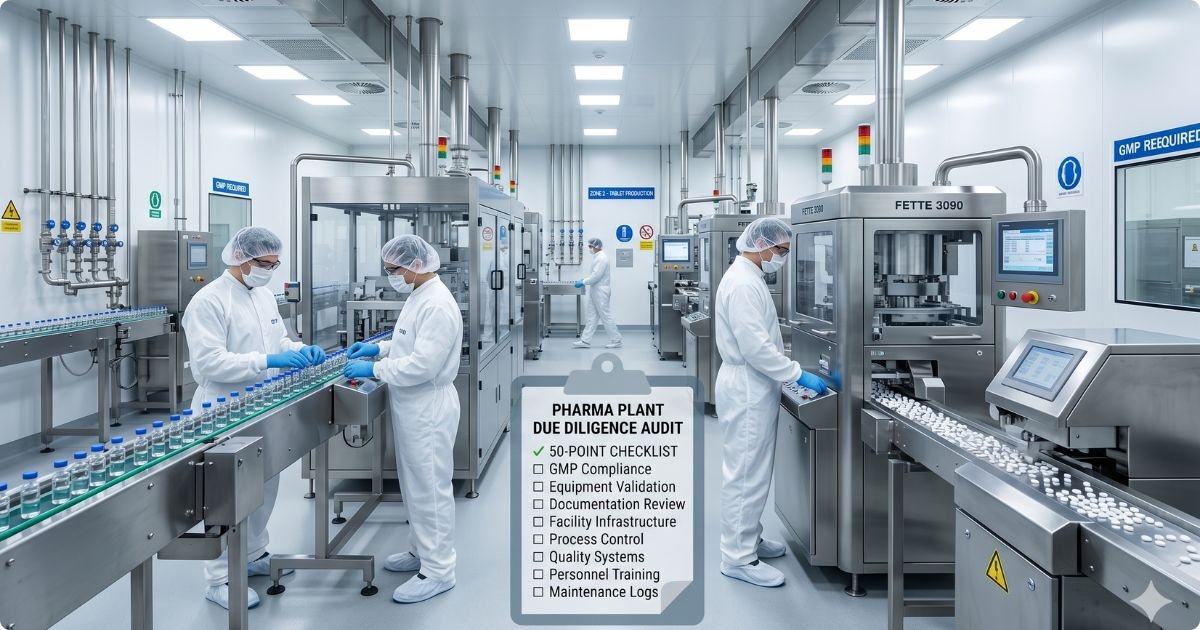
The full checklist below has 50 points across eight areas, ten of them marked deal-critical. Rate each one and the tool scores the plant as you go.
Why a plant tour is not due diligence
Buying a running unit is faster than building one, but you also buy the seller’s compliance history. An equipment list and a walk through the production block will not show a missed retention fee, an upgradation plan that was never filed, or an audit trail that was switched off. Those are the findings that stop production after closing.
The timing matters. The last extended deadline for small and medium manufacturers to meet revised Schedule M ended on 31 December 2025[1], and CDSCO has asked state regulators to plan compliance inspections[2]. A plant that has not upgraded carries a risk the price must reflect.
A fixed checklist makes two plants comparable, gives every finding evidence and a rating, and turns the result into negotiating terms. If you are still at the search stage, start with the verified pharma plants for sale in India.
The 50-point pharma plant acquisition checklist
Rate each point Pass, Gap (fixable, needs cost and time) or Red flag (serious or unresolved). The panel scores as you go. Your ratings stay on this page only; nothing is sent or saved.
Start rating points to see an indicative verdict.
Licences, ownership and deal route points 1–7 · weight 3
-
1
Manufacturing licences and product permissions
Deal-criticalCheck Copies of every Form 25 and Form 28 licence, the sections approved, and the product permission list endorsed on each. Match it against what the seller says the plant makes.
Red flag Products sold from the site that are not on the endorsed list, or sections running that were never approved.
-
2
Licence retention fee status
Deal-criticalCheck Manufacturing licences now stay valid until suspended or cancelled, provided a retention fee is paid every five years[3]. Ask for the challan for every five-year cycle.
Red flag A missed retention fee. A late fee of 2% per month runs for up to six months, after which the licence is deemed cancelled[3].
-
3
Deal structure and change in constitution
Deal-criticalCheck Settle share purchase versus asset transfer with your lawyer before signing. A change in the licensee’s constitution must be intimated, and the existing licence is reported to lapse three months after that intimation[4]. State regulators treat a change of proprietor or partners as a change in constitution needing a fresh licence[5].
Red flag A closing timetable with no room for the fresh-licence inspection, or a seller who says the licence “transfers automatically”.
-
4
Revised Schedule M status
Deal-criticalCheck Revised Schedule M (G.S.R. 922(E), 28 Dec 2023) bound large manufacturers after six months. Units with turnover up to ₹250 crore got a conditional extension to 31 Dec 2025 only if they filed a Form A upgradation plan within three months of 11 Feb 2025[1]. Ask for the Form A, the gap assessment and closure evidence. Track status on the Schedule M compliance dashboard.
Red flag No Form A on record, gaps still open after 31 Dec 2025, or no inspection under the revised Schedule yet. CDSCO asked state regulators in Nov 2025 to plan compliance inspections[2].
-
5
WHO-GMP, COPP and export registrations
Check WHO-GMP certificate, COPPs issued and product registrations in each export market, with validity dates and dosage forms covered.
Red flag Expired certificates, or dossiers held by a third party that will not follow the plant.
-
6
Loan licence and contract-manufacturing arrangements
Check Every loan licensee and third-party customer using the plant: agreements, notice periods and who carries stock, complaints and recalls. See how loan licence placement works.
Red flag Loan licensees with open NSQ cases or recalls the plant will inherit reputationally.
-
7
Environmental and statutory consents
Deal-criticalCheck Consent to Establish and Consent to Operate from the State Pollution Control Board (Water Act, 1974; Air Act, 1981), effluent treatment plant performance, hazardous-waste authorisation, fire NOC and factory licence.
Red flag Expired consents, show-cause notices, or an effluent plant sized for a smaller product mix than you plan to run.
Regulatory and quality history points 8–11 · weight 3
-
8
Inspection history and outcomes
Deal-criticalCheck Every state, CDSCO or joint, WHO-GMP and foreign inspection report from the last five years, with observations and closure evidence.
Red flag The same observation recurring across inspections: a systemic gap, not a one-off.
-
9
NSQ and spurious-drug alerts
Deal-criticalCheck Search CDSCO’s monthly NSQ alerts for the manufacturer’s name and address[6], and ask for the investigation behind every hit.
Red flag Repeat NSQ findings on the same product or test (dissolution, assay, microbial), or any link to a spurious drug.
-
10
Recalls and complaint trends
Check Three years of complaints and recalls, grouped by product and defect type.
Red flag Recalls traced to manufacturing defects, or a complaint log that is suspiciously empty.
-
11
Open regulatory commitments
Deal-criticalCheck Every CAPA promised to a regulator, with due dates and effectiveness evidence, including any FDA Form 483 or warning-letter commitments on export sites. A weak Form 483 response becomes your problem after closing.
Red flag Commitments overdue by more than one cycle, or CAPA closed on paperwork alone.
Facility, layout and utilities points 12–21 · weight 2
-
12
Layout, flows and segregation
Check Personnel, material and waste flows; segregation between dosage forms and of penicillin, cephalosporin or hormone areas where applicable; room sizes against the Schedule M minimum area by dosage form.
Red flag Cross-flows, or shared corridors between incompatible areas.
-
13
Building envelope and finishes
Check Walls, floors, ceilings, coving and sealed joints in production and clean areas.
Red flag Cracked floors, peeling paint or exposed services inside clean areas.
-
14
Room classification, pressure cascade and AHU zoning
Check Classifications, differential pressures and air-handling zoning against WHO HVAC guidance for non-sterile products[7].
Red flag Shared AHUs between incompatible areas, or reversed differentials.
-
15
HVAC qualification and monitoring
Check Qualification reports, periodic requalification and trends for pressure, temperature, humidity and particle counts. Compare with the nine HVAC qualification tests.
Red flag Excursions closed without an investigation.
-
16
Purified water system design
Check WHO expects hygienic design with zero-dead-leg valves where possible, and continuous circulation with turbulent flow, for example a Reynolds number above 4000[8].
Red flag Dead legs, storage without circulation, or sections that cannot be sanitised.
-
17
Water system qualification and monitoring
Deal-criticalCheck WHO expects water systems to be qualified and validated, with alert and action levels set from historical data[8]. Read a year of trends.
Red flag Missing PQ, frequent excursions, or limits copied from a textbook instead of derived from data.
-
18
Compressed air, nitrogen and process gases
Check Quality specification, filtration, dew point and point-of-use testing for any gas that touches product.
Red flag Product-contact gas with no defined specification.
-
19
Sterile areas and contamination control
Check Sterile plants only (rate Pass if not applicable). For EU or PIC/S markets, revised EU GMP Annex 1, in operation since 25 Aug 2023, expects a site-wide Contamination Control Strategy[9]. Check airlocks, gowning, transfer hatches and media fills. Background: aseptic processing control.
Red flag No documented strategy, or failed or missing media fills.
-
20
Utility redundancy and continuity
Check Power supply, DG sets, chillers, compressors and breakdown logs.
Red flag Single points of failure on HVAC or water.
-
21
Warehousing and cold chain
Check Segregation, FEFO practice, mapped cold rooms and temperature records.
Red flag Overcrowded stores or unmapped cold rooms.
Equipment, maintenance and validation points 22–30 · weight 2
-
22
Equipment list and age profile
Check Master equipment list with installation dates and major refurbishments.
Red flag Obsolete equipment with no spares support.
-
23
Fit for purpose, change parts and line clearance
Check Can granulation, compression, filling and packing lines run your batch sizes and changeovers? Check change parts and line-clearance records.
Red flag Lines that cannot reach your batch sizes, or makeshift change parts.
-
24
Preventive maintenance
Check PM schedules and completion records for critical equipment and utilities.
Red flag Systematically overdue PM; breakdown-driven maintenance.
-
25
Calibration of process instruments
Check Master list, records and traceability for balances, sensors and critical utility gauges.
Red flag Overdue calibration with no impact assessment for out-of-tolerance results.
-
26
Equipment qualification (IQ/OQ/PQ)
Check Sample qualification packages for major equipment; confirm traceability to user requirements and periodic requalification.
Red flag Fragmented or retrospective-only qualification.
-
27
Computerised systems and CSV
Check Revised Schedule M includes validation of GMP computerised systems[10]. List MES, SCADA, LIMS, ERP and stand-alone instrument software with their validation status.
Red flag Unvalidated systems, disabled audit trails or generic user IDs.
-
28
Process validation and ongoing verification
Check Validation reports and ongoing monitoring for key products.
Red flag One-time validation with no data review since.
-
29
Cleaning validation and cross-contamination control
Check Worst-case selection, basis for carry-over limits and recovery studies.
Red flag No rationale for product grouping or limits.
-
30
Capacity utilisation and bottlenecks
Check Theoretical capacity against actual output, after downtime, cleaning and changeovers.
Red flag Spare capacity that disappears once real efficiency is applied.
Quality management system points 31–38 · weight 2
-
31
Pharmaceutical quality system and management review
Check Revised Schedule M introduces a pharmaceutical quality system, quality risk management and product quality review[10]. For a formulation plant, ICH Q10 is the model[11]; ICH Q7 covers API manufacture only[12].
Red flag No management-review minutes; quality metrics not trended.
-
32
Quality risk management
Check Risk assessments that drove real decisions, in line with ICH Q9(R1), adopted Jan 2023[13].
Red flag Risk assessments written after the decision was taken.
-
33
Document control and batch records
Check SOP hierarchy, controlled copies, and a review of three to five batch records per key product.
Red flag Uncontrolled copies or unexplained corrections.
-
34
Deviations and investigations
Check Deviation log, sample investigation reports and time to closure.
Red flag Repeat deviations with “human error” as the default root cause.
-
35
CAPA effectiveness
Check Whether CAPA effectiveness is verified and fed into management review.
Red flag CAPA that never goes beyond retraining.
-
36
Change control
Check Sample change records for equipment, materials, methods and documents.
Red flag Changes implemented before approval.
-
37
Product quality review
Check Annual PQRs for key products: trends, conclusions and actions taken.
Red flag PQRs missing, or copied year to year.
-
38
Self-inspection and supplier qualification
Check Internal audit reports, vendor audits for API and key excipients, and quality agreements.
Red flag Repeat audit findings, or unaudited API vendors.
QC, microbiology and data integrity points 39–44 · weight 3
-
39
Analytical method validation and verification
Check Validation reports for in-house methods; verification for compendial methods; method-transfer records.
Red flag Missing specificity or robustness data, or unverified transfers.
-
40
Analytical instrument qualification and calibration
Check Qualification and calibration of HPLC, GC, UV, FTIR and dissolution systems, including software version and audit-trail status.
Red flag Audit trails switched off or never reviewed.
-
41
OOS, OOT and microbiology excursions
Check Recent OOS, OOT and environmental-monitoring excursions and how they were investigated.
Red flag Results invalidated without a root cause, or retesting into compliance.
-
42
Stability programme
Check Protocols, mapped chambers, storage conditions registered for each market, and trend review.
Red flag Missed pulls or unmapped chambers.
-
43
Data integrity (ALCOA+)
Deal-criticalCheck WHO describes ALCOA+ as data that are attributable, legible, contemporaneous, original and accurate, and also complete, consistent, enduring and available[14]. Review audit trails, user access and spreadsheets. See how each regulator defines ALCOA.
Red flag Shared logins, deleted injections or backdated entries.
-
44
Electronic data backup and recovery
Check Backup schedule, restore tests and access control for chromatography and LIMS data.
Red flag Backups that have never been test-restored.
People and culture points 45–48 · weight 1
-
45
Organisation and approved technical staff
Check Key heads of production and QC named with the licensing authority, their tenure, and whether they will stay after closing.
Red flag Licence-approved technical staff leaving at closing.
-
46
Staffing levels and attrition
Check Headcount against shifts and capacity, attrition in QA and QC, dependence on contract staff.
Red flag High turnover in QA or QC.
-
47
Training effectiveness
Check Training matrix, practical assessments and records.
Red flag Read-and-sign as the only training method.
-
48
Quality culture
Check How staff discuss deviations and answer questions during the visit.
Red flag Defensiveness, or an “output over quality” mindset.
Investment and integration points 49–50 · weight 1
-
49
Remediation and upgrade capex
Check Price every gap you found: HVAC, water, lab, CSV, civil work. Benchmark against the plant setup cost calculator and the 2026 plant cost breakdown to test buy-versus-build.
Red flag Remediation cost close to the cost of a new build.
-
50
Integration and tech-transfer readiness
Check Fit with your QMS, documentation standards and products; space and utility headroom for new lines.
Red flag No tech-transfer experience and no headroom for your products.
How the score works: each rated point counts Pass = 1, Gap = 0.5, Red flag = 0, weighted by section (licences, history and QC lab ×3; facility, equipment and QMS ×2; people and deal ×1). The weights are Laafon’s editorial judgement, not a regulatory standard. Any red flag on a deal-critical point overrides the percentage.
Share purchase or asset purchase: what happens to the licence
The deal structure decides which licensing route applies, so settle it before the technical audit is scoped. The Drugs and Cosmetics framework does not formally define “change in constitution”; CDSCO’s medical-device FAQs treat a change of more than 50% of voting capital as one, but that definition has not been written into the drugs framework[4]. Confirm the route with your State Licensing Authority.
| Question | Share purchase | Asset or business transfer |
|---|---|---|
| What you buy | The licensee company itself | Land, building, equipment and stock |
| Licence position | The company stays licensee, but a change in constitution may still need intimation and a fresh licence | The new legal entity needs its own licence, granted after inspection |
| Historical liabilities | Come with the company: NSQ cases, recalls, notices | Largely stay with the seller, subject to the contract |
| Diligence emphasis | Licence history, legal and compliance record | Facility readiness for a fresh inspection under revised Schedule M |
| Timeline risk | The three-month window after intimation | No production until the new licence is granted |
Turning findings into deal terms
Deal-critical red flags
Make them conditions precedent (for example, the fresh licence granted before closing), specific warranties with indemnities, or an escrow released on proof of closure. If none of those is acceptable to the seller, walk away.
Costed gaps
Price each one and deduct it, or agree who fixes it before closing. Water-system redesign, HVAC rezoning and data-integrity remediation are usually the largest items.
Minor gaps
Move them into a funded 90-day post-closing plan with owners and dates, so findings do not stay in the audit report.
These are common deal mechanisms, not legal advice. Your transaction lawyer decides the drafting.
Related on Laafon
- Current pharma plant listings – units for sale with sections, approvals and asking prices.
- WHO-GMP vs USFDA compliance – if the plant is meant to supply regulated markets.
- USFDA approval roadmap for Indian formulation plants – what an upgrade path after purchase looks like.
- List a pharma plant for sale – for owners preparing their own unit for buyer due diligence.
Want a technical team to run this checklist on site?
Laafon Galaxy’s team, with 23+ years in pharma QA, QC and regulatory affairs, runs licence, Schedule M and GMP due diligence for buyers, so you can focus on valuation.
Frequently asked questions
It is a structured list of licensing, regulatory, facility, equipment, quality-system, laboratory and people checks used to judge a manufacturing plant before you buy it. In India it starts with four deal-critical questions: are the licences valid and the retention fee paid, how will a change in constitution affect the licence, has the plant met revised Schedule M, and what do its inspection and NSQ history show.
Eight areas: licences and deal route, regulatory and quality history, facility and utilities, equipment and validation, the quality management system, the QC laboratory and data integrity, people and culture, and the cost of remediation and integration. Rate each point, and treat any red flag on licences, inspection history, NSQ alerts, water systems or data integrity as deal-critical.
Not automatically. A change in the licensee’s constitution has to be intimated, and the existing licence is reported to lapse three months after that intimation, so a fresh licence is needed. An asset purchase by a new company means that company needs its own licence. Confirm the exact route with the State Licensing Authority before signing.
Yes. Revised Schedule M was notified on 28 December 2023. Large manufacturers had six months; small and medium units with turnover up to Rs 250 crore had a conditional extension to 31 December 2025, available only to those that filed a Form A upgradation plan. Ask for the Form A, the gap assessment and evidence that every gap was closed.
Search the NSQ alerts that CDSCO publishes every month for the manufacturer’s name and address, then ask the seller for the investigation report and CAPA behind each hit. Repeat failures on the same product or test point to a process problem, not a one-off.
Since the 2017 amendment they stay valid until suspended or cancelled, provided a retention fee is paid every five years. If the fee is missed, a late fee of 2 percent per month applies for up to six months, after which the licence is deemed cancelled. Ask for the retention-fee challans.
Products made outside the endorsed permissions, an unpaid retention fee, no revised Schedule M upgradation plan, repeated inspection observations or NSQ failures, overdue regulatory commitments, an unqualified water system, and data-integrity failures such as shared logins or disabled audit trails.
Use it to sort findings, not to price the plant. Critical red flags become conditions precedent, specific warranties or an escrow; costed gaps become a price adjustment; minor gaps go into the post-closing improvement plan. The score is an indicative triage aid, not a valuation.
References
- Ministry of Health and Family Welfare, Press Information Bureau. Conditional extension of timeline to small and medium pharmaceutical manufacturers for compliance with revised Schedule ‘M’ notification. New Delhi: PIB; 12 Feb 2025. Available from: pib.gov.in/PressReleaseIframePage.aspx?PRID=2102291. Accessed Sep 2026.
- Business Standard. Pharma units likely to face action for Schedule M violations: experts. New Delhi: Business Standard; 8 Nov 2025. [Trade press – secondary source.] Available from: business-standard.com. Accessed Sep 2026.
- Government of India. Drugs and Cosmetics (Tenth Amendment) Rules, 2017. G.S.R. 1337(E), 27 Oct 2017. As summarised in: Mondaq. Drugs and Cosmetics (Tenth Amendment) Rules, 2017. [Secondary source – gazette text not opened for this edition.] Available from: mondaq.com. Accessed Sep 2026.
- Jaggi A. ‘Change in constitution’ under the Drugs & Cosmetics Act, 1940. Mondaq; 14 Oct 2024. [Secondary legal commentary.] Available from: mondaq.com. Accessed Sep 2026.
- Department of Drugs Control, Government of NCT of Delhi. Procedures for obtaining licences. Delhi: DDC. Available from: drugs.delhi.gov.in/drugs/procedures-obtaining-licences. Accessed Sep 2026.
- Central Drugs Standard Control Organisation. NSQ Alerts. New Delhi: CDSCO. Available from: cdsco.gov.in/opencms/opencms/en/Notifications/nsq-drugs/. Accessed Sep 2026.
- World Health Organization. Annex 8: Guidelines on heating, ventilation and air-conditioning systems for non-sterile pharmaceutical products. WHO Technical Report Series No. 1010. Geneva: WHO; 2018. Available from: who.int/publications/m/item/Annex-8-trs-1010. Accessed Sep 2026.
- World Health Organization. Annex 3: Good manufacturing practices: water for pharmaceutical use. WHO Technical Report Series No. 1033. Geneva: WHO; 2021. Available from: who.int/publications/m/item/annex-3-trs-1033. Accessed Sep 2026.
- European Commission. EudraLex Volume 4, Annex 1: Manufacture of Sterile Medicinal Products. C(2022) 5938 final. Brussels: EC; 22 Aug 2022 (in operation from 25 Aug 2023). Available from: health.ec.europa.eu. Accessed Sep 2026.
- The Tribune. Government notifies revised Schedule M guidelines; tightens rules to ensure pharma companies meet quality norms. 7 Jan 2024. [Trade press – secondary source summarising G.S.R. 922(E).] Available from: tribuneindia.com. Accessed Sep 2026.
- International Council for Harmonisation. Q10: Pharmaceutical Quality System. Step 4; Jun 2008. EMA/CHMP/ICH/214732/2007. Available from: ema.europa.eu. Accessed Sep 2026.
- International Council for Harmonisation. Q7: Good Manufacturing Practice Guide for Active Pharmaceutical Ingredients. Step 4; 10 Nov 2000. Available from: database.ich.org. Accessed Sep 2026.
- International Council for Harmonisation. Q9(R1): Quality Risk Management. Step 4; 18 Jan 2023. Available from: database.ich.org. Accessed Sep 2026.
- World Health Organization. Annex 4: Guideline on data integrity. WHO Technical Report Series No. 1033. Geneva: WHO; 2021. Available from: who.int/publications/m/item/annex-4-trs-1033. Accessed Sep 2026.
Disclaimer: This checklist is technical and educational content, not legal, investment or regulatory advice. Indian statutory instruments, Schedule M timelines and state licensing practice change frequently; confirm the current position with the State Licensing Authority, CDSCO and your legal advisers before acting. Reviewed by Darshan Singh, M.Sc. (Organic Chemistry), D.Pharm, 23+ years in pharma QA, QC and regulatory affairs. Published 16 Apr 2026; updated 22 Sep 2026.