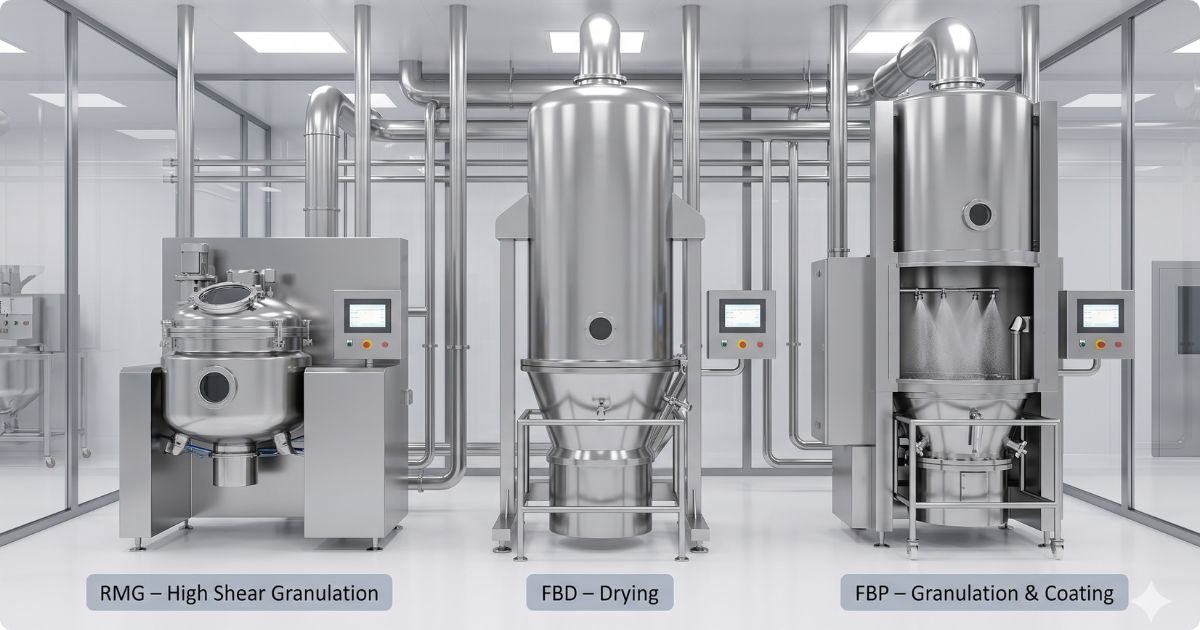

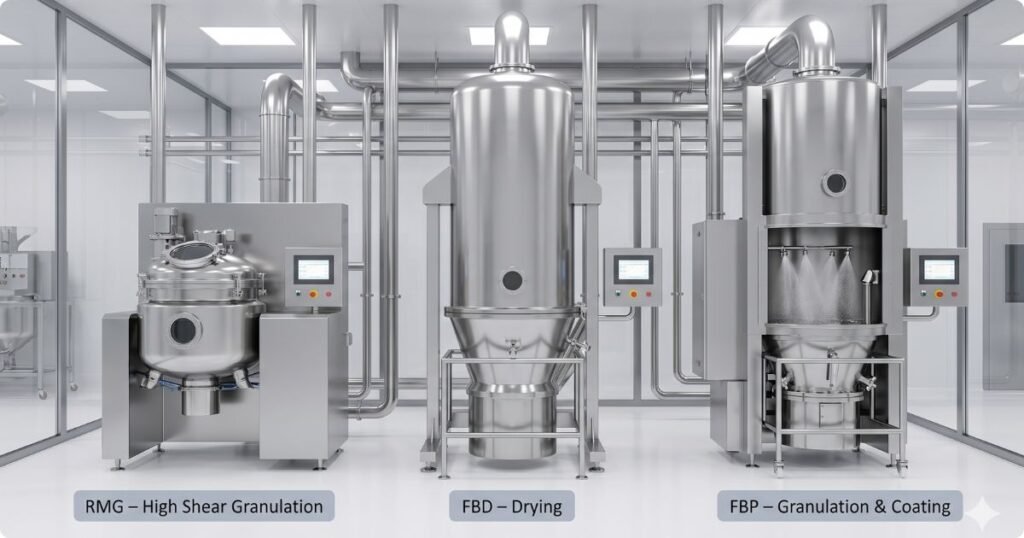
Granulation and drying are core unit operations in solid oral dosage manufacturing, directly impacting flowability, compressibility, content uniformity, and stability of tablets and capsules. Equipment selection at these stages is a major determinant of batch robustness, cycle time, and regulatory compliance because each technology offers different shear profiles, heat and mass transfer characteristics, and cleaning challenges. Fluid Bed Dryers (FBD), Fluid Bed Processors (FBP), and Rapid Mixer Granulators (RMG) are among the most widely used wet granulation and drying technologies in pharmaceutical manufacturing, often used in combination within a single process flow.[1][2][3][4]
This article provides a practical, decision‑oriented comparison of FBD, FBP, and RMG for solid oral dosage forms, with emphasis on functionality, process integration, CPP/CQA linkage, and GMP/regulatory expectations.
What is a Fluid Bed Dryer (FBD)?
Principle of operation
A Fluid Bed Dryer operates on the principle of fluidization, in which a bed of moist granules is suspended in an upward flow of conditioned air or gas. When the air velocity exceeds the particle settling velocity, particles behave like a boiling fluid, dramatically increasing effective surface area for heat and mass transfer and enabling rapid, uniform drying. Moisture evaporates from the granule surface and is carried away in the exhaust air until the desired loss on drying (LOD) or residual moisture content is achieved.[5][6][7]
Key components
Typical cGMP fluid bed dryers include:[5][6][7]
- Air handling unit with heaters, filters, and controls for inlet air temperature, flow, and humidity.
- Product container or bowl with perforated bottom or distributor plate.
- Expansion chamber with filters or finger bags for powder retention.
- Exhaust blower and ducting for controlled exhaust air flow.
- Control system (HMI/PLC) for temperature, differential pressure, airflow, and time.
- Optional spray nozzles and solution delivery system in FBDs upgraded toward processing capability.
Typical uses in pharma
In solid oral manufacturing, the primary use of FBD is drying of wet granules produced by RMG or other wet granulation equipment before milling and compression. FBDs may also be used to dry pellets, beads, and occasionally to pre‑dry moisture‑laden excipients or wet‑milled API dispersions.[2][3][8]
Advantages
- Very efficient convective drying with uniform heat and mass transfer, leading to shorter drying times than tray drying.[5][6][7]
- Good control of inlet air temperature, airflow, and exhaust temperature supports consistent residual moisture and LOD.
- Batch sizes from R&D scale to large commercial scale with relatively simple scale‑up based on airflow and bed depth.[2]
- Closed, contained system (when properly designed) reduces operator exposure to potent materials versus open trays.[6]
Limitations
- Drying only: standard FBDs do not provide granulation or coating; a separate granulator is required.[5][6]
- Potential for attrition and generation of fines if airflow is too high or distributor design is poor.[5][6]
- Segregation risk for very broad particle size distributions or density differences, particularly during charging and discharging.[2]
- Bag clogging and filter fouling can occur, affecting airflow and drying uniformity if not adequately designed or maintained.[5][6]
GMP and cleaning considerations
Regulators expect FBDs to be designed with smooth, cleanable surfaces, appropriate materials of construction (e.g., 316L stainless steel), and validated cleaning procedures covering product contact parts such as bowls, filters, and air distribution plates. EU GMP Annex 15 explicitly requires cleaning validation for all product contact equipment, including grouping and worst‑case selection where justified, and does not accept visual inspection alone as a cleaning acceptance criterion. Dedicated or campaign‑based FBD bags are often used to minimize cross‑contamination, with procedures that require inspection for integrity and traceability of bag usage.[9][10][8]
What is a Fluid Bed Processor (FBP)?
Multi‑function capability
A Fluid Bed Processor extends the basic FBD design to enable drying, granulation, and coating in the same equipment by adding spray systems and interchangeable inserts. Top‑spray inserts support binder solution spraying for granulation, bottom‑spray (Wurster) inserts are used for particle and pellet coating, and tangential spray (rotor) inserts handle pellet layering, powder coating, and taste‑masking applications.[11][12][13][2]
Types of FBP configurations
- Top spray: Binder or solution is sprayed from above into the fluidized bed to agglomerate particles, producing granules while simultaneously drying them.[11][12]
- Bottom spray (Wurster): Product is circulated through a partitioned column where coating suspension is sprayed upward from the bottom; commonly used for uniform coating of pellets or multiparticulates.[12][13][11]
- Tangential spray (rotor): Product bed rests on a rotating disc with tangential spray onto the moving pellet bed, suited for layering and high coating loads.[13][11][12]
Applications in pharma
FBPs are used for one‑pot granulation and drying, functional coating of pellets and granules (e.g., modified‑release, enteric, taste‑masking), and drying/coating of multiparticulate systems used in capsules or sachets. They are especially valuable where integrated processing reduces handling, exposure, and transfer losses and where coating uniformity of small particles is critical for release performance.[11][12][13][2]
Advantages over FBD
- Multi‑function capability allows combining granulation, drying, and/or coating in one vessel, reducing equipment footprint and transfer steps compared to separate RMG + FBD + coater lines.[11][12][2]
- One‑pot top‑spray granulation can simplify process flow and reduce total cycle time for certain formulations, particularly for low‑to‑medium dose products.[12][11]
- Bottom‑spray Wurster coating offers excellent coating uniformity and controlled thickness on pellets, improving dose uniformity and release profiles.[13][11][12]
- Tangential spray systems enable high coating loads and efficient pellet layering with good mechanical strength.[11][12]
Limitations and cost considerations
- Higher capital cost and mechanical complexity versus basic FBD, including multiple inserts, spray guns, and solution delivery systems.[11][12]
- More complex cleaning and cleaning validation due to nozzles, lines, and multiple product contact components; risk‑based cleaning strategies and potential need for CIP/WIP systems are common.[9][10]
- Scale‑up of spray processes can be more challenging than simple drying, requiring careful control of droplet size, spray rate, atomization air, and bed dynamics to avoid agglomeration or spray‑drying.[13][2]
- For high‑shear granulation needs and very dense granules, a dedicated RMG may still provide better control than top‑spray FBP.[1][2]
What is a Rapid Mixer Granulator (RMG)?
Working principle
A Rapid Mixer Granulator, also known as a high‑shear mixer, uses a combination of a main impeller and a high‑speed chopper to mix powders and transform them into wet granules. The impeller, typically with two full‑length and two half‑length blades, lifts and circulates the powder bed, while the chopper breaks down wet lumps and controls granule size through high‑speed cutting action. Granulation occurs through a rising, whirling, and tumbling motion of the material, combined with binder solution addition.[1][14][15]
Role in wet granulation
In the classical wet granulation process, RMG is used for dry mixing of API and excipients, binder addition, and wet massing to obtain granules with the desired density, porosity, and size distribution before drying in an FBD. The process typically includes dry mixing, binder solution spraying or pouring, and a wet massing phase where impeller and chopper speeds are adjusted to reach the granulation end‑point.[1][2][15][3]
Critical process parameters (CPPs)
From a QbD/ICH Q8 perspective, the main CPPs for RMG include:[1][16][17][4]
- Impeller speed and profile (shear intensity, mixing pattern).
- Chopper speed and on/off profile.
- Mixing time in dry and wet phases.
- Binder solution addition rate, method (spray vs pour), and total quantity.
- Granulation end‑point criteria (torque, power consumption, granule size, or PAT signal).
- Product temperature and mass consistency.
These CPPs are directly linked to CQAs such as granule size distribution, bulk density, flowability, and content uniformity, which in turn affect tablet weight variation, hardness, disintegration, and dissolution.[16][17][4]
Advantages
- Very fast mixing and wet granulation, often within 5–20 minutes for a batch, improving productivity relative to low‑shear systems.[1][2][15]
- High shear enables formation of dense, strong granules suitable for high‑dose or poorly flowing APIs.[2][1]
- Closed, contained design reduces dusting and cross‑contamination risk and supports processing of potent compounds when combined with appropriate containment.[1]
- Well‑established scale‑up methodologies based on tip speed, Froude number, or specific power input.[2]
Limitations and scale‑up considerations
- Over‑granulation risk if mixing is prolonged or binder quantity is excessive, leading to high density granules, poor compressibility, and potential dissolution failures.[1][2][4]
- Thermal and mechanical stress may be problematic for very heat‑ or shear‑sensitive APIs.[2]
- Scale‑up requires careful matching of shear environment and granulation end‑point criteria between development and commercial equipment; simple linear time scaling is often inappropriate.[16][2]
- RMGs cannot perform final drying or coating, so integration with FBD or FBP is required.
Key Differences: FBD vs FBP vs RMG
Comparison table
| Parameter | Fluid Bed Dryer (FBD) | Fluid Bed Processor (FBP) | Rapid Mixer Granulator (RMG) |
|---|---|---|---|
| Primary function | Drying of wet granules or pellets by fluidization | Integrated drying, granulation, and coating (top, bottom, tangential spray) | High‑shear wet mixing and granulation of powders |
| Process stage | Downstream of granulation (post‑RMG or FBP granulation) | Can be used for granulation, drying, and/or coating in one vessel | Upstream wet granulation step before drying |
| Output type | Dried granules or pellets ready for milling/blending | Granules and/or coated pellets with defined coating level | Wet granules or wet mass requiring subsequent drying |
| Shear level | Low shear, mainly fluidization | Generally low‑to‑moderate shear (top‑spray granulation), higher mechanical stress in rotor inserts | High shear due to impeller and chopper |
| Efficiency | Highly efficient convective drying; short drying times | Efficient combined operations but more complex to optimize | Very fast granulation; short batch times for mixing and granulation |
| Flexibility | Limited to drying (plus minor upgrades) | High flexibility: drying, granulation, pellet coating, layering | Focused on granulation; limited functionality outside wet granulation |
| Capital cost | Lower relative to FBP for same capacity | Higher due to multi‑function design and spray systems | Moderate; widely available in many sizes |
| Cleaning complexity | Moderate (bowl, filters, ducts, bags) | High (nozzles, lines, inserts, complex internal geometry) | Moderate (bowl, impeller, chopper, seals) |
| Typical use | Conventional wet granulation line (RMG → FBD) | One‑pot processing and pellet coating applications | Main wet granulator in batch tablet manufacturing |
This comparison highlights that RMG is primarily a granulation device, FBD is primarily a dryer, and FBP is a multi‑function processor bridging both roles with additional coating capability.[1][12][13][2]
When to Use What?
Classical wet granulation workflow (RMG + FBD)
For most high‑volume solid oral products using conventional wet granulation, the standard sequence RMG → wet mill (if required) → FBD → mill → blender → compression is still the workhorse. RMG provides robust high‑shear granulation, while FBD ensures efficient, uniform drying with well‑understood scale‑up parameters. This combination is particularly suitable for:[1][6][2][3][8]
- Medium to high‑dose tablets where strong, dense granules are required.
- Formulations with poor flowability or high API load where high‑shear granulation offers better control.
- Facilities that already have separate RMG and FBD assets and established validation packages.
One‑pot processing with FBP
An FBP with top‑spray granulation may be preferred when simplifying process flow and minimizing transfers are high priorities. Typical use cases include:[11][12][2]
- Low‑to‑medium dose formulations where gentle granules are adequate and high‑shear is not essential.
- Products where integrated granulation–drying–coating (e.g., taste‑masked or modified‑release pellets) in one unit reduces handling risk, exposure, and line footprint.[12][13][11]
- R&D and clinical manufacturing where flexibility to run drying‑only, granulation, or coating in the same equipment supports fast changeovers.
However, for very cohesive powders or high‑dose actives that demand strong densification, an RMG may still provide a more controllable granulation step.[1][2]
Moisture‑sensitive or heat‑sensitive products
For moisture‑sensitive APIs, dry granulation or direct compression is often preferred over wet granulation; however, when wet granulation is necessary, minimizing residence time and exposure to elevated temperature becomes critical. In such cases:[18][2]
- RMG + FBD can be configured with lower inlet temperatures and tight end‑point control to avoid over‑drying; shorter, optimized FBD cycles reduce thermal stress.[6][2][4]
- FBP can sometimes offer gentler drying because of efficient heat and mass transfer and shorter processing times in a single vessel, but spray parameters must be optimized to avoid overwetting and re‑drying cycles.[11][12][2]
For very heat‑labile products, direct compression, dry granulation (roller compaction), or low‑temperature drying techniques (e.g., vacuum tray, lyophilization of intermediates) may be more appropriate than FBD/FBP.
High‑shear versus low‑shear needs
- Use RMG when high‑shear granulation is required to densify powders, break agglomerates, and achieve narrow granule size distributions with good flow.[1][2]
- Use FBP top‑spray granulation when a gentler, lower‑shear process is sufficient and integrated drying is advantageous.[11][12]
- Use FBD alone when only drying is needed (e.g., drying wet‑milled suspensions or pre‑granulated materials) and no wet granulation is performed in the same batch.
Practical decision framework
A practical decision framework for equipment selection may consider:
- API and excipient properties: hygroscopicity, heat sensitivity, compressibility, and flow.[2][17][4]
- Dose strength and tablet size constraints.
- Desired granule density and mechanical strength.
- Facility layout, containment needs, and available utilities.
- Desired integration level (separate unit operations versus one‑pot processing).
- Lifecycle cost (CAPEX, cleaning, changeover, maintenance, validation).
In many cases, hybrid strategies are used: RMG + FBD for base granulation, followed by pellet coating in an FBP or pan coater for specialized release profiles.
Process Flow Integration
Wet granulation line integration
A typical batch wet granulation process using RMG and FBD follows these steps:[2][3][8]
- Sifting of API and excipients.
- Charging into RMG for dry mixing.
- Binder solution preparation.
- Binder addition and wet massing in RMG to defined end‑point.
- Discharge of wet mass to wet mill (if required) for de‑lumping.
- Transfer of wet granules to FBD for drying to target LOD.
- Dry milling and final blending.
- Compression and optional coating.
Equipment integration can be achieved by gravity transfer (stacked RMG and FBD), vacuum transfer, or through closed transfer systems to limit operator exposure and cross‑contamination.[19][3]
Direct compression vs. granulation strategy
Where API and excipient properties allow, direct compression can eliminate the need for RMG and FBD entirely, simplifying the process and reducing equipment qualification and cleaning burden. However, for poorly flowing APIs, low dose uniformity challenges, or where specific release profiles are needed, wet granulation with RMG + FBD or FBP remains the preferred approach.[2][17][4]
In development, it is common to evaluate direct compression, wet granulation (RMG + FBD or FBP), and sometimes roller compaction before locking the commercial process.
Critical Process Parameters (CPPs) and Critical Quality Attributes (CQAs)
RMG CPP–CQA linkage
Key CPPs for RMG include impeller/chopper speed, mixing time, binder addition rate, granulation end‑point criteria, and product temperature. These parameters influence CQAs such as granule size distribution, bulk/tapped density, flow properties, and content uniformity, which in turn determine tablet weight variation, hardness, friability, disintegration, and dissolution.[1][16][17][4]
FBD/FBP CPP–CQA linkage
For drying and fluid bed processing, important CPPs are inlet air temperature, airflow rate, exhaust air temperature and humidity, bed depth, and drying time. Additional CPPs for FBP include spray rate, atomization air pressure, nozzle position, spray pattern, and product temperature during spraying.[5][11][12][6][13][2][4]
These CPPs affect CQAs such as residual moisture content, granule strength, bulk density, and particle size distribution for drying, and coating thickness, uniformity, and integrity for FBP coating processes.[2][17][4]
Example CPPs and CQAs by unit operation
Based on QbD/QRM guidance and manufacturing experience, typical CPPs and CQAs are:[16][17][4]
- Wet granulation (RMG)
- CPPs: mixing time, impeller speed, binder addition rate and time, method of binder addition, product temperature.
- CQAs: moisture content of wet mass, granule size and distribution, bulk/tapped density, blend uniformity.
- Drying (FBD/FBP)
- CPPs: drying time, inlet air temperature and flow, exhaust air temperature and flow, bed depth.
- CQAs: residual moisture content, granule strength, density, flow properties.
- Coating (FBP bottom/tangential spray)
- CPPs: spray rate, inlet air temperature, atomization air pressure, pan or rotor speed, spray pattern.
- CQAs: appearance, coating thickness, mechanical integrity, percent weight gain, dissolution profile.
ICH Q8, Q9, and Q10 emphasize identifying and controlling these CPPs to ensure CQAs consistently meet the Quality Target Product Profile (QTPP).[17][4][16]
Regulatory and GMP Considerations
USFDA and EU GMP expectations
FDA and EU GMP require that facilities, utilities, and process equipment used for granulation and drying be appropriately designed, qualified, and maintained in a validated state. Qualification typically follows the IQ–OQ–PQ sequence, with PQ demonstrating that the equipment performs as intended under routine operating conditions with actual product. FDA 21 CFR 211.63 and EU GMP Annex 15 are frequently cited in inspections where equipment qualification or process validation is deficient.[20][9][21][22]
Cleaning validation and cross‑contamination control
EU GMP Annex 15 and associated cleaning validation guidance require documented evidence that cleaning procedures reproducibly remove product residues, cleaning agents, and microbial contaminants from product contact surfaces of equipment such as RMG bowls, FBD bowls and filters, and FBP inserts. Visual cleanliness alone is not considered sufficient; analytical methods with appropriate limits (dose‑ or health‑based) must be used, and grouping of similar equipment is allowed only with scientific justification.[9][10][23]
Cross‑contamination control strategies include use of dedicated or campaign‑specific FBD bags, contained transfers between RMG, FBD, and FBP, appropriate air handling/pressure cascades, and robust SOPs for product changeover and line clearance.[10][8][9]
Data integrity (ALCOA+)
Data generated during granulation and drying—such as batch records, equipment logs, HMI trends, and PAT data—must comply with ALCOA+ principles: Attributable, Legible, Contemporaneous, Original, Accurate, Complete, Consistent, Enduring, and Available. FDA’s 2018 CGMP data integrity guidance and MHRA/WHO documents explicitly anchor data integrity expectations to ALCOA(+), and data integrity deficiencies remain a common cause of warning letters and EU non‑compliance reports.[24][25][26][27]
Equipment qualification (IQ/OQ/PQ)
All RMG, FBD, and FBP units must undergo documented IQ, OQ, and PQ before routine GMP use, including verification of critical utilities, control systems, alarms, and safety interlocks. PQ should demonstrate consistent performance across a defined operating range and batch size, and is often combined with process performance qualification (PPQ) runs as per FDA’s process validation guidance. Changes to equipment (e.g., new FBP insert, nozzle design, or control logic) require change control, impact assessment, and potential re‑qualification.[20][21][22]
Common Mistakes and Troubleshooting
Over‑granulation and poor granule quality (RMG)
Common RMG issues include over‑granulation due to excessive binder, overly long wet massing times, or too high impeller/chopper speeds, leading to hard, non‑compressible granules and poor dissolution. Under‑granulation can produce fragile, dusty granules with poor flowability and high weight variation risk. Practical mitigations include:[1][2][4]
- Defining clear granulation end‑point criteria (e.g., power draw, torque, or PAT‑based moisture/size measures).
- Performing design of experiments (DoE) to map CPP ranges and interactions.
- Implementing in‑process controls for granule size, density, and LOD.
Uneven drying and attrition (FBD/FBP)
In FBD and FBP, uneven drying can arise from improper airflow distribution, overloaded bowls, poor distributor plate design, or clogged filters. Excessive airflow or long drying times can cause attrition and generation of fines, potentially leading to segregation and coating defects downstream. Corrective actions include optimizing batch load, bed depth, inlet air distribution, and filter maintenance, and using appropriate process controls (e.g., exhaust temperature plateau, online moisture sensors).[5][6][2]
Operator errors and equipment misuse
Typical operator‑related issues include incorrect set‑points, skipping pre‑checks, inadequate recording of deviations, and incorrect assembly of product contact parts (e.g., misaligned FBD bags, improperly installed RMG chopper seals). Mitigation relies on robust training, SOPs with clear steps and limits, use of checklists for assembly and line clearance, and automation with interlocks where appropriate.[2][21][8]
Real‑World Industry Examples
Tablet manufacturing using RMG + FBD
Most medium‑to‑large‑scale tablet manufacturing lines continue to use RMG for granulation followed by FBD for drying before milling, blending, and compression. This configuration has extensive regulatory precedence and a large knowledge base, making it attractive for generic products and high‑volume brands.[2][3][8]
Pellet coating in FBP
FBP with bottom‑spray (Wurster) or tangential spray inserts is widely used for coating pellets with modified‑release or enteric systems, where small multiparticulates are filled into capsules or compressed into tablets. These systems offer precise coating thickness and uniformity, which are critical for achieving targeted release profiles and minimizing dose dumping.[11][12][13][2]
High‑volume production vs. R&D
In high‑volume plants, dedicated RMG and FBD lines are often preferred for throughput and ease of parallelization, while FBPs may be used in specialized coating suites or for selected one‑pot processes. In R&D and clinical supply, FBP systems offer versatility to run drying‑only, granulation, or coating campaigns in smaller batch sizes, supporting rapid process development and scale‑up.[11][12][13][2]
FAQs
-
Can a Fluid Bed Processor (FBP) replace a Rapid Mixer Granulator (RMG)?
An FBP with top‑spray granulation can replace RMG for certain formulations, especially low‑to‑medium dose products requiring relatively gentle granules and where integrated granulation–drying is desirable. However, for high‑dose, poorly flowing, or highly cohesive APIs that require strong, dense granules, an RMG’s high‑shear environment typically offers better control and robustness.[11][1][12][2]
-
Why is a Fluid Bed Dryer (FBD) used after RMG?
RMG produces a wet mass or wet granules that must be dried to a defined residual moisture level before milling and compression to ensure flowability, compressibility, and stability. FBD provides rapid, uniform convective drying under controlled temperature and airflow conditions, making it an ideal downstream unit operation after RMG in classical wet granulation.[5][1][6][2][4]
-
Which is better for moisture‑sensitive drugs: RMG + FBD or FBP?
For moisture‑sensitive drugs where wet granulation is still required, both configurations can be used if exposure time and temperature are carefully controlled. RMG + FBD often benefits from established scale‑up and the ability to run short, low‑temperature drying cycles, while FBP can minimize transfers and total processing time by integrating granulation and drying; choice should be based on formulation behavior, stability data, and CPP/CQA risk assessment.[11][12][2][4]
-
What is the working principle of a fluid bed dryer in pharma?
A fluid bed dryer works by passing heated, filtered air through a perforated base plate to fluidize wet granules or pellets, suspending them in the air stream so that moisture evaporates rapidly and is carried away in the exhaust. This fluidization leads to efficient heat and mass transfer and uniform drying across the batch.[5][6][7]
-
What is the RMG granulation process?
The RMG granulation process involves dry mixing of API and excipients, controlled addition of binder solution, and high‑shear wet massing using an impeller and chopper to produce granules with defined size and density. The process is typically controlled through predefined mixing times, impeller/chopper speeds, and an end‑point based on torque, power draw, or direct granule characterization.[1][15][3]
-
What are typical uses of a fluid bed processor in pharma?
Fluid bed processors are used for top‑spray granulation, drying of wet granules, bottom‑spray Wurster coating of pellets and multiparticulates, and tangential‑spray pellet layering and coating for modified‑release and taste‑masking applications. Their flexibility makes them attractive for R&D, clinical supply, and commercial production of complex solid oral dosage forms.[11][12][13][2]
-
How do wet granulation equipment options compare in pharma?
Wet granulation equipment such as RMG, FBD, and FBP differ mainly in their function (granulation vs. drying vs. coating), shear environment, and integration level. RMG provides high‑shear granulation, FBD provides efficient drying, and FBP integrates drying, granulation, and coating; equipment selection should be based on formulation needs, quality attributes, and lifecycle cost rather than perceived popularity.[1][12][13][2]
Conclusion
In solid oral manufacturing, Fluid Bed Dryers, Fluid Bed Processors, and Rapid Mixer Granulators serve complementary roles: RMG as the primary high‑shear granulator, FBD as the primary dryer, and FBP as a flexible one‑pot processor and pellet coater. The optimal choice is formulation‑ and process‑specific and should be driven by CPP–CQA relationships, granulation and drying needs, regulatory expectations for cleaning and qualification, and the total lifecycle cost of ownership.[1][12][13][2]
Rather than asking which machine is “best,” manufacturers should ask which combination of RMG, FBD, and FBP delivers the most robust, compliant, and efficient process for the intended product and facility.
References:
- Pharmaguideline. Fluidized Bed Dryer – Principle, construction, working, uses, merits, demerits [Internet]. 2024 Apr 16 [cited YYYY Mon DD]. Available from: https://www.pharmaguideline.com/2007/02/principle-construction-working-uses-merits-demerits-of-fbd.html
- Pharma Granulation Guide – Fluid Bed Dryer and other technologies [Internet]. Pharmanow; [cited YYYY Mon DD]. Available from: https://www.pharmaguideline.com/2016/01/working-and-principle-of-rapid-mixer-granulator-rmg.html
- Pharmaguideline. Working and Principle of Rapid Mixer Granulator (RMG) [Internet]. 2024 Apr 16 [cited YYYY Mon DD]. Available from: https://www.pharmaguideline.com/2016/01/working-and-principle-of-rapid-mixer-granulator-rmg.html
- Senieer. Fluid Bed Processor: Working Principle and Application [Internet]. 2018 Oct 27 [cited YYYY Mon DD]. Available from: https://www.senieer.com/what-is-fluid-bed-processor/
- Senieer. Fluid Bed Processor – Technical brochure (PDF) [Internet]. [cited YYYY Mon DD]. Available from: https://www.senieer.com/wp-content/uploads/2021/09/Fluid-Bed-Processor-PDF.pdf
- Pharmaguddu. Fluidized bed dryer (FBD): Principle, Working, Troubleshooting, and Components [Internet]. 2023 May 13 [cited YYYY Mon DD]. Available from: https://pharmaguddu.com/principle-and-working-fluidized-bed-dryer-fbd/
- Riddhi Pharma. Fluid Bed Dryer: Working Principle and Benefits [Internet]. 2024 May 15 [cited YYYY Mon DD]. Available from: https://www.riddhipharma.com/fluid-bed-dryer-working-principle.html
- European Commission. EU Guidelines for Good Manufacturing Practice – Annex 15: Qualification and Validation [Internet]. 2015 Mar 29 [cited YYYY Mon DD]. Available from: https://health.ec.europa.eu/system/files/2016-11/2015-10_annex15_0.pdf
- Cleaningvalidation.com. What’s in Annex 15? – Cleaning validation focus [Internet]. 2025 Jul 23 [cited YYYY Mon DD]. Available from: https://cleaningvalidation.com/memos/whats-in-annex-15/
- Pharmaguideline. SOP for Tablet Granulation, Compression and Coating [Internet]. 2024 Apr 16 [cited YYYY Mon DD]. Available from: https://www.pharmaguideline.com/2011/05/sop-for-procedure-for-tablet.html
- Industrial Pharmacist. CPP and CQA in Different Stages of Drug Product Manufacturing [Internet]. 2024 Sep 6 [cited YYYY Mon DD]. Available from: https://industrialpharmacist.com/2024/07/cpp-and-cqa-in-different-stages-of-drug-product-manufacturing/
- Intuition Labs. ICH Q8 Explained: A Guide to Pharmaceutical Development [Internet]. 2025 Nov 14 [cited YYYY Mon DD]. Available from: https://intuitionlabs.ai/articles/ich-q8-pharmaceutical-development
- Bioprocesstools. CPP and CQA Mapping: How to Define Your Design Space [Internet]. 2026 Apr 11 [cited YYYY Mon DD]. Available from: https://bioprocesstools.com/blog/cpp-cqa-mapping-design-space/
- LinkedIn – Granulation Process in Pharmaceutical Industry: Types & Wet Granulation (RMG → FBD) [Internet]. 2026 Jan 31 [cited YYYY Mon DD]. Available from: https://www.linkedin.com/posts/alamgirafsar_pharmaceuticalindustry-granulation-pharmamanufacturing-activity-7423731585411080192-…
- Prolific 3D Tech. Wet Granulation Process | RMG | FBD | Co Mill – YouTube animation [Internet]. 2019 Oct 24 [cited YYYY Mon DD]. Available from: https://www.youtube.com/watch?v=4opuXtKdpPQ
- Assyro. Equipment Qualification: Complete Guide to IQ OQ PQ in Pharma [Internet]. 2026 Apr 7 [cited YYYY Mon DD]. Available from: https://assyro.com/blog/equipment-qualification-guide
- LinkedIn. EU GMP Annex 15 Cleaning Validation Requirements – Infographic post [Internet]. 2025 Dec 13 [cited YYYY Mon DD]. Available from: https://www.linkedin.com/posts/rakesh-5238b6253_eugmp-annex15-eudralex-activity-7405965557042184192-iUfN
- Totallab. ALCOA & ALCOA+ Principles – Pharma Data Integrity Guide [Internet]. 2026 Mar 25 [cited YYYY Mon DD]. Available from: https://totallab.com/resources/alcoa-principles/
- Pharmaguideline. ALCOA, ALCOA+ and ALCOA++ Principles | Ensuring Data Integrity [Internet]. 2026 Feb 15 [cited YYYY Mon DD]. Available from: https://www.pharmaguideline.com/2018/12/alcoa-to-alcoa-plus-for-data-integrity.html