
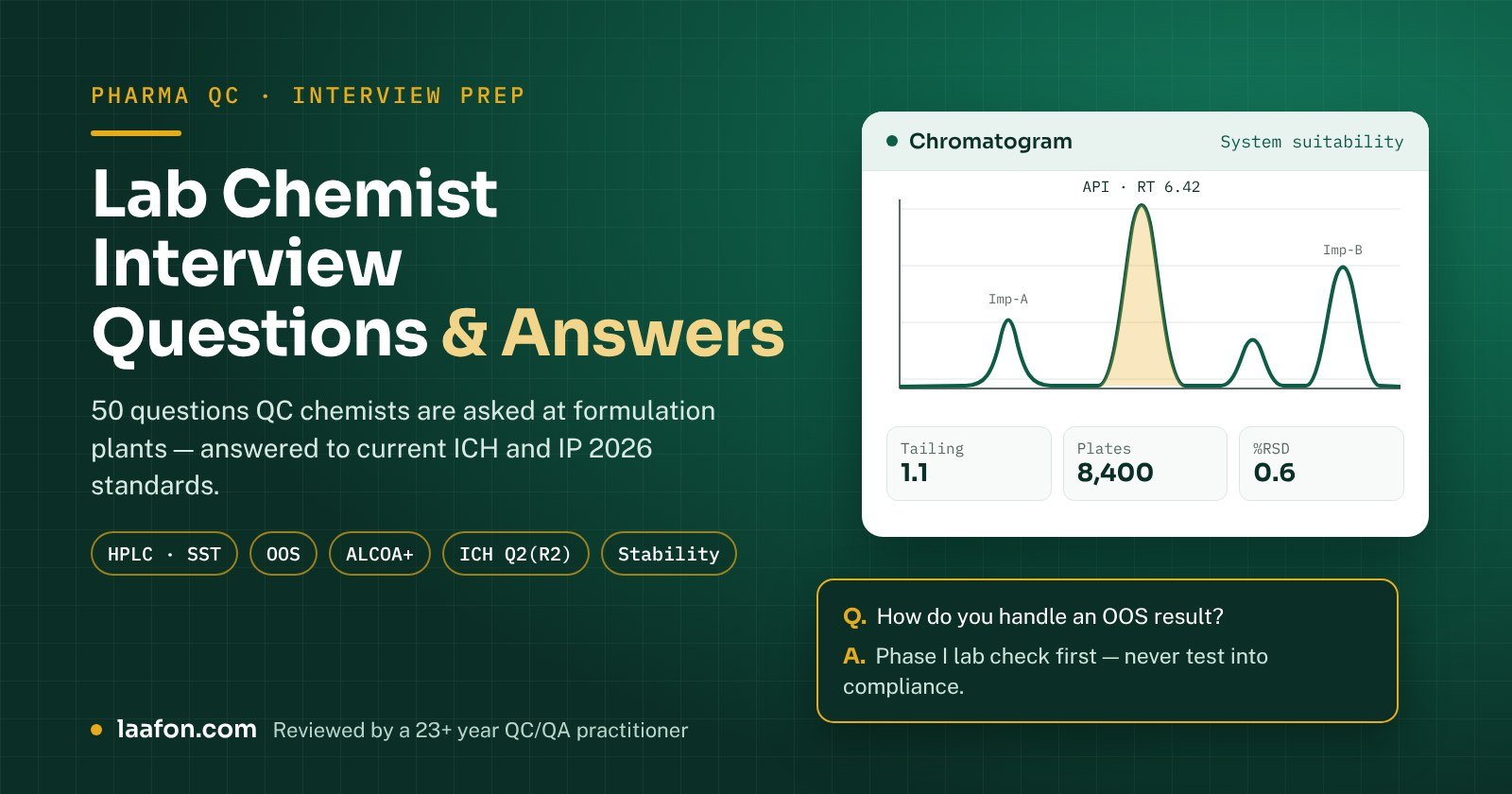

Interview prep · Pharma QC
Lab chemist interview questions and answers in pharmaceutical QC test five areas: GMP and data integrity (ALCOA+), analytical instruments (HPLC, GC, UV-Vis, FTIR, Karl Fischer, dissolution), method validation under ICH Q2(R2), how you handle OOS results and deviations, and stability testing. The 50 questions below come up repeatedly in QC chemist interviews at formulation plants, and the answers are written to the standards in force in November 2026.
Standards interviewers now expect you to quote
Many question banks still cite superseded versions. If you are asked about guidelines, use these:
- Method validation: ICH Q2(R2), adopted at Step 4 on 1 November 2023, with its companion ICH Q14 on analytical procedure development. Quote these, not Q2(R1).[1][2]
- Quality risk management: ICH Q9(R1), Step 4 on 18 January 2023.[3]
- Elemental impurities: ICH Q3D(R2).[4]
- Indian Pharmacopoeia: IP 2026, the 10th edition, released by the Indian Pharmacopoeia Commission in January 2026 with 121 new monographs (3,340 in total).[5]
- Stability: ICH Q1A(R2) still applies. A consolidated ICH Q1 revision was scheduled for Step 4 adoption in November 2026, so check the ICH website before your interview.[6][7]
50 lab chemist interview questions and answers
Tap a question to see the answer. Use Save as PDF to keep a copy for revision.
To confirm, through analytical testing and documentation, that raw materials, packing materials, in-process samples and finished products meet their approved specifications before they are used or released. The work is done under GMP: in India that means Schedule M, which was revised and notified in December 2023, alongside ICH guidelines for anything going to regulated export markets.
By applying ALCOA+: data must be Attributable, Legible, Contemporaneous, Original and Accurate, plus Complete, Consistent, Enduring and Available. WHO set out these expectations in its 2021 data integrity guideline.[8] For electronic records that means validated computerised systems, individual (never shared) log-ins, audit trails switched on and reviewed, controlled access rights and secure back-ups. Plants exporting to the US also work to 21 CFR Part 11. See ALCOA vs ALCOA+ vs ALCOA++: which regulator says what.
HPLC separates the components of a mixture by their different partitioning between a stationary phase packed in a column (for example C18) and a liquid mobile phase pumped through it under pressure. In QC it is used for assay of the active ingredient, related substances (impurity profiling), dissolution and content uniformity testing. More detail: principle of HPLC with system suitability limits.
Method validation is documented evidence that an analytical procedure is fit for its intended purpose. Under ICH Q2(R2) the performance characteristics are specificity/selectivity, range (which covers the response, including linearity, and the lower range limit), accuracy and precision (repeatability and intermediate precision).[1] Under ICH Q14, robustness is usually evaluated during method development.[2] Without validation, a result cannot support a batch release or a regulatory filing. See pharmaceutical method validation under ICH Q2(R2).
Follow the OOS SOP. Phase I is a laboratory investigation: the analyst and supervisor check the raw data, calculations, instrument, standards and sample preparation, ideally before solutions are discarded. If no clear laboratory error is found, Phase II is a full-scale investigation that includes a review of production. Retests are allowed only under a predefined procedure, and the number of retests is fixed in advance. Retesting until a result passes (testing into compliance) is unacceptable under FDA guidance.[9] The investigation ends with a root cause and CAPA.
Accuracy is how close a result is to the true or accepted value. Precision is how close repeated results are to each other under stated conditions. A method can be precise without being accurate, for example when a wrongly prepared standard gives a consistent bias.
GMP is the system of requirements that ensures products are consistently produced and controlled to quality standards. For a QC chemist it governs how samples are handled, how instruments are calibrated, how tests are performed and recorded, and how results are reviewed, so that every result is reliable and traceable. India’s GMP requirements are in Schedule M; see the Revised Schedule M deep dive.
QRM is the systematic assessment, control, communication and review of risks to quality, described in ICH Q9(R1).[3] In QC it is used to decide which methods, instruments or stages carry the most risk to a correct release decision, to set calibration and review frequencies, and to scope OOS and deviation investigations. Common tools are FMEA, fishbone diagrams and risk ranking.
Each instrument has a calibration SOP and schedule, uses traceable certified standards and carries a status label showing the calibration due date. Preventive maintenance follows its own schedule. An instrument that fails calibration is taken out of use and the impact on results generated since the last passing calibration is assessed. All activities are recorded by trained personnel.
Karl Fischer titration determines water content through the reaction of iodine and sulphur dioxide with water in the presence of a base and an alcohol, usually methanol. Volumetric KF suits samples with higher water content; coulometric KF suits trace levels. In QC it is used for water content of APIs, excipients and finished products, because moisture affects stability. See Karl Fischer calibration and KF factor.
A dissolution tester measures how fast and how completely the drug is released from a dosage form such as a tablet or capsule into a defined medium. It confirms batch-to-batch consistency and is the routine in-vitro indicator of release performance for solid oral dosage forms.
Examples: GC and GC-MS for residual solvents and volatile impurities, ICP-MS or ICP-OES for elemental impurities, LC-MS for unknown impurities and degradation products, NMR for structure elucidation, and XRD or DSC for polymorphism and crystallinity. Name only the ones you have actually used.
Follow the issuing bodies directly: Indian Pharmacopoeia Commission notices and IP amendment lists, CDSCO notifications, ICH guideline updates, USP Pharmacopeial Forum, and FDA and EMA guidance. Add journals, webinars and internal training.
SST is a check, performed before or during an analysis, that the chromatographic system is working adequately at the time of the test. Typical parameters are tailing factor, theoretical plates, resolution and the relative standard deviation of replicate injections, each against the limit in the method or monograph. A failed SST means no sample results are reported from that run.
pH affects solubility, stability, dissolution and ionisation, and therefore absorption. QC measures pH of solutions, buffers, oral liquids and injectables against specified ranges using a meter calibrated with standard buffers before use.
LOD is the lowest amount of analyte that can be detected but not necessarily quantified. LOQ is the lowest amount that can be quantified with acceptable accuracy and precision. In the signal-to-noise approach, ICH Q2(R2) treats a ratio of 3:1 as generally acceptable for LOD and at least 10:1 for LOQ.[1] Both matter most in impurity testing.
ICH guidelines harmonise the technical requirements for registering medicines. The ones a QC chemist should know: Q2(R2) validation of analytical procedures and Q14 analytical procedure development[1][2]; Q3A and Q3B impurities, Q3C residual solvents and Q3D(R2) elemental impurities[4]; Q1A(R2) stability[6]; Q6A specifications; Q7 GMP for APIs; Q9(R1) quality risk management[3]; and Q10 pharmaceutical quality system.
By testing raw materials, in-process samples and finished products, reviewing the data against specification, raising and supporting investigations for any OOS or deviation, and completing the certificate of analysis. QA makes the final release or rejection decision using that data.
Polymorphism is the ability of a solid to exist in more than one crystal form. Polymorphs can differ in solubility, melting point, stability and bioavailability, so where it matters QC confirms the specified form using techniques such as XRD or DSC.
Use a real example and structure it as situation, steps, result. For an HPLC pressure fluctuation: check mobile phase level and degassing, look for leaks, check the purge valve, pump seals and check valves, then the column or guard column for blockage. Consult the manual and SOP, involve the service engineer if needed, and record every step and the impact assessment in the instrument log.
A reference standard is a highly characterised material used as the benchmark for identification and quantitation. Primary standards come from a pharmacopoeia (IP, USP, Ph. Eur.) or are fully characterised in-house; working (secondary) standards are qualified against the primary and used for routine testing. See working standard qualification SOP.
Through a stability programme designed to ICH Q1A(R2). For the general case the conditions are long-term 25 °C ± 2 °C / 60% RH ± 5% RH or 30 °C ± 2 °C / 65% RH ± 5% RH, intermediate 30 °C / 65% RH, and accelerated 40 °C ± 2 °C / 75% RH ± 5% RH for at least 6 months.[6] WHO defines climatic zone IVb (hot and very humid) as 30 °C / 75% RH.[10] Samples are pulled at set time points and tested for assay, impurities, dissolution and physical parameters to establish shelf life. See stability chamber SOP.
AIQ is documented evidence that an instrument is suitable for its intended use. USP <1058> describes the 4Q model: Design Qualification (DQ), Installation Qualification (IQ), Operational Qualification (OQ) and Performance Qualification (PQ), and groups instruments into A, B and C by complexity.[11]
GC separates volatile and semi-volatile compounds between a stationary phase in a column and a carrier gas. It is the technique of choice for residual solvents (controlled under ICH Q3C) and other volatile impurities that HPLC cannot handle well.
Segregate waste by hazard class (flammable, corrosive, toxic, halogenated), store it in labelled compatible containers in a designated area, and hand it to an authorised waste handler, following the lab safety SOP and environmental regulations.
Change control ensures that any planned change to a method, instrument, specification or SOP is documented, assessed for impact on quality and compliance, approved before implementation and verified afterwards. It prevents uncontrolled changes from affecting results.
FTIR measures the absorption of infrared radiation by molecular vibrations, giving a fingerprint spectrum unique to a compound. In QC it is used mainly for identification of raw materials and finished products against a reference spectrum.
An assay is a quantitative determination of the amount or potency of a component, reported as a number. A limit test shows that an impurity does not exceed a specified limit, usually by comparison with a standard, without reporting an exact value.
Prioritise by criticality and deadline: batch release testing and stability pull points first, then routine work. Plan the day, communicate early with the supervisor if a delay is likely, and never trade data quality or safety for speed.
Method transfer is the documented qualification of a receiving laboratory to run a method developed or validated elsewhere. It shows that the receiving lab gets equivalent results, which is essential when testing moves between sites or to a contract lab.
The Beer-Lambert law states that absorbance is directly proportional to concentration and path length: A = εbc. It is the basis of UV-Vis assays, where the concentration of an absorbing analyte is calculated from its absorbance at a chosen wavelength.
RSD (coefficient of variation) is the standard deviation expressed as a percentage of the mean. It is the routine measure of precision, used in system suitability, method validation and trend review. A lower RSD means better repeatability.
Follow the glassware cleaning SOP: detergent wash, rinses with potable and purified water, solvent rinse where needed, drying and protected storage. Dedicate glassware to sensitive tests where cross-contamination is a risk.
A pharmacopoeia is the official book of standards for medicines: monographs, specifications and test methods. In India the official book is the Indian Pharmacopoeia; the current edition is IP 2026, the 10th edition, published by the Indian Pharmacopoeia Commission.[5] Export products are also tested to USP, Ph. Eur., BP or JP as their registration requires. The specification states which pharmacopoeia applies.
An SOP is an approved, written instruction for performing a routine activity. It ensures that every analyst does the task the same way, reduces errors, supports training and shows inspectors how work is controlled.
Elemental impurities are metals that may come from catalysts, raw materials, equipment or packaging. ICH Q3D(R2) classifies them by toxicity and likelihood of occurrence and sets permitted daily exposures (PDEs) by route of administration.[4] Control is based on a risk assessment, with testing by ICP-MS or ICP-OES where needed.
Weigh the reference standard accurately on a calibrated balance, dissolve and dilute to volume in calibrated volumetric glassware, mix well, and correct for the standard’s assigned potency. Label it with preparation and expiry date and use it within its validated stability.
Robustness is a method’s capacity to remain unaffected by small, deliberate changes in parameters such as mobile-phase pH, column temperature or flow rate. ICH Q14 states that for most procedures robustness is evaluated during development, ahead of validation; the results feed the system suitability criteria and the analytical procedure control strategy.[2][1]
Normal phase: polar stationary phase and non-polar mobile phase; polar compounds are retained most strongly, so it suits polar analytes and positional isomers. Reverse phase: non-polar stationary phase (C18, C8) and polar mobile phase; non-polar to moderately polar compounds are retained most, and it is the workhorse of pharmaceutical analysis. Ion exchange: separates ions by their charge interaction with a charged stationary phase; used for ionic drugs, amino acids and counter-ions.
A QMS is the documented system of processes, procedures and responsibilities through which a company achieves its quality objectives, across development, manufacturing, QC and distribution. ICH Q10 describes the pharmaceutical quality system model.
Sterility, bacterial endotoxin and microbial limit testing are usually done by the microbiology section, but a QC chemist must understand them because sterile product release depends on them, and chemical and microbiological results are reviewed together.
Cleaning validation is documented evidence that a cleaning procedure consistently removes product residues, cleaning agents and microbial contamination to acceptable limits. It prevents cross-contamination on shared equipment; QC tests the swab and rinse samples.
A deviation is an unplanned departure from an approved procedure, specification or standard. It is recorded promptly, classified by risk, investigated for root cause, assessed for product impact and closed with CAPA.
By trending OOS and OOT results, flagging recurring instrument or method problems, taking part in root cause analysis and proposing practical improvements to methods and documentation.
Retention time is the time from injection to the peak maximum; under fixed conditions it is characteristic of a compound and is used for identification. Peak area is proportional to the amount of analyte and is used for quantitation.
Sampling takes a representative portion of a material according to a predefined sampling plan and SOP, using clean tools in a controlled area. Containers are labelled as sampled, and samples are protected from contamination until testing so the result represents the whole batch.
MS measures the mass-to-charge ratio of ions, giving molecular weight and structural information. Coupled with chromatography (LC-MS, GC-MS) it identifies and quantifies impurities, degradation products and unknowns with high sensitivity and specificity.
Follow the safety SOPs, wear the right PPE, handle volatile and toxic chemicals in a fume hood, store chemicals by compatibility, know where the eyewash, safety shower and spill kit are, and report any incident or unsafe condition immediately.
SPC uses statistical tools such as control charts to monitor results over time. In QC it detects trends and shifts in assay results or instrument performance before they turn into OOS results, so action can be taken early.
A Laboratory Information Management System tracks samples, tests, results, specifications, instruments and reports. It reduces manual transcription errors, supports data integrity through access control and audit trails, and speeds up review and release. Like any GxP computerised system, it must be validated.
References
- International Council for Harmonisation. ICH Q2(R2) Validation of Analytical Procedures. Step 4 version, 1 November 2023. Amsterdam: European Medicines Agency; 2023. Available from: https://www.ema.europa.eu/en/documents/scientific-guideline/ich-q2r2-guideline-validation-analytical-procedures-step-5-revision-1_en.pdf. Accessed November 2026.
- International Council for Harmonisation. ICH Q14 Analytical Procedure Development. Step 4 version, 1 November 2023. Amsterdam: European Medicines Agency; 2023. Available from: https://www.ema.europa.eu/en/documents/scientific-guideline/ich-q14-guideline-analytical-procedure-development-step-5-revision-1_en.pdf. Accessed November 2026.
- International Council for Harmonisation. ICH Q9(R1) Quality Risk Management. Step 4 version, 18 January 2023. Brussels: European Commission; 2023. Available from: https://health.ec.europa.eu/system/files/2023-10/mp_ich_q9guideline-ra_en.pdf. Accessed November 2026.
- European Medicines Agency. ICH Q3D Elemental impurities — Step 5, Revision 2 (legal effective date 24 September 2022). Amsterdam: EMA; 2022. Available from: https://www.ema.europa.eu/en/ich-q3d-elemental-impurities. Accessed November 2026.
- Indian Pharmacopoeia Commission. Union Health Minister releases 10th Edition of Indian Pharmacopoeia — IP 2026. Ghaziabad: IPC; 2026. Available from: https://www.ipc.gov.in/news-highlights/1421-union-health-minister-shri-j-p-nadda-releases-10th-edition-of-indian-pharmacopoeia-ip-2026.html. Accessed November 2026.
- International Council for Harmonisation. ICH Q1A(R2) Stability Testing of New Drug Substances and Products. Step 4 version, 6 February 2003. Geneva: ICH; 2003. Available from: https://database.ich.org/sites/default/files/Q1A(R2)%20Guideline.pdf. Accessed November 2026.
- International Council for Harmonisation. ICH Q1 Expert Working Group Work Plan (Q1/Q5C revision of the stability guideline series). Geneva: ICH; 2026. Available from: https://database.ich.org/sites/default/files/ICH52_Q1_EWG_WorkPlan_2026_0318.pdf. Accessed November 2026.
- World Health Organization. Annex 4: WHO Guideline on data integrity. WHO Technical Report Series No. 1033. Geneva: WHO; 2021. Available from: https://www.who.int/publications/m/item/annex-4-trs-1033. Accessed November 2026.
- US Food and Drug Administration. Investigating Out-of-Specification (OOS) Test Results for Pharmaceutical Production — Guidance for Industry, Level 2 revision. Silver Spring (MD): FDA; May 2022. Available from: https://www.fda.gov/regulatory-information/search-fda-guidance-documents/investigating-out-specification-test-results-pharmaceutical-production. Accessed November 2026.
- World Health Organization. Annex 10: Stability testing of active pharmaceutical ingredients and finished pharmaceutical products. WHO Technical Report Series No. 1010. Geneva: WHO; 2018. Available from: https://extranet.who.int/prequal/sites/default/files/document_files/TRS1010_Annex10.pdf. Accessed November 2026.
- United States Pharmacopeia. General Chapter <1058> Analytical Instrument Qualification (version official 1 August 2017). Rockville (MD): USP; 2017. Available from: https://doi.usp.org/USPNF/USPNF_M1124_10101_01.html. Accessed November 2026.
Educational content for interview preparation, not legal or regulatory advice. Pharmacopoeial texts, ICH guidelines and Indian statutory instruments are revised frequently; confirm the current version with the issuing body before relying on a limit or date.