
Short answer
Aseptic vs sterile: the difference in one minute
Sterile describes the state of a product: the absence of viable micro-organisms, defined in regulatory practice as a sterility assurance level (SAL) of 10−6 or better, meaning no more than one non-sterile unit in a million[2]. Aseptic describes a way of working: handling product, containers and devices that are already sterile in an environment where air, materials and people are controlled to stop microbial, endotoxin and particle contamination[1].
So terminal sterilization vs aseptic processing is not a choice between “sterile” and “less sterile”. Both routes end in a sterile product. Terminal sterilization kills micro-organisms in the sealed final container; aseptic processing sterilizes the parts separately and keeps them sterile while they are put together. EU GMP Annex 1, the EMA and the US FDA all say the same thing: terminally sterilize whenever possible, and use aseptic processing only when you cannot[1][2][3].
Terminal sterilization vs aseptic processing compared
The FDA’s aseptic processing guidance puts the difference plainly. In terminal sterilization, product, container and closure are filled and sealed with low bioburden but are not yet sterile; the sealed unit is then sterilized by heat or irradiation. In aseptic processing, the drug, the container and the closure are each sterilized separately and then brought together, so there is no lethal step left once the unit is closed[3]. Every row below follows from that one fact.
| Point of comparison | Terminal sterilization | Aseptic processing |
|---|---|---|
| What gets sterilized | The filled, sealed product in its final container | Bulk solution (usually by filtration), containers and closures, separately |
| How sterility is assured | A validated lethal cycle with a demonstrated SAL ≤ 10−6[2] | Sterilized components plus a controlled environment; capability shown by aseptic process simulation (media fill)[1] |
| Typical methods | Moist heat (121 °C for 15 min, or F0 ≥ 8 min), dry heat, ionising radiation[2] | Sterilizing-grade filtration at a nominal 0.22 µm or less, then aseptic filling[1][2] |
| Filling environment | At least Grade C; Grade A with a Grade C background where contamination risk is unusual (slow fill, wide necks)[1] | Grade A critical zone with a Grade B background room, unless an isolator is used[1] |
| Where errors creep in | Few: the closed container limits the chance of error after sterilization[3] | Many: each separate sterilization and every manual or mechanical manipulation during assembly is a contamination risk[3] |
| Key validation evidence | Load mapping, heat penetration, at least three runs demonstrating SAL ≤ 10−6[2] | Filter validation and integrity testing, environmental monitoring, media fills with a zero-growth target[1] |
| Role of the sterility test | The same for both: the last in a series of controls. It cannot make up for a process that does not meet its design or validation parameters[1] | |
| Dossier position | The default; no justification needed for choosing it | Must be justified by the decision tree, a risk assessment and evidence of efforts to make terminal sterilization work[2] |
| Typical products | Heat-stable small-volume injections in glass ampoules and vials; large-volume parenterals | Proteins and other heat-labile biologicals, many dry powder injections, many eye drops in plastic dropper bottles |
Swipe the table sideways on a phone.
The facility consequence is the row most plant owners underestimate. A terminal-sterilization line can fill in Grade C. An aseptic line needs a Grade B suite around the Grade A zone, which carries the strictest gowning, monitoring and cleaning load in the plant. Our guide to aseptic processing control under FDA, Annex 1 and Schedule M sets out those Grade A and B limits clause by clause.
Why regulators default to terminal sterilization
Three regulators, three documents, one position:
- EU GMP Annex 1 (2022), clause 8.34: where possible, finished product should be terminally sterilized with a validated and controlled process, because this gives greater assurance of sterility than sterile filtration and/or aseptic processing. Where terminal sterilization is not possible, the manufacturer should consider post-aseptic processing terminal heat treatment[1].
- EMA sterilisation guideline, section 4.3: finished products intended to be sterile should be terminally sterilized in their final container whenever possible, as Ph. Eur. general chapter 5.1.1 states. During the evaluation, “substantial efforts should be made to enable terminal sterilisation”[2].
- US FDA aseptic processing guidance (2004), section III: it is a well-accepted principle that sterile drugs should be made by aseptic processing only when terminal sterilization is not feasible, with an exception for packaging that gives a unique and substantial advantage, such as some dual-chamber syringes[3].
The reason is arithmetic, not preference. A lethal cycle applied to the sealed unit can be shown to leave no more than one non-sterile unit in a million. An aseptic process has no lethal step after closure, so its assurance rests on how well people, air, surfaces and components are controlled during every fill.
For Indian sterile units. Revised Schedule M Part II (G.S.R. 922(E), 28 Dec 2023) sets the specific requirements for sterile products, parenterals and sterile ophthalmics[4], and CDSCO’s circular of 7 Aug 2024 asks manufacturers to gap-assess against WHO TRS 1044 Annex 2 as well[5][6]. Revised Schedule M is now being enforced, with state inspections under way; live status is tracked on our CDSCO Schedule M compliance dashboard. A unit exporting to EU or PIC/S markets will be assessed against the Annex 1 and EMA texts quoted on this page.
The EMA decision trees, step by step
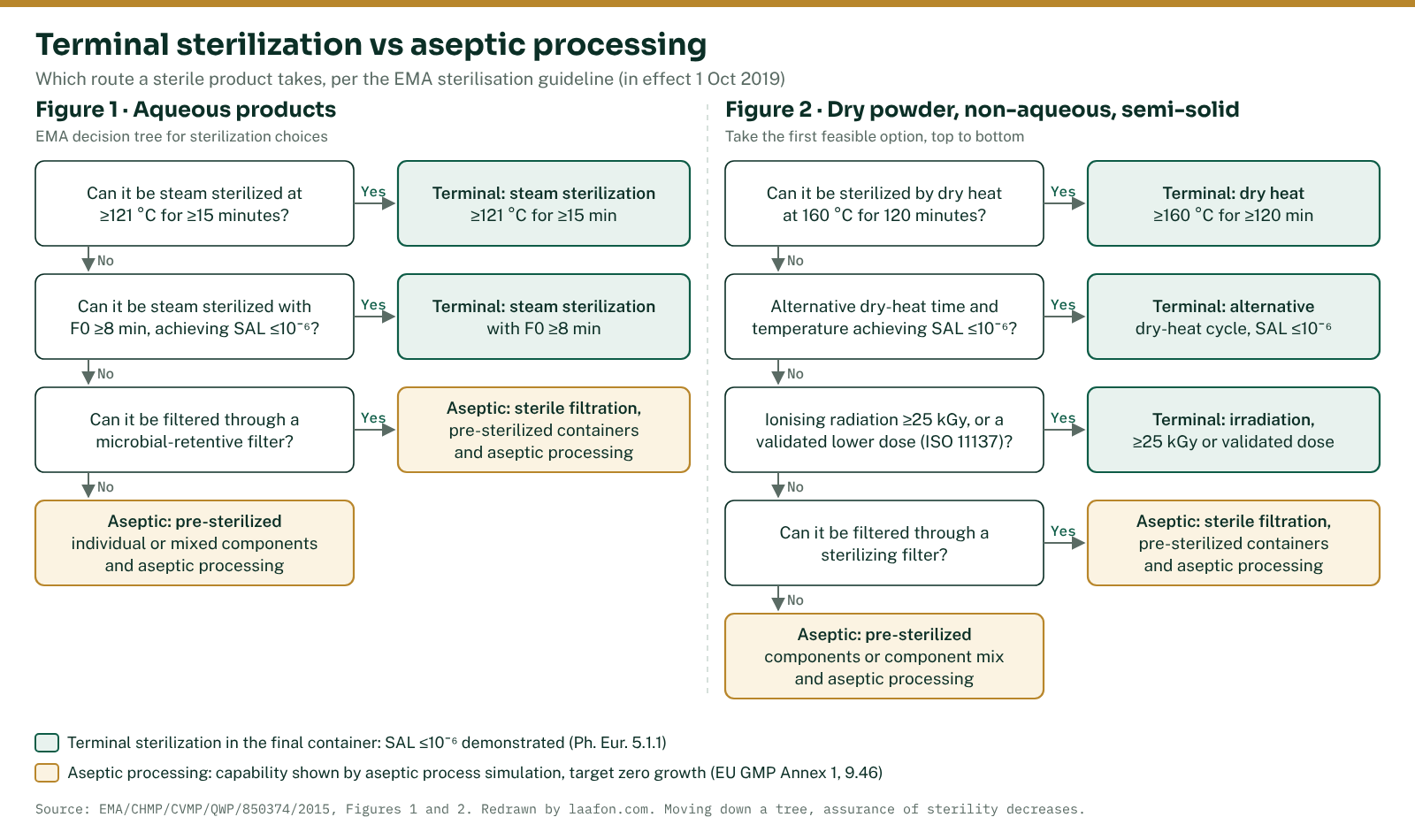
The EMA guideline (EMA/CHMP/CVMP/QWP/850374/2015, in effect since 1 Oct 2019) turns the terminal sterilization vs aseptic processing choice into two decision trees, one for aqueous products and one for dry powders, non-aqueous liquids and semi-solids. Moving down either tree, the assurance of sterility falls, so the first feasible option should normally be chosen[2].
Aqueous products (Figure 1)
- Can the product be steam sterilized at ≥ 121 °C for ≥ 15 minutes? If yes, use that cycle.
- If not, can it be steam sterilized with F0 ≥ 8 minutes while still achieving SAL ≤ 10−6? If yes, use that cycle.
- If not, can it be filtered through a microbial-retentive filter? If yes, combine sterile filtration, pre-sterilized containers and aseptic processing.
- If not, use pre-sterilized individual or mixed components and aseptic processing.
Dry powder, non-aqueous liquid and semi-solid products (Figure 2)
- Dry heat at 160 °C for 120 minutes.
- Dry heat with an alternative time and temperature that still achieves SAL ≤ 10−6.
- Ionising radiation at an absorbed minimum dose of ≥ 25 kGy, or a validated lower dose (with reference to ISO 11137).
- Sterile filtration, pre-sterilized containers and aseptic processing.
- Pre-sterilized components or component mix and aseptic processing.
Two details are easy to miss. First, heat sits above irradiation even though both give the same assurance of sterility, because heat has lower risk (for example, no radiolysis impurities) and is easier to control. Second, the aqueous tree has no irradiation step at all[2]. If an aqueous product reaches aseptic processing, the trees are then applied to its individual components.
Find your route
Pick the product type, then the first method in the tree that the product survives without unacceptable degradation.
1. Product type
2. First method the product survives
Choose one option from each group
Your route, the evidence it needs and the filling grade will appear here.
The top of Figure 1, the Ph. Eur. reference cycle. No justification for the method is needed.
- Evidence: load mapping and heat penetration, and at least three runs demonstrating SAL ≤ 10⁻⁶.
- Bioburden: limit of 100 CFU/100 mL before sterilization; routine testing not required for this cycle.
- Filling: at least Grade C (Annex 1, 8.3).
Second step of Figure 1. Still terminal sterilization, but the cycle relies on knowing the bioburden.
- Evidence: SAL ≤ 10⁻⁶ demonstrated over at least three runs; F0 delivered to the slowest-to-heat location.
- Bioburden: 100 CFU/100 mL limit tested routinely; hold temperatures of 110 to 115 °C also need the bioburden characterised for heat resistance.
- Filling: at least Grade C (Annex 1, 8.3).
The aqueous tree has no irradiation step. Under the tree, the next question is whether the product can be filtered.
- An irradiation route for an aqueous product needs its own scientific justification; the guideline suggests scientific advice for methods outside the standard ones.
- Check radiolysis impurities: this is why the EMA puts heat ahead of irradiation.
- If it can be filtered, the default route is sterile filtration plus aseptic processing.
Third outcome of Figure 1. Justify in the development section why no terminal cycle works.
- Filter: nominal pore size 0.22 µm or less; integrity tested before use (PUPSIT) and after use.
- Bioburden before filtration: NMT 10 CFU/100 mL in most situations.
- Filling: Grade A with Grade B background, or an isolator. Media fills target zero growth.
- Also assess post-aseptic terminal heat treatment (Annex 1, 8.34).
Bottom of Figure 1, the lowest assurance route. Apply the decision trees to each component or component mix.
- Each component needs its own validated sterilization method.
- Filling: Grade A with Grade B background, or an isolator.
- Media fills must simulate the full assembly, with every permitted intervention.
The top of Figure 2, the dry-heat reference cycle. No justification for the method is needed.
- Evidence: heat distribution and penetration studies, and a validated cycle demonstrating SAL ≤ 10⁻⁶.
- Confirm the product and container tolerate the cycle without degradation above qualified levels.
Second step of Figure 2. A lower temperature for longer, or another combination, is acceptable if it is designed, validated and controlled.
- Evidence: the cycle must still demonstrate SAL ≤ 10⁻⁶.
- Record why the reference cycle failed, with the degradation data.
Third step of Figure 2. Still terminal sterilization in the final container.
- Dose: absorbed minimum dose of 25 kGy, or a lower dose validated with reference to ISO 11137.
- Assess radiolysis impurities and container compatibility.
- Record why both dry-heat options failed.
Fourth step of Figure 2, for non-aqueous liquids that can pass a sterilizing filter.
- Filter: nominal pore size 0.22 µm or less, compatible with the vehicle; integrity tested before and after use.
- Filling: Grade A with Grade B background, or an isolator. Media fills target zero growth.
Bottom of Figure 2: the usual route for sterile powders filled as powders.
- The active and excipients are sterilized beforehand and handled aseptically; apply the decision tree to each component.
- Filling: Grade A with Grade B background, or an isolator. Media fills must simulate the powder process as it really runs.
- See our dry powder filling SOP for the line itself.
When aseptic processing is accepted, and what is not a justification
The EMA accepts aseptic processing without much argument where the product clearly cannot survive any terminal method. For proteins and other heat-labile biological substances, where it is well known that terminal sterilization is not possible, a justification based on scientific rationale is generally enough[2].
It also accepts aseptic processing in a few cases where the formulation could be terminally sterilized but another benefit outweighs the loss of assurance. The guideline lists them[2]:
- A container with a user benefit that cannot be terminally sterilized, such as eye-drop containers that deliver single drops, containers for preservative-free multi-dose non-parenteral products, and containers that make administration easier.
- Safer handling of toxic products, for example plastic vials instead of glass for cytotoxics.
- The longest possible shelf-life for radiopharmaceuticals whose shelf-life is under one week.
The same section is just as clear about what does not justify aseptic processing on its own:
| Reason offered | EMA position (section 4.3) |
|---|---|
| “Our container is heat-labile” | Choosing a heat-labile container cannot by itself be the sole reason; alternative materials should be investigated and the efforts made to find a container that can be terminally sterilized should be discussed[2] |
| “Terminal sterilization shortens shelf-life or changes storage conditions” | Not in itself a reason, unless the new storage condition or shelf-life would cause significant problems for the user[2] |
| “Degradants go above the ICH Q3B qualification threshold” | Not enough on its own without further justification. If the impurities are metabolites or are already qualified at that level, terminal sterilization is still considered feasible[2] |
| “The product degrades under our current cycle” | Present the efforts made to develop a formulation and container that can be terminally sterilized: pH, choice of excipients, container, sterilization method and manufacturing conditions[2] |
Cost does not appear anywhere in the guideline as a justification. A sterility assurance argument built on capital or running cost will not survive assessment.
The middle route: post-aseptic processing terminal heat treatment
Some products cannot take a full steam cycle but can take some heat. For these, Annex 1 asks manufacturers to consider a terminal heat step after aseptic processing[1]. Both Annex 1 and the EMA define it the same way: a terminal moist heat process applied after aseptic processing that has been shown to give SAL ≤ 10−6, but that does not meet the requirements of steam sterilization, for example F0 ≥ 8 min. Annex 1 adds that it may also help destroy viruses that filtration does not remove[1][2].
The EMA’s cycle table sets the conditions for this route: F0 below 8 min, a bioburden of 0 CFU/100 mL reached by aseptic filtration and processing before the heat step, the pre-filtration bioburden characterised for heat resistance, and a hold temperature above 110 °C unless a lower one is justified[2]. Because the product is filled aseptically first, it carries the full aseptic burden (Grade A in B, media fills) and gains extra assurance on top.
What each route has to prove
Terminal sterilization
- Cycle validation: load mapping including the slowest-to-heat locations, and at least three sterilization runs demonstrating SAL ≤ 10−6 as described in Ph. Eur. 5.1.1[2].
- Bioburden before sterilization: the EMA table uses 100 CFU/100 mL. Testing is non-routine for the 121 °C/15 min reference cycle and an overkill cycle (F0 above 12 min), and routine for F0-based cycles[2].
- Equipment: see our guides to autoclave validation and F0 and to depyrogenation vs sterilization for the cycle and tunnel detail.
Aseptic processing
- Sterile filtration: a nominal pore size of 0.22 µm or less is acceptable without further justification. Bulk bioburden immediately before filtration is tested routinely, and NMT 10 CFU/100 mL (TAMC) is acceptable in most situations[2].
- Filter integrity: tested before use after sterilization (PUPSIT) and non-destructively after use[1].
- Aseptic process simulation: the target is zero growth. Any contaminated unit is a failed APS, followed by root-cause investigation, corrective action and normally at least three consecutive successful repeats[1]. Media-fill frequency and the Schedule M Part II wording are compared in our aseptic processing control guide.
- Environmental monitoring: excursions are deviations to investigate; our SOP for environmental monitoring excursions sets out the steps.
Aseptic vs sterile: five misconceptions to retire
These five appear on many Indian pharma blogs. Two of them were on this page until November 2026, which is why it was rewritten from the primary sources.
| Misconception | What the sources say |
|---|---|
| “Aseptic means pathogens are absent; harmless organisms may remain.” | That is the clinical idea of asepsis. In pharmaceutical manufacturing, aseptic processing handles product that is already sterile and aims to prevent microbial, endotoxin/pyrogen and particle contamination altogether[1]. |
| “Sterile means every organism is absolutely destroyed.” | Sterility is defined by probability: absence of viable micro-organisms at SAL ≤ 10−6, no more than one non-sterile item per million[2]. |
| “Fumigation and 70 % IPA make a room sterile.” | Rooms are cleaned and disinfected, not sterilized. Schedule M Part II and WHO TRS 1044 both require more than one disinfectant and periodic use of a sporicide, because common agents do not kill spores[4][6]. |
| “A passing sterility test proves the batch is sterile.” | The sterility test is only the last in a series of critical controls and cannot assure sterility of a product that does not meet its design, procedural or validation parameters[1]. |
| “Aseptic or terminal is a free choice for the manufacturer.” | Terminal sterilization is the default in Annex 1, the EMA guideline and the FDA guidance; aseptic processing must be justified[1][2][3]. |
SOP: selecting and justifying the sterilization method
The document below turns the decision trees into an auditable record. It belongs to formulation development and QA rather than to the production floor: it is the paper trail an assessor or inspector asks for when a product is filled aseptically.
Selection and justification of the sterilization method for sterile products
1. Purpose
To select the sterilization method for each sterile product by the EMA decision trees, and to document the justification wherever a terminal method is not used.
2. Scope
Applies to new sterile products, and to existing products on any change to formulation, primary container, sterilization process or manufacturing site. It covers finished products and, where aseptic processing is selected, their individual components. It does not cover cycle validation protocols, media-fill protocols or cleanroom qualification, which have their own SOPs.
3. Responsibility
- Formulation development (F&D): runs the stability and degradation studies at each step of the tree.
- QC microbiology: bioburden characterisation and heat-resistance testing.
- Production and engineering: confirm equipment capability for the selected cycle.
- Regulatory affairs: transfers the justification to the dossier development section.
- Head, Quality Assurance: approves the selection record and its periodic review.
4. Definitions
- Sterility: absence of viable micro-organisms, as defined by SAL ≤ 10−6[2].
- Aseptic processing: handling of sterile product, containers and/or devices in a controlled environment that prevents microbial, endotoxin/pyrogen and particle contamination[1].
- F0: lethality of a saturated steam process, expressed as equivalent minutes at 121 °C, for organisms with a z-value of 10[2].
- Overkill sterilization: a process with lethality F0BIO above 12 minutes[2].
5. Procedure
6. Acceptance criteria and reference conditions
| Parameter | Criterion | Basis |
|---|---|---|
| Steam reference cycle | ≥ 121 °C for ≥ 15 min | regulatory EMA Figure 1, Table 1[2] |
| Alternative steam cycle | F0 ≥ 8 min, SAL ≤ 10−6; hold above 110 °C unless justified | regulatory EMA Table 1[2] |
| Bioburden before steam sterilization | 100 CFU/100 mL | regulatory EMA Table 1[2] |
| Dry heat reference cycle | ≥ 160 °C for ≥ 120 min | regulatory EMA Figure 2[2] |
| Ionising radiation | ≥ 25 kGy absorbed minimum dose, or validated lower dose (ISO 11137) | regulatory EMA Figure 2[2] |
| Terminal method validation | ≥ 3 runs demonstrating SAL ≤ 10−6 | regulatory EMA, citing Ph. Eur. 5.1.1[2] |
| Sterilizing filter | Nominal pore size ≤ 0.22 µm | regulatory EMA; Annex 1, 8.79[1][2] |
| Bioburden before sterile filtration | NMT 10 CFU/100 mL (TAMC), in most situations | regulatory EMA[2] |
| Filter integrity | Pre-use post-sterilization (PUPSIT) and post-use | regulatory Annex 1, 8.87[1] |
| Filling room, terminal route | At least Grade C; Grade A in C at unusual risk | regulatory Annex 1, 8.3 and 8.4[1] |
| Filling room, aseptic route | Grade A with Grade B background, unless an isolator is used | regulatory Annex 1, 4.4[1] |
| Aseptic process simulation | Zero growth; any contaminated unit fails the APS | regulatory Annex 1, 9.46[1] |
| Re-evaluation of the selection | On every relevant change, and at each product quality review | site policy not a regulatory frequency |
Swipe the table sideways on a phone. Indian units should also check each criterion against Revised Schedule M Part II and WHO TRS 1044 Annex 2; the Schedule M media-fill wording differs from Annex 1.
7. Deviation handling
If a product is found to be filled aseptically without an approved selection record, raise a deviation, complete Annexure-I retrospectively with the available data, and assess through change control whether a terminal or post-aseptic heat step is now feasible. If new data show that a higher step in the tree has become feasible (for example after a container change), raise a change control to move the product up the tree.
8. Precautions
- Never record cost or equipment availability as the reason for choosing aseptic processing.
- Base degradation conclusions on the intended commercial container, not a development vial.
- Keep the raw stability and bioburden data with the selection record; the summary alone will not satisfy an assessor.
9. Annexure-I: Sterilization method selection record
| Tree step | Method / condition tested | Result (assay, degradants, integrity) | Feasible? (Y/N) | Data reference | Done by / date | Checked by QA / date |
|---|---|---|---|---|---|---|
| 1 | Reference cycle | |||||
| 2 | Reduced cycle at SAL ≤ 10⁻⁶ | |||||
| 3 | Irradiation (Figure 2 only) | |||||
| 4 | Sterile filtration + aseptic | |||||
| 5 | Post-aseptic terminal heat treatment assessed |
10. Annexures
- Annexure-I: Sterilization method selection record
- Annexure-II: Formulation and container development summary
- Annexure-III: Risk assessment for aseptic processing
11. Revision history
| Version | Effective date | Change | Change control no. |
|---|---|---|---|
| 00 | DD-MMM-YYYY | New SOP | ___ |
| 01 | DD-MMM-YYYY | Aligned with EU GMP Annex 1 (2022), clause 8.34 | ___ |
This SOP is a template. It needs local adaptation, validation and QA approval before use, and every criterion must be checked against the current edition of each source.
Frequently asked questions
No. Sterile is a property of the product: no viable micro-organisms, at a sterility assurance level of 10⁻⁶ or better. Aseptic is a way of handling already-sterile product, containers and closures so that they stay free of microbial, endotoxin and particle contamination. An aseptically processed product is still labelled sterile; only the route to that claim differs.
Because a validated lethal cycle applied to the sealed container gives greater assurance of sterility than sterile filtration and aseptic handling. EU GMP Annex 1 clause 8.34, section 4.3 of the EMA sterilisation guideline and section III of the FDA 2004 guidance all say to terminally sterilize where possible and use aseptic processing only when it is not feasible.
The EMA guideline requires terminal sterilization to demonstrate a sterility assurance level of 10⁻⁶ or better, as described in Ph. Eur. 5.1.1. That means a probability of no more than one non-sterile unit in a million sterilized units, shown over at least three validation runs.
Not on its own. The EMA guideline says the choice of a heat-labile container cannot be the sole reason for not terminally sterilizing; alternative materials should be investigated and documented. A container can justify aseptic processing only when it gives a real user benefit, such as single-drop eye-drop bottles or preservative-free multi-dose containers.
Under EU GMP Annex 1, products for terminal sterilization are filled in at least Grade C, moving to Grade A with a Grade C background where the contamination risk is unusual. Aseptic filling takes place in a Grade A zone with a Grade B background room, unless an isolator is used. Indian units should also check Revised Schedule M Part II.
A moist heat step applied after aseptic filling that is shown to give a sterility assurance level of 10⁻⁶ or better without meeting full steam sterilization requirements such as F0 of at least 8 minutes. Annex 1 asks manufacturers to consider it whenever a product cannot be terminally sterilized, because it adds assurance on top of the aseptic process.
No. EU GMP Annex 1 clause 10.5 treats the sterility test as only the last in a series of critical control measures. It cannot assure the sterility of a product that does not meet its design, procedural or validation parameters, which is why cycle validation or media fills carry the real weight.
Planning a sterile section?
The choice between a terminal-sterilization line and an aseptic suite fixes your cleanroom grades, HVAC design, monitoring load and capital budget before a single machine is ordered. Laafon’s plant setup consultancy scopes sterile and injectable sections against Revised Schedule M, from room layout to qualification planning.
Related on Laafon
References
- European Commission. EudraLex Volume 4, EU Guidelines for Good Manufacturing Practice for Medicinal Products for Human and Veterinary Use. Annex 1: Manufacture of sterile medicinal products. C(2022) 5938 final. Brussels: European Commission; 2022 Aug 22. Glossary and clauses 4.4, 8.3, 8.4, 8.34, 8.79, 8.87, 9.46, 10.5. Available from: https://health.ec.europa.eu/system/files/2022-08/20220825_gmp-an1_en_0.pdf. Accessed Nov 2026.
- European Medicines Agency. Guideline on the sterilisation of the medicinal product, active substance, excipient and primary container. EMA/CHMP/CVMP/QWP/850374/2015. Amsterdam: EMA; 2019 Mar 6 (in effect 1 Oct 2019). Sections 4.3 and 5, Table 1, Figures 1 and 2, Definitions. Available from: https://www.ema.europa.eu/en/documents/scientific-guideline/guideline-sterilisation-medicinal-product-active-substance-excipient-and-primary-container_en.pdf. Accessed Nov 2026.
- US Food and Drug Administration. Guidance for industry: Sterile drug products produced by aseptic processing — current good manufacturing practice. Rockville (MD): FDA; 2004 Sep. Sections II.B and III. Available from: https://www.fda.gov/media/71026/download. Accessed Nov 2026.
- Ministry of Health and Family Welfare. G.S.R. 922(E): Drugs Rules, Revised Schedule M. Part II: Specific requirements for manufacture of sterile products, parenteral preparations and sterile ophthalmic preparations. Gazette of India, Extraordinary. New Delhi; 2023 Dec 28. Available from: https://cdsco.gov.in/opencms/opencms/en/Notifications/Gazette-Notifications/. Accessed Nov 2026.
- Central Drugs Standard Control Organization (QMS Monitoring Division). Circular: Implementation of Schedule M and WHO Technical Report Series (TRS). File No. QMS/38/Misc/2024. New Delhi: CDSCO; 2024 Aug 7. Available from: https://cdsco.gov.in/opencms/opencms/system/modules/CDSCO.WEB/elements/download_file_division.jsp?num_id=MTE1ODE=. Accessed Nov 2026.
- World Health Organization. Annex 2: WHO good manufacturing practices for sterile pharmaceutical products. In: WHO Expert Committee on Specifications for Pharmaceutical Preparations: fifty-sixth report. WHO Technical Report Series, No. 1044. Geneva: WHO; 2022. Available from: https://www.who.int/publications/m/item/trs1044-annex2. Accessed Nov 2026.
Technical and educational content for pharmaceutical professionals, not legal, regulatory or medical advice. The SOP above is a template requiring local qualification, validation and Quality Assurance approval before use. EU GMP Annex 1, EMA and FDA guidance, Revised Schedule M and pharmacopoeial texts change between editions; confirm the current version of each source before relying on a figure. Clause numbers refer to the versions listed in the references.