
Short answer. An out-of-specification result is a laboratory test result that falls outside a specification. Environmental monitoring data are not measured against specifications at all. They are measured against alert levels and action limits that the manufacturer sets from qualification and routine trend data.
So what the industry calls an OOS in environmental monitoring is, in every governing text, an action limit excursion. EU GMP Annex 1 (2022) and WHO TRS 1044 Annex 2 do not contain the abbreviation OOS even once. India’s notified Schedule M says of its own microbial table that the values “are not intended to represent specifications, but are for information only”. And the FDA guidance that defines OOS investigations applies to “chemistry-based laboratory testing” — the word environmental does not appear in it.
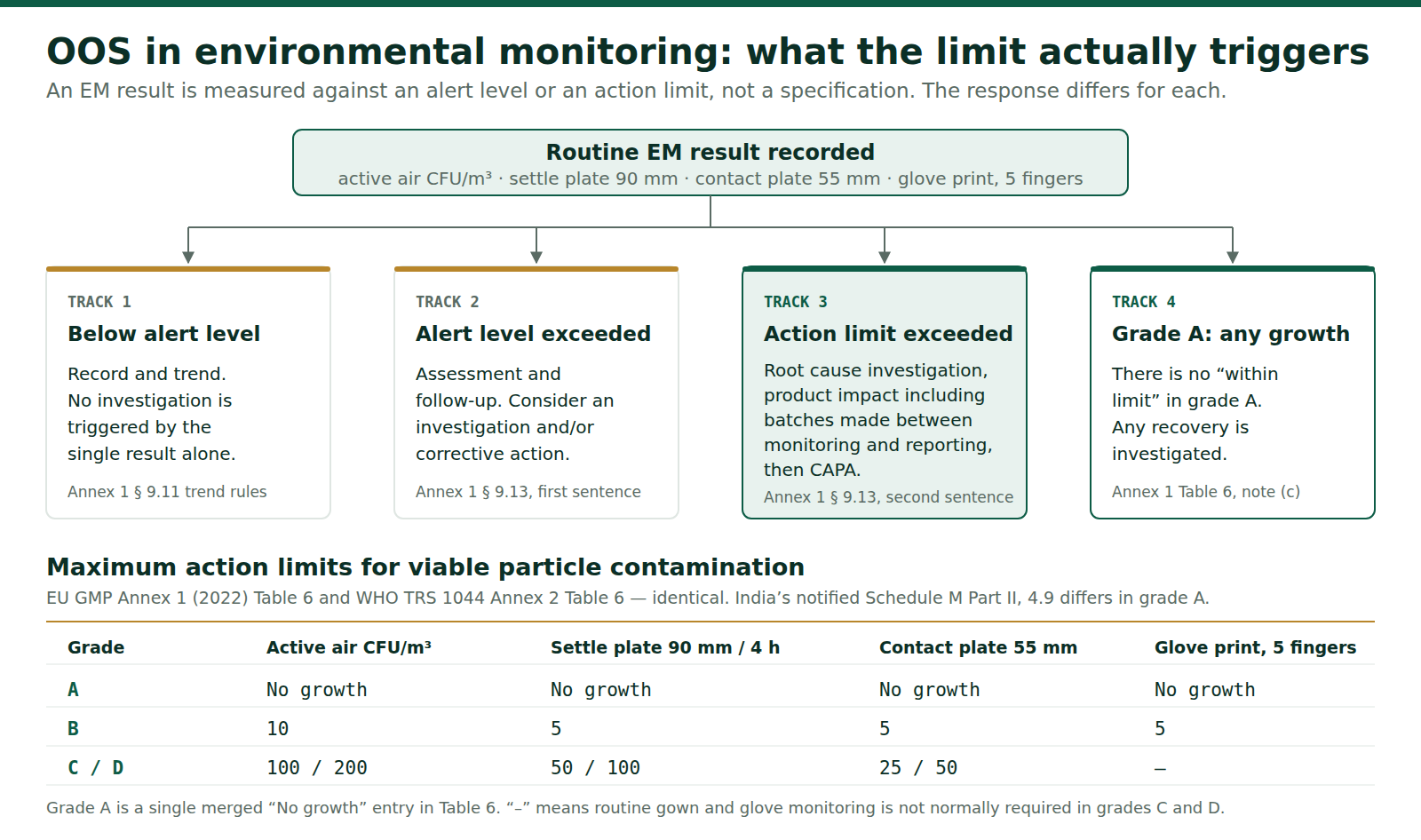
The distinction decides which procedure you run. An excursion at an alert level needs assessment and follow-up. An excursion at an action limit needs a root cause investigation, a product impact assessment that reaches the batches made between monitoring and reporting, and CAPA. Any growth at all in grade A needs an investigation, because grade A has no “within limit” condition.
Why an OOS in environmental monitoring is an action limit excursion
The term OOS has a defined meaning, and it is narrower than common usage. The FDA guidance that established the framework states its own scope in one sentence: “This guidance applies to chemistry-based laboratory testing of drugs regulated by CDER.” It defines OOS results as “all test results that fall outside the specifications or acceptance criteria established in drug applications, drug master files (DMFs), official compendia, or by the manufacturer.”
Environmental monitoring data fail that definition on both counts. They are not chemistry-based laboratory testing of a drug, and they are not compared against a specification registered anywhere. A settle plate is not a release test.
This is not an inference drawn from the guidance’s silence. The full text was searched character by character: the word environmental does not appear anywhere in it, and neither does sterility. The word microbiological appears exactly once, in the section on averaging, noting that USP prefers averages for microbiological assays because of the variability of the biological test system. There is no environmental monitoring provision in the OOS guidance because environmental monitoring was never in its scope.
Why the wrong word produces the wrong procedure
A facility that routes an environmental monitoring excursion through its product OOS SOP inherits that SOP’s machinery: hypothesis testing, retesting, resampling, invalidation of the original result. Applied to a settle plate, most of that is meaningless — there is no original sample left to retest, and a plate showing growth cannot be invalidated by a second plate showing none.
What the excursion procedure actually needs instead is a classification step, an isolate identification step, a trend review that looks backwards across the site, and a product impact assessment with a defined batch scope. Those are the steps the governing texts prescribe, and they do not appear in a product OOS SOP at all.
What each regulator actually calls it
Five documents govern this subject for an Indian manufacturer supplying the domestic market, the EU, or a WHO-GMP tender. Each was retrieved in full and searched for the term. The pattern is consistent.
| Document | What it calls an exceeded EM limit | Does “OOS” appear? |
|---|---|---|
| EU GMP Annex 1, 2022 revision primary [1] | Excursion from an action limit or an alert level. Table 6 is titled “Maximum action limits for viable particle contamination”. | No. 0 occurrences of “OOS” and 0 of “out-of-specification” in the whole Annex. “Excursion” appears 11 times. |
| WHO TRS 1044, Annex 2, 2022 primary [2] | Identical wording and identical Table 6. Clause 3.2 speaks of “environmental monitoring excursions”. | No. 0 occurrences. “Excursion” appears 11 times, “action limit” 15 times. |
| FDA, Sterile Drug Products Produced by Aseptic Processing, 2004 primary [3] | A result exceeding an action level. Table 1 footnote (c) calls the figures “recommended levels of environmental quality”. | Not used for EM. The guidance never calls these limits specifications. |
| FDA, Investigating Out-of-Specification Test Results, 2006 primary [4] | Not applicable. Scope is “chemistry-based laboratory testing of drugs regulated by CDER”. | Throughout — but “environmental” appears 0 times and “sterility” 0 times. |
| Schedule M, notified by G.S.R. 922(E), 28 Dec 2023 statutory [5] | Part II clause 4.10: “If the action limits are exceeded or a trend is identified in the alert limits, investigation shall be initiated”. | 11 times — all of them in Part V, on active pharmaceutical ingredients. None in the sterile environmental monitoring clauses. “Excursion” appears 0 times. |
Swipe the table sideways on a phone. Occurrence counts are from a character search of the full published text of each document, not from a summary.
The sentence most Indian sites have never read
Schedule M Part II clause 4.9 introduces the microbial limits table with a qualification that is easy to miss and hard to argue with once seen:
“The sampling methods and numerical values included in the said Table are not intended to represent specifications, but are for information only.”
India’s own statutory GMP rule therefore says, in terms, that its environmental monitoring numbers are not specifications. A document titled “SOP for OOS results in environmental monitoring” is describing something that Schedule M has already said cannot exist under that name.
USP general chapter ⟨1116⟩ reaches the same conclusion for aseptic processing environments, stating that the numerical values for air, surface and personnel monitoring “are not intended to represent limits or specifications but are strictly informational”, and adding that it is “not scientifically reasonable to suggest that the attainment of these values guarantees microbial control or that excursions beyond values in this chapter indicate a loss of control”. ⟨1116⟩ goes further than the GMP texts and recommends tracking contamination recovery rates — the percentage of samples showing any recovery — rather than treating each CFU count as a pass or fail. check source The figures quoted here are from the 2012 revision of ⟨1116⟩; the current USP–NF chapter text is behind a subscription and was not retrieved, so verify against the edition in force at your site.
Grade A to D action limits compared
The limits themselves are where the jurisdictions separate. EU GMP Annex 1 and WHO TRS 1044 Annex 2 are word-identical. India’s notified Schedule M carries the pre-2022 European table. The FDA works from ISO classes rather than grades. Figures are given in the order active air CFU/m³ / settle plate 90 mm per 4 h / contact plate 55 mm / glove print, 5 fingers.
| Grade | EU Annex 1 (2022) and WHO TRS 1044 | Schedule M Part II, 4.9 | FDA 2004 Table 1 |
|---|---|---|---|
| Grade A | No growth Table 6, note (c) “any growth should result in an investigation” |
< 1 in all four columns stated as average values |
ISO 5: 1 CFU/m³ active air, 1 CFU/4 h settle plate “should normally yield no microbiological contaminants” |
| Grade B | 10 / 5 / 5 / 5 | 10 / 5 / 5 / 5 | ISO 7: 10 CFU/m³ / 5 CFU per 4 h |
| Grade C | 100 / 50 / 25 / not routinely required | 100 / 50 / 25 / – | ISO 8: 100 CFU/m³ / 50 CFU per 4 h |
| Grade D | 200 / 100 / 50 / not routinely required | 200 / 100 / 50 / – | No corresponding row in Table 1 |
| Status | Maximum action limits. More stringent limits may be applied. Alert levels are set separately from qualification and trend data. | “Not intended to represent specifications, but are for information only.” | “Values represent recommended levels of environmental quality.” Alternate action levels are expressly permitted. |
Swipe the table sideways on a phone. The only grade-to-ISO equivalence stated in the FDA guidance is its own footnote (b): “An ISO 5 particle concentration is equal to Class 100 and approximately equals EU Grade A.” The grade B, C and D rows are aligned here by cleanroom class convention, not by any mapping the FDA guidance itself publishes.
Alert level and action limit are not two names for one thing
Annex 1 defines both in its glossary, and the definitions are doing different work. An action limit is “an established relevant measure (e.g. microbial, or airborne particle limits) that, when exceeded, should trigger appropriate investigation and corrective action based on the investigation.” An alert level is “an established relevant measure… giving early warning of potential drift from normal operating conditions and validated state, which does not necessarily give grounds for corrective action but triggers appropriate scrutiny and follow-up.”
Two practical consequences follow. First, the table of action limits is a ceiling, not a target: clause 9.9 says alert levels “should be established based on results of cleanroom qualification tests and periodically reviewed based on ongoing trend data”, and clause 9.12 says action limits “may be more stringent than those listed”. A site copying Table 6 into its SOP as its only set of limits has not set alert levels at all. Second, an alert level breach is not a lesser action limit breach; it is a different event with a different, lighter response.
Annex 1 clause 9.11 also lists what counts as a trend, and the list is worth reproducing in any monitoring SOP: increasing numbers of excursions from action limits or alert levels; consecutive excursions from alert levels; regular but isolated excursions from action limits that may share a common cause, such as excursions that always follow planned preventive maintenance; and changes in microbial flora type and numbers, with particular attention to spore-forming organisms and moulds.
Where India’s Schedule M diverges, and the amendment that has been agreed
The grade A row is the difference that matters. Schedule M Part II clause 4.9 gives “< 1” for all four grade A columns and closes the table with the note “These are average values.” That wording is inherited from the pre-2022 European Annex 1. The 2022 revision removed it, replaced the grade A figures with “No growth”, and added note (c): “It should be noted that for grade A, any growth should result in an investigation.” WHO TRS 1044 Annex 2 carries the identical note.
The practical gap is real. Under an averaging convention, a single colony recovered in a grade A zone can be arithmetically absorbed. Under Annex 1 and WHO TRS 1044 it cannot: grade A has no acceptable non-zero count, and a single recovery is an investigation trigger on its own.
Status of the amendment, as at the date of this page
India has agreed to close that gap but has not yet notified it. The Drugs Consultative Committee recommended alignment at its meeting of 17 June 2025. The Drugs Technical Advisory Board then took the proposal at its 93rd meeting, held on 16 February 2026, under Agenda No. 3, Part (A) — “Consideration of the proposal for revision of limits for microbial contamination in ‘Grade A’ area in Schedule M as per WHO Technical Report Series (TRS) 1044 annexure II”. The minutes record that the Board “after deliberation agreed for the proposed amendment to revise the limit for microbial contamination” in line with WHO TRS 1044 Annexure II.
No gazette notification giving effect to that amendment could be located. Until one issues, the text in force remains the Schedule M notified by G.S.R. 922(E) on 28 December 2023, with grade A at < 1 and the averaging note intact. A DTAB agreement is an input to a notification, not a notification. Sites should nonetheless expect the change and should be able to show that grade A recoveries are investigated regardless of arithmetic — which is in any case what an EU or WHO-GMP inspector will look for today.
One inconsistency worth recording: the DTAB minutes locate the table at “Table II of Para B under the Part XIID of Schedule M”. The notified Schedule M was searched in full: it runs from Part I to Part XIII, contains no Part XIID, and contains exactly one table of recommended microbial limits — at Part II, clause 4.9. The Board’s citation does not match the notified instrument’s own numbering. Read the amendment carefully against the notified text when it issues.
SOP for investigation of the OOS results in environment monitoring
Whatever your quality manual calls it, the procedure below is the one an inspector expects to see behind an OOS in environmental monitoring. It keeps the structure and the two annexure formats that this page has carried since 2023, and adds the classification step, the acceptance criteria and the batch-scope rule that the original lacked. Adapt it to your own numbering; it is written for a grade A to D sterile facility and for a microbiology laboratory serving one.
1. Purpose
To define the investigation, product impact assessment and corrective action to be carried out when a routine environmental or personnel monitoring result exceeds an established alert level or action limit, or when any microbial growth is recovered from a grade A zone.
2. Scope
Applies to viable and total particle monitoring of grade A, B, C and D areas and of personnel gowns and gloves within the sterile manufacturing block and its supporting microbiology laboratory.
This procedure does not cover out-of-specification laboratory test results on product, in-process material or active pharmaceutical ingredients. Those follow the site’s product OOS procedure. It also does not cover sterility test failures, media fill failures or water system excursions, each of which has its own procedure and its own batch-disposition rules.
3. Responsibility
- Microbiologist: reads and records the result, verifies laboratory controls, isolates and identifies recovered organisms, raises the Action Taken Report.
- Officer / In-charge, Microbiology: classifies the excursion, initiates the investigation, compiles the historical review.
- Head, Production: completes the production-side checklist, implements area corrective actions.
- Head, Quality Assurance: owns the product impact assessment, approves the batch scope, approves CAPA and closes the investigation. No batch within the assessed scope is certified or released until the investigation is closed.
4. Materials and records required
- Monitoring records for the affected location covering at least the preceding four weeks.
- Media preparation, sterilisation, growth promotion and negative control records for the media lot used.
- Incubation temperature and duration records for both the bacterial and the fungal incubation.
- Area cleaning, disinfection, disinfectant rotation and fumigation records.
- HVAC records: differential pressure, air change rate, temperature, relative humidity, and the last HEPA filter integrity test.
- Personnel records: gowning qualification status, media fill participation, entry and exit log, and the operator’s own monitoring history.
- Batch manufacturing records for every batch processed in the affected area between the sampling event and the reporting of the result.
5. Procedure
(b) Alert level exceeded — assessment and follow-up, with consideration of an investigation or corrective action to prevent further deterioration.
(c) Action limit exceeded — full root cause investigation, product impact assessment and CAPA.
(d) Any growth in grade A — investigate, irrespective of count.
6. Acceptance criteria
| Parameter | Limit | Basis |
|---|---|---|
| Grade A — all viable monitoring methods | No growth | regulatory EU GMP Annex 1 Table 6 and WHO TRS 1044 Annex 2 Table 6 [1][2]. Schedule M presently states < 1 as an average value [5] |
| Grade B — active air / settle plate / contact plate / glove print | 10 / 5 / 5 / 5 | regulatory Annex 1 Table 6; Schedule M Part II 4.9 agrees [1][5] |
| Grade C — active air / settle plate / contact plate | 100 / 50 / 25 | regulatory Annex 1 Table 6; Schedule M Part II 4.9 agrees [1][5] |
| Grade D — active air / settle plate / contact plate | 200 / 100 / 50 | regulatory Annex 1 Table 6; Schedule M Part II 4.9 agrees [1][5] |
| Alert levels, all grades | Site-specific | site policy No pharmacopoeial or statutory figure exists. Annex 1 clause 9.9 requires them to be derived from qualification results and reviewed against trend data [1] |
| Settle plate exposure, grades A and B | Maximum 4 hours | regulatory Annex 1 Table 6 note (a); exposure time must be supported by recovery studies [1] |
| Isolate identification, grades A and B | Species level | regulatory Annex 1 clause 9.31 [1] |
| Investigation closure time | Site-specific | site policy No governing text states a number. The often-quoted 30 days is not in the FDA OOS guidance, whose only numeric deadline is a 3 working day field alert report [4] |
Swipe the table sideways on a phone. Limits marked site policy are internal convention and must be justified in your contamination control strategy; they are not pharmacopoeial or statutory requirements.
7. Frequency
This procedure is event-driven, not scheduled. The monitoring that generates the events runs continuously in grade A for the full duration of critical processing, including aseptic set-up, and at a frequency for grades B, C and D justified by risk assessment in the contamination control strategy. Personnel monitoring in grades A and B is performed at periodic intervals during the process; gloves and gowns are not sanitised immediately before sampling, because doing so suppresses recovery.
8. Precautions
- Sampling must not itself pose a contamination risk to the operation. A sampling method that disturbs grade A airflow is a defect, not a control.
- Do not average an excursion away. Averaging conceals localised conditions, and an averaging convention for grade A is the specific divergence India has agreed to remove.
- Do not close an investigation on “operator error” without an identified mechanism and a corrective action that addresses it. An unexplained recovery in grade A is an open finding, not a closed one.
- An absent recovery does not prove absence of contamination; monitoring methods do not always recover organisms present, so consecutive clean results are weak evidence on their own.
- Record the reasoning for excluding a batch from the investigation scope. An exclusion without a recorded justification is the most common documentation finding on this subject.
9. Deviation handling
If any step cannot be completed as written — the isolate is not recoverable, the historical data are incomplete, the affected batch has already been dispatched — raise a deviation against this SOP, state the impact of the gap on the conclusion, and have QA record whether the investigation can still support a disposition decision. Where a batch has been distributed and the investigation cannot exclude impact, escalate under the site’s recall and regulatory reporting procedure.
10. Annexure-I: Action Taken Report format
| Field | Entry |
|---|---|
| Area name and grade | |
| Date and time of monitoring | |
| Sampling method | |
| Exact sampling location | |
| CFU observed | |
| Alert level for this location | |
| Action limit for this location | |
| Excursion class (a / b / c / d per step 5.3) | |
| Batches in the affected area between monitoring and reporting | |
| Raised by / date | |
| Received by Production / QA, date |
11. Annexure-II: Production investigation checklist
| No. | Parameter checked | Acceptance | Observation |
|---|---|---|---|
| 1 | Area temperature | Per area specification | |
| 2 | Relative humidity | Per area specification | |
| 3 | Differential pressure, affected room and adjacent rooms | Per HVAC qualification | |
| 4 | Air change rate and recovery time | Per HVAC qualification | |
| 5 | Last HEPA filter integrity test, date and result | Within due date, passed | |
| 6 | Cleaning and disinfection record for the location | Complete and in date | |
| 7 | Disinfectant preparation date and rotation | Within validated hold time | |
| 8 | Last fumigation or sporicidal treatment | Within due date | |
| 9 | Deviations recorded during batch manufacture | None open and relevant | |
| 10 | Power interruption on the day, with duration | None, or impact assessed | |
| 11 | Maintenance or engineering activity in the area | None, or covered by a work permit | |
| 12 | Visual inspection of surfaces, seals, gaskets, floors | No abnormality | |
| 13 | Number of persons in the area and their entry or exit pattern | Within qualified limit | |
| 14 | Personnel monitoring results for those operators | Within limits | |
| 15 | Gowning qualification and media fill participation status | Current | |
| 16 | Historical review of the location, minimum four weeks | No adverse trend | |
| 17 | Isolate identification and comparison with site flora | Source identified | |
| 18 | Probable source of contamination, with justification | Stated |
12. Revision history
| Version | Date | Change | Reason |
|---|---|---|---|
| 00 | DD-MMM-YYYY | First issue | New procedure |
| 01 | DD-MMM-YYYY | Added excursion classification step and defined batch scope for product impact | Alignment with EU GMP Annex 1 (2022) clauses 9.11 and 9.13 |
Frequently asked questions
No. What sites record as an OOS in environmental monitoring is an action limit excursion. An OOS result is a laboratory test result outside a registered or compendial specification, and the FDA guidance that defines the term limits itself to chemistry-based laboratory testing. Environmental monitoring limits are alert levels and action limits set by the manufacturer. EU GMP Annex 1 and WHO TRS 1044 Annex 2 never use the term OOS, and India’s Schedule M states that its own microbial table is not intended to represent specifications. The correct term is an action limit excursion.
An alert level gives early warning of drift and triggers scrutiny and follow-up, without necessarily requiring corrective action. An action limit, when exceeded, triggers a root cause investigation, an assessment of the potential impact on product, and corrective and preventive action. Action limits have published ceilings in Annex 1 Table 6; alert levels have no published figure at all and must be derived from your own qualification and trend data.
No governing text says so. What they require is that the investigation determine the potential impact on process and product quality and whether other processes or batches are affected, and that the reason for including or excluding a batch from that scope be justified and recorded. The FDA guidance similarly indicates that microbial contamination detected on a critical site would not necessarily result in batch rejection. Disposition follows the investigation; it is not decided by the count alone.
For the notified rule as it stands, Schedule M Part II clause 4.9, which gives < 1 as an average value. For an EU or WHO-GMP audience, Annex 1 and WHO TRS 1044 Annex 2, which give no growth and require any recovery in grade A to be investigated. DTAB agreed at its 93rd meeting on 16 February 2026 to amend Schedule M into line with WHO TRS 1044, but no gazette notification giving effect to that agreement has been located. A site supplying both markets should work to the stricter position now.
None of the governing texts state a number. The 30 day figure quoted on many sites is not in the FDA OOS guidance; that guidance uses only qualitative wording such as thorough, timely and well documented, and its single numeric deadline is the 3 working day field alert report for products under an approved application. Annex 1 requires the investigation to be completed before certification or release of the batch, which is a gate rather than a clock. Set a closure target in your own SOP and describe it as site policy.
Annex 1 clause 9.31 requires identification to species level for organisms detected in grade A and grade B areas, and requires that their potential impact on product quality for each implicated batch, and on the overall state of control, be evaluated. For grades C and D, identification is to be considered where action limits or alert levels are exceeded, where an organism may indicate loss of control, or where the organism is difficult to control such as spore-formers and moulds, at a frequency sufficient to maintain a current understanding of the typical flora.
Setting grade limits for a new sterile block?
Alert levels and action limits have to be derived from the qualification of the rooms they apply to, which means the classification, the HVAC design and the contamination control strategy have to exist before the monitoring SOP is written. Our CDSCO Schedule M compliance dashboard sets out the Part II requirements for sterile areas clause by clause, and we advise on sterile-area classification and Schedule M readiness as part of pharmaceutical regulatory compliance consultation.
Related SOPs on Laafon
- SOP for Environment monitoring — the sampling programme that generates the results this page investigates: locations, methods and recording format.
- Aseptic processing control and contamination prevention — the wider control strategy that an excursion investigation feeds back into.
- SOP for fumigation of microbiology lab — the sporicidal treatment record that Annexure-II item 8 asks for.
- SOP for preparation of sanitizing solution — disinfectant preparation and hold time, checked at Annexure-II item 7.
- SOP for rodents, insects and birds control in production — the pest control programme behind a recurring environmental source.
- SOP for dry powder filling operation — a grade A filling operation and the in-process controls an excursion investigation will review.
- WHO-GMP vs USFDA compliance — how the two frameworks diverge beyond environmental monitoring.
- USFDA pharma compliance and inspection readiness guide — how an excursion investigation is read during an inspection.
References
- European Commission. EudraLex Volume 4, Annex 1: Manufacture of Sterile Medicinal Products. C(2022) 5938 final, Brussels, 22 August 2022; in operation 25 August 2023. Available from: https://health.ec.europa.eu/system/files/2022-08/20220825_gmp-an1_en_0.pdf. Accessed September 2026.
- World Health Organization. WHO good manufacturing practices for sterile pharmaceutical products. WHO Technical Report Series No. 1044, Annex 2, 2022. Available from: https://cdn.who.int/media/docs/default-source/medicines/norms-and-standards/guidelines/production/trs1044-annex-2-gmp-for-sterile-pharmaceutical-products.pdf. Accessed September 2026.
- US Food and Drug Administration. Guidance for Industry: Sterile Drug Products Produced by Aseptic Processing — Current Good Manufacturing Practice. CDER, CBER, ORA; September 2004. Available from: https://www.fda.gov/media/71026/download. Accessed September 2026.
- US Food and Drug Administration. Guidance for Industry: Investigating Out-of-Specification (OOS) Test Results for Pharmaceutical Production. CDER; October 2006. Available from: https://www.fda.gov/media/71001/download. Accessed September 2026.
- Ministry of Health and Family Welfare, Government of India. Drugs (Amendment) Rules, 2023 — Revised Schedule M. G.S.R. 922(E), 28 December 2023. Gazette notifications available from: https://cdsco.gov.in/opencms/opencms/en/Notifications/Gazette-Notifications/. Accessed September 2026.
- Central Drugs Standard Control Organisation. Minutes of the 93rd meeting of the Drugs Technical Advisory Board held on 16 February 2026, Agenda No. 3. Available from: https://cdsco.gov.in/opencms/resources/UploadCDSCOWeb/2018/UploadCommitteeFiles/93rd%20DTAB%20approved%20Minutes.pdf. Accessed September 2026.
- United States Pharmacopeia. General chapter ⟨1116⟩ Microbiological Control and Monitoring of Aseptic Processing Environments. USP–NF. Public preview available from: https://doi.usp.org/USPNF/USPNF_M99835_01_01.html. Accessed September 2026. Figures quoted on this page are from the 2012 revision; the current chapter text is subscription-only and was not retrieved.
This procedure is a template for adaptation. It requires local qualification, validation and Quality Assurance approval before use, and every acceptance criterion must be verified against the current pharmacopoeial edition and the statutory instrument in force at your site. Pharmacopoeial texts and Indian statutory instruments change between editions, and an amendment to the Schedule M microbial limits table has been agreed but not, at the date of writing, notified. Technical and educational content only, not medical, legal or investment advice.