
How to respond to a USFDA Form 483
A Form FDA 483 lists the conditions an FDA investigator thinks may violate the FD&C Act. It is handed over at the end of the inspection, and it is not FDA’s final finding[1]. You do not have to reply. But FDA says a reply can be the primary or a key part of how it decides whether further action, such as a warning letter, is needed[2].
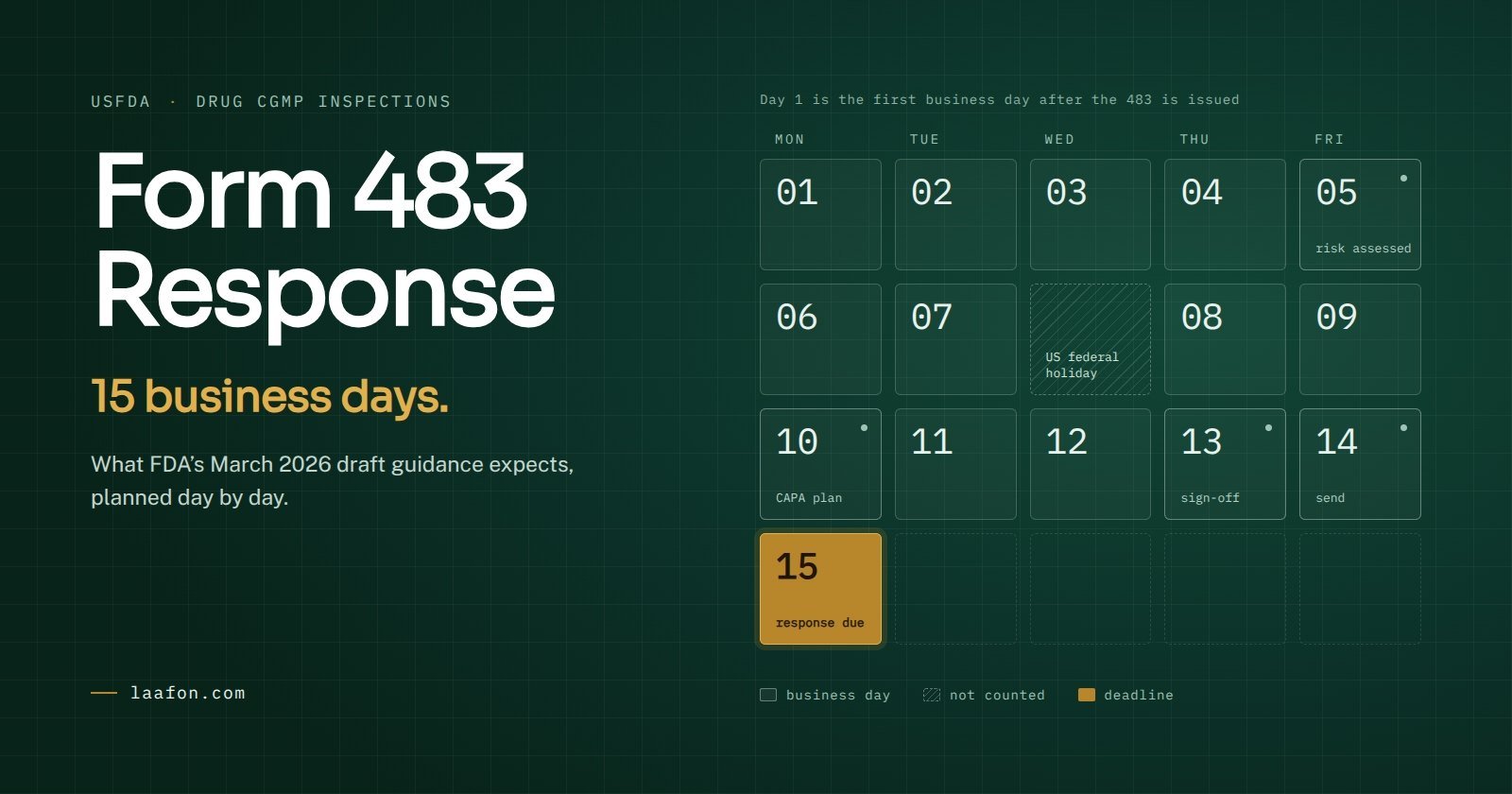
FDA’s March 2026 draft guidance asks for one complete response, in English, sent by email to the address printed on the 483, within 15 business days. Business days are Monday to Friday, excluding US federal holidays. Someone from executive management should sign it. For each observation, it should give a patient and product risk assessment, an investigation, the root cause, a dated CAPA plan and signed evidence[2]. FDA will not ordinarily hold back a warning letter to review a response that arrives late[2][3].
Common 483 advice the draft guidance now contradicts
Until March 2026, the 15-business-day rule was the only FDA text on 483 responses. It came from a 2009 Federal Register notice[3], and everything else was industry folklore. FDA published the draft guidance on 9 March 2026 (91 FR 11325)[4]. It covers human and animal drug sites inspected for CDER, CBER and CVM. Several widely repeated tips, including some in the earlier version of this page, do not match it.
| Topic | Common advice | What FDA’s draft guidance and the regulations say |
|---|---|---|
| Deadline | “Day 15”, counted in calendar days | 15 business days: Monday to Friday, excluding US federal holidays under 5 U.S.C. 6103. If FDA amends the 483, the 15 days run from the amendment[2][5]. |
| Late response | FDA issues a warning letter without reading a late reply | FDA “will not ordinarily delay” regulatory action, such as a warning letter, to review it[2]. It weighs the late material along with your reply to any warning letter[3]. |
| Where to send | A letter to the investigator, copied to the District Director | By email to the address listed on the 483. Split files larger than 100 MB across emails, or use an alternative electronic gateway[2]. |
| Who signs | Only a VP of QA or plant head. A QA manager must never sign. | A person in executive management who allocates resources and can deliver the commitments. A site head or head of the quality unit may also sign[2]. |
| Consultants | Consultants should not write the response | If someone outside the site prepared it, state who they are and their relationship to you, and include letters of authorisation. Consultants sign the documents they provide. FDA recommends a CGMP consultant when observations involve data integrity[2]. |
| Number of replies | Reply to each observation separately as each CAPA finishes | One response covering all observations within 15 business days. After that, send follow-up reports against a communication plan you set out[2]. |
| Effectiveness | “No recurrence in internal audits for 12 months” | An adequate effectiveness check “should consist of more than routine sampling and testing”. If it fails, reopen the investigation and the CAPA plan[2]. |
| Contract sites | Purchasing controls under 21 CFR 211.84 and 820.50 | §211.84 covers testing of components, not purchasing. For drugs, FDA treats contractors as an extension of your own operation (§200.10(b)), and your quality unit approves or rejects contract-made product (§211.22(a))[6][7]. For devices, §820.50 no longer exists: the QMSR, effective 2 Feb 2026, incorporates ISO 13485:2016[8]. |
Scroll sideways to see the full table →
Status check. On 16 Oct 2026 FDA still listed the guidance as a draft, “not for implementation”, under docket FDA-2025-D-1504. The formal comment period closed on 8 May 2026, though FDA accepts comments on any guidance at any time[4]. It reflects how the reviewers who read your response think. Treat it as the working standard and watch for the final version.
When is your 483 response due?
Enter the date on your Form 483, or the date of an amended 483. The calculator counts 15 business days and skips weekends and US federal holidays, using the observed dates OPM publishes[5].
Response due (15th business day)
Fri, 6 Nov 2026
21 calendar days. No US federal holidays fall in this window.
- Risk assessment and investigation plans fixed (business day 5)Fri, 23 Oct 2026
- CAPA plan drafted (business day 10)Fri, 30 Oct 2026
- Executive review and signature (business day 13)Wed, 4 Nov 2026
- Send, with one day of buffer (business day 14)Thu, 5 Nov 2026
How it counts: day 1 is the first business day after the 483 is issued. Holidays are the 11 federal holidays in 5 U.S.C. 6103 on their observed dates. A Saturday holiday moves to Friday and a Sunday holiday to Monday. It does not include Inauguration Day, which applies only around Washington DC, or ad-hoc closures ordered by the President. Indian holidays do not stop the clock. The guidance gives no cut-off time of day, so send at least one business day early. The milestones are Laafon’s working plan, not FDA dates.
A 15-business-day plan built on the guidance
The guidance sets the content and the deadline but no internal schedule. The schedule below is ours: work streams overlap, and each is tied to the section of the guidance it delivers.
- Close-out meeting
Clarify before the investigator leaves
FDA encourages you to raise disagreements with its representatives during the inspection[2]. Confirm what each observation means and which requirement it rests on. Record any correction made on the spot, with evidence. Note the FDA Establishment Identifier (FEI) and the response email address printed on the 483.
- Business days 1–2
Management review and the investigation team
Review the 483 at site level and, where it applies, at corporate level. Set up a multidisciplinary investigation team with clear roles and executive backing. Rank the observations by severity. Check past inspections and internal audits for repeats or similar trends, because a pattern points to a systemic issue[2].
- Business days 1–5
Patient and product risk assessment
Cover inventory and distributed lots still within expiry. For each, assess the possible effect on safety, identity, strength, quality and purity[2]. Under 21 CFR 211.192, an investigation must extend to other batches and other products that may be linked to the same failure[9]. Our batch record review SOP shows that review step. Putting a quality issue in the 483 response does not replace a Field Alert Report you owe under 21 CFR 314.81(b)(1)[2].
- Business days 3–10
Investigation and root cause
- Write an investigation plan. Set a risk-based scope and justify any operation you leave out[2]. For the risk logic, see ICH Q9 quality risk management for risk-based inspections.
- Test each candidate root cause on its own. Avoid testing that only confirms your first hypothesis. Fixing the most obvious cause is “often not sufficient”[2].
- Ask why your quality unit or management did not find the problem before FDA did[2].
- “Human error” is not where an investigation ends. The guidance’s own example of a root cause is a “design flaw that led to human error”[2].
- Business days 6–12
CAPA plan with real dates
Make commitments “realistic, measurable, and achievable”. Give each a target date, including dates for interim actions. Extend the CAPA to other drugs, processes, facilities and contract organisations where the same weakness could exist. Update the CAPA plan once the scope is fully investigated[2].
- Business days 10–13
Assemble, translate and sign
Add a table of contents, then the required front-matter elements (next section). Sign every attachment. Submit everything in English. Where you translate a document, include the original and a translator statement giving the translator’s name, address and qualifications. FDA generally does not intend to review untranslated documents[2].
- Business day 14 (limit: day 15)
Email the response
Send it to the email address on the 483 and keep the sent receipt. If an observation needs longer than 15 business days, include the CAPA plan and a proposed timeframe for the full response in this same submission[2].
- After submission
Follow-up reports and effectiveness
Send follow-up reports on the dates your communication plan promised. Check each CAPA for effectiveness and for unintended effects. FDA may verify both at the next inspection[2].
What goes into the response, section by section
Front matter FDA expects
After a table of contents, the draft guidance lists these elements[2]:
- The site’s name, full address and FEI number, which is printed at the top of the 483.
- A copy of the 483 issued at close-out.
- Who prepared the response, if not the site, and their relationship to it: consultant, US agent or outside counsel.
- Who signed it. That should be a member of executive management.
- Letters of authorisation for any consultant or outside counsel.
- Global investigation plans and reports, whoever prepared them.
- An executive summary and a detailed section for each observation.
- A discussion of each observation and any other inspection item. You may group related observations, but give each group its own numbered section in the table of contents.
Inside each observation section
- Risk assessment focused on patients and product. Include distributed lots within expiry[2].
- Investigation report. Give the scope, a summary, the affected drugs and lot numbers, the root causes and related systemic issues, the CAPA plan, the actions already completed (including interim actions), and the planned effectiveness evaluation, with results if you have them[2].
- Attachments, such as documents, photographs, video, diagrams or data. Sign each one to show you stand behind it[2].
- Progress status for every CAPA: to be initiated, in progress, or completed, plus anything that could move the dates[2].
Promised or half-finished corrections do not stop FDA acting at any time. Your duty to correct the problems stands whether or not you respond[2].
Executive summary table
The column headings follow the example format in the draft guidance[2]. The two rows are illustrative only.
| 483 observation no. or other item | General category / system | Summary | CAPA number | Target date (incl. interim actions) | Current progress |
|---|---|---|---|---|---|
| Obs. 1 | Laboratory controls | OOS investigations closed without a documented root cause. Retrospective review of 24 months of OOS records under way. | CAPA-26-014 | Interim: 2026-11-06 Final: 2027-01-29 | In progress. Retrospective review 40 % complete. |
| Discussion item | Quality system | Investigator’s verbal concern on trending of deviations. Monthly quality-metrics review added to the management review SOP. | CAPA-26-017 | 2026-12-15 | To be initiated |
Scroll sideways to see the full table →
Findings that need more than the standard template
Data integrity
FDA defines data integrity as data that is complete, consistent and accurate: attributable, legible, contemporaneously recorded, original or a true copy, and accurate (ALCOA)[10]. WHO’s ALCOA+ adds complete, consistent, enduring and available[11]. To remediate, FDA expects an investigation of scope and root causes, and a risk assessment that includes data supporting applications. It also expects a management strategy with a global corrective action plan. That can mean a third-party auditor, and moving the people responsible away from CGMP or application data[10]. For these findings, the draft guidance recommends engaging a CGMP consultant[2].
Repeat observations
Look at earlier inspections and internal audits for the same or similar observations. A repeat usually points to a systemic issue, so investigate why the earlier CAPA failed, not just the new instance[2].
Observations at a contract site
You cannot pass the blame to the contractor. FDA regards contractors as an extension of your own operation, and your quality unit approves or rejects what they make[6][7]. FDA’s guidance on quality agreements sets out how the agreement should divide CGMP duties[12]. The draft guidance asks investigations to check whether the deficiency affects contract organisations[2].
When you disagree
Describe the contested facts, give the scientific data, and cite the statute, regulation or guidance you rely on. Unresolved concerns can go to the FDA Ombudsman, or to the office that directed the inspection. For formal dispute resolution, the draft points to FDA’s January 2006 guidance[2]. Disagree with evidence, not adjectives.
After you respond: classification and escalation
FDA classifies every inspection[13]:
If FDA finds significant violations, it can issue a warning letter. A close-out letter follows only after FDA has checked the corrections, usually by re-inspection. FDA states that it “will not be issued based on representations that some action will or has been taken”[14]. If you are already at that stage, our USFDA warning letter compliance plan covers the next response.
Why Indian sites should rehearse the response before the inspection
- Less notice. On 6 May 2025 FDA said it would expand unannounced inspections at foreign sites, building on its pilot in India and China[15]. The 15 business days start when the investigator leaves, ready or not.
- Risk-ranked selection. CDER gives every site a risk score through its Site Selection Model. Inputs include compliance history, time since the last inspection, patient exposure and hazard signals[16]. In June 2025 FDA said its AI tool Elsa was being used to “identify high-priority inspection targets”[17]. Neither replaces the investigator’s own judgement. Both make a weak compliance history more likely to be found.
- US calendar, English evidence. Diwali does not stop the clock, but Thanksgiving does. Logbooks and batch records kept in Hindi or a regional language need verified translations with a translator statement[2].
To see which observations are most often cited, read the 10 most-cited drug 483 observations. Then rehearse with our USFDA inspection checklist for a pharmaceutical facility.
If your site is still working towards its first US approval, start with the USFDA approval roadmap for Indian formulation plants. For CDSCO and state inspections of the same site, use the Revised Schedule M compliance dashboard.
Have a 483 open right now?
Send us the observations. We will check your root cause, risk assessment and CAPA dates against FDA’s draft guidance before the response goes out. The review is done by a practitioner who has served as QC head, QA head and plant head.
Get a Form 483 response and CAPA reviewPrefer to write first? Use the Laafon contact page.
USFDA Form 483 questions
FDA recommends responding within 15 business days of the 483 being issued. Business days are Monday to Friday, excluding US federal holidays. If FDA amends the 483, the 15 business days run from the amendment[2]. That is usually about three calendar weeks, longer when a federal holiday falls in the window.
No. If an observation cannot be fully addressed in time, FDA recommends sending the CAPA plan and a proposed timeframe within the 15 business days. Then send follow-up reports on the dates in your communication plan, with interim measures described in the meantime[2].
A person in executive management should sign it, someone who can allocate resources and deliver the commitments. A site head or head of quality may also sign. A consultant can prepare it if the response says so, includes letters of authorisation, and the consultant signs the documents they supplied. FDA recommends a CGMP consultant for data integrity findings[2].
Look in FDA’s OII FOIA Electronic Reading Room. It posts only selected records: those FDA chose to publish, and those requested under FOIA three or more times. Anything else has to be requested through FOIA[18].
Related on Laafon
- USFDA pharma compliance: the 10 most-cited 483sWhat investigators cite most often, and the CGMP rules behind it.
- USFDA inspection checklistA walk-through to run before the investigator arrives.
- Warning letter compliance planThe next stage if a 483 escalates.
- USFDA approval roadmapFor Indian formulation plants preparing for their first US filing.
References
- U.S. Food and Drug Administration. FDA Form 483 Frequently Asked Questions. Silver Spring: FDA; content current as of 9 Jan 2020. Available from: https://www.fda.gov/inspections-compliance-enforcement-and-criminal-investigations/inspection-references/fda-form-483-frequently-asked-questions. Accessed Oct 2026.
- U.S. Food and Drug Administration (CDER, CBER, CVM, OII). Responding to FDA Form 483 Observations at the Conclusion of a Drug CGMP Inspection; Draft Guidance for Industry. Silver Spring: FDA; Mar 2026. Available from: https://www.fda.gov/media/191427/download. Accessed Oct 2026.
- U.S. Food and Drug Administration. Review of Post-Inspection Responses. Federal Register. 2009 Aug 11;74(153):40211–2. Docket No. FDA-2009-N-0335. Available from: https://www.govinfo.gov/content/pkg/FR-2009-08-11/html/E9-19107.htm. Accessed Oct 2026.
- U.S. Food and Drug Administration. Responding to FDA Form 483 Observations at the Conclusion of a Drug CGMP Inspection; Draft Guidance for Industry; Availability. Federal Register. 2026 Mar 9;91:11325–6. Docket No. FDA-2025-D-1504. Available from: https://www.federalregister.gov/documents/2026/03/09/2026-04578/. Guidance status checked on FDA’s guidance page. Accessed Oct 2026.
- U.S. Office of Personnel Management. Federal Holidays (holidays under 5 U.S.C. 6103 and their observed dates). Washington DC: OPM. Available from: https://www.opm.gov/policy-data-oversight/pay-leave/federal-holidays/. Accessed Oct 2026.
- Code of Federal Regulations. Title 21, §211.22 – Responsibilities of quality control unit. Available from: https://www.ecfr.gov/current/title-21/chapter-I/subchapter-C/part-211/subpart-B/section-211.22. Accessed Oct 2026.
- Code of Federal Regulations. Title 21, §200.10 – Contract facilities (including consulting laboratories) utilized as extramural facilities by pharmaceutical manufacturers. Available from: https://www.ecfr.gov/current/title-21/chapter-I/subchapter-C/part-200/subpart-A/section-200.10. Accessed Oct 2026.
- U.S. Food and Drug Administration. Quality Management System Regulation (QMSR). Silver Spring: FDA; content current as of 2 Feb 2026. Available from: https://www.fda.gov/medical-devices/postmarket-requirements-devices/quality-management-system-regulation-qmsr. Accessed Oct 2026.
- Code of Federal Regulations. Title 21, §211.192 – Production record review. Available from: https://www.ecfr.gov/current/title-21/chapter-I/subchapter-C/part-211/subpart-J/section-211.192. Accessed Oct 2026.
- U.S. Food and Drug Administration. Data Integrity and Compliance With Drug CGMP: Questions and Answers; Guidance for Industry. Silver Spring: FDA; Dec 2018. Available from: https://www.fda.gov/media/119267/download. Accessed Oct 2026.
- World Health Organization. Guideline on data integrity. In: WHO Expert Committee on Specifications for Pharmaceutical Preparations, Fifty-fifth report. WHO Technical Report Series No. 1033, Annex 4. Geneva: WHO; 2021. Available from: https://www.who.int/publications/m/item/annex-4-trs-1033. Accessed Oct 2026.
- U.S. Food and Drug Administration. Contract Manufacturing Arrangements for Drugs: Quality Agreements; Guidance for Industry. Silver Spring: FDA; Nov 2016. Available from: https://www.fda.gov/media/86193/download. Accessed Oct 2026.
- U.S. Food and Drug Administration. Inspection Classifications. Silver Spring: FDA; content current as of 18 Apr 2024. Available from: https://www.fda.gov/inspections-compliance-enforcement-and-criminal-investigations/inspection-basics/inspection-classifications. Accessed Oct 2026.
- U.S. Food and Drug Administration. About Warning and Close-Out Letters. Silver Spring: FDA; content current as of 20 Mar 2024. Available from: https://www.fda.gov/inspections-compliance-enforcement-and-criminal-investigations/warning-letters/about-warning-and-close-out-letters. Accessed Oct 2026.
- U.S. Food and Drug Administration. FDA Announces Expanded Use of Unannounced Inspections at Foreign Manufacturing Facilities [press release]. Silver Spring: FDA; 6 May 2025. Available from: https://www.fda.gov/news-events/press-announcements/fda-announces-expanded-use-unannounced-inspections-foreign-manufacturing-facilities. Accessed Oct 2026.
- U.S. Food and Drug Administration, CDER Office of Pharmaceutical Quality. MAPP 5014.1 Rev. 1: Understanding CDER’s Risk-Based Site Selection Model. Silver Spring: FDA; effective 26 Jun 2023. Available from: https://www.fda.gov/media/116004/download. Accessed Oct 2026.
- U.S. Food and Drug Administration. FDA Launches Agency-Wide AI Tool to Optimize Performance for the American People [press release]. Silver Spring: FDA; 2 Jun 2025. Available from: https://www.fda.gov/news-events/press-announcements/fda-launches-agency-wide-ai-tool-optimize-performance-american-people. Accessed Oct 2026.
- U.S. Food and Drug Administration. OII FOIA Electronic Reading Room. Silver Spring: FDA; content current as of 6 Oct 2026. Available from: https://www.fda.gov/about-fda/office-inspections-and-investigations/oii-foia-electronic-reading-room. Accessed Oct 2026.
This page is technical and educational guidance for pharmaceutical quality and regulatory professionals. It is not legal advice, and it does not replace review of your specific observations by qualified regulatory or legal counsel. The FDA guidance it relies on is a non-binding draft and may change when finalised. Check the current FDA text before you submit. Last reviewed 16 Oct 2026.