
What USFDA pharma compliance means for a drug plant
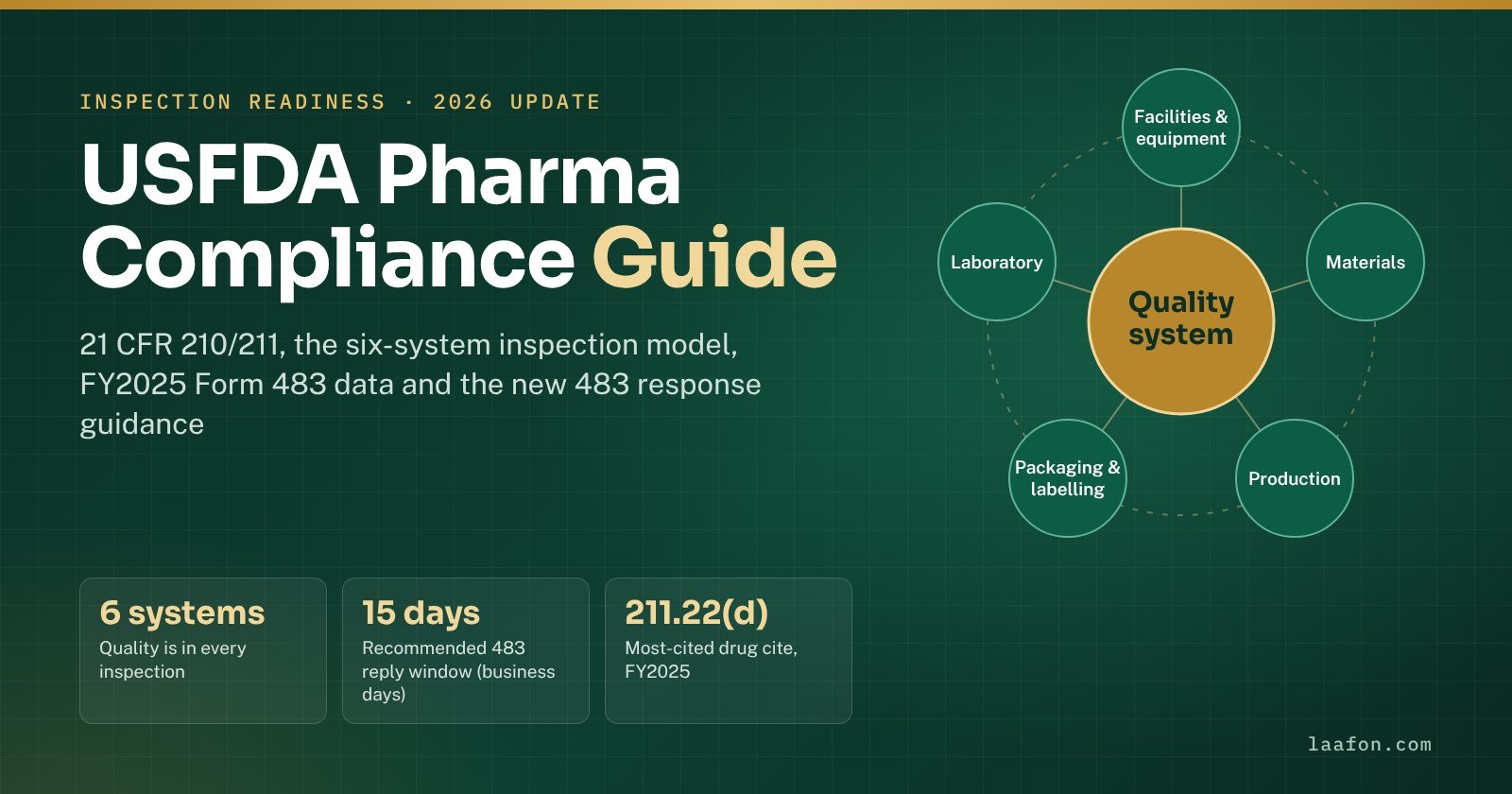
USFDA pharma compliance means manufacturing to the CGMP rules in 21 CFR Parts 210 and 211. A drug made without them is legally adulterated, even if every batch passes its tests[1][2]. FDA checks compliance through inspections. Its routine drug programme (Compliance Program 7356.002) audits up to six systems, and the quality system is always one of them[3].
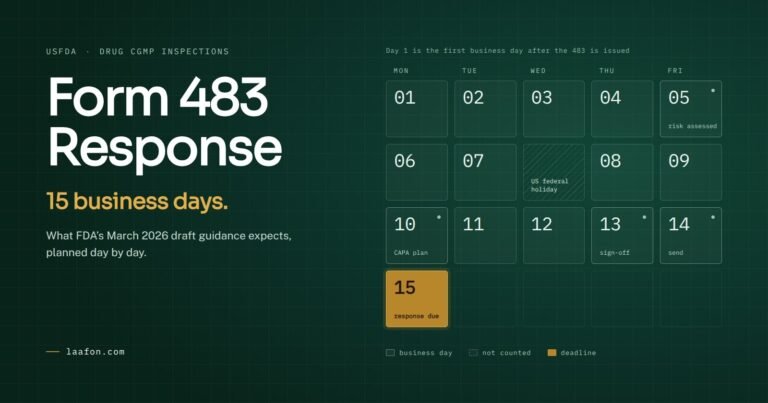
Every inspection is classified NAI, VAI or OAI[4]. If the investigator sees objectionable conditions, you receive a Form FDA 483. You do not have to reply, but FDA recommends one complete response within 15 business days. Later responses will not ordinarily delay a warning letter[5].
What has changed in USFDA inspections since 2025
If your USFDA pharma compliance SOPs or inspection-readiness plan were written before mid-2025, check them against these five changes.
- 6 May 2025More unannounced foreign inspections. FDA said it will expand unannounced inspections at foreign manufacturing sites. This builds on its earlier pilot programme in India and China[6]. Plan for no advance notice.
- 26 Jun 2025Remote regulatory assessments guidance finalised. A records request under section 704(a)(4) of the FD&C Act is a mandatory remote assessment. Other remote assessments are voluntary[7].
- 7 Aug 2025FDA PreCheck launched. PreCheck is designed to help build new US manufacturing facilities. It is not a route for an Indian site[8].
- Mar 2026Draft guidance on Form 483 responsesDraft
For the first time, FDA has set out what a drug CGMP 483 response should contain[5]. - 29 Jun 2026Pre-approval inspection programme rewritten. Compliance Program 7346.832 was reissued and took effect on 10 Aug 2026. It has four objectives, and a 704(a)(4) records request can now be used before, or instead of, a pre-approval inspection[9].
USFDA guidelines for the pharmaceutical industry: what is binding and what is guidance
In USFDA pharma compliance, “USFDA guidelines” usually means a mix of three kinds of document. Regulations are law. Guidance sets out FDA’s current thinking and is non-binding. Compliance programmes are the instructions investigators follow during an inspection. Here are the ones a finished-dosage or API plant works to.
Scroll sideways to see the full table →
| Document | What it controls | Version in force | Type |
|---|---|---|---|
| 21 CFR Part 210[1] | General provisions. Under §210.1(b), a drug made outside CGMP is adulterated. | Current eCFR text | Regulation |
| 21 CFR Part 211[2] | CGMP for finished pharmaceuticals: quality unit, buildings, equipment, components, production, packaging, laboratory controls, records | Current eCFR text | Regulation |
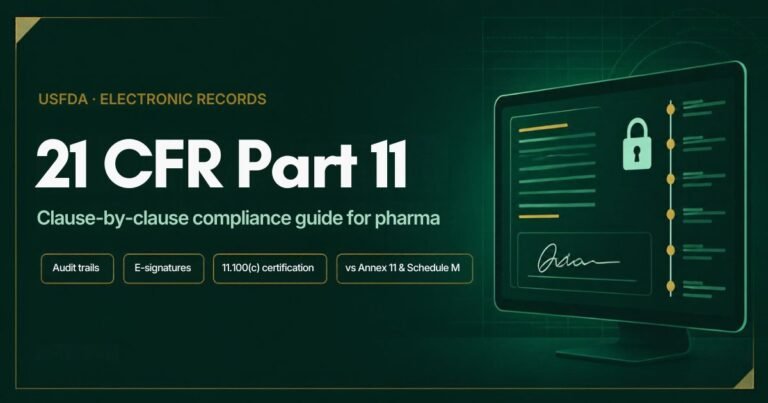
| 21 CFR Part 11 and its Scope and Application guidance[10] | Electronic records and signatures. FDA reads Part 11 narrowly, but access controls, authority checks and the predicate rules are still enforced. | Guidance Sep 2003 | Regulation Guidance |
| Data Integrity and Compliance With Drug CGMP: Q&A[11] | Data that is complete, consistent and accurate (ALCOA). Audit trail review frequency | Dec 2018 | Guidance |
| Process Validation: General Principles and Practices[12] | Three-stage lifecycle: design, qualification, continued verification | Jan 2011 (Rev. 1) | Guidance |
| Guide to Inspections: Validation of Cleaning Processes[13] | What investigators look for in cleaning validation. FDA does not set acceptance limits. | Jul 1993 | Investigator guide |
| ICH Q7[14] | GMP for active pharmaceutical ingredients | 10 Nov 2000 | ICH guideline |
| ICH Q9(R1)[15] | Quality risk management | 18 Jan 2023 | ICH guideline |
| ICH Q10[16] | Pharmaceutical quality system | 4 Jun 2008 | ICH guideline |
| Compliance Program 7356.002[3] | How surveillance and for-cause drug CGMP inspections run (six-system model) | Issued 16 Sep 2022 | Inspection programme |
| Compliance Program 7346.832[9] | Pre-approval inspections for NDAs and ANDAs | Issued 29 Jun 2026; effective 10 Aug 2026 | Inspection programme |
| Responding to FDA Form 483 Observations[5] | Recommended structure and content of a 483 response | Mar 2026 | Draft guidance |
Before an audit, check FDA’s guidance search page for each document. Drafts are labelled “not for implementation” until FDA finalises them.
Which USFDA inspection are you preparing for?
USFDA pharma compliance is tested through different kinds of inspection. Each uses its own FDA compliance programme, so the preparation is different. Answer two questions to see which programme applies and where to focus.
Choose one answer to each question
The applicable compliance programme will appear here.
You will also see the areas to prepare first.
Programme mapping is from FDA Compliance Programs 7356.002 and 7346.832[3][9]. The sterile (7356.002A) and API (7356.002F) programmes are listed on FDA’s Drug Compliance Programs page. This tool helps you plan; it does not predict the scope of any individual inspection.
The 10 most-cited USFDA 483 observations for drug makers (FY2025)
FDA publishes how often each regulation is cited on Form 483s. In FY2025 (Oct 2024–Sep 2025), drug inspections produced 2,837 citations across 316 provisions. The ten below account for 1,035 of them, or 36.5%[17].
Source: FDA Inspection Observations, FY2025, Drugs tab[17]. FDA says these spreadsheets are not a complete list. They only count 483s generated by its electronic inspection tools; manually prepared 483s are not included.
What the data says about USFDA pharma compliance. The top three are not technical failures. They are about written procedures that are missing or not followed, and investigations that stop too early. Before an inspection, start with quality unit SOPs, deviation and OOS investigations, and batch-record procedures. Equipment and cleaning come next.
USFDA audit checklist by system: what investigators examine
The six-system model is the backbone of USFDA pharma compliance checks. Compliance Program 7356.002 groups CGMP into six systems. A full inspection covers at least four of them. An abbreviated inspection covers at least two. Both always include the quality system[3]. Choose a system to see what is checked and its most-cited FY2025 provisions[17].
Quality system
Most cited: 211.22(d) · 243, and 211.192 · 164
- Quality unit duties and procedures written down and followed (§211.22). This is the single most-cited drug provision.
- Deviation and OOS investigations that find the root cause and extend to other batches, not just “human error” (§211.192)
- Annual product reviews, complaint handling, change control and CAPA effectiveness checks
- Management review of the quality system, in the way ICH Q10 describes[16]
Facilities and equipment system
Most cited: 211.67(a) · 95, 211.68(b) · 87, 211.63 · 81, 211.67(b) · 70
- Equipment designed and sized for its use, and located for cleaning and maintenance (§211.63)
- Written cleaning and maintenance procedures, followed and recorded (§211.67)
- Controls on computerised and automated equipment so only authorised people can change master records (§211.68(b))
- HVAC, water systems, pressure cascades and pest control for the buildings (Subpart C)
Materials system
Subpart E (§§211.80–211.94) · no materials provision in the FY2025 drug top 10
- Components, containers and closures quarantined until the quality unit releases them
- An identity test on each component lot. Supplier certificates may be used for the other attributes only after the supplier has been qualified.
- Supplier qualification and quality agreements, including for contract laboratories
- Storage conditions, stock rotation and rejected-material control
Not appearing in the top 10 does not mean investigators skip it. It is still one of the six systems that may be audited.
Production system
Most cited: 211.100(a) · 162, and 211.113(b) · 68
- Approved written production and process-control procedures, and records that show they were followed (§211.100)
- Validated aseptic and sterilisation processes for sterile products (§211.113(b))
- Process validation evidence across all three stages, including continued process verification[12]
- In-process controls, yield checks and line clearance
Packaging and labelling system
Subpart G (§§211.122–211.137) · no provision in the FY2025 drug top 10
- Labelling issued, reconciled and stored under control so mix-ups cannot happen
- Line clearance and inspection of packaging operations
- Expiry dating backed by stability data
- Tamper-evident packaging where it is required
Laboratory control system
Most cited: 211.160(b) · 121, and 211.165(a) · 44
- Specifications, sampling plans and test methods that are scientifically sound (§211.160(b))
- Release testing of every batch before distribution (§211.165(a))
- Instrument qualification and calibration, and audit trails on chromatography data systems
- Stability programme, reserve samples and OOS handling
Data integrity in USFDA pharma compliance: what FDA actually requires
ALCOA, as FDA defines it
FDA’s 2018 guidance defines data integrity as completeness, consistency and accuracy. The data should be attributable, legible, contemporaneously recorded, original or a true copy, and accurate (ALCOA)[11]. The guidance does not use the term “ALCOA+”. The extra letters come from other regulators. Our ALCOA vs ALCOA+ comparison by regulator shows which agency says what.
How often to review audit trails
FDA does not set one review frequency. If CGMP specifies how often the underlying data must be reviewed, review the audit trail at least that often. If it does not, set the frequency by risk, considering how critical the data is and what controls exist[11].
Part 11 is read narrowly
Since 2003, FDA has used enforcement discretion on Part 11’s validation, audit-trail, retention and copying clauses. It has not done so for access controls, authority checks, e-signatures or the predicate CGMP rules. Those still apply in full[10]. For system-level detail, see the 21 CFR Part 11 compliance manual.
Process validation, cleaning validation and ICH Q9(R1)
Process design
Stage 1 defines the commercial process using what was learned in development and scale-up[12].
Process qualification
Stage 2 has two parts: (1) facility design and qualification of equipment and utilities, and (2) process performance qualification (PPQ)[12]. IQ/OQ/PQ belongs inside this stage. It is not the whole validation lifecycle.
Continued process verification
Stage 3 gives ongoing assurance during routine production that the process stays in a state of control[12].
Cleaning limits: FDA does not set them. FDA’s investigator guide says it does not intend to set acceptance specifications. It mentions 10 ppm, 1/1000 of the normal therapeutic dose and “no visible residue” only as limits that industry representatives have quoted. Your limits must be logical, practical, achievable, verifiable and scientifically justifiable[13].
In USFDA pharma compliance, quality risk management follows ICH Q9(R1), adopted on 18 January 2023[15]. It sits alongside ICH Q10 for the pharmaceutical quality system[16] and ICH Q7 for API sites[14]. FDA’s 2022 drug manufacturing programme explicitly includes Q9, Q10 and Q12 elements[3]. For more on how risk shapes FDA’s choice of sites, see risk-based USFDA inspections and ICH Q9.
Form 483, inspection classification and warning letters
Form FDA 483
At the end of the inspection, the investigator lists any conditions that, in their judgement, may break FDA requirements[17].
Your response
Responding is voluntary. FDA recommends a single response within 15 business days, signed by executive management, with a table of contents and a CAPA plan that is realistic, measurable and achievable[5]. FDA has worked to the 15-business-day window since 15 Sep 2009[18].
Classification
NAI: no objectionable conditions. VAI: objectionable conditions, but no action recommended. OAI: regulatory or administrative action recommended[4]. An OAI does not by itself mean an enforcement action will follow[19].
Warning letter or close-out
FDA issues a warning letter for significant violations. A close-out letter comes only after corrections have actually been made and verified by FDA, usually through a follow-up inspection[20].
Two things a response cannot fix. Corrective actions that are promised or only partly done do not stop FDA from acting at any time[5]. And if a site delays, denies, limits or refuses an inspection, its drugs are deemed adulterated under section 501(j)[21].
For a step-by-step response method, read our USFDA Form 483 response strategy. If a warning letter has already arrived, see the warning letter CAPA plan.
USFDA pharma compliance for Indian plants
Schedule M is not 21 CFR 211
Meeting Revised Schedule M is the legal minimum for an Indian licence. It is not evidence of USFDA pharma compliance. Schedule M is now being enforced: the MSME extension ended on 31 Dec 2025, and in Nov 2025 CDSCO directed state regulators to inspect units[22] (position as of 16 Oct 2026). Track status on the CDSCO Schedule M compliance dashboard. The gaps are mapped in WHO-GMP vs USFDA compliance.
“USFDA-approved plant” is shorthand
FDA approves drug applications. What a site actually has is an inspection history. Before you buy, or contract with, a plant described as USFDA-approved, check its inspection classifications, warning letters and import alerts on FDA’s public databases[19]. Also check which dosage forms the last inspection covered. The pharma plant acquisition checklist covers the rest of due diligence.
Preparing for a first USFDA inspection
A site that has never been inspected should plan for a pre-approval inspection under the 2026 programme[9]. The phase-by-phase path for an oral solid site is set out in the USFDA approval roadmap for Indian formulation plants.
A 90-day USFDA inspection readiness plan
This plan reflects the author’s QA practice in USFDA pharma compliance. FDA does not prescribe a readiness timeline.
- Run a gap audit against Part 211, system by system, using the six tabs above
- Rank the gaps by patient risk using ICH Q9(R1) tools
- Pull your last three years of 483s, internal audits and complaints to find repeat themes
- Rewrite quality unit, investigation and production SOPs first. These match the top-three FY2025 citations.
- Review audit-trail settings, user privileges and data-review practice on every GxP system
- Close CAPAs with effectiveness checks, not just a completed action
- Run an unannounced mock inspection with a front room, a back room and timed document retrieval
- Train subject-matter experts to answer the question asked, with the record in hand
- Prepare a 483 response template in the structure FDA’s 2026 draft guidance recommends
USFDA pharma compliance and inspection readiness: common questions
For USFDA pharma compliance, the binding rules are the CGMP regulations in 21 CFR Parts 210 and 211, plus Part 11 for electronic records. Around them sit non-binding FDA guidances (process validation 2011, data integrity 2018), ICH Q7, Q9(R1) and Q10, and the compliance programmes investigators follow, such as 7356.002 for drug manufacturing and 7346.832 for pre-approval inspections.
Responding is voluntary, but FDA recommends a single response covering all observations within 15 business days of the 483 being issued. FDA will not ordinarily delay a warning letter to review a response that arrives after that.
A Form 483 lists the conditions the investigator observed at the end of the inspection. A warning letter comes later from FDA, when the agency believes it has found significant violations. It sets a timeframe for your response, and it is closed out only after FDA verifies the corrections.
NAI (no action indicated) means no objectionable conditions were found. VAI (voluntary action indicated) means objectionable conditions were found, but FDA will not take or recommend action. OAI (official action indicated) means regulatory or administrative action is recommended.
Yes. In May 2025 FDA announced that it would expand unannounced inspections at foreign manufacturing facilities, building on an earlier pilot in India and China. FDA has said it is not required by law to give advance notice.
In FDA’s FY2025 data, 21 CFR 211.22(d) was the most-cited drug provision, with 243 citations. It covers quality unit responsibilities and procedures that are not in writing or not followed. Next came 211.192 on investigations (164) and 211.100(a) on written production procedures (162).
FDA’s 2018 data integrity guidance uses ALCOA: attributable, legible, contemporaneous, original or true copy, and accurate. It defines data integrity as complete, consistent and accurate data. The term ALCOA+ comes from other regulators’ guidance, not FDA’s.
No. FDA’s 2011 guidance describes three stages: process design, process qualification and continued process verification. Equipment and utility qualification is one part of Stage 2, alongside process performance qualification (PPQ).
No. FDA PreCheck, announced on 7 August 2025, is designed to help build new drug manufacturing facilities in the United States. Indian sites are still assessed through the usual pre-approval and surveillance inspection programmes.
Getting an Indian site ready for its first USFDA inspection, or drafting a 483 response? We can review your USFDA pharma compliance position against Part 211 and the 2026 draft guidance before the investigator does.
Book a regulatory compliance consultationRelated on Laafon
- USFDA PAI checklistUse this if your next inspection is tied to an ANDA or NDA.
- Form 483 response strategyHow to build a response, observation by observation.
- Warning letter compliance planFor sites already under a warning letter.
- 21 CFR Part 11 compliance manualValidating computerised systems and controlling audit trails.
- WHO-GMP vs USFDAWhere a WHO-GMP site usually falls short of US CGMP.
- USFDA approval roadmapTimeline and pitfalls for an Indian formulation plant.
References
- Code of Federal Regulations. Title 21, Part 210 – Current Good Manufacturing Practice in Manufacturing, Processing, Packing, or Holding of Drugs; General (incl. §210.1(b)). Washington: National Archives (eCFR); current text. Available from: https://www.ecfr.gov/current/title-21/chapter-I/subchapter-C/part-210. Accessed October 2026.
- Code of Federal Regulations. Title 21, Part 211 – Current Good Manufacturing Practice for Finished Pharmaceuticals. Washington: National Archives (eCFR); current text. Available from: https://www.ecfr.gov/current/title-21/chapter-I/subchapter-C/part-211. Accessed October 2026.
- U.S. Food and Drug Administration. Compliance Program 7356.002: Drug Manufacturing Inspections. Silver Spring: FDA; issued 16 Sep 2022, implemented 17 Oct 2022. Available from: https://www.fda.gov/media/75167/download. Accessed October 2026.
- U.S. Food and Drug Administration. Inspection Classifications. Silver Spring: FDA; 2024. Available from: https://www.fda.gov/inspections-compliance-enforcement-and-criminal-investigations/inspection-basics/inspection-classifications. Accessed October 2026.
- U.S. Food and Drug Administration (CDER, CBER, CVM, OII). Responding to FDA Form 483 Observations at the Conclusion of a Drug CGMP Inspection – Draft Guidance for Industry. Docket FDA-2025-D-1504. Silver Spring: FDA; March 2026. Available from: https://www.fda.gov/media/191427/download. Accessed October 2026.
- U.S. Food and Drug Administration. FDA Announces Expanded Use of Unannounced Inspections at Foreign Manufacturing Facilities [press release]. Silver Spring: FDA; 6 May 2025. Available from: https://www.fda.gov/news-events/press-announcements/fda-announces-expanded-use-unannounced-inspections-foreign-manufacturing-facilities. Accessed October 2026.
- U.S. Food and Drug Administration. Conducting Remote Regulatory Assessments – Questions and Answers; Guidance for Industry; Availability. Federal Register. 2025 Jun 26;90(121). Available from: https://www.govinfo.gov/content/pkg/FR-2025-06-26/pdf/2025-11809.pdf. Accessed October 2026.
- U.S. Food and Drug Administration. FDA Announces New FDA PreCheck Program to Boost U.S. Drug Manufacturing [press release]. Silver Spring: FDA; 7 Aug 2025. Available from: https://www.fda.gov/news-events/press-announcements/fda-announces-new-fda-precheck-program-boost-us-drug-manufacturing. Accessed October 2026.
- U.S. Food and Drug Administration. Compliance Program 7346.832: Preapproval Inspections. Silver Spring: FDA; issued 29 Jun 2026, implemented 10 Aug 2026. Available from: https://www.fda.gov/media/193382/download. Accessed October 2026.
- U.S. Food and Drug Administration. Part 11, Electronic Records; Electronic Signatures – Scope and Application. Guidance for Industry. Silver Spring: FDA; September 2003. Available from: https://www.fda.gov/regulatory-information/search-fda-guidance-documents/part-11-electronic-records-electronic-signatures-scope-and-application. Accessed October 2026.
- U.S. Food and Drug Administration. Data Integrity and Compliance With Drug CGMP: Questions and Answers. Guidance for Industry. Silver Spring: FDA; December 2018. Available from: https://www.fda.gov/media/119267/download. Accessed October 2026.
- U.S. Food and Drug Administration. Process Validation: General Principles and Practices. Guidance for Industry, Revision 1. Silver Spring: FDA; January 2011. Available from: https://www.fda.gov/media/71021/download. Accessed October 2026.
- U.S. Food and Drug Administration. Guide to Inspections: Validation of Cleaning Processes. Silver Spring: FDA; July 1993. Available from: https://www.fda.gov/validation-cleaning-processes-793. Accessed October 2026.
- International Council for Harmonisation. ICH Q7: Good Manufacturing Practice Guide for Active Pharmaceutical Ingredients. Step 4 version dated 10 November 2000. Geneva: ICH; 2000. Available from: https://database.ich.org/sites/default/files/Q7%20Guideline.pdf. Accessed October 2026.
- International Council for Harmonisation. ICH Q9(R1): Quality Risk Management. Adopted 18 January 2023. Geneva: ICH; 2023. Available from: https://database.ich.org/sites/default/files/ICH_Q9%28R1%29_Guideline_Step4_2022_1219.pdf. Accessed October 2026.
- International Council for Harmonisation. ICH Q10: Pharmaceutical Quality System. Step 4 version dated 4 June 2008. Geneva: ICH; 2008. Available from: https://database.ich.org/sites/default/files/Q10%20Guideline.pdf. Accessed October 2026.
- U.S. Food and Drug Administration, Office of Inspections and Investigations. Inspection Observations – FY 2025 (Drugs tab). Silver Spring: FDA; 2025. Available from: https://www.fda.gov/inspections-compliance-enforcement-and-criminal-investigations/inspection-references/inspection-observations. Accessed October 2026.
- U.S. Food and Drug Administration. Review of Post-Inspection Responses. Docket FDA-2009-N-0335. Federal Register. 2009 Aug 11;74(153); effective 15 Sep 2009. Available from: https://www.govinfo.gov/content/pkg/FR-2009-08-11/html/E9-19107.htm. Accessed October 2026.
- U.S. Food and Drug Administration. FDA Data Dashboard – Firm/Supplier Evaluation Resources. Silver Spring: FDA. Available from: https://datadashboard.fda.gov/oii/fd/fser.htm. Accessed October 2026.
- U.S. Food and Drug Administration. About Warning and Close-Out Letters. Silver Spring: FDA. Available from: https://www.fda.gov/inspections-compliance-enforcement-and-criminal-investigations/warning-letters/about-warning-and-close-out-letters. Accessed October 2026.
- U.S. Food and Drug Administration. FDASIA Title VII Overview (sections 705, 706 and 707; Pub. L. 112-144). Silver Spring: FDA. Available from: https://www.fda.gov/regulatory-information/food-and-drug-administration-safety-and-innovation-act-fdasia/fdasia-title-vii-overview. Accessed October 2026.
- Business Standard. Pharma units likely to face action for Schedule M violations: experts [news report; secondary source]. New Delhi: Business Standard; 8 Nov 2025. Available from: https://www.business-standard.com/industry/news/cdsco-asks-state-units-to-start-inspections-under-schedule-m-norms-125110801170_1.html. Accessed October 2026.
Disclaimer. This USFDA pharma compliance guide is technical and educational. It is not legal, medical or investment advice. FDA guidance, compliance programmes and Indian statutory instruments change often, and draft guidance is not for implementation. Check each source before relying on it. Figures are as published by FDA for FY2025. Last reviewed 16 Oct 2026 by Darshan Singh.