
GMP · Export regulation · India
WHO-GMP vs USFDA cGMP: the short answer
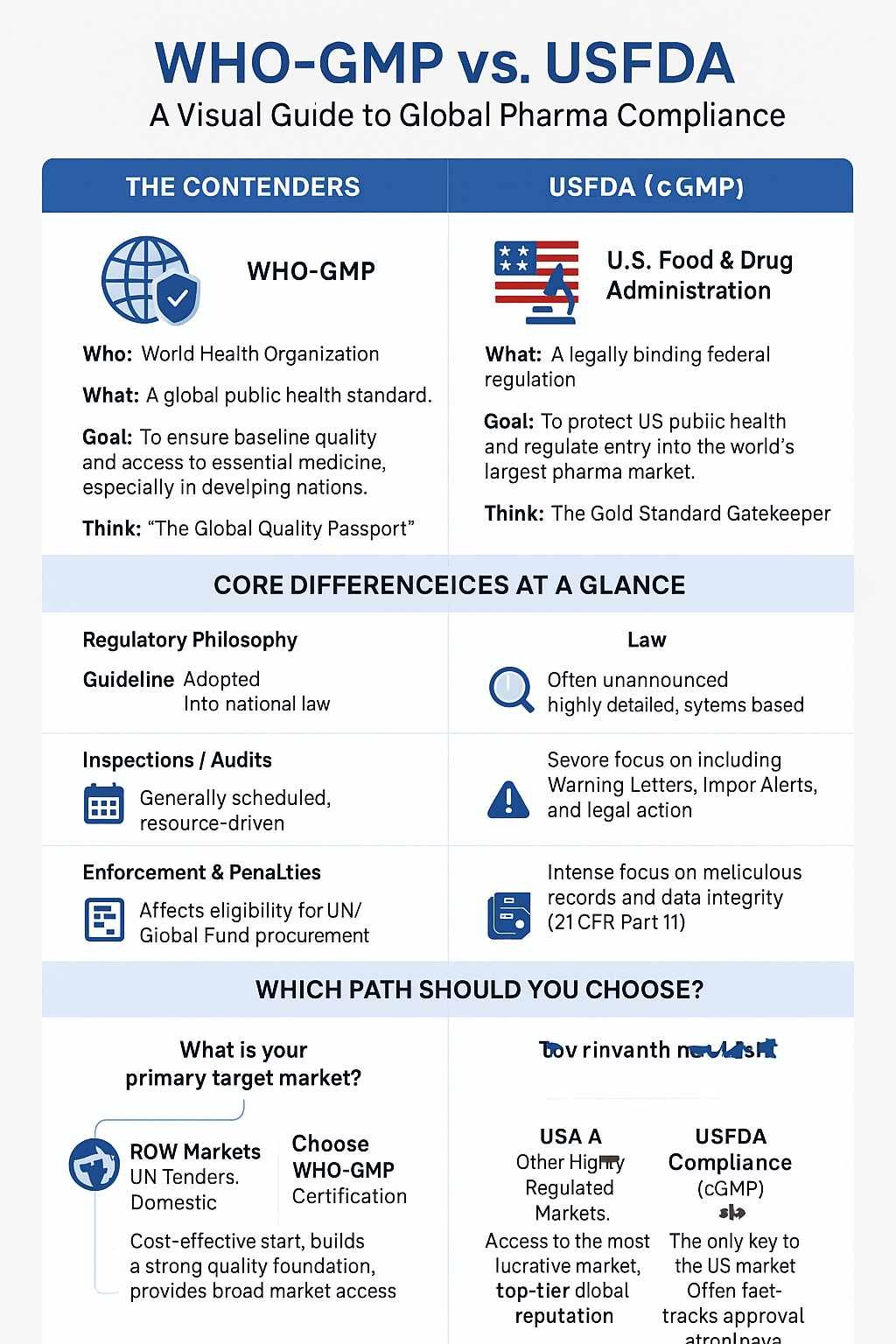
WHO-GMP vs USFDA is not a choice between two certificates of the same kind. WHO-GMP is a World Health Organization guideline that national regulators adopt; WHO itself does not certify factories, except when it inspects for its Prequalification programme.[1][2] In India, the WHO-GMP certificate and COPP are issued by CDSCO after a joint inspection with the State Licensing Authority.[3]
USFDA cGMP is binding United States law, set out in 21 CFR Parts 210 and 211 and enforced by FDA inspection.[4] There is no “FDA certificate”: to sell in the US the site must also be registered, its products listed and a US agent named.[5] And since December 2023, Revised Schedule M sits under both as the legal floor for every Indian plant.[6]
- USFDA = US Food and Drug Administration
- cGMP = current GMP
- 21 CFR 210/211
- G.S.R. 922(E), 28 Dec 2023
The three layers an Indian plant answers to
Most confusion between WHO-GMP and USFDA compliance comes from treating them as alternatives. For a plant in India they are layers. The first is compulsory for everyone; the other two depend on where you sell.
Layer 1 · every licensed unit
Revised Schedule M
The GMP schedule of the Drugs Rules, 1945, revised by G.S.R. 922(E) dated 28 Dec 2023.[6] It added a pharmaceutical quality system, quality risk management, product quality review, equipment qualification and controls on computerised systems.[7]
Layer 2 · export credential
WHO-GMP certificate and COPP
Issued by the certifying authority of the exporting country under the WHO Certification Scheme.[2] In India that is CDSCO, after a joint inspection by its zonal office and the State Licensing Authority; applications have gone only through the ONDLS portal since 15 Aug 2025.[3]
Schedule M is in its enforcement phase (status as of 21 Oct 2026). Manufacturers with turnover above ₹250 crore had six months from notification and smaller ones twelve.[6] MSMEs could extend to 31 Dec 2025 only by filing a Form A upgrade plan.[9] On 7 Nov 2025 CDSCO asked state regulators to inspect units that took the extension and to act immediately against units that did not apply.[10] A WHO-GMP certificate does not exempt a plant from Schedule M. For later notices, see the Revised Schedule M compliance dashboard.
WHO-GMP vs USFDA compliance: 8 differences that change your plant
The principles overlap heavily. What differs is legal force, who inspects, how inspections happen and what happens when they go badly.
Scroll the table sideways →
| Aspect | WHO-GMP | USFDA cGMP | Revised Schedule M (India) |
|---|---|---|---|
| What it is | WHO guideline; main principles in TRS 986 Annex 2, adopted by national regulators[1] | US federal regulation, 21 CFR Parts 210 and 211[4] | Indian law: Drugs Rules, 1945, Schedule M, revised by G.S.R. 922(E)[6] |
| Who certifies | The national certifying authority; WHO inspects only for Prequalification[2][11] | No certificate. Registration, listing and a US agent are required before import[5] | Licence condition enforced by the State Licensing Authority, with CDSCO |
| Indian route | CDSCO zonal office plus State authority joint inspection; COPP via ONDLS[3] | FDA inspects the Indian site directly | Applies to every licensed manufacturer |
| Inspection style | Typically on application for a certificate or renewal | Risk-based; about 3,000 foreign inspections a year in 90+ countries, with unannounced visits expanding since 6 May 2025[12] | State inspections directed by CDSCO since Nov 2025[10] |
| Validation | Qualification and validation expected under WHO GMP[1] | Lifecycle model: process design, process qualification, continued process verification[13] | Detailed equipment qualification and validation now written in[7] |
| Data integrity | Dedicated WHO guideline, TRS 1033 Annex 4 (2021)[14] | 21 CFR 211.68, Part 11 and FDA’s 2018 data integrity guidance[4][8] | Computerised systems need access control, audit trails and backups[7] |
| When it goes wrong | Certificate refused or not renewed by the certifying authority[2] | Form 483, Warning Letter, Import Alert, consent decree and, at worst, criminal prosecution[15][16] | Action by the State Licensing Authority against the licence[10] |
| Who asks for it | Importing regulators and tender bodies in WHO-GMP-referencing markets | The US market and buyers who supply it | Every Indian regulator, for every unit |
Where the original version of this guide was wrong. It described WHO-GMP data-integrity expectations as basic and less prescriptive. WHO has had a dedicated data integrity guideline since 2021,[14] so the real gap with the FDA is inspection intensity and enforcement, not the principle. For the US side clause by clause, see the 21 CFR Part 11 compliance guide.
Which standard does your plant need?
Answer two questions. The result names the standard to design or upgrade to, and the first control point to check.
1. Where will most of your product be sold in the next five years?
2. Where is the plant today?
Choose one option in each question to see the standard you need.
The answer depends on your market first and your plant’s stage second.
What FDA enforcement looks like: the Ranbaxy record
Ranbaxy remains the clearest public example of how far US enforcement can go against an Indian manufacturer. The dates below are from FDA’s own enforcement page and the US Department of Justice.
- 15 Jun 2006Warning Letter to the Paonta Sahib plant.[16]
- 16 Sep 2008Warning Letters to Dewas and Batamandi (Paonta Sahib); Import Alert on drugs from Dewas and Paonta Sahib.[16]
- Feb 2009FDA applies its Application Integrity Policy to Paonta Sahib.[16]
- 25 Jan 2012Consent decree of permanent injunction filed.[16]
- 13 May 2013Ranbaxy USA Inc., the US subsidiary, pleads guilty to three felony adulteration counts and four felony counts of false statements to FDA. Total settlement: $500 million, of which $130 million was a criminal fine, $20 million forfeiture and $350 million civil.[15]
- 16 Sep 2013Import Alert on the Mohali plant.[16]
- 23 Jan 2014Toansa plant barred from making drugs for the US market.[16]
Two corrections to the common telling. It was Ranbaxy USA Inc. that pleaded guilty, not the Indian parent company.[15] And FDA action is not a fixed ladder from Form 483 to prosecution: in 2008 the warning letters and the import alert were issued on the same day.[16]
Form 483 is where most plants meet the FDA
A Form 483 lists conditions an investigator considers objectionable. FDA states it is not a final Agency determination that a violation occurred.[17] Since 15 Sep 2009, FDA generally gives a detailed review only to responses received within 15 business days before it decides on a Warning Letter.[18] The working method is in the Form 483 response checklist, and the escalation path in the Warning Letter response plan.
The retrofit trap: why you design for the highest market first
No public dataset gives a reliable rupee figure for moving a plant from WHO-GMP to US readiness; the cost depends on dosage form, area classification and how the plant was built. What follows is practitioner experience, not a benchmark.
- Hard to retrofit: HVAC zoning and pressure cascades, water system design, and room layout for material and personnel flow. These are fixed in civil work.
- Expensive to retrofit: computerised systems that were never validated, with no audit trail or with shared logins. Records created before the upgrade stay weak.
- Cheap to fix early, costly later: change control, CAPA effectiveness checks and training records. Inspectors read years of history, not the current week.
To size the base plant before any export upgrade, use the pharma plant setup cost calculator.
40-point USFDA and WHO-GMP compliance audit
Tick each point you could prove to an inspector today with documents, not intentions. The tags point to the 21 CFR Part 211 section an FDA investigator would read; Revised Schedule M and WHO GMP cover the same ground. Your ticks are saved in this browser only.
Start ticking to see where your plant stands.
Quality system 0/5
Premises and HVAC 0/5
Equipment and validation 0/5
Materials and supply chain 0/5
Production and batch release 0/5
QC laboratory 0/5
Data integrity and IT 0/5
People and inspection readiness 0/5
Start with the layer every inspector checks first
Whatever market you aim for, a state or CDSCO inspector will read your plant against Revised Schedule M before anyone asks about WHO-GMP or USFDA. The dashboard tracks the notifications, deadlines and enforcement directives in one place.
Track Revised Schedule M deadlines and enforcementRelated on Laafon
WHO-GMP and USFDA: frequently asked questions
USFDA stands for the United States Food and Drug Administration. In pharmaceutical manufacturing it usually refers to FDA’s current good manufacturing practice (cGMP) rules for finished drugs in 21 CFR Parts 210 and 211, and to the inspections FDA runs to enforce them.[4]
No. The US does not accept a WHO-GMP certificate in place of its own rules. The plant must comply with 21 CFR Parts 210 and 211, register the establishment, list each drug and name a US agent before importing, and most generic prescription drugs also need an approved ANDA, which normally brings an FDA inspection.[4][5]
CDSCO issues it, together with the Certificate of Pharmaceutical Product (COPP), after a joint inspection by a CDSCO zonal or sub-zonal office and the State Licensing Authority. Since 15 Aug 2025 applications are accepted only online through ONDLS. WHO itself does not issue these certificates.[2][3]
The c stands for current. US law and FDA regulations use the term current good manufacturing practice, which means a plant is judged against the systems and controls expected today, not against the practice in force when it was built. GMP is the general term used by WHO, Schedule M and most other regulators.
No. Schedule M is a condition of every Indian manufacturing licence, while the WHO-GMP certificate and COPP are export documents issued on application. The 2023 revision raised the legal floor with a pharmaceutical quality system, risk management and validation requirements, which narrows the gap a plant must close to obtain a WHO-GMP certificate.[6][7]
Increasingly, yes. On 6 May 2025 FDA announced it would expand unannounced inspections of foreign manufacturing sites, building on a pilot in India and China, and said it can act against firms that delay, deny or limit an inspection.[12] Plants that supply the US should be ready for an inspection on any working day.
References
- World Health Organization. WHO good manufacturing practices for pharmaceutical products: main principles. WHO Technical Report Series No. 986, Annex 2. Geneva: WHO; 2014. Available from: who.int. Accessed Oct 2026.
- World Health Organization. WHO Certification Scheme on the quality of pharmaceutical products moving in international commerce: issuing a certificate. Geneva: WHO. Available from: who.int. Accessed Oct 2026.
- Roy S. No more physical WHO-GMP certificate applications after August 15: DCGI alerts pharma firms. Medical Dialogues; 2025 Aug 11 (reports CDSCO circulars IT/COPP/ONDLS/2025/001 and IT-13011(12)/7/2025; joint inspection procedure as reported by Medical Dialogues, 2020 Mar 15). Available from: medicaldialogues.in. Accessed Oct 2026. Secondary source.
- Electronic Code of Federal Regulations. Title 21, Part 211: Current good manufacturing practice for finished pharmaceuticals. Washington (DC): National Archives; current edition. Available from: ecfr.gov. Accessed Oct 2026.
- Electronic Code of Federal Regulations. Title 21, Part 207: Requirements for foreign and domestic establishment registration and listing for human drugs. Washington (DC): National Archives; current edition. Available from: ecfr.gov. Accessed Oct 2026.
- Lok Sabha, Ministry of Chemicals and Fertilizers. Unstarred Question No. 864, answered 2024 Nov 29 (G.S.R. 922(E) dated 28.12.2023 and compliance timelines). New Delhi: Lok Sabha Secretariat. Available from: eparlib.sansad.in. Accessed Oct 2026.
- JSA Advocates and Solicitors. JSA Prism, Healthcare: revised Schedule M. New Delhi: JSA; 2024 Jan. Available from: jsalaw.com. Accessed Oct 2026. Secondary source (legal analysis).
- U.S. Food and Drug Administration. Data integrity and compliance with drug CGMP: questions and answers. Guidance for industry. Silver Spring (MD): FDA; 2018 Dec. Available from: fda.gov. Accessed Oct 2026.
- Pharmaceuticals Export Promotion Council of India. Circular PXL/HO/Cir-087/2024-25: extension of revised Schedule M implementation for manufacturers with turnover up to Rs 250 crore. Hyderabad: Pharmexcil; 2025 Feb 6. Available from: pharmexcil.com. Accessed Oct 2026.
- Business Standard. Pharma units likely to face action for Schedule M violations: experts. New Delhi: Business Standard; 2025 Nov 8. Available from: business-standard.com. Accessed Oct 2026. Secondary source.
- World Health Organization. Prequalification of medical products: medicines, information for manufacturers. Geneva: WHO. Available from: extranet.who.int. Accessed Oct 2026.
- U.S. Food and Drug Administration. FDA announces expanded use of unannounced inspections at foreign manufacturing facilities [press release]. Silver Spring (MD): FDA; 2025 May 6. Available from: fda.gov. Accessed Oct 2026.
- U.S. Food and Drug Administration. Guidance for industry: Process validation: general principles and practices. Silver Spring (MD): FDA; 2011 Jan. Available from: hhs.gov. Accessed Oct 2026.
- World Health Organization. Guideline on data integrity. WHO Technical Report Series No. 1033, Annex 4. Geneva: WHO; 2021. Available from: who.int. Accessed Oct 2026.
- U.S. Department of Justice, Office of Public Affairs. Generic drug manufacturer Ranbaxy pleads guilty and agrees to pay $500 million to resolve false claims allegations, cGMP violations and false statements to the FDA [press release 13-542]. Washington (DC): DOJ; 2013 May 13. Available from: justice.gov. Accessed Oct 2026.
- U.S. Food and Drug Administration. Regulatory actions against Ranbaxy and Sun Pharma. Silver Spring (MD): FDA. Available from: fda.gov. Accessed Oct 2026.
- U.S. Food and Drug Administration. Understanding the Form FDA 483 process and timeline [presentation]. Silver Spring (MD): FDA. Available from: fda.gov. Accessed Oct 2026.
- Food and Drug Administration. Review of post-inspection responses. Federal Register. 2009 Aug 11;74(153). Docket FDA-2009-N-0335. Available from: govinfo.gov. Accessed Oct 2026.
This page is technical and educational information for pharmaceutical professionals. It is not legal, regulatory or investment advice. Indian statutory instruments, CDSCO procedures, WHO guidelines and FDA programmes change frequently; check the current official text before acting. Status statements are dated 21 Oct 2026.