
Answer first
Three pharmacopoeias describe the same measurement and they are not interchangeable. USP General Chapter <791> pH, Ph. Eur. 2.2.3 and IP 2.4.24 do not appear on either of the Pharmacopoeial Discussion Group harmonisation tables that USP publishes, so a laboratory must follow the pharmacopoeia its monograph actually cites.[4][5]
pH meter calibration has exactly one acceptance figure that all three texts share: after standardising on two bracketing buffers, a third buffer of intermediate pH must read within ±0.05 pH unit of its tabulated value at the measurement temperature.[1][2] Everything else differs. Only IP 2.4.24 puts numbers on electrode slope and offset (90–105 per cent and 0 ± 30 mV); Ph. Eur. 2.2.3 does not mention slope, offset or asymmetry potential anywhere in the chapter.[1][2]
And no pharmacopoeia sets a calibration interval. The daily-calibration rule in most Indian QC laboratories is site policy, which IP 2.4.24 expressly requires you to justify from historical performance rather than from a compendial number.[1]
On this page
- pH meter diagram: the combination electrode, part by part
- pH meter calibration acceptance criteria in USP, Ph. Eur. and IP
- Reference buffer table: pH values from 15 °C to 35 °C
- Which buffers should you calibrate with?
- SOP template: calibration of a pH meter
- Five findings that fail a pH meter audit
- Frequently asked questions
- References
pH meter diagram: the combination electrode, part by part
A modern pharmaceutical pH meter is a high-impedance voltmeter attached to a single combination electrode. Both IP 2.4.24 and Ph. Eur. 2.2.3 place the same requirement on the meter itself: an input resistance at least 100 times that of the electrodes, and enough sensitivity to discriminate at least 0.05 pH unit or 0.003 V.[1][2] That specification is the reason a laboratory meter cannot be replaced with a pocket tester in a regulated test.
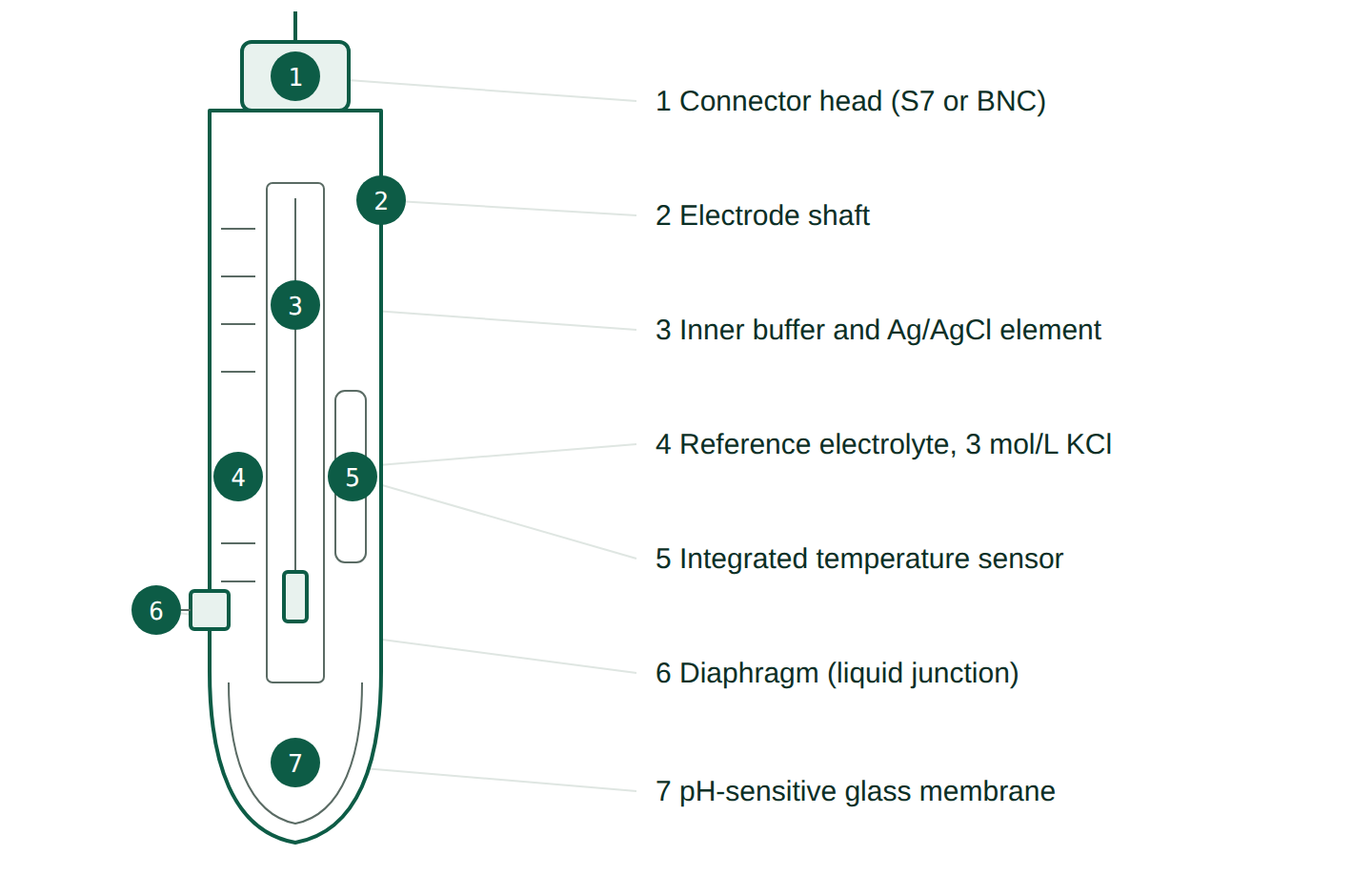
The two halves matter operationally because they fail differently. A measuring half-cell failure shows up as a slope outside the acceptable range; a reference half-cell failure shows up as a drifting or offset zero point, and is far more common in pharmaceutical use because the diaphragm is what contacts syrups, suspensions and protein solutions. Tap a numbered point below for the function and the failure mode.
Select a numbered point on the diagram
Each point gives the component’s function and the failure it produces at calibration.
pH meter calibration acceptance criteria in USP, Ph. Eur. and IP
This is the table most laboratories are missing. The three chapters agree on the verification tolerance and on almost nothing else, and because pH is not a harmonised chapter the differences are not academic — they are what an inspector reads against the monograph you are testing to.
| Parameter | IP 2.4.24 | Ph. Eur. 2.2.3 | USP <791> |
|---|---|---|---|
| Calibration buffers | Two bracketing the sample, plus one intermediate verification buffer[1] | Potassium hydrogen phthalate as primary standard plus one further buffer[2] | At least two, bracketing the expected sample pH[6] |
| Maximum span between calibration buffers | not stated | not stated | should not exceed 4 pH units[6] |
| Verification buffer tolerance | ±0.05 pH[1] | ±0.05 pH[2] | ±0.05 pH[7] |
| Measurement temperature | 25° ± 2°[1] | 20–25 °C, all measurements at the same temperature[2] | buffers and sample within ±2 °C, or use ATC[7] |
| Electrode slope | 90–105 %[1] | not mentioned[2] | not retrievable check source |
| Offset / asymmetry potential | 0 ± 30 mV[1] | not mentioned[2] | not retrievable check source |
| Calibration interval | Periodic; frequency justified from historical performance, sensor maintenance and measurement frequency[1] | not stated[2] | not stated[6] |
| Meter input resistance | ≥ 100 × electrode resistance[1] | ≥ 100 × electrode resistance[2] | not retrievable check source |
| Meter discrimination | 0.05 pH or 0.003 V[1] | 0.05 pH or 0.003 V[2] | not retrievable check source |
Swipe the table sideways on a phone. Rows marked check source could not be verified against a retrievable primary text: USP <791> sits behind the USP–NF subscription,[3] and the USP column here is taken from two instrument-maker technical guides to the chapter,[6][7] not from the chapter itself. Verify against your own USP–NF access before writing any of it into a specification.
Why the slope figure on most websites is not a compendial limit
Search for pH electrode acceptance criteria and you will be told that USP requires a slope of 95 to 105 per cent. That figure has no retrievable compendial source. What is retrievable is this: IP 2.4.24 gives 90 to 105 per cent and an offset of 0 ± 30 mV, describing them as typical acceptable parameters;[1] Ph. Eur. 2.2.3 does not contain the words slope, offset or asymmetry potential at all;[2] and the instrument manufacturers publish their own ranges, which disagree with IP and with each other — Thermo Scientific Orion specifies 92 to 102 per cent slope and ±59 mV offset for its own meters.[7]
The practical consequence for an Indian manufacturer is straightforward. If your specification cites IP, 90 to 105 per cent is a compendial limit and you may cite the chapter. If you have tightened it to 95 to 105 per cent, that is a valid internal specification but it is yours, and your SOP should say so rather than attributing it to a pharmacopoeia that does not carry it. Presenting an internal convention as a compendial requirement is the kind of documentation error that turns a routine calibration observation into a data-integrity discussion.
Reference buffer table: pH values from 15 °C to 35 °C
IP 2.4.24 Table-2 and Ph. Eur. 2.2.3 Table 2.2.3.-2 carry identical values, both deriving from the same primary standard buffer determinations.[1][2] Buffer pH is temperature dependent, which is why the verification tolerance is stated against the tabulated value at the buffer solution temperature and not against the nominal room-temperature figure printed on the bottle.
| Reference buffer solution | 15 °C | 20 °C | 25 °C | 30 °C | 35 °C |
|---|---|---|---|---|---|
| Potassium tetraoxalate 0.05 M | 1.67 | 1.68 | 1.68 | 1.68 | 1.69 |
| Potassium hydrogen tartrate, saturated at 25 °C | — | — | 3.56 | 3.55 | 3.55 |
| Potassium dihydrogen citrate 0.05 M | 3.80 | 3.79 | 3.78 | 3.77 | 3.76 |
| Potassium hydrogen phthalate 0.05 M | 4.00 | 4.00 | 4.01 | 4.02 | 4.02 |
| Equimolal phosphate: KH2PO4 0.025 M + Na2HPO4 0.025 M | 6.90 | 6.88 | 6.87 | 6.85 | 6.84 |
| Phosphate: KH2PO4 0.0087 M + Na2HPO4 0.0303 M | 7.45 | 7.43 | 7.41 | 7.40 | 7.39 |
| Disodium tetraborate 0.01 M | 9.28 | 9.23 | 9.18 | 9.14 | 9.10 |
| Carbonate: Na2CO3 0.025 M + NaHCO3 0.025 M | 10.12 | 10.06 | 10.01 | 9.97 | 9.93 |
| Calcium hydroxide, saturated at 25 °C | 12.81 | 12.63 | 12.45 | 12.29 | 12.13 |
Values as tabulated in IP 2.4.24 Table-2 and Ph. Eur. 2.2.3 Table 2.2.3.-2.[1][2] Potassium hydrogen tartrate carries no value below 25 °C because the buffer is defined as saturated at 25 °C. Commercial buffers traceable to a national standard and carrying a stated value accurate to 0.02 pH are acceptable in place of laboratory-prepared solutions.[7]
Which buffers should you calibrate with?
Pick the pH range your sample actually falls in and the pharmacopoeia your monograph cites. The rule underneath is the same everywhere — the two calibration buffers must span the sample pH, and the verification buffer sits between them — but the tolerances that apply and the constraints on buffer spacing are not.
Choose one option from each group
The buffer pair, the verification buffer and the acceptance criteria that apply will appear here.
SOP template: calibration of a pH meter
1. Purpose
To lay down a procedure for the calibration and performance verification of the laboratory pH meter and combination glass electrode used for pH determination of raw materials, in-process samples and finished products.
2. Scope
Applicable to bench and portable pH meters with combination glass electrodes in the Quality Control laboratory. This procedure does not cover in-line process pH transmitters, pH measurement in non-aqueous or partially aqueous media, or the conductivity and total organic carbon tests applied to Purified Water and Water for Injection, which are governed by their own chapters and covered separately in our high-purity water system specifications guide and conductivity meter SOP.
3. Responsibility
- Analyst / Chemist, QC: performing calibration, recording results, reporting out-of-limit observations before use.
- Officer, Quality Control: verifying entries, controlling buffer receipt, dating and discard, maintaining the electrode history record.
- Head, Quality Assurance: approval of this SOP, of acceptance limits, and of the justification for the calibration frequency.
4. Materials and equipment
- pH meter with input resistance at least 100 times the electrode resistance and discrimination of at least 0.05 pH unit or 0.003 V.[1]
- Combination glass electrode with integrated or separate temperature sensor.
- Reference buffer solutions, laboratory prepared per the pharmacopoeial method or commercial buffers traceable to a national standard with a stated value accurate to 0.02 pH.[7]
- Carbon dioxide-free purified water for rinsing and for buffer preparation.
- Electrode storage solution as specified by the electrode manufacturer, and 3 mol/L KCl refill electrolyte for refillable electrodes.
- Lint-free tissue, calibrated thermometer or the meter’s own temperature probe.
5. Procedure
6. Acceptance criteria
| Parameter | Limit | Basis |
|---|---|---|
| Verification buffer reading | within ±0.05 pH of the tabulated value at the buffer temperature | compendial IP 2.4.24; Ph. Eur. 2.2.3[1][2] |
| Electrode slope | 90 % to 105 % | compendial IP 2.4.24 only; absent from Ph. Eur. 2.2.3[1][2] |
| Offset / zero point | 0 ± 30 mV (about 0.5 pH at 25°) | compendial IP 2.4.24 only[1] |
| Calibration temperature | 25° ± 2° | compendial IP 2.4.24; Ph. Eur. 2.2.3 states 20–25 °C[1][2] |
| Reading stability before acceptance | site defined, e.g. drift below 0.01 pH in 30 s | site policy not a compendial requirement |
| Calibration frequency | site defined and justified | site policy IP requires the frequency to be derived from historical performance, maintenance and use[1] |
| Electrode replacement trigger | site defined | site policy commonly repeated slope or offset failure after cleaning and reconditioning |
Swipe the table sideways on a phone. Rows badged site policy are internal convention and must not be attributed to a pharmacopoeia in your SOP or in a specification.
7. Precautions
- Do not reuse calibration buffer. Pour the volume required into a clean beaker and discard it after use; returning it to the bottle contaminates the whole container and carries the previous sample’s ions into the next calibration.
- Blot the electrode, never wipe it.
- Keep the refill hole of a refillable electrode open during measurement so the electrolyte maintains a positive outflow through the diaphragm.
- Record the actual temperature of every reading. Automatic temperature compensation corrects the electrode’s response for temperature; it does not convert the sample’s pH to its value at 25 °C, because the sample’s own pH is genuinely temperature dependent.
- Buffers absorb atmospheric carbon dioxide. Alkaline buffers, particularly the carbonate and calcium hydroxide solutions, drift downward once opened and must be dated on opening.
- For low-conductivity samples the reading will be slow and unstable; this is a junction potential effect, not an instrument fault, and needs an electrode designed for the purpose.
8. Deviation handling
- Record the failing calibration in Annexure-I before doing anything else. An unrecorded failed attempt followed by a recorded passing one is a data-integrity finding, not a housekeeping matter.
- Confirm buffer identity, in-use expiry and temperature. A buffer past its opening date is the most common single cause.
- Clean the electrode per the manufacturer’s instructions for the residue involved — protein, fat, or inorganic deposit — and recondition it in storage solution.
- Refill and, for a refillable electrode, verify electrolyte flow through the diaphragm.
- Repeat the calibration with fresh buffer. If it fails again, take the instrument out of service, raise a deviation, and assess the impact on results generated since the last passing calibration.
- Replace the electrode if slope or offset fails repeatedly after cleaning. Record the replacement in the electrode history so the calibration frequency justification stays evidence-based.
9. Annexure-I: pH meter calibration record
| Date | Buffer 1 (pH / temp) | Buffer 2 (pH / temp) | Slope % | Offset mV | Verification buffer: tabulated / observed | Pass or fail | Done by | Checked by |
|---|---|---|---|---|---|---|---|---|
10. Revision history
| Version | Effective date | Change | Reason |
|---|---|---|---|
| 00 | DD-MMM-YYYY | New document | First issue |
| 01 | DD-MMM-YYYY | Slope and offset limits aligned to IP 2.4.24; source attribution corrected | Periodic review |
Five findings that fail a pH meter audit
- A slope limit attributed to the wrong pharmacopoeia. The SOP cites USP for 95–105 per cent. The retrievable compendial figure is IP’s 90–105 per cent.[1] Either cite IP and use its numbers, or declare the tighter limit as an internal specification.
- A calibration frequency with no justification behind it. IP 2.4.24 asks for the frequency to be derived from historical performance, sensor maintenance and how often the instrument is used.[1] “Daily, as per SOP” is not a justification; the electrode history record is.
- No temperature recorded against the buffer reading. The ±0.05 tolerance is against the tabulated value at the buffer’s temperature, so a reading without its temperature cannot be assessed against the limit at all.
- Calibration buffers that do not bracket the sample. Calibrating on 4.01 and 7.00 and then measuring a sample at pH 9 extrapolates beyond the calibrated range. The bracketing requirement is common to all three chapters.
- Failed calibration attempts absent from the record. Repeating until it passes, with only the passing attempt recorded, is the classic pH-meter data-integrity observation and is trivially visible in the audit trail of any meter with electronic records.
Equipping or requalifying a QC laboratory
Instrument selection, qualification scope and the calibration programme are decided when a laboratory is designed, not after it is built. If you are costing a new QC block or bringing an existing one up to a Schedule M standard, our pharma plant setup cost calculator covers instrument and laboratory line items alongside the rest of the facility.
Frequently asked questions
USP General Chapter <791> pH. The chapter is available through a USP–NF subscription rather than free access. The more useful point for a laboratory is that it is not a harmonised chapter: pH does not appear on USP’s Pharmacopoeial Discussion Group status tables for either general chapters or general methods, so USP <791>, Ph. Eur. 2.2.3 and IP 2.4.24 cannot be treated as interchangeable and your method must follow the pharmacopoeia the monograph cites.
No pharmacopoeia specifies an interval. IP 2.4.24 states that calibration or verification should be executed periodically and that the frequency is determined from the historical performance of the measurement system, the maintenance of the pH sensor and the frequency of measurement operation. Daily calibration before use is a widespread and defensible site policy, but it is site policy, and an inspector may reasonably ask for the performance data behind it rather than for the SOP that states it.
No, and this is the most consequential misunderstanding in routine pH work. ATC corrects for the temperature dependence of the electrode’s response, which is the slope term in the Nernst relationship. It does not and cannot correct for the temperature dependence of the sample’s own dissociation equilibria. A solution genuinely has a different pH at 30 degrees than at 25, and that difference is real, not an instrument artefact. This is why the pharmacopoeial texts fix a measurement temperature rather than relying on compensation.
It is the ratio of the electrode’s measured response to the theoretical Nernstian response at the calibration temperature, which is about 59.2 mV per pH unit at 25 degrees. An electrode reporting 97 per cent is delivering roughly 57.4 mV per pH unit. The percentage form is useful because it is temperature independent, so the same acceptance limit applies whether calibration was performed at 22 or 28 degrees. IP 2.4.24 gives 90 to 105 per cent as typical acceptable parameters; Ph. Eur. 2.2.3 sets no slope criterion at all.
Yes, provided they are traceable to a national standard and carry a stated pH value accurate to 0.02 pH, and provided you record the lot, the certificate value and the opening date. The compendial requirement is on the value and its traceability, not on who prepared the solution. In practice commercial buffers reduce a real source of error, because laboratory-prepared buffers depend on carbon dioxide-free water and on drying conditions that are easy to get wrong.
The reference half-cell depends on a concentrated potassium chloride electrolyte held in equilibrium across the diaphragm. Storing the electrode in water sets up a concentration gradient that leaches the electrolyte out through the junction, and the hydrated gel layer on the glass membrane degrades at the same time. The visible result is a slow, drifting response and an offset that will not come back into limit. Store in the manufacturer’s storage solution, which is normally a potassium chloride solution buffered near pH 4.
Related on Laafon
- Karl Fischer titration and calibration procedure — the companion titrimetric calibration, including factor acceptance limits
- SOP for conductivity meter — the sibling electrochemical instrument in most QC laboratories
- Principle of HPLC and system suitability acceptance limits
- Gas chromatography for residual solvents under ICH Q3C and USP <467>
- Pharmaceutical method validation: roadmap to compliance
- All standard operating procedures on Laafon
References
- Indian Pharmacopoeia Commission. 2.4.24 pH Values. Indian Pharmacopoeia. Ghaziabad: IPC. Available from: https://ipc.gov.in/images/2.4.24._pH_Values_V1_Web.pdf. Accessed September 2026.
- European Pharmacopoeia. 2.2.3 Potentiometric determination of pH. European Pharmacopoeia 7.0. Strasbourg: EDQM. Available from: https://www.drugfuture.com/Pharmacopoeia/EP7/DATA/20203E.PDF. Accessed September 2026.
- United States Pharmacopeial Convention. General Chapter <791> pH. USP–NF. Rockville, MD. Subscription access at https://www.uspnf.com/. Accessed September 2026.
- United States Pharmacopeial Convention. Harmonization Status for General Chapters (Pharmacopeial Discussion Group). Available from: https://www.usp.org/harmonized-standards/pdg/general-chapters. Accessed September 2026.
- United States Pharmacopeial Convention. Harmonization Status for General Methods (Pharmacopeial Discussion Group). Available from: https://www.usp.org/harmonized-standards/pdg/general-methods. Accessed September 2026.
- Mettler-Toledo. pH Measurements Following USP 791. White paper. Available from: https://www.mt.com/us/en/home/library/white-papers/lab-analytical-instruments/pH-measurement-USP-791.html. Accessed September 2026.
- Thermo Fisher Scientific. pH Measurement per USP <791>: Preparing your Lab. R-USP791-E. Available from: https://documents.thermofisher.com/TFS-Assets/LPD/Handbooks/USP%20791%20Measuring%20pH%20eBook%20R-USP791-E%200819.pdf. Accessed September 2026.
This procedure is a template for adaptation. It requires local qualification, validation and Quality Assurance approval before use, and every acceptance criterion must be verified against the current pharmacopoeial edition applicable at your site. The Ph. Eur. text cited here is from a superseded edition and the USP column is derived from instrument-maker technical guides rather than from USP–NF itself; pharmacopoeial texts and Indian statutory instruments change between editions. Technical and educational content only, not medical, legal or investment advice.