
The short answer
Calibrating a volumetric Karl Fischer titrator means determining the water equivalence factor (F) of the titrant — how many milligrams of water one millilitre of reagent consumes. Sodium tartrate dihydrate is the standard of choice because it is a stoichiometric hydrate: two molecules of water per molecule of salt, a fixed 15.66 % water by mass, and a free-flowing solid you can weigh accurately in air.
- Water equivalence factor F = (W × 0.1566) ÷ V
- DST water content 36.04 / 230.08 = 15.66 %
- DST weighed, USP <921> 20 – 125 mg
- Fresh classical reagent approx. 5 mg water / mL
- Volumetric drift, conditioned cell ≤ 10 µL/min
- Coulometric drift, conditioned cell ≤ 4 µg/min
There is no USP factor limit. USP <921> gives the formula and the weighing range, not an acceptance window for F. Every “KF factor limit” you will see quoted is a site or manufacturer convention. That distinction is set out in full in the acceptance criteria table below.
Why sodium tartrate dihydrate is used for KF calibration
This is the question practitioners actually ask, and it has a precise answer. Sodium tartrate dihydrate (Na2C4H4O6·2H2O, commonly written DST or Na tartrate) is named in USP <921> as a standardisation option, and it wins on four practical grounds.[1]
- Its water content is fixed by stoichiometry, not by certification. Two moles of water of crystallisation per mole of salt gives 36.04 ÷ 230.08 = 0.1566, that is 15.66 % w/w water. USP builds this ratio directly into the factor formula, so you never need a certified water value — the chemistry supplies it.[1] Commercial KF standards are sold on exactly this figure.[9]
- It is a weighable solid, and water is not. A USP standardisation uses 20–125 mg of DST, which releases roughly 3–20 mg of water. Delivering that much water directly would mean pipetting 3–20 µL — a volume where evaporation and moisture pickup on the balance dominate the result. Weighing a crystalline solid by difference removes that error entirely.
- It is not hygroscopic. The water is locked in the crystal lattice, so the standard does not gain or lose water in normal laboratory air the way a liquid water standard or an open reagent does.
- It releases its water completely into the methanolic medium. The water of crystallisation dissolves out and titrates quantitatively, which is what makes the calculated ratio usable as a true reference value.
The one failure mode to know. Sodium tartrate dihydrate dissolves slowly in methanol.[6] If the titrator reaches an apparent endpoint before the crystals have fully dissolved, less water is released, the titrant volume V is understated, and the calculated factor comes out high. Every subsequent water content result is then biased high. Allow full dissolution, or use a longer endpoint delay, before accepting the result.
KF factor and water content calculator
Both calculations below are the compendial ones. Use the first after a standardisation run, the second on a sample result.
Calculations run entirely in your browser. Nothing you type is sent anywhere or stored.
Karl Fischer titration cell: labelled diagram and component specifications
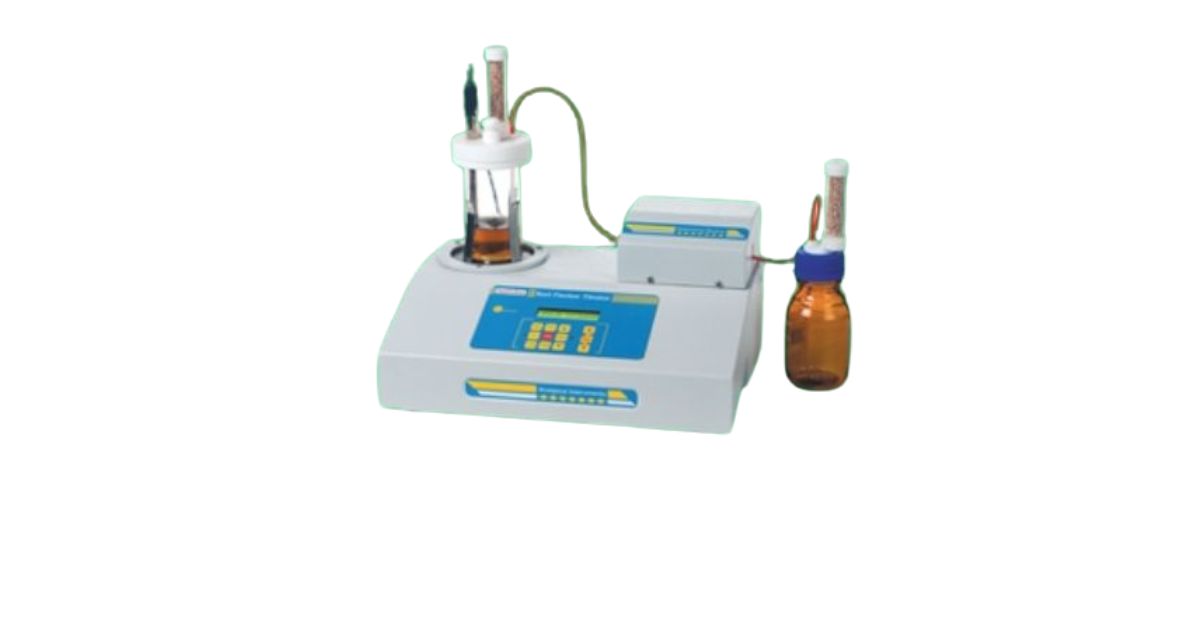
The apparatus described in Ph. Eur. 2.5.12 is a titration vessel carrying two identical platinum electrodes, tight inlets for solvent and titrant, and an inlet admitting air only through a desiccant.[2] Select a numbered part below for its function, working specification and the failure it most often causes.
Select a component
Tap any numbered part above, or use the buttons, to see what it does, its working specification and the failure it most commonly causes.
Schematic of a volumetric Karl Fischer titration cell. Component arrangement follows the apparatus described in Ph. Eur. 2.5.12 and USP <921>.[1][2] Not to scale.
Component specification table
| # | Component | Function | Working specification | Most common failure |
|---|---|---|---|---|
| 1 | Titration vessel | Holds the working medium and keeps atmospheric moisture out | Sealed glass cell with tight inlets for solvent and titrant; air admitted only through a desiccant [2] | A dry or ungreased ground joint leaks and drift never settles |
| 2 | Double platinum electrode | Bipotentiometric endpoint detection | Two identical platinum electrodes, approx. 200 mV applied; endpoint when current rises to 50–150 µA and holds for 30 s to 30 min [1] | Filmed or passivated pins give drifting or premature endpoints |
| 3 | Drying tube | Admits pressure-equalising air free of moisture | Molecular sieve or indicating silica gel; replace on colour change [2] | Spent desiccant is the single most common cause of high drift |
| 4 | Burette / dosing unit | Delivers titrant of known water equivalence factor | 5, 10 or 20 mL burette; classical reagent approx. 5 mg water per mL when freshly prepared [1][6] | An air bubble in the line overstates delivered volume and biases F low |
| 5 | Septum sample port | Sample introduction without opening the cell | Replace after repeated punctures; keep open only as long as the transfer takes | A cored septum leaks continuously and raises drift |
| 6 | Magnetic stirrer and bar | Keeps the medium homogeneous so the reaction goes to completion | Constant speed producing a vortex without splashing onto the electrode | Too slow delays the endpoint; too fast splashes the electrode and gives erratic detection |
| 7 | Working medium | Dissolves the sample and takes part in the reaction | KF-grade methanol; methanol is a reactant, not only a solvent; practical working range approx. pH 5.5–8 [8] | Above approx. pH 8.5 iodine reacts with hydroxide and methylate ions and stoichiometry is lost [8] |
| 8 | Solvent drain | Removes spent medium when reagent capacity is exhausted | Change the medium once it is saturated or the titration time lengthens noticeably | An overloaded medium gives long, drifting titrations and low recoveries |
Swipe the table sideways on a phone.
The reaction, and why methanol matters
Karl Fischer titration rests on the quantitative reaction of water with sulfur dioxide and iodine in an anhydrous medium in the presence of a base.[1] The historical Bunsen reaction runs in water; Karl Fischer’s contribution was to move it into a non-aqueous alcoholic medium where water becomes the limiting reagent.
In an alcoholic medium the reaction proceeds in two steps. The alcohol and sulfur dioxide first form an alkyl sulfite with the base, and iodine then oxidises that sulfite to a sulfate, consuming exactly one molecule of water per molecule of iodine:[8]
Step 2 [RNH]SO3CH3 + I2 + H2O + 2 RN → [RNH]SO4CH3 + 2 [RNH]I
Three consequences follow, and they are the reason the method behaves the way it does in a QC lab:
- Methanol is a reactant, not just a solvent. It is consumed in step 1. Substituting a non-participating solvent changes the chemistry, which is why KF-grade methanol or a validated working medium is specified rather than any convenient solvent.[8]
- The stoichiometry is one mole of iodine per mole of water. That 1:1 ratio is what makes the titrant factor a simple mass-per-volume constant.[8]
- The base sets the pH, and the pH sets the accuracy. The practical working range is approximately pH 5.5–8. Above about pH 8.5 the reaction rate rises through side reactions between iodine and hydroxide or methylate ions, and the stoichiometry is no longer reliable.[8]
On pyridine. The classical USP <921> reagent is prepared from 125 g of iodine, 670 mL of methanol and 170 mL of pyridine, with sulfur dioxide passed into further pyridine.[1] Most laboratories now buy ready-made pyridine-free reagents, in which imidazole or a similar base replaces pyridine. The chemistry and the calibration procedure are the same; the toxicity and odour profile are not. Use whichever your validated method and your reagent supplier’s documentation specify.
Volumetric or coulometric: which method your sample needs
| Volumetric — USP Method Ia / Ib | Coulometric — USP Method Ic | |
|---|---|---|
| Iodine source | Added as a titrant of known factor | Generated at the anode from iodide in the cell [1] |
| Typical water range | 100 ppm – 100 % [8] | 1 ppm – 5 % [8] |
| Water per determination | 2 – 250 mg [1] | 0.5 – 5 mg [1] |
| Calibration model | Factor determined against sodium tartrate dihydrate or a water standard [1] | No titre. Verified by recovery on a certified water standard [5] |
| Drift for a conditioned cell | ≤ 10 µL/min [4] | ≤ 4 µg/min; ≤ 10 µg/min with an oven [5] |
| Suits | APIs, excipients, granules and blends with appreciable water | Trace water in solvents, oils, lyophilised products and low-moisture APIs |
Swipe the table sideways on a phone.
Karl Fischer acceptance criteria: what is compendial and what is not
This is the section most KF pages get wrong. Pharmacopoeial texts specify how to determine the factor; they do not set an acceptance window for its value. Presenting an internal convention as a USP limit is the most damaging error this content can make, so each row below is labelled with its actual source.
| Parameter | Value | Basis |
|---|---|---|
| Sodium tartrate dihydrate weighed for standardisation | 20 – 125 mg, accurately weighed by difference | compendial USP <921> [1] |
| Water equivalence factor formula | F = (W × 36.04/230.08) ÷ V | compendial USP <921> [1] |
| Nominal strength, freshly prepared classical reagent | approx. 5 mg water / mL | compendial USP <921> [1] |
| Sample size, volumetric (Method Ia) | estimated to contain 2 – 250 mg water | compendial USP <921> [1] |
| Sample size, coulometric (Method Ic) | estimated to contain 0.5 – 5 mg water | compendial USP <921> [1] |
| Electrometric endpoint | 50 – 150 µA sustained 30 s to 30 min at approx. 200 mV | compendial USP <921> [1] |
| Coulometric recovery on a water standard | 97.5 – 102.5 % at 1000 µg; 90.0 – 110.0 % at 100 µg | compendial WHO Int. Ph. 2.11 [3] |
| Baseline drift must be monitored | required; no numerical limit given | compendial USP <921>, WHO Int. Ph. 2.11 [1][3] |
| Drift, conditioned volumetric cell | ≤ 10 µL/min | manufacturer Metrohm AB-077 [4] |
| Drift, conditioned coulometric cell | ≤ 4 µg/min; ≤ 10 µg/min with oven | manufacturer Metrohm AB-137 [5] |
| Replicate factor determinations | at least three | manufacturer Metrohm AB-424 [6] |
| RSD of triplicate factor determinations | ideally ≤ 0.3 % | manufacturer Metrohm [7] |
| Titrant sensitivity to temperature | approx. 0.1 % factor decrease per 1 °C rise | manufacturer Metrohm [7] |
| Certified liquid water standards for coulometric checks | 1.00 ± 0.003 mg/g and/or 0.10 ± 0.005 mg/g | manufacturer Metrohm AB-137 [5] |
| Frequency of factor determination | set locally — commonly each working day and on each new reagent lot | site policy not a compendial requirement |
| Acceptance window for F | set locally against the titrant’s nominal strength | site policy no pharmacopoeial limit exists |
| Full instrument calibration / requalification interval | set locally — commonly six-monthly or annual | site policy not a compendial requirement |
Swipe the table sideways on a phone. Rows badged site policy are internal convention and must be justified in your own validation or calibration master plan — they are not pharmacopoeial requirements and quoting them as such will not survive an audit.
SOP: calibration of a volumetric Karl Fischer titrator
A template you can adapt into your own quality management system. Every field shown as enter value is a document control entry you must complete before the procedure is issued.
1. Purpose
To describe the procedure for determining the water equivalence factor of Karl Fischer titrant using certified sodium tartrate dihydrate, so that water content results generated on the instrument are traceable and defensible.
2. Scope
Applies to all volumetric Karl Fischer titrators in the Quality Control laboratory, for routine factor determination and after any reagent change. This procedure does not cover coulometric titrators, the oven or vaporiser accessory, preparation of Karl Fischer reagent from components, or design, installation, operational and performance qualification (DQ / IQ / OQ / PQ), which are covered by separate procedures.
3. Responsibility
- Analyst / Chemist, QC: performs the standardisation, records raw data contemporaneously, reports any out-of-limit result before proceeding.
- Officer / Executive, QC: verifies calculations, checks records against Annexure-I, releases the working factor for use.
- Head, Quality Assurance: approval, deviation review and periodic review of this procedure.
4. Materials, equipment and reagents
- Volumetric Karl Fischer titrator with double platinum pin electrode and magnetic stirrer
- Calibrated analytical balance, readable to 0.01 mg, within its calibration validity
- Karl Fischer titrant of stated nominal strength, with the supplier’s certificate of analysis
- Methanol, Karl Fischer grade (low water), or the validated working medium for your method
- Sodium tartrate dihydrate, certified reference material for Karl Fischer titration, water content 15.66 % [9]
- Desiccant for the drying tube: molecular sieve or indicating silica gel
- Vacuum grease for ground-glass joints; dry weighing boat or spatula; lint-free tissue
5. Procedure
6. Acceptance criteria
Apply the table in Karl Fischer acceptance criteria above. Compendial rows are fixed. Rows badged site policy — the factor acceptance window, the determination frequency and the requalification interval — must be filled in with your own approved values and justified in your calibration master plan. Do not copy a number from any website, including this one, into a controlled document without that justification.
7. Frequency
- Factor determination: at a frequency defined in your calibration master plan, and always on opening a new titrant container or lot. Basis: site policy. Manufacturer guidance is to determine the factor daily at first and then judge stability from the observed trend.[7]
- Full instrument calibration or requalification: at the interval defined in your calibration master plan. Basis: site policy, not a compendial requirement.
8. Precautions and safety
- Karl Fischer reagents contain methanol and sulfur dioxide and, in classical formulations, pyridine. Handle in a fume hood with appropriate personal protective equipment and dispose of spent medium per your local waste rules and the supplier’s safety data sheet.
- Keep the titrant bottle tightly closed. Every opening admits moisture and lowers the factor; a 1 °C temperature rise alone lowers it by about 0.1 %.[7]
- Keep the sodium tartrate dihydrate container closed. The hydrate itself is stable, but surface moisture on the crystals is not part of the 15.66 % and will bias the factor.
- Never attempt to weigh 20–125 mg of liquid water as an alternative standard on an open balance. Evaporation over the weighing period is larger than the analytical tolerance.
- Clean the instrument immediately after any reagent spillage to prevent corrosion.
- Electrode cleaning and regeneration are instrument-specific. Follow the manufacturer’s manual; do not improvise a chemical regeneration on a platinum electrode.
9. Deviation handling
Missing from most published KF procedures, and the section an auditor will look for.
- RSD above the site limit: check that the standard fully dissolved, review weighing technique and drift stability, then repeat the set. Do not average a failing set with a passing one.
- Factor materially below nominal: suspect reagent degradation or moisture ingress. Check the drying tube, ground-glass joints and septum, then replace the titrant.
- Factor materially above nominal: suspect incomplete dissolution of the standard, or under-delivery from an air bubble in the burette line. Re-prime and repeat.
- Drift will not stabilise: replace the desiccant, re-grease the joints, replace the septum, and confirm the working medium is not saturated.
- Any out-of-limit result: raise a deviation or incident per your quality management system before releasing further analytical data, and assess the impact on every result generated since the last passing factor determination.
10. Annexure-I: Karl Fischer factor determination record
| Date | Titrant lot | Std lot / CoA | Drift | W (mg) | V (mL) | F (mg/mL) | Mean F | RSD % | Done by | Checked by |
|---|---|---|---|---|---|---|---|---|---|---|
Copies as tab-separated text. Paste straight into Excel or Google Sheets, then add your document control header.
Other annexures to raise alongside this SOP: Annexure-II, Instrument usage logbook. Annexure-III, Calibration status label. Annexure-IV, Reagent receipt and opening record.
11. Revision history
| Version | Effective date | Change | Reason |
|---|---|---|---|
| 00 | enter date | New procedure issued | Initial issue |
| 01 | enter date | enter change | enter reason |
Loss on drying is not water content
Two of the most common searches around this topic are the difference between loss on drying and water content, and whether one can substitute for the other. They measure different things.
- Loss on drying, USP <731>, determines “the amount of volatile matter of any kind that is driven off under the conditions specified”.[10] Residual solvents, adsorbed gases and any other volatile all count towards the figure. USP directs that where water is the only volatile constituent, the <921> method is used instead.[10]
- Karl Fischer titration, USP <921>, is specific to water through the iodine reaction, and it captures water of crystallisation released into the medium — water that a low-temperature drying oven may never drive off.[1]
The practical consequence: for most materials loss on drying is greater than or equal to the Karl Fischer water content, and a wide gap between the two is a signal, not noise. It usually points to residual solvent, which is confirmed by gas chromatography rather than by either moisture method. Follow whichever test the individual monograph specifies; the two are not interchangeable at your discretion.
Frequently asked questions
Because its water content is fixed by stoichiometry rather than by certification. Sodium tartrate dihydrate carries two molecules of water of crystallisation per molecule of salt, which is 36.04 divided by 230.08, or 15.66 % water by mass. USP <921> builds that exact ratio into the water equivalence factor formula. It is also a non-hygroscopic, free-flowing solid that can be weighed accurately in air, whereas the 3 to 20 mg of water it represents could not be pipetted with comparable accuracy.
F equals W multiplied by 36.04 divided by 230.08, all divided by V. F is the water equivalence factor in mg of water per mL of reagent, W is the weight of sodium tartrate dihydrate in mg, V is the volume of reagent consumed in the second titration in mL, 36.04 is twice the molecular weight of water and 230.08 is the molecular weight of sodium tartrate dihydrate. The ratio 36.04 divided by 230.08 is 0.1566, the water fraction of the standard. Where a certified water standard is used instead, F is simply W divided by V.
No. USP <921> specifies how to determine the water equivalence factor and states that a freshly prepared classical reagent is equivalent to approximately 5 mg of water per mL, but it does not set an acceptance window for the factor value. Any specific limit you see quoted is a site or manufacturer convention. Set your own window against the titrant’s nominal strength, justify it in your calibration master plan, and do not cite it as a pharmacopoeial requirement.
Drift is the rate at which the conditioned cell takes up moisture from its surroundings, expressed as titrant volume or micrograms of water per minute. It is measured after conditioning and before titrating, and it is subtracted as a drift correction over the titration time. USP <921> and the WHO International Pharmacopoeia require baseline drift to be monitored but set no number. Manufacturer guidance gives 10 microlitres per minute or less for a conditioned volumetric cell, and 4 micrograms per minute or less for a coulometric cell, rising to 10 micrograms per minute when an oven is fitted. Spent desiccant in the drying tube is the most common cause of high drift.
Methanol is not only the solvent, it is a reactant. It combines with sulfur dioxide and the base to form a methyl sulfite, which iodine then oxidises in the water-consuming step. That is why the medium is specified as Karl Fischer grade methanol or a validated working medium rather than any convenient solvent, and why substituting a non-participating solvent changes the chemistry. Methanol also keeps the medium in the practical working range of about pH 5.5 to 8, outside which the stoichiometry becomes unreliable.
Loss on drying under USP <731> measures all volatile matter driven off under the specified conditions, so residual solvents are counted along with water. Karl Fischer titration under USP <921> is specific to water and also captures water of crystallisation. Loss on drying is therefore usually equal to or higher than the Karl Fischer result, and a large gap between the two normally indicates residual solvent. USP directs that where water is the only volatile constituent present, the Karl Fischer method is used. Follow whichever test the individual monograph specifies.
There is no compendial frequency. It is a site decision, justified in your calibration master plan. Manufacturer guidance is to determine the factor daily at first and then set the interval from the observed stability, and always to redetermine it when a new titrant container or lot is opened. Titrant factor is genuinely unstable: every opening of the bottle admits moisture, and a temperature rise of 1 degree Celsius lowers the factor by roughly 0.1 % through volume expansion alone.
A double platinum pin electrode. Ph. Eur. 2.5.12 describes the titration vessel as carrying two identical platinum electrodes. Detection is bipotentiometric: about 200 millivolts is applied across the pair, and the endpoint is taken when a slight excess of reagent raises the current to between 50 and 150 microamperes and holds it there for 30 seconds to 30 minutes, per USP <921>. Electrode cleaning and regeneration are instrument-specific and should follow the manufacturer’s manual.
Choose by the water level in the sample. Volumetric titration suits samples where water is a major component, roughly 100 ppm to 100 %, and a determination consumes 2 to 250 mg of water. Coulometric titration suits trace water, roughly 1 ppm to 5 %, with 0.5 to 5 mg of water per determination. Volumetric titrant needs a factor determined against sodium tartrate dihydrate or a water standard; a coulometric cell has no titre and is instead verified by recovery against a certified water standard. The individual monograph will usually specify which method applies.
Related on Laafon
- Principle of HPLC: system suitability limits and SOPThe same compendial-versus-site-policy distinction applied to chromatography acceptance limits.
- Dropping mercury electrode: labelled diagram and USP specsBackground on polarised-electrode detection, the same principle the KF endpoint relies on.
- Gas chromatography: principle, instrumentation and workingHow to confirm the residual solvent behind a wide loss-on-drying versus water content gap.
- ALCOA vs ALCOA+ vs ALCOA++: which regulator says whatThe data integrity expectations that govern how calibration records in Annexure-I must be made.
- SOP for calibration of dissolution test apparatusA sibling QC calibration procedure in the same document format.
- Stability chamber working principle and SOPWhere water content becomes a stability-indicating parameter across a shelf-life study.
Equipping a QC laboratory from scratch
A Karl Fischer titrator is one line in a QC instrument list that also has to carry HPLC, GC, dissolution, UV and stability, each with its own qualification scope, utilities and space allocation. If you are costing a formulation plant and need that instrument schedule priced alongside the building, utilities and licensing, the pharma plant setup cost calculator works through it block by block.
References
- United States Pharmacopeial Convention. General Chapter <921> Water Determination. USP 35–NF 30. Rockville (MD): USP; 2012. Available from: https://www.drugfuture.com/Pharmacopoeia/usp35/PDF/0424-0427%20[921]%20WATER%20DETERMINATION.pdf. Accessed September 2026. Verify against the USP–NF edition current at your site.
- European Directorate for the Quality of Medicines and HealthCare. Chapter 2.5.12 Water: semi-micro determination; Chapter 2.5.32 Water: micro determination. European Pharmacopoeia. Strasbourg: EDQM. Official text available from: https://www.edqm.eu/. Accessed September 2026.
- World Health Organization. 2.11 Micro determination of water by the Karl Fischer method. The International Pharmacopoeia, working document QAS/23.926 for public consultation. Geneva: WHO; 2023. Available from: https://cdn.who.int/media/docs/default-source/medicines/norms-and-standards/current-projects/2023-08-21-watermicrodeterminationbykf-qas23-926-forpublicconsultation.pdf. Accessed September 2026.
- Metrohm AG. Application Bulletin AB-077: Volumetric water content determination according to Karl Fischer. Herisau: Metrohm. Available from: https://www.metrohm.com/content/dam/metrohm/shared/documents/application-bulletins/AB-077_3.pdf. Accessed September 2026.
- Metrohm AG. Application Bulletin AB-137: Coulometric water content determination according to Karl Fischer. Herisau: Metrohm. Available from: https://www.metrohm.com/content/dam/metrohm/shared/documents/application-bulletins/AB-137_6.pdf. Accessed September 2026.
- Metrohm AG. Application Bulletin AB-424: Titer determination in volumetric Karl Fischer titration. Herisau: Metrohm. Available from: https://www.metrohm.com/content/dam/metrohm/shared/documents/application-bulletins/AB-424_1.pdf. Accessed September 2026.
- Metrohm AG. Titer determination in Karl Fischer titration [Internet]. Herisau: Metrohm. Available from: https://www.metrohm.com/en/discover/blog/20-21/titer-determination-in-karl-fischer-titration.html. Accessed September 2026.
- Mettler-Toledo. Karl Fischer Guide 1: Water content determination by Karl Fischer titration. Greifensee: Mettler-Toledo. Available from: https://www.mt.com/dam/MT-NA/KarlFischerHelpPage/KF_Guide_1.pdf. Accessed September 2026.
- Honeywell Fluka. HYDRANAL Standard sodium tartrate dihydrate, standard for Karl Fischer titration, water content 15.66 % [product documentation]. Available from: https://www.fishersci.com/shop/products/hydranal-standard-sodium-tartrate-dihydrate-standard-karl-fischer-titration-water-content-15-66-honeywell-fluka-1/6002551. Accessed September 2026.
- United States Pharmacopeial Convention. General Chapter <731> Loss on Drying. USP 35–NF 30. Rockville (MD): USP; 2012. Available from: https://www.drugfuture.com/Pharmacopoeia/usp35/PDF/0317-0318%20%5B731%5D%20LOSS%20ON%20DRYING.pdf. Accessed September 2026.
This procedure is a template for adaptation. It requires local qualification, validation and Quality Assurance approval before use, and every acceptance criterion must be verified against the pharmacopoeial edition current and applicable at your site. Pharmacopoeial texts and Indian statutory instruments change between editions, and the values reproduced here are drawn from the editions cited in the references. Manufacturer figures apply to the instruments and reagents of the manufacturer named and may not transfer to other equipment. Technical and educational content only; not medical, legal or investment advice.