
Gas chromatography separates a mixture by repeatedly partitioning volatile components between an inert carrier gas (the mobile phase) and a liquid or solid film coated inside a capillary column (the stationary phase). Components that spend more time dissolved in the stationary phase move more slowly and elute later, giving each a characteristic retention time.
Gas chromatography in pharmaceutical industry laboratories is used for four things: residual solvent testing to ICH Q3C and USP 467, volatile impurity and genotoxic impurity limits, assay of volatile actives such as essential oils and inhalation anaesthetics, and alcohol content determination. Residual solvents are by a wide margin the most common reason a GC sits in an Indian formulation QC lab, and it is the application with the hardest numeric acceptance criteria.
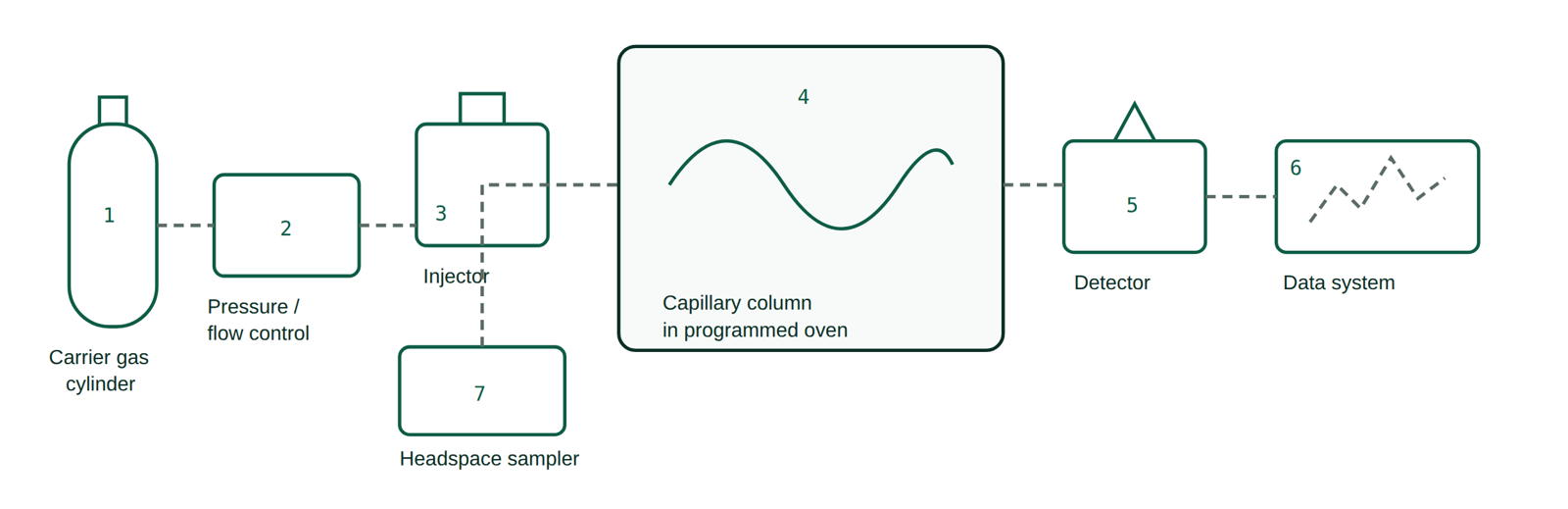
How a gas chromatograph is arranged
Tap any numbered part of the schematic for its function, the specification that usually matters on qualification, and the failure it produces when it drifts.
Carrier gas cylinder
- Function
- Supplies the inert mobile phase that transports the vaporised sample through the column.
- What is specified
- USP 467 specifies nitrogen or helium as carrier gas at a linear velocity of about 35 cm per second with a split ratio of 1 to 5.
- Common failure
- Trace oxygen or moisture from a depleted trap or a leaking fitting oxidises the stationary phase, raising baseline noise and shortening column life.
Source: USP General Chapter 467, Residual Solvents [1].
Figure 1. Flow path of a capillary gas chromatograph configured for headspace residual solvent analysis. Schematic; not to scale.
Detectors for gas chromatography in pharmaceutical industry laboratories
The detector decides what the method can see. For residual solvents the choice is made for you: USP General Chapter 467 specifies a flame ionisation detector for all three of its procedures.
| Detector | Responds to | Typical pharmaceutical use | Practical limitation |
|---|---|---|---|
| FID Flame ionisation |
Almost all organic compounds containing carbon-hydrogen bonds | Residual solvents to USP 467; alcohol content; volatile actives. The default pharma detector. | Effectively blind to water, permanent gases and fully halogenated compounds such as carbon tetrachloride. |
| TCD Thermal conductivity |
Any species with thermal conductivity different from the carrier gas | Permanent gases, water, and compounds an FID cannot see. Non-destructive. | Substantially less sensitive than an FID, so unsuitable for trace impurity limits. |
| ECD Electron capture |
Electronegative species, especially halogenated compounds | Halogenated genotoxic impurities and pesticide residues in herbal and botanical materials. | Contains a radioactive foil in most designs, which brings a separate licensing and disposal obligation in India. |
| NPD Nitrogen phosphorus |
Nitrogen and phosphorus containing organics | Nitrogen-bearing impurities and residual amine catalysts. | The alkali bead is a consumable with a finite life and drifting response. |
| MS Mass spectrometric |
Mass to charge ratio of the fragmented analyte | Identification and confirmation of unknown volatile impurities; nitrosamine work. | Higher qualification and maintenance burden; needs a trained analyst, not just a trained operator. |
Swipe the table sideways on a phone. Selectivity descriptions follow the detector classification in Agilent’s technical overview on interpreting GC detector specifications [4]; quantitative sensitivity figures are instrument-specific and should be taken from your own instrument’s declared specification rather than from a general table.
Residual solvents: the numbers a GC method has to meet
ICH Q3C classifies solvents by toxicity, and USP General Chapter 467 is the compendial procedure that measures them. Class 1 solvents are known or strongly suspected human carcinogens and environmental hazards; where they are used or produced they must be identified and quantified [1][2].
Class 1 solvents and their concentration limits
| Solvent | Concentration limit | Concern | Basis |
|---|---|---|---|
| Benzene | 2 ppm | Carcinogen | compendial [1][2] |
| Carbon tetrachloride | 4 ppm | Toxic and environmental hazard | compendial [1][2] |
| 1,2-Dichloroethane | 5 ppm | Toxic | compendial [1][2] |
| 1,1-Dichloroethene | 8 ppm | Toxic | compendial [1][2] |
| 1,1,1-Trichloroethane | 1500 ppm | Environmental hazard | compendial [1][2] |
Class 2 and Class 3
Class 2 solvents are non-genotoxic animal carcinogens or agents of other irreversible toxicity, and are controlled by a permitted daily exposure (PDE) rather than a flat limit. ICH Q3C tabulates 26 of them. Five representative entries:
| Class 2 solvent | PDE | Option 1 concentration limit |
|---|---|---|
| Methanol | 30.0 mg/day | 3000 ppm |
| Toluene | 8.9 mg/day | 890 ppm |
| Acetonitrile | 4.1 mg/day | 410 ppm |
| Trichloroethylene | 0.8 mg/day | 80 ppm |
| Chloroform | 0.6 mg/day | 60 ppm |
Values from ICH Q3C(R9) and USP 467 [1][2]. Consult the current chapter for the complete 26-solvent table before writing a specification.
Class 3 solvents have low toxic potential and PDEs of 50 mg or more per day. ICH Q3C states that amounts of 50 mg per day or less, corresponding to 5000 ppm or 0.5 percent under Option 1, would be acceptable without further justification [2].
Option 1 concentration limit calculator
ICH Q3C Option 1 limits assume a maximum daily dose of 10 g of product. If your product’s daily dose is larger or smaller, the ppm limit changes. The relationship given in the guideline is Concentration (ppm) = 1000 x PDE / dose, with PDE in mg/day and dose in g/day [2].
At a 10 g/day dose this reproduces the Option 1 limit tabulated in ICH Q3C.
This calculator implements the Option 1 formula only. Option 2, and any case where several Class 2 solvents are present, requires the cumulative treatment set out in the guideline and a documented justification. It does not replace a specification approved by your QA function.
The three USP 467 procedures
USP General Chapter 467 is not a single method. It is a decision sequence: screen, confirm, quantify. Most analysts meet Procedure A and never need the other two, which is precisely why Procedure B is the step people get wrong on audit.
Screening
The first-pass separation. If no peak exceeds its limit, testing stops here.
- Column: G43 phase, 0.32 mm x 30 m with 1.8 micrometre film, or 0.53 mm x 30 m wide-bore with 3.0 micrometre film. G43 is 6 percent cyanopropylphenyl / 94 percent dimethylpolysiloxane [3].
- Carrier gas: nitrogen or helium at about 35 cm per second, split ratio 1:5.
- Detector: flame ionisation.
- Oven programme: 40 °C held 20 min, ramp 10 °C/min to 240 °C, hold 20 min. Injector 140 °C, detector 250 °C.
- Headspace: one of three parameter sets, with equilibration between 80 and 105 °C for 45 to 60 min.
System suitability
- Signal-to-noise ratio of 1,1,1-trichloroethane: not less than 5
- Signal-to-noise ratio of each peak: not less than 3
- Resolution between acetonitrile and methylene chloride: not less than 1.0
Confirmation
Run when Procedure A shows a peak at or above its limit. The point of Procedure B is orthogonal selectivity: it uses a polar wax phase so that pairs which co-elute on G43 are separated, confirming identity before anyone writes an out-of-specification report.
- Column: G16 phase, 0.32 mm x 30 m with 0.25 micrometre film, or 0.53 mm x 30 m with 0.25 micrometre film. G16 is a high molecular weight polyethylene glycol wax phase [3].
- Oven programme: 50 °C held 20 min, ramp 6 °C/min to 165 °C, hold 20 min.
- Carrier gas, detector and headspace conditions as Procedure A.
System suitability
- Signal-to-noise ratio of benzene: not less than 5
- Signal-to-noise ratio of each peak: not less than 3
- Resolution between acetonitrile and trichloroethylene: not less than 1.0
Quantification
Run when Procedures A and B both confirm a solvent is present above its limit. Procedure C quantifies it against a reference standard, using whichever phase gives the better separation for that particular solvent.
- Column and conditions: as Procedure A (G43) or Procedure B (G16), depending on the solvent being measured.
- System suitability: as stated for the procedure whose conditions are adopted.
The audit point. A laboratory that reports a residual solvent result straight from a Procedure A screening peak, without the Procedure B confirmation, has not followed the chapter. Confirmation and quantification are separate steps for a reason: G43 deliberately co-elutes some pairs.
SOP: operation and system suitability check of a gas chromatograph

Figure 2. The same flow path as a static schematic, for printing alongside the procedure below or pasting into a qualification document.
An adaptable template. It assumes headspace GC-FID configured for residual solvent testing, which is the commonest arrangement in an Indian formulation QC lab.
1. Purpose
To define the procedure for operating a headspace gas chromatograph with flame ionisation detection, and for verifying system suitability before analytical results are reported.
2. Scope
Applies to headspace GC-FID systems in the Quality Control laboratory used for residual solvent testing of drug substances, excipients and finished products. It does not cover instrument installation, operational and performance qualification (IQ/OQ/PQ), analytical method validation, GC-MS operation, or the preventive maintenance schedule, each of which is covered by its own SOP.
3. Responsibility
- Analyst, Quality Control: operation, system suitability injection, recording of raw data and reporting of results.
- Officer, Quality Control: verification of system suitability compliance before results are released; investigation initiation on failure.
- Head, Quality Assurance: approval of this SOP, periodic review, and approval of any deviation.
4. Materials and equipment
- Gas chromatograph with headspace sampler and flame ionisation detector, calibrated and within its qualification validity.
- Capillary column of the phase specified in the method: G43 for Procedure A and C, G16 for Procedure B.
- Carrier gas: nitrogen or helium, of the purity grade stated in the method, with in-line moisture and oxygen traps.
- Hydrogen and zero air for the FID, from cylinders or a certified generator.
- Reference standards traceable to a pharmacopoeial or certified source, within validity.
- Diluent, headspace vials, crimp caps and septa of the grade stated in the method.
5. Procedure
6. Acceptance criteria
| Parameter | Limit | Basis |
|---|---|---|
| Signal-to-noise, 1,1,1-trichloroethane (Procedure A) | NLT 5 | compendial USP 467 [1] |
| Signal-to-noise, each peak (Procedures A and B) | NLT 3 | compendial USP 467 [1] |
| Resolution, acetonitrile and methylene chloride (Procedure A) | NLT 1.0 | compendial USP 467 [1] |
| Signal-to-noise, benzene (Procedure B) | NLT 5 | compendial USP 467 [1] |
| Resolution, acetonitrile and trichloroethylene (Procedure B) | NLT 1.0 | compendial USP 467 [1] |
| Blank interference at analyte retention times | None | site policy good practice, not a stated 467 criterion |
| Replicate injection RSD, peak area | Per method | check source set by the individual monograph or validated method, not by 467 |
| Tailing factor, plate count | Per method | check source general chromatography criteria live in USP 621 and the monograph |
Swipe the table sideways on a phone. Rows marked site policy are internal convention. Rows marked check source are deliberately left open: USP General Chapter 467 does not itself set an RSD or tailing limit, and quoting a number here that your monograph does not require would be wrong. Take those from the current edition of the applicable monograph and USP 621.
7. Frequency
- System suitability: before every analytical sequence, and again at the end of a long sequence where the method requires bracketing. method-driven
- Instrument calibration and performance verification: at the interval defined in your approved calibration master plan. site policy The commonly used six-monthly interval is a site convention, not a compendial requirement; the basis must be documented and justified.
- Column performance check: on installation, after any maintenance affecting the flow path, and at the interval stated in the method.
8. Precautions and safety
- Hydrogen is flammable and forms explosive mixtures with air. Leak-test every fitting after any work on the gas lines, and never leave hydrogen flowing to an unlit FID.
- Injector, detector and oven surfaces operate well above 200 °C. Allow the specified cool-down before opening the oven or changing a column.
- Class 1 solvent standards, benzene in particular, are handled in a fume hood with the controls stated in the safety data sheet.
- Audit exposure: the failures that draw observations are documentation failures, not safety failures. Unexplained manual integration, a system suitability injection run after the samples, an instrument used past its calibration due date, and a column serial number absent from the raw data are all findings.
9. Deviation handling
- If system suitability fails, stop. Do not inject samples. Record the failure in the instrument log with the chromatogram attached.
- Identify and correct the assignable cause (septum, liner, column, gas supply, standard preparation), record what was changed, then re-equilibrate and re-inject the suitability solution.
- If suitability fails a second time, raise a deviation under the site deviation SOP and inform Quality Assurance before any further analysis on that instrument.
- Samples already injected on a system that subsequently fails end-of-sequence suitability are invalidated for that sequence and re-analysed after the cause is corrected.
10. Annexure-I: GC system suitability record
| Date | Instrument ID | Column S/N | Parameter | Limit | Observed | Pass / Fail | Done by | Checked by |
|---|---|---|---|---|---|---|---|---|
| S/N 1,1,1-trichloroethane | NLT 5 | |||||||
| S/N each peak | NLT 3 | |||||||
| Resolution ACN / MeCl2 | NLT 1.0 |
Copies as tab-separated text, ready to paste into Excel or Google Sheets.
11. Revision history
| Version | Effective date | Change | Reason |
|---|---|---|---|
| 00 | DD-MMM-YYYY | New document | First issue |
| 01 | DD-MMM-YYYY | Section 6 acceptance criteria aligned to current USP 467 | Periodic review |
Troubleshooting: symptom, likely cause, first action
| Symptom | Most likely cause | First action |
|---|---|---|
| Retention times drifting later across a sequence | Carrier gas flow falling, usually a leaking septum or a loosening column nut | Leak-check the injector, replace the septum, re-establish the set linear velocity. |
| Retention times drifting earlier | Column shortened by repeated trimming, or oven programme not reproducing | Verify the installed column length against the method and confirm the oven programme readback. |
| Rising or noisy baseline at high oven temperature | Column bleed from an oxidised stationary phase, or a contaminated detector | Check the oxygen and moisture traps, condition the column, then clean the FID jet if unresolved. |
| Peak areas low and irreproducible in headspace | Vial not sealing, or equilibration temperature or time not reached | Check crimp integrity and septum type, verify headspace oven temperature and equilibration time against the method. |
| Tailing solvent peaks | Active sites in a contaminated liner, or an incorrect liner type for the injection mode | Replace the liner with the deactivated type stated in the method and re-run suitability. |
| Ghost peaks in the blank | Carryover from the syringe or transfer line, or contaminated diluent | Run consecutive blanks; if the peak decays it is carryover, if it is constant the diluent or vials are the source. |
| FID will not ignite | Hydrogen or air flow incorrect, or a blocked jet | Verify both flows against the manufacturer’s specification, then inspect the jet. |
General diagnostic guidance for capillary GC. It does not replace the manufacturer’s service documentation for your instrument.
GLC and GSC: the distinction that still appears in exams
Gas chromatography divides by the state of the stationary phase. In gas-liquid chromatography (GLC) the stationary phase is a liquid film on an inert support or bonded to the capillary wall, and separation is by partition. In gas-solid chromatography (GSC) the stationary phase is a solid adsorbent, and separation is by adsorption. Essentially all pharmaceutical residual solvent work is GLC: the G43 and G16 phases named in USP 467 are both liquid phases [3].
| Feature | Gas-liquid (GLC) | Gas-solid (GSC) |
|---|---|---|
| Stationary phase | Liquid film, bonded or coated | Solid adsorbent such as molecular sieve, alumina or porous polymer |
| Separation mechanism | Partition | Adsorption |
| Typical analytes | Volatile and semi-volatile organics | Permanent gases and light hydrocarbons |
| Pharmaceutical use | Residual solvents, volatile impurities, alcohol content | Rare in formulation QC; used for gas purity and headspace gas analysis |
Questions people ask
The principle behind gas chromatography in pharmaceutical industry laboratories is differential partition. A vaporised sample is carried by an inert gas through a column coated with a liquid stationary phase. Each component distributes itself between the two phases according to its volatility and its affinity for the stationary phase, so components elute at different, characteristic retention times. In pharmaceutical quality control that separation is used mainly to measure residual solvents against the limits in ICH Q3C and USP General Chapter 467.
A flame ionisation detector, for all three procedures. The chapter also specifies nitrogen or helium as carrier gas at approximately 35 cm per second with a 1:5 split ratio.
Procedure A screens on a G43 column. Procedure B confirms identity on a G16 wax column, which has different selectivity so that pairs co-eluting on G43 are separated. Procedure C quantifies against a reference standard using whichever of the two phases better resolves the solvent in question. A result reported from Procedure A alone, without confirmation, does not follow the chapter.
2 ppm. Benzene is a Class 1 solvent, classified as a human carcinogen, and where it is used or produced in manufacture or purification it must be identified and quantified. The other Class 1 limits are carbon tetrachloride 4 ppm, 1,2-dichloroethane 5 ppm, 1,1-dichloroethene 8 ppm and 1,1,1-trichloroethane 1500 ppm.
There is no compendial calibration interval for a gas chromatograph. The interval is set by your approved calibration master plan, and the basis for it must be documented and justifiable to an inspector. The six-monthly interval widely used in Indian QC laboratories is a site convention, not a pharmacopoeial requirement. What is method-driven, and non-negotiable, is the system suitability check before each analytical sequence.
ICH Q3C states that it is only necessary to test for solvents that are used or produced in the manufacture or purification of the drug substance, excipients or drug product. Where a cumulative calculation across all contributing components shows the level to be below the guideline limit, testing may be omitted on that documented basis. The justification, not the omission, is what an inspector will ask to see.
Equipping or requalifying a QC laboratory
Gas chromatography in pharmaceutical industry laboratories is specified at plant setup, not after it: instrument selection, room layout, gas supply and the qualification documentation set are all decided then, and a GC bought before the residual solvent scope is defined is usually the wrong GC. Our pharma plant setup cost calculator gives an indicative QC laboratory equipping budget by dosage form and scale, and the assumptions behind each figure are stated so you can substitute your own.
Related on Laafon
- Principle of HPLCThe liquid-phase counterpart, with system suitability acceptance limits and an interactive flow-path diagram.
- Karl Fischer titration and calibration procedureWater content determination, factor acceptance limits and a full calibration SOP.
- Types of column in HPLCColumn chemistry selection, for the analyst choosing between phases.
- ICH guidelinesWhere Q3C sits in the quality, safety and efficacy series.
- Revised Schedule M: key pointsThe QC laboratory requirements that apply to Indian manufacturing sites.
- All SOPs on LaafonThe full standard operating procedure library.
References
- United States Pharmacopeial Convention. General Chapter 467 Residual Solvents. USP-NF. Available from: https://www.uspnf.com/sites/default/files/usp_pdf/EN/USPNF/generalChapter467Current.pdf. Accessed September 2026.
- International Council for Harmonisation. ICH Harmonised Guideline Q3C(R9): Impurities: Guideline for Residual Solvents. 2024. Available from: https://www.database.ich.org/sites/default/files/ICH_Q3C(R9)_Guideline_MinorRevision_2024_2024_Approved.pdf. Accessed September 2026.
- Merck / Sigma-Aldrich. Residual Solvents Testing by Gas Chromatography. Technical article. Available from: https://www.sigmaaldrich.com/US/en/technical-documents/technical-article/analytical-chemistry/gas-chromatography/residual-solvents-testing-by-gas-chromatography. Accessed September 2026.
- Agilent Technologies. A Guide to Interpreting Detector Specifications for Gas Chromatography. Publication 5989-3423EN. Available from: https://www.agilent.com/cs/library/technicaloverviews/public/5989-3423EN.pdf. Accessed September 2026.
- United States Pharmacopeial Convention. General Chapter 621 Chromatography. USP-NF. Consult the current official edition for system suitability definitions and allowable adjustments.
This procedure is a template for adaptation. It requires local qualification, validation and Quality Assurance approval before use, and every acceptance criterion must be verified against the current pharmacopoeial edition applicable at your site. Pharmacopoeial texts and Indian statutory instruments change between editions. Technical and educational content only; not medical, legal or investment advice.