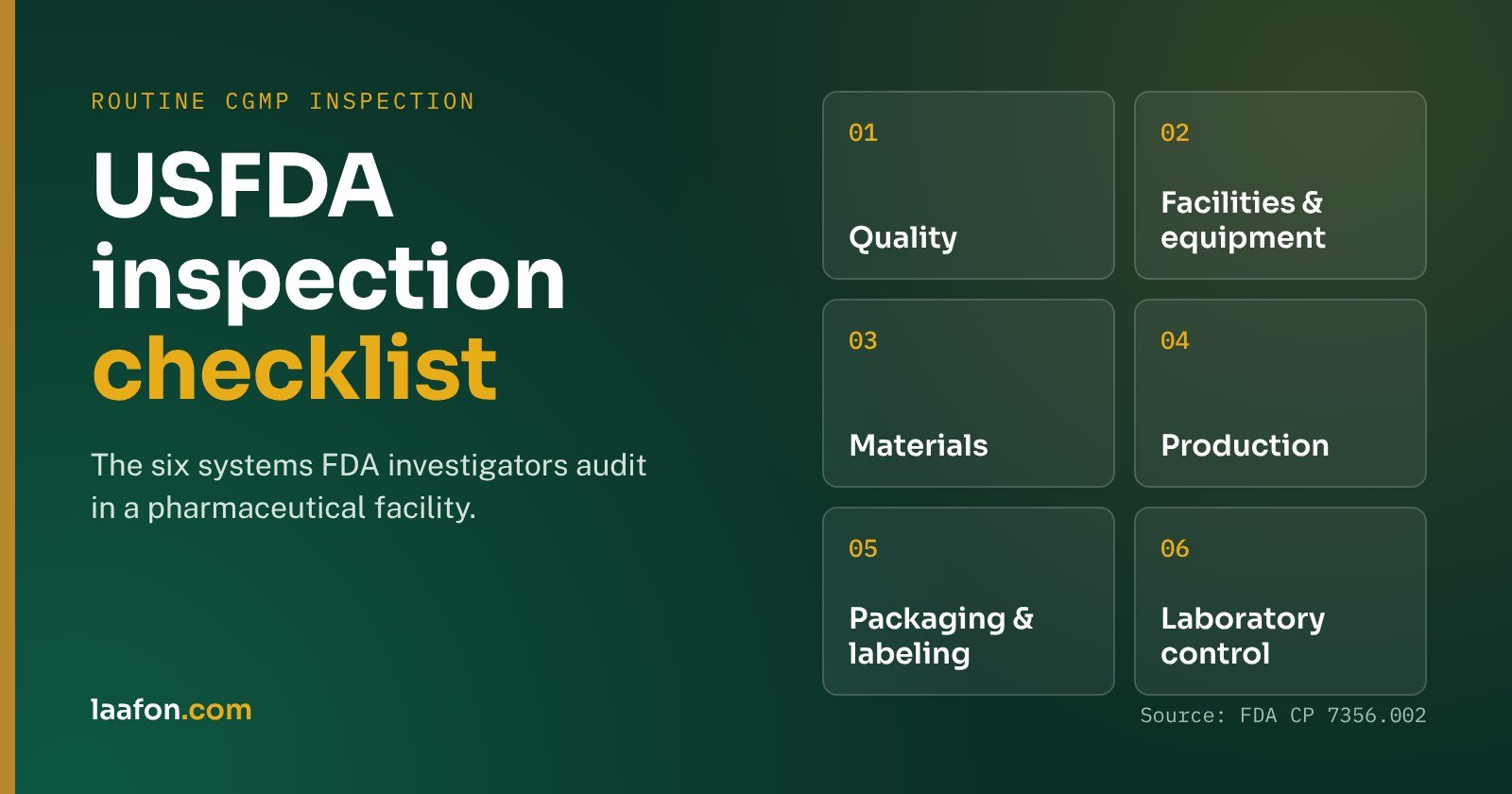

A USFDA inspection checklist for a pharmaceutical facility should follow the six systems FDA investigators audit under CGMP: quality, facilities and equipment, materials, production, packaging and labeling, and laboratory control. A drug manufacturing inspection normally covers at least two of them and always includes the quality system; a full inspection normally covers at least four.[1] Routine inspections are no longer on a two-year cycle: FDA replaced that rule with a risk-based schedule in 2012.[2]
Correction, 30 October 2026. Earlier versions of this page said FDA inspects every facility at least once every two years. That requirement ended in 2012.[2] The inspection types, record lists and sources below were rebuilt from FDA’s current compliance program for drug manufacturing inspections.[1]
Types of FDA inspection, and where each is covered
This page is the checklist for a routine (surveillance) inspection of an operating site. The other inspection types have their own guides.
| Inspection type | When it happens | Where to read more |
|---|---|---|
| Pre-approval | Before FDA approves a drug application, to check the site can make the product as filed. | USFDA pre-approval inspection (PAI) checklist |
| Surveillance (routine) | A periodic CGMP inspection of a site FDA has selected through its risk-based site selection model.[1] | This page. How FDA picks sites: ICH Q9 and risk-based USFDA inspections |
| Follow-up compliance | After a regulatory action, to verify that corrective actions were carried out.[1] | USFDA Form 483 response strategy |
| For-cause | In response to specific events or information, such as complaints or recalls.[1] | Use the checklist below; complaint and recall records sit in the quality system. |
Scroll sideways to see the full table on a phone.
How often does FDA inspect a drug facility?
Until 2012, FDA was required to inspect domestic drug establishments every two years, with no comparable requirement for foreign sites. FDASIA replaced that with a risk-based approach for both.[1][2] FDA’s compliance program says selection for routine surveillance is now driven by a risk-based site selection model, and FDA lists a firm’s compliance history and the inherent risk of the drug it makes among the criteria.[1][2] Treat inspection readiness as a permanent state, not a countdown from your last visit.
- Unannounced inspections are expanding. On 6 May 2025 FDA announced it would expand unannounced inspections at foreign manufacturing facilities, building on its pilot in India and China.[3]
- Remote assessments are not inspections. FDA’s program says remote regulatory assessments, including section 704(a)(4) records requests, are not the same as an inspection and do not satisfy the section 510(h) inspection requirement.[1]
USFDA inspection checklist: the six systems FDA inspects
FDA’s compliance program lists what investigators cover in each system.[1] FDA publishes the manual its investigators work from as the Investigations Operations Manual; the current edition is the 2026 version.[4] Use the lists below as a readiness self-check: for every line, know which record proves it and who can produce it on the day.
A full inspection normally covers at least four systems, including quality. An abbreviated inspection normally covers at least two, including quality, and can be widened to a full inspection if objectionable findings arise.[1]
Quality system
- Management oversight, including quality risk management and knowledge management
- Oversight of contracted operations and suppliers, with quality agreements
- Deviation, discrepancy and failure investigations, with CAPA and effectiveness checks
- Change management, including changes to products in approved applications
- Quality and medical complaint reviews
- Annual product reviews with statistical analysis
- Handling of rejects, quarantine, stability failures, rework and returns
- Training and approval of validations
- Risk assessment for hazardous impurities such as nitrosamines
Facilities and equipment system
- Cleaning, maintenance, sanitation and pest control records
- Layout and air handling that prevent cross-contamination
- Utilities and building change control
- Equipment installation and operational qualification
- Calibration and maintenance, including computerised equipment
- Cleaning procedures and cleaning validation
- Equipment identification and investigation of discrepancies
Materials system
- Quarantine until release, with representative sampling
- Identity testing of every component lot
- Container and closure identification and supplier test result verification
- Storage conditions, inventory and first-in-first-out use
- Rejected material quarantined and its source verified
- Water and process gas systems
- Computerised system validation and security
- Lot-level distribution records
Production system
- Complete master and batch records, with yield calculations
- In-process controls and tests, with justified specifications
- Line set-up, line clearance and cleaning logs
- Process validation, statistical evaluation and the need for revalidation
- Time limits and prevention of objectionable microorganisms
- Investigation of discrepancies
- Change control and training
Packaging and labeling system
- Label storage, issuance, examination and reconciliation
- Control of look-alike labels
- Line clearance and physical separation of packaging lines
- Lot number and expiry date control, and printing device monitoring
- Packaging records with label specimens
- Tamper-resistant packaging, where applicable, and its validation
Laboratory control system
- Adherence to methods, and method validation or verification
- Reference standards and chromatographic system suitability
- Testing of the correct samples, with complete raw data retained
- Out-of-specification procedures and investigations
- Reserve samples
- Stability program using stability-indicating methods
- Instrument calibration, maintenance and computerised system validation
- Staffing and training
What happens at the close of the inspection and after it
- Close-out discussion. FDA discusses its findings with management at the close of the inspection.[1]
- Form FDA 483. Where observations are issued, FDA’s program says the form should be specific and contain only significant items, grouped by system and listed in order of importance.[1]
- Your written response. FDA will generally allow 15 business days to respond to Form 483 observations.[5] The Form 483 response guide covers how to structure it.
- Final classification. FDA evaluates the inspection findings, and any information you provide afterwards, before assigning the classification.[6]
Indian manufacturers: the Revised Schedule M inspection
Indian plants are inspected against Revised Schedule M by state regulators, whether or not they export. The revised schedule was published on 28 December 2023, and MSME implementation was extended to 31 December 2025 for units that applied. On 7 November 2025 the DCGI asked state and UT drug controllers to inspect manufacturing units for compliance and to send monthly reports.[7] The six-system records above are a sensible base for either inspection. Status as of 30 October 2026; confirm the current position before relying on it.
Preparing for a state or FDA inspection? See where your plant stands on each Revised Schedule M requirement.
Related on Laafon
- ICH Q9(R1) and risk-based USFDA inspections: how FDA chooses which drug sites to inspect.
- USFDA approval roadmap for Indian formulation plants: the steps from gap analysis to approval.
- WHO-GMP vs USFDA compliance: key differences and a 40-point checklist.
- USFDA PAI checklist: readiness for the pre-approval inspection.
This page is technical and educational. It is not legal, regulatory or medical advice. FDA compliance programs and Indian statutory instruments change often; check the current text before acting. Reviewed by Darshan Singh, a pharmaceutical QA, QC and regulatory professional with more than 23 years of experience.
References
- US Food and Drug Administration. Compliance Program 7356.002: Drug Manufacturing Inspections. Issued 16 Sep 2022; implemented 17 Oct 2022. Silver Spring (MD): FDA; 2022. Available from: https://www.fda.gov/media/75167/download. Accessed 30 Oct 2026.
- US Food and Drug Administration. FDASIA Title VII overview (Section 705, risk-based inspection schedule). Silver Spring (MD): FDA. Available from: https://www.fda.gov/regulatory-information/food-and-drug-administration-safety-and-innovation-act-fdasia/fdasia-title-vii-overview. Accessed 30 Oct 2026.
- US Food and Drug Administration. FDA announces expanded use of unannounced inspections at foreign manufacturing facilities [press announcement]. 6 May 2025. Available from: https://www.fda.gov/news-events/press-announcements/fda-announces-expanded-use-unannounced-inspections-foreign-manufacturing-facilities. Accessed 30 Oct 2026.
- US Food and Drug Administration. Investigations Operations Manual (2026 version). Silver Spring (MD): FDA; 2026. Available from: https://www.fda.gov/inspections-compliance-enforcement-and-criminal-investigations/inspection-references/investigations-operations-manual. Accessed 30 Oct 2026.
- US Food and Drug Administration. Review of post-inspection responses. Fed Regist. 2009 Aug 11;74(153):40211-2. Docket FDA-2009-N-0335. Available from: https://www.govinfo.gov/content/pkg/FR-2009-08-11/html/E9-19107.htm. Accessed 30 Oct 2026.
- US Food and Drug Administration. Inspection classifications. Silver Spring (MD): FDA. Available from: https://www.fda.gov/inspections-compliance-enforcement-and-criminal-investigations/inspection-basics/inspection-classifications. Accessed 30 Oct 2026.
- Press Trust of India. DCGI orders inspections of pharma units to ensure compliance with revised Schedule M norms. The Week. 2025 Nov 10. Available from: https://www.theweek.in/wire-updates/national/2025/11/10/des91-health-dcgi-inspection.html. Accessed 30 Oct 2026.