
Short answer
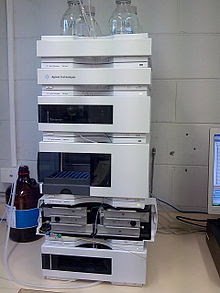
HPLC separates the components of a mixture by pumping the sample, dissolved in a liquid mobile phase, through a column packed with a solid stationary phase under high pressure. Each component partitions between the two phases to a different extent, so components that interact more strongly with the stationary phase move more slowly and leave the column later. The detector records each component as a peak at a characteristic retention time, and the peak area is proportional to the amount present.
In a pharmaceutical quality control laboratory that principle is only half the requirement. A chromatogram is evidence only if the system passed system suitability immediately before the samples were injected, on an instrument that has been qualified. This page covers the separation principle and instrumentation, then the acceptance limits that decide whether a run is valid.
How the separation actually works
Two phases compete for every molecule in the injected sample. The mobile phase is the liquid solvent or solvent mixture the pump drives through the system. The stationary phase is the packing material bonded to porous particles inside the column. A molecule spends part of its time dissolved in the moving liquid and part of it adsorbed on or partitioned into the stationary phase, and only the time it spends in the mobile phase moves it along the column.
The consequence is that separation is a matter of relative affinity, not of size or speed alone. In the reverse phase mode used for the majority of pharmaceutical assays, the stationary phase is non-polar (typically C18 alkyl chains) and the mobile phase is polar (water or buffer mixed with acetonitrile or methanol). Polar analytes have little affinity for the packing, so they elute early; non-polar analytes are retained and elute late. Changing the proportion of organic solvent changes the retention of everything on the column, which is why mobile phase composition is a controlled parameter rather than an operator preference. The full range of packing chemistries is covered separately in the guide to types of column in HPLC.
Two elution modes exist. In an isocratic run the mobile phase composition is held constant throughout, which is simple, reproducible and well suited to a small number of analytes with similar polarity. In a gradient run the composition is changed on a programmed profile during the run, usually increasing the organic proportion, so that strongly retained components are eluted in reasonable time without broadening into unusable peaks. Gradient methods separate more components but are harder to transfer between instruments, because the gradient the column actually experiences depends on the system dwell volume.
Instrumentation: the flow path, component by component
Select any component in the diagram to see its function, the specification that matters in a qualified laboratory, and the failure it most often causes in a chromatogram.
Figure 1. Flow path of a modern quaternary or binary HPLC system. Swipe the diagram sideways on a phone.
Select a component
- Function
- Tap a labelled part of the diagram, or one of the buttons above, to see what it does.
- What is controlled
- Typical controlled parameter and where its limit comes from.
- Typical failure it causes
- The chromatographic symptom an analyst sees when this component degrades.
Component specifications at a glance
| Component | Function in the separation | Controlled parameter | Common failure signature |
|---|---|---|---|
| Mobile phase reservoirs | Hold the solvents that carry the sample through the system | Composition, pH of the aqueous buffer, filtration | Retention shift, baseline rise, buffer precipitation |
| Degasser | Removes dissolved gas before it reaches the pump head | Vacuum integrity | Erratic baseline, pressure ripple, detector spikes |
| Pump | Delivers the mobile phase at constant, pulse-free flow against column back pressure | Flow rate accuracy and precision | Retention time drift, pulsating baseline, area imprecision |
| Injector / autosampler | Introduces a reproducible sample volume into the pressurised flow | Injection volume precision, carryover | High replicate area RSD, ghost peaks in the blank |
| Column | Provides the stationary phase where separation occurs | Chemistry, particle size, dimensions, temperature | Loss of resolution, peak tailing, rising back pressure |
| Detector | Converts eluting analyte concentration into a measurable signal | Wavelength accuracy, noise, linearity | Reduced sensitivity, non-linear response, drifting baseline |
| Data system | Acquires, integrates and stores the chromatogram with its audit trail | Integration parameters, access control, audit trail | Inconsistent integration, unexplained reprocessing, data integrity findings |
Swipe the table sideways on a phone. Failure signatures are the typical presentation, not an exhaustive troubleshooting list.
System suitability: the limits that decide whether a run is valid
System suitability testing checks that the whole analytical system, meaning the instrument, the column, the mobile phase, the reagents and the analyst together, is performing adequately at the moment of use. It is not the same activity as instrument qualification, and it does not replace method validation. WHO guidance is explicit that a system suitability test should form part of the sample set and should meet its predefined acceptance criteria before samples are injected and throughout the analysis.[4]
The peak symmetry requirement changed, and many SOPs have not caught up
A large proportion of quality control SOPs still specify a tailing factor of not more than 2.0. That figure originates in the CDER reviewer guidance Validation of Chromatographic Methods of November 1994, where it is a recommendation for method development and review.[3]
The Pharmacopoeial Discussion Group harmonised the chromatography chapters, and the harmonised text introduced a general requirement for peak symmetry of 0.8 to 1.8. This became official in USP General Chapter 621 with USP-NF 2022 Issue 3 on 1 December 2022,[1] and in Ph. Eur. general chapter 2.2.46, published in Ph. Eur. 11th Edition with an implementation date of 1 January 2023, where the default symmetry factor range was widened from 0.8 to 1.5 up to 0.8 to 1.8 and applies to both tests and assays.[2]
Why the difference matters in practice. A one sided limit of not more than 2.0 accepts any peak that is not tailing, including a badly fronting peak with a symmetry factor of 0.5. A two sided requirement of 0.8 to 1.8 fails that peak. Fronting is a real and diagnostic defect, usually column overload, a partially blocked frit or a sample solvent much stronger than the mobile phase, and a one sided limit hides it. If your SOP still carries only the older limit, that is worth raising at the next periodic review.
Parameters, formulas and where each limit comes from
| Parameter | Formula | Requirement | Basis |
|---|---|---|---|
| Peak symmetry, As | As = W0.05 / (2d) | 0.8 to 1.8 | compendial general requirement, USP 621 and Ph. Eur. 2.2.46 [1][2] |
| Tailing factor, T (legacy form) | T = W0.05 / (2f) | not more than 2.0 | guidance CDER 1994 recommendation [3] |
| Resolution, Rs | Rs = 1.18 (tR2 − tR1) / (Wh1 + Wh2) | greater than 2.0 | guidance CDER 1994, between the peak of interest and the closest potential interferent [3]. Formula per USP 621 [1] |
| Column efficiency, N | N = 5.54 (tR / Wh)2 | per monograph | compendial formula, USP 621 [1]. The numeric limit is set by the individual monograph |
| Retention factor, k | k = (tR − tM) / tM | greater than 2 | guidance CDER 1994, so the peak is well resolved from the void volume [3] |
| Repeatability, replicate injections | RSD of peak response | 1.0 percent or less, n at least 5 | guidance CDER 1994 [3]. USP 621 sets repeatability by a table keyed to the number of replicate injections and the target value [1] |
| Signal to noise ratio | measured over the baseline | per monograph | compendial harmonised text measures noise over a baseline of 20 times the peak width at half height, with 5 times permitted where 20 is not obtainable [2] |
Swipe the table sideways on a phone. The governing limit is always the one in the individual monograph or the validated method. The general chapter applies where the monograph is silent, and a guidance recommendation is not a compendial requirement at all. Verify every value against the pharmacopoeial edition in force at your site before writing it into an SOP.
Permitted adjustments to a monograph method
Analysts frequently assume that any change to a compendial method makes it a validated in-house method. The harmonised chapter permits defined adjustments, within which the method remains the compendial method, provided system suitability is still met and the adjustment is justified and documented.[1] For isocratic liquid chromatography the ranges are:
| Parameter | Permitted adjustment, isocratic | Gradient |
|---|---|---|
| Mobile phase, minor component | plus or minus 30 percent relative, or plus or minus 2 percent absolute, whichever is larger | as isocratic |
| pH of aqueous buffer | plus or minus 0.2 units | plus or minus 0.2 units |
| Buffer salt concentration | plus or minus 10 percent | plus or minus 10 percent |
| Flow rate | plus or minus 50 percent, column dimensions unchanged | adjusted for change in particle size and column diameter |
| Column temperature | plus or minus 10 degrees Celsius | plus or minus 5 degrees Celsius |
| Column length to particle size ratio | minus 25 percent to plus 50 percent | gradient time scaled to column volume |
| Retention time shift | judged by system suitability | within plus or minus 15 percent of original retention |
Gradient methods are deliberately less tolerant than isocratic ones because the gradient the column experiences depends on system dwell volume. Confirm every figure against the edition in force before relying on it.
Qualification is a separate activity from system suitability
An HPLC system is classified as a Group C instrument under USP General Chapter 1058 on analytical instrument qualification: a complex instrument with significant computerisation, for which all elements of qualification including software validation must be considered.[5] That means design qualification, installation qualification, operational qualification and performance qualification. WHO good chromatography practices set out the same lifecycle, beginning with user requirement specifications and running through factory and site acceptance testing to IQ, OQ and PQ.[4]
The distinction an auditor will probe is straightforward. Qualification asks whether the instrument works. System suitability asks whether the analytical procedure is working on that instrument today. Method validation asks whether the procedure is fit for its purpose at all. Passing system suitability on an unqualified instrument does not make the data reliable, and a qualified instrument does not excuse a missing system suitability injection sequence.
SOP: operation and system suitability verification of an HPLC system
The block below is a working template. It is written to be adapted, not copied. Complete every dashed fill-in field with your own document control data, and reconcile every acceptance criterion against the monograph and pharmacopoeial edition applicable at your site.
1. Purpose
To define the procedure for operating a high performance liquid chromatography system and for verifying system suitability before analytical samples are injected.
2. Scope
This procedure applies to all HPLC systems used for the analysis of raw materials, in-process samples, finished products and stability samples in the Quality Control laboratory. It does not cover instrument qualification (DQ, IQ, OQ, PQ), analytical method validation or transfer, preventive maintenance beyond the daily checks listed in section 5, or the operation of LC-MS systems.
3. Responsibility
- Analyst, Quality Control: executing the procedure, recording results contemporaneously, and reporting any system suitability failure before proceeding.
- Officer, Quality Control: verifying entries, reviewing chromatograms and the audit trail, and initiating investigation of a failure.
- Head, Quality Assurance: approval of this SOP, periodic review, and approval of any deviation.
4. Materials, equipment and reagents
- Qualified HPLC system with pump, degasser, autosampler, column oven and UV-Vis or PDA detector, with a chromatography data system having an enabled audit trail.
- Analytical column of the chemistry and dimensions specified in the test method.
- HPLC grade solvents; water of the grade specified in the method.
- Buffer salts of analytical reagent grade or better, as specified in the method.
- Membrane filters, 0.45 micrometre or 0.22 micrometre as specified, compatible with the mobile phase.
- Reference standard of known potency with a valid certificate of analysis.
- Calibrated pH meter, analytical balance and volumetric glassware of the required class.
5. Procedure
6. Acceptance criteria
| Parameter | Limit | Basis |
|---|---|---|
| Peak symmetry of the analyte peak | 0.8 to 1.8 | compendial general requirement, USP 621 / Ph. Eur. 2.2.46 [1][2] |
| Resolution from the closest interferent | per monograph; greater than 2.0 where unspecified | guidance CDER 1994 [3] |
| RSD of replicate standard injections | per monograph; 1.0 percent or less, n at least 5, where unspecified | guidance CDER 1994 [3] |
| Theoretical plates | per monograph | compendial formula per USP 621 [1] |
| Blank interference at analyte retention time | none detected | site policy define the reporting threshold in the method |
| Back pressure variation from historical value | SET LOCALLY | site policy not a compendial requirement |
Limits marked site policy are internal convention and must be justified locally. Limits marked guidance are regulatory recommendations, not compendial requirements. Where the monograph specifies a value, the monograph governs.
7. Frequency
- System suitability: before samples are injected in every analytical run, and throughout the analysis as the method directs. This is the WHO good chromatography practices expectation.[4]
- Daily checks: each day of use, per section 5 and the preventive maintenance schedule.
- Calibration and performance verification interval: site policy commonly six or twelve months. No pharmacopoeial text sets a universal calibration interval for an HPLC system. The interval must be justified from instrument criticality, usage, manufacturer recommendation and historical performance, and documented in the site validation master plan.
8. Precautions and safety
- Organic solvents used as mobile phase are flammable and, in the case of acetonitrile and methanol, toxic. Handle in adequate ventilation and use the specified personal protective equipment.
- Never allow a buffer to dry inside the pump, injector or column. Flush with water before the storage solvent.
- Do not exceed the maximum pressure rating of the column or the system.
- Depressurise before disconnecting any fitting.
- Audit precautions: the audit trail must remain enabled and must not be disabled by any user; unrecorded trial or test injections are a data integrity finding; peaks must not be reintegrated without a documented, approved justification; each analyst must use their own unique user account; and records must satisfy ALCOA plus principles, which WHO good chromatography practices states explicitly for chromatographic data.[4]
9. Deviation handling
- Stop the sequence. Do not inject samples on a system that has failed system suitability.
- Record the failing parameter and its observed value in Annexure I and raise the event under the site deviation or laboratory incident procedure.
- Establish the assignable cause before any repeat. Typical causes by parameter: high RSD points to the injector, a leak or an air bubble; symmetry outside range points to column overload, column degradation, a blocked frit or a sample solvent stronger than the mobile phase; low resolution points to column ageing or mobile phase composition; retention drift points to flow rate, temperature or composition.
- Correct the cause, record the correction, and repeat the full system suitability sequence. A repeat without an identified assignable cause is testing into compliance and will be treated as such by an inspector.
- Where a batch result is affected, extend the investigation under the out of specification procedure and assess impact on previously released batches analysed on the same system.
10. Annexure I: System suitability record
| Date | Product / method | Column ID | Parameter | Limit | Observed | Pass / Fail | Done by | Checked by |
|---|---|---|---|---|---|---|---|---|
| Peak symmetry | 0.8 to 1.8 | |||||||
| Resolution | per monograph | |||||||
| RSD, n at least 5 | per monograph | |||||||
| Theoretical plates | per monograph |
Copies as tab separated text, ready to paste into a spreadsheet.
Further annexures to raise locally
- Annexure II: HPLC instrument usage logbook format.
- Annexure III: Mobile phase preparation record.
- Annexure IV: Column usage and history record.
- Annexure V: System suitability failure investigation checklist.
11. Revision history
| Version | Effective date | Change | Reason |
|---|---|---|---|
| 00 | DD-MMM-YYYY | New document | Initial issue |
| 01 | DD-MMM-YYYY | Peak symmetry acceptance criterion revised to a two sided range | Alignment with the harmonised chromatography general chapter |
Preventive maintenance schedule
Most system suitability failures are the visible end of a maintenance omission. The schedule below groups the tasks by the interval at which they are commonly performed. Every interval here is site policy or a manufacturer recommendation, not a pharmacopoeial requirement, and must be set from the instrument manual and your own performance history.
| Interval | Task | Why it matters |
|---|---|---|
| Each day of use | Check solvent levels and waste headroom; inspect all fittings for leaks; record equilibrated back pressure; purge lines | A leak invalidates flow accuracy and shows up as retention drift and area imprecision |
| Weekly | Wash the buffer from the whole flow path; inspect the pump head and drain for salt deposits; clean the needle and needle seat exterior | Crystallised buffer scores plungers and seals and is the leading avoidable pump repair |
| Monthly | Replace or clean the inlet solvent filters; check the in-line filter or guard column; verify column oven temperature against an independent reference | A blocked frit raises back pressure and distorts peak shape, often presenting as fronting or splitting |
| Every six months | Replace pump piston seals; inspect and clean check valves; replace the autosampler rotor seal and injection needle as indicated by carryover or precision trends | Seal wear is progressive and is first visible as rising replicate RSD before it becomes a leak |
| Annually or per manufacturer | Detector lamp replacement based on logged lamp hours and measured noise; full performance verification of flow accuracy, injection precision, wavelength accuracy and detector linearity | Lamp ageing reduces sensitivity gradually and can pass a symmetry check while failing a limit of quantitation requirement |
Record every intervention in the instrument logbook. An unrecorded repair between two passing system suitability runs is a finding in its own right.
Frequently asked questions
A liquid mobile phase carries the sample under high pressure through a column packed with a stationary phase, and components separate because each one partitions differently between the two phases, eluting at its own characteristic retention time.
Both figures exist, and they come from different kinds of document. Not more than 2.0 is a recommendation in the CDER reviewer guidance of 1994. The harmonised chromatography general chapter introduced a general requirement for peak symmetry of 0.8 to 1.8, official in USP 621 from 1 December 2022 and implemented in Ph. Eur. 2.2.46 from 1 January 2023. Where an individual monograph states a limit, that limit governs over both.
No pharmacopoeial text prescribes a universal interval. Six or twelve months are the intervals most commonly adopted in Indian quality control laboratories, but the interval is a site decision that must be justified from criticality, usage, the manufacturer recommendation and historical performance, and documented. Anyone quoting a compendial calibration frequency for HPLC should be asked for the chapter reference.
The separation principle is identical. UHPLC uses columns packed with smaller particles, which increases efficiency and shortens run time but generates much higher back pressure, so the instrument is built for a higher pressure rating and a smaller dwell volume. Transferring a method between the two is a change that must be assessed against the permitted adjustment ranges, and a gradient method in particular will not transfer unchanged because the dwell volume differs.
No. They are separate activities. Qualification, covered by USP general chapter 1058, establishes that the instrument itself works and for a Group C instrument such as an HPLC includes DQ, IQ, OQ and PQ with software validation. System suitability establishes that the analytical procedure is performing on that instrument at the time of use. Neither substitutes for the other, and neither substitutes for method validation.
Tailing usually indicates secondary interactions with residual silanols, a partially blocked frit, or column degradation. Fronting usually indicates column overload or a sample solvent stronger than the mobile phase. Fronting matters because a one sided limit of not more than 2.0 accepts it, so a laboratory using only the legacy criterion can pass a visibly distorted peak. A two sided requirement of 0.8 to 1.8 catches it.
Equipping or expanding a quality control laboratory
Instrument selection, qualification scope and the QC laboratory layout are decided at plant design stage, and getting the instrument list wrong is expensive to correct once the room is built. Our pharma plant setup cost calculator models the capital requirement including QC laboratory equipping, and the plant setup consultancy service covers instrument specification, qualification documentation and QC layout against Schedule M requirements.
Related on Laafon
- Types of column in HPLC Reference guide to reverse phase, normal phase, ion exchange, size exclusion and chiral chemistries, with a selection and troubleshooting table.
- SOP for preventive maintenance of HPLC The full maintenance and calibration procedure with recording formats, in more detail than the summary schedule above.
- Top 5 HPLC models in India Model comparison with indicative pricing, for a laboratory at the purchasing stage.
- Pharmaceutical method validation Where system suitability sits inside the wider validation exercise, and what each validation parameter demonstrates.
- All quality control SOPs The full SOP library covering instruments, utilities, microbiology and documentation.
References
- United States Pharmacopeial Convention. General Chapter 621 Chromatography, PDG Stage 4 harmonised text; official with USP-NF 2022 Issue 3, 1 December 2022. Rockville, MD: USP; 2022. Available from: https://www.usp.org/harmonization-standards/pdg/excipients/chromatography. Accessed September 2026.
- European Directorate for the Quality of Medicines and HealthCare. General chapter 2.2.46. Chromatographic separation techniques now published in Ph. Eur. 11th Edition; implementation 1 January 2023. Strasbourg: EDQM; 2022. Available from: https://www.edqm.eu/en/-/general-chapter-2.2.46.-chromatographic-separation-techniques-now-published-in-ph.-eur.-11th-edition. Accessed September 2026.
- Center for Drug Evaluation and Research. Reviewer Guidance: Validation of Chromatographic Methods. Rockville, MD: US Food and Drug Administration; November 1994. Available from: https://www.fda.gov/media/75643/download. Accessed September 2026.
- World Health Organization. Good chromatography practices. WHO Expert Committee on Specifications for Pharmaceutical Preparations, fifty-fourth report. WHO Technical Report Series No. 1025, Annex 4. Geneva: WHO; 2020. Available from: https://www.who.int/docs/default-source/medicines/norms-and-standards/guidelines/trs1025/trs1025-annex4.pdf. Accessed September 2026.
- United States Pharmacopeial Convention. General Chapter 1058 Analytical Instrument Qualification. Rockville, MD: USP. Available from: https://www.usp.org/. Accessed September 2026.
The standard operating procedure above is a template for adaptation. It requires local qualification, validation and Quality Assurance approval before use, and every acceptance criterion must be verified against the pharmacopoeial edition in force at your site. Pharmacopoeial texts and Indian statutory instruments change between editions, and a limit correct in one edition may not be correct in the next. Where an individual monograph specifies a value, the monograph governs over any general chapter or guidance figure quoted here. This page is technical and educational content only, and is not medical, legal or investment advice.