
Published 12 February 2023 · Fully revised 20 September 2026 · Darshan Singh, 23 years in pharmaceutical QA, QC and drug regulatory affairs
Short answer
Kala Amb, in Sirmaur district of Himachal Pradesh, is one of 118 pharmaceutical clusters formally recognised by the Department of Pharmaceuticals — one of seven in Himachal, alongside Baddi-Barotiwala-Nalagarh, Paonta Sahib, Parwanoo, Sansarpur, Solan and Una.[1] This page lists 49 units commonly named in Kala Amb and, more usefully in 2026, shows you how to check any one of them yourself.
The reason that second half now matters more than the list: the transition window for India’s revised Schedule M closed on 31 December 2025, and Himachal’s enforcement drive since has been severe. Of the state’s 655 drug manufacturing units, only 116 applied for the upgrade route, and in the first post-deadline inspection round just 10 of about 90 units inspected were found fully compliant.[5][6] A 2023-vintage company list tells you nothing about which of those 49 units can still legally manufacture today.
What changed for every Kala Amb unit between 2024 and 2026
If you last looked at this cluster before 2024, three things have moved underneath it. All three affect whether a company on the list below is a safe manufacturing partner.
1. Revised Schedule M is now the operative GMP standard
The Ministry of Health and Family Welfare substituted the whole of Schedule M to the Drugs Rules, 1945 by notification G.S.R. 922(E) dated 28 December 2023, retitling it Good Manufacturing Practices and Requirements of Premises, Plant and Equipment for Pharmaceutical Products.[3] Manufacturers above ₹250 crore turnover had to comply first. Smaller units were given a route out: under G.S.R. 127(E) dated 11 February 2025 (the Drugs Amendment Rules, 2025), a manufacturer with turnover below ₹250 crore could apply to the Central Licence Approving Authority within three months, submitting an upgradation plan, and — if granted — have its deadline extended to 31 December 2025.[4]
Note the two qualifiers that the industry commentary usually drops: the extension had to be applied for, and it had to be granted. It was never automatic. Most Kala Amb units are squarely inside the under-₹250-crore band, so for practical purposes every unit on the list below falls into one of three states: it applied and upgraded; it applied and has not finished; or it never applied at all.
2. Himachal’s enforcement drive has already closed units
The numbers, from the two most recent reported inspection rounds. In January 2026, after the deadline expired, state drug regulators reported that 10 of roughly 90 units inspected were fully compliant, with notices issued to around 80, and about 370 MSME units under scrutiny.[5] By April 2026, inspectors had been assigned 360 units and completed 270; around 70 were found not operational, including units that had surrendered their manufacturing licences, and roughly 10 to 12 firms had surrendered licences over the preceding months. In one recent monthly alert, 37% of drug samples from Himachal-based manufacturers failed quality parameters.[6]
Both reports are statewide. Neither breaks the figures down by cluster, so none of them can be attributed specifically to Kala Amb — the named cluster in the April report is Baddi-Barotiwala-Nalagarh. Treat these as the regulatory weather across Himachal, not as a count of Kala Amb closures.
3. Almost every ISO claim in circulation is now out of date
ISO published ISO 9001:2026, the sixth edition, on 16 September 2026, and withdrew ISO 9001:2015 on the same date.[7][8] ISO 9001:2008 was withdrawn in 2015 and ISO 9001:2000 in 2010.[8] That means a directory entry reading ISO 9001:2008 now cites a standard that has been dead for eleven years and is two editions behind. ISO’s own guidance is that certified organisations transition within the timeframe set by their certification cycle and should ask their certification body — so a current certificate against the 2015 edition is not automatically invalid, but a certificate against 2008 or 2000 certainly tells you nothing about the company today.[7]
Directory: 49 pharmaceutical companies in Kala Amb
Search by company name, road or product type. Filter by what the unit says it does.
Read this before you use the table. Every entry below — establishment year, business model and certification — is as listed by the company or by public business directories. Laafon Galaxy has not audited these units and does not certify them. Nothing here is independently verified, no ranking is implied, and inclusion is not a recommendation. Entries marked ⚠ carry a claim that does not stand up on its face; the reason is given in the cell. Use the verification steps below the table before you contract with anyone on it.
49 of 49 units shown
| Company | Location in Kala Amb | Listed since | What the unit lists itself as doing | Certifications as listed |
|---|---|---|---|---|
| Digital Vision | 176 Mauza Ogli, Nahan Road | 2009 | PCD franchise, manufacturing, export | ISO 9001:2000 ⚠, GMP |
| Symbiosis Pharmaceutical | Suketi Road | 2006 | Manufacturing, PCD franchise | GMP, ISO |
| Orison Pharma International | Khari, Sadhoura Road | 2008 | Tablets, capsules, ointments, Ayurvedic | GMP, ISO |
| Shivam Enterprises | Suketi Road | 2007 | Manufacturing, export, supply — eye and ear drops, injections | GMP, ISO |
| Biological Inc. | Suketi Road | 2006 | Allopathic medicine manufacturing, dealer | ISO 9001:2008 ⚠ |
| August Remedies | Nahan Road | 2006 | Pharmaceutical dealer | Listed as closed ⚠ |
| Sojin Flora | Mogi Nand, Nahan Road | 2007 | Manufacturing, retail — anti-diabetic | EU GMP ⚠, WHO-GMP |
| Accura Care | Mogi Nand, Nahan Road | 2007 | Third-party manufacturing — tablets, capsules, nutraceuticals | ISO 9001:2001 ⚠, GMP |
| Integrated Lab | Mogi Nand | 2007 | Manufacturing, export, retail — injections, tablets | WHO |
| Athens Life Sciences | Vill Johron | 2007 | Third-party manufacturing, PCD franchise | WHO-GMP, ISO |
| Alps Communication P Ltd | Nahan Road, near Pidilite | 2011 | Third-party manufacturing — tablets, suspensions | WHO, GMP |
| Nibvir Pharma | Mauza Ogli, Nahan Road | 2012 | Distribution, manufacturing — supplements | ISO, GMP, HACCP |
| Westin Pharmaceuticals | Nahan Road | 2011 | Third-party manufacturing, PCD franchise | DCGI ⚠, ISO, WHO |
| Helpzyn Pharmaceuticals | Nahan Road, near the police post | 2006 | Manufacturing — capsules | GMP, ISO |
| Ronald Pharmaceuticals | Nahan Road | 2006 | Manufacturing, distribution | WHO-GMP, ISO 9001:2015 ⚠ |
| Saitech Pharmaceuticals | Trilokpur Road | 2009 | Contract manufacturing, export — injectables | WHO-GMP, ISO 9001:2008 ⚠ |
| Kirsvy Pharmaceuticals | Suketi Road | 2018 | Manufacturing | GMP, ISO |
| M.B.C. Pharmaceuticals | Vill Johron | 2012 | Solid and non-sterile dosage forms | WHO-GMP, ISO |
| Vellinton Healthcare | Trilokpur Road | 2016 | Manufacturing, export — injectables, eye drops | WHO-GMP, ISO, GLP |
| Vidhyasha Pharmaceuticals | Nahan Road | 2010 | Contract manufacturing — softgels, tablets, capsules | WHO-GMP |
| GMT Pharma International | Vill Johron, Trilokpur Road | 2012 | Third-party manufacturing — injections, eye drops | WHO, GMP, ISO |
| Iskon Remedies | Nahan Road | 2006 | Third-party manufacturing — injections, eye and nasal drops | WHO, GMP, GLP, ISO |
| Primus Pharmaceuticals | Sadhaura Road | 2012 | PCD franchise, manufacturing, Ayurvedic range | GMP, ISO |
| Grampus Laboratories | Vill Johron, Trilokpur Road | 2007 | Human and veterinary manufacturing, dealer | ISO 9001:2008 ⚠, WHO-GMP |
| Sidhi Vinayak Industries | Vill Johron, Trilokpur Road | 2014 | Manufacturing, supply — syrups, tablets | GMP, ISO |
| Shedwell Pharma P Ltd | Industrial Area | 2015 | Manufacturing — tablets, capsules, ointments | WHO-GMP, GLP, ISO |
| MMG Healthcare | Vill Johron, Trilokpur Road | 2007 | Third-party manufacturing — injections, eye and ear drops | GMP |
| Sarv Biolabs | Trilokpur Road | 2012 | Manufacturing — APIs, phytochemicals | WHO-GMP, ISO |
| Pushkar Pharma | Khari-Toka Sahib Road | 2008 | Injections, eye drops; third-party manufacturing | GMP, GLP, ISO 9001:2008 ⚠ |
| Samay Pharma India P Ltd | 34-35, Industrial Area | 2015 | Third-party manufacturing — tablets, capsules, syrups | GMP, GLP |
| Candour Pharmaceuticals | Suketi Road | 2019 | PCD franchise, third-party manufacturing | GMP, ISO |
| SBS Biotech | Vill Rampur Jatan | 2007 | Biotechnology, drug development | GMP, ISO |
| Oscar Remedies | Vill Johron | 2006 | Manufacturing, dealer | WHO-GMP, GLP |
| JMM Formulation | Suketi Road | 2011 | Manufacturing, supply, wholesale | GMP |
| Algen Healthcare P Ltd | Sadhaura Road | 2012 | PCD franchise, manufacturing | GMP, GLP, ISO |
| Elnova Pharma | Mogi Nand, Nahan Road | 2012 | Contract manufacturing — softgel capsules | WHO-GMP |
| Gnosis Pharmaceuticals | Mogi Nand, Nahan Road | 2007 | PCD franchise, manufacturing | GMP, ISO |
| Indkus Biotech India Ltd | Mogi Nand, Nahan Road | 2007 | Dealer, wholesale, retail | EN ISO 9001:2008 ⚠, WHO-GMP |
| Wel Cure Remedies Pvt Ltd | Mogi Nand, Nahan Road | 2014 | CDMO, manufacturing — beta-lactam antibiotics | WHO-GMP, ISO |
| Sunvet Pharma P Ltd | Sainwala, Nahan Road | 2009 | Veterinary injections, PCD franchise | GMP, ISO |
| Panm Biotech | Mogi Nand, Nahan Road | 2007 | Manufacturing, dealer, retail — tablets, capsules | GMP, ISO |
| Medisys Biotech | Nahan Road | 2007 | Manufacturing, PCD franchise — allopathic, nutraceuticals | WHO-GMP |
| Itearsa Biotech | Mogi Nand, Nahan Road | 2014 | Third-party manufacturing — tablets, capsules, injectables | GMP, ISO |
| DDM Pharmaceuticals | Ogli, Sadhaura Road | 2021 | Manufacturing — capsules, tablets, veterinary | GMP, ISO |
| Aqua Softgel (OPI Group) | Khari, Sadhoura Road | 2013 | Manufacturing — Ayurvedic, softgels | GMP, ISO |
| Rica Enterprises (OPI Group) | Khari, Sadhoura Road | 2017 | Manufacturing | GMP, ISO |
| Himsagar Pharma | Khairi, Trilokpur Road | 2006 | Supply, dealer | GMP, ISO |
| Advin Pharma | Vill Johron, Trilokpur Road | 2007 | Manufacturing, PCD, third-party — nutraceuticals | ISO, GMP |
| Indorama Pharma | Vill Rampur Jatan, Nahan Road | 2020 | Third-party manufacturing — softgels, tablets, syrups | WHO-GMP, ISO, FDA ⚠, FSSAI |
Scroll the table sideways on a phone. Establishment years reflect the most frequently cited figure in public directories and differ between sources.
How to verify a Kala Amb manufacturer before you contract
This is the part no aggregator listing gives you, and in 2026 it is the only part that protects you. Work through all four in order. If a supplier resists step 1 or step 2, stop there.
Ask for the manufacturing licence, by form number
Himachal Pradesh grants drug manufacturing licences through the Drugs Control Licensing Authority. The Authority’s published service list maps the application to the licence issued.[9] The forms you should hear named:
- Form 25 — manufacture for sale of drugs other than those in Schedules C, C(1) and X. This covers most tablets, capsules and oral liquids. Applied for on Form 24.
- Form 28 — manufacture of Schedule C and C(1) drugs, which is where injectables, eye drops and other sterile products sit. Applied for on Form 27.
- Form 25A / 28A — loan licences, where the applicant uses someone else’s premises and plant. This is the route to look for if you intend to manufacture in Kala Amb without buying a facility.
- Form 25B — repacking only. A repacker is not a manufacturer; do not accept one as the other.
Match the licence’s scope to your product. A Form 25 holder cannot legally make your eye drops, whatever their brochure says. Note also that the HP Authority publishes no public register of licensees — there is no lookup tool — so the certificate copy and the licence number are what you have to work with. Ask for both, and ask for the product permission list attached to the licence.
If you are considering the loan-licence route yourself, the Form 24A/25A and 27A/28A loan licence process, with the real statutory fees is set out separately.
Establish where the unit sits on revised Schedule M
There are only three honest answers, and a compliant manufacturer will give you one of them without hesitation:
- Already compliant. Ask for the date of the last state or CDSCO inspection against revised Schedule M and the closure of observations. A unit that upgraded will be proud of this.
- Applied under G.S.R. 127(E) and upgrading. Ask to see the application to the Central Licence Approving Authority and the upgradation plan submitted with it. Ask what is still open — HVAC and air handling units are the deficiency most often reported in Himachal.[6]
- Never applied. This is the answer that should end the conversation. Statewide, only 116 of 655 units applied.[6] A unit in this category is exposed to inspection with no transition cover, and your batch is exposed with it.
Put the answer in writing into the contract as a warranty, with a right to terminate if the licence is suspended. Track the current position on the CDSCO revised Schedule-M compliance dashboard, and if you are assessing your own site rather than a partner’s, the 272-point Schedule M gap-assessment workbook covers Part I, the dosage-form parts and the Site Master File.
Check the public quality record — this one is free
CDSCO publishes monthly Not of Standard Quality alerts from both central and state drug testing laboratories, and since August 2025 has moved the data to a searchable public view.[10][11] Search the manufacturer’s name there before you send a purchase order. It takes two minutes and it is the single highest-yield check on this page.
- Open the CDSCO public NSQ drug view and search the company name, including obvious spelling variants.
- Open the monthly CDSCO and State NSQ alert PDFs for the last twelve months and search for the manufacturer and for the Kala Amb address.
- Check the spurious drugs list for the same period — that is a separate and more serious category than NSQ.
- Repeat the search for any sister concern. Several Kala Amb units on the list above share a parent group.
Context for what you find: in one recent monthly alert, 37% of drug samples drawn from Himachal-based manufacturers failed quality parameters, with particulate matter in injections, microbial contamination, incorrect pH, failed sterility and low assay among the reported defects.[6] A clean record in a state with that failure rate is a meaningful signal.
Read the certificates properly, not just the logos
Every certification claim has an issuer, a scope, a number and an expiry. A claim without all four is decoration.
- WHO-GMP. In India this ordinarily means a WHO-GMP certificate issued by the State Licensing Authority, and a Certificate of Pharmaceutical Product issued for export purposes. Ask which one they hold, for which products, and check the expiry — not the year it was first granted.
- ISO 9001. Ask for the edition and the certification body. Anything reading 2008 or 2000 names a withdrawn standard; ISO 9001:2015 was itself withdrawn on 16 September 2026 when ISO 9001:2026 was published.[7][8] Also check the certification body is accredited — an ISO certificate from an unaccredited issuer is worth nothing.
- EU GMP. A genuine EU GMP certificate is issued by an EU or EEA competent authority following inspection and appears on the EudraGMDP database. Ask for the certificate number and look it up.
- GLP. Applies to the testing laboratory, not the production floor. Useful, but it is not a manufacturing quality claim.
- Treat “DCGI approved” and “FDA approved” as red flags. Neither body certifies manufacturers in the way those phrases imply. Ask what specific approval is meant.
Finally, do the physical audit. The Himachal enforcement data makes the point plainly: paperwork and plant condition have diverged in this state, and only a site visit closes that gap.
The four checks, in the order that fails cheapest first.
What Kala Amb actually is, and the tax story that is usually told wrong
Kala Amb sits in Sirmaur district in southern Himachal Pradesh, on the Nahan road near the Haryana border, with the units clustered along Nahan Road, Suketi Road, Trilokpur Road and Sadhaura Road. The Department of Pharmaceuticals’ Survey of Pharma Clusters, published February 2023, lists Kala Amb, Sirmour as one of 118 pharmaceutical clusters across 19 states and union territories, and one of seven in Himachal Pradesh — the state accounting for 6% of India’s clusters.[1]
A correction to what this page used to say. The growth of Kala Amb is routinely attributed to an “excise free zone”, and the earlier version of this article linked that phrase to the Special Economic Zones Act, 2005. That was the wrong instrument. Kala Amb was never an SEZ. What applied was the area-based central excise exemption under the January 2003 special industrial package for Himachal Pradesh and Uttaranchal, given effect by Notification No. 50/2003-Central Excise dated 10 June 2003, which exempted goods cleared from units in specified industrial areas from the whole of the excise duty.[2] Two different legal regimes, often conflated.
The detail that matters commercially is that the benefit was always time-limited. Notification 50/2003 granted it for “a period not exceeding ten years from the date of publication of this notification in the Official Gazette or from the date of commencement of commercial production, whichever is later”, and only to new units that commenced commercial production on or after 7 January 2003, or existing units that expanded installed capacity by at least 25% after that date.[2]
When GST replaced central excise on 1 July 2017, the area-based exemptions went with it. They were succeeded by the Scheme of Budgetary Support, which reimburses 58% of the CGST and 29% of the IGST paid in cash after input tax credit is used — and, critically, only for the residual part of that original ten-year window, not a fresh ten years.[12]
So the practical position in 2026 is this: for a unit that started commercial production in the 2006 to 2012 window that dominates the table above, the ten-year clock has run out. The excise advantage is a historical explanation for why the cluster exists. It is not a benefit available to a company setting up in Kala Amb today, and any consultant who presents it as one is selling you a 2010 pitch. What remains real is the cluster effect itself: a dense supply base, a trained workforce, and packaging, testing and logistics vendors within a few kilometres.
Where the cluster’s technical depth sits
Filtering the directory above by capability gives a reasonable picture. Sterile products — dry and liquid injectables, eye drops, ear and nasal drops — are the most capital-intensive category here, and the units listing them include Vellinton Healthcare, GMT Pharma, Iskon Remedies, MMG Healthcare, Pushkar Pharma and Saitech. These sit under Form 28 rather than Form 25, and are the category where the Schedule M sterile-area requirements bite hardest. You can see the dosage forms Laafon Galaxy itself supplies in its own injectable range.
Softgels and nutraceuticals are a genuine Kala Amb speciality, with Elnova Pharma, Vidhyasha, Aqua Softgel, Advin and Indorama all listing softgel capacity. APIs and phytochemicals are thinner on the ground — Sarv Biolabs is the clearest example — and Ayurvedic and herbal manufacturing runs alongside the allopathic units, notably in the Orison group.
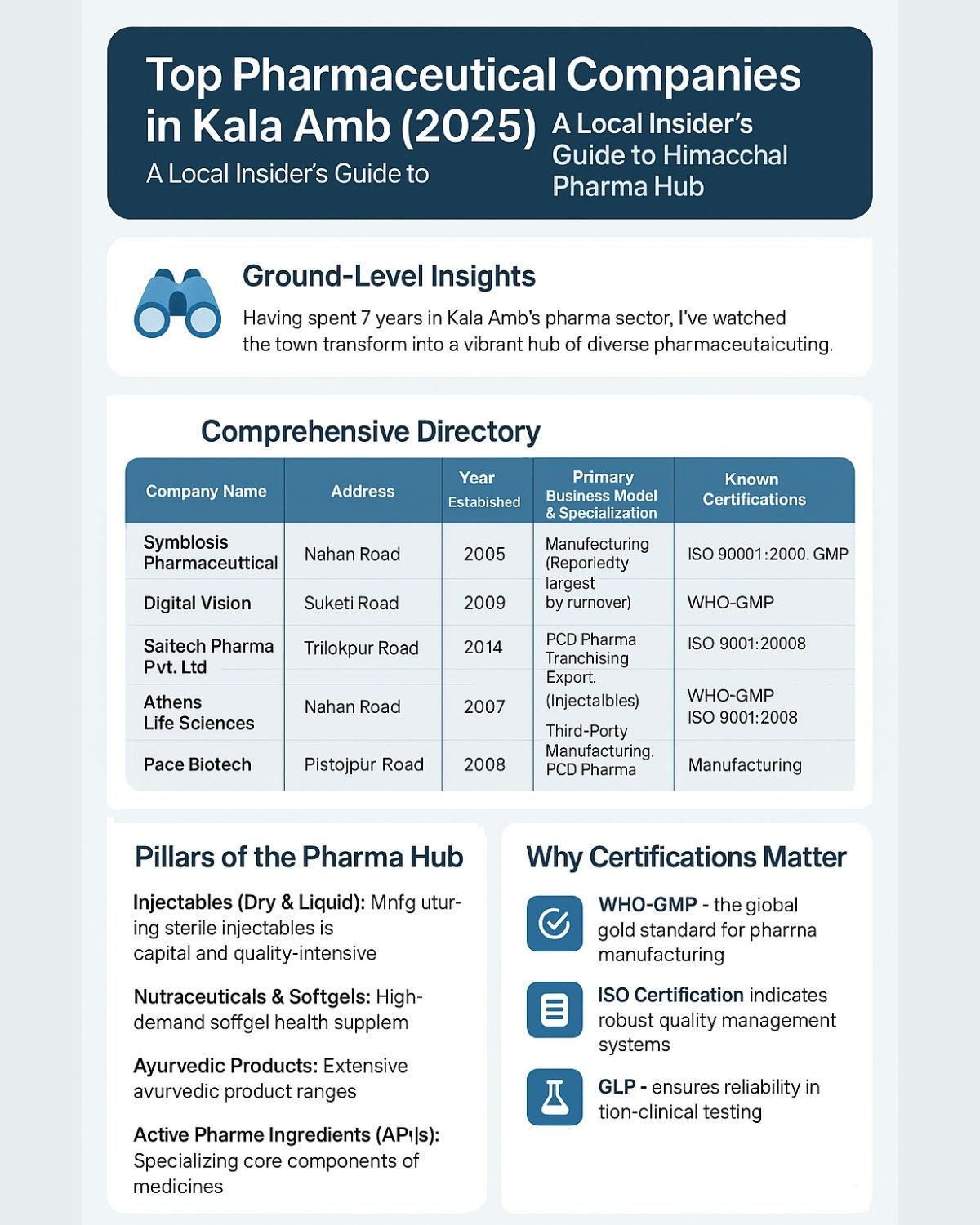
The earlier version of this page also named Pace Biotech, Saitech Medicare and Watran Pharmaceuticals as Kala Amb players. None appears in the directory, and at least one of those names is associated with Baddi rather than Kala Amb. They have been removed rather than carried forward unverified.
Third-party manufacturing and PCD franchise from Kala Amb
Two different commercial relationships get muddled constantly, so it is worth separating them before you approach anyone on the list.
Third-party or contract manufacturing means you own the brand and the market, and the Kala Amb unit makes the product to your specification under its licence and its Schedule M obligations. Your quality agreement, your batch release terms and your right to audit are the whole of your protection. Filtering the directory to “Third-party / contract” gives 17 units that list this model. If you want the mechanics of the arrangement itself — costing, minimum batch sizes, the documentation trail — that is covered in how third-party pharma manufacturing in India actually works.
PCD (Propaganda Cum Distribution) franchise is the reverse: the manufacturer owns the brand, and you take monopoly distribution rights for a territory. Eleven units in the table list PCD programmes. The questions that decide whether a PCD agreement is worth signing — territory definition, product list, pricing protection, promotional-input commitments — are set out on Laafon Galaxy’s own PCD franchise programme, run from Karnal, which is a useful reference for what a properly structured agreement contains even if you go on to sign with a Kala Amb company instead.
What this page got wrong before, and what changed
This article was first published on 12 February 2023 and last touched in August 2025. This revision corrects the following.
- The “excise free zone” was linked to the SEZ Act, 2005. Wrong instrument. Corrected to the area-based central excise exemption under Notification 50/2003-CE, with the ten-year limit and the GST-era budgetary support successor explained.
- The tax benefit was presented as a standing reason to manufacture in Kala Amb. It expired with the ten-year window for the units concerned. Now stated as history, not as an offer.
- “ISO 9001:2001” was listed for one unit. No such edition exists. Flagged in the table rather than silently deleted, because the underlying directory entry is what a reader will find elsewhere.
- “DCGI” and “FDA” were listed as certifications. Neither certifies manufacturers in that sense. Both flagged.
- Every ISO edition cited in the table is now withdrawn. ISO 9001:2026 was published on 16 September 2026. Flags added throughout.
- One company appeared under three names — Saitech Pharmaceuticals, Saitech Pharma and Saitech Medicare — and another as both Vellinton Healthcare and Vellinton Lifesciences. Normalised, with the variants kept searchable.
- Companies named in the prose were absent from the table. Pace Biotech, Saitech Medicare and Watran Pharmaceuticals removed as unverified for this cluster.
- There was no mention of revised Schedule M at all on a page about choosing an Indian manufacturer, two and a half years after G.S.R. 922(E) and nine months after the compliance deadline lapsed. That is the substantive addition in this revision.
- The listing was presented as fact. It is now explicitly labelled as self-declared and unaudited, because that is what it is.
Frequently asked questions
This page lists 49 units commonly named in Kala Amb, compiled from public business directories. There is no official published count. The Department of Pharmaceuticals recognises Kala Amb, Sirmour as one of India’s 118 pharmaceutical clusters but does not give it a unit count, and the Himachal Pradesh Drugs Control Licensing Authority publishes no public register of licensees. Himachal Pradesh as a whole had 655 drug manufacturing units as reported in April 2026. Treat any specific Kala Amb figure, including the 49 here, as indicative rather than authoritative.
Not from an official source, and that is worth understanding rather than working around. The Himachal Drugs Control Licensing Authority runs an online licensing system but publishes no downloadable register of licensed manufacturers, and CDSCO’s most recent national list of drug manufacturers and CoPP holders dates from January 2018. Any PDF circulating as a current Kala Amb company list is a scraped directory compilation, not a regulatory document. The table on this page is the same kind of material, which is why it is labelled as unverified and paired with the verification steps above. Use your browser’s print or save-as-PDF function if you want it offline.
Filter the directory above to “Injectables / eye drops” and you will see the units that list sterile capability, including GMT Pharma International, Iskon Remedies, MMG Healthcare, Pushkar Pharma, Saitech Pharmaceuticals, Vellinton Healthcare and Itearsa Biotech. Before you approach any of them, remember that sterile products fall under Schedule C and C(1) and therefore need a Form 28 licence, not the Form 25 that covers general tablets and capsules. Ask which licence they hold and which products are named on the permission list attached to it. Sterile-area requirements are also where revised Schedule M is most demanding and most expensive to meet.
No. Kala Amb was never a Special Economic Zone. It benefited from the area-based central excise exemption under Notification 50/2003-Central Excise, which gave eligible units a full excise exemption for ten years from commencement of commercial production. Those exemptions ended when GST came in on 1 July 2017 and were replaced by the Scheme of Budgetary Support, which refunds 58% of CGST and 29% of IGST paid in cash — but only for whatever remained of that original ten-year period. For units established in the mid-2000s to early 2010s, that period has closed. A company setting up in Kala Amb in 2026 gets the cluster advantages, not the tax holiday.
It passed. Revised Schedule M was notified by G.S.R. 922(E) on 28 December 2023. Manufacturers with turnover below ₹250 crore could apply under G.S.R. 127(E) dated 11 February 2025 for an extension to 31 December 2025, conditional on filing an upgradation plan with the Central Licence Approving Authority within three months and on that application being granted. That date has now passed and enforcement inspections have followed across Himachal Pradesh. Reported figures from January and April 2026 indicate low compliance rates statewide and a number of licence surrenders. Verify the current national position before acting on this, since implementation continues to evolve.
CDSCO publishes this and it is free to search. Monthly Not of Standard Quality alerts are issued separately for central and state drug testing laboratory results, along with a monthly list of spurious drugs, and since August 2025 the NSQ data is available through a searchable public view on the CDSCO online portal. Search the manufacturer’s name and its address, try spelling variants, and cover at least the last twelve months. Also search any sister concern, since several Kala Amb units share a parent group. This check costs nothing and is the most informative thing you can do before placing an order.
Yes, by two routes. A third-party or contract manufacturing agreement leaves the licence and the compliance burden with the Kala Amb unit while you own the brand. A loan licence, granted on Form 25A for general formulations or Form 28A for Schedule C and C(1) products, puts the licence in your name while you use another party’s premises and plant — which means the Schedule M exposure becomes partly yours, so the host facility’s compliance status matters even more. Which route suits you depends on volume, on how much control you need over the process, and on whether you intend to build your own site later.
No. WHO-GMP in the Indian context generally means a certificate issued by the State Licensing Authority, supported by a Certificate of Pharmaceutical Product for export purposes. It is accepted by many regulators in Africa, South East Asia and the CIS, but it is not equivalent to an EU GMP certificate issued by a European competent authority, and it is not an FDA approval. Each destination market applies its own registration and inspection requirements. Ask which specific markets the manufacturer has actually shipped to and registered products in, and ask for the CoPP itself rather than a logo on a brochure.
Related on Laafon
- Company and plant listings tagged Kala AmbIndividual units in this cluster with listing dossiers, updated as they come to market.
- CDSCO revised Schedule-M compliance dashboardCurrent status, notifications and guidance on the standard driving Himachal’s inspections.
- Revised Schedule M gap assessment toolkitA 272-point self-audit workbook if you are assessing a site rather than a supplier.
- Third-party pharma manufacturing in IndiaHow the contract, the costing and the documentation trail actually work.
- Pharma loan licence: Form 25A and 28AManufacture under your own licence in someone else’s plant, with the real statutory fees.
- Pharma plants for sale across IndiaVerified listings, including units in Himachal, if acquisition beats contracting.
- Pharma plant setup cost calculatorLand, construction, machinery and section-wise capital estimates before you commit.
Assessing a Kala Amb unit before you commit?
Laafon Galaxy has worked in pharmaceutical QA, QC and drug regulatory affairs for over two decades, and handles licence verification, Schedule M gap assessment and pre-contract due diligence on manufacturing partners across Himachal, Haryana, Punjab and Uttarakhand.
Book a regulatory compliance consultationReferences
- [1] Centre for Market Research and Social Development. Final Report — Survey of Pharma Clusters. New Delhi: Government of India, Ministry of Chemicals and Fertilizers, Department of Pharmaceuticals; February 2023. Table 3.3, State/UT wise locations of the pharma clusters. Available from: https://pharma-dept.gov.in/sites/default/files/Final%20Report-Survey%20of%20Pharma%20Clusters.pdf. Accessed September 2026.
- [2] Government of India, Ministry of Finance, Department of Revenue. Notification No. 50/2003-Central Excise, G.S.R. 471(E). New Delhi; 10 June 2003. Available from: https://taxguru.in/excise-duty/notification-50-2003central-excise-dated-10th-june2003.html. Accessed September 2026.
- [3] Ministry of Health and Family Welfare, Department of Health and Family Welfare (India). Notification G.S.R. 922(E) — amendment of the Drugs Rules, 1945, substituting Schedule M as Good Manufacturing Practices and Requirements of Premises, Plant and Equipment for Pharmaceutical Products. The Gazette of India, Extraordinary, Part II, Section 3(i). New Delhi; 28 December 2023. Copy consulted: https://pharmadocx.com/wp-content/uploads/2024/01/Notified-Schedule-M-dt-28.12.2023-1.pdf. Accessed September 2026.
- [4] Ministry of Health and Family Welfare (India). Drugs Amendment Rules, 2025, G.S.R. 127(E), gazette reference CG-DL-E-11022025-260908. New Delhi; 11 February 2025. Summarised at: https://cliniexperts.com/regulatory-update/extension-of-timeline-for-implementation-of-schedule-m-for-small-medium-manufacturers/. Accessed September 2026.
- [5] Sharma A. Himachal: Schedule M enforcement bares pharma fault lines. The Tribune. Shimla; 16 January 2026. Available from: https://www.tribuneindia.com/news/himachal/schedule-m-enforcement-bares-pharma-fault-lines/. Accessed September 2026.
- [6] Sharma A. Small pharma units in Himachal shut shop as revised Schedule M norms tighten compliance net. The Tribune. Solan; 11 April 2026. Available from: https://www.tribuneindia.com/news/himachal/small-pharma-units-in-himachal-shut-shop-as-revised-schedule-m-norms-tighten-compliance-net/. Accessed September 2026.
- [7] International Organization for Standardization. ISO 9001:2026 Quality management systems — Requirements. 6th ed. Geneva: ISO; published 16 September 2026. Available from: https://www.iso.org/standard/9001. Accessed September 2026.
- [8] International Organization for Standardization. ISO 9001:2015 Quality management systems — Requirements, lifecycle record (stage 95.99, withdrawn 16 September 2026; supersedes ISO 9001:2008, withdrawn 2015, and ISO 9001:2000, withdrawn 2010). Geneva: ISO. Available from: https://www.iso.org/standard/62085.html. Accessed September 2026.
- [9] Drugs Control Licensing Authority, Himachal Pradesh. Services — application and licence form mapping (Form 24/25, 24A/25A, 24B/25B, 27/28, 27A/28A, 27B/28B). Available from: https://dcla.hp.gov.in/Web/Service. Accessed September 2026.
- [10] Central Drugs Standard Control Organization, Directorate General of Health Services, Ministry of Health and Family Welfare (India). Public view of Not of Standard Quality drugs. Available from: https://cdscoonline.gov.in/CDSCO/viewPublicNSQDrug. Accessed September 2026.
- [11] Central Drugs Standard Control Organization (India). Alerts — monthly CDSCO and State NSQ alerts and spurious drug lists. Available from: https://cdsco.gov.in/opencms/opencms/en/Alerts/. Accessed September 2026.
- [12] Agrawal D, Shah A, Krishnan A. Area based central excise exemption gets budgetary support under GST. Khaitan and Co LLP; 13 October 2017. Available from: https://www.mondaq.com/india/sales-taxes-vat-gst/637128/area-based-central-excise-exemption-gets-budgetary-support-under-gst. Accessed September 2026. Secondary source; the underlying DIPP notification of 5 October 2017 could not be opened directly.
Disclaimer. This page is technical and educational content for pharmaceutical professionals. It is not medical, legal, investment or procurement advice. Company details, establishment years and certification claims are reproduced from public business directories and company self-declarations; they have not been audited or verified by Laafon Galaxy Pharmaceuticals, and inclusion is neither an endorsement nor a recommendation. Indian statutory instruments, pharmacopoeial texts and CDSCO positions change frequently — verify the current position with the Central Drugs Standard Control Organization, the Himachal Pradesh Drugs Control Licensing Authority, or qualified professional advice before relying on anything here for a commercial or regulatory decision.