
Technical reference · Reviewed and updated 27 August 2026 · Dimensions and operating limits quoted from USP General Chapter 801
The short answer
A dropping mercury electrode (DME) is a mercury electrode formed by a sequence of mercury drops falling from a small aperture at the end of a fine glass capillary.[1] It is the working electrode in a polarographic cell — not the reference electrode. The reference is normally a saturated calomel electrode with a large surface area.[2]
Its whole advantage is that the electrode surface is destroyed and rebuilt every few seconds, so it never fouls and every measurement starts on clean metal.
- approx 0.04 mmcapillary bore
- 6 to 15 cmcapillary length
- 40 to 80 cmmercury head, h
- 3 to 5 sdrop time at open circuit
- 25 ± 0.5 °Ccell temperature control
- over 4 cmreservoir diameter
What changed in this revision
The earlier version of this page gave the capillary length as 5 to 9 mm and described the mercury drop as serving as both working and reference electrode. Both were wrong. Every dimension below is now taken from USP General Chapter 801 Polarography,[2] and the step-by-step mercury handling instructions have been removed — see the safety note near the end for why.
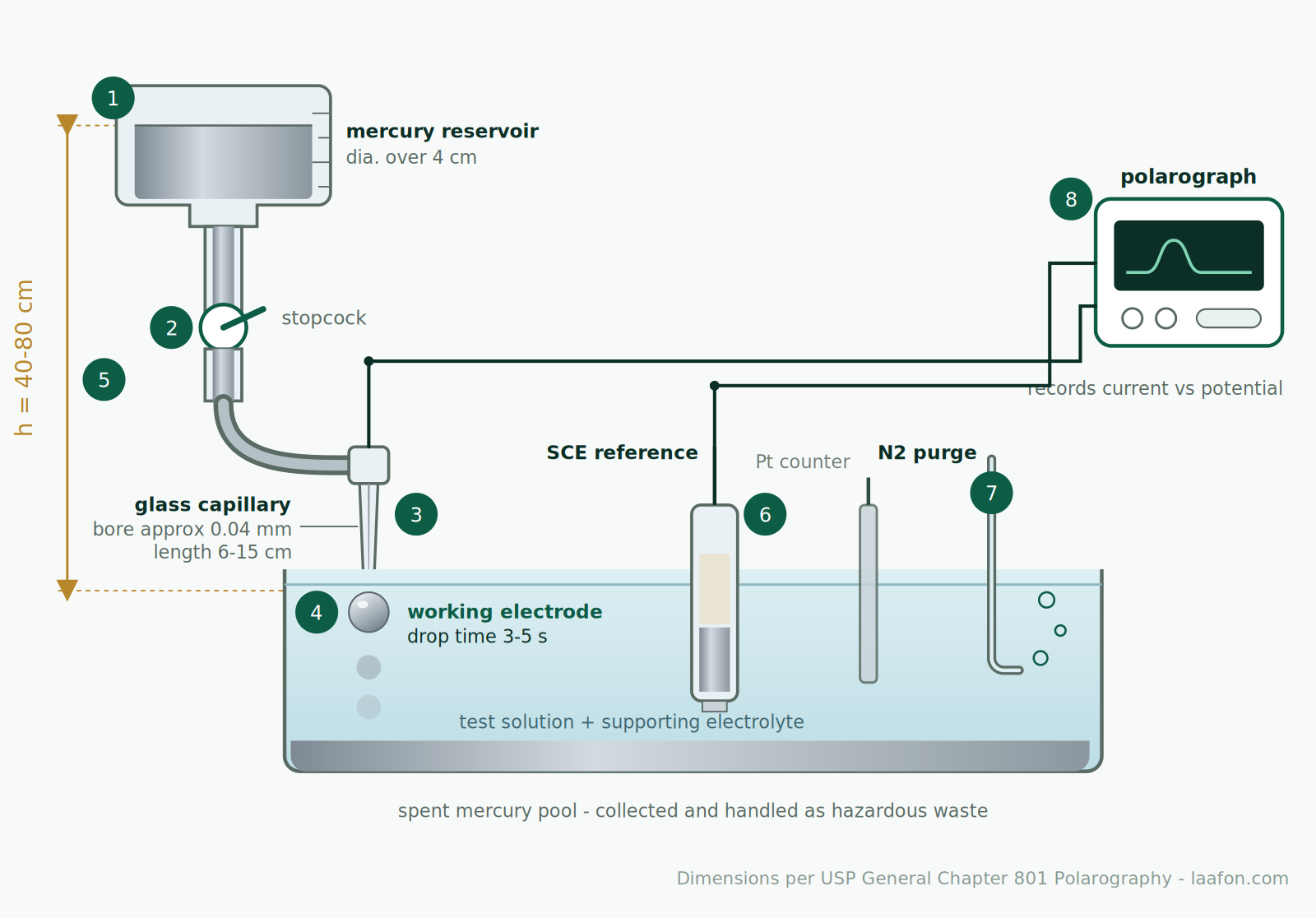
Labelled diagram of a dropping mercury electrode
Tap any numbered marker below the drawing to see what that part does and the specification it has to meet. The drawing is a schematic cross-section, not to scale — the capillary bore is roughly the thickness of a human hair, and the mercury head above it is most of a metre.
1 · Mercury reservoir (levelling bulb)
Holds the mercury that feeds the capillary and sets the head pressure driving it. USP specifies a reservoir more than 4 cm in diameter, for a practical reason: a wide reservoir barely drops in level as mercury is consumed, so the head — and therefore the diffusion current — stays constant across a run of samples.[2]
diameter over 4 cm · graduated for level checks2 · Stand tube and stopcock
Thick-walled tubing carries mercury down from the reservoir; the stopcock isolates the capillary and trims the flow rate. The flow rate it sets is m, in mg per second, one of the two terms in the capillary constant.
In practice the stopcock is a coarse control. Fine control of drop time comes from the head height and the capillary itself.
sets m, the mercury mass flow rate3 · Glass capillary
The precision part. USP gives a bore of approximately 0.04 mm and a length of 6 to 15 cm.[2] Exact length is chosen together with the head height so that drop time lands in the 3 to 5 second window.
Because m and t both depend on the capillary and the head, USP advises using the same capillary at a constant head throughout a series of analyses. Results from different capillaries are only comparable if the capillary constant is known.
bore approx 0.04 mm · length 6 to 15 cm4 · The mercury drop — this is the working electrode
The drop grows, the current grows with its area, the drop falls, and a fresh one starts. This is the whole point of the design: a surface that is renewed every few seconds cannot be poisoned or fouled by adsorbed material.[1]
It is a common exam error to call the drop a reference electrode. It is not. It is the indicator or working electrode, and its potential is deliberately varied.
drop time 3 to 5 s at open circuit, capillary immersed5 · Mercury head, h
Measured from the capillary tip to the top of the mercury pool in the reservoir. USP gives a working range of 40 to 80 cm.[2]
The relationship worth remembering: the diffusion current is proportional to the square root of the head height. Raise the column fourfold and the signal only doubles. It is also the standard diagnostic test — if the limiting current tracks the square root of h, the current is diffusion-controlled rather than kinetic or adsorption-controlled.
h = 40 to 80 cm · i(d) proportional to square root of h6 · Reference electrode
Normally a saturated calomel electrode (SCE) with a large surface area.[2] Large area matters: it keeps the reference effectively non-polarisable, so the applied voltage appears almost entirely across the DME.
Unless a method states otherwise, quoted half-wave potentials are measured against the SCE. For non-aqueous solutions, which are resistive, the iR drop needs correcting before an accurate DME potential can be reported.
potentials reported versus SCE unless stated otherwise7 · Nitrogen purge
Dissolved oxygen is reduced at the DME in two steps — first to hydrogen peroxide, then to water — and interferes with anything measured more negative than about 0 V versus SCE. It has to go.
USP: bubble oxygen-free nitrogen through the solution for 10 to 15 minutes immediately before recording, then stop bubbling and blanket the surface. A stirred solution is not diffusion-controlled, so the wave must be recorded on a quiet, vibration-free cell.[2]
N2 for 10 to 15 min, then blanket, never bubble during the scan8 · Polarograph
Applies a rising potential to the DME against the reference and records the resulting current. The output is the polarogram: a residual current, then a rising wave, then a limiting plateau. Wave height, measured after subtracting residual current, is the analytical signal.
Because the drop is growing and falling throughout, an undamped trace is visibly saw-toothed. Modern instruments sample only at the end of drop life, which removes the oscillation.
wave height measured at the half-wave potentialConstruction of the dropping mercury electrode: real dimensions
The assembly is simple, and every number in it is chosen to keep one quantity stable — the amount of mercury reaching the solution per unit time. Change the head, the capillary or the temperature, and the calibration changes with it.
| Component | Specification | Why it is set there |
|---|---|---|
| Capillary bore | approx 0.04 mm | Fine enough to form a reproducible drop; wide enough not to block. Blockage is the commonest DME failure. |
| Capillary length | 6 to 15 cm | Trimmed with the head height to land drop time in the 3 to 5 s window. |
| Mercury head, h | 40 to 80 cm | Drives the flow. Diffusion current varies as the square root of h, so h must be held constant across a run. |
| Drop time, t | 3 to 5 s | Measured at open circuit with the capillary immersed in the test solution. |
| Reservoir diameter | over 4 cm | Keeps the mercury level, and therefore the head, from falling measurably during a series of runs. |
| Cell temperature | 25 ± 0.5 °C | Diffusion coefficients rise 1 to 2 percent per degree. Half a degree is the tolerable error. |
| Reference electrode | SCE, large area | Non-polarisable, so the applied potential falls across the DME. |
| Working range, dc | 10⁻² to 10⁻⁵ M | Standard dc polarography. Pulse techniques extend this — see the tabs below. |
Scroll the table sideways on a phone. All values from USP General Chapter 801 Polarography.[2]
Where the technique came from
Jaroslav Heyrovský developed polarography at Charles University from 1922 and received the 1959 Nobel Prize in Chemistry for it.[3] The DME is the electrode he built the method around, and IUPAC still names him in its definition of the term.[1] Understanding why a falling drop was such a good idea in 1922 is most of the way to understanding why solid electrodes needed decades of surface chemistry to catch up.
Working of the DME: from drop life to diffusion current
Apply a slowly increasing negative potential to the drop against the reference. Below the reduction potential of anything in solution, only a small residual current flows. Once the analyte starts reducing at the drop surface, current rises, then flattens as the reaction becomes limited by how fast fresh analyte can diffuse to the drop. That plateau is the limiting current; subtract residual current from it and the remainder is the diffusion current, which is proportional to concentration.[2]
The potential at half the wave height is the half-wave potential, and it is characteristic of the species rather than its concentration. That is what makes polarography qualitative as well as quantitative: position identifies, height quantifies.
The Ilkovič equation
This is the part the earlier version of this page omitted entirely, and it is the only reason the DME is a quantitative instrument rather than a curiosity:
Ilkovič equation
i(d) = k · n · D1/2 · C · m2/3 · t1/6
k is 708 for the maximum current and 607 for the current averaged over drop life. With i(d) in microamperes, D in cm² per second, C in millimoles per litre, m in mg per second and t in seconds.[2][4]
The product m2/3 t1/6 is the capillary constant. It is the term that lets results from two different capillaries be compared at all.
Diffusion current calculator
Enter your own capillary and solution values. Nothing is assumed for you except the Ilkovič constant, which you choose with the last field.
Assumptions you should check before quoting a result: the current is genuinely diffusion-controlled (verify by confirming it tracks the square root of the mercury head), the cell is held at 25 ± 0.5 °C, dissolved oxygen has been removed, and sufficient supporting electrolyte is present to suppress migration. This calculator is a teaching and method-development aid. It is not a substitute for calibrating against a reference standard under the conditions of your own monograph.
Advantages and disadvantages of the dropping mercury electrode
Advantages
- Continuously renewed surface. Each drop is a new electrode, so adsorbed products and poisons are discarded rather than accumulated. This is the property no solid electrode can match.[1]
- Reproducible, calculable area. Drop area follows from m and t, which is why the Ilkovič equation works at all.
- Very high hydrogen overpotential. Mercury tolerates strongly negative potentials without evolving hydrogen, opening a window most metals cannot reach.[5]
- Many metals form amalgams with mercury, which stabilises the reduced product and sharpens the wave.[1]
- Half-wave potential identifies the species largely independently of concentration and of which capillary was used.[2]
Disadvantages
- Mercury is toxic and volatile at room temperature. USP carries an explicit caution on mercury vapour in the polarography chapter itself.[2]
- Useless at positive potentials. Mercury oxidises readily, especially with anions that complex or precipitate Hg(I) or Hg(II), so the anodic range is closed.[5]
- Charging current sets the floor. The growing drop continuously charges the double layer, and this capacitative current is what limits dc polarography to around 10⁻⁵ M.[2]
- Capillary blockage. A 0.04 mm bore clogs, and a blocked capillary usually means a new one.
- Waste and disposal burden. Every run produces spent mercury requiring hazardous-waste handling.
- Availability. IUPAC records that liquid mercury use has largely been discontinued over toxicity concerns.[5]
DME, HMDE, SMDE and the mercury-free alternatives
The old page promised a section on alternatives and never delivered one. Here it is. The first three are all mercury; the last two are what most laboratories moved to.
Dropping mercury electrode
Drops fall freely and continuously from the capillary, each lasting a few seconds.[1] The classical polarographic electrode and the one the Ilkovič equation describes.
Best for: teaching the method, and historical or archival dc polarographic procedures where the monograph specifies it.
Limit: charging current from the growing drop caps dc sensitivity near 10⁻⁵ M, and mercury consumption is continuous.
Hanging mercury drop electrode
A single drop is extruded and held; the whole experiment runs on that one drop.[1]
Best for: anodic stripping voltammetry, where analyte must be pre-concentrated into a stationary drop before being stripped back out. USP names the HMDE as the common working electrode for stripping work, reaching 10⁻⁷ to 10⁻⁹ M.[2]
Limit: the surface is not renewed during the run, so fouling is possible again.
Static mercury drop electrode
A drop is grown to a set radius, then held stationary while the measurement is made, then mechanically knocked off.[1]
Best for: most modern mercury-based voltammetry. Holding the area constant during measurement removes the charging current that a growing drop generates, which is the single biggest sensitivity gain over a classical DME.
Limit: still mercury, with all the handling and disposal that implies.
Mercury film electrode
A thin mercury layer deposited on a conducting substrate, usually glassy carbon — typically 10 to 1000 nm thick over an area of 0.1 to 0.5 cm².[5]
Best for: stripping analysis needing high sensitivity from a very small mercury inventory. The high surface-to-volume ratio concentrates analyte efficiently.
Limit: less reproducible than a drop, and more prone to intermetallic interference.[5]
Solid, mercury-free electrodes
Glassy carbon, carbon paste, screen-printed carbon, platinum, gold and bismuth-based films are the practical replacements, and are what a laboratory commissioning new electroanalytical capacity today would specify.
Best for: anything positive of the mercury window, and any laboratory that does not want mercury on its inventory at all.
Limit: narrower cathodic window than mercury, surfaces need polishing or conditioning, and they foul — which is precisely the problem the falling drop was invented to solve. For most pharmaceutical assay work the question is moot, since HPLC and UV-visible methods displaced polarography long ago.
Mercury handling, and why the construction steps were removed
Removed: the do-it-yourself construction procedure
The previous version of this page carried step-by-step instructions for pouring, acid-washing and filtering elemental mercury using a dropping funnel and rubber tubing. That has been removed and will not be restored.
Mercury has a significant vapour pressure at room temperature and the vapour is poisonous. USP requires that mercury work be done in a well-ventilated laboratory, in a work area built so that spilled or spattered droplets can be completely recovered, with scrupulous clean-up after every use.[2] Those are engineering controls, not a bench procedure a reader should follow from a web page. Anyone commissioning a mercury electrode should be working from their institution or employer chemical hygiene plan and a manufacturer manual, not from an article.
The regulatory position in India
The Minamata Convention on Mercury is the binding international instrument covering mercury supply, trade, mercury-added products and mercury waste; it entered into force on 16 August 2017.[11] India ratified it on 18 June 2018, registering exemptions that extended the phase-out date for certain mercury-added products from 2020 to 2025.[6] WHO India has been supporting the Ministry of Health and Family Welfare and MoEFCC on the shift to mercury-free healthcare devices.[7]
Be precise about what this does and does not say
The Convention product phase-outs target listed mercury-added products such as thermometers and sphygmomanometers. A dropping mercury electrode is not individually named in those lists, and nothing here should be read as a statement that DMEs are banned in India. What has changed in practice is the surrounding environment: mercury supply and waste are regulated, institutional appetite for mercury inventory has collapsed, and IUPAC itself records that liquid mercury use has largely been discontinued.[5] Confirm the current position for your own site and state with your regulatory affairs function before making a procurement or disposal decision.
An honest note on relevance
The earlier version of this page closed by recommending the DME for routine measurement. That recommendation has been withdrawn. In a modern pharmaceutical quality control laboratory the DME is best understood as foundational teaching material and the historical basis of stripping voltammetry, not as an instrument to specify for new work. Assays that once used polarography are now almost always run by HPLC, GC or UV-visible spectrophotometry. Where trace-metal voltammetry is genuinely needed, the SMDE, mercury film or a solid mercury-free electrode is the sensible choice.
Frequently asked questions
A dropping mercury electrode is a mercury electrode formed by a sequence of mercury drops falling from a small aperture at the tip of a fine glass capillary. It is the working electrode used in polarography, and it was introduced by Jaroslav Heyrovsky. Each drop lasts a few seconds before falling, so the electrode surface is continuously renewed and cannot become poisoned.
It is the working electrode, sometimes called the indicator or microelectrode. It is never the reference. In a polarographic cell the reference is a separate electrode, normally a saturated calomel electrode with a large surface area, and half-wave potentials are quoted against it. Calling the mercury drop a reference electrode is one of the most common errors in student notes on this topic.
A mercury reservoir more than 4 cm in diameter, thick-walled tubing with a stopcock, and a fine glass capillary of approximately 0.04 mm bore and 6 to 15 cm length. The capillary is glass, not silver or any other metal. Electrical contact to the mercury is made with a wire, commonly platinum or tungsten, at the reservoir.
The main advantages are a continuously renewed surface that cannot be poisoned, a reproducible and calculable electrode area, and a very high hydrogen overpotential that allows work at strongly negative potentials. The main disadvantages are that mercury is toxic and volatile at room temperature, that mercury oxidises so the electrode is unusable at positive potentials, that the growing drop generates a charging current which limits dc sensitivity to around 10 to the minus 5 molar, and that the fine capillary blocks easily.
The capillary constant is m to the power two thirds multiplied by t to the power one sixth, where m is the mercury flow rate in mg per second and t is the drop time in seconds. It appears in the Ilkovic equation and it is the only way results obtained on two different capillaries can be compared. In practice USP advises using the same capillary at a constant mercury head throughout a series of analyses rather than relying on the correction.
It is a compromise. A longer drop gives a larger area and more signal, but it also gives more charging current and a slower scan. A shorter drop scans faster and resolves more detail per unit potential, but gives less signal per drop. USP specifies that the capillary length and the mercury head be adjusted together to give a drop time between 3 and 5 seconds at open circuit with the capillary immersed in the test solution.
Yes. Glassy carbon, carbon paste, screen-printed carbon, platinum, gold and bismuth-based film electrodes are the usual mercury-free replacements. Within the mercury family, the static mercury drop electrode and the mercury film electrode use far less mercury and give better sensitivity than a classical dropping electrode. For most pharmaceutical assay work the question does not arise, because HPLC, GC and UV-visible spectrophotometry replaced polarographic assays long ago.
Related analytical references on laafon.com
- UV-Visible Spectrophotometer SOP, Calibration and AdvantagesThe technique that replaced polarography for most routine pharmaceutical assays. Covers the SOP and the calibration checks.
- Gas Chromatography: Principle, Instrumentation and WorkingThe other instrument a QC analyst reaches for instead. Useful sibling reading on detector and separation principles.
- Pharmaceutical Method Validation: Roadmap to Compliance and AccuracyIf you are developing an electroanalytical method rather than following a monograph, this is the validation framework it has to satisfy.
- SOP for Calibration of Dissolution Test ApparatusA worked example of how instrument calibration SOPs are structured and documented.
- ALCOA vs ALCOA+ vs ALCOA++: Which Regulator Says WhatInstrument raw data, including polarograms, has to meet these data-integrity attributes. Compares FDA, MHRA, WHO, PIC/S and EMA positions.
- All SOPs and instrument guidesThe full SOP category on laafon.com.
Need this level of scrutiny on your own analytical documentation?
Laafon Galaxy Pharmaceuticals reviews QC method documentation, instrument SOPs and specifications against current pharmacopoeial and CDSCO requirements — including the kind of dimensional and terminology errors corrected on this page.
Request a compliance consultationReferences
- International Union of Pure and Applied Chemistry. Dropping mercury electrode. In: IUPAC Compendium of Chemical Terminology (Gold Book), 5th ed. Research Triangle Park, NC: IUPAC; 2025. Available from: https://goldbook.iupac.org/terms/view/09103. Accessed August 2026.
- United States Pharmacopeial Convention. General Chapter 801, Polarography. USP–NF. Rockville, MD: USP. Available from: https://doi.usp.org/USPNF/USPNF_M99600_01_01.html. Accessed August 2026. Full text is available to USP–NF subscribers.
- The Nobel Prize in Chemistry 1959: Jaroslav Heyrovsky. Stockholm: Nobel Prize Outreach. Available from: https://www.nobelprize.org/prizes/chemistry/1959/summary/. Accessed August 2026.
- International Union of Pure and Applied Chemistry. Ilkovic equation. In: IUPAC Compendium of Chemical Terminology (Gold Book), 5th ed. IUPAC; 2025. Available from: https://goldbook.iupac.org/terms/view/09139. Accessed August 2026.
- International Union of Pure and Applied Chemistry. Mercury electrode. In: IUPAC Compendium of Chemical Terminology (Gold Book), 5th ed. IUPAC; 2025. Available from: https://goldbook.iupac.org/terms/view/09102. Accessed August 2026.
- Department of Chemicals and Petrochemicals, Government of India. Minamata Convention. New Delhi: DCPC. Available from: https://chemicals.gov.in/minamata-convention. Accessed August 2026.
- World Health Organization, India. India moves towards a mercury free healthcare sector. 20 December 2024. Available from: https://www.who.int/india/news-room/detail/20-12-2024-india-moves-towards-a-mercury-free-healthcare-sector. Accessed August 2026.
- Bard AJ, Faulkner LR. Electrochemical Methods: Fundamentals and Applications. 2nd ed. New York: John Wiley and Sons; 2001.
- Kissinger PT, Heineman WR, editors. Laboratory Techniques in Electroanalytical Chemistry. 2nd ed, revised and expanded. New York: Marcel Dekker; 1996. See the chapter on mercury electrodes.
- Bond AM. Modern Polarographic Methods in Analytical Chemistry. New York: Marcel Dekker; 1980.
- United Nations Environment Programme. Minamata Convention on Mercury: text and annexes. Geneva: Minamata Convention Secretariat. Available from: https://minamataconvention.org/en/resources/minamata-convention-mercury-text-and-annexes. Accessed August 2026.
Standard texts for readers going deeper: Bard and Faulkner[8] for the theory, Kissinger and Heineman[9] for practical electrode work, and Bond[10] for polarographic method development.
Disclaimer. This page is technical and educational content for pharmaceutical, analytical and academic readers. It is not medical advice, investment advice, or a substitute for a validated procedure. Pharmacopoeial texts and Indian statutory instruments are revised frequently: verify the current official version of any chapter, monograph or notification before applying it. Mercury is a hazardous substance and must only be handled under an appropriate institutional chemical hygiene plan and local hazardous-waste rules.
Author. Darshan Singh, M.Sc. (Organic Chemistry), D. Pharm — pharmaceutical quality assurance, quality control and drug regulatory affairs. Author profile.