
Rhapsido (remibrutinib) in one screen
Rhapsido is an oral Bruton’s tyrosine kinase (BTK) inhibitor approved by the US FDA on 30 September 2025 for chronic spontaneous urticaria (CSU) in adults who stay symptomatic on H1 antihistamines. It is the first FDA-approved BTK inhibitor for CSU [4]. It blocks BTK inside mast cells and basophils, so histamine and other mediators are never released — antihistamines only block histamine after release [1].
- Dose25 mg twice daily
- ContraindicationsNone listed
- Main riskBleeding, 9% vs 2%
- Half-life1 to 2 hours
- NDA218436
- US list price$4,521 / 30 days
This page was originally published on 5 December 2025 and has been rebuilt against primary documents. Four statements in the earlier version were wrong and have been corrected, because they matter clinically:
- Hepatic impairment is not a contraindication. Section 4 of the approved label states there are no contraindications. Section 8.6 says to avoid use in Child-Pugh A, B and C. “Avoid” and “contraindicated” are not interchangeable in FDA labelling [1].
- Omalizumab is subcutaneous, not an intravenous infusion. For chronic idiopathic urticaria it is 150 mg or 300 mg by subcutaneous injection every 4 weeks [6].
- Dupilumab is not off-label in CSU. FDA approved it for CSU on 18 April 2025, five months before Rhapsido [7].
- Rhapsido is not cheaper than omalizumab. Its US list price is $4,521 per 30-day pack, about $54,250 a year [5]. The earlier “$30–45K, 70% saving” figure had no source and pointed the wrong way.
Cost figures, market-share forecasts and cross-trial response-rate comparisons that could not be traced to a primary document have been removed rather than re-stated.
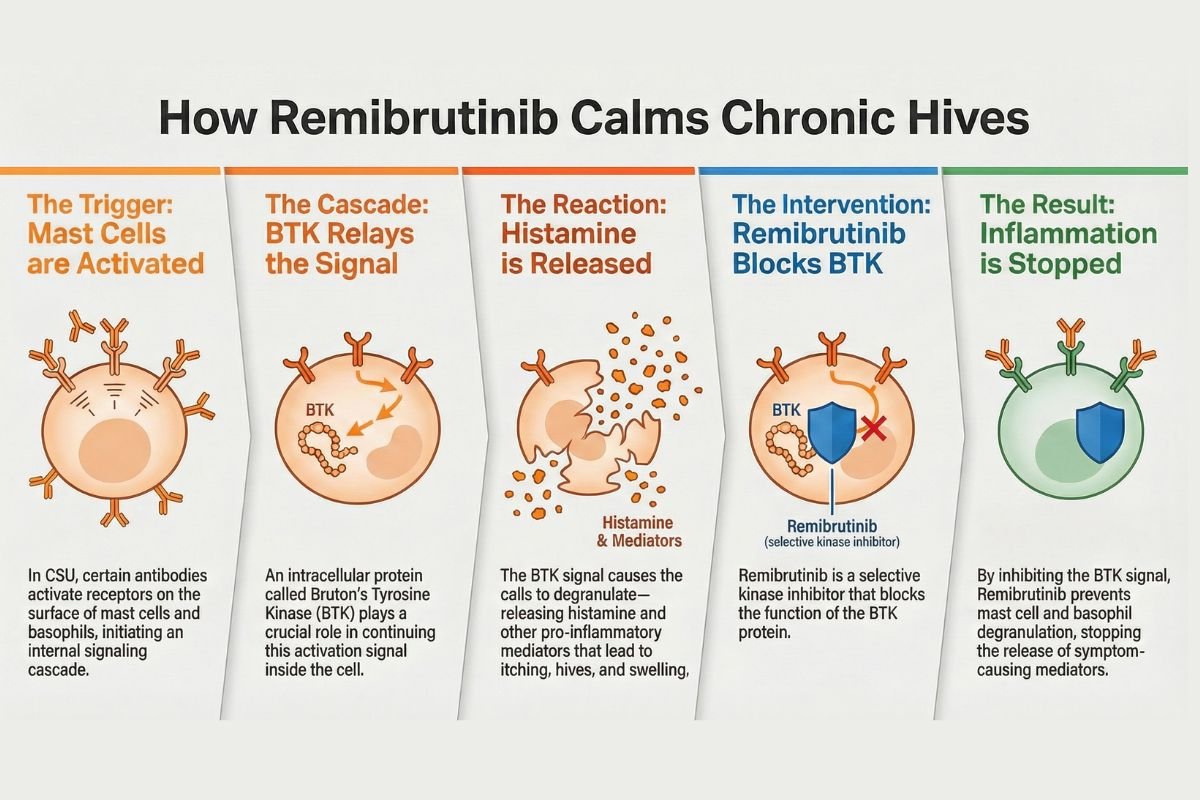
Rhapsido mechanism of action: how remibrutinib blocks BTK
Mechanism of action of Rhapsido in plain language
In CSU, mast cells and basophils in the skin are switched on inappropriately and dump histamine and other inflammatory mediators into the tissue. That release is what produces the wheal and the itch. Antihistamines work downstream: histamine is already out, and the drug simply blocks it from reaching its receptor. When the release is heavy enough, blocking receptors is not sufficient, which is why roughly half of CSU patients stay symptomatic on antihistamines [4].
Remibrutinib works one step earlier. BTK is an intracellular signalling protein that the mast cell needs in order to convert an incoming activation signal into degranulation. Inhibit BTK and the cell receives the signal but cannot act on it. No degranulation, no histamine release, no wheal [1].
- Step 01Autoantibody or antigen engages FcεR1, FcγR or the B cell receptor on a mast cell or basophil.
- Step 02The receptor recruits and activates BTK inside the cell.
- Step 03BTK signalling drives granule release — histamine and other proinflammatory mediators.
- Step 04Remibrutinib inhibits BTK at step 02, so step 03 does not happen.
Molecular detail for regulatory and medical affairs readers
Remibrutinib is an oral small-molecule kinase inhibitor of BTK. BTK is expressed in mast cells, basophils, B cells, macrophages and thrombocytes, and participates in signalling through the high-affinity IgE receptor (FcεR1), Fc gamma receptors (FcγR) and the B cell antigen receptor (BCR). Remibrutinib also inhibits the related kinases TEC and BMX [1].
The label states the inhibition of degranulation covers mediator release driven by pathogenic IgE or IgG directed against FcεR1 or against IgE itself [1]. That dual coverage is the mechanistic reason the trials found improvement in itch and hive scores at Week 12 to be consistent regardless of baseline total IgE — a practical difference from an anti-IgE antibody, whose target is the circulating immunoglobulin rather than the intracellular switch.
Two pharmacodynamic findings are worth carrying into any medical-information response. A flat dose-response relationship for UAS7 at Week 4 was observed across 0.2 to 4 times the recommended daily dose, so higher exposure does not buy more effect. And at roughly 9 times the mean steady-state peak concentration, no clinically significant QTc prolongation was seen [1].
Rhapsido is correctly described as the first FDA-approved BTK inhibitor for CSU [4]. It is not the first BTK inhibitor approved in a non-malignant immune-mediated disease. Rilzabrutinib (Wayrilz) was approved for immune thrombocytopenia on 29 August 2025, thirty-two days earlier [8]. The broader claim will not survive review.
Dosing, safety and interactions: the label in four tabs
Every figure below is taken from the approved US prescribing information for NDA 218436, Reference ID 5668289 [1].
Recommended dosage
25 mg orally twice daily, with or without food. Tablets are swallowed whole with water and must not be split, crushed or chewed. A missed dose is skipped, not doubled.
Product description
25 mg light yellow, round, curved, unscored film-coated tablet, 7 mm diameter, debossed “LV” on one face and the Novartis logo on the other. Supplied in a 40 mL HDPE bottle of 60 tablets with 2 g silica gel and a child-resistant closure, NDC 0078-1483-20. Store at 20 °C to 25 °C, excursions 15 °C to 30 °C, in the original container to protect from moisture. The approval letter sets an expiry dating period of 24 months from manufacture [2].
Surgery
Interrupt treatment for 3 to 7 days before and after surgery, the exact interval depending on the type of surgery and the bleeding risk. No laboratory monitoring schedule is specified in the label.
The one safety signal that matters
Mucocutaneous bleeding occurred in 9% of patients on Rhapsido against 2% on placebo over the 24-week controlled period. Petechiae (4%) and contusion (2%) were the most commonly reported. No severe bleeding reactions occurred, and no association was found between bleeding and low platelet counts. Bleeding led to discontinuation in 0.5% of treated patients and in none on placebo. Findings were similar through Week 52.
The subgroup finding most write-ups miss
Bleeding was markedly more common in women — 11.4% of female patients on Rhapsido against 4.4% of male patients. Placebo rates were 2.9% and 1.0% respectively [3]. Since 65% to 68% of the trial population was female, and CSU skews female in practice, this is the number to quote when counselling.
Antithrombotics
Anticoagulants were not permitted in the studies and there are no data on concomitant use. Aspirin up to 100 mg daily and clopidogrel up to 75 mg daily were allowed. The label asks prescribers to weigh risks and benefits of antithrombotic co-administration rather than prohibiting it.
Live vaccines
No data exist on live or live-attenuated vaccines during treatment, so they should be avoided. This sits in Warnings and Precautions 5.2, not in Contraindications.
Remibrutinib is a CYP3A4 substrate
Avoid concomitant use with strong or moderate CYP3A4 inhibitors and with strong or moderate CYP3A4 inducers. The label makes no distinction between strong and moderate in the recommendation itself — both are avoid.
- Ritonavir 100 mg twice daily for 4 days: Cmax up 3.3-fold, AUC up 4.3-fold.
- Erythromycin (moderate inhibitor), model-predicted: Cmax up about 1.9-fold, AUC up about 2.3-fold.
- Carbamazepine 300 mg twice daily for 14 days: Cmax down 74%, AUC down about 77%.
- Efavirenz (moderate inducer), model-predicted: Cmax down about 60%, AUC down about 64%.
- Grapefruit juice: Cmax up 1.24-fold, AUC up 1.3-fold — small, but worth a counselling line.
Remibrutinib as a perpetrator
Remibrutinib is a P-glycoprotein inhibitor. Monitor more frequently when co-administered with P-gp substrates where small concentration changes can matter, digoxin being the label’s example: at four times the recommended dose, digoxin Cmax rose 2.1-fold and AUC 1.4-fold. Rosuvastatin, a BCRP and OATP1B substrate, showed Cmax up 1.6-fold and AUC up 1.7-fold under the same conditions.
What did not interact
No clinically significant change was seen with oral midazolam, tolbutamide, caffeine, or with oral contraceptives containing ethinyl estradiol and levonorgestrel. In a population that is roughly two-thirds female and of reproductive age, that last one is the question you will actually be asked.
Hepatic impairment — avoid, not contraindicated
Exposure rises across all grades: AUC 2.33-fold in Child-Pugh A, 2.3-fold in Child-Pugh B and 3.49-fold in Child-Pugh C, with Cmax up 1.85, 1.65 and 1.99-fold respectively. Section 8.6 directs prescribers to avoid use in mild, moderate or severe impairment. Section 4 lists no contraindications at all.
Renal impairment
No clinically significant pharmacokinetic differences in mild (eGFR 60 to 89), moderate (30 to 59) or severe (15 to 29) renal impairment. No dosage adjustment.
Geriatric
53 patients (8.7%) of those treated were 65 to 85 years old, none over 85. No observed differences in safety or effectiveness against younger adults.
Pregnancy and lactation
Human data are insufficient. In pregnant rabbits, external fetal malformations and maternal toxicity occurred at 141 times human exposure at the maximum recommended dose; pregnant rats showed no adverse fetal effects up to 126 times. Nothing is known about presence in human milk. A pregnancy exposure registry is running via Novartis on 1-888-669-6682.
Paediatric
Safety and effectiveness are not established under 18 years. FDA waived the study requirement for birth to under 6 years and deferred the 6-to-11 and 12-to-17 studies — a distinction worth getting right, since a waiver is permanent and a deferral is not [2].
REMIX-1 and REMIX-2: the efficacy data behind the approval
Two identical 52-week, multicentre, randomised, double-blind, placebo-controlled trials — REMIX-1 (NCT05030311) and REMIX-2 (NCT05032157) — enrolled 925 adults with CSU inadequately controlled on H1 antihistamines. Efficacy rests on the 912 patients treated during the 24-week controlled period, followed by a 28-week open-label period. Randomisation was 2:1 to remibrutinib 25 mg twice daily or placebo. Entry required itch and hives for at least 6 consecutive weeks plus UAS7 ≥ 16, ISS7 ≥ 6 and HSS7 ≥ 6 over the 7 days before randomisation [1]. The programme ran at 237 sites in 18 countries; 200 patients were enrolled in the United States and 712 outside it [3].
| Endpoint | REMIX-1 drug (n=309) | REMIX-1 placebo (n=153) | REMIX-2 drug (n=297) | REMIX-2 placebo (n=153) |
|---|---|---|---|---|
| ISS7 change, LS mean | -9.52 | -6.89 | -8.95 | -5.72 |
| ISS7 difference (95% CI) | -2.63 (-3.70, -1.56) | -3.23 (-4.29, -2.16) | ||
| HSS7 change, LS mean | -10.47 | -6.86 | -10.47 | -6.00 |
| HSS7 difference (95% CI) | -3.61 (-4.85, -2.36) | -4.47 (-5.71, -3.23) | ||
| UAS7 change, LS mean | -20.02 | -13.79 | -19.41 | -11.73 |
| UAS7 ≤ 6 at Week 2 | 33.7% | 3.3% | 30.0% | 5.9% |
| UAS7 ≤ 6 at Week 12 | 49.8% | 24.8% | 46.8% | 19.6% |
| UAS7 = 0 at Week 12 | 31.1% | 10.5% | 27.9% | 6.5% |
Scroll sideways to see all four arms. All co-primary and secondary comparisons reached p < 0.001 against placebo. Source: prescribing information, Section 14, Table 3 [1].
Reading the Week 2 number honestly
Roughly one patient in three reached well-controlled disease (UAS7 ≤ 6) within 14 days, against 3.3% and 5.9% on placebo. That is the most commercially quoted figure in the file and it is real. What cannot be said from this data is how it compares numerically with omalizumab or dupilumab: there is no head-to-head trial against any active comparator. Placing remibrutinib response rates in the same table as figures pulled from other trials, run in other populations under other protocols, produces a comparison that looks quantitative and is not. The earlier version of this page did exactly that; the table has been removed.
What the trial population does not tell you
- Severity enrichment. 65% and 60% of patients had UAS7 ≥ 28. Behaviour in mild disease is not characterised.
- Established disease. Mean CSU duration was 6.6 and 5.2 years; 39% and 29% had it longer than 5 years.
- Prior biologic exposure. 32% and 31% had previously received anti-IgE biologics — useful, since it means the effect is not confined to biologic-naive patients.
- Ethnic imbalance between the twins. REMIX-1 was 25% Hispanic or Latino; REMIX-2 was 5%. REMIX-2 was 45% Asian against 30% in REMIX-1 [1]. The trials are described as identical in design, not in population.
- Duration. The controlled period is 24 weeks. Durability beyond one year is a post-marketing question, not an answered one.
Is this patient a candidate? A label-based screen
Three questions cover the label’s actual gating criteria. This reproduces what Sections 2, 5, 7 and 8 say — it is not a substitute for clinical assessment.
Rhapsido pre-prescription screen
1. Hepatic function
2. Concomitant CYP3A4 modulators
3. Surgery planned, or on an antithrombotic
Answer all three questions above
The screen will show the label position and the section that governs it.
Governing label section: to be determined
Where Rhapsido sits among CSU therapies
The comparison below is restricted to route, schedule, approved population and US list price — facts that come from labels and manufacturer pricing pages. Response rates are deliberately absent, because no randomised head-to-head data exist for any pairing in this table.
| Attribute | Rhapsido (remibrutinib) | Xolair (omalizumab) | Dupixent (dupilumab) |
|---|---|---|---|
| Class | Oral BTK inhibitor | Anti-IgE monoclonal antibody | Anti-IL-4Rα monoclonal antibody |
| Route | Oral tablet | Subcutaneous injection | Subcutaneous injection |
| Schedule in CSU | 25 mg twice daily | 150 or 300 mg every 4 weeks | Weight and age based |
| FDA CSU approval | 30 Sep 2025 | 2014 | 18 Apr 2025 |
| Approved ages (CSU) | 18 and over | 12 and over | 2 and over |
| Routine lab monitoring | Not required | Not required | Not required |
| Distinct labelled risk | Bleeding, 9% vs 2% | Anaphylaxis (boxed warning) | Conjunctivitis, injection-site reactions |
| US list price | $4,521 / 30 days | Varies by dose and payer | Varies by dose and payer |
Scroll sideways for all three agents. Sources: Rhapsido and Xolair prescribing information, Sanofi CSU approval releases, and the Novartis list-price statement dated 7 January 2026 [1][5][6][7].
Wholesale acquisition cost is not what a payer pays and not what a patient pays. Rebates, formulary position and manufacturer support programmes all move the real figure, and none of that is public. Any annual cost stated for Rhapsido, including the $54,250 implied by the list price, is arithmetic on a list figure, not an observed spend. Treat cost-effectiveness assertions from any source, including this page, as unverified until a published economic evaluation exists.
Regulatory status beyond the United States, including India
The original version of this page stopped at the US approval. Eight months of regulatory activity have followed.
- China — approved for CSU after the US decision.
- European Union — CHMP adopted a positive opinion on 27 February 2026 [11]; the European Commission granted marketing authorisation on 27 April 2026 [9].
- Guidelines — Novartis states remibrutinib is included in the 2026 international guideline for the definition, classification, diagnosis and management of urticaria [9]. Guideline inclusion usually matters more to uptake than any single approval.
- Label expansion — the Phase III RemIND programme met its endpoints in chronic inducible urticaria across the three most prevalent subtypes, and a supplemental NDA has been filed with FDA for the symptomatic dermographism subtype [9].
Is Rhapsido available in India?
On the evidence available at the date of this update, no CDSCO marketing authorisation for remibrutinib has been published. What does exist is clinical-trial permission: CDSCO’s Central Licensing Authority issued Form CT-06 to Novartis Healthcare Private Limited, Mumbai, for the Phase 3 study CLOU064A2302 under the New Drugs and Clinical Trials Rules, 2019 [10], and the Subject Expert Committee subsequently cleared a protocol amendment for the long-term extension study. Indian sites therefore contributed to the global programme, but participation in a trial is not marketing approval and gives no import, sale or price status.
For an Indian company the practical route to a domestic launch would be an application under the New Drugs and Clinical Trials Rules, 2019, supported by the global dossier, with CDSCO deciding whether a local clinical trial can be waived on the strength of the Indian arm of the REMIX programme. No public filing confirming that step has been located. Anyone quoting an Indian price or launch date for remibrutinib today is quoting a projection, not a fact — the same caution applies here as on the Datroway approval and India status page.
Post-marketing requirements: what Novartis still owes FDA
The approval letter attaches three deferred paediatric assessments under PREA and three required studies under section 505(o)(3). There is no REMS. Note the waiver in the first row — it is permanent, unlike the deferrals [2].
| Ref | Study | Basis | Completion | Final report |
|---|---|---|---|---|
| — | Birth to under 6 years | PREA waiver — study requirement removed | n/a | n/a |
| 4896-1 | 24-week RCT, ages 12 to under 18 | PREA deferral | Sep 2027 | Feb 2028 |
| 4896-2 | 24-week open-label PK, ages 6 to under 12 | PREA deferral | Oct 2030 | Mar 2031 |
| 4896-3 | Juvenile toxicity study, rat, oral gavage | PREA deferral | May 2027 | Aug 2027 |
| 4896-4 | Prospective pregnancy exposure registry | 505(o)(3) | Jun 2038 | Dec 2038 |
| 4896-5 | Retrospective pregnancy cohort study | 505(o)(3) | Jun 2033 | Dec 2033 |
| 4896-6 | Milk-only lactation study | 505(o)(3) | Jul 2028 | Sep 2028 |
Scroll sideways for completion dates. Protocols go to IND 131325 with a cross-reference letter to the NDA [2].
Review timeline, for regulatory affairs readers
FDA received the application on 31 January 2025 and approved it on 30 September 2025 — 242 calendar days, faster than a standard review clock but not, on the public record, the product of a formal expedited programme. The application was not referred to an advisory committee; the letter’s stated reason is that the safety evaluation raised no significant safety or efficacy issues in the intended population and there were no controversial issues that would benefit from committee discussion [2]. For anyone benchmarking Indian submissions against US timelines, that combination — no advisory committee, no REMS, no contraindications, one Warnings and Precautions signal — is the profile of a clean immunology file, and it is a useful reference point for the kind of dossier discussed on the USFDA approval roadmap for Indian formulation plants.
Frequently asked questions
Rhapsido (remibrutinib) is an oral small-molecule inhibitor of Bruton’s tyrosine kinase. BTK sits inside mast cells, basophils, B cells, macrophages and thrombocytes, and relays signals from the high-affinity IgE receptor, Fc gamma receptors and the B cell antigen receptor. Blocking BTK prevents mast cell and basophil degranulation, so histamine and other proinflammatory mediators are not released. Antihistamines act after release; remibrutinib acts before it. The label states this covers release driven by pathogenic IgE or IgG.
In the pooled 24-week controlled data from 912 patients, adverse reactions at 3% or above and more common than placebo were nasopharyngitis 11% versus 9%, bleeding 9% versus 2%, headache 7% versus 6%, nausea 3% versus 2% and abdominal pain 3% versus 2%. Bleeding is the signal that carries a Warnings and Precautions entry: mostly petechiae and contusion, no severe events, no link to low platelet counts, and discontinuation in 0.5% of treated patients. Bleeding was more frequent in women, 11.4% against 4.4% in men.
Novartis states the US list, or wholesale, price as $4,521 per pack of 60 tablets, a 30-day supply, as of 7 January 2026. That works out to roughly $54,250 a year at list. What a payer or a patient actually pays will differ because of rebates, formulary tier, prior authorisation and manufacturer support programmes, and none of those figures are published. There is no published Indian price, because there is no published Indian marketing approval.
Remibrutinib is classed as a kinase inhibitor, specifically a Bruton’s tyrosine kinase inhibitor. Its estimated elimination half-life is 1 to 2 hours, with an apparent oral clearance of 160 L/hr, which is why the dose is twice daily despite the drug being small and orally bioavailable. Median Tmax is 1 hour, steady-state Cmax is 57 ng/mL, plasma protein binding is 95.4%, and apparent volume of distribution is about 1,238 L. Metabolism is primarily by CYP3A4. Its molecular formula is C27H27F2N5O3, molecular weight approximately 507.54 g/mol.
No. Section 4 of the approved US label states there are no contraindications. Section 8.6 directs prescribers to avoid use in patients with mild, moderate or severe hepatic impairment, Child-Pugh Class A, B and C, because exposure increases 2.33-fold, 2.3-fold and 3.49-fold by AUC respectively. In FDA labelling terms an instruction to avoid and a contraindication are different things, and secondary sources that describe hepatic impairment as an absolute contraindication for this product are overstating the label.
No published CDSCO marketing authorisation for remibrutinib has been located as of August 2026. CDSCO’s Central Licensing Authority did grant Form CT-06 clinical trial permission to Novartis Healthcare Private Limited for the Phase 3 protocol CLOU064A2302 under the New Drugs and Clinical Trials Rules, 2019, and the Subject Expert Committee later approved a protocol amendment for the extension study. Indian sites participated in the global programme, but that is trial permission, not import or marketing approval, and it confers no price or availability status.
Related reading on Laafon
- FDA New Drug List 2026Every novel approval of the current year with the same sourcing discipline applied here.
- Datroway (datopotamab deruxtecan): MOA, approvals and IndiaThe same mechanism-plus-regulatory-status format applied to an oncology ADC.
- Voyxact (sibeprenlimab): efficacy, dosage and safety in IgA nephropathyAnother 2025 first-in-class approval read directly from the label.
- FDA novel drug approvals trackerRunning table of CDER novel approvals with dates and sponsors.
- USFDA approval roadmap for Indian formulation plantsWhat an Indian site has to build before a US filing is realistic.
- CDSCO Revised Schedule M compliance dashboardGap assessment against the revised Indian GMP schedule.
Need a regulatory read you can put your name on?
Most published summaries of a new approval are assembled from press releases and each other. The errors in the first version of this page came from exactly that. If you need a drug, a dossier gap or a CDSCO submission checked against the primary instruments rather than the secondary coverage, that is the work.
Darshan Singh — 23 years in pharmaceutical QA, QC and drug regulatory affairs. One MHRA inspection, four WHO-GMP audits, roughly ten State FDA inspections faced in person.
Book a 30-minute call Regulatory compliance consultation Contact Laafon GalaxyReferences
- US Food and Drug Administration. RHAPSIDO (remibrutinib) tablets, for oral use — highlights of prescribing information. Reference ID 5668289. Silver Spring (MD): FDA; September 2025. Available from: accessdata.fda.gov. Accessed August 2026.
- US Food and Drug Administration, Center for Drug Evaluation and Research. NDA 218436 approval letter, Rhapsido (remibrutinib) tablets. Silver Spring (MD): FDA; 30 September 2025. Available from: accessdata.fda.gov. Accessed August 2026.
- US Food and Drug Administration. Drug Trials Snapshot: RHAPSIDO. Silver Spring (MD): FDA; content current as of 29 December 2025. Available from: fda.gov. Accessed August 2026.
- Novartis. Novartis receives FDA approval for Rhapsido (remibrutinib), the only oral, targeted BTKi treatment for chronic spontaneous urticaria. Media release. Basel: Novartis; 30 September 2025. Available from: novartis.com. Accessed August 2026.
- Novartis. RHAPSIDO savings and support — list price statement as of 7 January 2026. Available from: rhapsido.com. Accessed August 2026.
- US Food and Drug Administration. XOLAIR (omalizumab) injection, for subcutaneous use — prescribing information. Silver Spring (MD): FDA. Available from: accessdata.fda.gov. Accessed August 2026.
- Sanofi. Dupixent approved in the US as the first new targeted therapy in over a decade for chronic spontaneous urticaria. Press release. Paris and Tarrytown (NY): Sanofi; 18 April 2025. Available from: sanofi.com. Accessed August 2026.
- Sanofi. Sanofi’s Wayrilz approved in US as first BTK inhibitor for immune thrombocytopenia. Press release. Paris: Sanofi; 29 August 2025. Available from: sanofi.com. Accessed August 2026.
- Novartis. Novartis Rhapsido receives European Commission approval as first oral targeted treatment for chronic spontaneous urticaria. Media release. Basel: Novartis; 27 April 2026. Available from: novartis.com. Accessed August 2026.
- Central Drugs Standard Control Organisation, Directorate General of Health Services, Government of India. Permission in Form CT-06 to conduct clinical trial, protocol CLOU064A2302, M/s Novartis Healthcare Private Limited, under the New Drugs and Clinical Trials Rules, 2019. New Delhi: CDSCO. Available from: cdsco.gov.in. Accessed August 2026.
- Novartis. Novartis receives positive CHMP opinion for remibrutinib in chronic spontaneous urticaria. Media release. Basel: Novartis; 27 February 2026. Available from: novartis.com. Accessed August 2026.
Disclaimer. This page is technical and educational content written for pharmaceutical, regulatory and healthcare professionals. It is not medical advice, prescribing guidance, investment advice, or a substitute for the current approved labelling in your jurisdiction. Prescribing decisions must rest on the labelling in force where the patient is treated and on individual clinical assessment. Regulatory positions, pharmacopoeial texts and Indian statutory instruments change frequently; verify the current position with the relevant authority before acting. Product names are the trademarks of their respective owners; Laafon Galaxy Pharmaceuticals has no commercial relationship with any manufacturer named here.