At a glance · for healthcare professionals
Diclofenac sodium injection 75 mg/mL: action, dose and limits
- How it works: it blocks both COX-1 and COX-2, so less arachidonic acid is converted into the prostaglandins that drive pain, inflammation and fever.[1]
- Adult IM dose: 75 mg (1 mL of a 75 mg/mL ampoule) once daily by deep injection into the upper outer quadrant of the buttock. In severe cases give a second dose, in the other buttock.[2][3]
- Hard limits: no more than 150 mg (2 mL) in 24 hours and no more than 2 days of injections, then switch to tablets or suppositories.[2]
- IV use: only as a diluted, slow infusion in hospital for post-operative pain. Never as an IV bolus.[2]
- Status in India: Schedule H, so sold only on prescription.[4]
Clinically reviewed 8 Oct 2026 · Sources: the approved product labels (SmPC and Indian prescribing information), DrugBank, PubMed
Own brand · Laafon Galaxy Pharmaceuticals
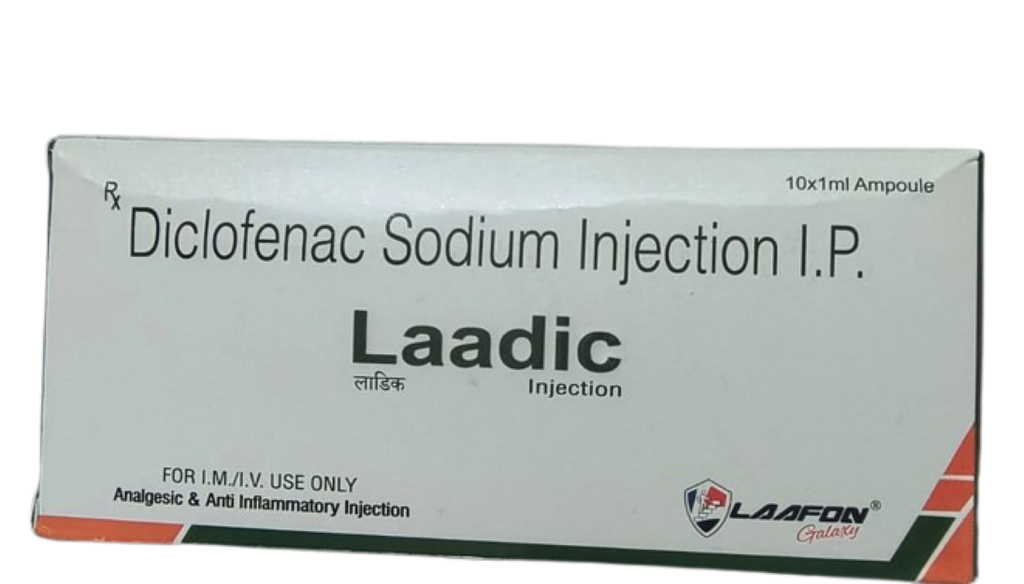
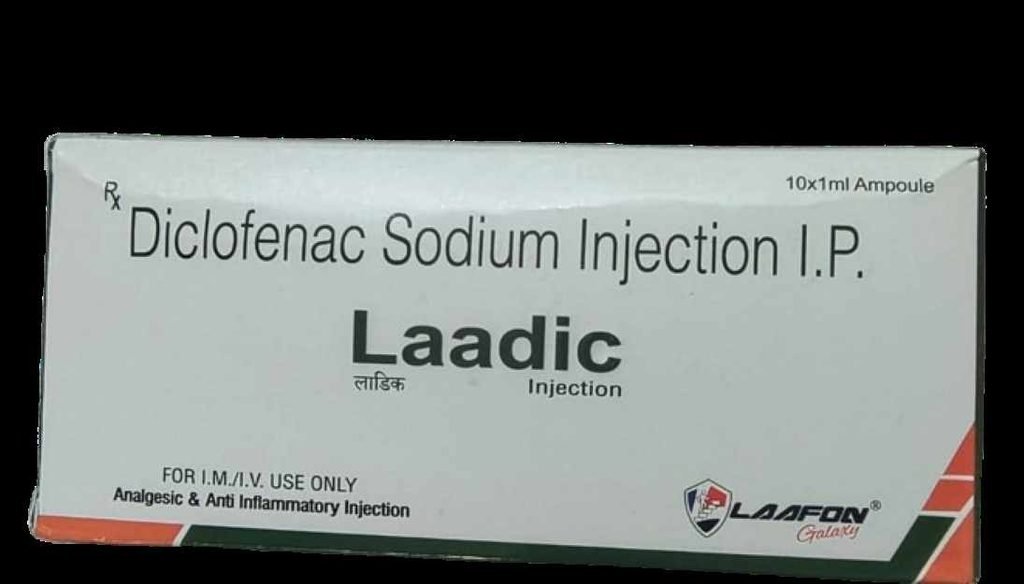
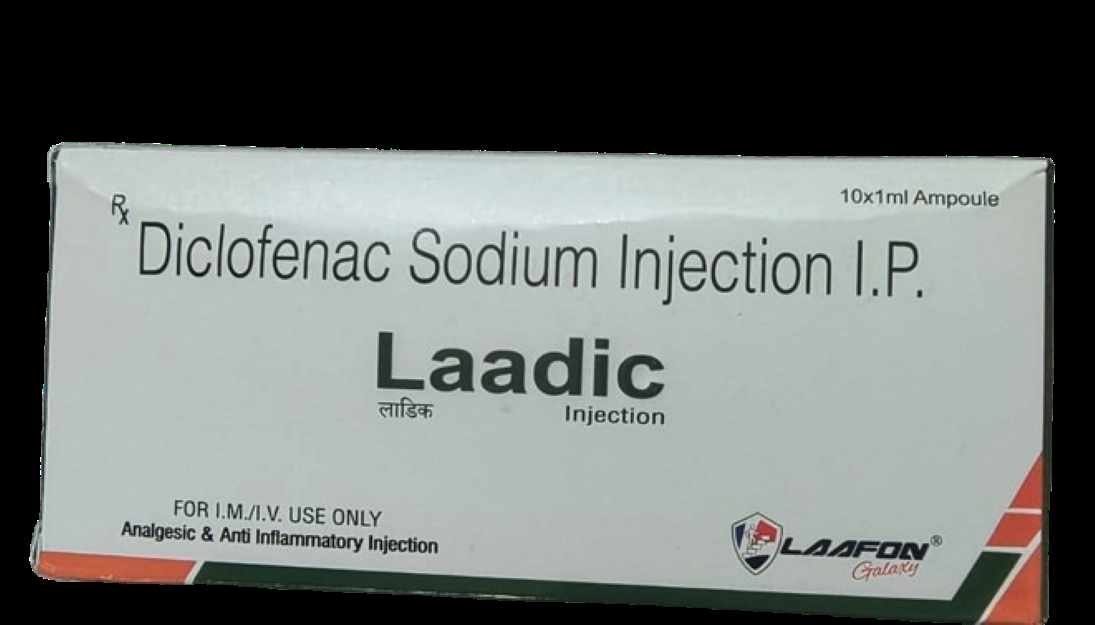
Laadic Injection: product details
| Brand | Laadic Injection (लाडिक) |
|---|---|
| Composition | Each mL: Diclofenac Sodium IP 75 mg, Water for Injection IP q.s. (from the ampoule label) |
| Pack | 10 × 1 mL ampoules in a tray |
| Route (as labelled) | Intramuscular or intravenous (I.M./I.V.) |
| Class | NSAID: analgesic and anti-inflammatory |
| Legal status | Rx · Schedule H |
| MRP | ₹24.00 per 1 mL ampoule (as printed on the label, batch Mfg 06/2025) |
| Storage | Cool, dry and dark place. Protect from direct sunlight (label). |
| Marketed by | Laafon Galaxy Pharmaceuticals |
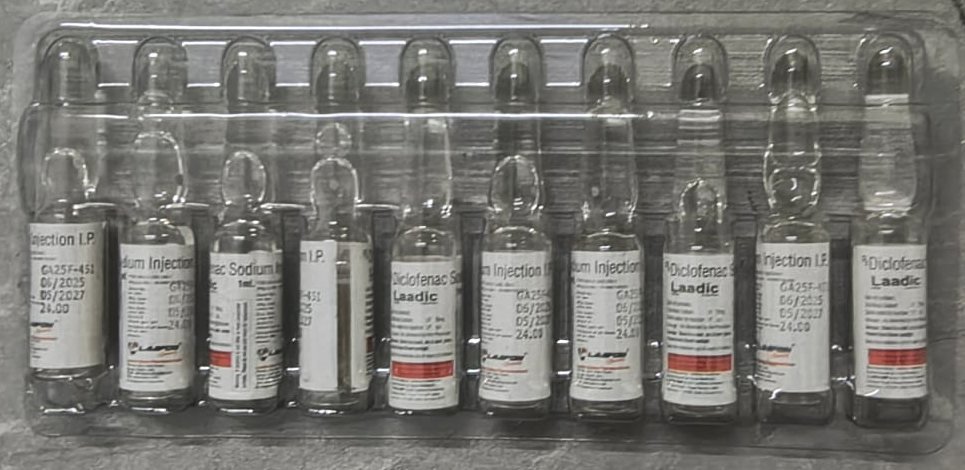
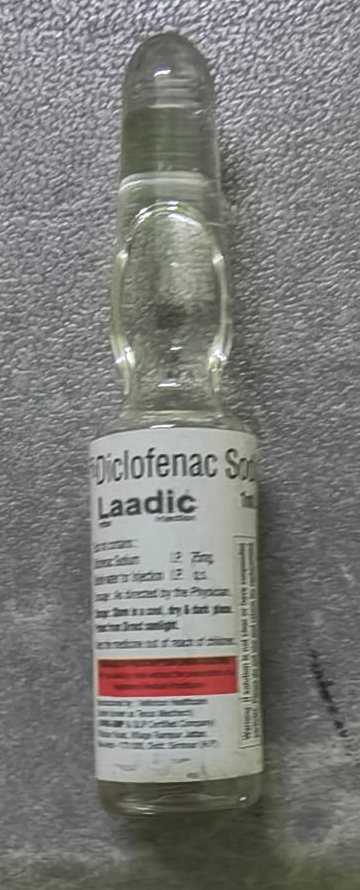
Note the strength: Laadic carries 75 mg in 1 mL. Many reference products carry the same 75 mg in 3 mL (25 mg/mL), so always calculate the dose in mg rather than copying a volume across brands.
Mechanism of action (MOA) of diclofenac
Diclofenac inhibits cyclooxygenase-1 and cyclooxygenase-2, the enzymes that make prostaglandin G2/H2 from arachidonic acid. Lower prostaglandin production is the common mechanism behind its analgesic, anti-inflammatory and antipyretic effects.[1] A review of its pharmacology describes it as inhibiting COX-1 and COX-2 with relative equipotency, rather than favouring one isoform.[5]
Why the side effects follow the same pathway
COX-1 makes the prostaglandins that protect the stomach lining and keep kidney blood flow steady, and it also supports platelet thromboxane. That is why the labelled warnings centre on gastrointestinal ulceration and bleeding, fluid retention and renal effects. A shift in the prostacyclin–thromboxane balance is also why there is a dose-related risk of arterial thrombotic events.[2] A 2013 European review concluded that systemic diclofenac’s cardiovascular risk is similar to that of the selective COX-2 inhibitors.[6]
Beyond COX: proposed additional mechanisms
Laboratory research suggests diclofenac may also inhibit the thromboxane-prostanoid receptor and lipoxygenase enzymes, affect how arachidonic acid is released and taken up, and activate the nitric oxide–cGMP antinociceptive pathway. The review that collected this work notes that none of these has clinical data proving it matters at the bedside.[5] Treat them as hypotheses, not as reasons to prefer diclofenac.
Why the injection acts quickly: pharmacokinetics
Figures for a 75 mg IM dose from the approved product label.[2] Absorption begins as soon as the drug is injected.
Diclofenac injection uses (labelled indications)
Intramuscular (IM)
- Renal colic
- Exacerbations of osteoarthritis and rheumatoid arthritis
- Acute back pain
- Acute gout
- Acute trauma and fractures
- Post-operative pain
From the reference product label.[2] The Indian prescribing information for a 75 mg/mL ampoule lists post-operative pain, rheumatoid arthritis and osteoarthritis.[3]
What the clinical evidence shows
Renal colic. In a double-blind trial of 1,644 emergency-department patients, 68% of those given diclofenac 75 mg IM had at least a 50% fall in pain score at 30 minutes. The figures were 66% with IV paracetamol 1 g and 61% with IV morphine 0.1 mg/kg. Diclofenac was significantly more effective than morphine and caused fewer acute adverse events (1% vs 3%).[7]
Post-operative pain. In 90 women having abdominal hysterectomy, IM diclofenac 75 mg cut the 24-hour need for rescue tramadol to a mean of 20 mg, against 56.7 mg with IV paracetamol 1 g. Only 20% of patients needed rescue, against 50%. Adding paracetamol to diclofenac gave no further benefit.[8]
Read the trial dose carefully. The hysterectomy study gave 75 mg every 8 hours (225 mg in 24 hours), which is above the labelled ceiling of 150 mg a day.[2][8] In practice, follow the label limit, not the trial protocol.
Migraine, dental pain and fever are not listed indications for the injection in either label above.[2][3] The earlier version of this page listed migraine and dental pain, and both have been removed.
Diclofenac injection dose for adults: IM or IV, in mg and mL
Pick the route and the clinical situation. The regimen shown comes from the approved labels,[2][3] and the volumes are worked out for Laadic’s 75 mg/mL strength.
1. Route
2. Clinical situation
Standard adult IM dose: 75 mg (1 mL) once daily
Give a deep intragluteal injection into the upper outer quadrant. In severe cases a second 75 mg dose may be given the same day, into the other buttock.
Max 150 mg (2 mL) per 24 h · max 2 days, then oral or rectal
Dose-to-volume table for a 75 mg/mL ampoule
| Dose | Volume of Laadic (75 mg/mL) | Same dose from a 25 mg/mL product | Where it applies |
|---|---|---|---|
| 25 mg | 0.33 mL | 1 mL | Lower end of the IV loading dose for prevention |
| 50 mg | 0.67 mL | 2 mL | Upper end of the IV loading dose for prevention |
| 75 mg | 1 mL (one ampoule) | 3 mL | Standard single IM or IV-infusion dose |
| 150 mg | 2 mL (two ampoules) | 6 mL | Maximum total in any 24 hours, all routes |
On small screens, scroll the table sideways.
IV infusion: how the reference label says to prepare it
Just before starting, dilute the dose in 100–500 mL of 0.9% sodium chloride or 5% glucose. Both solutions are first buffered with sodium bicarbonate (0.5 mL of 8.4% or 1 mL of 4.2%). The diluted dose is then infused over the times shown in the selector, and the label states that diclofenac must not be given as an IV bolus.[2] These preparation steps come from the reference 75 mg/3 mL product. Where Laadic’s own package insert gives different dilution instructions, follow the insert.
Injection technique and the injection-site warning
The labelled IM site is the upper outer quadrant of the buttock, injected deep into the gluteal muscle. The deltoid is not the labelled site. The label asks for its IM instructions to be followed strictly, to avoid nerve damage, local necrosis and embolia cutis medicamentosa (Nicolau syndrome).[2] A systematic review found 62 published cases of Nicolau syndrome after NSAID injections since 1992, and 53 of them followed diclofenac.[9] If a patient has sudden severe pain at the injection site with livid or mottled skin, stop and assess it urgently.
Children
Both labels say diclofenac injection is not recommended for children, and neither gives a per-kg injection dose.[2][3] Any paediatric use is a specialist decision outside the label.
Elderly
Use with particular caution. Give the lowest effective dose to frail or low-body-weight patients and watch for GI bleeding.[2]
Kidney and liver
Contraindicated in renal or hepatic failure. In mild to moderate impairment use with caution; the label gives no specific dose adjustment.[2]
Diclofenac injection contraindications
Do not use by any route
- Hypersensitivity to diclofenac or any excipient
- Active, or a history of, gastric or intestinal ulcer, bleeding or perforation
- Asthma, angioedema, urticaria or rhinitis triggered by aspirin or other NSAIDs
- Established heart failure (NYHA II–IV), ischaemic heart disease, peripheral arterial disease or cerebrovascular disease
- Hepatic failure or renal failure
- Last trimester of pregnancy
Also do not use for IV infusion
- With other NSAIDs or with anticoagulants, including low-dose heparin
- History of bleeding disorder (haemorrhagic diathesis) or cerebrovascular bleeding
- Operations with a high risk of haemorrhage
- Any history of asthma
- Moderate or severe renal impairment (serum creatinine above 160 µmol/L)
- Hypovolaemia or dehydration from any cause
Both lists come from the reference label and the Indian prescribing information for 75 mg/mL ampoules.[2][3] The cardiovascular contraindications were added after the 2013 European review.[6] The previous version of this page left them out.
Pregnancy. Do not give in the first or second trimester unless clearly necessary. Diclofenac is contraindicated in the third trimester. From week 20 onwards it can cause oligohydramnios through fetal kidney dysfunction.[2]
Side effects of diclofenac injection
Common
- Injection-site reaction, pain or hardening (induration)
- Headache, dizziness, vertigo
- Nausea, vomiting, diarrhoea, indigestion, abdominal pain, wind, loss of appetite
- Raised liver transaminases
- Rash
Serious: stop and assess
- GI ulceration, bleeding or perforation, which can be fatal
- Arterial thrombotic events (heart attack, stroke), more likely at higher doses and with longer use
- Bronchospasm in people with asthma
- Injection-site tissue damage, including Nicolau syndrome
From the reference product label.[2]
Drug interactions to check before injecting
| Co-medication | What to watch for |
|---|---|
| Lithium, digoxin | Diclofenac can raise their plasma levels, so monitor levels |
| Diuretics and antihypertensives | Weaker blood-pressure effect and higher risk to kidney function. Some combinations raise potassium |
| Anticoagulants and antiplatelets | Higher bleeding risk. Contraindicated with IV diclofenac |
| Other NSAIDs, including COX-2 inhibitors; corticosteroids | Additive GI ulcer and bleeding risk. Avoid combining NSAIDs |
| SSRIs | Higher GI bleeding risk |
| Methotrexate | Higher methotrexate toxicity when given close together |
| Ciclosporin, tacrolimus | Higher kidney toxicity |
| Quinolone antibacterials | Convulsions reported with the combination |
| Antidiabetics, phenytoin, potent CYP2C9 inhibitors (e.g. voriconazole) | Changed glucose control or drug levels. CYP2C9 inhibitors raise diclofenac exposure |
Interaction groups as listed in section 4.5 of the reference label.[2]
Diclofenac injection in Indian regulation
Schedule H prescription drug
Schedule H to the Drugs Rules, 1945 includes the entry “Diclofenac Sodium/Potassium/Acid”. Diclofenac can therefore be sold by retail only against a registered medical practitioner’s prescription.[4] See the full Schedule H drugs list with labelling and dispensing rules.
Single-dose packs only
Notification G.S.R. 558(E), dated 17 July 2015, restricted diclofenac injection for human use to single-dose packaging. The aim was to protect vultures, because multi-dose vials were being diverted for veterinary use.[10] Laadic’s 1 mL ampoule is a single-dose pack.
Price control status
The National List of Essential Medicines 2022 lists diclofenac injection only at 25 mg/mL.[11] The 75 mg/mL strength is outside that listing, so it has no NPPA ceiling price, and its MRP is the one printed by the marketer. See the current NPPA ceiling price list for scheduled strengths.
75 mg/mL vs 25 mg/mL diclofenac injections
The dose is the same whichever product you use. What changes is how much liquid carries it, and what else is in the ampoule.
| Product | Strength | Volume for 75 mg | Stated excipients | Source |
|---|---|---|---|---|
| Laadic (Laafon Galaxy) | 75 mg/mL | 1 mL | Water for Injection IP | Ampoule label |
| Dicloran AQ (J.B. Chemicals) | 75 mg/mL | 1 mL | Water for Injections IP | Indian prescribing information[3] |
| Voltarol ampoules (UK reference) | 25 mg/mL | 3 mL | Propylene glycol, benzyl alcohol, sodium metabisulphite, mannitol | UK SmPC[2] |
| NLEM 2022 listed strength | 25 mg/mL | 3 mL | Not specified | NLEM 2022[11] |
This is a formulation comparison, not a ranking. On small screens, scroll the table sideways.
Other diclofenac products in the Laadic range
- Laadic-P TabletDiclofenac potassium + paracetamol
- Laadic-MR TabletDiclofenac + chlorzoxazone + paracetamol
- Laadic-SP TabletDiclofenac + serratiopeptidase + paracetamol
- Faster GelTopical diclofenac diethylamine with linseed oil, methyl salicylate and menthol
Distributors and pharmacies: Laadic Injection is part of the Laafon Galaxy PCD range.
Laadic PCD franchise enquiryFrequently asked questions
After a 75 mg IM injection, absorption starts at once and the plasma level peaks in about 20 minutes.[2] In a large renal colic trial, 68% of patients given 75 mg IM had at least halved their pain score by 30 minutes.[7] The plasma half-life is 1–2 hours, but the daily limit of 150 mg still applies.
Yes, but only as a diluted, slow infusion in hospital for post-operative pain, never as an IV bolus. For treatment, 75 mg is infused over 30 minutes to 2 hours. Before infusion it is diluted in 100–500 mL of buffered saline or 5% glucose.[2] The Laadic carton is labelled for I.M./I.V. use. Extra contraindications apply to IV use, including anticoagulant therapy and dehydration.
The adult dose is 75 mg once daily, or twice in severe cases, up to 150 mg in 24 hours for no more than 2 days.[2] With a 75 mg/mL product such as Laadic, 75 mg is 1 mL and the daily maximum is 2 mL. With a 25 mg/mL product, the same 75 mg is 3 mL, so always work from mg, not mL.
It is contraindicated in the third trimester. In the first and second trimesters it should not be given unless clearly necessary. From week 20 onwards it can cause oligohydramnios through fetal kidney dysfunction, so the label advises monitoring and stopping if this occurs.[2]
Both contain diclofenac sodium at a 75 mg dose per ampoule. The UK Voltarol ampoule holds 75 mg in 3 mL with propylene glycol, benzyl alcohol and sodium metabisulphite as excipients.[2] Laadic holds 75 mg in 1 mL, and its label lists water for injection as the vehicle. The dosing limits and contraindications are the same.
Who wrote and reviewed this page
Reviewed by Yogesh Chaudhary, B.Pharm
Registered Pharmacist, Uttar Pradesh State Pharmacy Council. Senior Pharmacist, S.N. Medical College, Agra, with 15+ years in clinical pharmacy and medication management.
Clinical review: 8 October 2026
Written by Darshan Singh
M.Sc. Organic Chemistry, D.Pharm. 23+ years in pharmaceutical quality control, quality assurance and drug regulatory affairs.
First published 14 Feb 2023 · Rebuilt 8 Oct 2026
References
- DrugBank Online. Diclofenac (DB00586). Available from: https://go.drugbank.com/drugs/DB00586. Accessed October 2026.
- Novartis Pharmaceuticals UK Ltd. Voltarol Ampoules: Summary of Product Characteristics. Electronic medicines compendium; text revised 9 September 2025. Available from: https://www.medicines.org.uk/emc/product/1043/smpc. Accessed October 2026.
- J.B. Chemicals and Pharmaceuticals Ltd. Dicloran AQ (Diclofenac Sodium Injection IP 75 mg/mL): prescribing information, India. September 2021. Available from: https://jbpharma.com/wp-content/uploads/2021/10/Dicloran-AQ_PI_India_September-2021_Ver-00.pdf. Accessed October 2026.
- Central Drugs Standard Control Organisation. The Drugs and Cosmetics Act, 1940 and Rules, 1945 (as amended up to 31 December 2016), Schedule H. Government of India. Available from: https://cdsco.gov.in/opencms/export/sites/CDSCO_WEB/Pdf-documents/acts_rules/2016DrugsandCosmeticsAct1940Rules1945.pdf. Accessed October 2026.
- Gan TJ. Diclofenac: an update on its mechanism of action and safety profile. Curr Med Res Opin. 2010;26(7):1715-31. doi:10.1185/03007995.2010.486301. Available from: https://pubmed.ncbi.nlm.nih.gov/20470236/. Accessed October 2026.
- European Medicines Agency. New safety advice for diclofenac (EMA/592685/2013). London: EMA; 25 September 2013. Available from: https://www.ema.europa.eu/en/documents/referral/diclofenac-article-31-referral-new-safety-advice-diclofenac_en.pdf. Accessed October 2026.
- Pathan SA, Mitra B, Straney LD, Afzal MS, Anjum S, Shukla D, et al. Delivering safe and effective analgesia for management of renal colic in the emergency department: a double-blind, multigroup, randomised controlled trial. Lancet. 2016;387(10032):1999-2007. doi:10.1016/S0140-6736(16)00652-8. Available from: https://pubmed.ncbi.nlm.nih.gov/26993881/. Accessed October 2026.
- Pal A, Biswas J, Mukhopadhyay P, Sanyal P, Dasgupta S, Das S. Diclofenac is more effective for post-operative analgesia in patients undergoing lower abdominal gynecological surgeries: a comparative study. Anesth Essays Res. 2014;8(2):192-6. doi:10.4103/0259-1162.134502. Available from: https://pubmed.ncbi.nlm.nih.gov/25886225/. Accessed October 2026.
- Lardelli PF, Jermini LMM, Milani GP, Peeters GGAM, Ramelli GP, Zgraggen L, et al. Nicolau syndrome caused by non-steroidal anti-inflammatory drugs: systematic literature review. Int J Clin Pract. 2020;74(10):e13567. doi:10.1111/ijcp.13567. Available from: https://pubmed.ncbi.nlm.nih.gov/32479658/. Accessed October 2026.
- Press Information Bureau, Government of India. Environment Ministry recommends ban on multidose vial of Diclofenac to save vultures [press release reprinted by Business Standard]; 18 September 2015. Notification G.S.R. 558(E) dated 17 July 2015. Available from: https://www.business-standard.com/article/government-press-release/environment-ministry-recommends-ban-on-multidose-vial-of-diclofenac-to-save-115091800321_1.html. Accessed October 2026.
- Ministry of Health and Family Welfare. National List of Essential Medicines 2022, section 2.1.2 (Diclofenac). New Delhi: Government of India; 2022. Available from: https://qps.nhsrcindia.org/sites/default/files/2022-09/nlem2022.pdf. Accessed October 2026.
Disclaimer: This page gives technical and educational product information for healthcare professionals and the pharmaceutical trade. It is not medical advice. Diclofenac injection is a Schedule H prescription medicine: it must be given only by, or on the order of, a registered medical practitioner, and must not be self-administered. Prescribing details can differ between brands, so always check the package insert supplied with the product. Product labels and Indian statutory instruments change over time; this page reflects the sources above as of 8 October 2026.