
Short answer
An SOP for fumigation of microbiology lab is only defensible if the cycle is validated and if re-entry is decided by a measured fumigant concentration — never by smell or by elapsed time. Fumigation is whole-room bio-decontamination, not a housekeeping task. In an Indian facility the governing occupational number is the Factories Act, 1948 Second Schedule limit for formaldehyde: 1.0 ppm (1.5 mg/m³) as an 8-hour TWA and 2 ppm (3 mg/m³) as a 15-minute STEL.[2] Efficacy is normally demonstrated with Bacillus atrophaeus spore biological indicators at 10⁶ population, with a 6-log reduction as the acceptance criterion.[8]
This page is a working template, not a description of one. It carries the exposure limits, the critical process parameters, the acceptance criteria and the annexure formats a QC microbiologist actually needs when writing or defending a fumigation SOP in front of a state licensing inspector or a customer auditor.
What changed for Indian microbiology labs
Three things have moved since most fumigation SOPs in circulation were written, and all three show up in audits.
Revised Schedule M is now being inspected against. The revised Schedule M was notified by G.S.R. 922(E) dated 28 December 2023.[9] Manufacturers with turnover of ₹250 crore or less could apply for an extension under G.S.R. 127(E) dated 11 February 2025, which moved their compliance date to 1 January 2026; the DCGI subsequently directed State Licensing Authorities to begin inspecting against the revised Schedule.[10] A fumigation SOP with no validation data behind its contact time and no measured re-entry criterion is now an obvious finding.
The WHO reference most SOPs cite has been superseded. A very large number of fumigation SOPs still cite WHO Technical Report Series No. 961, Annex 6 (2011). That text was revised and replaced by TRS 1044, Annex 2, issued 31 October 2022, produced jointly with the European Union and PIC/S.[6] Citing the withdrawn edition is a small thing that tells an auditor the document has not been reviewed in years.
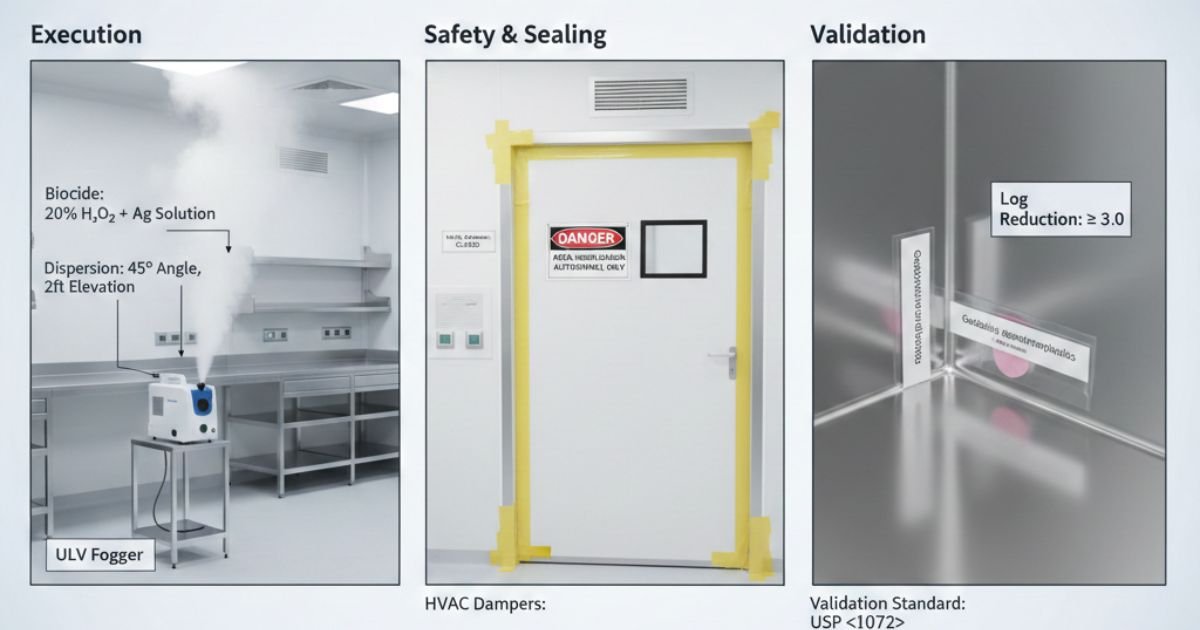
Fumigation is explicitly a validated process, not a housekeeping task. EU GMP Annex 1, in operation since 25 August 2023, states at clause 4.36 that where fumigation or vapour disinfection of cleanrooms and associated surfaces is used, the effectiveness of the fumigation agent and the dispersion system should be understood and validated.[5] The same Annex requires at 4.33 that routine disinfection include the periodic use of a sporicidal agent — meaning fumigation supplements a disinfection programme, it does not replace one.
Exposure limits that govern microbiology lab fumigation
These are the numbers that decide when people may go back in. They are statutory or regulatory limits, not site policy, and they should be quoted with their source inside the SOP itself.
| Substance / limit | Value | Source and status |
|---|---|---|
| Formaldehyde — 8-hour TWA | 1.0 ppm (1.5 mg/m³) | India, Factories Act 1948, Second Schedule entry (57). Statutory.[2] |
| Formaldehyde — 15-min STEL | 2 ppm (3 mg/m³) | India, Factories Act 1948, Second Schedule entry (57). Statutory.[2] |
| Formaldehyde — 8-hour TWA (US) | 0.75 ppm | OSHA 29 CFR 1910.1048 PEL. Applies to US sites; useful as a benchmark for export-facing facilities.[3] |
| Formaldehyde — action level (US) | 0.5 ppm | OSHA 29 CFR 1910.1048. Triggers periodic monitoring and medical surveillance.[3] |
| Formaldehyde — odour threshold | 0.5 – 1.0 ppm | ATSDR. Overlaps the exposure limit, so smell is not a valid re-entry test.[4] |
| Formaldehyde — IDLH | 20 ppm | NIOSH, cited in ATSDR medical management guidelines.[4] |
| Ammonia — TWA / STEL | 25 ppm / 35 ppm | India, Second Schedule entry (8). Relevant where ammonia neutralisation is used.[2] |
| Hydrogen peroxide — TWA | 1 ppm (1.5 mg/m³) | India, Second Schedule entry (64). Applies to VPHP alternatives.[2] |
| bis(chloromethyl) ether — TWA | 0.001 ppm (0.005 mg/m³) | India, Second Schedule entry (33), flagged H.C. (confirmed human carcinogen). See the incompatibility warning below.[2] |
Scroll the table sideways on a phone. The Second Schedule was substituted by S.O. 170(E) dated 2 March 1989.
A classification mismatch worth knowing before an audit. The Indian Second Schedule flags formaldehyde as S.C. — suspected human carcinogen. That schedule dates from 1989. IARC reclassified formaldehyde as carcinogenic to humans, Group 1, on the basis of sufficient evidence for nasopharyngeal cancer, published in Monographs Volume 88.[1] Your risk assessment should be written against the Group 1 classification, even though the statutory numeric limit you must meet is the one in the Second Schedule.
Fumigant charge and purge-time estimator
The most common question asked about lab fumigation is not what it is — it is how much. Published SOPs quote formalin and potassium permanganate quantities that differ by a factor of five, and most quote them per container with no room volume attached, which makes them impossible to apply. The estimator below normalises the published figures per cubic metre so you can at least see the spread you are choosing between. The ratio table that follows explains why the spread exists.
Purge estimate assumes roughly 25 air changes: time (min) = 25 × volume ÷ extract rate. The source procedure prints this relationship in a transposed form that is dimensionally inconsistent; the form implemented here is the one that reproduces its intent. Treat the output as a planning figure only.
Charge quantities and contact time must be established for your own room volume, surface materials, HVAC design and worst-case load through a documented qualification study. The output above is a starting point for a protocol, not an approved parameter. Purge time never authorises re-entry. Re-entry is authorised by a measured formaldehyde concentration and nothing else.
Formalin and potassium permanganate ratio: what the published figures actually say
Almost every SOP in circulation gives a formalin and potassium permanganate quantity, and almost none gives a source. Laid side by side and normalised to a common room volume, the published figures disagree by roughly a factor of five. That disagreement is the real answer to the question, and it is worth understanding before you copy any single number into your own document.
| Published figure | As stated | Normalised per 28 m³ | Source type |
|---|---|---|---|
| Heated vaporiser, no permanganate | 100 mL formalin + 900 mL water per 28.3 m³ | ≈ 99 mL formalin | Named institutional biological-safety procedure, with a stated contact time and a measured re-entry rule.[7] |
| Permanganate route, volume-based | 500 mL formalin + 170 g KMnO₄ per 28 m³ | 500 mL formalin | Widely repeated in Indian pharmaceutical practice; not traceable to a primary or regulatory source.[13] |
| Permanganate route, per container | 10–15 g KMnO₄ + 25–30 mL formalin per container | Not derivable | Common blog and template SOP figure. No room volume and no container count are stated, so it cannot be applied to a specific room. |
The five-fold spread is not a rounding difference. It reflects two genuinely different methods — controlled vaporisation of a dilute charge versus a rapid exothermic permanganate reaction — carrying different concentration profiles and different residue behaviour.
Why the calculation does not predict the room. Measured formaldehyde concentrations in fumigated rooms are consistently and substantially lower than the quantity-and-volume calculation predicts, which is why fumigation that “should” have failed on paper often works and fumigation that “should” have worked sometimes does not.[7] Absorption into surfaces, leakage through imperfect seals and paraformaldehyde deposition all remove fumigant from the air. A ratio is a starting point for a qualification protocol, never a substitute for one. The only figure that means anything in an audit is the one you established with biological indicators in your own rooms.
What to put in the protocol instead of a copied ratio
- State the measured room volume, not the floor area.
- State which route you are validating — vaporiser or permanganate — and do not mix figures between them.
- Run at least three cycles at the chosen charge with biological indicators at worst-case locations, and record temperature and relative humidity at dwell start for each.
- Where a cycle fails, change one variable — charge, contact time or humidity — and record which. Changing two at once tells you nothing.
- Fix the validated charge in the SOP as a quantity per measured room volume, with the qualification report referenced by number.
Critical process parameters: why formaldehyde fumigation fails
Formaldehyde is an alkylating agent. It has to dissolve into a film of moisture around the organism to work, which is why humidity and temperature are process parameters rather than ambient conditions you record for completeness. Get them wrong and the cycle can look perfectly executed on paper while achieving very little.
| Parameter | Target | Why it matters |
|---|---|---|
| Relative humidity | 65 % minimum | Water is added with the formalin specifically to generate it. UK regulatory guidance for containment laboratories cites 70–90 % RH.[7][8] |
| Temperature | above 20 °C | Below 18 °C efficacy drops. Below 9 °C formaldehyde sublimes and is hard to vaporise at all.[7] |
| Contact time | not less than 12 h | Best run overnight. Must be confirmed by your own qualification study, not adopted from a published SOP.[7] |
| Pre-cleaning | Complete, surfaces dry | Annex 1 requires cleaning before disinfection so residues cannot inhibit the agent.[5] |
| Overcharging | Avoid | Excess formaldehyde deposits sticky paraformaldehyde on surfaces and can block filters.[7] |
Large rooms are harder than the literature suggests. Measured formaldehyde levels in fumigated rooms are consistently lower than the quantity-and-volume calculation predicts.[7] In a 35 m³ enclosure at a calculated 600 ppm for three hours, log reductions of Geobacillus stearothermophilus on stainless steel discs of only 2.27 to 5.55 have been reported — short of a 6-log criterion.[11] This is the argument for placing biological indicators at genuine worst-case locations rather than at convenient ones.
Three fumigation practices that fail a GMP audit
1. Using smell as the re-entry criterion
A great many published SOPs, including earlier versions of this one, allow re-entry once the odour is no longer perceptible. The formaldehyde odour threshold is 0.5 to 1.0 ppm — it straddles the Indian statutory 8-hour TWA of 1.0 ppm and sits above the OSHA PEL of 0.75 ppm. ATSDR states plainly that for sensitised persons odour is not an adequate indicator and may not give reliable warning of hazardous concentrations.[4]
The defensible rule is a measured one. Purge, then measure with a direct-reading formaldehyde meter or air-sampling tubes through a door port. The referenced institutional procedure allows a single person wearing a full-face respirator to enter for verification only once the reading is below 2 ppm, and permits general staff back only below 0.5 ppm.[7] An Indian site should set its own general re-entry limit at or below the Second Schedule TWA of 1.0 ppm and justify the value in the SOP.
2. Leaving hypochlorite discard jars in the room
Under certain conditions formaldehyde reacts with hydrochloric acid and with chlorine-containing disinfectants such as hypochlorites to form bis(chloromethyl) ether, a potent lung carcinogen.[7] Hydrochloric acid and hypochlorite must be physically removed from the room before fumigation begins. The scale of the hazard is visible in the statutory limits themselves: India’s Second Schedule sets bis(chloromethyl) ether at 0.001 ppm and flags it a confirmed human carcinogen, a thousand times stricter than the formaldehyde limit.[2]
A microbiology lab is exactly the room where this goes wrong, because hypochlorite discard jars are standard equipment and are easy to overlook during pre-fumigation clearance. Put it on the checklist as a signed line item.
3. Specifying a cartridge respirator for the fumigation itself
Concentrations generated during a room fumigation are many hundreds of times the workplace exposure limit. Cartridge respirators are not appropriate at those levels; entry during fumigation requires full breathing apparatus supplied from an independent air source, by trained users.[7] In practice this means the correct control is that nobody enters at all. A full-face cartridge respirator with formaldehyde filters has a place only in the post-purge verification entry, after measurement has shown the concentration to be low, and only where the wearer has passed quantitative face-fit testing.
An SOP that lists “NIOSH-approved respirator or mask” as the PPE for fumigation without distinguishing the fumigation phase from the verification phase is describing a control that does not exist.
SOP for fumigation of microbiology lab — adaptable template
Adapt every field below. The header placeholders are deliberately unmissable: a document number invented for someone else’s quality management system is worse than a blank.
Standard Operating Procedure — Fumigation of the Microbiology Laboratory
1.0Purpose
To define a validated, measurable procedure for whole-room chemical fumigation of the microbiology laboratory, including the conditions under which personnel may re-enter.
2.0Scope
Applies to scheduled and event-driven fumigation of the microbiology laboratory suite — sterility testing room, incubation room, media preparation room, change rooms and associated airlocks — at /REPLACE-SITE-NAME.
Excluded: fumigation or bio-decontamination of biological safety cabinets and laminar airflow units, which follows the equipment manufacturer’s cycle under a separate SOP; isolator and RABS bio-decontamination; production-area sanitisation; and routine surface disinfection, which is a separate daily activity and is not replaced by fumigation.
3.0Responsibility
- Microbiologist / Officer QC — prepares the room, executes the cycle, places and retrieves biological indicators, performs monitoring, completes records.
- Head, Quality Control — approves the fumigation schedule, reviews each record, authorises release of the area for use.
- Head, Quality Assurance — approves the SOP and the qualification protocol, approves deviations and CAPA, ensures periodic requalification.
- Engineering / Utility — isolates and restarts AHU and exhaust, confirms room sealing integrity, operates the remote purge switch.
- Safety Officer — verifies exposure monitoring equipment calibration, respirator face-fit records and training currency before each cycle.
4.0Materials, equipment and reagents
- Formaldehyde solution approximately 37 % w/v (formalin), IP or LR grade as defined in the approved specification
- Purified water for dilution
- Electric fumigation vaporiser of capacity appropriate to the room volume, or, where the potassium permanganate route is validated, KMnO₄ (commercial grade) in wide-mouth non-reactive heat-resistant containers
- Self-contained biological indicators, Bacillus atrophaeus, population 10⁶, with certificate of analysis stating population, purity and identity
- Direct-reading formaldehyde meter, or formaldehyde air-sampling tubes with pump — calibrated, with current calibration certificate
- Calibrated thermo-hygrometer for the room
- Door sealing tape, foam sealing strip, warning signage
- Full-face respirator to EN 136 or equivalent with formaldehyde-rated filters, individually face-fit tested; chemical-resistant gloves; coverall; eye protection
- Spill kit; ammonia solution where an approved neutralisation step is used
5.0Procedure
- Schedule the cycle so that at least one full working day separates fumigation from the resumption of laboratory activity.
- Complete routine cleaning of floors, benches and equipment per the applicable cleaning SOP. Cleaning precedes disinfection; residues inhibit the agent.
- Remove all open media, cultures, plates, incubated samples and waste from the suite.
- Remove all hydrochloric acid and all chlorine-containing disinfectants, including hypochlorite discard jars, from every room in scope. Record the removal as a signed line on Annexure-I. This step exists to prevent formation of bis(chloromethyl) ether.
- Confirm all surfaces, sinks and floors are dry. Standing water alters the humidity profile and skews the cycle.
- Cover or remove sensitive electronic equipment where the manufacturer requires it.
- Verify calibration status of the formaldehyde meter and the thermo-hygrometer; record certificate numbers on Annexure-I.
- Switch off all laminar airflow units, biosafety cabinets, split air-conditioners and the AHU serving the suite. Deactivate smoke detectors in the affected zone and record the deactivation.
- Seal external ventilation grilles, service duct penetrations and any gap through which vapour could pass to adjacent areas. Where a false ceiling exists, confirm the void does not interconnect with other areas.
- Confirm the purge route is unobstructed and that the remote extract switch operates from outside the room. Run the extract for five minutes, then switch off.
- Place biological indicators at the worst-case locations defined in the qualification report — typically behind and under benching, inside equipment enclosures, at floor level in corners, and at the point furthest from the vaporiser. Record each location on Annexure-II.
- Retain one BI from the same lot outside the room as an unexposed positive control.
- Record starting room temperature and relative humidity.
- Calculate the formalin and water charge from the validated ratio in the qualification report for the measured room volume. Record the calculation, not just the result.
- Charge the vaporiser with the calculated formalin and water. Do not overcharge; excess deposits paraformaldehyde.
- Where the potassium permanganate route is used instead and has been validated for this room: weigh KMnO₄ into wide-mouth non-reactive containers with ample free volume, then add formalin slowly. The reaction is vigorous and exothermic. Do not lean over the container. Charge the furthest container first and work toward the door.
- Activate the vaporiser and leave the room immediately.
- Lock the door and seal its edges with tape.
- Display “DANGER — FUMIGATION IN PROGRESS, ENTRY PROHIBITED” at every entry point and at the adjacent corridor approach.
- Record start time. Under no circumstances is entry permitted during the cycle; cartridge respirators do not protect at fumigation concentrations.
- Hold for the validated contact time, not less than 12 hours. Overnight is preferred.
- Where instrumentation allows, log temperature, relative humidity and formaldehyde concentration through the dwell phase. Where it does not, record the fact that the cycle is not monitored in real time — this is a known limitation of manual fumigation and should be stated rather than hidden.
- Using the remote switch, start the extract without entering the room. Open dampers remotely if required.
- Purge for at least the time calculated from room volume and extract capacity. Where an approved ammonia neutralisation step forms part of the validated cycle, apply it per the qualification report and note that ammonia carries its own exposure limit of 25 ppm TWA.
- Measure the residual formaldehyde concentration from outside the room, through a door sampling port, using the calibrated direct-reading meter or sampling tubes.
- Verification entry: once the reading is below the site verification limit, one trained person wearing a face-fit-tested full-face respirator with formaldehyde filters, coverall and gloves may enter to survey all areas, including corners and enclosed spaces where pockets of vapour persist.
- General re-entry: permit other staff only once measurements across the room are below the site re-entry limit defined in section 6.0. Do not substitute odour, elapsed time or absence of irritation for a measurement.
- Remove all sealing materials, inspect surfaces for paraformaldehyde residue and clean as required.
- Restore AHU, LAF units and smoke detectors. Record restoration.
- Retrieve all biological indicators, taking care not to transfer contamination to laboratory or testing areas. Incubate exposed BIs and the unexposed positive control per the manufacturer’s instructions.
- Perform post-fumigation environmental monitoring — settle plates, active air sampling and surface swabs — at the locations and to the limits defined in section 6.0.
- Head QC reviews BI results, environmental monitoring results and the completed record, and authorises release of the area for use.
- Do not resume critical operations before release is signed.
6.0Acceptance criteria
Each row below states whether the value is a compendial or statutory requirement or a site policy decision. Presenting a site convention as a regulatory limit is the single most damaging error this kind of document can contain.
| Criterion | Limit | Basis |
|---|---|---|
| Biological indicator kill | No growth from all exposed BIs; growth in positive control | Site policy, aligned to published practice using B. atrophaeus 10⁶ with a 6-log reduction criterion.[8] The 6-log target is a convention, not a compendial requirement for room fumigation. |
| Formaldehyde — general re-entry | ≤ 1.0 ppm, measured | Statutory ceiling: Factories Act 1948 Second Schedule 8-h TWA.[2] Sites may set a tighter internal limit; 0.5 ppm is used in the referenced institutional procedure.[7] |
| Formaldehyde — verification entry with respirator | ≤ 2.0 ppm, measured | Site policy, aligned to referenced institutional practice.[7] Also the Second Schedule 15-minute STEL.[2] |
| Relative humidity at dwell start | ≥ 65 % | Process parameter from published fumigation practice; confirm your own target in qualification.[7][8] |
| Room temperature at dwell start | above 20 °C | Process parameter; efficacy falls below 18 °C.[7] |
| Contact time | ≥ 12 h | Site policy derived from published practice; must be confirmed by qualification.[7] |
| Post-fumigation EM — Grade B area | Air 10 CFU/m³; settle plate 5 CFU/4 h; contact plate 5 CFU/plate | EU GMP Annex 1 Table 2 qualification limits. Apply only where the room is a classified cleanroom of that grade.[5] |
| Post-fumigation EM — Grade C area | Air 100 CFU/m³; settle plate 50 CFU/4 h; contact plate 25 CFU/plate | EU GMP Annex 1 Table 2 qualification limits.[5] |
| Post-fumigation EM — Grade D area | Air 200 CFU/m³; settle plate 100 CFU/4 h; contact plate 50 CFU/plate | EU GMP Annex 1 Table 2 qualification limits.[5] |
A general microbiology laboratory is usually not a classified cleanroom. Where it is not, set your own alert and action levels from your historical environmental monitoring baseline and say so in the SOP rather than importing Annex 1 grades that do not apply to the room.
7.0Frequency
- Scheduled: at an interval set by quality risk management and by trend review of environmental monitoring data. Weekly, fortnightly and monthly intervals all appear in industry practice; none of them is a compendial requirement. Justify your interval from your own data.
- Event-driven: after civil or maintenance work in the suite; after a confirmed action-level excursion in environmental monitoring; after a spillage involving cultures; after a sterility test failure investigation implicates the area.
- Requalification: where the suite is a classified cleanroom, Annex 1 sets maximum requalification intervals of 6 months for Grade A and B and 12 months for Grade C and D.[5]
8.0Precautions and safety
- Formaldehyde is classified by IARC as carcinogenic to humans, Group 1.[1] Exposure must be minimised, not merely kept under a limit.
- Remove hydrochloric acid and all chlorine-releasing disinfectants before sealing. See section 5.1 step 4.
- No entry during the cycle. Cartridge respirators do not protect at fumigation concentrations.[7]
- Vapour escaping to adjacent occupied areas is an uncontrolled release of a hazardous chemical, not a housekeeping nuisance. Confirm sealing before starting.
- Only named, trained and assessed personnel may perform fumigation. Face-fit test records must be current and product-specific.
- Agents causing transmissible spongiform encephalopathies are resistant to formalin; fumigation is not an appropriate control for them.[7]
- Audit-failure precautions, distinct from personal-injury ones: unrecorded smoke-detector deactivation; BI lot with no certificate of analysis; uncalibrated formaldehyde meter; a re-entry decision with no measurement attached to it.
9.0Deviation handling
- Any BI shows growth. Do not release the area. Raise a deviation. Verify the positive control grew, confirm BI lot and storage, review recorded temperature, humidity, charge and contact time against the validated parameters, then repeat the cycle with corrected parameters and additional BIs at the failing location. Assess the impact on any testing already performed in the area since the previous release.
- Positive control shows no growth. The BI lot or incubation is invalid; the run proves nothing. Repeat with a fresh lot before drawing any conclusion about the cycle.
- Residual formaldehyde will not fall below the re-entry limit. Continue purging. Do not shorten the criterion. Investigate sealing, extract capacity and overcharging. Where the level plateaus, treat as a facility deviation and involve Engineering.
- Humidity or temperature outside target at dwell start. The cycle is not to the validated parameters. Either abort and re-run under controlled conditions or record it as a deviation with a documented impact assessment; do not silently accept it.
- Post-fumigation EM exceeds the action level. Investigate under the quality system as a contamination event, not as a fumigation failure alone. Identify the isolate; a resistant flora finding points to the disinfection programme rather than the fumigation cycle.[5]
10.0Annexures
- Annexure-I — Fumigation Execution and Clearance Record
- Annexure-II — Biological Indicator Placement and Result Record
- Annexure-III — Post-fumigation Environmental Monitoring Record
- Annexure-IV — Fumigation Training and Face-Fit Test Register
Annexure-I — Fumigation Execution and Clearance Record
| Field | Entry | Done by / date | Verified by |
|---|---|---|---|
| Rooms in scope | |||
| Measured room volume (m³) | |||
| Cleaning completed per SOP no. | |||
| HCl and hypochlorite removed from all rooms | |||
| Cultures, media and waste removed | |||
| AHU / LAF / split AC switched off (time) | |||
| Smoke detectors deactivated (time) | |||
| Sealing completed and verified | |||
| Formalin volume charged (mL) | |||
| Water volume charged (mL) | |||
| Temperature at dwell start (°C) | |||
| Relative humidity at dwell start (%) | |||
| Cycle start time | |||
| Purge start time | |||
| Formaldehyde meter ID and calibration due date | |||
| Reading before verification entry (ppm) | |||
| Reading before general re-entry (ppm) | |||
| Sealing materials removed, surfaces inspected | |||
| AHU, LAF and smoke detectors restored (time) | |||
| Deviation raised (Y/N and reference) | |||
| Area released for use — Head QC |
11.0Revision history
| Version | Effective | Change | Reason |
|---|---|---|---|
| 00 | /REPLACE-DATE | New document | Initial issue |
| 01 | /REPLACE-DATE | Re-entry criterion changed from absence of odour to a measured concentration; BI acceptance criterion added; chemical incompatibility clearance step added | Odour threshold overlaps the statutory exposure limit; efficacy was previously unverified |
This is a template. It requires local qualification, validation and QA approval before use in a regulated facility. Charge quantities, contact time, purge time and acceptance criteria must be established for your own rooms and equipment. Pharmacopoeial texts and Indian statutory instruments change between editions — verify every limit quoted here against the current edition before you sign the document.
Formaldehyde or vapour-phase hydrogen peroxide
EU GMP Annex 1 names vapour-phase hydrogen peroxide explicitly in the fumigation clause, and the same validation expectation applies to both agents.[5] The decision is rarely about efficacy alone.
| Factor | Formaldehyde / formalin | Vapour or aerosolised H₂O₂ |
|---|---|---|
| Carcinogenicity | IARC Group 1, carcinogenic to humans[1] | Not classified as a human carcinogen; decomposes to water and oxygen |
| Indian statutory 8-h TWA | 1.0 ppm[2] | 1 ppm[2] |
| Typical biological indicator | Bacillus atrophaeus[8] | Geobacillus stearothermophilus[12] |
| Aeration | Slow; needs measured clearance and can leave paraformaldehyde residue | Faster; catalytic breakdown to water and oxygen, no toxic residue |
| Cycle control | Manual charge; concentration, RH and temperature usually not controlled in real time[8] | Generator-controlled cycle with defined injection rate, dwell and aeration parameters |
| Capital cost | Low — vaporiser or containers only | Higher — dedicated generator and monitoring, plus cycle development |
| Material compatibility | Reacts with HCl and hypochlorites to form bis(chloromethyl) ether[7] | Oxidiser; check compatibility with electronics, some elastomers and unsealed metals |
For a facility going through a Schedule M upgrade anyway, the honest comparison is not formaldehyde against hydrogen peroxide in the abstract. It is whether you can generate, monitor and evidence a controlled cycle at all. A manually charged formaldehyde cycle with no real-time monitoring can still be validated with biological indicators, but the evidence package is thinner and the occupational risk is carried by your own staff.
Frequently asked questions
There is no compendial frequency. Weekly, fortnightly and monthly intervals all appear in industry practice, and none of them is a regulatory requirement. Set the interval from quality risk management and from your own environmental monitoring trend data, and fumigate additionally after civil or maintenance work, after a confirmed action-level excursion, and after a spillage involving cultures. An interval you can justify from your own data will survive an audit; a weekly interval copied from a template will not.
Only when a measurement says so. Purge the room, then measure residual formaldehyde with a calibrated direct-reading meter or air-sampling tubes from outside through a door port. General re-entry should be permitted only below your defined site limit, which cannot exceed the Factories Act Second Schedule 8-hour TWA of 1.0 ppm. Absence of smell is not a valid test: the odour threshold is 0.5 to 1.0 ppm and sensitised people may show symptoms below it.
It remains in use and is not prohibited under Indian drug law, and the Factories Act Second Schedule sets a permissible exposure limit for it rather than banning it. But it is an IARC Group 1 human carcinogen, and both EU GMP Annex 1 and current practice expect the cycle to be validated and the exposure controlled. Continued use is a defensible choice only if you can produce validation data, exposure measurements and training records. If you cannot, the problem is not the agent — it is the absence of evidence.
Bacillus atrophaeus spore indicators at a population of 10⁶ are the usual choice for formaldehyde, with a 6-log reduction as the working acceptance criterion. Geobacillus stearothermophilus is the usual choice for hydrogen peroxide. Place indicators at genuine worst-case locations, keep an unexposed indicator from the same lot as a positive control, and verify the lot’s population, purity and identity before use.
Under certain conditions formaldehyde reacts with hydrochloric acid and with chlorine-releasing disinfectants such as hypochlorites to form bis(chloromethyl) ether, a potent lung carcinogen with an Indian statutory 8-hour limit of 0.001 ppm — a thousand times stricter than the formaldehyde limit. Microbiology labs routinely keep hypochlorite discard jars on the bench, so this is a realistic hazard rather than a theoretical one. Make removal a signed line item on the clearance record.
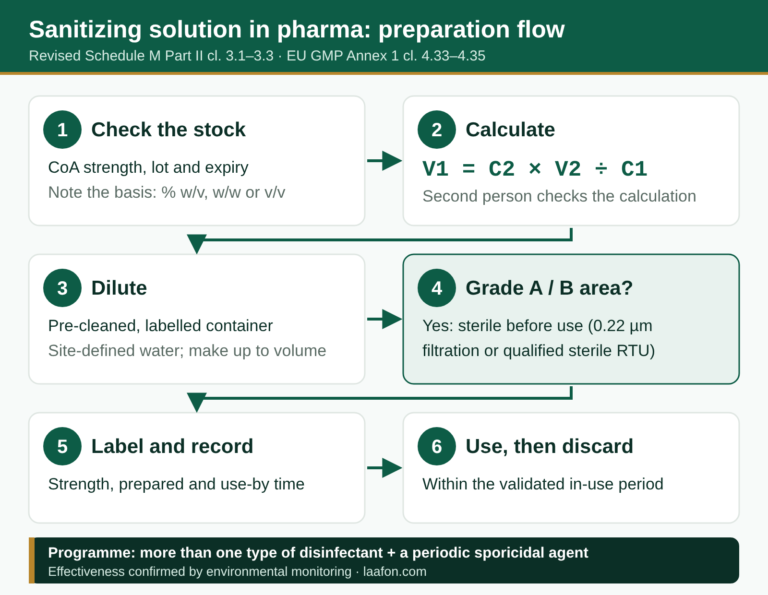
No. EU GMP Annex 1 treats disinfection as a written, validated programme using more than one type of agent with different modes of action, including the periodic use of a sporicide, and treats fumigation as a separate validated activity. Fumigation supplements that programme. A facility that fumigates monthly but has no validated daily disinfection regime has the sequence backwards.
Where fumigation sits in a Schedule M upgrade
Fumigation is one line item in a much larger contamination-control picture: room classification, HVAC design, sterile-area layout and the environmental monitoring programme that decides your fumigation frequency in the first place. If you are working through a revised Schedule M gap assessment for a microbiology or sterile suite, our compliance dashboard tracks the notification timeline, the inspection position and the facility areas that carry the most remediation cost.
Open the Schedule M compliance dashboardRelated on Laafon Galaxy
- Pharma plant area requirements under Schedule M Area allocations for QC and microbiology sections when you are sizing or upgrading a facility.
- Karl Fischer calibration: factor limits and DST SOP The same acceptance-criteria treatment applied to a QC instrument calibration.
- Principle of HPLC: system suitability limits and SOP System suitability acceptance limits for the chemical side of the QC laboratory.
- All SOPs on Laafon Galaxy The full QC and QA standard operating procedure library.
- Pharmaceutical plant design consultants in India Facility design support where room sealing, HVAC and cleanroom layout are the constraint.
References
- International Agency for Research on Cancer. Formaldehyde, 2-butoxyethanol and 1-tert-butoxypropan-2-ol. IARC Monographs on the Evaluation of Carcinogenic Risks to Humans, Volume 88. Lyon: IARC; 2006. Available from: https://www.inchem.org/documents/iarc/vol88/volume88.pdf. Accessed September 2026.
- Government of India. The Factories Act, 1948 — The Second Schedule (see section 41F): Permissible levels of certain chemical substances in work environment. Substituted by S.O. 170(E), 2 March 1989, Gazette of India Extraordinary. Reproduced by Labour Department, Government of NCT of Delhi. Available from: https://labour.delhi.gov.in/it/second-schedule. Accessed September 2026.
- Occupational Safety and Health Administration. 29 CFR 1910.1048 — Formaldehyde. Washington DC: US Department of Labor. Available from: https://www.ecfr.gov/current/title-29/subtitle-B/chapter-XVII/part-1910/section-1910.1048. Accessed September 2026.
- Agency for Toxic Substances and Disease Registry. Formaldehyde — Medical Management Guidelines. Atlanta: ATSDR, Centers for Disease Control and Prevention. Available from: https://wwwn.cdc.gov/tsp/MMG/MMGDetails.aspx?mmgid=216&toxid=39. Accessed September 2026.
- European Commission. EudraLex Volume 4, Annex 1: Manufacture of Sterile Medicinal Products. Brussels: European Commission; 22 August 2022, in operation 25 August 2023. Available from: https://health.ec.europa.eu/system/files/2022-08/20220825_gmp-an1_en_0.pdf. Accessed September 2026.
- World Health Organization. WHO good manufacturing practices for sterile pharmaceutical products. WHO Technical Report Series No. 1044, Annex 2. Geneva: WHO; 31 October 2022. Revision of TRS No. 961, Annex 6 (2011). Available from: https://www.who.int/publications/m/item/trs1044-annex2. Accessed September 2026.
- University of York, Department of Biology. Biological safety: Fumigation. York: University of York. Available from: https://www.york.ac.uk/biology/current-students-staff/health-safety/biological-safety/fumigation/. Accessed September 2026.
- Tearle J, MacRae G, Andrews S, Clarke A, Stuart J, Tremblay G. Biological validation and observations of formaldehyde fumigation in operational and representative scenarios in high-containment laboratories. Applied Biosafety. 2020;25(1):41–47. Available from: https://pmc.ncbi.nlm.nih.gov/articles/PMC9134618/. Accessed September 2026.
- Department of Drugs Control, Government of Puducherry. Revised Schedule M — G.S.R. 922(E) dated 28 December 2023. Available from: https://drugscontrol.py.gov.in/revised-schedule-m-gsr-922e. Accessed September 2026.
- Vaayath. CDSCO directive to State Licensing Authorities on inspections against the Revised Schedule M, notice dated 7 November 2025; extension applicants covered by G.S.R. 127(E) dated 11 February 2025, effective 1 January 2026. Available from: https://vaayath.com/cdsco-revised-schedule-m-inspections-2025/. Accessed September 2026. [Secondary source — verify against the CDSCO notice before quoting in a regulatory submission.]
- Choi YW, Sunderman MM, McCauley MW, Richter WR, Willenberg ZJ, Wood J, et al. Formaldehyde vapor characteristics in varied decontamination environments. Applied Biosafety. 2021. Available from: https://pmc.ncbi.nlm.nih.gov/articles/PMC7511015/. Accessed September 2026.
- Comparing the efficacy of formaldehyde with hydrogen peroxide fumigation on infectious bronchitis virus. Applied Biosafety. Available from: https://pmc.ncbi.nlm.nih.gov/articles/PMC7307011/. Accessed September 2026.
- Pharmaguddu. Fumigation and fogging in pharmaceutical. Available from: https://pharmaguddu.com/fumigation-and-fogging-pharmaceutical/. Accessed September 2026. [Industry practice source, cited here only as evidence of the quantities in common circulation. The figure is not traceable to a regulatory or primary source and must not be adopted without validation.]
This article is technical and educational content for pharmaceutical quality professionals. It is not medical, legal or investment advice, and it is not a substitute for your site’s approved procedures. Occupational exposure limits, pharmacopoeial texts and Indian statutory instruments change between editions and revisions — verify every figure against the current source before relying on it. Laafon Galaxy Pharmaceuticals accepts no liability for use of this template without local qualification, validation and QA approval.