
Reviewed 11 August 2026 · QC/QA and drug regulatory affairs desk
Wet Cough Syrups in India: the 2026 Status Check
Two things about this category changed in the last twelve months, and neither is visible on a product label. This block covers both, plus a corrected composition table.
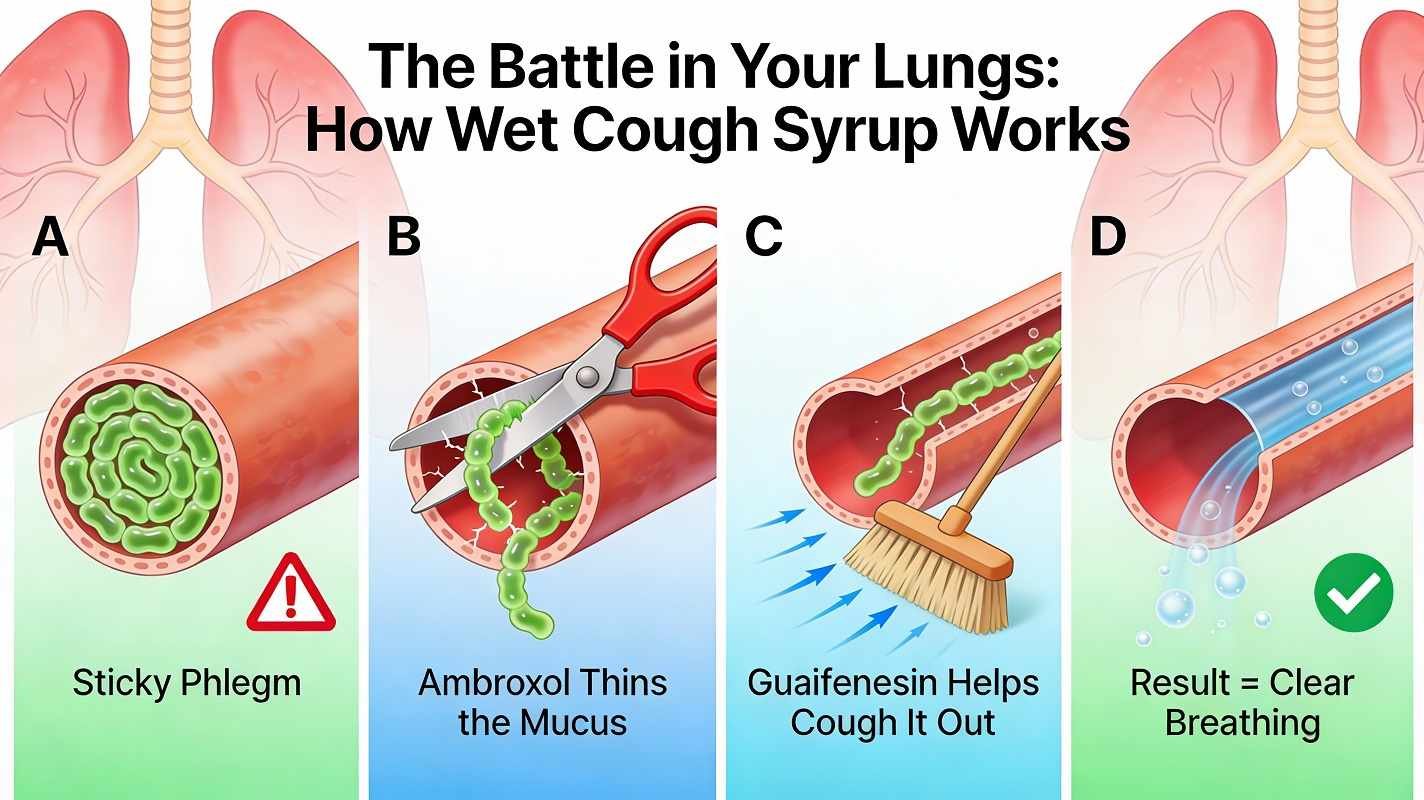
The short version. A wet cough syrup thins mucus (mucolytic), increases the fluid that dilutes it (expectorant), or widens the airway so it can be cleared (bronchodilator). Most Indian brands combine two or three of these.
Two 2026 facts worth knowing before you compare brands:
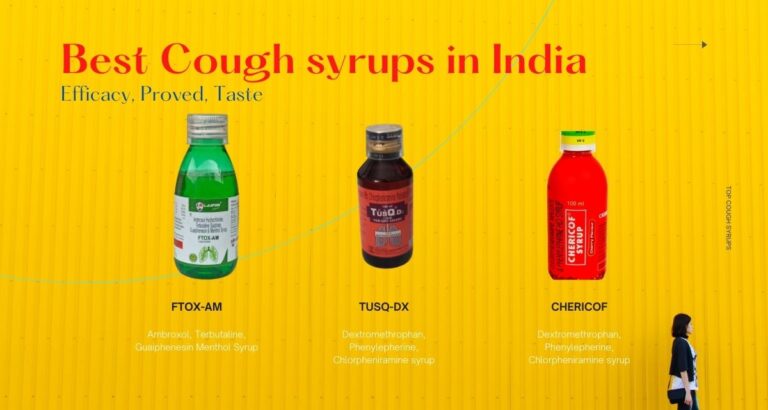
- Eight of the most-searched brands share only five distinct compositions. Three of them are the same medicine under three names; two more are an identical four-ingredient formula from two different companies.
- Cough syrups lost their household-remedy exemption on 9 June 2026. The word “Syrups” was omitted from Schedule K of the Drugs Rules, 1945 [1]. What that actually does is narrower than most headlines suggested — see the tabs below.
What changed in 2026, and what did not
G.S.R. 477(E) · 9 June 2026 · Drugs (Fifth Amendment) Rules, 2026
The Ministry of Health and Family Welfare omitted the word “Syrups” from item (7) under serial number 13 of Schedule K of the Drugs Rules, 1945. The entry previously read syrups, lozenges, pills and tablets for cough; it now reads lozenges, pills and tablets for cough [1][2].
Serial number 13 of Schedule K is the household-remedies entry. It permits a defined short list of medicines to be sold without a sale licence in villages with a population of not more than one thousand where no licensed dealer operates nearby. Removing “Syrups” from that list means cough syrups can no longer be sold through that unlicensed village-retail route [2].
The amendment came into force on publication in the Official Gazette. It followed draft rules issued in December 2025 and consultation with the Drugs Technical Advisory Board [2].
This is the part the news coverage mostly compressed into “cough syrups are now prescription-only”, which is true as a practical outcome but not a precise description of the instrument.
- The Schedule K entry never covered scheduled drugs to begin with. One of the standing conditions on serial number 13 is that the product must not contain a substance specified in Schedule G, H or X [2]. Bromhexine hydrochloride and terbutaline sulphate both appear in Schedule H. Any brand built on them — including three of the eight in the table below — sat outside that exemption before 9 June 2026 and sits outside it now. For those products, nothing about their legal status changed on that date.
- Solid cough dosage forms keep the exemption. Lozenges, pills and tablets for cough remain in item (7). Only the liquid form was removed.
- It is a licensing change, not a scheduling change. No molecule was added to Schedule H and no fixed-dose combination was banned by this notification.
If you are checking a specific molecule rather than a brand, work from the current schedule list rather than from a label: see the Schedule H drugs list and labelling rules. Ambroxol, levosalbutamol and diphenhydramine were not independently verified against the current Schedule H list for this review — confirm each against the CDSCO position before relying on it for a regulatory decision.
DGHS advisory · 3 October 2025
The Directorate General of Health Services advised all states and union territories that cough and cold medications should not be prescribed or dispensed to children under two years of age, and are generally not recommended below five years. Above five, use should follow clinical evaluation with close supervision, correct dosing, the shortest effective duration, and avoidance of multiple-drug combinations [3].
This is stricter and more recent than the December 2023 order that many articles still cite. That earlier directive was narrower: it required manufacturers of the chlorpheniramine maleate plus phenylephrine fixed-dose combination to carry a warning that the combination should not be used in children below four years [4]. It applied to that one combination, not to cough syrups generally.
Neither instrument is a dosing guide. This page does not provide dosage for any age group.
On 13 October 2025 the World Health Organization issued Medical Product Alert N°5/2025 after India’s CDSCO reported, on 8 October, the presence of diethylene glycol in at least three oral liquid medicines: specific batches of COLDRIF (Sresan Pharmaceutical), Respifresh TR (Rednex Pharmaceuticals) and ReLife (Shape Pharma) [5]. WHO had identified localised clusters of acute illness and child fatalities in India on 30 September 2025. Production at the implicated sites was halted, product authorisations were suspended, and recalls were initiated by state authorities [5].
The acceptable safety limit WHO applies to both diethylene glycol and ethylene glycol in these products is not more than 0.10 per cent [6]. That figure is the whole reason a solvent-quality specification and per-batch identity testing on every consignment of glycerin and propylene glycol is not paperwork — it is the control point that separates a compliant syrup from a fatal one.
None of the eight brands in the table below has been implicated in that incident. Formulators working on oral liquids may find the QC test set and compendial limits in syrup vs. suspension: QC tests, limits and GMP rules more directly useful than this page.
Does the class on the label match the cough?
This checks pharmacological fit only. It is not a recommendation, not a diagnosis, and not a reason to change or stop a prescribed medicine.
Choose one option in each row
The verdict below describes whether the drug classes on the label act on the problem the cough presents. It does not rank brands.
Control point: confirm against the prescription in hand.
Eight brands, five compositions
Strengths are per 5 ml. Brands sharing a composition group are the same medicine pharmacologically, sold under different names by different companies — normal branded-generic practice in India, and the single most useful thing to know at a pharmacy counter.
| Composition group | Brand | Marketed by | Actives per 5 ml | Class mix |
|---|---|---|---|---|
| A · 3 brands | Ascoril LS | Glenmark | Ambroxol 30 mg + Levosalbutamol 1 mg + Guaifenesin 50 mg | Mucolytic + bronchodilator + expectorant |
| A · 3 brands | Grilinctus-LS | Franco-Indian | Ambroxol 30 mg + Levosalbutamol 1 mg + Guaifenesin 50 mg | Mucolytic + bronchodilator + expectorant |
| A · 3 brands | Solvin-LS | Ipca | Ambroxol 30 mg + Levosalbutamol 1 mg + Guaifenesin 50 mg | Mucolytic + bronchodilator + expectorant |
| B · 1 brand | Grilinctus-BM | Franco-Indian | Bromhexine 8 mg + Terbutaline 2.5 mg | Mucolytic + bronchodilator (no expectorant) |
| C · 1 brand | Ambrodil-S | Aristo | Ambroxol 15 mg + Salbutamol 1 mg | Mucolytic + bronchodilator (no expectorant) |
| D · 1 brand | Benadryl Cough Formula | JNTL Consumer Health | Diphenhydramine 14.08 mg + Ammonium chloride 138 mg + Sodium citrate 57.03 mg (with ethanol) | Antihistamine + expectorant (no bronchodilator) |
| E · 2 brands | Alkof | Cipla Health | Bromhexine 2 mg + Guaifenesin 50 mg + Terbutaline 1.25 mg + Menthol 0.5 mg | Mucolytic + expectorant + bronchodilator |
| E · 2 brands | Ascoril Expectorant corrected Aug 2026 | Glenmark | Bromhexine 2 mg + Guaifenesin 50 mg + Terbutaline 1.25 mg + Menthol 0.5 mg [7] | Mucolytic + expectorant + bronchodilator |
Scroll the table sideways on a phone. Earlier versions of this page listed Ascoril Expectorant as bromhexine 4 mg with no menthol. The Indian pack is bromhexine 2 mg with menthol 0.5 mg [7], which makes it compositionally identical to Alkof. The 4 mg bromhexine figure belongs to an export presentation, not the Indian one. Composition can change between pack sizes and reformulations — always confirm against the label in hand.
What the evidence base actually says
The Cochrane review of over-the-counter medicines for acute cough included 29 placebo-controlled trials in 4,835 people and concluded that there is no good evidence either for or against the effectiveness of OTC cough medicines [8].
Two qualifications matter and are usually dropped. First, that review assessed over-the-counter preparations; the prescription mucolytic-bronchodilator combinations that dominate the Indian market were not individually assessed against placebo in it. Second, within the review, no study of expectorants in children met the inclusion criteria at all, while single trials of mucolytics in both adults and children did favour active treatment [8]. So the honest position is not “these do nothing” — it is that the evidence bar is lower than the marketing confidence, and thinnest of all for expectorants in children.
Before you buy or switch
Every product in the table is a prescription medicine in practice. Buy from a licensed pharmacy, where batch provenance and storage are traceable. If a bottle smells, tastes or looks different from a previous bottle of the same brand, stop and contact the pharmacist. Do not give any cough syrup to a child under two, and do not substitute across composition groups on price or availability alone — ask the pharmacist to check the composition against the prescription.
Questions people actually search
In practice, yes. Since 9 June 2026 the word “Syrups” has been omitted from item (7) under serial number 13 of Schedule K of the Drugs Rules, 1945, which removed cough syrups from the household-remedies list that allowed sale without a sale licence in small villages with no licensed dealer nearby. Separately, the combination syrups most commonly prescribed for a wet cough contain Schedule H substances such as bromhexine or terbutaline, and those have always required a prescription. Lozenges, pills and tablets for cough were not removed from the Schedule K entry.
A productive cough is a cough that brings up mucus, also called a wet or chesty cough. A productive cough syrup is therefore a formulation designed to help that mucus leave the airway rather than to stop the cough. It does this in one of three ways or a combination of them: a mucolytic such as ambroxol or bromhexine breaks down the structure of the mucus, an expectorant such as guaifenesin increases airway fluid so the mucus is diluted, and a bronchodilator such as terbutaline or levosalbutamol widens the airway so it can be cleared. A cough suppressant is the opposite tool and is generally the wrong choice for a productive cough, because suppressing the reflex leaves the mucus where it is.
Of the eight brands in the table above, five contain guaifenesin at 50 mg per 5 ml: Ascoril LS, Grilinctus-LS and Solvin-LS carry it alongside ambroxol 30 mg and levosalbutamol 1 mg, while Alkof and Ascoril Expectorant carry it alongside bromhexine 2 mg, terbutaline 1.25 mg and menthol 0.5 mg. Guaifenesin is very rarely sold in India as a single-ingredient syrup; it is almost always formulated with a mucolytic, a bronchodilator or both. Grilinctus-BM, Ambrodil-S and Benadryl Cough Formula contain no guaifenesin.
Pharmacologically, yes. All three carry ambroxol 30 mg, levosalbutamol 1 mg and guaifenesin 50 mg per 5 ml, from Glenmark, Franco-Indian and Ipca respectively. The difference between them is the brand name, the manufacturer and the price, not the active ingredients or their strengths. If a pharmacist offers one in place of another and the strength matches the prescription, that is standard branded-generic substitution rather than an error. Ascoril Expectorant is a separate matter: despite the shared brand family it is a different formulation from Ascoril LS, and is instead identical in composition to Alkof.
Yes. Bronchodilators such as salbutamol, levosalbutamol and terbutaline are added to open the airway where bronchospasm accompanies the mucus, and they are the reason several of these combinations carry cardiac and thyroid precautions. Of the eight brands listed above, only Benadryl Cough Formula contains no bronchodilator at all — it pairs an antihistamine with two expectorants. Combinations built on a mucolytic plus an expectorant without a beta-2 agonist do exist in the wider Indian market. Whether a bronchodilator is appropriate for a particular patient is a prescribing decision, not a shelf decision, and is not something to change on your own.
For manufacturers and formulators, not patients
If you make oral liquids, the June 2026 Schedule K change alters your distribution channel assumptions and the DEG/EG position alters your raw-material testing burden. We advise on Revised Schedule M gap assessment, oral liquid QC specifications and third-party manufacturing arrangements.
Third-party manufacturing and compliance supportReferences
- Ministry of Health and Family Welfare, Government of India. Drugs (Fifth Amendment) Rules, 2026. Notification G.S.R. 477(E), dated 9 June 2026. New Delhi: Gazette of India; 2026. Gazette copy available from the Gazette of India e-Gazette portal (search the notification number). Accessed August 2026.
- All India Organisation of Chemists and Druggists press note on G.S.R. 477(E), as reported. Medical Dialogues; 16 June 2026. Available from: https://medicaldialogues.in/news/industry/pharma/aiocd-welcomes-government-decision-to-bring-cough-syrups-under-stricter-control-172971 Accessed August 2026. [Trade press; used for the scope and standing conditions of Schedule K serial number 13.]
- Directorate General of Health Services, Ministry of Health and Family Welfare, Government of India. Advisory on rational use of cough syrups in the paediatric population; 3 October 2025. Reported by News on AIR (Prasar Bharati). Available from: https://www.newsonair.gov.in/health-ministry-advises-cough-syrups-should-not-be-prescribed-or-dispensed-to-children-below-two-years Accessed August 2026.
- Central Drugs Standard Control Organisation. Directive on labelling of the chlorpheniramine maleate plus phenylephrine fixed-dose combination in children below four years, dated 18 December 2023, as reported. The Tribune; 21 December 2023. Available from: https://www.tribuneindia.com/news/india/regulator-bans-anti-cold-syrup-for-under-4-children-574238 Accessed August 2026.
- World Health Organization. Medical Product Alert N°5/2025: substandard (contaminated) oral liquid medicines. Geneva: WHO; 13 October 2025. Available from: https://www.who.int/news/item/13-10-2025-medical-product-alert-n-5-2025–substandard-(contaminated)-oral-liquid-medicines Accessed August 2026.
- World Health Organization. Medical Product Alert N°6/2023: substandard (contaminated) syrup medicines. Geneva: WHO; 7 August 2023. Available from: https://www.who.int/news/item/07-08-2023-medical-product-alert-n-6-2023–substandard-(contaminated)-syrup-medicines Accessed August 2026. [Cited for the stated acceptable safety limit of not more than 0.10 per cent for diethylene glycol and ethylene glycol.]
- Tata 1mg. Ascoril Expectorant: composition and product record. Gurugram: Tata 1mg; record last updated 11 August 2026. Available from: https://www.1mg.com/drugs/ascoril-expectorant-1049699 Accessed August 2026. [Pharmacy reference; used to correct the per 5 ml composition.]
- Smith SM, Schroeder K, Fahey T. Over-the-counter (OTC) medications for acute cough in children and adults in community settings. Cochrane Database Syst Rev. 2014;2014(11):CD001831. doi:10.1002/14651858.CD001831.pub5. Indexed in PubMed, PMID 25420096. Available from: https://doi.org/10.1002/14651858.CD001831.pub5 Accessed August 2026.
Scope and limitations. This block is technical and educational information for a general and professional readership. It is not medical advice, not a diagnosis and not a dosing instruction, and it does not recommend one brand over another. Indian statutory instruments and pharmacopoeial texts change frequently; positions stated here reflect sources checked in August 2026 and may be superseded. Brand compositions reflect the per 5 ml strengths listed on the cited sources at the time of review and can vary by pack size and reformulation. Always confirm against the product label in hand and consult a physician or pharmacist before starting, stopping, combining or substituting any cough medicine, and never give a cough syrup to a child without medical guidance.