
GSDP in India: what the draft rule says
What changes for you: if you hold a drug manufacturing, loan, repacking, import, sale or blood-centre licence, following CDSCO’s GSDP guidelines would become a condition of that licence once this draft is final.
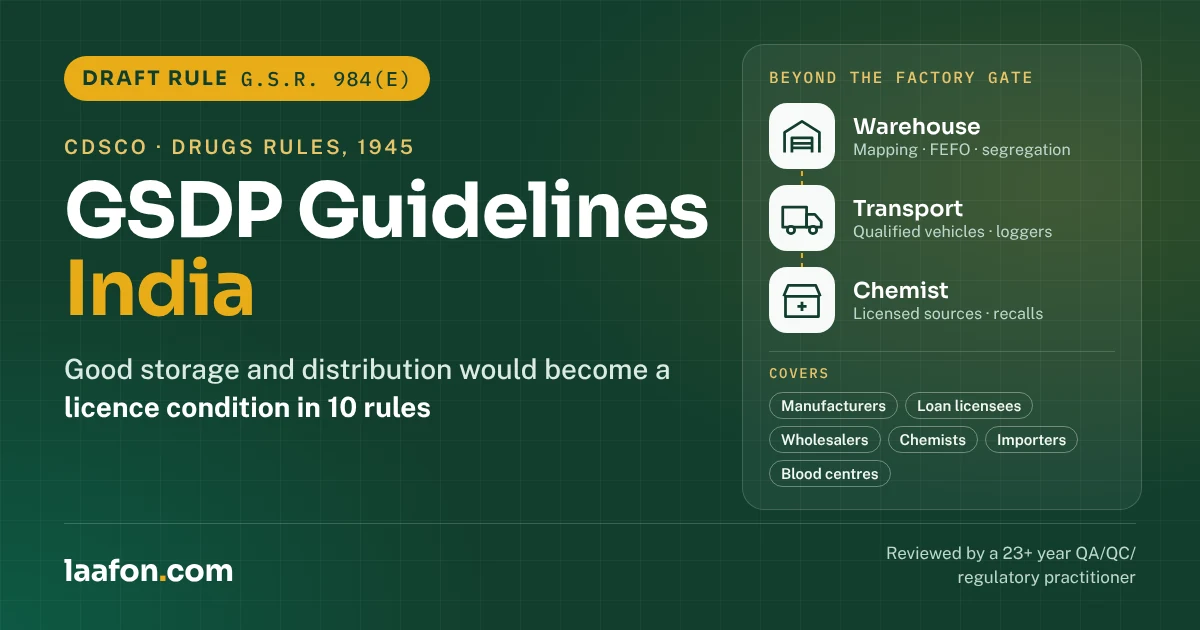
Short answer: Draft G.S.R. 984(E), dated 4 November 2026, adds a definition of CDSCO’s GSDP guidelines (Good Storage and Distribution Practices) to Rule 2 of the Drugs Rules, 1945, and the same licence condition to 9 other rules: 26, 33A, 65, 74, 74A, 74B, 78, 78A and 122P.
Watch: GSDP guidelines in India in under 4 minutes
This is a draft rule, not yet in force. Draft G.S.R. 984(E) from the Health Ministry would make compliance with CDSCO’s GSDP guidelines (Good Storage and Distribution Practices) a drug licence condition once it is final. The video covers who is covered rule by rule, six controls from CDSCO’s draft guidelines, the comment window and the missing transition period.
Chapters
- 0:00 Why GSDP could become a licence condition
- 0:13 From advisory guidance to licence condition
- 0:41 What draft G.S.R. 984(E) says
- 1:14 Who is covered, rule by rule
- 1:48 Six GSDP controls to check first
- 2:29 Timing, comments and no transition period
- 2:52 From 23+ years of practice
- 3:18 Three key takeaways
- 3:36 Next step: the free GSDP self-check
Read the full video transcript
One sentence added to nine rules could make GSDP a condition of almost every drug licence in India. This is a draft. It is not enforced yet. But it is worth knowing now. Today, GSDP is guidance. It is advisory. This draft would change that. Once final, GSDP would become a licence condition. You already know revised Schedule M. It covers the factory.
GSDP covers everything after the factory gate. The warehouse, the truck, the stockist, the chemist shop. So a temperature excursion in a godown or an unrecorded return could count as a licence violation. Not just bad practice. Here is the draft. G.S.R. 984(E) dated 4 November 2026. It was published in the Gazette of India Extraordinary on 12 November, number 878.
The Health Ministry issued it under Sections 12 and 33 of the Drugs and Cosmetics Act after consulting DTAB. It does two things. First, it adds a definition of the GSDP guidelines to Rule 2. Second, it adds one condition to nine rules. The condition says, “The licensee shall ensure compliance with the Good Distribution Practices Guidelines.” Who is covered?
Almost every drug licence. Importers under Rule 26. Government hospital imports under Rule 33A. Retail and wholesale sale licences under Rule 65. Manufacturers under Rules 74 and 78. Repackers under Rule 74A. Loan licensees under Rules 74B and 78A. And blood centres under Rule 122P. Transporters and third party logistics firms hold no drug licence.
GSDP reaches them through written agreements with licensees. Now, what would GSDP ask for? These come from CDSCO’s draft guidelines. The adopted text may differ. Here are six controls to check first. One. Temperature mapping. Map your stores and monitor the worst case spots. Two. FEFO. First expiry, first out with near expiry checks.
Three. Data loggers for transport calibrated at least once a year. Four. Returns. Quarantine first. Resell only after assessment. Five. Recall. A written procedure with its effectiveness checked every year. Six. Records. Temperature data kept for shelf life plus one year. Now, timing. This is a draft. It is not in force. The comment window runs 30 days from the 12 November Gazette date.
That is about 12 December, 2026. Comments go by email to the Health Ministry. The address is on screen and in the post. Send yours by 11 December. The draft gives no transition period. The start date will be fixed in the final notification. Problems rarely start inside the factory. They start after dispatch at the handover between warehouse, transporter and stockist when nobody clearly owns storage conditions.
Firms often have the procedure written but not the proof. Mapping, loggers and return assessments are partly done and records are where it falls short. In any godown, I would first check the temperature records and the returns area. They show quickly whether the system really works. Three takeaways. One. This is a draft. But it would make GSDP a licence condition in nine rules.
Two. It reaches almost every licence type. Transporters are reached through contracts. Three. Start with the six controls and send your comments by 11 December. Your next step, take the free 20 question GSDP readiness self-check. It is on the post page. Nothing you enter leaves your browser.
Until now, India’s GDP and GSDP guidelines were advisory drafts. This amendment would make them enforceable licence conditions, so a temperature excursion in a stockist’s godown or an unrecorded return could count as a breach of licence conditions, not just bad practice (see who enforces it and what can follow). Below: who is covered, what GSDP requires, a 20-point readiness self-check, and the drafting gaps worth raising before the comment window closes.
What the draft does not do. It adds no new Schedule to the Drugs Rules and does not reproduce the guidelines. It only points to a CDSCO document, and the DTAB-adopted text of that document was not public when we checked on 22 Nov 2026. Until CDSCO publishes it, the exact requirements cannot be fully defined. (In 2018 and 2019, DTAB had agreed to add the guidelines as a separate Schedule; this draft takes a different route.)
G.S.R. 984(E) at a glance
| Instrument | G.S.R. 984(E), draft Drugs (…… Amendment) Rules, 2026. Ministry of Health and Family Welfare (Department of Health and Family Welfare). F. No. X.11014/17/2026-DR |
|---|---|
| Dated | 4 November 2026. Published in Gazette of India Extraordinary, Part II, Section 3(i), No. 878, dated 12 November 2026 |
| Legal basis | Sections 12(1) and 33(1) of the Drugs and Cosmetics Act, 1940, after consultation with the Drugs Technical Advisory Board (DTAB) |
| What it adds | (1) A definition in Rule 2 of the “Guidelines on Good Storage and Distribution Practices (GSDP) for Pharmaceutical Products”: the Good Distribution Practices guidelines formulated by CDSCO and adopted by DTAB. (2) The same licence condition inserted in 9 other rules (26, 33A, 65, 74, 74A, 74B, 78, 78A and 122P): “The licensee shall ensure compliance with the Good Distribution Practices Guidelines.” |
| What it does not add | No new Schedule and no text of the guidelines. The rule points to a CDSCO document whose DTAB-adopted version is not yet public. |
| Comment window | 30 days from the date the Gazette copies are made available to the public. We count from the Gazette date, 12 November 2026, which puts the close at about 12 December 2026. Send comments by 11 December to be safe. |
| Where to send | Under Secretary (Drugs), MoHFW, C Wing, First Floor, Kartavya Bhavan 1, New Delhi 110001, or drugsdiv-mohfw@gov.in |
| Effective date | Not fixed. It will be “the date as specified by the Government at the time of final publication”. The draft gives no transition period. |
Does GSDP apply to my licence?
Select your licence type to see which rule the draft amends and the first five things to fix.
Not covered by this draft: licences under the Ayurvedic, Siddha and Unani parts of the Drugs Rules, homoeopathic sale and manufacturing licences, cosmetics (now under the Cosmetics Rules, 2020) and medical devices (under the Medical Devices Rules, 2017).
Manufacturers
- Rules amended
- Rule 74 (Forms 25 and 25F) and Rule 78 (Forms 28, 28B and 28D)
- New condition
- Rule 74 clause (r); Rule 78 clause (s)
- Practical effect
- Revised Schedule M already covers your in-plant warehouse. The GSDP guidelines extend the obligation past the factory gate, to how your goods are stored, shipped and handed over to C&F agents and stockists.
First five actions
- Temperature-map the finished-goods store (summer and winter) and put calibrated monitors at the mapped hot and cold spots.
- Sign written quality agreements with every C&F agent, transporter and courier, setting out who owns storage conditions, excursions and returns.
- Qualify transport for label conditions, using calibrated data loggers for temperature-sensitive and cold-chain products.
- Make sure dispatch records allow batch-to-customer traceability, and run one mock recall to prove it.
- Add a procedure for segregating and reporting suspected spurious or NSQ stock found anywhere in your chain.
Already working on Schedule M? See the Revised Schedule M compliance dashboard.
Loan licensees
- Rules amended
- Rule 74B (Form 25A) and Rule 78A (Forms 28A and 28DA)
- New condition
- Rule 74B sub-rule (9); Rule 78A sub-rule (10)
- Practical effect
- The obligation sits with you as licensee, even though the goods are made, stored and often dispatched from the host plant. If the loan-licence agreement is silent on storage and distribution, you carry the gap.
First five actions
- Amend the loan-licence or technical agreement to allocate GSDP duties: finished-goods storage, dispatch, transport, returns and recall.
- Get the host plant’s temperature mapping and monitoring records for the area where your batches wait before dispatch.
- Keep your own distribution records (batch, customer, quantity, date) rather than relying only on the host’s invoices.
- Audit your C&F and transport partners and keep the audit reports on file.
- Write a recall procedure that names who acts at the host plant and who acts in your distribution chain.
Setting up a loan licence? See pharma loan licence consulting.
Wholesalers, stockists, C&F agents and PCD distributors
- Rule amended
- Rule 65 (conditions of sale licences, retail and wholesale)
- New condition
- Rule 65 sub-rule (22)
- Practical effect
- This is the largest group the GSDP guidelines will reach. Godown temperature, FEFO, licensed-source verification and returns handling become enforceable sale-licence conditions.
First five actions
- Map and monitor godown temperature, with a calibrated thermometer or logger in the worst-case spot (usually near the roof or loading door in summer).
- Enforce FEFO (first-expiry, first-out) issue and run a monthly near-expiry check.
- Keep copies of the supplier’s and buyer’s drug licences on file, and stop buying from or selling to unlicensed parties.
- Mark separate, labelled areas for quarantine, returns, recalled and expired stock.
- Quarantine returned goods on receipt and resell them only after a written assessment.
Starting a PCD distributorship? See PCD pharma franchise in India: licences, cost and checks.
Retail chemists
- Rule amended
- Rule 65 (conditions of sale licences)
- New condition
- Rule 65 sub-rule (22)
- Practical effect
- Storage at the counter, in the back room and in the refrigerator becomes a licence condition, which Drugs Inspectors can check once the rule is final.
First five actions
- Keep a daily temperature log for the shop and the vaccine or insulin refrigerator, using a calibrated thermometer.
- Buy only from licensed wholesalers and file every purchase invoice with its batch and expiry.
- Separate expired, damaged and returned stock in a labelled “not for sale” area.
- Check near-expiry stock monthly and follow FEFO on the shelf.
- Keep a simple procedure for acting on recall and NSQ alerts, recording what was found and returned.
Related: Schedule H drugs list, labelling and dispensing rules.
Importers
- Rule amended
- Rule 26 (conditions of import licence, Forms 10 and 10-A)
- New condition
- Rule 26 sub-rule (viii)
- Practical effect
- The weak point is the handover from port or airport to your warehouse. CDSCO’s draft GDP guidelines have a separate chapter on importation.
First five actions
- Agree storage conditions in writing with your customs broker (CHA) and the port or airport cargo terminal.
- Use qualified cold-chain transport from port to warehouse, and keep the logger data with each consignment.
- Keep imported stock in quarantine until release, with documented release.
- Put a quality agreement in place with the foreign manufacturer covering complaints, recalls and excursions.
- Make sure batch-wise traceability runs from the bill of entry to the final buyer.
Repackers
- Rule amended
- Rule 74A (Form 25B)
- New condition
- Rule 74A clause (j)
- Practical effect
- Both the bulk you receive and the repacked goods you dispatch fall under GSDP storage and transport controls.
First five actions
- Temperature-map the bulk store and the finished-goods store.
- Inspect and record bulk on receipt (seal, labelling, temperature in transit).
- Keep segregated quarantine and reject areas.
- Sign transport agreements and use loggers for sensitive products.
- Keep batch traceability from the bulk lot to each repacked lot and buyer.
Blood centres and blood-product licensees
- Rule amended
- Rule 122P (Forms 28-C, 28-E, 26-G and 26-I)
- New condition
- Rule 122P sub-rule (xvi)
- Practical effect
- Schedule F Part XII-B already sets storage temperatures. GSDP adds formal requirements for transport, contract parties, self-inspection and recall.
First five actions
- Validate the transport boxes used for whole blood, components and plasma.
- Calibrate data loggers for transport, at least once a year.
- Sign written agreements with hospitals and transport providers who move components.
- Run an annual self-inspection covering distribution, not just processing.
- Test your recall and look-back procedure.
Government hospitals and autonomous institutions importing for patients
- Rule amended
- Rule 33A (Form 11A import for treatment of patients)
- New condition
- Rule 33A sub-rule (h)
- Practical effect
- Small-quantity imports for patient treatment must be stored and handled to GSDP standards from arrival to use.
First five actions
- Define a controlled storage location in the pharmacy, with temperature monitoring.
- Keep receipt records that include the transport temperature.
- Record issues to each patient for traceability.
- Document how unused or expired stock is disposed of.
- Name the person responsible in the hospital pharmacy.
Transporters, couriers and 3PL warehouses
- Rule amended
- None directly for transporters and couriers, which hold no drug licence. A 3PL warehouse that stocks drugs for distribution needs a sale licence for those premises (Section 18(c) of the Act bars stocking for distribution without one), and the Rule 65 condition then applies to it directly.
- How it reaches you
- Through your licensed customers. CDSCO’s draft requires a written agreement with every agency involved in storage, transport and distribution, defining GDP responsibilities, and periodic audits of contract parties.
- Practical effect
- Expect manufacturers and distributors to ask for your SOPs, vehicle condition records, logger data and staff training records before renewing contracts.
First five actions
- Write SOPs for vehicle cleaning, loading, temperature control and handling excursions.
- Use calibrated data loggers and keep the downloads per trip.
- Keep a pest-control and cleaning record for vehicles and transit godowns.
- Train and authorise drivers, including identity and authorisation documents for pickups.
- Never subcontract without the client’s written approval.
If you are a C&F agent, an e-pharmacy or a hospital pharmacy
- C&F agents that stock and distribute drugs need a wholesale sale licence for their premises, so the Rule 65 condition applies to them directly. See the Wholesaler panel above.
- E-pharmacies: India has no enacted e-pharmacy rules; the 2018 draft rules were never finalised. Online platforms dispense from premises that hold retail or wholesale sale licences, so Rule 65 applies to those premises and the delivery chain behind them.
- Hospital pharmacies that hold a retail sale licence fall under Rule 65 like any chemist. Government hospitals importing under Form 11A are also covered by Rule 33A.
Not sure where your gaps are? Take the 20-question readiness self-check below, or book a GSDP gap review with a regulatory consultant.
If the rule becomes final: who checks, and what can follow
GSDP would be enforced through the same machinery as every other licence condition. Drugs Inspectors are appointed under Section 21 of the Drugs and Cosmetics Act, 1940, and Section 22 gives them powers to inspect premises, examine records and take samples. State Drugs Control Departments inspect sale and manufacturing licensees; CDSCO grants and oversees import licences.
| Licence | Licensing authority | Suspension or cancellation |
|---|---|---|
| Retail and wholesale sale (Rule 65) | State Licensing Authority | Rule 66 |
| Manufacturing, repacking and loan licences (Rules 74, 74A, 74B, 78, 78A) | State Licensing Authority; some categories also need Central Licence Approving Authority approval | Rule 85 |
| Import licences (Rule 26) | Central Licensing Authority (CDSCO) | Rule 29 |
The tools available to regulators:
- Inspection findingsGSDP gaps found at inspection are recorded, and the licensee is expected to correct them.
- Show-cause noticeBefore suspending or cancelling, the licensing authority must give the licensee an opportunity to show cause (Rules 66 and 85 both require this).
- Suspension or cancellationIf a licence condition is not complied with, the authority can suspend the licence for a period or cancel it.
- Prosecution, in serious casesSection 18(c) of the Act bars manufacturing, selling, stocking or distributing drugs except in accordance with the conditions of a licence. Section 27(d) makes other contraventions of the Act or rules punishable with imprisonment of one to two years and a fine of at least ₹20,000.
Blood-centre licences (Rule 122P) and Form 11A hospital imports (Rule 33A) have their own licensing and cancellation provisions. This is a summary of the law, not legal advice.
From guidance to licence condition: 2012 to 2026
- 8 Oct 2012CDSCO’s Guidelines on Good Distribution Practices for Biological Products (CDSCO/GDP.BP Ver. 00) take effect.
- 25 Sep 2018CDSCO circulates draft GDP guidelines for all pharmaceutical products for comment (F. No. 15-14/2018-DC).
- 29 Nov 2018 and 11 Jun 2019DTAB, at its 81st and 83rd meetings, agrees to bring the guidelines into the Drugs Rules as a separate Schedule.
- 2 Apr 2024A revised draft is uploaded to the CDSCO website.
- 9 Aug 2024A further revised draft, aligned with WHO TRS 1025 Annex 7 (good storage and distribution practices), opens for 30 days of comment.
- 17 Jun 2025The 66th Drugs Consultative Committee meeting makes its recommendations on the guidelines.
- 16 Feb 2026The 93rd DTAB meeting suggests minor corrections and agrees to amend the Drugs Rules to give the guidelines legal force.
- 4 Nov 2026Draft G.S.R. 984(E) is issued, Gazetted on 12 Nov 2026 and announced by the Ministry on 19 Nov 2026. Comment window open.
- NextFinal notification, with the effective date set at that time. This page will be updated when it is published.
What the GSDP guidelines will require in practice
The draft rule refers to guidelines “formulated by CDSCO and adopted by DTAB”. The DTAB-corrected final text was not public when we checked (21 Nov 2026), so the points below come from CDSCO’s published draft, Guidelines on Good Distribution Practices for Pharmaceutical Products (CDSCO/GDP.PP Ver. 00; a draft for consultation, not the DTAB-adopted text). Treat the details as indicative until CDSCO publishes the adopted version.
Quality system and people
- Defined organisation, a responsible person and written job descriptions
- GDP training, with records
- Written procedures, plus an annual self-inspection with follow-up of corrective actions
Storage and temperature
- Storage areas temperature-mapped under representative conditions
- Monitors placed where fluctuation is most likely, calibrated at defined intervals, with readings recorded
- Temperature records kept for the product’s shelf life plus one year
Stock control
- FEFO: products due to expire first are distributed first
- Regular checks for near-expiry stock
- No supply or receipt of expired or nearly expired products
Transport
- Transport within label storage conditions, on risk-based routes
- Suitable, clean vehicles with pest control; dedicated vehicles where possible
- Transport data loggers calibrated at least once a year
Returns, recalls, complaints
- Returns quarantined and reissued only after a written, risk-based assessment
- Written recall procedure with a named person, checked for effectiveness every year
- Final recall report reconciling quantities delivered and recovered
Spurious products and contracts
- Suspect spurious, adulterated or NSQ products segregated, labelled “not for sale” and reported to the regulator without delay
- Written agreements with all contract parties; subcontracting only with written approval; periodic audits
- Documents kept for at least one year after product expiry
The draft is structured around WHO’s guidance on good storage and distribution practices (TRS 1025, Annex 7), so firms already working to WHO-GMP export standards will find the structure familiar. Need written GSDP procedures? See pharma SOP writing services.
GSDP guidelines readiness self-check (20 questions)
Check one site (factory store, godown or shop) against the main GSDP guidelines requirements. Scoring: Yes = 2, Partly = 1, No = 0. Nothing you enter leaves your browser, and you see your score straight away.
Prefer paper? Download the 20-point checklist (PDF, no sign-up)Your readiness score
0 / 40
Gaps to close
This self-check is based on CDSCO’s draft GDP guidelines and is indicative only. The adopted GSDP text may differ, and a self-check is not an inspection.
Six drafting gaps worth raising before the deadline
A close reading of the Gazette text turns up points that licensees and associations can raise with the Ministry while the comment window is open.
- The defined term and the operative term differ.Rule 2 defines “Guidelines on Good Storage and Distribution Practices (GSDP) for Pharmaceutical Products”, but all 9 new licence conditions require compliance with the “Good Distribution Practices Guidelines”, a phrase the draft never defines. The final rule should use one defined term throughout.
- The guidelines being incorporated are not publicly final.The rule would bind licensees to a document “adopted by DTAB”, but the DTAB-corrected text was not on CDSCO’s website when we checked; only earlier drafts were. Licensees cannot comply with a text they cannot see. CDSCO should publish the adopted version, with a document number and version, before or alongside final notification.
- No transition period.The draft takes effect on a date set at final publication. By contrast, the parallel bulk-drug wholesale draft (G.S.R. 987(E)) gives existing licensees until the later of their current retention period expiring or 12 months. The chemists’ body AIOCD has already asked for phased implementation that does not overburden small and medium traders.
- Two pending drafts claim the same Rule 65 slot.G.S.R. 861(E) (28 Sep 2026, prescription-drug advertising) also proposes a new Rule 65 sub-rule (22). One of them will have to be renumbered when the final rules are issued.
- The Hindi and English texts disagree, and one insertion point looks wrong.The new Rule 2 definition is clause (j) in the Hindi text and clause (k) in the English. Separately, the draft inserts Rule 74 clause (r) “after sub-rule (i)”, but in CDSCO’s consolidated text Rule 74 appears to end at clause (q), so the insertion should probably read “after clause (q)”.
- Transporters and couriers are outside the licence net.Transporters and couriers hold no drug licence, so GSDP reaches them only through contracts with licensees. The final rule or the GSDP guidelines should state clearly how far a licensee’s responsibility extends for goods in a contractor’s hands.
How to comment: email drugsdiv-mohfw@gov.in with the subject “Comments on draft G.S.R. 984(E) dated 04.11.2026”. Quote the draft rule number for each comment, propose replacement text, and send it before 11 December 2026.
Comment template you can copy
Two example comments are filled in. Edit them, add your own in the same format, and paste the text into your email.
To: drugsdiv-mohfw@gov.in
Subject: Comments on draft G.S.R. 984(E) dated 04.11.2026 - Good Storage and Distribution Practices

Dear Sir/Madam,

With reference to draft G.S.R. 984(E) dated 04.11.2026, published in the Gazette of India (Extraordinary) No. 878 dated 12.11.2026, I/we submit the following comments.

Name / organisation: [ ]
Licence type held: [ ]
Contact: [ ]

Comment 1
Draft provision: the new condition in Rules 26, 33A, 65, 74, 74A, 74B, 78, 78A and 122P
Issue: the condition cites "Good Distribution Practices Guidelines", a term the draft does not define. Rule 2 defines "Guidelines on Good Storage and Distribution Practices (GSDP) for Pharmaceutical Products".
Proposed text: "The licensee shall comply with the Guidelines on Good Storage and Distribution Practices (GSDP) for Pharmaceutical Products, as applicable to the activities covered by this licence."

Comment 2
Draft provision: commencement
Issue: there is no transition period for existing licensees, who need time for temperature mapping, data loggers, training and transporter agreements.
Proposed text: "Provided that a licensee holding a licence on the date of commencement of these rules shall comply with this condition within twelve months of such commencement."

Comment 3
Draft provision: [rule number]
Issue: [what is unclear or impractical, and why]
Proposed text: [your replacement wording]

Yours faithfully,
[Name, designation, signature]
Frequently asked questions
Is GSDP mandatory in India now?
Not yet. G.S.R. 984(E) is a draft published for comment. GSDP becomes a binding licence condition only once the Ministry publishes the final rules, from the date it specifies in that notification. Until then, CDSCO’s GSDP guidelines remain guidance.
What is the difference between GDP and GSDP?
Good Distribution Practices (GDP) cover how medicines are procured, transported and supplied. Good Storage and Distribution Practices (GSDP) is WHO’s combined term, which also includes good storage practices. The draft rule uses both names for the same CDSCO document, one of the points worth raising in comments.
Which licence holders does G.S.R. 984(E) cover?
Holders of import licences (Rule 26), Form 11A hospital import licences (Rule 33A), retail and wholesale sale licences (Rule 65), manufacturing licences (Rules 74 and 78), repacking licences (Rule 74A), loan licences (Rules 74B and 78A) and blood-centre and blood-product licences (Rule 122P).
Does GSDP apply to retail chemists?
Yes. The new condition goes into Rule 65, which governs both retail and wholesale sale licences. For a chemist shop, the practical requirements are temperature control and records (including the refrigerator), buying from licensed sources, FEFO, segregating expired and returned stock, and acting on recalls.
When is the last date to comment on the draft?
The window is 30 days from the date the Gazette copies were made available to the public. Counting from the Gazette date, 12 November 2026, it closes on about 12 December 2026. Send comments to drugsdiv-mohfw@gov.in by 11 December to be safe.
Do transporters need a drug licence under GSDP?
The draft does not create a licence for transporters. They are covered indirectly, because CDSCO’s GSDP guidelines require licensees to have written agreements with every agency involved in storage, transport and distribution and to audit them.
What happens if a licensee does not comply once the rule is final?
GSDP would be a licence condition, so a breach can be raised at inspection and, after a show-cause notice, can lead to suspension or cancellation of the licence (Rule 66 for sale licences, Rule 85 for manufacturing licences, Rule 29 for import licences). In serious cases the Act’s offence provisions, Sections 18(c) and 27, can also apply.
Does the draft apply to AYUSH medicines, cosmetics or medical devices?
No. It amends only the licence rules listed above. Licences under the Ayurvedic, Siddha and Unani parts of the Drugs Rules, homoeopathic sale and manufacturing licences, cosmetics (Cosmetics Rules, 2020) and medical devices (Medical Devices Rules, 2017) are not touched.
Does GSDP apply to C&F agents and e-pharmacies?
Yes, through their sale licences. C&F agents that stock drugs need a wholesale licence, and online pharmacies dispense from licensed premises, so the Rule 65 condition applies to both. India has no enacted e-pharmacy rules yet.
Is there a transition period for existing licensees?
The draft does not provide one. Trade bodies have asked for phased implementation, so a transition period may appear in the final notification, but nothing is confirmed. It is safer to start closing gaps now.
Close your GSDP gaps before the rule is final
Laafon reviews GSDP storage and distribution systems for manufacturers, loan licensees and distributors: gap assessment against CDSCO’s GSDP guidelines, temperature-mapping plans, quality agreements and SOP sets, reviewed by a 23+ year QA/QC/regulatory practitioner.
Sources
- Ministry of Health and Family Welfare. Draft Drugs (…… Amendment) Rules, 2026. G.S.R. 984(E), 4 Nov 2026. Gazette of India, Extraordinary, Part II, Sec. 3(i), No. 878; 12 Nov 2026. Available from: https://egazette.gov.in/WriteReadData/2026/278021.pdf
- Central Drugs Standard Control Organisation. Guidelines on Good Distribution Practices for Pharmaceutical Products. Document No. CDSCO/GDP.PP Ver. 00. Draft for consultation, not the DTAB-adopted final text. New Delhi: CDSCO. Available from: https://cdsco.gov.in/opencms/export/sites/CDSCO_WEB/Pdf-documents/New-Drugs/GDP.pdf
- Central Drugs Standard Control Organisation. Guidelines on Good Distribution Practices for Biological Products. CDSCO/GDP.BP Ver. 00; effective 8 Oct 2012. Available from: https://www.cdsco.gov.in/opencms/export/sites/CDSCO_WEB/Pdf-documents/biologicals/5gdpBIOLOGICALPRODUCTS.pdf
- Drugs Technical Advisory Board. Minutes of the 93rd meeting, 16 Feb 2026, Agenda No. 2. Not yet listed on CDSCO’s DTAB minutes page when checked on 22 Nov 2026; copy available from: https://thehealthmaster.com/wp-content/uploads/2026/03/93rd-DTAB-held-on-16-02-2026.pdf
- Lok Sabha. Unstarred Question No. 1159 on Good Distribution Practices (reply citing DTAB 81st and 83rd meetings). Available from: https://eparlib.nic.in/bitstream/123456789/956873/1/AU1159.pdf
- World Health Organization. Good storage and distribution practices for medical products. WHO Technical Report Series No. 1025, Annex 7. Geneva: WHO; 2020.
- The Drugs and Cosmetics Act, 1940. Section 18 (prohibition of manufacture and sale) and Section 27 (penalties). Available from: https://www.caseon.in/public/section/section-18-the-drugs-and-cosmetics-act-1940 and https://www.caseon.in/public/section/section-27-the-drugs-and-cosmetics-act-1940
- Central Drugs Standard Control Organisation. The Drugs Rules, 1945 (consolidated text, undated; check for later amendments). Rules 29, 33A, 66, 74 and 85. Available from: https://cdsco.gov.in/opencms/resources/UploadCDSCOWeb/2022/drug_rules/Drugs%20Rules,%201945.pdf
- All India Radio News. Health Ministry proposes incorporating Good Storage and Distribution Practices into Drugs Rules, 1945. 19 Nov 2026. Available from: https://newsonair.gov.in/health-ministry-proposes-incorporating-good-storage-and-distribution-practices-into-drugs-rules-1945/
- Medical Dialogues. Chemist body opposes DTAB proposals on drug ads, nicotine gum OTC, pushes for regulated trade. Apr 2026. Available from: https://medicaldialogues.in/amp/news/industry/industry-perspective/chemist-body-opposes-dtab-proposals-on-drug-ads-nicotine-gum-otc-pushes-for-regulated-trade-167956
- Medical Dialogues. Health Ministry proposes ban on prescription drug advertisements without prior approval (G.S.R. 861(E)). Oct 2026. Available from: https://medicaldialogues.in/amp/news/industry/pharma/health-ministry-proposes-ban-on-prescription-drug-advertisements-without-prior-approval-180904
- DD News. Health Ministry proposes separate licensing framework for wholesale of bulk drugs (G.S.R. 987(E)). 19 Nov 2026. Available from: https://ddnews.gov.in/en/health-ministry-proposes-separate-licensing-framework-for-wholesale-sale-of-bulk-drugs/
- Medical Dialogues. CCTV at pharmacies: Health Ministry proposes surveillance of prescription drug sales (G.S.R. 791(E)). Sep 2026. Available from: https://medicaldialogues.in/amp/news/industry/pharma/cctv-at-pharmacies-health-ministry-proposes-surveillance-of-prescription-drug-sales-3-month-recording-mandate-179527
- IANS via NewKerala. Govt proposes pharma distribution norms, eases revised Schedule M rules for select drug categories (G.S.R. 985(E)). 19 Nov 2026. Available from: https://www.newkerala.com/news/a/govt-proposes-pharma-distribution-norms-eases-revised-schedule-221.htm
- London School of Hygiene and Tropical Medicine. E-pharmacy in India: regulation, practice and performance. July 2026. Available from: https://www.lshtm.ac.uk/media/102426
This page explains a draft regulation for general information. It is not legal advice. Check the final Gazette notification before acting.
Update log
- 22 Nov 2026 (revision): corrected the rule count (a definition in Rule 2 and a licence condition in 9 other rules); stated one basis for the comment deadline; softened the Rule 74 clause note; added enforcement, the draft’s limits, licences not covered, notes for C&F agents, e-pharmacies and hospital pharmacies, a comment template and a printable checklist.
- 22 Nov 2026: first published.