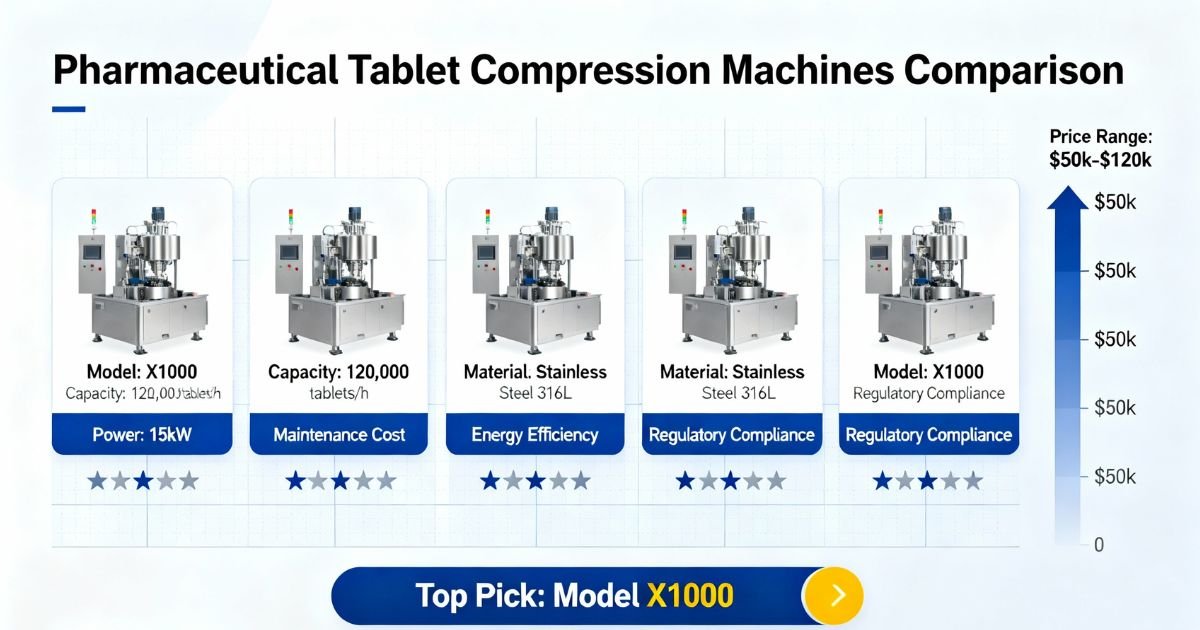

In pharmaceutical manufacturing, selecting a tablet compression machine that meets USFDA and EU GMP standards ensures consistent tablet quality, high throughput, and seamless regulatory compliance. These top five models—Fette Compacting FE55, Korsch AG XL 400 (4th Generation), GEA NexGen Press 45, Syntegon TPR 500, and IMA Active Prexima Series (300/800)—stand out for their advanced features like precise force control, containment options, and user-friendly designs tailored for high-volume production.
Fette Compacting FE55: Compact High-Output Efficiency
The FE55 delivers up to 626,400 tablets per hour with 87 punch stations, making it ideal for single- and double-layer tablets in a footprint of just 1.6 m². Its TRI.EASY design offers 360-degree accessibility, smooth compression rollers for low-force applications, and pneumatic adjustments for first-layer sampling with minimal product loss. All product-contact parts use high-quality stainless steel, supporting fast GMP-compliant cleaning, while the HMI monitors parameters in real-time for 21 CFR Part 11 compliance.
Key strengths include an innovative Fill-O-Matic feeding system for complex mixtures and compatibility with SmartInterface for data integrity. Containment versions handle OEB requirements, reducing cross-contamination risks in regulated environments. Operators appreciate the tool-free adjustments and reduced downtime, boosting overall equipment effectiveness.
Korsch AG XL 400 (4th Generation): Versatile High-Speed Precision
Korsch’s XL 400 4th Generation, particularly the SFP model, achieves 338,400 single-layer tablets per hour at 120 RPM with 100 kN pre- and main compression forces. The carrier plate design eliminates corner columns for superior compression zone access, enabling quick cleaning and changeovers under 30 minutes. It complies fully with EC machinery directives, GMP, FDA regulations, and 21 CFR Part 11, including CE certification.
Advanced features like an integrated electrical cabinet, sealed design without fans, and torque drive minimize noise below 80 dB(A) and vibration, preventing powder segregation. The Smart-Touch HMI supports gesture controls and multimedia help, while turret exchange is semiautomatic for efficiency. DryCon® containment options suit OEB 3-5 applications, perfect for potent compounds.
GEA NexGen Press 45: Agile Large-Scale Throughput
GEA’s NexGen Press 45, evolved from Performa/Moda lines, exceeds 500,000 tablets per hour, targeting high-volume runs with flexibility for MUPS, bilayers, and microtablets. The FAST CHANGEOVER Exchangeable Compression Module (FCO ECM) adapts to OEB5 containment, with inline or offline washing options. Six compression modes and Air Compensator technology address poor flow and weight variation issues common in GMP production.
This double-sided press handles diverse formulations via option packs, ensuring high yield and minimal waste. Its robust build supports continuous operation in USFDA/EU GMP facilities, with proven scalability from smaller NexGen models. Manufacturers value the reduced environmental impact and productivity gains in solid dosage lines.
Syntegon TPR 500: Robust Production Flexibility
Syntegon’s TPR 500 produces over 400,000 tablets per hour across 56 stations, accommodating various shapes, sizes up to 16 mm, and granulates via modular powder feed systems. A two-level design separates technical and production areas for hygienic cleaning, with continuous GMP/GDP monitoring of fill and compression parameters. The ergonomic setup and quick changeovers minimize maintenance, enhancing uptime in medium-to-large batches.
Integrated die technology and bilayer capabilities suit pharmaceuticals and nutraceuticals, while options like OEB3 containment add safety. All TPR series software unifies operations from R&D to scale-up, with low footprint optimizing facility layouts. Users report reliable handling of challenging mixtures without segregation.
IMA Active Prexima Series (300/800): Scalable High-Performance Range
IMA’s Prexima 300 suits medium output, while the double-sided Prexima 800 hits 1,044,000 tablets per hour at 100 RPM with 100 kN forces (D, B, BB, BBS tooling up to 20 mm). Both offer 360-degree accessibility for easy intervention and bilayer production, fully compliant with stringent GMP standards. The single-sided 300 scales efficiently, bridging pilot to full production.
Robust construction ensures uniformity in weight, content, and hardness, critical for USFDA validation. Features like extended feeder lengths and precise dwell control handle high-speed demands. Facilities praise the series for reduced operator exposure and seamless integration into automated lines.
Price Summary Table (Estimates)
Note: Prices are approximate based on 2025 market data, varying by configuration, containment, and region. Contact manufacturers for quotes.
Choosing the Right Machine for Your Facility
Evaluate based on batch size, tablet types, and containment needs—FE55 for compact efficiency, XL 400 for precision speed, NexGen 45 for versatility, TPR 500 for hygiene, and Prexima for scalability. All prioritize cGMP design, data logging, and minimal intervention to pass audits. Integrating these with MES systems maximizes compliance and ROI in regulated plants.
Schedule Your Free Regulatory Compliance Audit
Unsure if your current tablet press meets USFDA Form 483 requirements? Book a 30-minute consultation with our GMP compliance experts to identify gaps and upgrade paths.
Frequently Asked Questions:
What is the key difference between single-sided and double-sided tablet presses, and which should I choose?
Single-sided presses (like Korsch XL 400 SFP and IMA Prexima 300) compress tablets from one side only, typically achieving moderate output speeds of 338K–450K tablets/hour. They suit mid-volume production runs and are ideal when you need flexibility for frequent product changeovers.
Double-sided presses (like IMA Prexima 800 and GEA NexGen Press 45) compress from both upper and lower dies simultaneously, enabling throughputs exceeding 500K tablets/hour. Choose double-sided if your facility runs large batches continuously or produces high-demand products.
Practical consideration: Compact facilities with space constraints may prefer the single-sided Prexima 300 or FE55, which occupy minimal footprint (FE55 = 1.6 m²), while high-volume operations benefit from double-sided machines despite larger facility requirements.
How do 21 CFR Part 11 compliance and data integrity features prevent regulatory audit failures?
21 CFR Part 11 mandates electronic records and signatures must have the same legal standing as paper records. All five machines (FE55, XL 400, NexGen 45, TPR 500, Prexima series) meet this by logging:
- Real-time compression force, fill weight, and dwell time to secure databases
- Audit trails showing who accessed data and when, with timestamps
- Electronic signatures for batch records and operator interventions
- Validated cleaning procedures with parameter monitoring
Regulatory benefit: During FDA Form 483 inspections, manufacturers with these logs demonstrate reproducible processes and traceability. Missing or unsecured data often triggers warning letters. Integrated HMI systems on modern presses capture all parameters automatically, eliminating manual transcription errors that regulators scrutinize closely.
What do OEB3, OEB4, and OEB5 containment levels mean, and when do I need each for my product line?
OEB stands for Occupational Exposure Band, a European standard (and increasingly adopted globally) for controlling operator exposure to potent compounds:
| OEB Level | Exposure Risk | Compound Examples | Machine Options |
|---|---|---|---|
| OEB3 | Low potency; typical pharmaceuticals | Acetaminophen, ibuprofen, vitamin supplements | Syntegon TPR 500, basic enclosures |
| OEB4 | Moderate potency; restricted exposure required | Some hormones, immunosuppressants | GEA NexGen 45 (with optional upgrade) |
| OEB5 | High potency; maximum containment | Cytotoxics, oncology drugs, potent APIs | GEA NexGen 45 with FAST CHANGEOVER ECM, Korsch XL 400 DryCon®, TPR 500 advanced option |
How does compression force affect tablet hardness, weight uniformity, and USFDA batch acceptance?
Compression force is the pressure applied by upper and lower dies to compact powder into tablets. All five machines offer pre-compression and main compression stages:
- Pre-compression: Light force (20–40 kN) removes entrapped air and ensures density uniformity
- Main compression: Higher force (80–100 kN typical, customizable) creates final tablet hardness
Impact on quality:
- Insufficient force: Tablets crumble, fail disintegration tests → batch rejection
- Excessive force: Capping (top splits off), increased die wear, higher ejection force → operator complaints, frequent die changes
- Inconsistent force: Weight and hardness variation → fails USFDA Pharmacopeial Standards (USP <905> Uniformity of Dosage Units)
Regulatory implication: USFDA Form 483 citations for “out-of-spec hardness” or “uncontrolled process parameters” often stem from poorly calibrated compression forces. Machines like Korsch XL 400 (100 kN precision) and FE55 (pneumatic adjustments in 30 μm steps) allow fine-tuning to eliminate batch failures.
Best practice: Use machines with real-time force monitoring (all five do this via HMI) and validate compression settings for each product during tech transfer. Document these setpoints in your batch record for compliance.
What is the total cost of ownership (TCO) beyond machine purchase price, and how do I justify the ROI for my facility?
Purchase price is only 25–35% of TCO. Factor in:
| Cost Category | Details | Impact |
|---|---|---|
| Installation & Validation | Site prep, IQ/OQ/PQ studies, utilities | $50K–$150K (18–24 weeks) |
| Spare Parts (5 years) | Dies, punches, rollers, seals | $30K–$60K depending on uptime needs |
| Maintenance & Support | Annual service contracts, technician visits | $15K–$30K/year |
| Training & Documentation | Operator certification, SOP development | $10K–$20K |
| Cleaning/Changeover Time | Lost production during validation | $50K–$200K annually for conservative schedules |
| Downtime Risk | Single machine failure halts entire line | $100K–$500K per day in lost revenue |
ROI calculation example (FE55, $500K machine):
- Output: 626,400 tablets/hour × 8 hours/day × 250 production days = 1.25B tablets/year
- Margin per tablet: $0.001 (typical generic API) = $1.25M annual revenue
- TCO (Year 1): $500K purchase + $100K install + $25K maintenance = $625K
- Net benefit Year 1: $625K; breakeven < 1 year
- Payback period: 6–9 months for high-volume facilities; 18–24 months for low-volume
Strategic justification:
- Compact footprint (FE55 on 1.6 m²) = lower real estate cost vs. larger presses
- Dual-capability machines (FE55 does single- and double-layer) = reduced SKU inventory
- Lower downtime = higher capacity utilization (95%+ vs. 70% with older equipment)
- Validated compliance = zero audit findings = no remediation costs
Recommendation: Compare machines by cost per tablet produced, not upfront price. NexGen 45 at $850K producing 500K tablets/hour yields $1.70/1M tablets; FE55 at $500K producing 626K tablets/hour yields $0.80/1M tablets—a 53% efficiency advantage.
References
- Fette Compacting. (n.d.). FE Series Tablet Presses. https://www.fette-compacting.com/en/products-technologies/tablet-presses/fe-series
- Fette Compacting. (n.d.). Next Generation Tableting Technology – FE55. https://www.fette-compacting.cn/Upload/ajax/file/62621f6f0deca.pdf
- Korsch AG. (n.d.). XL 400 4 SFP. https://www.korsch.com/product-detail/food-confectionary/xl400-4sfp
- GEA. (2024). New tablet press with high throughput presented. https://www.gea.com/en/news/trade-press/2024/new-tablet-press-nexgen-45/
- Syntegon. (n.d.). Tablet Press Machine. https://www.syntegon.com/solutions/pharma/tablet-press/
- American Pharmaceutical Review. (2025). PREXIMA 800 Tablet Press. https://www.americanpharmaceuticalreview.com/25344-Pharmaceutical-Tablet-Press-Machines/17546273-PREXIMA-800-Tablet-Press/