
Modified-release dosage forms / Compendial nomenclature
Prolonged Release vs Sustained Release: What the Pharmacopoeias Actually Say
Nearly every article on this topic invents a technical difference between the two terms. No pharmacopoeia and no regulator defines one. Here is what the USP, the Ph. Eur., the EDQM, the US FDA and the Indian Pharmacopoeia actually say — and what genuinely does differ between one modified-release product and another.
The short answer
There is no official difference. “Prolonged release” and “sustained release” are not two categories of dosage form. They are two names, from two different naming traditions, for the same idea: a product engineered to release its drug more slowly than a conventional tablet or capsule.
What separates the terms is jurisdiction and status, not technology. Europe made “prolonged-release” an official standard term. The United States made “extended-release” the compendial one and expressly retired the alternatives — including both “sustained-release” and “prolonged-release” [1]. India follows the European wording. “Sustained release” survives everywhere as industry vernacular and on brand names, with no compendial standing anywhere.
Why this matters more than a vocabulary quibble
If you are writing a product name, a monograph reference, a dossier or a label, choosing the wrong word is a deficiency, not a style preference. And in India there is a second trap: a modified or sustained-release version of an already-approved drug is always a new drug requiring central approval, however you label it [8].
The three naming systems, side by side
Three bodies govern the vocabulary, and they do not agree with each other. Once you see them in one table, the supposed “difference” between prolonged and sustained release dissolves into a difference between rulebooks.
| Term | EDQM / Ph. Eur. / BP / IP | USP / US FDA | Status in practice |
|---|---|---|---|
| Modified release | Parent category. Covers prolonged, delayed and pulsatile release [3] | Parent category. FDA divides it into extended-release and delayed-release only [6] | Official in both |
| Prolonged release | Official standard term. Release over a longer duration than a conventional product, achieved by formulation or manufacturing design [2] | Expressly not preferred for monograph titles [1] | Correct in EU, UK, India |
| Extended release | Recognised by the Ph. Eur. as the equivalent term for prolonged release [3] | The compendial term. All slower-release synonyms are folded into it [1] | Correct in the US |
| Sustained release | Absent from the EDQM release-characteristics vocabulary altogether [2] | Not preferred. FDA treats extended, controlled and sustained as interchangeable [6] | Vernacular and brand names only |
| Controlled release | Not a standard term | Not preferred for monograph titles [1] | Useful informally for zero-order products |
| Delayed release | Official. Release later than a conventional product; includes gastro-resistant and enteric-coated forms [2] | Official. A lag between dosing and first measurable plasma level [6] | Official in both — a genuinely different thing |
Scroll sideways to see all columns
The one row worth dwelling on is the second. In the American system, prolonged-release is just as non-preferred as sustained-release. The USP Nomenclature Guidelines list prolonged-release, repeat-action, controlled-release, long-acting and sustained-release together, and direct that all of them give way to extended-release for compendial purposes [1]. The dosage-form definitions themselves sit in USP General Chapter 1151, which classifies forms by physical characteristic and applies the same preference to extended-release tablets and capsules [5]. So the two words at the centre of this question are, in the USP’s own framework, members of the same rejected set. They cannot be opposites.
Which term should you actually use?
Pick your market and the document you are writing. The answer changes with both.
1. Which market is the product for?
2. Where does the term appear?
Choose one option from each row
The correct wording depends on the market and on whether you are naming a product, citing a monograph, or choosing a brand suffix.
Suffixes: which ones actually mean anything
SR, ER, XR, XL, CR, LA, PR, MR, Retard. Practitioners assume these encode a technology. Almost none of them do. With the exception of the two compendial words, every suffix in the table below is chosen by the marketing department, not conferred by a pharmacopoeia. One company’s SR and another’s XR may have entirely different release profiles for the same molecule.
| Suffix | Usually stands for | Official? | What you can safely infer |
|---|---|---|---|
ER | Extended release | Yes — USP | In a USP monograph title, a defined compendial dosage form with drug-release specifications |
PR / prolonged-release | Prolonged release | Yes — EDQM | In an EU or IP context, a defined standard term |
SR | Sustained release | No | Slower than immediate release. Nothing more |
CR | Controlled release | No | Often implies an attempt at zero-order, but not guaranteed |
XR / XL | Extended release | Brand only | Nothing beyond what the label claims |
LA / SA | Long-acting / sustained action | No | Nothing beyond the label |
MR | Modified release | Category only | Could be prolonged, delayed or pulsatile — check the label |
Retard | Slow release (European usage) | Convention | A traditional matrix product; check the actual specification |
OROS / GITS | Osmotic delivery system | Trade name | Genuinely informative — identifies an osmotic pump mechanism |
Scroll sideways to see all columns
The practical consequence for substitution
Because suffixes are not standardised, two modified-release products of the same molecule at the same strength are not automatically interchangeable. Interchangeability is established by bioequivalence data against the specific reference product, not by matching letters on the carton. This is why the Indian Pharmacopoeia Commission moved to a flexible monograph approach for prolonged-release dissolution: different Indian brands of the same prolonged-release product were showing materially different dissolution profiles [10].
What genuinely differs: release kinetics
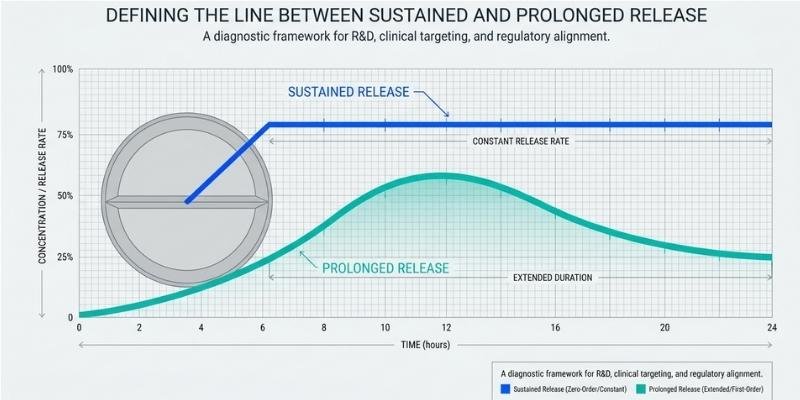
If the labels do not distinguish products, something must. It is the release order — the mathematical shape of the release curve. This is the distinction the popular articles are groping towards when they claim SR gives a flat line and PR a declining one. The real division is between zero-order and everything else, and it applies regardless of which word is on the box.
Zero-order — constant rate
The drug leaves the dosage form at a fixed amount per unit time, independent of how much remains. This is the profile that deserves the name “controlled release”, and it produces the flattest plasma curve and the lowest peak-to-trough fluctuation.
Osmotic pump systems approach it most closely, because the driving force is water influx across a semipermeable membrane rather than a diminishing concentration gradient. A plot of cumulative percentage released against time is a straight line.
First-order — rate falls as drug depletes
Release is proportional to the amount of drug still in the system, so the rate declines continuously. Most conventional matrix products described as “sustained release” behave this way.
This is the honest version of the claim that prolonged-release products “taper off”. It is true of first-order systems — but it is a property of the kinetics, not of the word on the label. A product labelled prolonged-release may be zero-order; one labelled sustained-release may be first-order; and the reverse is equally common.
Higuchi — diffusion from a matrix
For drug diffusing out of an insoluble or slowly eroding matrix, the cumulative amount released is proportional to the square root of time. The rate therefore falls off, but more gently than first-order.
A straight line on a plot of cumulative release against the square root of time indicates diffusion control. This is the workhorse model for hydrophilic HPMC and lipid matrix tablets, which is to say for most of the SR tablets manufactured in India.
Korsmeyer–Peppas — diagnosing the mechanism
A semi-empirical model used on the first 60 per cent of release to identify which mechanism dominates. The release exponent n is the diagnostic output.
nat or below about 0.45 for a cylinder — Fickian diffusionnbetween about 0.45 and 0.89 — anomalous, or non-Fickian, transport: diffusion plus polymer relaxationnat about 0.89 — Case II transport, driven by relaxation and erosion
In development, this is the model that tells you whether a reformulation has changed the release mechanism or merely its rate — a distinction that matters when you are defending a change to a regulator.
The metric that decides the dosing claim
None of the above justifies a once-daily claim on its own. What does is the fluctuation index at steady state — the swing between peak and trough plasma concentration across a dosing interval. A flatter profile means fewer concentration-related adverse effects and supports a reduced dosing frequency. That is the clinical purpose of the entire modified-release exercise, and it is measured, not asserted.
The formulation technologies behind the label
Different mechanisms produce different kinetics. Two products both labelled SR can sit at opposite ends of this table.
| System | How release is controlled | Typical kinetics | Practical notes |
|---|---|---|---|
| Hydrophilic matrix HPMC, xanthan | Polymer hydrates into a gel layer; drug diffuses out as the matrix swells and erodes | Higuchi, often anomalous | Cheapest and most common. Sensitive to polymer grade, viscosity and compression force |
| Inert or lipid matrix ethylcellulose, waxes | Drug diffuses through a permanent porous skeleton | Higuchi | Matrix passes intact in the stool, which alarms patients unless counselled |
| Reservoir / membrane-coated | A rate-controlling film governs diffusion out of the core | Near zero-order while a gradient persists | Coating defects cause dose dumping; coat weight uniformity is critical |
| Osmotic pump elementary, push-pull | Water drawn across a semipermeable membrane expels drug through a laser-drilled orifice | Zero-order | Largely independent of gastric pH and motility. Highest cost and tightest process control |
| Ion-exchange resin | Drug bound to a resinate is displaced by gastrointestinal ions | Variable, ion-dependent | Release depends on the patient’s ionic environment and diet |
| Multiparticulate pellets | Many individually coated units, each releasing independently | Depends on coat | Failure of one pellet is not failure of the dose — the lowest dose-dumping risk |
Scroll sideways to see all columns
How a prolonged-release product is actually specified
For a QC or regulatory function, this is where the terminology question becomes concrete. A conventional tablet is usually released on a single-point dissolution test. A prolonged-release product cannot be, because a single point cannot describe a curve.
The Ph. Eur. sets the expectation plainly: dissolution acceptance criteria for prolonged-release forms normally need three or more time points [4]. Each has a distinct job:
- Early point — set where roughly 20 to 30 per cent has dissolved, specifically to catch dose dumping [4]
- Middle point — around 50 per cent, to define the shape of the release pattern [4]
- Final point — to demonstrate essentially complete release, generally understood as more than 80 per cent [4]
On the USP side, the drug-release test for modified-release articles sits in General Chapter 724, with the underlying apparatus and staged sampling in General Chapter 711 [11]. Testing proceeds through levels: six units first, and only if those fail to conform does the test extend to a further six, and then to twelve more — twenty-four units in total at the final stage [11]. For delayed-release products an acid stage precedes the buffer stage, since the entire purpose is to survive gastric conditions.
When profiles are compared — between batches, between a test and reference product, or before and after a manufacturing change — the similarity factor f2 is the standard tool. An f2 above 50 supports a conclusion of similar dissolution profiles [6]. Where the change is a scale-up or a post-approval change to an existing modified-release product — a different polymer supplier, a larger batch, a new site — the FDA’s SUPAC-MR guidance sets out the level of testing and documentation expected for each category of change [7]. Because these datasets carry release decisions, the raw dissolution records fall squarely within ALCOA and ALCOA+ data integrity expectations — a routine finding area in CDSCO and WHO inspections.
India: the compliance point most often missed
This is the section with real consequences, and it is where Indian manufacturers most often get caught.
A sustained-release version is always a new drug
Under Rule 2(1)(w) of the New Drugs and Clinical Trials Rules, 2019, a modified or sustained-release form of a drug — or a novel drug delivery system — already approved by the Central Licensing Authority falls within the definition of a new drug [8]. Critically, the Explanation to that rule provides that while ordinary new drugs cease to be new after four years, products in this sub-clause shall always be deemed to be new drugs [8].
The four-year clock never starts. There is no point at which a sustained-release formulation becomes a state-licensable product. Central approval is required indefinitely.
If you take one enforcement fact from this article, take this one. Following deliberation at the 64th meeting of the Drugs Consultative Committee on 19 June 2024, the DCGI issued a circular dated 24 February 2025 to all State and Union Territory Drugs Controllers, directing uniform implementation of Rule 2(1)(w) [9]. The circular makes explicit that the rule captures gastro-resistant tablets and capsules, delayed-release tablets and capsules, and enteric-coated tablets and capsules, along with novel drug delivery systems [9].
That clarification closed a real gap. Enteric coating had frequently been treated as a routine formulation variation licensable at state level. It is not. If your site manufactures enteric-coated or gastro-resistant products under a state licence without central new-drug permission, that is an exposure worth reviewing against the circular directly — and it interacts with the prescription-status obligations covered in our guide to Schedule H drugs and their restrictions in India.
On terminology, the Indian Pharmacopoeia follows the European convention rather than the American one. IP monographs use prolonged-release — for example, Metformin Hydrochloride Prolonged-release Tablets — and the IPC’s own 2022 policy note on dissolution testing for these products uses the same wording [10]. The governing dissolution chapter is IP 2.5.2, harmonised with the corresponding Ph. Eur. and USP texts, currently read with the IP Addendum 2024 [12]. For an Indian dossier or label, prolonged-release is the correct register; extended-release is American; sustained-release is neither.
Dose dumping: why the specification exists
The early dissolution time point described above is not bureaucratic. It exists because modified-release products concentrate what would be several conventional doses into a single unit. When the rate-controlling mechanism fails, the entire load is released at once.
The reference case is Palladone, an extended-release hydromorphone capsule approved by the FDA in 2004. Studies showed that taking a capsule with alcohol produced substantially higher peak plasma concentrations than taking it with water, with the effect increasing sharply at higher alcohol strengths [13]. The rate-controlling polymers were soluble in ethanol, so alcohol dismantled the mechanism. The product was withdrawn from the market in 2005 [13]. In-vitro alcohol-induced dose-dumping testing in ethanol-containing media is now an expectation for modified-release opioids as a direct result.
A second case shows the risk running the other way. In Europe, modified-release paracetamol products were suspended by a legally binding European Commission decision of 19 February 2018 [14]. The problem was not that the products failed — it was that in overdose, the prolonged and unpredictable absorption made standard overdose management protocols unreliable. Slower release is not automatically safer release.
Common claims that do not survive checking
Because this question is so heavily written about, a set of confident but unsupported statements has propagated across the web. Each of the following appears on currently ranking pages.
| Frequently published claim | Status | What the sources support |
|---|---|---|
| “Sustained release gives a flat plasma curve; prolonged release gives a declining one” | Unsupported | No pharmacopoeia or regulator assigns either curve shape to either term. Curve shape follows the release kinetics of the specific product |
| “Prolonged release and extended release are different dosage forms” | Incorrect | The Ph. Eur. treats extended-release as the equivalent term for prolonged-release [3] |
| “The FDA formally distinguishes sustained from controlled release” | Incorrect | FDA guidance states these terms are used interchangeably with extended release [6] |
| “SR and ER products of the same drug are interchangeable” | Unsafe | Interchangeability requires bioequivalence against the specific reference product, not matching suffixes |
| “An enteric-coated product is a minor variation of the plain tablet” | Incorrect in India | Expressly a new drug requiring central approval [9] |
| “Modified release always means safer or gentler” | Not established | The EU suspension of modified-release paracetamol turned on harder overdose management [14] |
Scroll sideways to see all columns
Frequently asked questions
In substance, yes. Both describe a dosage form engineered to release its active ingredient more slowly than a conventional product. The difference is regulatory status rather than technology: prolonged-release is an official standard term in the European system and in the Indian Pharmacopoeia, while sustained-release has no compendial standing anywhere and survives as industry vernacular and on brand names.
Extended-release is the official term used in United States Pharmacopeia monograph titles. Sustained-release is one of the descriptors the USP expressly directs should not be used in their place. US FDA guidance goes further and states that extended, controlled and sustained are used interchangeably. So the pair are not two technologies but one concept under an official name and an unofficial one.
The Indian Pharmacopoeia follows European convention and uses prolonged-release, as in Metformin Hydrochloride Prolonged-release Tablets. The Indian Pharmacopoeia Commission used the same wording in its 2022 update introducing dissolution testing and a flexible monograph approach for these products. For an Indian dossier or label, prolonged-release is the correct register rather than the American extended-release.
Yes, and permanently. Rule 2(1)(w) of the New Drugs and Clinical Trials Rules, 2019 brings modified and sustained-release forms and novel drug delivery systems within the definition of a new drug, and the Explanation to the rule provides that such products shall always be deemed to be new drugs. The usual four-year period after which a new drug ceases to be new does not apply, so central approval is required indefinitely.
Yes. Following the 64th Drugs Consultative Committee meeting of 19 June 2024, the DCGI issued a circular dated 24 February 2025 directing State and Union Territory Drugs Controllers to apply Rule 2(1)(w) uniformly to gastro-resistant tablets and capsules, delayed-release tablets and capsules, and enteric-coated tablets and capsules. Treating enteric coating as a minor state-licensable variation is not correct.
Not on the basis of the suffix. Marketing suffixes such as SR, XR, XL, CR and LA are not standardised and do not guarantee an equivalent release profile. Interchangeability is established only by bioequivalence data against the specific reference product. Any substitution decision for an individual patient is a clinical one for the prescriber or pharmacist.
The European Pharmacopoeia indicates that acceptance criteria for prolonged-release dosage forms normally consist of three or more points: an early point set around 20 to 30 per cent dissolved to guard against dose dumping, a middle point near 50 per cent to define the release pattern, and a final point demonstrating essentially complete release, generally understood as more than 80 per cent.
Dose dumping is the unintended rapid release of the whole drug load from a modified-release unit. It matters because such a unit holds what would otherwise be several conventional doses. The reference case is Palladone, an extended-release hydromorphone capsule whose rate-controlling polymers dissolved in alcohol, producing far higher peak concentrations when taken with alcohol; the product was withdrawn in 2005. Alcohol-induced dose-dumping testing is now expected for modified-release opioids.
Classifying a modified-release product for the Indian market?
Whether a formulation is a new drug requiring central approval — and what dossier that triggers — is a determination worth getting right before the batch, not after the inspection.
Regulatory compliance consultationDeveloping a prolonged-release product with a partner site? See third-party manufacturing.
References
- United States Pharmacopeial Convention. Nomenclature Guidelines, G01.11-03. Effective 30 March 2020. Rockville, MD: USP. Available from: https://www.usp.org/sites/default/files/usp/document/usp-nomenclature-guidelines.pdf. Accessed August 2026.
- European Directorate for the Quality of Medicines and HealthCare. Standard Terms: internal controlled vocabularies for pharmaceutical dose forms, version 1.3.0. Strasbourg: EDQM; 9 June 2023. Available from: https://standardterms.edqm.eu. Accessed August 2026.
- Council of Europe. European Pharmacopoeia, general glossary and general monographs on Tablets (0478) and Capsules (0016). Strasbourg: EDQM. Available from: https://www.edqm.eu. Accessed August 2026.
- Council of Europe. European Pharmacopoeia general chapter 5.17.1, Recommendations on dissolution testing. Strasbourg: EDQM. Available from: https://www.edqm.eu. Accessed August 2026.
- United States Pharmacopeial Convention. General Chapter 1151, Pharmaceutical Dosage Forms. Rockville, MD: USP. Available from: https://www.uspnf.com/sites/default/files/usp_pdf/EN/USPNF/pharmaceuticalDosageForms.pdf. Accessed August 2026.
- US Food and Drug Administration, Center for Drug Evaluation and Research. Bioavailability Studies Submitted in NDAs or INDs: General Considerations. Guidance for Industry. Silver Spring, MD: FDA. Available from: https://www.fda.gov/media/121311/download. Accessed August 2026.
- US Food and Drug Administration. SUPAC-MR: Modified Release Solid Oral Dosage Forms. Guidance for Industry. Rockville, MD: FDA; September 1997. Available from: https://www.fda.gov/media/70956/download. Accessed August 2026.
- Ministry of Health and Family Welfare, Government of India. New Drugs and Clinical Trials Rules, 2019. G.S.R. 227(E), 19 March 2019. Rule 2(1)(w) and Explanation thereto. New Delhi: Gazette of India.
- Central Drugs Standard Control Organisation. Circular, File No. ND-13020/2/2024-eoffice, 24 February 2025: uniform implementation of Rule 2(1)(w) of the New Drugs and Clinical Trials Rules, 2019 for gastro-resistant, delayed-release and enteric-coated dosage forms. New Delhi: CDSCO. Available from: https://cdsco.gov.in/opencms/resources/UploadCDSCOWeb/2018/UploadCircularFile/ND-13020-2-2024-eoffice.pdf. Accessed August 2026.
- Indian Pharmacopoeia Commission. Inclusion of dissolution test in prolonged-release formulations in IP and adoption of flexible monograph approach. Ghaziabad: IPC; 4 February 2022. Available from: https://www.ipc.gov.in. Accessed August 2026.
- United States Pharmacopeial Convention. General Chapter 711, Dissolution, and General Chapter 724, Drug Release. Rockville, MD: USP. Available from: https://www.usp.org. Accessed August 2026.
- Indian Pharmacopoeia Commission. Indian Pharmacopoeia 2022, general chapter 2.5.2 Dissolution, with Addendum 2024 effective 1 July 2024. Ghaziabad: IPC. Available from: https://www.ipc.gov.in. Accessed August 2026.
- US Food and Drug Administration. Information for Healthcare Professionals: hydromorphone hydrochloride extended-release capsules, marketed as Palladone. Silver Spring, MD: FDA; July 2005. Available from: https://www.fda.gov. Accessed August 2026.
- European Medicines Agency. Modified-release paracetamol-containing products: CMDh position and European Commission decision, EMA/118413/2018, 19 February 2018. Amsterdam: EMA. Available from: https://www.ema.europa.eu. Accessed August 2026.
Technical and educational content for pharmaceutical, regulatory and quality professionals. Not medical advice, and not a substitute for the prescribing information for any individual product. Pharmacopoeial texts and Indian statutory instruments are revised frequently; verify the current edition of any monograph, rule or circular before relying on it in a submission or a release decision. Compendial general chapter numbers cited here should be checked against the edition your organisation subscribes to. Written and verified by Darshan Singh, MSc Organic Chemistry, with 23 years in pharmaceutical quality assurance, quality control and drug regulatory affairs. Last verified against source documents in August 2026.