
The SOP for dry powder filling operation defines step‑by‑step controls for aseptic vial filling of sterile powders, including environmental conditions, machine setup, component transfer, in‑process weight and quality checks, and documentation. It ensures each vial receives the correct dose under validated sterile conditions compliant with GMP requirements.
SOP for Dry Powder Filling Operation(Format)
Objective
To describe the standardized procedure for aseptic filling, stoppering and sealing of sterile dry powder injection vials using an automatic vial powder filling machine in order to ensure consistent fill weight, sterility and product quality.
Scope
This SOP applies to dry powder injection filling operations carried out in the sterile injection block of XYZ Pharma (vial sizes 7.5 ml, 10 ml and 20 ml, 20 mm neck finish) using qualified vial powder filling, stoppering and sealing machines.
Responsibilities
- Production Chemist/Officer: Execute filling operation as per SOP, perform in‑process checks, record data in BMR, immediately report deviations.
- Production Manager: Ensure availability of trained personnel, approved batch documents, and qualified equipment; review and approve records.
- IPQA Officer: Provide line clearance, perform independent in‑process checks and environmental monitoring, review results, and decide on batch disposition as per quality system.
Abbreviations
- SOP – Standard Operating Procedure
- RH – Relative Humidity
- QA – Quality Assurance
- IPQA – In‑Process Quality Assurance
- AHU – Air Handling Unit
- LAF – Laminar Airflow
- BMR – Batch Manufacturing Record
Working principle of dry powder vial filling machine
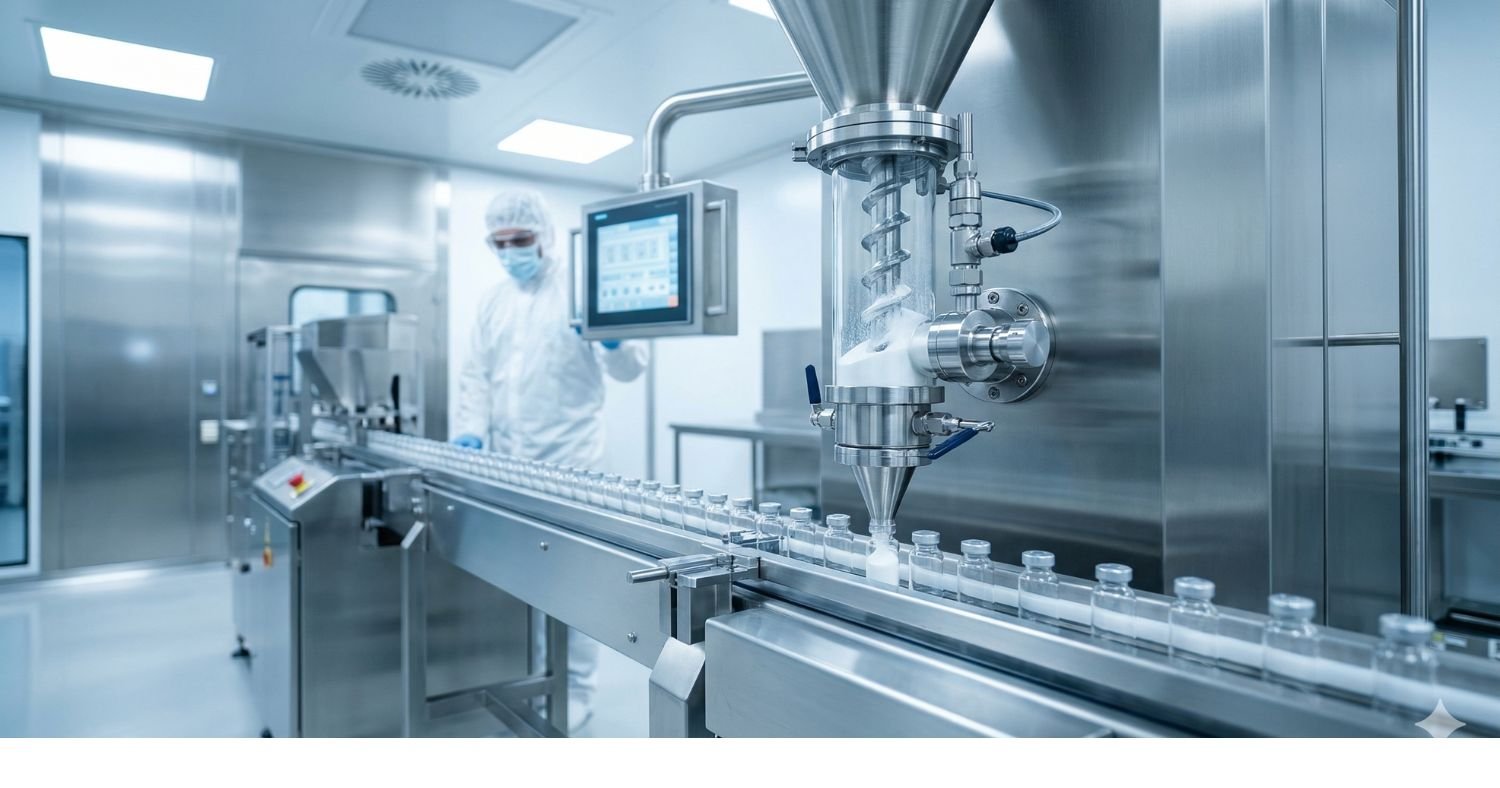
Modern injectable dry powder vial filling machines are typically monobloc systems that combine powder filling and rubber stoppering on a single base frame. They employ a rotary powder wheel fitted with multiple piston‑type powder ports working on a vacuum and compressed‑air principle.
Key elements of the working principle:
- Powder hopper and agitation: Sterilized bulk powder is transferred into a 316L stainless‑steel hopper, where mechanical agitators maintain uniform bulk density and prevent bridging.
- Rotary powder wheel and pistons: The wheel has multiple ports; as it rotates, each port passes under the hopper and fills with powder by vacuum suction while a piston inside the port sets the volume and thus target fill weight.
- Vacuum pick‑up and excess scrapping: A vacuum plate behind the wheel helps draw powder into each port, and a fixed scraper removes excess powder from the wheel surface to achieve consistent dosing.
- Discharge into funnels: When the filled port aligns above the filling funnel, low‑pressure sterile air or nitrogen pushes the powder out of the port and down through the funnel into the vial positioned beneath.
- Vial handling and indexing: A conveyor with infeed worm and star wheel accurately positions each vial under its respective funnel; no‑vial–no‑fill interlocks prevent powder discharge if a vial is missing.
- Online weighing (where provided): Some machines incorporate dual weighing modules on the star wheel: one measures empty vial weight and the second gross weight after filling; software calculates net powder weight and rejects out‑of‑tolerance vials.
- Stoppering and sealing: After filling, vials move to a rubber stoppering station under LAF, then to an automatic sealing machine for aluminum flip‑off seals, maintaining container‑closure integrity.
This section should be placed early in the article and linked in internal navigation to directly meet the “working principle” query intent.
Environmental and AHU conditions for dry powder filling
Dry powder injection areas require strict environmental control to protect both sterility and powder quality. RH and temperature are particularly critical because moisture can cause powder caking, reduced solubility and changes in potency.
Typical AHU and room parameters for powder vial filling (to be aligned with site qualification data):
- Cleanliness: Grade A unidirectional airflow at the point of fill and stoppering, within a Grade B background, as per EU GMP Annex 1; isolator technology may allow lower background classification.
- Temperature: Generally maintained between 20–25 °C in sterile powder vial areas to protect product and operator comfort.
- Relative Humidity: Typically controlled between 30–40% for dry powder injection operations to minimize moisture uptake and powder sticking while avoiding static‑related issues.
- Pressure differentials: Positive pressure of 10–15 Pa between cleaner and less‑clean areas to maintain clean‑to‑less‑clean airflow.
- Air changes and filtration: Sufficient air changes with terminal HEPA filters (for example, 20–40 ACPH) to maintain particle counts within specified limits.
Continuous or at least frequent monitoring of temperature, RH and pressure is expected, with documented alarms and procedures for handling excursions in line with GMP guidance.
Pre‑requisites and line clearance
Before starting any dry powder filling batch, the following pre‑requisites must be completed:
- AHU operation and room stabilization
- Start the dedicated AHUs for the filling room at least 3 hours prior to operation to achieve stable temperature, RH and pressure differentials.
- Verify and record that environmental conditions are within specified limits.
- Area cleaning and status
- Ensure that the filling room and LAF hoods are cleaned and disinfected as per cleaning SOP; verify that the area status label indicates “CLEANED” and “LINE CLEARANCE OFFERED”.
- Confirm that previous batch materials and documents have been removed.
- Line clearance by IPQA
- IPQA checks the cleanliness, label status, absence of previous product, availability of approved BMR, and calibration/qualification status of equipment, then documents line clearance.
- Material availability and status
- Confirm availability of sterilized vials, rubber stoppers and aluminum seals with approved status labels, along with sterilized bulk powder, batch documents, and required change parts.
- Personnel preparation
- Ensure that only trained and gowned personnel enter the aseptic core; gowning must follow the site sterile gowning SOP and be appropriate for Grade B/A operations.
Step‑by‑step procedure for dry powder filling operation
1. Component transfer into sterile area
- Transfer sterilized vials, rubber closures and aluminum seals from the washing and sterilization area into the vial filling sterile area through double‑door autoclave or sterilization tunnel and pass boxes, as applicable.
- Verify component details (size, type, batch number, quantity) against BMR and approved specifications.
- Vials: 7.5 ml, 10 ml and 20 ml clear glass vials, 20 mm neck finish.
- Rubber closures: 20 mm butyl rubber stoppers suitable for dry powder injection.
- Aluminum seals: 20 mm flip‑off or plain seals as per product requirement.
2. Machine setup and empty‑vial trial run
- Assemble sterilized change parts on the powder filling machine (star wheel, funnels, hopper, powder wheel, piston assembly) under LAF, using aseptic technique.
- Set conveyor speed and synchronize star wheel and filling head speed as per validated settings.
- Run the machine without powder (dummy run) with empty vials and collect at least 10 sealed empty vials to confirm smooth movement, correct stopper placement and seal integrity; record observations in the BMR.
3. Setting fill weight and control limits
- Transfer sterilized bulk powder into the hopper under LAF, minimizing exposure time and avoiding any direct contact.
- Set the target fill weight per vial and upper/lower control limits as per BMR (based on assay, overage policy and allowable weight variation).
- Adjust piston stroke on the powder wheel to approximate target fill weight.
- Start filling at slow speed and collect vials corresponding to all powder wheel stations (for example, 1 vial per port) to establish correlation between station number and fill weight.
4. Initial in‑process verification
- After two complete revolutions of the filling wheel, collect a composite sample of at least 16 consecutively filled vials from the filling wheel.
- Weigh each vial (tare‑adjusted) individually and record weights; calculate mean fill weight and individual variation against specified limits.
- If mean weight or any individual vial is out of limit, adjust piston settings and repeat the 16‑vial check until results are within acceptance criteria; document adjustments.
- Reconstitute the contents of the 16 vials with the specified volume of Water for Injection (for example, 5 ml) and assess:
- Time to complete dissolution.
- Presence of visible particulate matter against black and white background, as per visual inspection SOP.
5. Routine filling operation
Once initial checks are satisfactory and IPQA has authorized continuation:
- Start the filling machine at validated speed; ensure no‑vial–no‑fill and other safety interlocks are functioning.
- Continuously monitor powder level in the hopper; avoid running the hopper nearly empty to prevent weight drift.
- Ensure that stoppering and sealing operations are synchronized, with correct seating of stoppers and crimp quality verified periodically.
6. Ongoing in‑process controls during filling
The following in‑process controls are typically performed for sterile dry powder injection batches:
- Weight variation checks:
- Every hour, collect 16 consecutively filled vials and check individual fill weight against specified upper and lower limits.
- Every 30 minutes, check at least 3 vials for rapid verification of fill weight trend.
- If results fall outside limits, stop the machine, segregate impacted vials (from last acceptable check to current), investigate and adjust machine before restarting.
- Reconstitution and visual check:
- Every 4 hours (or as defined in BMR), collect approximately 16 vials, reconstitute each with the specified volume of WFI and check for complete solubility and absence of visible particulate matter.
- Environmental monitoring:
- Expose settle plates and perform active air sampling in the filling room and LAF as per environmental monitoring SOP and Annex 1 expectations.
- Perform surface contact plate monitoring of critical surfaces at defined intervals.
- Differential pressure, temperature and RH:
- Record parameters at defined frequencies (for example, every hour) and ensure they are within approved ranges; document any excursions and actions taken.
- Visual inspection of ongoing output:
- At defined intervals, visuallycheck a sample of filled, stoppered and sealed vials for fill level, cosmetic defects, stopper placement and seal integrity, as per visual inspection SOP.
7. Completion, machine stoppage and documentation
- After completion of batch filling, allow star wheel to clear and stop the machine as per OEM instructions.
- Perform reconciliation of vials and powder (issued vs filled vs rejected vs returned) in coordination with IPQA.
- Document all in‑process check results, deviations, interventions and corrective actions in the BMR and relevant logs.
- Inform cleaning team to execute post‑campaign or end‑of‑batch cleaning SOP for vial filling machine and area.
In‑process checks and typical acceptance criteria
Actual numerical limits must follow product registration and internal quality standards, but common approaches include:
- Weight variation: Limits typically expressed as ±x % of target fill weight or based on pharmacopeial recommendations for powder‑for‑injection content uniformity; sampling of 16 vials is a widely used practice in industry SOPs.
- Reconstitution time: Must meet product specification (for example, complete dissolution within y seconds/minutes at designated temperature) with no caking or undissolved lumps.
- Visible particulates: No visible foreign or intrinsic particulate matter under controlled inspection conditions; visual inspection is considered a critical QC step for parenterals.
- Environmental limits: Microbial and particulate limits as per Annex 1 and site EM program, with predefined alert and action levels.
Documented and consistently applied acceptance criteria strengthen inspection readiness and demonstrate process control.
Common problems and troubleshooting tips
- Gradual decrease in fill weight: Often due to powder density changes in the hopper or wear in pistons; troubleshoot by adjusting piston stroke, checking hopper agitation and verifying vacuum and compressed air pressures.
- Powder sticking or bridging: Typically linked to high RH or electrostatic issues; confirm RH is within 30–40%, improve hopper agitation and ensure powder is properly milled and dried.
- Excess powder spillage: May indicate mis‑alignment between funnel and vial or incorrect timing; re‑align change parts and verify conveyor–star wheel synchronization.
- Frequent environmental excursions: Investigate AHU performance, filter integrity and door‑opening practices; adjust balancing or repair as per HVAC qualification guidelines.
In all cases, document investigations and corrective and preventive actions (CAPA) in accordance with the pharmaceutical quality system.
If you want to get Prepared SOPs for any Instrument or Process contact Us
FAQ – Dry powder filling operation
What is the ideal RH and temperature for dry powder injection filling?
Most sterile dry powder injection rooms operate around 20–25 °C with RH controlled between 30–40%, balancing moisture control with static and operator comfort. Exact limits must be defined during qualification and product development.
Why are 16 vials commonly used for weight‑variation checks?
Many industry SOPs use a 16‑vial sample for statistical evaluation of fill weight, providing a practical balance between detection power and operational feasibility. It allows assessment of mean and range while keeping testing time manageable during aseptic operations.
How often should weight checks be done during filling?
A common practice is to perform full 16‑vial weight checks every hour and quick 3‑vial trend checks every 30 minutes, with additional checks after any major adjustment or intervention. Frequencies should be defined in the validated BMR.
Why is environmental monitoring performed during filling and not only before or after?
Aseptic processing guidelines emphasize real‑time or concurrent environmental monitoring to detect conditions during the actual critical operation that may impact sterility assurance. Pre‑ and post‑checks alone may miss transient contamination events.
What differentiates a dry powder vial filling machine from a liquid filling machine?
Dry powder filling machines use vacuum‑assisted powder wheels or auger systems with pistons to dose solid powder, whereas liquid fillers typically rely on volumetric piston, peristaltic or time‑pressure systems designed for liquids.
References:
- European Commission. EudraLex Volume 4, EU GMP Annex 1: Manufacture of sterile medicinal products. Brussels: European Commission; 2022. Available from: https://health.ec.europa.eu/
- U.S. Food and Drug Administration. Sterile Drug Products Produced by Aseptic Processing — Current Good Manufacturing Practice. Guidance for Industry. Rockville (MD): FDA; 2004 Oct. Available from: https://www.fda.gov/regulatory-information/search-fda-guidance-documents/sterile-drug-products-produced-aseptic-processing-current-good-manufacturing-practice
- Central Drugs Standard Control Organization. Schedule M: Good Manufacturing Practices and Requirements of Premises, Plant and Equipment for Pharmaceutical Products. New Delhi: CDSCO; revised edition. Available from: https://rajasthanpharmacycouncil.in/admin/attachments/Revised%20Schedule%20%20M%204.pdf
- World Health Organization. WHO good practices for pharmaceutical quality control laboratories. WHO Technical Report Series No. 957, Annex 1. Geneva: WHO; 2010. Available from: https://www.who.int/
- World Health Organization. WHO good practices for pharmaceutical quality control laboratories (revised draft). Geneva: WHO; 2021. Available from: https://cdn.who.int/
- Prism Pharma Machinery. Monoblock rotary dry powder filling & sealing machine – working principle and features. Prism Pharma Machinery; 2024. Available from: https://www.prismpharmamachinery.com/monoblock-rotary-dry-powder-filling/
- Adinath International. Injectable dry powder filling machine – working principle and technical features. Adinath International; 2024. Available from: https://www.powderfillingmachines.in/injectable-dry-powder-filling-machine/
- Adinath International. Injectable powder filling machine – vial dry powder filler. Adinath International; 2024. Available from: https://www.adinathmachines.com/liquid-and-powder-filling-machines/injectable-powder-filling-machine/
- Pharmaguideline. Role of RH and temperature in dry powder injection. Pharmaguideline.com; 2020 Dec 19. Available from: https://www.pharmaguideline.com/2017/09/role-of-rh-and-temperature-in-dry-powder-injection.html
- Pharmaguideline. Understanding the stability of injectable products. Pharmaguideline.com; 2025. Available from: https://www.pharmaguideline.com/2025/04/understanding-stability-of-injectable-products.html
- PharmaDevils. SOP for operating and cleaning of automatic high speed injectable powder filling machine. PharmaDevils; 2023. Available from: https://pharmadevils.com/
- Pharmapath. SOP for in‑process quality checks during filling and packing. Pharmapath.in; 2024 Dec 21. Available from: https://pharmapath.in/in-process-quality-checks-during-filling-and-packing/
- International Pharmaceutical Association (IPA). Best practices on media fill for sterile products. Mumbai: IPA; 2025. Available from: https://www.ipa-india.org/sites/default/files/2025-07/Best-Practices-in-Media-Fill-for-Sterile-Products.pdf
- Senieer. Key points for ventilation, air conditioning and air purification in pharmaceutical cleanrooms. Senieer.com; 2022 Mar 27. Available from: https://www.senieer.com/62-key-important-points-for-ventilation-air-conditioning-and-air-purification-in-pharmaceutical-cleanroo/
- PDA. GMP Annex 1 implementation – how ready‑to‑use vials and cartridges can meet new regulation requirements efficiently. PDA Letter; 2025 Jan 22. Available from: https://www.pda.org/pda-letter-portal/home/full-article/gmp-annex-1-implementation