Product information · updated 24 November 2026
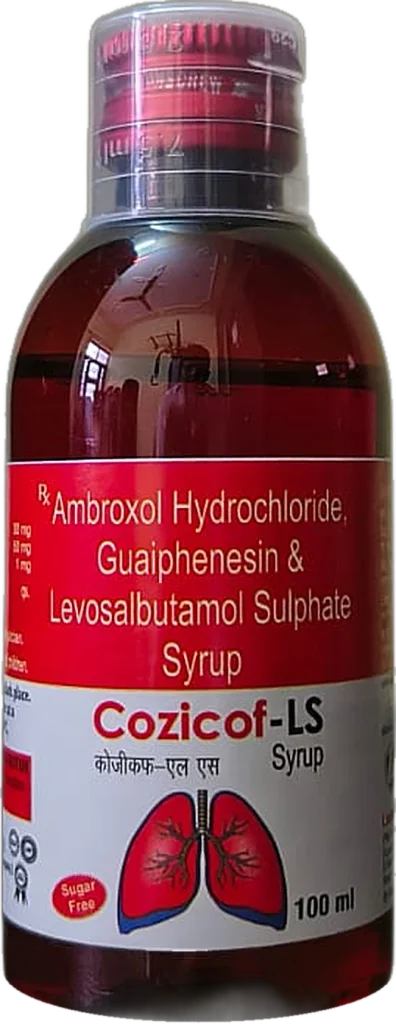
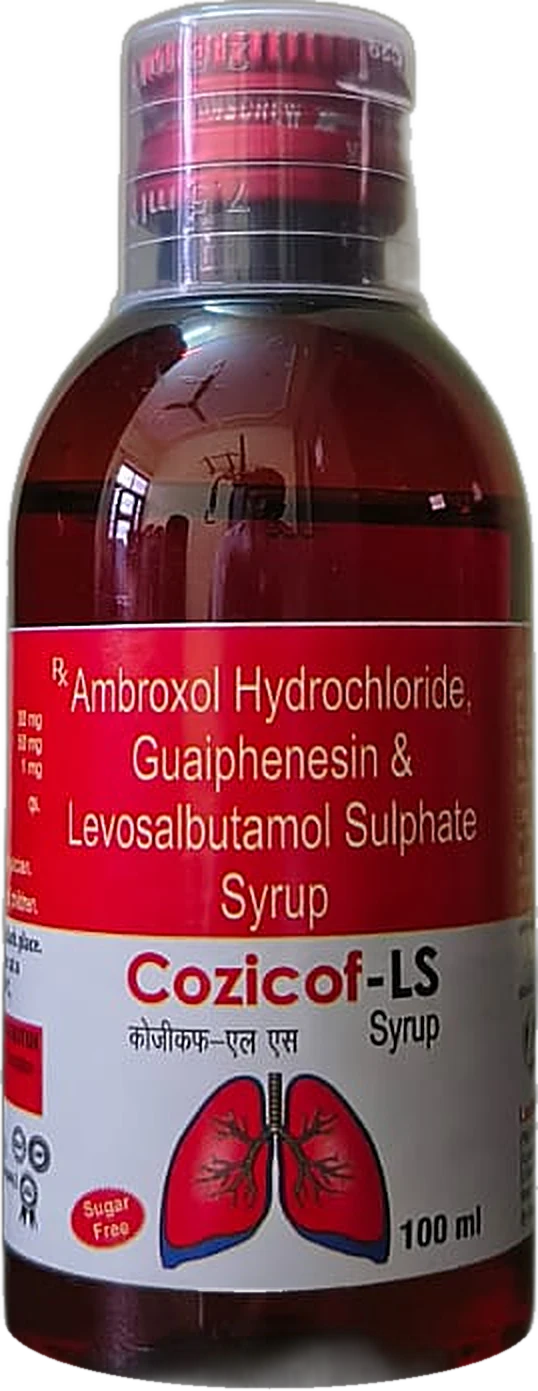
Cozicof-LS is a levosalbutamol ambroxol guaiphenesin syrup: each 5 ml holds ambroxol hydrochloride IP 30 mg, guaiphenesin IP 50 mg and levosalbutamol sulphate IP 1 mg, in a sugar-free base. This composition was approved by the Drugs Controller General of India on 19 March 2009 for one use: symptomatic relief of bronchospasm in bronchial asthma and chronic bronchitis[1]. In practice that means a wet cough with wheeze or tight airways. Prescribing information for this strength, filed with the Rwanda Food and Drugs Authority, gives adults and children over 11 years 5 to 10 ml three times a day and children aged 6 to 11 years 5 ml three times a day[2]; it gives no dose below 6 years, and it is not for children under 6[3][4][5].
It is marketed by Laafon Galaxy Pharmaceuticals at an MRP of ₹112 per 100 ml.
- Rx · Schedule H label
- Not for children under 6
- DCGI-approved composition (2009)
- Sugar free
- Not on India’s banned-FDC lists (checked 24 Nov 2026)
- Brand
- Cozicof-LS Syrup
- Pack
- 100 ml bottle, sugar free
- MRP
- ₹112 per 100 ml
- Marketed by
- Laafon Galaxy Pharmaceuticals
- Manufactured at
- A third-party WHO-GMP certified facility
- Licence
- State drug manufacturing licence
- Dose on label
- As directed by the physician
- Storage
- Cool, dry, dark place, not above 30 °C
The MRP is the price printed on current stock. Laafon Galaxy markets Cozicof-LS; it is manufactured for us at a third-party WHO-GMP certified facility under a state drug manufacturing licence. The rest of the range is on all Laafon Galaxy products.
Levosalbutamol ambroxol guaiphenesin syrup: what is in each 5 ml
The three ingredients do three different jobs: one opens the airways, one thins sticky mucus, and one helps it move up and out. That is why the approved use is cough with airway narrowing, not every cough.
Scroll the table sideways →
| Ingredient | Per 5 ml | Class | What it does |
|---|---|---|---|
| Levosalbutamol sulphate IP | 1 mg | Beta-2 agonist bronchodilator | Relaxes airway muscle. It is the (R)-isomer of salbutamol, the half that carries almost all the beta-2 activity[6] |
| Ambroxol hydrochloride IP | 30 mg | Mucolytic (secretolytic) | Thins sticky mucus and stimulates surfactant release in the lungs[7] |
| Guaiphenesin IP (guaifenesin) | 50 mg | Expectorant | Thins mucus in the air passages so it is easier to cough up[8] |
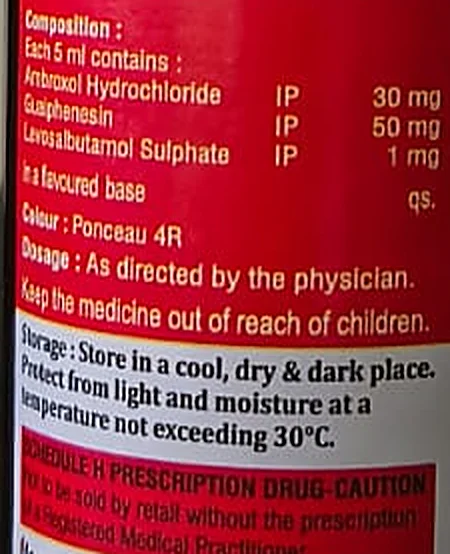
What the Cozicof-LS label says
- Composition: each 5 ml contains ambroxol hydrochloride IP 30 mg, guaiphenesin IP 50 mg and levosalbutamol sulphate IP 1 mg, in a flavoured, sugar-free base
- Colour: Ponceau 4R (relevant for anyone who reacts to azo dyes)
- Dosage: as directed by the physician
- Storage: cool, dry and dark place; protect from light and moisture; not above 30 °C
- Caution: Schedule H prescription drug; not to be sold by retail without the prescription of a Registered Medical Practitioner
How the three ingredients work
Levosalbutamol. Salbutamol is sold as a 50:50 mix of two mirror-image forms; levosalbutamol is the (R)-form alone, where the beta-2 bronchodilator activity sits[6]. It eases wheeze and chest tightness.
Ambroxol. The active metabolite of bromhexine[9]. It stimulates synthesis and release of surfactant by type II pneumocytes. Its half-life is 7 to 12 hours and it is about 90% protein-bound[7].
Guaiphenesin. An expectorant that loosens mucus. MedlinePlus notes it can help control symptoms but does not treat the cause or speed recovery[8].
Cozicof-LS syrup uses: the approved indication
The DCGI approval for this composition and strength covers symptomatic relief of bronchospasm in bronchial asthma and chronic bronchitis[1]. A doctor decides whether that applies to a particular patient. For how a wet-cough formula compares with other brands, see our guide to wet cough syrup brands and compositions in India.
Suited to
- Wet (productive) cough with thick mucus in a patient with asthma or chronic bronchitis
- Cough with wheeze or chest tightness where a doctor wants an oral bronchodilator
- Patients who need a liquid rather than a tablet
Not suited to
- Common cold, sinusitis, sneezing, runny nose or watery eyes: none of the three ingredients is an antihistamine or decongestant
- Dry, tickly cough with no mucus (see dry cough syrups for adults)
- An acute severe asthma attack, which needs urgent care and an inhaled reliever
- Use together with a cough suppressant[2]
Cozicof-LS dose by age
Cozicof-LS is a prescription medicine, so the dose on the prescription comes first. The label itself says only “as directed by the physician”. The guidance below follows the prescribing information for this exact strength filed with the Rwanda FDA[2], the Health Ministry’s October 2025 advisory on cough syrups for children[5], and UK and Maltese regulators’ advice on over-the-counter cough medicines containing an expectorant such as guaiphenesin[4][10].
1. Who is the syrup for?
2. Any of these: heart disease, high blood pressure, overactive thyroid, diabetes, seizures, a stomach ulcer, kidney or liver disease, pregnancy or breastfeeding, or an allergy to any ingredient (including the colour Ponceau 4R) or to bromhexine?
Choose an age group to see the guidance
The answer appears here. It does not replace the prescription.
Scroll the table sideways →
| Age | Guidance | Basis |
|---|---|---|
| Under 2 years | Do not give. Cough and cold medicines should not be prescribed or dispensed at this age. | MoHFW advisory, 3 Oct 2025[5] |
| 2 to 5 years | Not for use. | No dose is given below 6 years[2]; oral salbutamol tablets are approved only from 6 years[3]; UK regulator: expectorant cough medicines not for under 6[4]; MoHFW: generally not recommended under 5[5] |
| 6 to 11 years | 5 ml three times a day, only as a doctor prescribes after examining the child | Prescribing information[2]; MoHFW: close supervision[5] |
| 12 years and adults | 5 to 10 ml three times a day | Prescribing information[2] |
| Older adults | No separate dose for this syrup; older patients are started on lower doses of oral salbutamol, so the doctor may start low | US salbutamol tablet label[3] |
How long? For children aged 6 to 12, regulators’ advice on cough medicines containing an expectorant limits use to no more than 5 days; that advice was written for over-the-counter products, and the prescribing doctor sets the actual course[10]. See the doctor again if an adult’s cough lasts more than 7 days, or if it keeps coming back or comes with fever, rash or a persistent headache[2]. Do not take more than 4 doses in 24 hours[2]. Shake the bottle and use the measuring cup, not a kitchen spoon. Needing it more often than usual can be a sign that asthma is becoming unstable and needs review[3].
For all of the 2026 age rules on children’s cough syrups in one place, see cough syrup for children in India: the 2026 age rules.
Who should not take Cozicof-LS, and drug interactions
Do not use if
Tell the doctor first
- Heart disease, an irregular heartbeat or high blood pressure
- Seizures, an overactive thyroid or diabetes[3]
- Severe asthma: beta-agonists can lower blood potassium[2]
- Kidney disease or serious liver disease: ambroxol metabolites can build up[12]
- A past stomach or duodenal ulcer[12]
- Pregnancy or breastfeeding[2]
Scroll the table sideways →
| Taken with | What can happen | What to do |
|---|---|---|
| Beta-blockers (for example propranolol) | Block levosalbutamol’s effect and may cause severe bronchospasm in people with asthma[2][3] | Not usually prescribed together |
| Cough suppressants (codeine, dextromethorphan), including our Ftox-DX syrup | Taking a cough suppressant with this syrup is not recommended[2] | Do not combine |
| Other beta-agonists or sympathomimetics: reliever inhalers, terbutaline syrups such as FTOX-AM, decongestant tablets such as Laricold | Added heart and blood-pressure effects[2]; FTOX-AM also doubles up ambroxol and guaiphenesin | Do not take two cough syrups together unless the doctor prescribes both |
| Loop or thiazide diuretics (for example furosemide) | Low potassium and ECG changes may get worse[2][3] | Use with caution; potassium may need checking |
| Digoxin | Blood digoxin levels fell by 16 to 22% with oral salbutamol[3] | Monitor digoxin levels |
| MAO inhibitors or tricyclic antidepressants, now or in the past 2 weeks | Effects on blood vessels may be increased[2][3] | Only with extreme caution, under a doctor |
| Urine test for 5-HIAA | Guaiphenesin can interfere with the result[2] | Tell the laboratory |
Cozicof-LS side effects
Common
- From levosalbutamol: hand tremor, palpitations, muscle cramps[2]; with oral salbutamol also nervousness, headache, fast heartbeat, poor sleep, dizziness and nausea[3]
- From ambroxol: allergic reactions such as skin rash or nettle-rash are possible[2]
- From guaiphenesin: headache, nausea or vomiting[8]
Stop and get medical help
- Wheeze or breathlessness that gets worse straight after a dose (paradoxical bronchospasm, which can be life-threatening)[3]
- A spreading rash, blisters, mouth sores or swelling. In 2015 EMA confirmed a small risk of severe skin reactions and a low risk of anaphylaxis with ambroxol[9]
- Chest pain or a fast, pounding or irregular heartbeat[13]
Overdose shows as a racing heart, nervousness, headache and tremor, and with guaiphenesin stomach upset, nausea and drowsiness; get medical care straight away[2].
Pregnancy and breastfeeding
The combination should be used with caution in pregnancy, and it is not known whether it passes into breast milk[2]; oral salbutamol is used in pregnancy only if the benefit justifies the risk[3]. Oral beta-agonists must not be used to suppress premature labour[11].
Is levosalbutamol, ambroxol and guaiphenesin syrup banned in India?
No. This exact three-ingredient combination is not in the September 2018 (328 FDCs), June 2023 (14 FDCs) or August 2024 (156 FDCs) prohibition lists[14][15][16], or in the 16 FDCs prohibited on 11 June 2026, none of which is a cough or cold combination[17]. Several syrups that look similar are. They use racemic salbutamol instead of levosalbutamol, or add one more ingredient, so read the full composition, not just “LS” or “AX” on the label.
Swipe the tabs sideways for more →
Levosalbutamol 1 mg + Ambroxol 30 mg + Guaiphenesin 50 mg per 5 ml. Approved by the DCGI on 19 March 2009 (CDSCO list of approved drugs, S. No. 50)[1], and not on the 2018, 2023, 2024 or June 2026 prohibition lists. Cozicof-LS is made to this approved composition under a state drug manufacturing licence.
Salbutamol sulphate is listed in Schedule H of the Drugs Rules, 1945[18]; levosalbutamol, its (R)-isomer, is not named separately in the list. The Cozicof-LS label carries the Schedule H prescription-drug caution, so it is sold only on a doctor’s prescription. G.S.R. 477(E), dated 9 June 2026, also removed the word “Syrups” from the household-remedy entry of Schedule K (serial 13, item 7)[19]. See Schedule H drugs: regulations and restrictions in India.
Levosalbutamol 0.5 mg + Ambroxol 15 mg + Guaiphenesin 50 mg per 5 ml. This half-strength syrup has its own entry: an NOC dated 17 July 2015 for the same indication, bronchospasm in bronchial asthma and chronic bronchitis[20]. It is a different product from Cozicof-LS, which carries twice the levosalbutamol and ambroxol per 5 ml.
Ambroxol + Salbutamol + Ammonium chloride + Guaiphenesin + Menthol. Prohibited in the 2024 batch of 156 FDCs: the orders are dated 2 August 2024 and were published in the Gazette of India on 12 August 2024 (CDSCO list, S. No. 115)[16]. It differs from Cozicof-LS by using racemic salbutamol and adding ammonium chloride and menthol. The full list with every S.O. number is on our page of the 156 FDCs banned in 2024.
Salbutamol + Cetirizine + Ambroxol. Prohibited in the September 2018 batch of 328 FDCs, along with Salbutamol + Choline theophyllinate + Ambroxol and Salbutamol + Bromhexine + Guaiphenesin + Menthol[14][21]. Adding an antihistamine or a theophylline to a bronchodilator-mucolytic syrup is a pattern the 2018 review rejected.
Salbutamol + Bromhexine. Prohibited on 2 June 2023 in the batch of 14 FDCs, together with Salbutamol + Etofylline + Bromhexine (S.O. 2407(E))[15]. Bromhexine is the parent drug of ambroxol, which is why these are easy to confuse with an ambroxol syrup.
Status checked against the 2018, 2023, 2024 and June 2026 lists on 24 November 2026. FDC prohibitions are added by gazette notification under section 26A of the Drugs and Cosmetics Act, 1940, so re-check before relying on this for a purchase or licence decision.
What the evidence does and does not show
- The combination: one randomised trial is indexed in PubMed. In 244 adults with acute bronchitis and productive cough, an ambroxol + guaifenesin + levosalbutamol oral solution (10 ml three times a day for 2 weeks) reached the primary efficacy endpoint in 57% of patients against 44% with a bromhexine + guaifenesin + salbutamol syrup. The trial was open-label, run in Russia, and its abstract does not state the strengths used[22].
- Levosalbutamol versus salbutamol: in a double-blind trial in 70 children with acute asthma, nebulised levalbuterol was not more effective than racemic salbutamol[23]. The “purer isomer” argument has not translated into a clear clinical advantage.
- Children with colds: a South Indian study (published online in December 2025) judged 65.7% of cough-medicine prescriptions for children’s acute respiratory infections irrational; levosalbutamol, ambroxol and guaifenesin syrups were among those commonly prescribed[24]. It is another reason this syrup belongs only where there is real bronchospasm.
Other brands with the same composition
Many companies sell levosalbutamol 1 mg + ambroxol 30 mg + guaiphenesin 50 mg per 5 ml under “LS” brand names. The active content is the same; excipients, colour, sugar-free status and price differ. Listed for comparison only.
Scroll the table sideways →
| Brand | Marketed by | Per 5 ml | Checked against |
|---|---|---|---|
| Cozicof-LS | Laafon Galaxy Pharmaceuticals | 1 mg + 30 mg + 50 mg | This page (MRP ₹112 per 100 ml) |
| Ascoril LS, Solvin-LS, Grilinctus-LS | Glenmark, Ipca, Franco-Indian | 1 mg + 30 mg + 50 mg | Our wet cough syrup brand guide |
Some “LS” or “AX” syrups use racemic salbutamol, half the strength, or extra ingredients. Compare the composition line on the carton, not the brand suffix.
Oral liquid quality: DEG and EG testing
On 13 October 2025 WHO issued Medical Product Alert N°5/2025 after CDSCO reported diethylene glycol (DEG) in specific batches of three Indian oral liquids: COLDRIF, Respifresh TR and ReLife[25]. On 8 October 2025 the Centre asked Drug Controllers of all States and UTs to ensure that each batch of raw material and each batch of finished product is tested before release[26]; the duty itself sits in Rules 74(c) and 78(c)(ii) of the Drugs Rules, 1945[27].
For trade buyers of any cough syrup
- Ask for the batch certificate of analysis and check that it covers the finished product, not just the API.
- Check that the batch number, manufacturing date and expiry on the CoA match the carton.
- Buy only through licensed distributors, as WHO advises[25].
- Manufacturers: DEG and EG enter through excipients such as glycerin and propylene glycol, so testing starts at raw material sampling.
Trade enquiry: Cozicof-LS Syrup
For licensed retailers, wholesalers and distributors. Cozicof-LS is a prescription medicine and is supplied to licensed trade buyers only. Ask about stock, batch CoA and trade terms on WhatsApp, call 98124 46733, or email contact@laafon.com.
Building a respiratory range? See our PCD pharma franchise and third-party manufacturing terms.
Related on Laafon
- Wet cough syrups in India: brands and compositionsWhich popular brands share the same formula, grouped by composition.
- FTOX-AM SyrupLaafon’s terbutaline-based wet-cough syrup, with ambroxol, guaiphenesin and menthol.
- Cough syrup for children: the 2026 age rulesUnder-2, under-4 and under-5 restrictions in one place.
- 156 FDCs banned in 2024The full list with S.O. numbers, to check any combination.
- Schedule H1 drug listThe stricter register-and-record list, and how it differs from Schedule H.
Cozicof-LS syrup: frequently asked questions
No. The levosalbutamol 1 mg + ambroxol 30 mg + guaiphenesin 50 mg per 5 ml syrup was approved by the DCGI on 19 March 2009 and is not on the 2018, 2023, 2024 or June 2026 FDC prohibition lists (checked 24 November 2026). Look-alike syrups that use racemic salbutamol with ammonium chloride, cetirizine or bromhexine are prohibited.
Its approved use is symptomatic relief of bronchospasm in bronchial asthma and chronic bronchitis: in practice, a wet cough with wheeze or tight airways. It is not a medicine for the common cold, sinusitis, sneezing or a dry cough.
Prescribing information for this strength gives adults and children aged 12 and over 5 to 10 ml three times a day, and no more than 4 doses in 24 hours. Follow the dose your doctor prescribes, and see the doctor again if the cough lasts more than 7 days.
Not under 6 years. For children aged 6 to 11 the labelled dose is 5 ml three times a day, only on a doctor’s prescription after examination. UK and Maltese advice on cough medicines with an expectorant limits use in children aged 6 to 12 to 5 days. The Health Ministry’s October 2025 advisory says cough and cold medicines should not be given under 2 and are generally not recommended under 5.
Yes. The label carries the Rx mark and the Schedule H caution: not to be sold by retail without the prescription of a Registered Medical Practitioner. Laafon Galaxy supplies it only to licensed trade buyers. It contains a bronchodilator with heart and potassium effects, so a doctor should check that it suits you before you take it.
Not unless a doctor prescribes both. FTOX-AM adds a second bronchodilator (terbutaline) and doubles the ambroxol and guaiphenesin. Dry cough syrups such as Ftox-DX contain dextromethorphan, a cough suppressant that works against an expectorant.
Levosalbutamol is the half of salbutamol that carries the bronchodilator activity, so a smaller dose is used. A double-blind trial in children with acute asthma found nebulised levalbuterol no more effective than racemic salbutamol, so it should not be described as clearly superior.
Cozicof-LS is marketed by Laafon Galaxy Pharmaceuticals and manufactured for it at a third-party WHO-GMP certified facility under a state drug manufacturing licence. The MRP on current stock is ₹112 for a 100 ml bottle.
References
- Central Drugs Standard Control Organisation. List of approved drug from 01.01.2009 to 31.12.2009 (S. No. 50: Ambroxol 30 mg + Levosalbutamol 1 mg + Guaiphenesin 50 mg/5 ml syrup, approved 19.03.2009). New Delhi: CDSCO. Available from: cdsco.gov.in. Accessed November 2026.
- Rwanda Food and Drugs Authority. Summary of product characteristics: levosalbutamol sulphate 1 mg, ambroxol hydrochloride 30 mg and guaiphenesin 50 mg per 5 ml syrup. Kigali: Rwanda FDA; 2025. Available from: rwandafda.gov.rw. Accessed November 2026.
- DailyMed [Internet]. Bethesda (MD): National Library of Medicine (US). Label: albuterol sulfate tablets (set ID b0f73459-baeb-42a7-be48-2c3647d9b205). Updated 30 July 2024. Available from: dailymed.nlm.nih.gov. Accessed November 2026.
- Medicines and Healthcare products Regulatory Agency. Over-the-counter cough and cold medicines for children. Drug Safety Update. 2009;2(9). London: MHRA. Available from: gov.uk. Accessed November 2026.
- News On AIR (Prasar Bharati). Centre issues an advisory to States on use of cough syrups for children [Ministry of Health and Family Welfare advisory]. 3 October 2025. Available from: newsonair.gov.in. Accessed November 2026.
- DrugBank Online. Levosalbutamol (DB13139). Available from: go.drugbank.com/drugs/DB13139. Accessed November 2026.
- DrugBank Online. Ambroxol (DB06742). Available from: go.drugbank.com/drugs/DB06742. Accessed November 2026.
- MedlinePlus [Internet]. Bethesda (MD): National Library of Medicine (US); Guaifenesin. Revised 15 January 2022. Available from: medlineplus.gov. Accessed November 2026.
- European Medicines Agency. Ambroxol and bromhexine expectorants: safety information to be updated with risk of allergy and skin reactions (EMA/130676/2015). London: EMA; 25 February 2015. Available from: ema.europa.eu. Accessed November 2026.
- Medicines Authority (Malta). Use of over-the-counter cough and cold medicines in children: update. Circular No. P06/2009, 2 March 2009. Available from: medicinesauthority.gov.mt. Accessed November 2026.
- European Medicines Agency. Restrictions on use of short-acting beta-agonists in obstetric indications: CMDh endorses PRAC recommendations [press release]. Amsterdam: EMA; 25 October 2013. Available from: ema.europa.eu. Accessed November 2026.
- Thai Food and Drug Administration. Summary of product characteristics (template): ambroxol hydrochloride syrup, section 4.4 special warnings and precautions for use. Nonthaburi: Thai FDA. Available from: ndi.fda.moph.go.th. Accessed November 2026.
- MedlinePlus [Internet]. Bethesda (MD): National Library of Medicine (US); Albuterol (oral). Revised 15 October 2023. Available from: medlineplus.gov. Accessed November 2026.
- Press Information Bureau, Ministry of Health and Family Welfare. Government prohibits 328 fixed dose combinations [press release]. New Delhi: PIB; 12 September 2018. Available from: pib.gov.in. Accessed November 2026.
- Central Drugs Standard Control Organisation. List of prohibited FDC drugs: 14 FDCs dated 02.06.2023 (S.O. 2394(E) to S.O. 2407(E)). New Delhi: CDSCO; 2023. Available from: cdsco.gov.in. Accessed November 2026.
- Central Drugs Standard Control Organisation. List of prohibited FDC drugs: 156 FDCs dated 02.08.2024 (S. No. 115: S.O. 3399(E)); notifications published in the Gazette of India, Extraordinary, 12.08.2024. New Delhi: CDSCO; 2024. Available from: cdsco.gov.in. Accessed November 2026.
- Central Drugs Standard Control Organisation. List of 16 FDCs banned dated 11.06.2026: S.O. 3068(E) to S.O. 3083(E). New Delhi: CDSCO; 2026. Available from: cdsco.gov.in. Accessed November 2026.
- Central Drugs Standard Control Organisation. The Drugs Rules, 1945: Schedule H (list of prescription drugs as substituted by the notification of 16 March 2006, as later amended). New Delhi: CDSCO. Available from: cdsco.gov.in. Accessed November 2026.
- Ministry of Health and Family Welfare. G.S.R. 477(E), Drugs (Fifth Amendment) Rules, 2026, dated 09.06.2026. Gazette of India, Extraordinary, Part II, Section 3(i). Available from: egazette.gov.in. Accessed November 2026.
- Central Drugs Standard Control Organisation. List of FDCs issued NOC, and FDCs permitted for continued manufacture under the 18-month policy (as on 04.04.2018), S. No. 31. New Delhi: CDSCO; 2018. Available from: cdsco.gov.in. Accessed November 2026.
- Medical Dialogues. Health Ministry bans 328 FDC medicines: check out the complete list. 14 September 2018 (secondary compilation of S.O. 4379(E) to S.O. 4706(E) dated 07.09.2018; used only for the names of individual prohibited combinations). Available from: business.medicaldialogues.in. Accessed November 2026.
- Zaitsev AA, Leshchenko IV, Esaulova NA, Viktorova IA. [Evaluation of the efficacy and safety of a combination drug containing ambroxol, guaifenesin, and levosalbutamol versus a fixed-dose combination of bromhexine/guaifenesin/salbutamol in the treatment of productive cough in adult patients with acute bronchitis]. Ter Arkh. 2023;95(3):236-242. Russian. doi:10.26442/00403660.2023.03.202099. Available from: pubmed.ncbi.nlm.nih.gov/37167145. Accessed November 2026.
- Hardasmalani MD, DeBari V, Bithoney WG, Gold N. Levalbuterol versus racemic albuterol in the treatment of acute exacerbation of asthma in children. Pediatr Emerg Care. 2005;21(7):415-9. doi:10.1097/01.pec.0000169433.91196.6a. Available from: pubmed.ncbi.nlm.nih.gov/16027572. Accessed November 2026.
- Abimannane A, Kommu PPK, Dhodapkar R, Krishnakumar G. Patterns of irrational drug use in pediatric acute respiratory infections: a hospital-based cross-sectional study in South India. Perspect Clin Res. 2026;17(4):211-216. doi:10.4103/picr.picr_225_25. Available from: pubmed.ncbi.nlm.nih.gov/42948800. Accessed November 2026.
- World Health Organization. Medical Product Alert N°5/2025: Substandard (contaminated) oral liquid medicines. Geneva: WHO; 13 October 2025. Available from: who.int. Accessed November 2026.
- News On AIR (Prasar Bharati). Centre directs States to ensure batch testing of all pharma products [DGHS letter to State and UT Drug Controllers]. 8 October 2025. Available from: newsonair.gov.in. Accessed November 2026.
- Central Drugs Standard Control Organisation. The Drugs Rules, 1945, rules 74(c) and 78(c)(ii) (testing of each batch of raw material and finished product). New Delhi: CDSCO. Available from: cdsco.gov.in. Accessed November 2026.
Disclaimer: This page is educational product information for patients, healthcare professionals and licensed trade buyers. It is not promotional material or medical advice, and does not replace the prescription or the product label. Cozicof-LS is a prescription medicine; use it only as a registered medical practitioner directs. Indian drug schedules and FDC rules change by gazette notification; the status above was checked on 24 November 2026.