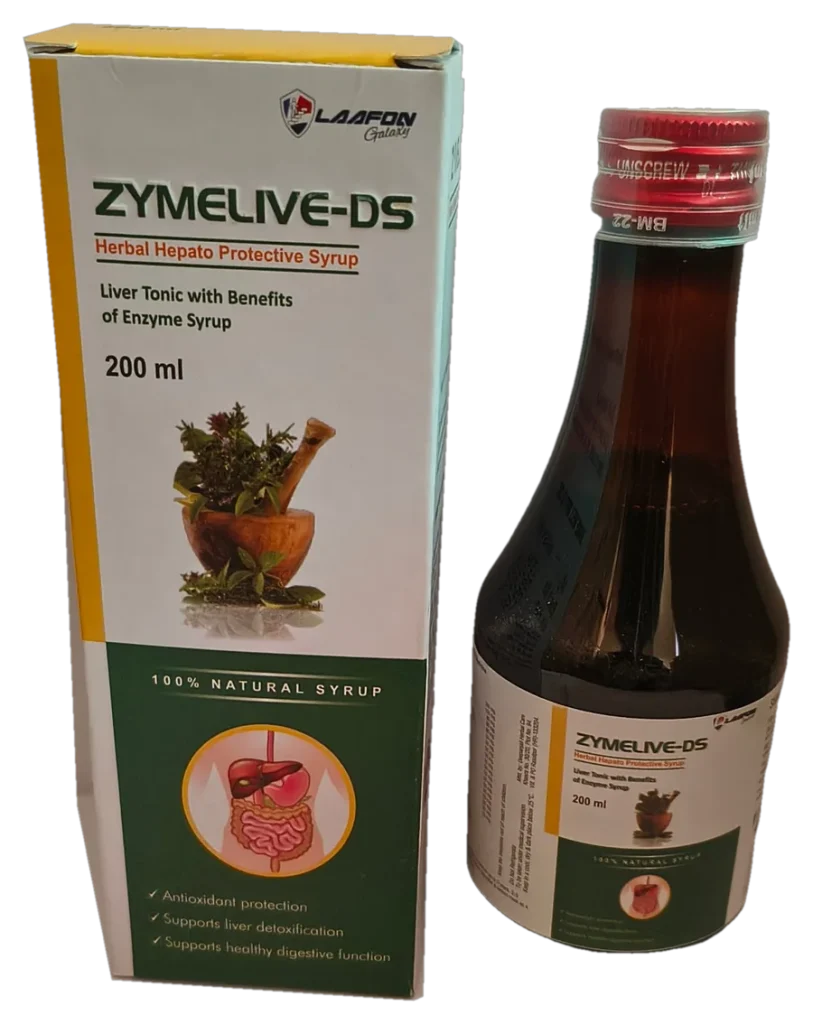
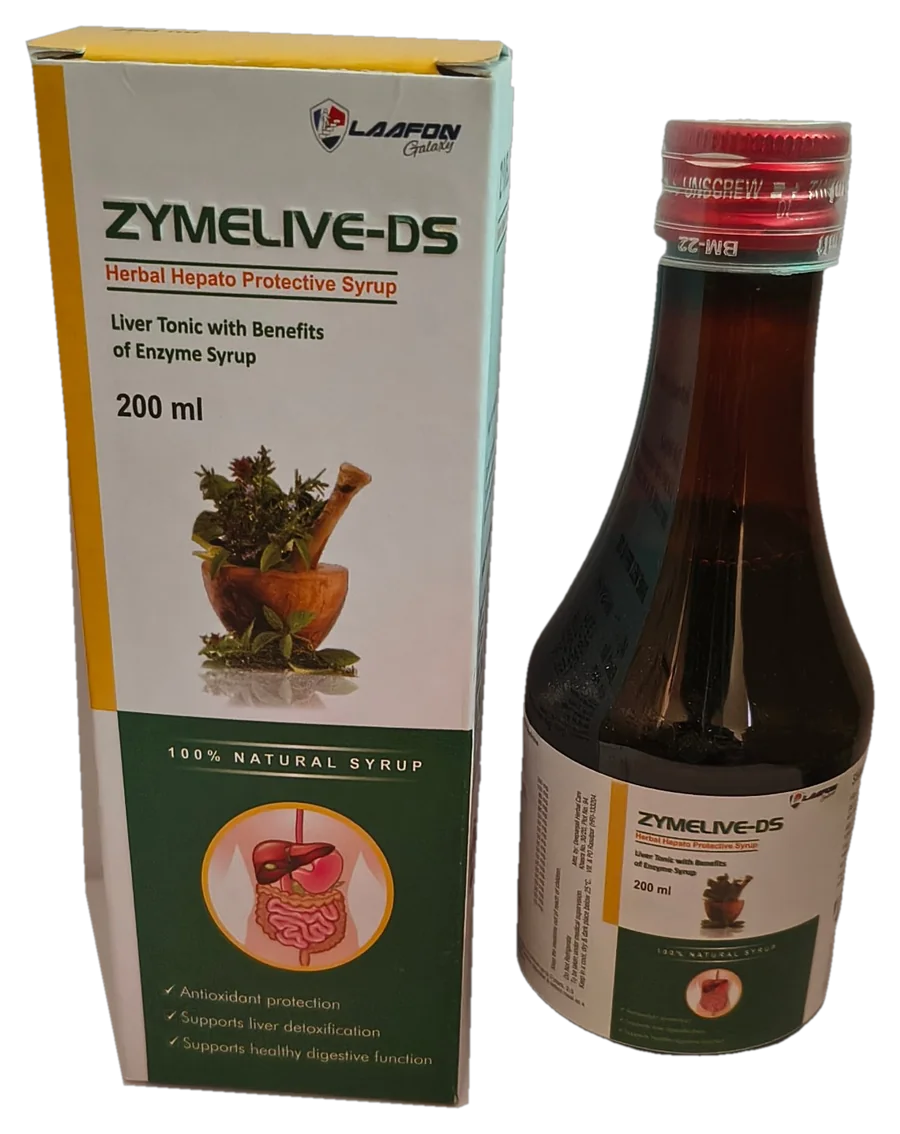
Ayurvedic proprietary medicine · 200 ml
Zymelive-DS Syrup: a 19-herb Ayurvedic digestive and liver tonic
Zymelive-DS is Laafon Galaxy’s herbal syrup made from extracts of 19 herbs, led by Bhringraj, Triphala, Pudina, Mulethi and Patol patra, with eight kitchen spices such as jeera, ajwain, sonth, saunf and dhania.[1] The carton describes it as a liver tonic that supports healthy digestive function.
₹155 MRP per 200 ml bottle, incl. of all taxes
- 1,240 mgherbal extracts per 10 ml
- 10–15 mladult dose, twice a day
- 6–10 daysone bottle at the adult dose
- Laafon Galaxymarketer of the brand
Delivery charge and payment options are confirmed on WhatsApp before you pay.
Order planner
How many bottles of Zymelive-DS do you need?
Pick who will take it and for how long. The planner uses the dose printed on the carton and builds a ready-to-send WhatsApp order.[1]
Example: adult, 2 teaspoons twice a day, for 15 days
- Daily amount
- 20 ml
- Needed for the period
- 300 ml
- Bottles (200 ml each)
- 2
- Total at MRP
- ₹310
For a child under 3: check with your doctor before starting, and again before giving it for more than a week. Never give more than the carton dose, and ask a doctor first for a baby under 1 year.
Adult dose from the carton: 2 to 3 teaspoons twice a day.
Send this order on WhatsAppIngredients
Zymelive-DS composition: all 19 herbs and how much you get per dose
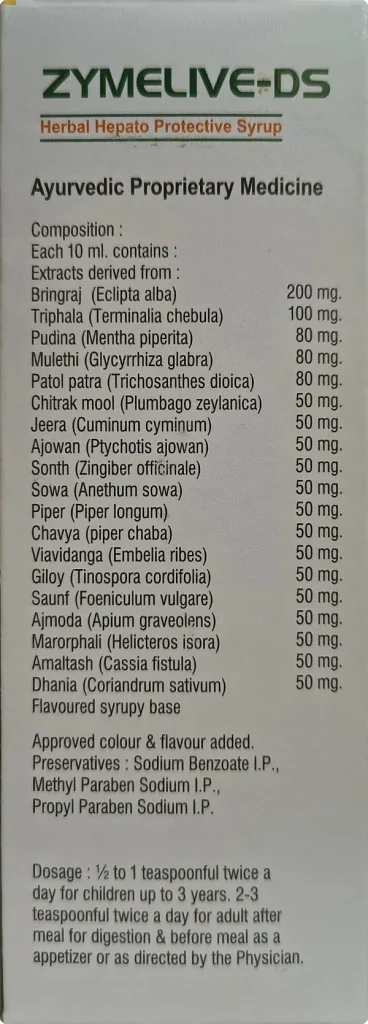
The carton lists extracts derived from 19 herbs in each 10 ml, in a flavoured syrupy base with approved colour and flavour. Preservatives: sodium benzoate IP, methyl paraben sodium IP and propyl paraben sodium IP.[1] It is sold as an Ayurvedic proprietary medicine, which under Section 3(h) of the Drugs and Cosmetics Act, 1940 means a formulation made only from ingredients described in the authoritative Ayurvedic books, where the formulation itself is not a classical one.[2]
| Herb | Botanical name (as on label) | Amount per 10 ml | Group | Traditional role |
|---|---|---|---|---|
| Bhringrajभृंगराज | Eclipta alba | 200 mg | Tonic herb | Traditionally used in South Asia for complaints of the skin, liver and stomach.[3] |
| Triphalaत्रिफला | Terminalia chebula | 100 mg | Bowel herb | Classical blend of amla, bahera and harad, best known for gentle laxative action.[4] The label names only harad (T. chebula). |
| Pudinaपुदीना | Mentha piperita | 80 mg | Digestive spice | Peppermint; a cooling flavour herb of Indian digestive preparations. |
| Mulethiमुलेठी | Glycyrrhiza glabra | 80 mg | Tonic herb | Licorice root; sweet-tasting. See the safety note on blood pressure.[5] |
| Patol patraपटोल पत्र | Trichosanthes dioica | 80 mg | Tonic herb | Leaf of the pointed gourd (parwal), a bitter herb of Ayurvedic digestive formulas. |
| Chitrak moolचित्रक मूल | Plumbago zeylanica | 50 mg | Pungent herb | A potent medicinal root, not a kitchen spice. Described as an appetiser and laxative, and traditionally also as an abortifacient, so it is avoided in pregnancy.[6] |
| Jeeraजीरा | Cuminum cyminum | 50 mg | Digestive spice | Cumin; one of the commonest kitchen spices for digestion. |
| Ajwainअजवाइन | Ptychotis ajowan | 50 mg | Digestive spice | Carom seed (today usually named Trachyspermum ammi); a household remedy for gas. |
| Sonthसोंठ | Zingiber officinale | 50 mg | Digestive spice | Dry ginger; one of the most-used digestive spices in Ayurveda. |
| Sowaसोआ | Anethum sowa | 50 mg | Digestive spice | Indian dill seed; a traditional carminative (eases wind). |
| Pippaliपिप्पली | Piper longum | 50 mg | Pungent herb | Long pepper (printed “Piper” on the label); a pungent medicinal herb used as an appetiser. |
| Chavyaचव्य | Piper chaba | 50 mg | Pungent herb | Java long pepper, a close relative of pippali, used the same way. |
| Vidangaविडंग | Embelia ribes | 50 mg | Bowel herb | False black pepper (printed “Viavidanga”); traditionally used against intestinal worms. |
| Giloyगिलोय (गुडूची) | Tinospora cordifolia | 50 mg | Tonic herb | Bitter stem, widely used in Ayurveda. See the safety note below.[7],[8] |
| Saunfसौंफ | Foeniculum vulgare | 50 mg | Digestive spice | Fennel; the familiar after-meal digestive seed. |
| Ajmodaअजमोद | Apium graveolens | 50 mg | Digestive spice | Celery seed; an aromatic digestive seed. Avoid if you are allergic to celery. |
| Marorphaliमरोड़फली | Helicteres isora | 50 mg | Bowel herb | Twisted-pod Indian screw tree (printed “Helicteros”); a folk remedy for stomach gripes. |
| Amaltashअमलतास | Cassia fistula | 50 mg | Bowel herb | Golden shower tree; Cassia plants are traditional laxatives.[9] |
| Dhaniaधनिया | Coriandrum sativum | 50 mg | Digestive spice | Coriander seed; a kitchen spice used in digestive preparations. |
Bars compare each herb with Bhringraj (200 mg).
How to read these amounts. The label gives each herb as an “extract derived from” the herb, but does not state the extract ratio. So these milligram figures cannot be compared with the powder (churna) doses given in Ayurvedic reference books. A range such as “200–300 mg” simply follows the 2 to 3 teaspoon dose on the carton.
The formula
How the Zymelive-DS blend is put together
8 kitchen spices
Jeera, ajwain, sonth, sowa, saunf, ajmoda, dhania and pudina. A review from CFTRI Mysore found that many common spices increase bile secretion and the activity of pancreatic digestive enzymes in animal studies.[10] This is the likely meaning of “benefits of enzyme syrup” on the carton.
3 pungent medicinal herbs
Pippali, chavya and chitrak mool. These are stronger medicinal herbs, not everyday spices. Chitrak in particular is a potent root that is traditionally avoided in pregnancy.[6]
4 traditional tonic herbs
Bhringraj, patol patra, giloy and mulethi. These bitter and sweet herbs are staples of Ayurvedic liver-tonic syrups. Laboratory studies on Bhringraj are promising, but its own reviewers note that animal and clinical studies are still needed.[3]
A plain statement. No clinical trial of Zymelive-DS itself has been published. Despite the word “enzyme” on the carton, the syrup contains no added digestive enzymes such as diastase or pepsin; the label lists herbs only. And we do not claim that it treats or prevents jaundice, hepatitis, fatty liver or any other liver disease: Schedule J of the Drugs and Cosmetics Rules, 1945 lists “jaundice/hepatitis/liver disorders” among conditions a drug may not claim to prevent or cure.[11] That schedule sits in the rules for allopathic drugs, but we follow it as the safer standard; advertisements for Ayurvedic medicines are also governed by the Drugs and Magic Remedies (Objectionable Advertisements) Act, 1954.[12] Think of it as an Ayurvedic digestive tonic, not a liver treatment.
Dosage
How to take Zymelive-DS syrup
| Who | Dose (carton) | How often | When |
|---|---|---|---|
| Adults | 2 to 3 teaspoons (10–15 ml) | Twice a day | After meals for digestion; before meals as an appetiser |
| Children up to 3 years | ½ to 1 teaspoon (2.5–5 ml) | Twice a day | Not stated; ask your doctor |
| Children 3 to 12 years | Not printed on the carton | Use only the dose your doctor gives | |
The carton adds “or as directed by the Physician”.[1] Use the measuring cup rather than a kitchen spoon, which varies in size. Shake the bottle before use, close the cap after each dose and store it in a cool, dry, dark place out of children’s reach.
Babies under 1 year: ask your doctor before giving any herbal syrup, even though the carton dose covers children “up to 3 years”. This is our advice, not a label instruction.
Safety
Who should check with a doctor before taking Zymelive-DS
- Pregnancy or breastfeeding. Do not take it unless your doctor advises it. It contains licorice, which pregnant women are advised to avoid,[5] and chitrak, which is traditionally regarded as an abortifacient.[6]
- An existing liver condition, an autoimmune disease, or jaundice now or in the past. Indian hepatologists have reported liver injury with autoimmune features in people taking giloy, often in large amounts for weeks.[7],[13] The Ministry of Ayush maintains that giloy is safe, says similar-looking species may be harmful, and advises using it on the advice of a registered Ayush physician.[8] Each 10 ml of Zymelive-DS has 50 mg of giloy extract.
- High blood pressure, heart disease, or medicines such as digoxin, diuretics, warfarin or steroids. Licorice can raise blood pressure, lower potassium and interact with these medicines.[5] The amount here is small (80 mg extract per 10 ml), but ask first.
- Diabetes. The base is a flavoured syrup and the label does not state the sugar content.[1]
- Loose motions or a sensitive bowel. Triphala and amaltash are laxative herbs.[4],[9]
- Allergy to any listed herb (including celery), to parabens or to sodium benzoate.
- Any other regular medicine. Tell your doctor you are taking a herbal syrup.
Stop taking it and see a doctor if you notice yellow eyes or skin, dark urine, pale stools, severe itching, or pain in the upper right side of the abdomen.
Do not self-treat with any tonic if you have vomiting of blood, black stools, unexplained weight loss, or indigestion that keeps coming back. These need a doctor’s examination.
हिंदी में
Zymelive-DS सिरप के उपयोग, खुराक और सामग्री (हिंदी में)
ध्यान दें: मिलते-जुलते नाम वाले लिवर सिरप दूसरी कंपनियों के हैं। यह जानकारी केवल Laafon Galaxy के Zymelive-DS (ज़ाइमलिव-डीएस) सिरप के बारे में है।
- Zymelive-DS सिरप क्या है?
- यह 19 जड़ी-बूटियों से बना एक आयुर्वेदिक पेटेंट (प्रोप्राइटरी) सिरप है। कार्टन पर इसे लिवर टॉनिक बताया गया है जो पाचन को सहारा देता है।
- कीमत क्या है?
- 200 ml की एक बोतल का MRP ₹155 है (सभी टैक्स सहित)।
- इसमें क्या-क्या है?
- हर 10 ml में: भृंगराज 200 mg, त्रिफला 100 mg, पुदीना, मुलेठी और पटोल पत्र 80-80 mg, और चित्रक, जीरा, अजवाइन, सोंठ, सोआ, पिप्पली, चव्य, विडंग, गिलोय, सौंफ, अजमोद, मरोड़फली, अमलतास व धनिया 50-50 mg (सभी अर्क के रूप में)।
- कितना और कब लेना है?
- बड़ों के लिए: 2 से 3 चम्मच (10–15 ml) दिन में 2 बार; पाचन के लिए खाने के बाद, भूख बढ़ाने के लिए खाने से पहले। 3 साल तक के बच्चे: आधा से 1 चम्मच दिन में 2 बार। 3 से 12 साल के बच्चों की खुराक कार्टन पर नहीं है, इसलिए डॉक्टर से पूछें।
- किन्हें सावधानी रखनी चाहिए?
- गर्भवती या स्तनपान कराने वाली महिलाएँ, लिवर या ऑटोइम्यून बीमारी वाले लोग, हाई BP, दिल की बीमारी या डायबिटीज़ वाले लोग, इसे लेने से पहले डॉक्टर से सलाह लें। आँखें या त्वचा पीली दिखें तो दवा बंद करके तुरंत डॉक्टर को दिखाएँ।
- क्या इसमें एंजाइम हैं?
- नहीं। लेबल पर केवल जड़ी-बूटियाँ हैं, अलग से कोई पाचक एंजाइम नहीं मिलाया गया है।
- कैसे मँगाएँ?
- ऊपर दिए “Order on WhatsApp” बटन से ऑर्डर भेजें। डिलीवरी चार्ज और भुगतान का तरीका WhatsApp पर बताया जाएगा।
Questions
Zymelive-DS syrup: frequently asked questions
The MRP is ₹155 for one 200 ml bottle, inclusive of all taxes. Any delivery charge is confirmed on WhatsApp before you pay.
It is an Ayurvedic herbal tonic. The carton says it supports healthy digestive function and liver detoxification and offers antioxidant protection, and gives a dose to take after meals for digestion or before meals as an appetiser. These are claims printed on the pack; Zymelive-DS itself has not been tested in a published clinical trial, and it is not a treatment for jaundice, hepatitis or any other liver disease.
2 to 3 teaspoons (10 to 15 ml) twice a day, after meals for digestion or before meals as an appetiser, or as your physician directs. At this dose one 200 ml bottle lasts 6 to 10 days.
The carton gives ½ to 1 teaspoon twice a day for children up to 3 years. It gives no dose for ages 3 to 12, so use only the dose your doctor gives. For a baby under 1 year, ask a doctor first.
No. The label lists only herbal extracts plus preservatives, colour and flavour. “Benefits of enzyme syrup” refers to the digestive spices in the blend, which increased digestive enzyme activity in animal studies.
Do not take it in pregnancy or while breastfeeding unless your doctor advises it. It contains licorice (mulethi) and chitrak, both of which are advised against in pregnancy.
No. Zymelive-DS is Laafon Galaxy’s own 19-herb formula. Syrups with similar-sounding names are made by other companies and have different ingredients, so check the composition on the carton.
Tap Order on WhatsApp, or use the order planner to work out the number of bottles. Send the pre-filled message with your name and delivery PIN code, and Laafon Galaxy will confirm the delivery charge and payment options.
More from Laafon Galaxy
Other Laafon Ayurvedic products
- Kuftips Cough SyrupAyurvedic syrup, 100 ml
- Gynaec-DS SyrupAyurvedic syrup, 200 ml
- Faster Pain OilAyurvedic massage oil, 60 ml
- All Laafon syrupsFull syrup range
- All Laafon productsComplete catalogue
Chemists, distributors and PCD partners
For trade rates or bulk supply of Zymelive-DS, message us on WhatsApp, or see our PCD franchise page and third-party manufacturing page.
References
- Zymelive-DS Syrup 200 ml: carton and bottle label [product label]. Laafon Galaxy Pharmaceuticals. Composition, dosage and pack claims as printed on the current pack; checked 2026 Nov 25.
- The Drugs and Cosmetics Act, 1940 (Act 23 of 1940), Section 3(h): Ayurvedic, Siddha or Unani proprietary medicine. New Delhi: Government of India.
- Timalsina D, Devkota HP. Eclipta prostrata (L.) L. (Asteraceae): ethnomedicinal uses, chemical constituents, and biological activities. Biomolecules. 2021;11(11):1738. doi: 10.3390/biom11111738
- Peterson CT, Denniston K, Chopra D. Therapeutic uses of Triphala in Ayurvedic medicine. J Altern Complement Med. 2017;23(8):607-14 (laxative action and gastrointestinal use). doi: 10.1089/acm.2017.0083
- Shane-McWhorter L. Licorice. In: MSD Manual Professional Version [Internet]. Rahway (NJ): Merck & Co.; 2025 Jul [cited 2026 Nov 25]. Available from: https://www.merckmanuals.com/professional/special-subjects/dietary-supplements/licorice
- Shukla B, Saxena S, Usmani S, Kushwaha P. Phytochemistry and pharmacological studies of Plumbago zeylanica L.: a medicinal plant review. Clin Phytosci. 2021;7. doi: 10.1186/s40816-021-00271-7
- Nagral A, Adhyaru K, Rudra OS, Gharat A, Bhandare S. Herbal immune booster-induced liver injury in the COVID-19 pandemic: a case series. J Clin Exp Hepatol. 2021;11(6):732-8. doi: 10.1016/j.jceh.2021.06.021
- Ministry of Ayush. Giloy is safe to use: Ministry of Ayush [Internet]. New Delhi: Press Information Bureau; 2021 Oct 5 [cited 2026 Nov 25]. Available from: https://pib.gov.in/PressReleasePage.aspx?PRID=1761086
- Khurm M, Wang X, Zhang H, Hussain SN, Qaisar MN, Hayat K, et al. The genus Cassia L.: ethnopharmacological and phytochemical overview. Phytother Res. 2021;35(5):2336-85. doi: 10.1002/ptr.6954
- Platel K, Srinivasan K. Digestive stimulant action of spices: a myth or reality? Indian J Med Res. 2004;119(5):167-79. PMID: 15218978.
- The Drugs and Cosmetics Rules, 1945, Schedule J (item 33: Jaundice/Hepatitis/Liver disorders). New Delhi: Government of India.
- The Drugs and Magic Remedies (Objectionable Advertisements) Act, 1954 (Act 21 of 1954), as on 15 April 2026 [Internet]. New Delhi: Legislative Department; 2026 [cited 2026 Nov 25]. Available from: https://www.indiacode.nic.in/indiacode/bitstream/123456789/1412/1/A1954-21.pdf
- Kulkarni AV, Hanchanale P, Prakash V, Kalal C, Sharma M, Kumar K, et al. Tinospora cordifolia (Giloy)-induced liver injury during the COVID-19 pandemic: multicenter nationwide study from India. Hepatol Commun. 2022;6(6):1289-300. doi: 10.1002/hep4.1904
This page gives product information from the pack label and published sources. It is not medical advice and does not replace a consultation with a registered medical practitioner or Ayurvedic physician. Zymelive-DS is marketed by Laafon Galaxy Pharmaceuticals. Page prepared by Darshan Singh, M.Sc. (23+ years in pharmaceutical QA, QC and regulatory affairs); last checked 25 November 2026.