
Ceffon Dry Syrup · at a glance
Ceffon Dry Syrup is Laafon Galaxy Pharmaceuticals’ cefixime oral suspension with Lactic Acid Bacillus. Once mixed, each 5 mL contains cefixime 50 mg and Lactic Acid Bacillus 60 million spores. Cefixime is a third-generation cephalosporin antibiotic, sold in India only on prescription as a Schedule H1 drug.[1][2] Doctors dose it by the child’s weight. After mixing, the carton says to keep it in the refrigerator and use it within 4 days.
- Rx · Schedule H1
- Cefixime 50 mg / 5 mL
- LAB 60 million spores / 5 mL
- 12 g powder → 30 mL
- Use within 4 days of mixing
Updated 13 Nov 2026: composition, mixing and storage corrected to match the current carton.
Ceffon dry syrup composition
The carton name is Cefixime & Lactic Acid Bacillus Oral Suspension. Because it also contains Lactic Acid Bacillus (LAB), it is not the single-ingredient Cefixime Oral Suspension IP, even though cefixime is the only antibiotic in it.[1]
| Each 5 mL of mixed suspension contains | Amount |
|---|---|
| Cefixime (as trihydrate) IP, equivalent to anhydrous cefixime | 50 mg |
| Lactic Acid Bacillus | 60 million spores |
That works out to 10 mg of cefixime per mL. The pack holds 12 g of dry powder, which makes 30 mL of suspension with the sterile water supplied in the carton.[1]
How cefixime and Lactic Acid Bacillus work
Cefixime 50 mg
Cefixime kills bacteria by blocking the synthesis of their cell walls. It is also stable against some of the beta-lactamase enzymes that bacteria use to break down penicillin-type antibiotics.[3] It has no effect on viruses.
Lactic Acid Bacillus 60 million spores
LAB is a spore-forming probiotic. The idea is to reduce the loose stools that antibiotics often cause. A Cochrane review of 33 trials in children found a clear benefit at 5 billion or more colony-forming units a day: 8% of children in those high-dose arms had antibiotic-associated diarrhoea, compared with 23% of controls.[4]
The LAB in Ceffon is far below that level. Even at the highest daily cefixime dose (400 mg, or 40 mL), it delivers under one-tenth of the 5-billion threshold. So no one should assume it prevents diarrhoea. Laafon’s Laamox-CV amoxicillin–clavulanate dry syrup carries the same 60 million spores per 5 mL.
Ceffon dry syrup uses
The US prescribing information for cefixime, the reference label for the molecule, approves it for adults and children aged six months and older with these bacterial infections:[3]
- Middle-ear infection (otitis media), caused by H. influenzae, M. catarrhalis or S. pyogenes.
- Throat and tonsil infection (pharyngitis, tonsillitis) caused by S. pyogenes. Treat for at least 10 days.
- Uncomplicated urinary tract infection caused by E. coli or P. mirabilis.
- Acute flare-ups of chronic bronchitis, and uncomplicated gonorrhoea, mainly adult indications for which the suspension form is rarely chosen.
Not for colds, coughs or flu. These are usually viral. An antibiotic prescribed without a proven or strongly suspected bacterial infection does not help the patient and raises the risk of drug-resistant bacteria.[3] WHO puts cefixime in its Watch group, the antibiotics it marks for closer stewardship because of their higher resistance potential.[5]
Ceffon dry syrup dose for children: how the dose is worked out
The dose comes from the child’s body weight, and the prescriber sets it. The cefixime label gives these rules:[3]
- Children six months and older: 8 mg per kg of body weight per day, either once a day or as 4 mg per kg every 12 hours.
- Children over 45 kg or over 12 years: the adult dose of 400 mg a day.
- Under six months: safety and effectiveness have not been established.
- Kidney disease: the dose must be reduced when creatinine clearance is below 60 mL/min. Dialysis does not remove significant amounts of cefixime.
Check the strength when switching brands. Cefixime suspensions come in different strengths, from 50 mg to 500 mg per 5 mL. The same number of mL can therefore hold very different amounts of drug, and the US label asks that every millilitre dose be written together with its concentration.[3] Ceffon is 50 mg per 5 mL. Measure with a proper dosing syringe or measuring cup, not a kitchen spoon.
For ear infections, the label says to use the suspension or chewable tablets, not ordinary tablets, because the suspension reaches higher blood levels at the same dose.[3] That is why Ceffon-200 cefixime tablets are not a direct swap for this syrup in a child with otitis media.
How to make Ceffon dry syrup suspension
These steps follow the instructions printed on the Ceffon carton.[1] Use only the sterile water vial packed with it.
- Shake the closed bottle to loosen the powder.
- Twist open the vial of sterile water supplied with the pack.
- Add about half of the sterile water to the bottle.
- Put the cap on and shake the bottle vigorously.
- Add more sterile water up to the ring mark on the bottle, then shake again.
- Store the mixed suspension in the refrigerator (2–8 °C). Use it within 4 days and throw away whatever is left.
Shake well before every dose. Stop at the ring mark. Any sterile water left in the vial isn’t needed.
Storage before and after mixing
Dry powder (unopened)
Store as printed on the carton, in a cool, dry place away from light. Keep it out of children’s reach and don’t use it after the expiry date.
After mixing
Refrigerate at 2–8 °C and use within 4 days, then discard any leftover suspension.[1]
Different cefixime products give different in-use periods. The US Suprax suspension, for example, lists 14 days at room temperature or in the fridge.[3] Always follow the carton of the product in hand. For Ceffon that is 4 days, refrigerated.
Side effects of Ceffon dry syrup
Stomach and bowel effects are the most common. In US clinical trials of cefixime tablets in adults, the reported rates were diarrhoea 16%, nausea 7%, loose or frequent stools 6%, flatulence 4%, abdominal pain 3% and indigestion 3%. About 5% of patients stopped treatment because of side effects.[3]
Get medical help urgently if any of these occur:
- Signs of a serious allergic reaction, such as swelling of the face, lips or tongue, difficulty breathing, widespread rash or hives. Anaphylaxis, including fatal cases, has been reported with cefixime. Stop the medicine.[3]
- Severe, watery or bloody diarrhoea. This can be Clostridioides difficile infection, which can appear up to two months after the antibiotic course ends.[3]
Who should not take it, and precautions
Do not use if the patient has
- a known allergy to cefixime or any other cephalosporin antibiotic.[3]
Tell the doctor first if the patient has
- a penicillin allergy. The label says cross-allergy among beta-lactam antibiotics may occur in up to 10% of penicillin-allergic patients.[3]
- kidney disease, which needs a lower dose.
- liver disease, poor nutrition or a long course planned. Cephalosporins can lower prothrombin activity, so the doctor may monitor clotting.[3]
Drug and lab-test interactions
- Carbamazepine: its blood levels have been reported to rise. Monitoring helps.[3]
- Warfarin and other anticoagulants: prothrombin time can rise, with or without bleeding.[3]
- Lab tests: possible false-positive urine ketone results (nitroprusside tests), false-positive urine sugar results with copper-reduction tests (Benedict’s, Fehling’s, Clinitest) and a false-positive direct Coombs test. Enzyme-based glucose strips are not affected.[3]
How Ceffon compares with other cefixime oral suspensions
Scroll the table sideways →
| Point | Ceffon Dry Syrup | Suprax suspension (US reference label) |
|---|---|---|
| Cefixime per 5 mL | 50 mg | 100, 200 or 500 mg |
| Added probiotic | Lactic Acid Bacillus 60 million spores per 5 mL | None |
| After mixing | Refrigerate, use within 4 days | 14 days, room temperature or refrigerated |
| Pack | 12 g powder for 30 mL, with sterile water vial | Several bottle sizes |
Sources: the Ceffon carton[1] and the Suprax prescribing information.[3] Indian cefixime syrups sold under other brands vary in strength and in-use period, so read each carton rather than swapping millilitre for millilitre. For the tablet market, see how cefixime tablet brands in India compare.
Ceffon Dry Syrup product details
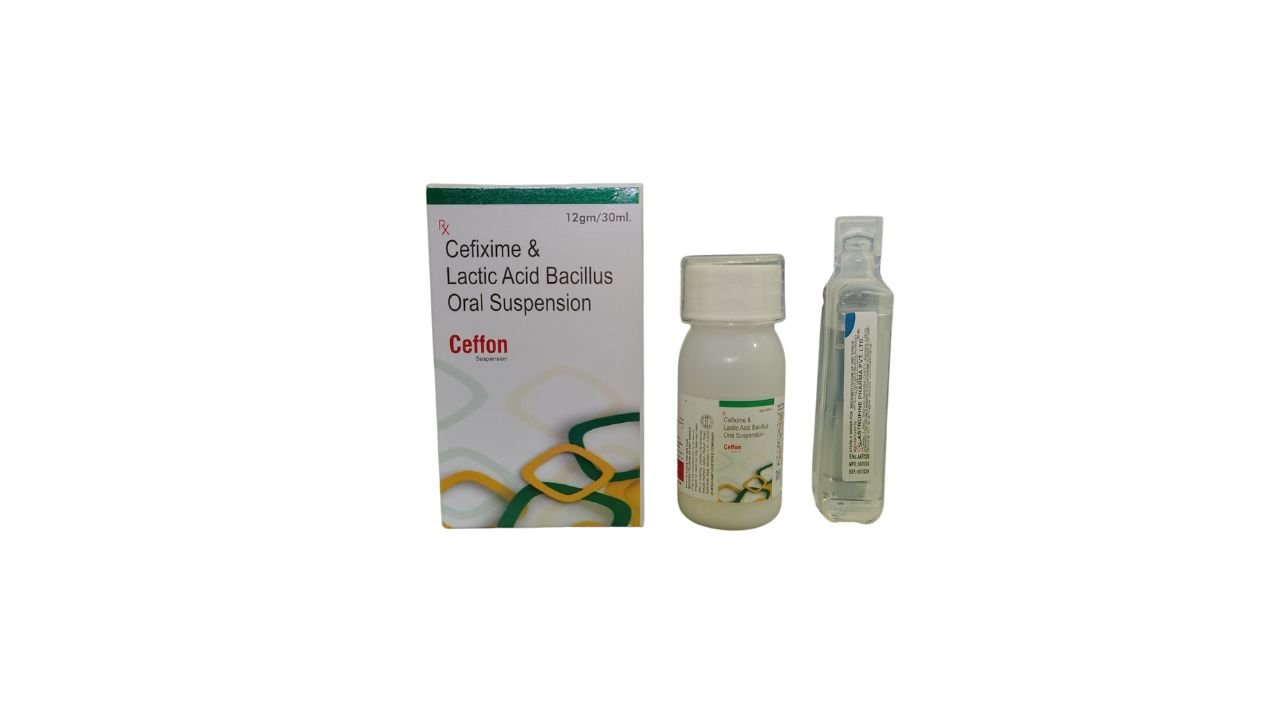
- Brand
- Ceffon Suspension (Ceffon Dry Syrup)
- Generic name
- Cefixime & Lactic Acid Bacillus Oral Suspension
- Per 5 mL
- Cefixime 50 mg + Lactic Acid Bacillus 60 million spores
- Dosage form
- Dry powder for oral suspension
- Pack
- 12 g powder for 30 mL, with a vial of sterile water
- Schedule
- Prescription only, Schedule H1 (red Rx)[2]
- MRP
- ₹75 per pack
- Marketed by
- Laafon Galaxy Pharmaceuticals
- Manufactured at
- A third-party WHO-GMP certified facility
A Schedule H1 medicine can be sold only against a prescription. Chemists must also record the sale in a separate register.[2] See the Schedule H1 drug list for the full rules.
Frequently asked questions about Ceffon dry syrup
It treats bacterial infections that a doctor has diagnosed. The labelled indications for cefixime are middle-ear infection, strep throat and tonsillitis, uncomplicated urinary tract infection, flare-ups of chronic bronchitis and uncomplicated gonorrhoea, in patients aged six months or older. It does not treat colds, coughs or flu, which are usually viral.
The doctor works it out from the child’s weight: 8 mg of cefixime per kg per day, once daily or split into two 12-hourly doses. Ceffon contains 50 mg per 5 mL (10 mg per mL). Follow the prescribed millilitre dose and measure it with a dosing syringe or measuring cup.
The carton says to keep the mixed suspension in the refrigerator at 2 to 8 °C, use it within 4 days and throw away any leftover. Other cefixime brands give different periods, so they don’t apply to Ceffon.
The cefixime label says safety and effectiveness have not been established below six months of age. Whether to use it in a younger infant is a decision for the treating doctor.
Tell the doctor before the first dose. The label warns that cross-allergy between penicillins and cephalosporins may occur in up to 10% of penicillin-allergic patients. A child with a known allergy to cefixime or any cephalosporin must not take it.
That hasn’t been shown at this dose. A Cochrane review found that probiotics prevent antibiotic-associated diarrhoea in children at 5 billion or more colony-forming units a day. The 60 million spores per 5 mL in Ceffon is far below that. If diarrhoea is severe, watery or bloody, contact a doctor.
Yes. Cefixime has been in Schedule H1 of the Drugs Rules since the 2013 amendment, so Ceffon can be sold only against a prescription, carries a red Rx on its label, and chemists must record each sale.
Ceffon is marketed by Laafon Galaxy Pharmaceuticals and made at a third-party WHO-GMP certified facility. The manufacturer’s name and address are printed on the bottle label.
References
- Laafon Galaxy Pharmaceuticals. Ceffon Suspension (Cefixime & Lactic Acid Bacillus Oral Suspension), 12 g/30 mL: carton and bottle label, including “How to make suspension” directions. Batch packaging examined November 2026.
- Ministry of Health and Family Welfare, Government of India. Drugs and Cosmetics (Fourth Amendment) Rules, 2013. G.S.R. 588(E), dated 30.08.2013 (insertion of Schedule H1, in force from 01.03.2014). Gazette of India, Extraordinary, Part II, Section 3(i).
- Lupin Pharmaceuticals. SUPRAX (cefixime) tablets, capsules, chewable tablets and for oral suspension: full prescribing information. Revised 10/2019. Silver Spring (MD): US Food and Drug Administration; 2019. Available from: https://www.accessdata.fda.gov/drugsatfda_docs/label/2019/202091s009lbl.pdf. Accessed November 2026.
- Guo Q, Goldenberg JZ, Humphrey C, El Dib R, Johnston BC. Probiotics for the prevention of pediatric antibiotic-associated diarrhea. Cochrane Database Syst Rev. 2019;4(4):CD004827. Available from: https://pubmed.ncbi.nlm.nih.gov/31039287/. Accessed November 2026.
- World Health Organization. AWaRe classification of antibiotics for evaluation and monitoring of use, 2023. Geneva: WHO; 2023 (WHO/MHP/HPS/EML/2023.04). Available from: https://www.who.int/publications/i/item/WHO-MHP-HPS-EML-2023.04. Accessed November 2026.
Disclaimer: This page is product and educational information for healthcare professionals, trade buyers and caregivers. It is not medical advice. Ceffon Dry Syrup is a prescription-only Schedule H1 medicine and must be used only as a registered medical practitioner directs. Indian drug rules and product labels change; check the carton of the pack in hand.