
Short answer: what a pharma plant costs in India in 2026
The pharma manufacturing plant cost in India runs from roughly ₹5–15 crore for a small oral-solids unit, ₹50–80 crore for a mid-scale multi-formulation export-capable facility, and ₹170–355 crore for a large sterile or API site. Land, building and machinery together account for 60–80% of capital expenditure in every band.
Since 1 January 2026, every licensed manufacturer in India — regardless of turnover — must meet Revised Schedule M. Compliance capital that used to be deferred is now a condition of holding the licence.[3]
Capital cost bands are Laafon Galaxy internal project estimates. Regulatory and scheme figures are sourced and referenced below.
Revised Schedule M is now a hard gate, not a roadmap item
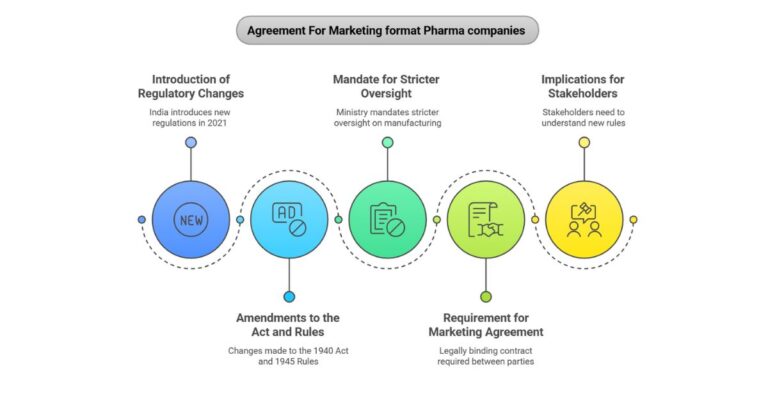
Revised Schedule M was notified as G.S.R. 922(E) on 28 December 2023, published by CDSCO.[1] Manufacturers above ₹250 crore turnover had to comply first. For small and medium manufacturers below that threshold, G.S.R. 127(E) dated 11 February 2025 extended the timeline to 31 December 2025 — but only for units that applied to the Central Licence Approving Authority in Form A within three months, with a written upgradation plan and an undertaking to begin work within three months of applying.[2]
That window has closed. Following the contaminated cough syrup deaths reported from September 2025, the regulator directed that all manufacturing units meet the revised standard from 1 January 2026, warning that strict action would follow non-compliance.[3]
What this means for your budget: HVAC classification, water systems, qualification and validation, and data-integrity-capable documentation are no longer phase-two spending. Any costing built before 2024 understates the compliance line. Check your gap position against the CDSCO Schedule M compliance dashboard before you fix a capital number.
Pharma manufacturing plant cost in India by plant type
Three configurations cover most Indian greenfield projects. Select one to see the component split, indicative built-up area and capacity.
Minimum investment to start a pharma company in India
Suited to domestic-market entry, a narrow product basket, and MSME operators building toward a franchise or third-party base.
| Cost component | Investment (₹ cr) | Share of budget |
|---|---|---|
| Land and site development | 0.5 – 2.0 | 8 – 12% |
| Building construction | 1.5 – 4.0 | 18 – 25% |
| Plant and machinery | 2.0 – 5.0 | 30 – 40% |
| Utilities (HVAC, water, power) | 0.5 – 1.5 | 8 – 10% |
| Regulatory approvals and licensing | 0.3 – 0.8 | 4 – 6% |
| Working capital and systems | 0.5 – 1.2 | 7 – 10% |
| Total capital expenditure | 5 – 15 | 100% |
Scroll the table sideways on a phone.
- Built-up area: 2,500–4,000 sq.m
- Capacity: 20–50 million tablets per month
- Expansion headroom: design for 30–40%
Mid-scale multi-formulation plant
Built for several dosage forms, institutional supply and an export pathway. This is the band where WHO-GMP-grade documentation and qualification become a serious cost line rather than a formality.
| Cost component | Investment (₹ cr) | Share of budget |
|---|---|---|
| Land and site development | 4 – 8 | 8 – 10% |
| Building construction | 15 – 25 | 25 – 35% |
| Plant and machinery | 20 – 35 | 35 – 45% |
| Utilities (HVAC, water, power, backup) | 4 – 7 | 7 – 10% |
| Approvals, documentation and QA | 1.5 – 3 | 3 – 5% |
| Working capital, systems and training | 5 – 8 | 8 – 10% |
| Total capital expenditure | 50 – 80 | 100% |
Scroll the table sideways on a phone.
- Built-up area: 10,000–15,000 sq.m
- Capacity: 200+ million tablets per month
- Standard: Revised Schedule M, with WHO-GMP as the export gate
Large-scale sterile or API plant
API synthesis, injectables and complex formulations. Effluent treatment, containment and environmental compliance move from a minor line to a major one here.
| Cost component | Investment (₹ cr) | Share of budget |
|---|---|---|
| Land and site development | 20 – 60 | 10 – 15% |
| Building construction | 50 – 100 | 25 – 35% |
| Plant and machinery | 60 – 120 | 35 – 50% |
| Utilities, water treatment, waste management | 15 – 30 | 8 – 12% |
| Approvals, EHS compliance and QA | 10 – 20 | 5 – 8% |
| Working capital, training and systems | 15 – 25 | 8 – 10% |
| Total capital expenditure | 170 – 355 | 100% |
Scroll the table sideways on a phone.
- Built-up area: 40,000–80,000 sq.m
- Standard: ICH and WHO-GMP, structured for a future USFDA pathway
- Scope: multi-product — tablets, capsules, injectables
Methodology, and what the bands do not include
Every pharma manufacturing plant cost range above is a Laafon Galaxy Pharmaceuticals internal project estimate, built from plant setup and regulatory engagements executed by our consulting practice and reviewed in August 2026. They are not published government figures, because no Indian regulator publishes plant capital costs. CDSCO, NPPA and the Department of Pharmaceuticals publish rules, fees and incentive schemes — not machinery prices or land rates.
Excluded from these bands: API and raw material procurement, product development and bioequivalence studies, brand building and distribution, interest during construction, and any cost of acquiring an existing licence.
Why they move: land rates vary several-fold between an industrial zone and a metro periphery; imported equipment prices move with the exchange rate; and compliance scope changes with dosage form. Treat the bands as a planning envelope, then price your actual configuration in the pharma plant setup cost calculator, which prices the same configuration under Revised Schedule M, WHO-GMP, EU-GMP and USFDA and returns a line-item PDF.
Price your own configuration, not a generic band
Generic bands only take you so far. The calculator prices the pharma manufacturing plant cost for your actual configuration — it takes your dosage forms, daily capacity, state, land rate and compliance standard, and returns total project cost with a component-level breakdown and a downloadable report.
Where the money actually goes
Land and site development
Land is the most location-sensitive line in the budget and the one most often underestimated, because site development — levelling, drainage, boundary wall, approach road, power connection — is treated as an afterthought. Budget it as a separate line from acquisition. In a notified industrial area or a state pharma park, part of this is already built and shared.
What does it cost to build a pharmaceutical manufacturing plant?
Compliance-grade construction is not ordinary industrial construction. The production block needs classified areas with the airlock and pressure-cascade discipline Revised Schedule M expects, a segregated QC laboratory with instrument and microbiology space, climate-controlled warehousing with quarantine and rejected-goods areas, and a utility block sized for the water and HVAC systems rather than squeezed into leftover space.
Construction cost per square metre rises sharply with classification level. A warehouse and an aseptic core are not comparable per-square-metre builds, which is why any single blended rate is misleading unless you state which areas it covers.
Plant and machinery — the largest single driver
Machinery is 30–50% of capital expenditure in every band, and the decision that most affects both regulatory risk and long-term running cost. An indicative single oral-solids line, before qualification and installation:
| Equipment | Indicative cost | Note |
|---|---|---|
| Blender / granulator | ₹30–50 lakh | Capacity-driven; rapid mixer granulator plus fluid bed dryer |
| Compression or capsule filling | ₹50–100 lakh | Output rate and tooling stations drive the spread |
| Coating equipment | ₹25–50 lakh | Only if the product basket needs it |
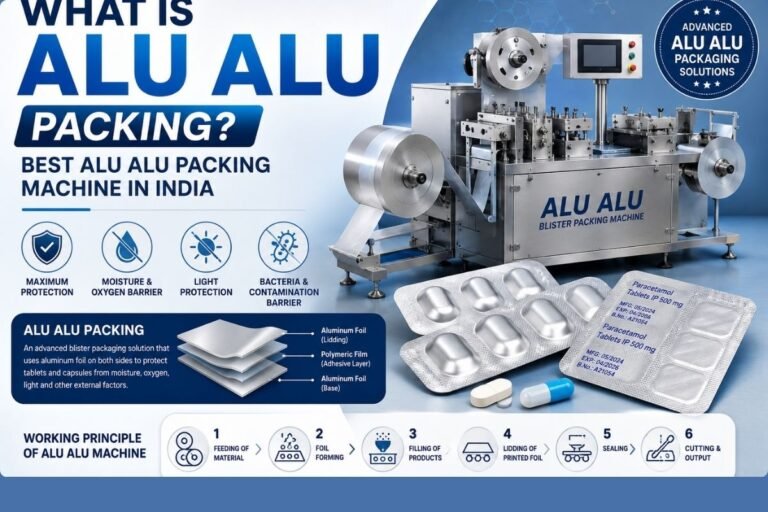
| Packaging line | ₹30–60 lakh | Blister plus strip, with serialisation for export |
| One integrated line | ₹1.5–2.5 cr | Excludes qualification, utilities and installation |
Laafon internal estimates, August 2026. Scroll sideways on a phone.
Three levers, and their real cost: Indian-built equipment is materially cheaper than European imports, but the saving is only real if the vendor can supply qualification documentation an inspector will accept — ask for the DQ, IQ, OQ and PQ protocol templates before you order, not after. Refurbished machinery saves more again, and carries the highest regulatory risk: it must be requalified in your facility, and its history must be documented. Leasing converts capital expenditure into operating expenditure and preserves working capital, at a higher total cost over the asset life.
Utilities and infrastructure
Purified water generation, storage and a properly designed distribution loop; HVAC sized for the classified areas; electrical infrastructure with backup adequate to hold classified conditions through an outage; and effluent treatment appropriate to your dosage forms. Under Revised Schedule M these are qualification-bearing systems, and the validation effort behind them is a genuine cost line, not paperwork.
Regulatory approvals and licensing
This line is routinely misquoted, because two different things get merged. The statutory fee payable to the licensing authority for a manufacturing licence under the Drugs Rules, 1945 is a modest, gazetted amount. The real cost of getting licensed is the work around it: site master file and quality manual preparation, validation and qualification protocols and their execution, stability study initiation, technical staff appointment against the prescribed qualifications, product-wise approvals, and the consultancy and testing that support all of it. Budget the second, and do not mistake it for the first.
Alongside the drug licence, plan for state pollution control board consent to establish and to operate, fire safety and building approvals, and the labour and tax registrations. Environmental clearance requirements differ sharply between a formulation unit and a bulk drug or API synthesis unit — confirm your category before you assume a timeline.
How location changes the number
Location is one of the largest single swing factors in the pharma manufacturing plant cost, and it affects far more than land price. It sets your labour cost, your proximity to equipment and excipient vendors, the depth of the local inspector pool, and which incentive schemes you can claim at all.
| Location type | Relative cost factor | Best suited to |
|---|---|---|
| Metro and Tier-1 periphery | 1.4 – 1.6× | Regulated-market plants where talent depth and logistics justify the premium |
| Tier-2 industrial cities | 1.0 – 1.2× | Balanced growth; most mid-scale projects land here |
| Established pharma clusters | 0.9 – 1.1× | Vendor networks, experienced manpower, familiar regulatory environment |
| Notified industrial zones and parks | 0.8 – 1.0× | Shared infrastructure and the strongest incentive eligibility |
| Emerging Tier-3 locations | 0.7 – 0.9× | Lowest entry cost, offset by thinner skilled manpower and vendor access |
Relative cost factors are Laafon internal planning multipliers, August 2026, benchmarked against a Tier-2 base of 1.0. Scroll sideways on a phone.
Existing clusters remain the pragmatic default for a first plant. Manpower who have worked through an inspection, vendors who understand qualification documentation, and a licensing authority familiar with the dosage form are worth more than a lower land rate. See established options in Baddi, Solan and Haridwar.
Government schemes that genuinely reduce your capital
These are the schemes as published. Each has eligibility conditions, application windows and documentation requirements that decide whether you actually receive anything — verify current status with the administering department before you build a subsidy into your project financing.
Production Linked Incentive (PLI) scheme for pharmaceuticals
A central scheme announced by the Ministry of Chemicals and Fertilizers with a total outlay of ₹15,000 crore, paying incentives on incremental sales over a base year across three product categories, for a maximum of six years per participant. Fifty-five manufacturers were selected from 278 applications.[4] Under the scheme guidelines, Categories 1 and 2 — biopharmaceuticals, complex generics, patented drugs, and APIs, key starting materials and drug intermediates — carry a 10% rate that steps down to 8% and then 6% in the final two years, while Category 3 carries 5% stepping down to 4% and 3%. Committed investment thresholds are ₹1,000 crore for Group A, ₹250 crore for Group B and ₹50 crore for Group C.[5]
Read the detail in our guide to the pharma Production Linked Incentive scheme.
Bulk Drug Parks scheme
A ₹3,000 crore scheme supporting common infrastructure in dedicated bulk drug parks, with grant-in-aid of up to ₹1,000 crore per park. The centre funds 70% of common infrastructure cost, rising to 90% for hilly states. Three parks received in-principle approval: Himachal Pradesh (Haroli, Una), Gujarat (Jambusar, Bharuch) and Andhra Pradesh (East Godavari).[6] For an API project, locating inside one of these materially changes the utilities and effluent line of your budget.
Haryana
Under the Haryana Pharmaceutical Policy, units in the state pharma park receive reimbursement of 25% of plant and machinery cost, capped at ₹50 lakh, an interest subsidy of 5% per annum for five years capped at ₹25 lakh per annum per unit, and employment generation support of ₹36,000 per year for SC and women employees and ₹30,000 for general category, for five years. The state bears up to ₹50 crore of external and internal infrastructure development for the Karnal park, and supports a common cluster laboratory and shared effluent treatment.[7]
Haryana has since announced a Pharmaceutical and Medical Devices Manufacturing Policy 2026 reported to offer capital assistance of 20–30% of project cost capped at ₹200 crore per unit, and operating expenditure support of up to ₹20 crore annually. This is reported by trade press rather than read from the notified policy document.[8] If Haryana is on your shortlist, obtain the notified text from the Department of Industries and Commerce before relying on these figures.
Gujarat
Pharmaceuticals and APIs are a named thrust sector under the Gujarat Industrial Policy 2022. The mechanism is not an income-tax holiday — it is net SGST reimbursement of 80–100% for up to ten years, capped as a percentage of eligible fixed capital investment per year, together with an interest subsidy of up to 7% on term loans and, for micro enterprises, a capital investment subsidy of up to 25% of the term loan amount subject to a cap.[9]
Do not finance against a subsidy you have not received
Capital subsidies are almost always reimbursements, paid after commissioning and after scrutiny. They improve your return; they do not fund your construction. Size your debt and equity as though the subsidy will arrive late, because it usually does.
Financing the project
A term loan against plant, machinery and land, with promoter equity of roughly 25–35%, is the standard structure for this asset class. What has changed is the pricing environment: the Reserve Bank of India repo rate stands at 5.25%, held at the June 2026 policy meeting with a neutral stance, after a series of cuts from 6.50% in December 2024.[10]
Because most MSME and mid-corporate term loans are now benchmarked to the repo rate plus a bank-determined spread, the repo rate is the floor under your pricing rather than the rate you will pay. Your actual rate depends on the spread your bank applies for credit rating, collateral cover and tenure. Ask for the effective rate in writing, and model the project at a rate above today’s, since a floating-rate loan over a seven-to-ten year tenure will see more than one rate cycle.
Beyond bank debt, the realistic routes are state industrial development corporation lending, private equity for export-focused projects with a defined exit, and the loan licence route — manufacturing under another unit’s licence while your own facility is built, which generates revenue and market presence during the construction period rather than after it. For many first-time entrants, third-party manufacturing is the lower-risk way to establish demand before committing capital to a plant at all.
The option most first-time investors overlook
Building greenfield is not the only route, and after 1 January 2026 it is not automatically the cheapest. A number of existing units hold a valid licence but cannot fund the Revised Schedule M upgrade — which makes them available, and makes the negotiation favourable to a buyer with capital.
Acquiring a running unit converts a two-year approval timeline into a due-diligence exercise. The trade is that you inherit the facility’s compliance history, its equipment age and its documentation quality — so the gap assessment has to happen before the term sheet, not after. Current listings include running pharma units in Himachal Pradesh and a manufacturing facility at Rudrapur, with the wider set on pharma plants for sale.
Frequently asked questions
The lowest realistic pharma manufacturing plant cost in India is not a single number. For a small oral-solids unit built to meet Revised Schedule M from day one, a realistic planning floor is the lower end of the ₹5–15 crore band, and that assumes an industrial-zone location and a narrow product basket. Figures quoted below that level generally exclude either compliance-grade construction, qualification and validation, or working capital. Since January 2026 there is no compliant configuration that avoids the classified-area, water-system and documentation spend.
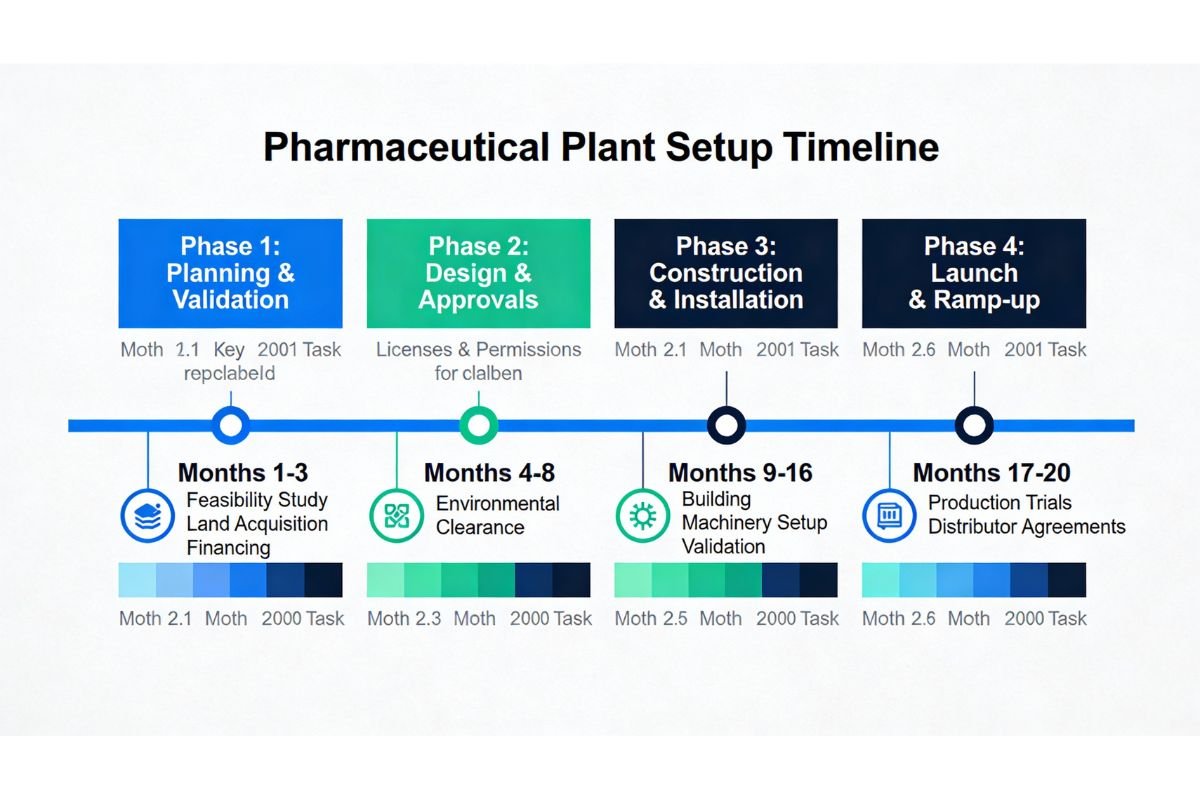
For a small to mid-scale plant, roughly eighteen months to two and a half years from first planning to commercial launch, running four overlapping phases: feasibility and land, design and statutory approvals, construction and equipment installation, then qualification, licensing and ramp-up. Sterile facilities take longer. The critical path usually runs through approvals and qualification rather than construction, which is why applications should be filed in parallel with civil work rather than after it.
No. WHO-GMP is an export requirement, not a condition of manufacturing for the domestic market. Revised Schedule M compliance, however, is mandatory for every licensed unit in India from 1 January 2026. The practical approach is to build the facility so that a WHO-GMP upgrade is a documentation and qualification exercise rather than a civil one — retrofitting airflow and area classification into a building not designed for it costs far more than designing for it at the outset.
Yes, and for a first plant it is usually the right decision. The condition is that expansion must be designed in at layout stage: spare utility capacity, a building envelope with room to extend, and material and personnel flows that still work when a second line is added. Retrofitting a line into a facility laid out for one is disruptive, expensive, and triggers requalification of areas that were previously approved.
It applies to every licensed manufacturer in India. Notified as G.S.R. 922(E) on 28 December 2023, it raised requirements across premises and area classification, HVAC and water systems, equipment qualification, the pharmaceutical quality system, computerised system validation and data integrity. Manufacturers with turnover below ₹250 crore received an extension to 31 December 2025 under G.S.R. 127(E) of 11 February 2025, conditional on filing Form A with an upgradation plan. From 1 January 2026 the standard applies universally.
Raw materials and excipients, packaging materials, direct and indirect manpower, utilities, distribution, and a compliance block that people consistently under-budget: licence renewals, periodic requalification and revalidation, stability studies, calibration and maintenance contracts, analyst training, internal audits and customer or regulatory inspections. Compliance is a recurring operating cost, not a one-time capital item.
Often, on time rather than only on price. Acquisition removes the approval timeline and gives immediate manufacturing capability, which for many buyers is worth more than the capital saved. The risk transfers to diligence: compliance history, equipment age and condition, documentation quality, product approvals, and the size of the Revised Schedule M gap. Price the upgrade before agreeing a valuation — a licence attached to a non-compliant facility is a liability with an upgrade bill behind it.
Related on Laafon
- Pharma plant setup cost calculatorPrice your configuration across four compliance standards and export a line-item PDF.
- CDSCO Schedule M compliance dashboardTwelve-area self-assessment to size your upgrade gap before you budget for it.
- Pharma PLI scheme explainedCategories, rates and eligibility for the central incentive scheme.
- Pharma plants for saleExisting licensed units, when acquiring beats building.
- Loan licence consultingManufacture under an existing licence while your own facility is built.
- Regulatory compliance consultationLicensing route, documentation and inspection readiness support.
References
- Ministry of Health and Family Welfare, Government of India. Notification G.S.R. 922(E): Revised Schedule M, Drugs Rules, 1945. New Delhi: Gazette of India; 28 December 2023. Accessed August 2026.
- Ministry of Health and Family Welfare, Government of India. Drugs (Amendment) Rules, 2025. Notification G.S.R. 127(E). New Delhi: Gazette of India; 11 February 2025. Available from: https://cdsco.gov.in/opencms/resources/UploadCDSCOWeb/2018/UploadGazette_NotificationsFiles/2025.02.11_G.S.R.%20127(E).pdf Accessed August 2026.
- Reuters. India orders drugmakers to meet global standards by January after cough syrup deaths; October 2025. Available from: https://www.aol.com/articles/india-orders-drugmakers-meet-global-185236596.html Accessed August 2026.
- Press Information Bureau, Ministry of Chemicals and Fertilizers, Government of India. Production Linked Incentive (PLI) scheme for the Pharmaceutical Sector; 26 November 2021. Available from: https://www.pib.gov.in/PressReleaseIframePage.aspx?PRID=1775321 Accessed August 2026.
- Dhruva Advisors. Production Linked Incentive Scheme for Pharmaceuticals: summary of scheme guidelines issued by the Department of Pharmaceuticals. 2023. Available from: https://www.dhruvaadvisors.com/wp-content/uploads/2023/08/Dhruva-Alert-PLI-Scheme-for-Pharmaceuticals.pdf Accessed August 2026. Secondary source summarising the notified scheme guidelines.
- BioSpectrum India. Centre approves three bulk drug parks in HP, Gujarat and AP; September 2022. Available from: https://www.biospectrumindia.com/news/22/21902/centre-approves-three-bulk-drug-parks-in-hp-gujarat-and-ap.html Accessed August 2026. Trade press reporting the Department of Pharmaceuticals scheme.
- Department of Industries and Commerce, Government of Haryana. Pharmaceutical Policy. Available from: https://investharyana.in/content/pdfs/Pharma%20policy.pdf Accessed August 2026.
- Medical Buyer. Haryana launches Pharma and MedTech Policy. 2026. Available from: https://medicalbuyer.co.in/haryana-launches-pharma-and-medtech-policy/ Accessed August 2026. Trade press report; notified policy text not independently verified.
- Government of Gujarat / Invest India. Gujarat Industrial Policy 2022 brochure. Available from: https://static.investindia.gov.in/s3fs-public/2022-10/Gujarat%20Industrial%20Policy%202022-%20Brochure.pdf Accessed August 2026.
- Reserve Bank of India monetary policy decisions, as compiled and reported by ClearTax. Repo rate held at 5.25% at the Monetary Policy Committee meeting of 3–5 June 2026. Available from: https://cleartax.in/s/repo-rate Accessed August 2026. Verify the current rate against rbi.org.in before use.
Disclaimer. This article is technical and educational content for pharmaceutical professionals and prospective manufacturers. It is not investment, financial, legal or medical advice. Capital cost bands are Laafon Galaxy internal planning estimates, not published or official figures, and actual project costs vary substantially with configuration, location and market conditions. Indian statutory instruments, pharmacopoeial texts and state incentive policies change frequently — verify every regulatory position and every scheme entitlement against the current notification and the administering authority before making a commercial decision.