Laafon Galaxy brand · Ayurvedic proprietary medicine
Gynaec-DS Syrup at a glance
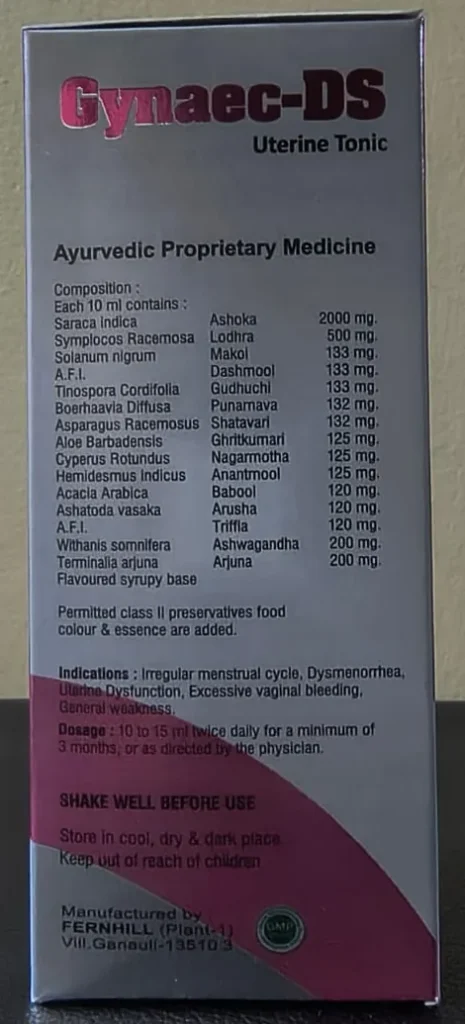
Gynaec-DS is an Ayurvedic syrup from Laafon Galaxy Pharmaceuticals. Each 10 ml contains 15 herbal ingredients, led by Ashoka 2,000 mg and Lodhra 500 mg.[1] This page gives the composition, the dose and pack as printed on the carton, the price, and the safety points to check first.
- Brand
- Gynaec-DS Syrup
- Category
- Ayurvedic proprietary medicine[1]
- Marketed by
- Laafon Galaxy Pharmaceuticals
- Pack
- 200 ml bottle in a carton
- MRP
- ₹165 per 200 ml
- Composition basis
- Each 10 ml, 15 herbal ingredients in a flavoured syrup base[1]
- Label dose
- 10 to 15 ml twice daily for a minimum of 3 months, or as directed by the physician[1]
- Storage
- Shake well before use. Store in a cool, dry and dark place, out of reach of children.[1]
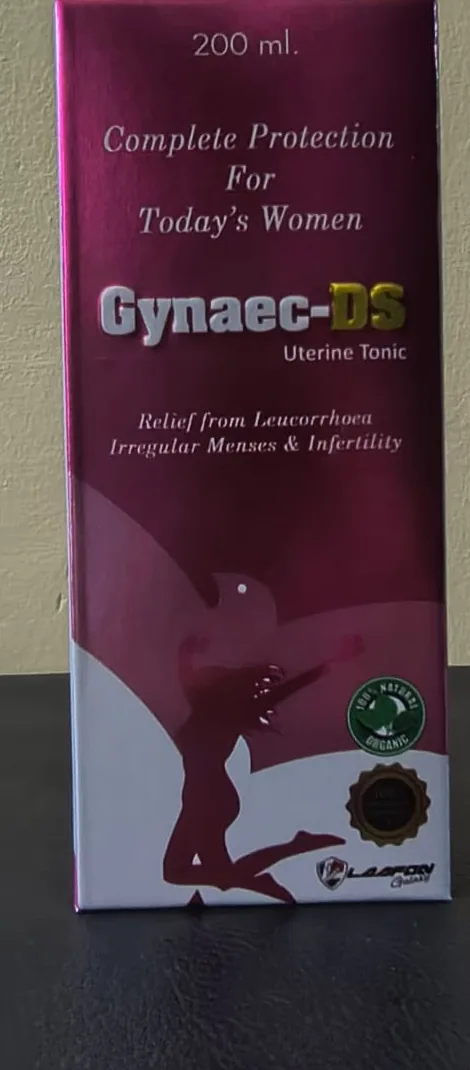
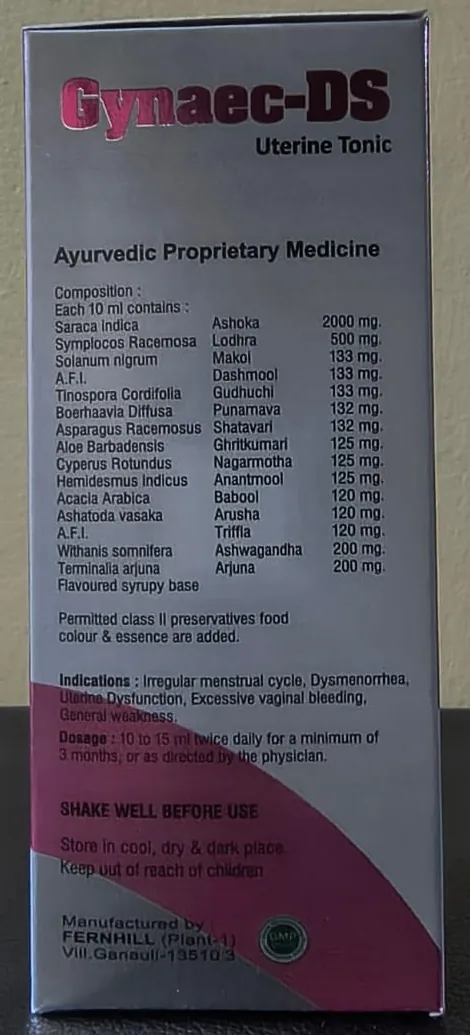
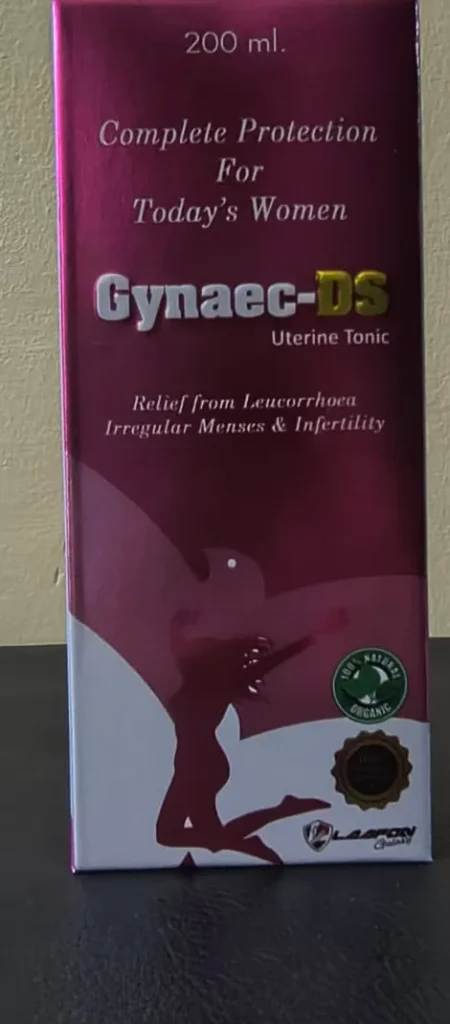
Photographs of the carton as supplied. The label text in the photographs is reproduced as printed.
Check the name on the carton
The brand is spelled Gynaec-DS. People also search for it as “gynec syrup”, “gyanaec”, “gynaejor DS” or “gyno DS syrup”. Other companies sell syrups with similar-sounding names that are different products. Before you buy, check that the carton says Gynaec-DS, carries the Laafon Galaxy logo, and lists the 15 ingredients shown below.
Gynaec-DS composition: what is in each 10 ml
The carton lists 15 herbal ingredients per 10 ml, in a flavoured syrup base with permitted Class II preservatives, food colour and essence.[1] Under Section 3(h) of the Drugs and Cosmetics Act, 1940, an Ayurvedic proprietary medicine is a formulation made only from ingredients described in the authoritative Ayurvedic books listed in the Act’s First Schedule, where the formulation itself is not one of the classical formulations in those books.[2]
- AshokaअशोकSaraca asoca†2,000 mg46.5%
- Lodhraलोध्रSymplocos racemosa500 mg11.6%
- MakoiमकोयSolanum nigrum133 mg3.1%
- DashmoolदशमूलGroup of ten roots, per the Ayurvedic Formulary of India (A.F.I.)133 mg3.1%
- Guduchi (Giloy)गिलोयTinospora cordifolia133 mg3.1%
- Punarnavaपुनर्नवाBoerhavia diffusa†132 mg3.1%
- ShatavariशतावरीAsparagus racemosus132 mg3.1%
- Ghritkumari (Aloe)घृतकुमारीAloe barbadensis125 mg2.9%
- NagarmothaनागरमोथाCyperus rotundus125 mg2.9%
- AnantmoolअनंतमूलHemidesmus indicus125 mg2.9%
- BaboolबबूलAcacia nilotica†120 mg2.8%
- Arusha (Vasaka)अडूसाAdhatoda vasica†120 mg2.8%
- Triphalaत्रिफलाHaritaki, Bibhitaki and Amalaki fruits, per the A.F.I.120 mg2.8%
- Ashwagandhaअश्वगंधाWithania somnifera†200 mg4.7%
- Arjunaअर्जुनTerminalia arjuna200 mg4.7%
Listed in the order printed on the carton. Percentages are each ingredient’s share of the 4,298 mg herbal total. † The carton prints an older synonym or a variant spelling (Saraca indica, Boerhaavia diffusa, Acacia arabica, Ashatoda vasaka, Withanis somnifera). The names above follow the Ayurvedic Pharmacopoeia of India.[3]
Why this page makes no treatment claims
The Drugs and Magic Remedies (Objectionable Advertisements) Act, 1954 restricts advertisements that suggest a medicine for the conditions listed in the Act.[4] This page therefore tells you what the product is, what is in it and how the label says to take it. Ask a registered medical practitioner whether it is suitable for you.
Gynaec-DS dose, and how many bottles you need
The carton gives the dose as 10 to 15 ml twice daily for a minimum of 3 months, or as directed by the physician. Shake the bottle well before each use.[1] At 10 ml twice daily a 200 ml bottle lasts 10 days. At 15 ml twice daily it lasts 6 to 7 days. Use the planner to see how many bottles a course needs at MRP.
Dose your physician advised
Length of course
Label minimum course at 10 ml twice daily: 9 bottles
20 ml a day, so one 200 ml bottle lasts 10 days. The course uses 1,800 ml. At MRP ₹165 a bottle, that is ₹1,485.
For planning only. Follow your physician’s advice on dose and duration. MRP is the maximum retail price; a seller may charge less.
Ask about availability
Availability and price questions are answered on WhatsApp. Chemists and distributors can ask for trade and distribution terms.
Gynaec-DS सिरप: हिंदी में मुख्य जानकारी
- यह क्या है?
- Gynaec-DS सिरप Laafon Galaxy Pharmaceuticals की एक आयुर्वेदिक प्रोप्राइटरी दवा है। हर 10 ml में अशोक 2000 mg और लोध्र 500 mg सहित 15 जड़ी-बूटियाँ हैं।
- यह किस लिए है?
- कानून (ड्रग्स एंड मैजिक रेमेडीज़ एक्ट, 1954) के कारण यह पेज बीमारी के इलाज का कोई दावा नहीं करता। यह दवा आपके लिए सही है या नहीं, यह किसी पंजीकृत डॉक्टर से पूछें।
- इसका दाम क्या है?
- 200 ml की बोतल का MRP ₹165 है।
- खुराक कितनी है?
- लेबल के अनुसार 10 से 15 ml, दिन में दो बार, कम से कम 3 महीने तक, या डॉक्टर के निर्देश के अनुसार। हर बार इस्तेमाल से पहले बोतल अच्छी तरह हिलाएँ।
- एक बोतल कितने दिन चलेगी?
- 10 ml दिन में दो बार लेने पर 10 दिन। 15 ml दिन में दो बार लेने पर 6 से 7 दिन।
- किन बातों का ध्यान रखें?
- गर्भावस्था या स्तनपान में, थायरॉइड या लिवर की बीमारी में, या कोई दूसरी दवा चल रही हो, तो पहले डॉक्टर से पूछें। आँखें या त्वचा पीली पड़ें, पेशाब गहरे रंग का हो या पूरे शरीर में खुजली हो, तो दवा बंद करें और डॉक्टर को दिखाएँ।
- कहाँ से लें?
- उपलब्धता और दाम के लिए ऊपर दिए WhatsApp बटन से पूछें।
Gynaec-DS safety: what to check before use
Herbal does not mean free of side effects. The points below come from published safety information on individual ingredients, not from studies of Gynaec-DS itself.
Stop taking it and see a doctor if you notice yellow eyes or skin, dark urine, itching all over the body, or pain in the upper abdomen. Rare cases of liver injury have been reported with ashwagandha supplements.[5][6]
- Pregnancy and breastfeeding. The US National Center for Complementary and Integrative Health advises avoiding ashwagandha during pregnancy and breastfeeding.[5] It also says aloe taken by mouth may be unsafe during pregnancy and breastfeeding.[7] Do not use Gynaec-DS during pregnancy or breastfeeding unless your doctor specifically advises it.
- Thyroid, autoimmune conditions and surgery. The same source says ashwagandha is not recommended for people with thyroid or autoimmune disorders, or for people about to have surgery.[5]
- Other medicines. Ashwagandha may interact with medicines for diabetes, high blood pressure and thyroid disorders, and with anticonvulsants, sedatives and immunosuppressants.[5] Tell your doctor about Gynaec-DS if you take any of these.
- Stomach upset. Ashwagandha can cause drowsiness, stomach upset, diarrhoea and vomiting in some people.[5] Aloe latex taken by mouth can cause abdominal pain, cramps and diarrhoea.[7]
- Guduchi (Giloy). A 2021 Indian case series linked Giloy to liver injury, and its authors later confirmed the plant’s identity by botanical and DNA analysis.[8] Other researchers dispute that authentic Tinospora cordifolia was the cause and point to adulteration with other Tinospora species.[9] The question is unresolved, so the liver warning above applies.
- Diabetes. The ingredients are in a flavoured syrup base.[1] If you have diabetes, ask your doctor before starting a 3-month course.
Gynaec-DS Syrup: questions buyers ask
Gynaec-DS Syrup is an Ayurvedic proprietary medicine marketed by Laafon Galaxy Pharmaceuticals. Each 10 ml contains 15 herbal ingredients, led by Ashoka 2,000 mg and Lodhra 500 mg, in a flavoured syrup base. It comes in a 200 ml bottle.
The MRP of a 200 ml bottle of Gynaec-DS Syrup is ₹165. A seller may charge less than MRP but not more. A 3-month course at 10 ml twice daily needs 9 bottles, which is ₹1,485 at MRP.
The carton gives the dose as 10 to 15 ml twice daily for a minimum of 3 months, or as directed by the physician. Shake the bottle well before each use. Store it in a cool, dry and dark place, out of reach of children.
At 10 ml twice daily (20 ml a day), one 200 ml bottle lasts 10 days. At 15 ml twice daily (30 ml a day), it lasts 6 to 7 days. A 90-day course needs 9 bottles at the lower dose and 14 bottles at the higher dose.
Do not take it during pregnancy or breastfeeding unless your doctor specifically advises it. It contains ashwagandha, which the US National Center for Complementary and Integrative Health advises avoiding during pregnancy and breastfeeding. It also contains aloe, which that source says may be unsafe by mouth in pregnancy and breastfeeding.
The carton states that the herbs are in a flavoured syrup base and that permitted Class II preservatives, food colour and essence are added. If you need to avoid sugar or any additive, ask your doctor or pharmacist before use.
No. Gynaec-DS is spelled G-Y-N-A-E-C, followed by a hyphen and DS, and is marketed by Laafon Galaxy Pharmaceuticals. Syrups with similar-sounding names from other companies are different products with different compositions. Check the brand name, the Laafon Galaxy logo and the composition panel on the carton.
Message Laafon Galaxy Pharmaceuticals on WhatsApp at +91 98124 46733 to ask about availability and price. Chemists and distributors can ask for trade terms on the same number.
More from the Laafon Galaxy Ayurvedic range
- Livtips SyrupAyurvedic syrup, 200 ml, with Punarnava, Makoy and Bhringraj
- Zymelive-DS SyrupAyurvedic syrup with enzymes, 200 ml
- Kuftips SyrupAyurvedic syrup with Tulsi, Vasaka and Yashtimadhu
- Faster Pain Relieving OilAyurvedic oil, 60 ml
References
- Laafon Galaxy Pharmaceuticals. Gynaec-DS Syrup 200 ml: carton label (composition, dosage and storage panel). Photographed October 2026.
- Government of India. The Drugs and Cosmetics Act, 1940 (Act No. 23 of 1940), sections 3(a) and 3(h). New Delhi: Legislative Department, Ministry of Law and Justice. Available from: https://www.indiacode.nic.in/handle/123456789/2409. Accessed October 2026.
- Pharmacopoeia Commission for Indian Medicine and Homoeopathy. List of single drugs. In: Macro and Microscopic Atlas of Ayurvedic Pharmacopoeial Drugs. The Ayurvedic Pharmacopoeia of India, Part I, Vol. I. Ghaziabad: PCIM&H, Ministry of AYUSH. Available from: https://pcimh.gov.in/WriteReadData/RTF1984/1536814669.pdf. Accessed October 2026.
- Government of India. The Drugs and Magic Remedies (Objectionable Advertisements) Act, 1954 (Act No. 21 of 1954), sections 3 and 14, and the Schedule. New Delhi: Legislative Department, Ministry of Law and Justice. Available from: https://www.indiacode.nic.in/indiacode/bitstream/123456789/1412/1/A1954-21.pdf. Accessed October 2026.
- National Center for Complementary and Integrative Health. Ashwagandha [fact sheet]. Bethesda (MD): NCCIH; updated March 2023. Available from: https://www.nccih.nih.gov/health/ashwagandha. Accessed October 2026.
- Björnsson HK, Björnsson ES, Avula B, Khan IA, Jonasson JG, Ghabril M, et al. Ashwagandha-induced liver injury: a case series from Iceland and the US Drug-Induced Liver Injury Network. Liver Int. 2020;40(4):825-9. doi:10.1111/liv.14393. Available from: https://pubmed.ncbi.nlm.nih.gov/31991029/. Accessed October 2026.
- National Center for Complementary and Integrative Health. Aloe vera [fact sheet]. Bethesda (MD): NCCIH; updated February 2025. Available from: https://www.nccih.nih.gov/health/aloe-vera. Accessed October 2026.
- Nagral A, Rudra OS, Menezes S, Menon S, Shailajan S, Mallakmir S, et al. Herb-induced liver injury: a guide to approach. Lessons from the Tinospora cordifolia (Giloy) case series story. J Clin Exp Hepatol. 2023;13(2):360-71. doi:10.1016/j.jceh.2022.11.001. Available from: https://pubmed.ncbi.nlm.nih.gov/36950495/. Accessed October 2026.
- Panneer Selvam K, Payyappallimana U, Ravikumar K, Venkatasubramanian P. Can Guduchi (Tinospora cordifolia), a well-known ayurvedic hepato-protectant cause liver damage? J Ayurveda Integr Med. 2023;14(1):100658. doi:10.1016/j.jaim.2022.100658. Available from: https://pubmed.ncbi.nlm.nih.gov/36400639/. Accessed October 2026.
This page gives product information for reference. It is not medical advice and makes no claim that Gynaec-DS treats, cures or prevents any disease. Read the carton label and consult a registered medical practitioner before use. Composition, pack and MRP are as printed on the current carton and as supplied by the marketer on 12 October 2026, and may change.