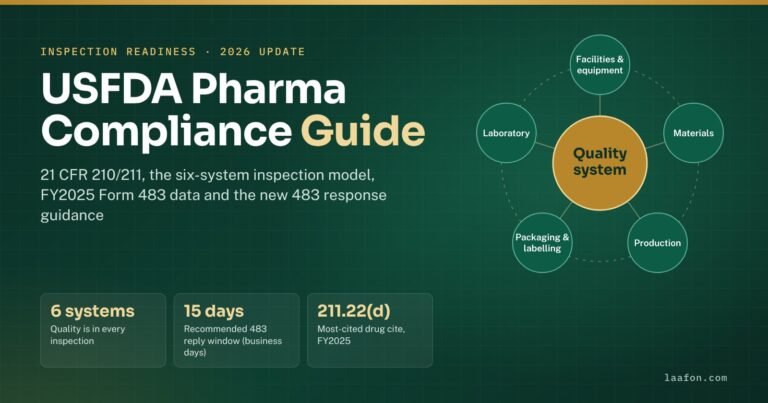
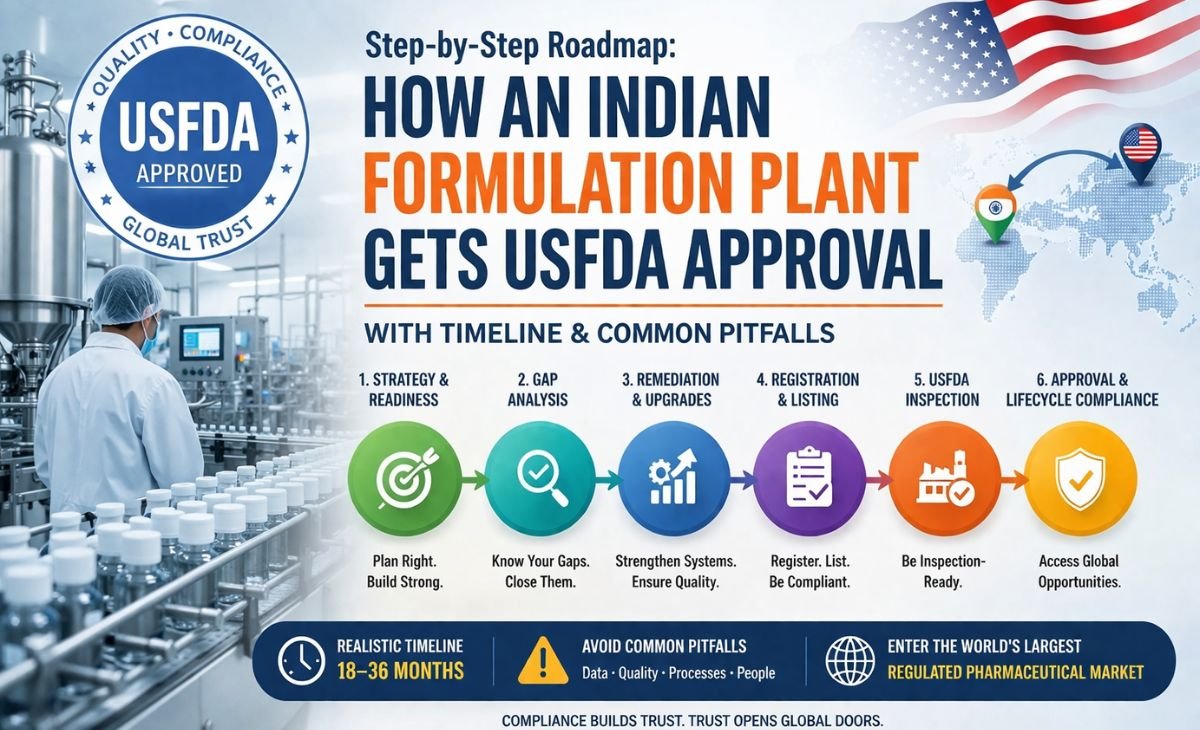

For an Indian formulation plant, “USFDA approval roadmap” essentially means that both your facility and your products meet United States Food and Drug Administration requirements for quality, safety, and compliance with current Good Manufacturing Practice (cGMP) under 21 CFR Parts 210 and 211. In practical terms, this means your systems, documentation, equipment, and people must satisfy detailed cGMP expectations for drug manufacturing, processing, packaging, and holding.
Once your plant and products meet USFDA expectations and the relevant applications are approved, you gain legitimate access to the US prescription and OTC drug market, the world’s largest regulated pharmaceutical market. For Indian exporters, this can transform the business model: it enables direct supply to US buyers, higher‑value US‑bound batches, contract manufacturing for global innovators and generics, and stronger credibility in other regulated markets such as the EU, UK, and WHO‑prequalified tenders.
This guide provides an evergreen, step‑by‑step USFDA approval process roadmap tailored for Indian formulation plants, with realistic timelines, typical pitfalls, and expert tips on how to prepare your site, people, and documents for a successful outcome.
Big Picture: What “USFDA Approval” Actually Involves
Before jumping into the stepwise roadmap, it helps to understand the three intertwined elements that USFDA will evaluate for a plant intending to supply the US market.
- Product approval – via an NDA (New Drug Application), ANDA (Abbreviated New Drug Application), or other relevant pathway, including the full CMC description of your facility and processes.
- Establishment registration and product listing – registering your facility and listing each US‑bound product as required under section 510 of the FD&C Act and 21 CFR Part 207.
- cGMP compliance of your plant – assessed through inspections, including pre‑approval inspections (PAIs) and routine surveillance inspections under 21 CFR 210/211.
Strictly speaking, FDA approves applications (e.g., ANDAs) and expects facilities named in those applications to maintain ongoing cGMP compliance and valid registration; it does not issue a permanent “USFDA certificate” for the plant. Your strategy must therefore align all three elements simultaneously: dossier, facility, and quality system.
Step‑by‑Step Roadmap: USFDA Approval Process for an Indian Formulation Plant
Step 1: Strategic Assessment and Readiness Decision
The journey starts with a realistic, cross‑functional decision: “Are we ready to invest 2–3 years and serious resources to become US‑compliant?”
Key actions in this stage:
- Market and portfolio fit evaluation
- Identify which products have potential in the US market (generic molecules with patent expiry, high‑volume commodities, or niche products with fewer competitors).
- Decide whether you will file ANDAs yourself or work as a contract manufacturer for US‑based sponsors, bearing in mind that your facility will still be inspected as per cGMP and PAI expectations.
- High‑level capability assessment
- Evaluate whether your existing facility design, utilities, equipment, and laboratories can be upgraded to meet 21 CFR 210/211 cGMP expectations (material flow, personnel segregation, HVAC, contamination control).
- Consider product types (oral solids, injectables, topicals) and whether your current layout and systems support US‑level controls, segregation, and data integrity expectations.
- Budget and timeline alignment
- Plan capital expenditure for building upgrades, new utilities, QC instruments, electronic systems, and regulatory/validation consultants.
- Align management expectations to a realistic 18–36 month horizon for full readiness and first US approval, depending on your starting point.
If senior leadership does not commit to a patient‑centric quality culture and sustained investment, later stages—especially USFDA audits and pre‑approval inspections—will expose the weaknesses.
Step 2: Detailed Gap Analysis vs 21 CFR 210/211 cGMP
A structured gap assessment against US cGMP is the backbone of your roadmap.
Key components:
- Document and system review
- Compare your existing SOPs, validation master plan, qualification reports, batch records, and quality systems against 21 CFR Parts 210 and 211 requirements for quality systems, facilities, equipment, production controls, lab controls, and records.
- Map your current Indian Schedule M status to US expectations; if your plant only just passes Schedule M today, it will struggle under WHO, EMA, and FDA scrutiny tomorrow.
- Shop‑floor and laboratory walk‑throughs
- Physically verify whether practices match written procedures—USFDA and other regulators focus strongly on the linkage between procedures and actual execution.
- Evaluate personnel training, gowning, material movement, data recording habits, and control of in‑process materials and deviations.
- Data integrity and electronic systems
- Assess whether your current systems comply with ALCOA+ principles (Attributable, Legible, Contemporaneous, Original, Accurate, plus Complete, Consistent, Enduring, Available).
- Identify non‑compliant practices such as shared logins, uncontrolled spreadsheets, manual overwriting of results, or missing audit trails, all of which have been central in recent data integrity enforcement by FDA and MHRA.
The output of this step should be a formal cGMP Gap Assessment Report with risk ranking and a prioritized remediation plan (CAPA program) aligned with risk‑based principles used across FDA, ICH, WHO, EMA, and CDSCO.
Step 3: Remediation, Upgrades, and QMS Strengthening
Once you know your gaps, the next 6–18 months are normally spent implementing corrective and preventive actions (CAPAs) and upgrading your quality system.
Typical focus areas:
- Quality Management System (QMS)
- Strengthen the quality unit’s independence, roles, and responsibilities as required by 21 CFR 211.22 and comparable EMA/WHO expectations.
- Formalize procedures for change control, deviation management, CAPA, OOS/OOT, complaints, recalls, and product quality review, consistent with ICH Q10 and WHO GMP.
- Facility, utilities, and equipment
- Upgrade critical utilities (HVAC, purified water, compressed air) to a validated state and ensure a lifecycle approach to qualification and maintenance.
- Implement robust preventive maintenance and calibration programs with traceable documentation, in line with FDA, EU GMP (EudraLex Volume 4), and Schedule M expectations.
- Process validation and cleaning validation
- Develop lifecycle‑based process validation: Stage 1 (process design), Stage 2 (process qualification), Stage 3 (continued process verification), as described in FDA’s Process Validation Guidance.
- Ensure cleaning validation protocols cover worst‑case products, equipment matrix, and analytical sensitivity, aligned with WHO GMP, EU GMP, and CDSCO guidance.
- Laboratory controls and data integrity
- Validate analytical methods, establish justified specifications, and implement robust OOS/OOT investigation procedures.[1–3,7]
- Move towards validated electronic systems or hybrid systems with access control and audit trails to address data integrity vulnerabilities highlighted in recent FDA and MHRA guidance.
- Training and culture building
- Implement structured cGMP, quality risk management, and data integrity training for all levels, with effectiveness checks.
- Encourage “right‑first‑time” practices and discourage retrospective documentation or backdating by reinforcing management’s commitment to quality.
By the end of this phase, your plant should be able to manufacture registration batches for US‑bound products under a robust, reproducible, and auditable system.
Step 4: Establishment Registration, DUNS, and Product Listing
In parallel with technical remediation, you must ensure your regulatory identity in USFDA systems is correctly established.
- Obtain or verify DUNS numbers
- A DUNS (Data Universal Numbering System) number is required for each manufacturing site and often for your US agent and importers; it is used in Structured Product Labeling (SPL) submissions for establishment registration and drug listing.
- Drug Establishment Registration under 21 CFR Part 207
- Foreign facilities that manufacture, prepare, propagate, compound, or process drugs for US commercial distribution must register with FDA and renew annually before 31 December.
- Foreign establishments must appoint a US agent as part of the registration process and keep contact details up to date.[4–6]
- Drug listing (NDC‑linked)
- Once registration is complete, each US‑marketed drug must be listed with FDA, including NDC codes and other product details submitted electronically in SPL format.
- Listing must be updated when there are relevant changes, such as formulation, labeling, or discontinuation, typically at least twice a year.
Establishment registration and product listing are necessary but not sufficient for US market entry; they do not replace application approval or cGMP compliance.
Step 5: Appointing and Managing the US Agent
A foreign drug manufacturing facility must designate a US agent as part of its establishment registration.[4–6]
Key points:
- The US agent is a person or entity based in the United States with a physical address and contact details submitted in FDA’s electronic registration system.
- The US agent acts as the primary point of contact between FDA and your foreign establishment for routine communications, inspection notices, and regulatory correspondence.
- While the agent does not replace your legal responsibilities, an experienced agent can significantly smooth interactions during PAI, post‑approval questions, and enforcement communications.
From an Indian plant’s perspective, choosing a US agent with strong regulatory experience and reliable communication is a strategic decision, not a mere formality.
Step 6: Dossier Preparation – ANDA/DMF and Supporting Documentation
For most Indian formulation plants targeting generics, the primary route is ANDA filing, sometimes supported by APIs referenced via Drug Master Files (DMFs) or other ICH‑aligned documentation.
Key activities:
- Determine regulatory strategy
- If you manufacture finished dosage forms, you or your US partner will file an ANDA that includes the full CMC description of your facility, process, controls, and stability data.
- If you supply APIs, you may submit a DMF and provide letters of authorization for ANDA/NDA applicants, ensuring alignment with ICH Q7/Q10 and relevant national GMPs.
- Align CMC with actual practices
- The dossier must accurately describe your manufacturing process, control strategy, validation approach, and quality system; any mismatch between the dossier and shop‑floor reality is a classic trigger for PAI findings.
- Changes implemented during remediation or scale‑up must be captured through proper change control and, where necessary, communicated to FDA via supplements or amendments.
- eCTD formatting and quality checks
- ANDAs must comply with FDA’s electronic Common Technical Document (eCTD) specifications; technical validation failures can delay review.
- Internal “refuse‑to‑receive” checks, completeness reviews, and formatting checks can prevent avoidable delays and help maintain planned approval timelines.
Close collaboration among QA, QC, production, engineering, and regulatory affairs is crucial; the strongest dossiers come from plants where technical and regulatory narratives are fully aligned.
Step 7: Submission, Review, and PAI (Pre‑Approval Inspection) Planning
Once the ANDA (or NDA/BLA) is submitted and accepted for review, FDA reviewers evaluate both the dossier and the manufacturing site(s) named in the application.
- When does PAI occur?
- For many applications, FDA schedules a Pre‑Approval Inspection (PAI) after the application reaches specific review milestones and is considered ready for facility evaluation, using a risk‑based approach defined in Compliance Program 7346.832.
- For ANDAs, PAIs generally occur within the standard review timeline, often about 6–12 months after submission depending on review cohort and risk factors.
- What does PAI assess?
- PAI verifies that your facility, equipment, processes, lab controls, data integrity systems, and quality systems can consistently produce the product as described in the application.
- Inspectors focus on process validation, cleaning validation, batch records, laboratory raw data, OOS/OOT handling, and overall data integrity, using CPGM 7346.832 and related guidance as their playbook.
- Inspection logistics
- PAIs typically last around 3–5 days, although this can vary by product and facility complexity.
- FDA generally provides advance notice, but can also conduct unannounced or for‑cause inspections; your plant must stay inspection‑ready from roughly 90 days after submission until a final action is taken.
A successful PAI is often the last major hurdle before approval; significant findings can delay approval by 6–18 months or longer, depending on severity and remediation speed.
Step 8: Handling USFDA Audit Outcomes – 483, EIR, OAI/WL
At the end of your PAI or routine surveillance inspection, investigators hold a close‑out meeting and may issue Form FDA 483 if they observe conditions they believe may violate cGMP.
Common outcomes:
- No 483 / minimal observations – Indicates strong compliance; FDA later issues an Establishment Inspection Report (EIR) classifying the inspection as “No Action Indicated (NAI)” or “Voluntary Action Indicated (VAI).”
- Multiple or severe observations – May lead to “Official Action Indicated (OAI)” status, warning letters, or import alerts, which can block or delay application approvals and future submissions.
Your response strategy:
- Timely, detailed written response
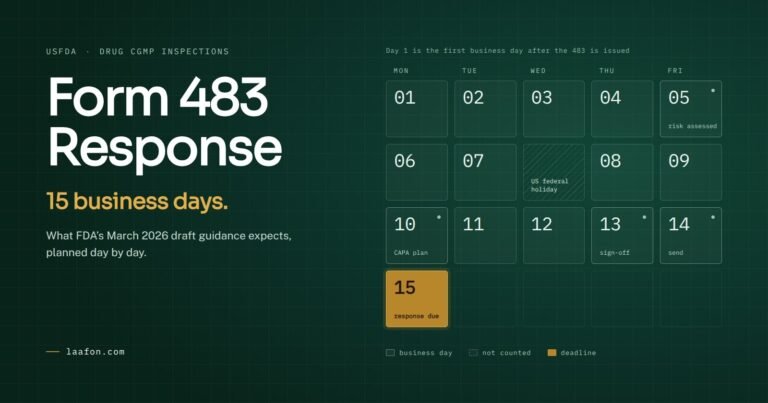
- Submit a comprehensive, root‑cause‑oriented response to each 483 observation within the standard 15‑working‑day expectation, addressing both corrective and preventive actions.
- Provide realistic timelines, responsible persons, and objective evidence (e.g., revised procedures, training records, completed validations).
- Robust CAPA implementation
- Go beyond patch fixes; focus on systemic corrections such as revising data governance, retraining complete functional groups, or redesigning processes.
- Monitor CAPA effectiveness through internal audits, trending, and management review consistent with ICH Q10 expectations.
- Ongoing communication
- Coordinate closely with your US agent and, where applicable, the US sponsor who filed the ANDA or NDA naming your facility.
- Provide periodic updates to FDA when remediation is complex or multi‑stage, backed by evidence of progress.
The quality of your 483 response and the credibility of your CAPA execution directly influence whether USFDA considers your facility “approvable” for current and future products.
Step 9: Final Application Approval and Routine Surveillance
If dossier review and inspection outcomes are satisfactory, FDA can grant final approval for your ANDA (or NDA/BLA), and your product becomes eligible for US marketing.
Post‑approval, FDA and other regulators continue to:
- Conduct routine cGMP surveillance inspections at risk‑based frequencies throughout the product lifecycle.
- Monitor product quality signals from field alerts, complaints, recalls, and pharmacovigilance systems.
Maintaining compliance is not a one‑time project; regulators expect continuous improvement, robust management oversight, and sustained data integrity across the lifecycle, which is the core message of ICH Q10, FDA guidance, WHO GMP, EU GMP, and revised Schedule M.[3,7–9,11]
Typical Timeline: From Initiation to USFDA Approval
Actual timelines vary with product complexity, baseline GMP maturity, and regulatory events, but the following ranges are realistic for many Indian formulation plants aiming for US market entry.
High‑Level Timeline Overview
| Phase | Key activities | Typical duration* |
|---|---|---|
| Strategic decision & initial assessment | Portfolio selection, capability review | 1–3 months |
| Detailed gap analysis vs 21 CFR 210/211 | Audits, diagnostic reports, remediation planning | 2–4 months |
| Remediation & QMS strengthening | Facility upgrades, validations, training, data integrity fixes | 6–18 months |
| Establishment registration & US agent | DUNS, 21 CFR 207 registration, listing | 1–3 months (overlaps) |
| Dossier preparation (ANDA/DMF) | CMC drafting, eCTD, internal QC | 3–9 months |
| ANDA review & PAI | Application review, PAI scheduling and completion | ~6–18 months from submission |
| CAPA and re‑inspection (if needed) | Addressing 483/OAI issues | 6–24 months extra for major issues |
*Phases can overlap; strong early preparation can compress timelines, while serious data integrity or system issues can extend them significantly.
In practice, a plant starting from semi‑regulated/“ROW” level often requires 18–30 months to reach first US approval, assuming focused investment and no major enforcement actions.
Common Pitfalls in Indian Plants – And How to Avoid Them
1. Treating USFDA as a Documentation Exercise Only
Many plants focus heavily on SOP rewriting and dossier polishing while neglecting habits and culture on the shop floor.
- Pitfall: Batch records claim “online data entry,” but operators complete logbooks only at the end of the shift or after the batch.
- Impact: Data integrity observations during PAI and surveillance inspections; potential OAI status and delayed approvals.
- Prevention: Reinforce real‑time documentation (ALCOA+), conduct Gemba walks, and use internal audits to cross‑check entries vs actual operations.
2. Weak Data Integrity Controls
Data integrity is one of the most common causes of PAI failures and warning letters globally.
- Pitfall: Shared logins on HPLC/GC systems, uncontrolled Excel files, manual overwriting of results, and missing audit trails.
- Impact: Regulators may question the reliability of all data, leading to import alerts, long remediation timelines, and loss of business opportunities.
- Prevention: Implement validated, access‑controlled systems, unique user IDs, audit trails, and robust backup policies aligned with FDA and MHRA data integrity guidance; train staff on data governance, not just on SOPs.
3. Incomplete or Superficial Validation
- Pitfall: “Three batches and done” process validation without lifecycle thinking, weak scientific rationale for critical parameters, and narrow cleaning validation coverage.
- Impact: FDA and other regulators may conclude that the process is not adequately understood or controlled, leading to critical observations and delayed approvals.
- Prevention: Apply FDA’s lifecycle process validation model and ICH Q8/Q9/Q10 principles, linking risk assessments to control strategy and continuous monitoring.
4. Mismatch Between Dossier and Actual Practice
- Pitfall: Changes in equipment, batch size, or analytical methods are implemented via internal change control but not reflected in the regulatory submission.
- Impact: During PAI, inspectors find that on‑ground practices do not match the ANDA/DMF description, eroding confidence in both the application and quality system.
- Prevention: Ensure that regulatory impact assessment is embedded into change control and that significant changes trigger supplements, amendments, or notifications to FDA and other regulators as appropriate.
5. Weak 483 Response and CAPA
- Pitfall: Defensive responses that deny observations, give generic assurances, or propose cosmetic fixes without time‑bound commitments or effectiveness checks.
- Impact: FDA may keep the facility in OAI status, issue warning letters, or defer approvals, impacting all products from the site.
- Prevention: Treat every observation as an opportunity for systemic improvement; perform deep root‑cause analysis, propose realistic CAPAs with clear milestones, and follow through with internal verification and management review.
Case Insight: An Indian Oral Solid Plant’s Journey to USFDA Compliance
Consider a hypothetical mid‑size oral solid dosage facility in western India that has historically supplied semi‑regulated markets.
Phase 1: Realisation and Gap Assessment
Senior management decides to enter the US generics market with a strategic partner. A diagnostic audit against 21 CFR 210/211 and WHO/EMA GMP reveals:
- Documentation and SOPs aligned with Schedule M and WHO‑GMP, but lacking robust change control, product quality reviews, and lifecycle validation.
- Multiple data integrity vulnerabilities in QC (shared logins, manual integrations, lack of audit trails), conflicting with FDA and MHRA guidance.
- Maintenance and calibration records incomplete for critical equipment, with limited evidence of periodic review.
Phase 2: Heavy Lifting – Upgrades and Validation
Over 12–15 months, the plant:
- Implements an ICH Q10‑aligned QMS with structured deviation, CAPA, change management, and management review processes.
- Transitions major QC instruments to a 21 CFR Part 11‑compliant CDS with role‑based access and audit trails, backed by FDA data integrity guidance.
- Executes full lifecycle process validation and cleaning validation for the target US product, adopting FDA’s three‑stage model and WHO/EMA expectations.
Culturally, operators must adapt to contemporaneous recording, and supervisors take on more responsibility for coaching and verification.
Phase 3: Registration, ANDA Submission, and PAI
The US sponsor files an ANDA naming this facility as the manufacturer while the plant completes drug establishment registration, DUNS mapping, and US agent appointment.[4–6]
FDA accepts the ANDA and, roughly nine months later, schedules a five‑day PAI. During the inspection:
- Investigators focus on process validation, cleaning validation, and OOS investigations.
- They identify two issues—limited worst‑case justification in the cleaning validation matrix and delayed entries in an IPC logbook—leading to a Form 483 with four observations.
Phase 4: Response, CAPA, and Approval
The plant responds within 15 working days with:
- A revised cleaning validation strategy expanding the worst‑case matrix and a commitment to complete new studies within 90 days.
- Strengthened procedures for contemporaneous logbook entries, retraining records, and new internal audit checks on documentation timeliness.
FDA classifies the inspection as VAI; after reviewing CAPA evidence and updated validation data, the ANDA receives final approval. The plant now uses this experience to strengthen its approach for future products and additional markets (EU, UK, WHO prequalification).[7–9,11]
Expert Tips for Indian QA/QC and Regulatory Leaders
1. Treat Data as a Product – Apply ALCOA+ Every Day
Regulators repeatedly emphasize that poor data integrity is a leading cause of PAI failure and warning letters.
- Implement clear policies for electronic and paper records: no overwriting, no backdating, no shared credentials, and controlled blank forms.
- Conduct routine internal data integrity audits—sample raw data, audit trails, and reported results—and feed findings into CAPA and management review.
2. Use the Right Tools and Software
Certain tools can significantly reduce compliance risk if implemented correctly:
- 21 CFR Part 11‑compliant LIMS and CDS with robust audit trails, user management, and electronic signatures.
- Electronic QMS platforms that manage deviations, CAPA, change control, training, and document lifecycle with traceability, aligned with ICH Q10.
- Validation lifecycle tools to manage URS, IQ/OQ/PQ, risk assessments, and periodic reviews for processes, equipment, utilities, and systems.
Vendor selection should consider data integrity, scalability, and audit readiness—not just license cost.
3. Build a Cross‑Functional Regulatory Communication Routine
- Hold regular cross‑functional meetings between QA, QC, production, engineering, and regulatory affairs to review regulatory changes, open commitments, and inspection learnings.
- Maintain a tracker of all regulatory commitments in ANDAs, DMFs, and correspondence, and verify their implementation on the shop floor.
4. Use Internal Mock Audits and Readiness Drills
- Conduct periodic mock USFDA audits using external experts who understand global inspection trends across USFDA, EMA, MHRA, WHO, and CDSCO.
- Simulate PAI scenarios (document requests, data traceability exercises, interview practice) so staff gain confidence and learn how to respond factually and calmly.
5. Maintain a Living Risk Register
- Maintain a plant‑level risk register for critical quality and compliance risks, updating it after each internal audit, deviation trend review, and regulatory change.[3,7–9]
- Use risk‑based thinking to prioritize CAPAs, investments, and training in line with ICH Q9/Q10 and WHO/EMA expectations.[7–9]
Ready to take your plant from “Schedule M compliant” to “USFDA‑ready”?
Don’t wait for a tough PAI to expose gaps. Use this roadmap as your internal playbook, start a cross‑functional review this week, and turn your Indian formulation site into a dependable US supply partner.
Conclusion:
Achieving USFDA approval for an Indian formulation plant is not a quick certification exercise; it is a multi‑year transformation of your systems, culture, and capabilities.
Plants that succeed typically share three characteristics:
- Regulatory patience: Management accepts that aligning with the USFDA approval process in India will take time, effort, and sometimes painful CAPAs, but remains committed through setbacks.
- Strong quality culture: QA is empowered, deviations are investigated honestly, and data integrity is non‑negotiable, fully aligned with FDA, ICH Q10, WHO GMP, EU GMP, and MHRA expectations.[5,7–10]
- Strategic planning: Portfolio selection, US agent choice, QMS upgrades, validation strategy, and ANDA/DMF planning are integrated, not handled in silos.[1,3,7–9,11]
If you approach USFDA approval with this mindset, the process becomes more than a regulatory checkbox; it becomes a sustainable competitive advantage for your organization in the global pharmaceutical market.[1,3,7–9,11]
FAQs
How is “USFDA approval” different from basic GMP or Schedule M compliance for an Indian plant?
USFDA approval is tied to the acceptance of specific applications (such as ANDAs) and ongoing cGMP compliance with 21 CFR Parts 210 and 211, not just a one‑time certificate for the facility. In contrast, Schedule M or basic GMP certification is a national requirement and typically less detailed than the lifecycle‑ and data‑integrity‑focused expectations applied by USFDA and other stringent authorities.
Do we need USFDA establishment registration before filing an ANDA or supplying the US market?
Yes. Any foreign facility that manufactures, repacks, or relabels drugs for the US must complete electronic drug establishment registration and product listing under 21 CFR Part 207 before commercial distribution. As part of this process, foreign manufacturers must also identify a qualified US agent and obtain a DUNS‑linked establishment entry in FDA’s electronic systems.
How long does it typically take for an Indian formulation plant to become “USFDA‑ready”?
For a plant starting from semi‑regulated or “ROW” level, it is common for the journey—from initial gap analysis, remediation, and validation to ANDA review and successful PAI—to take around 18–30 months. Timelines can be shorter if the site already operates near WHO/EMA GMP standards, and significantly longer if major data‑integrity or system‑level issues are identified during inspections.
What exactly happens during a USFDA Pre‑Approval Inspection (PAI)?
During a PAI, FDA investigators verify that your facility, processes, analytical methods, and data are consistent with what is described in the application and compliant with cGMP. They typically review process validation, cleaning validation, batch records, laboratory raw data, stability, and data‑integrity controls over a 3–5‑day on‑site inspection, then feed their findings into the final approval decision.
What are the most common reasons Indian plants face delays or rejections in the USFDA approval process?
Frequent causes include weak data‑integrity controls (shared logins, incomplete audit trails), superficial process/cleaning validation, and discrepancies between dossier content and actual shop‑floor practices. Poorly structured Form 483 responses and CAPAs—without deep root‑cause analysis, timelines, and effectiveness checks—also lead to prolonged OAI status and delayed ANDA approvals.
References
- U.S. Food and Drug Administration (FDA). Current Good Manufacturing Practice (CGMP) Regulations. Silver Spring (MD): FDA; updated 2025. Available from: https://www.fda.gov/drugs/pharmaceutical-quality-resources/current-good-manufacturing-practice-cgmp-regulations
- Electronic Code of Federal Regulations (eCFR). 21 CFR Part 211 – Current Good Manufacturing Practice for Finished Pharmaceuticals. Washington (DC): National Archives and Records Administration; updated 2025. Available from: https://www.ecfr.gov/current/title-21/chapter-I/subchapter-C/part-211
- U.S. Food and Drug Administration (FDA). Process Validation: General Principles and Practices. Guidance for Industry. Silver Spring (MD): FDA; 2011, updated 2020. Available from: https://www.fda.gov/regulatory-information/search-fda-guidance-documents/process-validation-general-principles-and-practices
- U.S. Food and Drug Administration (FDA). 21 CFR Part 207 – Subpart D: Listing. Washington (DC): FDA; 2016. Available from: https://www.law.cornell.edu/cfr/text/21/part-207/subpart-D
- U.S. Food and Drug Administration (FDA). Compliance Program 7346.832 – Pre‑Approval Inspections (PAI). Silver Spring (MD): FDA; updated 2019. Available from: https://www.fda.gov/media/121512/download
- U.S. Food and Drug Administration (FDA). Important Registration and Listing Reminder for Manufacturers of Biological Drug Products Subject to 21 C.F.R. Part 207. Silver Spring (MD): FDA; 2022. Available from: https://www.fda.gov/vaccines-blood-biologics/biologics-establishment-registration/important-registration-and-listing-reminder-manufacturers-biological-drug-products-subject-21-cfr-part-207
- World Health Organization (WHO). WHO Good Manufacturing Practices for Pharmaceutical Products: Main Principles. In: WHO Technical Report Series No. 986, Annex 2 (and subsequent updates). Geneva: WHO; 2014 and revisions. Available from: https://www.gmp-compliance.org/files/guidemgr/TRS986annex2.pdf
- International Council for Harmonisation of Technical Requirements for Pharmaceuticals for Human Use (ICH). Pharmaceutical Quality System Q10. Step 4 Guideline. Geneva: ICH; 2008 (rev). Available from: https://database.ich.org/sites/default/files/Q10%20Guideline.pdf
- European Commission. EudraLex – Volume 4: EU Guidelines for Good Manufacturing Practice for Medicinal Products for Human and Veterinary Use. Brussels: European Commission; updated 2026. Available from: https://health.ec.europa.eu/medicinal-products/eudralex/eudralex-volume-4_en
- Medicines and Healthcare products Regulatory Agency (MHRA). GxP Data Integrity Definitions and Guidance for Industry. London: MHRA; 2016. Available from: https://www.gov.uk/government/news/mhra-gxp-data-integrity-definitions-and-guidance-for-industry
- Central Drugs Standard Control Organisation (CDSCO). Schedule M – Good Manufacturing Practices and Requirements of Premises, Plant and Equipment for Pharmaceutical Products. New Delhi: CDSCO, Directorate General of Health Services; revised version overview. Available from: https://sgsystemsglobal.com/glossary/cdsco-schedule-m-indian-gmp/
- International Council for Harmonisation (ICH). ICH-Endorsed Guide for ICH Q8/Q9/Q10 Implementation: Points to Consider (R2). Geneva: ICH; 2011. Available from: https://database.ich.org/sites/default/files/Q8_Q9_Q10_Q&As_R4_Points_to_Consider_0.pdf
- U.S. Food and Drug Administration (FDA). Data Integrity and Compliance with Drug CGMP: Questions and Answers. Guidance for Industry. Silver Spring (MD): FDA; 2018. Available from: https://www.fda.gov/regulatory-information/search-fda-guidance-documents/data-integrity-and-compliance-drug-cgmp-questions-and-answers