
Short answer
A fluid bed dryer (FBD) dries wet granules by blowing filtered, heated air up through a perforated screen fast enough to lift the bed, so every granule is surrounded by moving air. Drying stops when the loss on drying (LOD) of the granules falls inside the limit written in the batch record. There is no single universal LOD figure; the limit belongs to the product.
This page covers FBD in pharma granulation end to end: the force balance that makes a bed fluidize, the three drying periods that explain the product-temperature curve, an interactive component diagram, the three Schedule M Part VIII clauses that apply to the dryer, and a 24-step operation SOP with a drying log you can copy. How the FBD differs from a fluid bed processor and a rapid mixer granulator is covered separately in Fluid Bed Dryer vs Fluid Bed Processor vs RMG.
Principle of FBD in pharma: when a bed of granules behaves like a fluid
Push air upward through a layer of granules resting on a perforated screen and, at low air velocity, nothing visible happens: the air simply percolates through the gaps and the pressure drop across the bed rises as the velocity rises. Keep increasing the velocity and you reach a point where the upward drag of the air on the particles equals the weight of the bed. The bed lifts, the particles separate slightly, and the whole mass starts to move and mix like a boiling liquid. That velocity is the minimum fluidization velocity, and the state beyond it is what gives the fluidized bed dryer its name.[1]
The force balance can be written down, which is exactly what a definition-only page leaves out. At minimum fluidization the pressure drop across the bed, multiplied by the bed’s cross-sectional area, equals the bed’s weight:[1]
Here εmf is the void fraction of the bed at minimum fluidization, ρp and ρair are the particle and air densities, Lmf is the bed height and g is gravitational acceleration. Two practical consequences follow for the granulation floor.
- Once the bed is fluidized, extra air does not raise the bed pressure drop much. Textbook data show the pressure drop staying roughly constant up to about twice the minimum fluidization velocity.[1] Extra air goes into bubbles and turbulence, and eventually into carrying fines up to the filter bags. More airflow is not automatically faster drying; it is also more fines on the bags.
- A heavier or deeper bed needs a higher pressure drop to lift. This is why the working capacity written into the equipment qualification matters. Overload the bowl and the blower may not fluidize the bottom layer at all.
Not every powder fluidizes well. Geldart’s classification of gas-fluidized particles separates very fine, cohesive powders (group C), which are difficult to fluidize and tend to lift as a plug or form channels, from the coarser groups that fluidize readily.[2] That is the physical reason an FBD dries granules well and struggles with ungranulated fine powder, and why a wet, lumpy mass loaded straight from the granulator often channels until it has been broken up.
The dryer does not granulate. The old version of this page said an FBD also “makes granules of uniform size”; that describes a fluid bed processor, which adds a binder spray system to the same air-handling principle. A plain FBD only removes liquid. Granule size is set upstream in the granulator and at the milling or sizing step, and the dryer’s job is to avoid breaking what the granulator built.
The three drying periods, and what product temperature is telling you
Batch fluid bed drying moves through three periods, and each one leaves a signature on the temperature probes the operator is logging.[3]
| Period | What is happening in the granule | What the operator sees |
|---|---|---|
| 1. Preheating | Granule surfaces are covered with liquid; the bed warms up and evaporation starts. | Product temperature climbs briefly after start-up. |
| 2. Constant-rate (unhindered) drying | Free surface moisture evaporates; drying rate is independent of time and the bed approaches the wet-bulb temperature of the drying air. | Product temperature holds on a plateau well below the inlet air temperature; most of the water leaves in this period. |
| 3. Falling-rate (hindered) drying | Surface water is gone; moisture must diffuse out from inside the granule, so convection no longer dominates and the drying rate falls. | Product and exhaust temperatures rise, because the heat supplied is no longer being used for evaporation. |
Swipe the table sideways on a phone.
The practical rule that follows: the rise in product temperature after its plateau is the signal to start sampling for LOD, not the signal that drying is complete. The falling-rate period is where over-drying happens, and also where heat-sensitive actives are most exposed, because the granule is no longer being cooled by evaporation. A commercial-scale study on a 250 kg FBD found that humidity and temperature probes in the inlet and outlet air ducts predicted granule moisture more accurately than a manually recorded NIR probe (RMSE 0.11 versus 0.29).[4] Outlet-air data are already on most Indian FBD panels; the gap is usually that nobody plots them.
The old claim that “the drying rate depends on the temperature of the air” is true only for period 2. In period 3 the rate is controlled by diffusion inside the granule, so raising inlet temperature speeds drying less and heats the product more.
Fluidized bed dryer diagram: tap each component
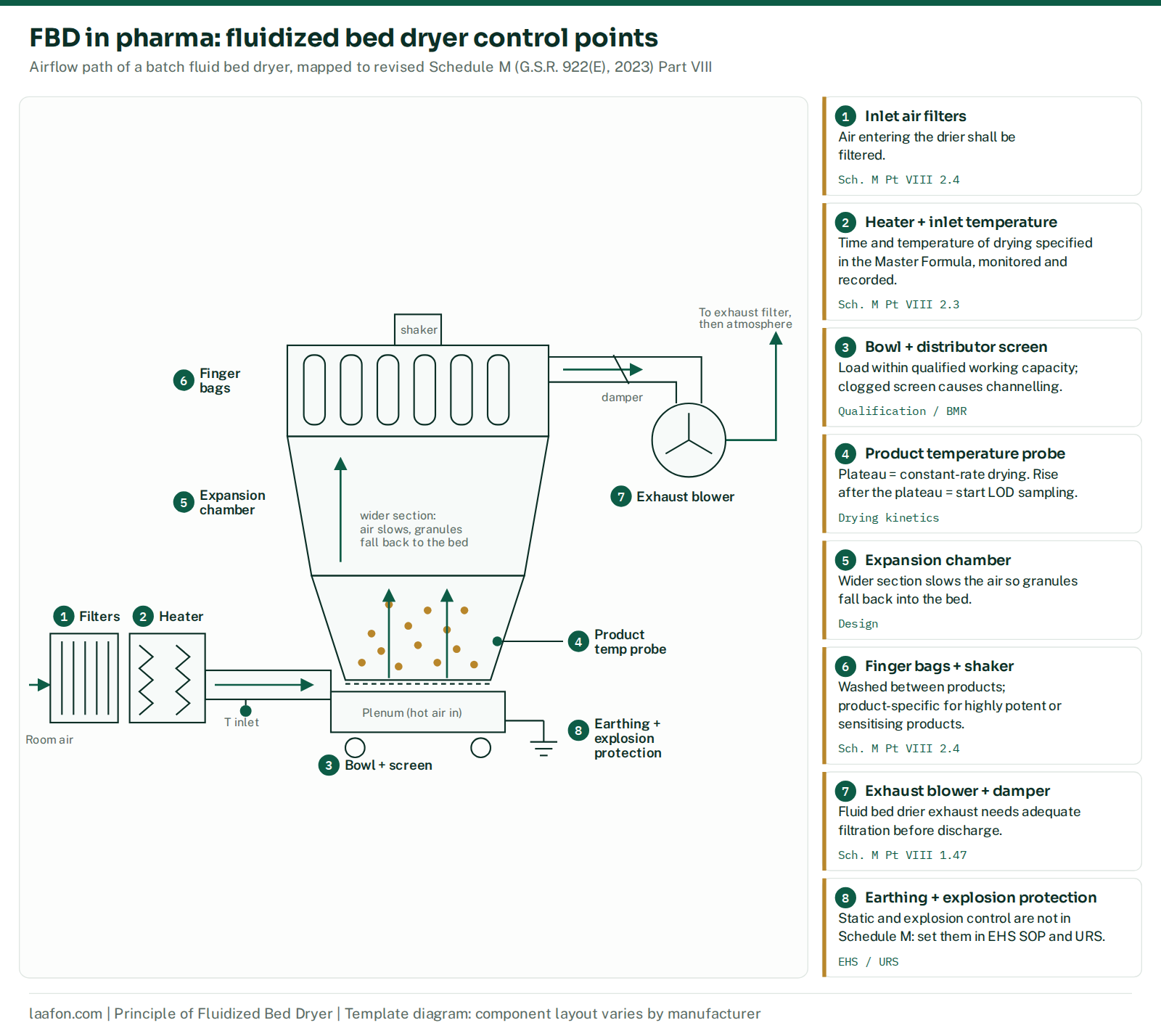
Tap a numbered part of the drawing, or a button below it, to see what the part does, what to check before a batch and how it usually fails. Air flows left to right into the plenum, up through the bowl, through the finger bags and out through the exhaust blower.
Swipe the drawing sideways to see the exhaust side, or use the buttons below.
1. Inlet air filters
- Function
- Clean the room or fresh air before it is heated and blown through the product. Schedule M requires that air entering the drier is filtered.[5]
- Check before the batch
- Filter differential pressure within the range in the equipment manual; filter change record current. The filtration grade itself is an HVAC/URS decision, not a compendial number.
- Typical failure
- A loaded filter starves the bed of air, so the batch fluidizes poorly and drying runs long; the operator raises the damper and the problem moves to the finger bags.
2. Heater and inlet air temperature sensor
- Function
- Steam or electric coils raise the air to the inlet temperature set in the Master Formula. Schedule M requires time and temperature for each drying operation to be specified in the Master Formula, monitored and recorded.[5]
- Check before the batch
- Calibration label on the inlet temperature indicator/controller is in date; set point matches the BMR.
- Typical failure
- Controller overshoot at start-up, or a sensor that drifted since calibration. Either one means the product sees a temperature nobody recorded.
3. Product container (bowl) and distributor screen
- Function
- Holds the wet granules on a perforated bottom that spreads the hot air evenly across the bed. The container is on a trolley and seals to the dryer body with an inflatable gasket.
- Check before the batch
- Screen intact and unclogged; gasket inflates and holds; load does not exceed the working capacity recorded in qualification.
- Typical failure
- A clogged or torn screen causes channelling (air escaping in jets through part of the bed while the rest stays static) and fines falling into the plenum.
4. Product (bed) temperature probe
- Function
- Measures the bed itself. Its plateau marks the constant-rate period and its rise marks the start of falling-rate drying.[3]
- Check before the batch
- Calibration in date; probe tip clean and positioned inside the fluidized zone, not in a dead corner.
- Typical failure
- A coated or badly positioned probe reads air, not product, and the endpoint signal disappears.
5. Expansion chamber
- Function
- The body widens above the bowl. The same volume of air moving through a larger cross-section travels slower, so most granules lifted by bubbles fall back into the bed instead of reaching the bags.
- Check before the batch
- Sight glass clean so fluidization can be observed; no residue from the previous batch on the walls.
- Typical failure
- Wet material sticking to the walls, which later falls back as over-dried or under-dried lumps.
6. Finger bags and shaking mechanism
- Function
- The finger bags are the exhaust filter: they retain fines carried up by the air, and the shaker knocks them back into the bed. Their finger shape gives more filtration area. They do not increase the drying surface of the product, which is what the old version of this page claimed.
- Check before the batch
- Bag ID matches the product; bags were washed if last used for a different product, and are product-specific for highly potent or sensitising products (Schedule M Part VIII 2.4).[5] No tears or loose stitching; earthing connection intact.
- Typical failure
- Blinding by fine or damp material: filter differential pressure rises, airflow falls and the bed stops fluidizing. A torn bag sends product into the exhaust.
7. Exhaust blower, damper and exhaust filtration
- Function
- The blower pulls air through the whole system and the damper sets the airflow. Schedule M requires fluid bed drier exhaust to have adequate filtration so the ambient air is not contaminated.[5]
- Check before the batch
- Damper moves freely; start position is the low opening in the BMR; exhaust filter status recorded.
- Typical failure
- Starting at full damper blows fines into the bags in the first minute. Exhaust and inlet points placed too close together can recirculate dust, which Schedule M 2.4 specifically warns against.[5]
8. Earthing and explosion protection
- Function
- Earthing and bonding give static charge a controlled path to ground so it cannot discharge as a spark.[12] Many FBDs are also built with explosion relief, suppression or pressure-shock-resistant construction; which one is a design decision recorded in the equipment’s documentation.
- Check before the batch
- Earthing cable clamped; bag-to-housing earthing connectors fitted; continuity check done at the interval in the site’s electrical-safety SOP.
- Typical failure
- An earthing strap left off after bag change, and a non-antistatic replacement bag bought on price. None of this is covered by Schedule M (see the safety section below).
Schedule M Part VIII clauses that govern the FBD
The revised Schedule M (G.S.R. 922(E), 28 December 2023) puts oral solid dosage requirements in Part VIII. Three of its clauses reach the dryer directly, and a fourth, in Part XIII, settles whether an FBD is required at all.[5] Section numbers below are as printed in the gazette text.
| Clause | What it requires | Where it lands in the SOP |
|---|---|---|
| Part VIII 1.47 | Exhaust air discharge points on equipment “such as from fluid bed driers” carry heavy dust loads and shall be provided with adequate filtration to prevent contamination of the ambient air. | Step 5.5; acceptance row “Exhaust air” |
| Part VIII 2.3 | Critical operating parameters such as time and temperature for each drying operation shall be specified in the Master Formula, monitored during processing and recorded in the batch records. | Steps 5.10 and 5.13; Annexure-I |
| Part VIII 2.4 | Filter bags shall not be used for different products without being washed in between; product-specific bags for certain highly potent or sensitising products; air entering the drier shall be filtered; prevent dust contamination from inlets and exhausts placed too close together. | Steps 5.3 and 5.5; acceptance rows “Finger bags” and “Inlet air” |
| Part XIII 3.1(a)(5) | For compressed tablets, lists as recommended equipment a “thermostatically controlled hot air oven with trays (preferably mounted on a trolley) or Fluid bed dryer”. | The FBD is one of two recommended options, not a mandate |
What Schedule M does not say. A search of the full 124-page gazette text finds no LOD or moisture limit for dried granules, and no occurrence of “electrostatic”, “earthing”, “earthed”, “grounding” or “bonding”. The word “explosion” appears once, and that is about storing materials that present a fire or explosion risk. The LOD limit comes from your registered product specification, and static and explosion control comes from process-safety practice, not from GMP text. If your SOP cites Schedule M for either, the citation is wrong. The CDSCO Schedule M compliance dashboard maps the rest of Part VIII.
SOP for operation of fluid bed dryer (drying of wet granules)
A working template, structured the way an auditor reads it. Adapt the header, the parameter references and the sampling plan to your own equipment and product before use.
Operation of Fluid Bed Dryer (FBD) for Drying of Wet Granules
1.0 Purpose
To lay down the procedure for operating the fluid bed dryer so that wet granules are dried to the loss-on-drying limit stated in the batch manufacturing record (BMR), with the critical parameters monitored and recorded.
2.0 Scope
Applies to the fluid bed dryer in the granulation section of the oral solid dosage block, for granules wetted with aqueous granulating fluid. Excluded: granulation or coating in a fluid bed processor; drying of granules wetted with flammable organic solvents, which needs equipment rated for flammable atmospheres and its own SOP; cleaning of the dryer (covered by the SOP for cleaning of fluidized bed dryer); and equipment qualification.
3.0 Responsibility
- Operator: pre-start checks, operation and recording in the BMR and the drying log.
- Production Officer / Executive: verification of set parameters, supervision, raising deviations.
- IPQA: line clearance, in-process LOD verification, sampling oversight.
- Head, Production: implementation and training.
- Head, Quality Assurance: approval of this SOP and of any deviation.
4.0 Equipment and materials
- Fluid bed dryer with product container, finger bag set (identified by number), calibrated inlet, product and exhaust temperature indicators and differential pressure gauges.
- Calibrated moisture analyser or LOD oven and analytical balance, as named in the BMR.
- Stainless steel scoop, sampling thief, labelled sample containers, lined product containers.
- Earthing cable and clamp; PPE (dust mask, gloves, ear protection, heat-resistant gloves for the container).
- Status labels, BMR, Annexure-I drying log.
5.0 Procedure
A. Pre-start checks
B. Loading
C. Drying
D. Endpoint
E. Unloading and closure
6.0 Acceptance criteria
| Parameter | Criterion | Basis |
|---|---|---|
| LOD of dried granules | Within the BMR limit for the product | product specification The limit is set per product; no pharmacopoeia or Schedule M clause gives one for granules |
| LOD test conditions | As prescribed in the method; where a single temperature is given, ± 2 °C | compendial Ph. Eur. 2.2.32[8] |
| Inlet air temperature, airflow, drying time | Within Master Formula ranges; monitored and recorded | regulatory Schedule M Part VIII 2.3[5] |
| Finger bags | Washed before use for a different product; product-specific for highly potent or sensitising products | regulatory Schedule M Part VIII 2.4[5] |
| Inlet air | Filtered | regulatory Schedule M Part VIII 2.4[5] |
| Exhaust air | Adequate filtration before discharge | regulatory Schedule M Part VIII 1.47[5] |
| Filter bag differential pressure | Within the equipment manufacturer’s operating range | manufacturer equipment manual |
| Earthing continuity | Resistance to earth within the site electrical-safety standard | check source No GMP limit exists. UK HSE guidance quotes resistance values from older British Standards;[12] confirm against the current edition your EHS team works to |
| Sampling locations and number | As stated in the BMR | site policy justified during process validation |
Swipe the table sideways on a phone. “Site policy” and “product specification” rows are not pharmacopoeial requirements.
7.0 Frequency
- Every batch: steps 5.1 to 5.24.
- Finger bag inspection: before every batch. Bag washing: at every product change (Schedule M Part VIII 2.4); between batches of the same product as per site policy.
- Calibration of temperature indicators and differential pressure gauges: per the site calibration schedule. No pharmacopoeia sets a calibration interval for an FBD, so the interval is a site decision and should be justified from drift history.
8.0 Precautions and safety
- Never run the dryer without the earthing clamp connected and the bag earthing connectors fitted.
- Never load granules wetted with flammable solvent into an FBD that is not designed and certified for it.
- Do not open the container or the filter housing while the blower is running.
- Do not bypass interlocks, the shaking cycle or the explosion-protection devices.
- Audit findings, not injuries, to avoid: parameters set but not recorded; bag IDs not logged; bags moved between products without a washing record; LOD tested by an analyser with no correlation to the reference method.
9.0 Deviation handling
| Observation | Probable cause | Immediate action |
|---|---|---|
| Bed does not fluidize, or channels | Overload; wet lumpy mass; clogged screen; low airflow | Stop; rake per 5.14; check load against capacity and the screen; raise a deviation if it recurs |
| Filter differential pressure rising steeply | Bag blinding; shaker fault; material still too wet | Check shaking cycle; stop and inspect bags; replace or wash |
| Dust at exhaust or around the gasket | Torn bag; gasket leak | Stop; inspect; raise deviation; assess yield loss and cross-contamination risk |
| LOD not reached within BMR time | Humid inlet air; low inlet temperature; overload | Check AHU and set points; extend only as the BMR provides; raise deviation |
| LOD below lower limit | Drying overrun | Stop; raise deviation; QA impact assessment on compression and dissolution |
| Product temperature above BMR maximum | Controller or sensor fault | Switch off heater; raise deviation; check calibration |
| Spark, smouldering or burning smell | Electrostatic discharge; hot spot; foreign material | Emergency stop per EHS SOP; do not open the dryer; evacuate and inform EHS and QA |
10.0 Annexures
Annexure-I: FBD drying log
| Time | Inlet air temp (°C) | Product temp (°C) | Exhaust temp (°C) | Filter ΔP | Damper / airflow | Bag shaking OK | LOD (% w/w) | Done by | Checked by |
|---|---|---|---|---|---|---|---|---|---|
Annexure-II: Labelled equipment diagram with Schedule M control points
Annexure-III: Finger bag usage and washing log
Columns: bag set ID, product, batch number, date used, washed on, washed by, inspection result, checked by. Keep it with the equipment log so a bag’s product history can be traced at inspection.
11.0 Revision history
| Version | Effective date | Change | Reason |
|---|---|---|---|
| 00 | DD-MMM-YYYY | New SOP | — |
| 01 | DD-MMM-YYYY | Aligned to revised Schedule M Part VIII 1.47, 2.3 and 2.4; endpoint tied to product-temperature trend and BMR LOD limit | Regulatory update |
Use of this template: this SOP is a template for adaptation. It requires local qualification of the equipment, process validation of the drying parameters and Quality Assurance approval before use. Every acceptance criterion must be checked against the current edition of the pharmacopoeia and the product’s registered specification. Pharmacopoeial texts and Indian statutory instruments change between editions.
Setting the LOD endpoint: method, sampling and why there is no universal number
Loss on drying is the loss of mass expressed as per cent m/m. Ph. Eur. 2.2.32 allows five procedures: over diphosphorus pentoxide at atmospheric pressure; in vacuo at 1.5 to 2.5 kPa; in vacuo within a prescribed temperature range; in an oven within a prescribed temperature range; and under high vacuum not exceeding 0.1 kPa. The sample is dried to constant mass or for the prescribed time, and where a single temperature is given the tolerance is ± 2 °C.[8] The oven procedure is what most granulation BMRs call up, and the conditions, the sample mass and the limit itself come from the product’s own specification.
LOD measures everything that leaves on heating, not only water. Where the specification is actually about water content, Karl Fischer titration is the specific method, and the two numbers should not be compared as if they were the same test.
Published endpoints show how product-specific the figure is. A commercial hydroxychloroquine sulfate process monitored by in-line NIR reached its drying endpoint typically between 1.5 % and 2.5 % moisture;[9] a Rutgers study of fluid bed drying stopped its batches when moisture fell below 1 %.[3] Neither is a limit you can borrow. Granules dried too far can compress poorly, and granules left too wet can stick and pick, which is why the limit is set during development and confirmed in process validation. The tablet compression guide covers what the press does with granules outside that window.
In-process moisture analysers (halogen or IR) are faster than an oven, but they are only as good as their correlation to the reference method. Near-infrared monitoring of moisture in fluid bed granulation and drying has been studied since at least 2005,[10] and the 2025 commercial-scale work cited above suggests outlet-air humidity and temperature can predict moisture well enough to support an endpoint.[4] Any such approach still has to be validated on your product before it replaces sampling.
Tray dryer or FBD: what Schedule M and SUPAC say
Schedule M lists the tray dryer and the FBD as alternatives. The US FDA’s SUPAC Manufacturing Equipment Addendum sorts dryers into classes “based upon the method of heat transfer and the dynamics of the solids bed”, with class meaning operating principle and subclass meaning design characteristic.[6] The two dryers fall into different classes, and that has a filing consequence in the US.
| Point | Hot air oven with trays | Fluid bed dryer |
|---|---|---|
| Schedule M Part XIII 3.1(a)(5)[5] | Listed as recommended | Listed as the alternative |
| SUPAC class[6] | Direct heating, static solids bed (subclass: tray and truck) | Direct heating, fluidized solids bed (no subclasses identified) |
| Bed during drying | Static layer on trays | Suspended and mixing in the air stream |
| Where moisture gradients form | Through the depth of each tray and between tray positions | Between dead zones and the fluidized bulk, if the bed channels |
| Endpoint evidence | Samples from defined tray positions | Product-temperature trend plus samples from the bed |
| Filter bags | None | Yes; Schedule M Part VIII 2.4 applies |
| Switching from one to the other (US) | Different class, so a different operating principle. Under SUPAC-IR a change to equipment of a different design and operating principle is a Level 2 change, filed as a prior approval supplement with justification.[7] | |
SUPAC is US FDA guidance for approved NDAs and ANDAs. For products registered in India or other markets, check the post-approval change rules of the authority that approved the product before changing dryers.
Why FBDs catch fire, and what Schedule M does not say
An FBD combines the three things a dust explosion needs: a fine combustible powder, a dispersed dust cloud, and a source of ignition in fast-moving, rubbing particles. An industry risk-management paper on explosive dusts in pharmaceutical plants lists fluid-bed drying with milling, sieving and pneumatic transfer as processes carrying a higher risk of mechanical sparks, powder dispersion and high-energy particle movement.[11] Electrostatic charge builds up as dry granules rub against each other, the bags and the container walls, and it discharges as a spark if it has no earth path. UK HSE guidance describes equipment earthing as the controlled way to prevent that build-up.[12]
Correction to the old version of this page. It said that blocked outlet filters raise the internal pressure and “can lead to fire”. Blocked bags raise the filter differential pressure and cut the airflow. That makes fluidization and drying worse, but it is not itself an ignition source. The fire risk comes from static discharge or a hot spot inside a dust cloud, and it is controlled by earthing, antistatic bags, correct solvent handling and the explosion protection built into the dryer.
None of this is in Schedule M. As noted above, the revised text contains no requirement on electrostatic charge, earthing or bonding, so these controls belong in your EHS procedures and the equipment’s user requirement specification. They are also where Indian plants most often cut costs, by buying non-antistatic replacement bags or leaving an earthing strap off after a bag change.
Need the tablets made without your own granulation block?
Equipping and qualifying a granulation section (RMG, FBD, sifter, blender and the HVAC around them) is one of the larger costs in a new oral solid dosage plant. If your immediate need is to get a product manufactured, Laafon Galaxy’s loan licence consulting covers the route (Form 25A / 28A) for having it made at an existing licensed manufacturer’s facility.
FAQs on the fluid bed dryer
Heated, filtered air is blown up through a perforated screen under the bed of wet granules. Once the air velocity is high enough that its drag equals the weight of the bed, the granules lift and behave like a fluid, so every granule is surrounded by moving hot air and dries quickly and evenly. Drying ends when the loss on drying reaches the limit in the batch record.
There is no universal figure. The LOD limit is part of each product’s specification, set during development and confirmed in process validation. Neither the pharmacopoeia nor Schedule M gives a general limit for granules. Published examples vary from below 1 % to 1.5 to 2.5 % depending on the product, so a limit copied from another product is not justified.
While surface water is evaporating, the heat supplied is used for evaporation and the bed stays on a temperature plateau. Once the surface water is gone, moisture has to diffuse out of the granule, less heat goes into evaporation and the bed temperature climbs. That rise is the cue to start LOD sampling.
Only after washing. Revised Schedule M Part VIII 2.4 says filter bags fitted to a fluid bed drier shall not be used for different products without being washed in between, and that certain highly potent or sensitising products need bags specific to that one product. Keep a bag usage and washing log so each set’s history can be traced.
No. Part XIII 3.1(a)(5) lists a thermostatically controlled hot air oven with trays, preferably on a trolley, or a fluid bed dryer as recommended equipment for the granulation and drying section. Either can be used, provided the drying parameters are specified, monitored and recorded as Part VIII 2.3 requires.
For a US-approved product, yes. The FDA’s SUPAC equipment addendum puts tray dryers and fluid bed dryers in different classes, and SUPAC-IR treats a change to a different design and operating principle as a Level 2 change needing a prior approval supplement. For other markets, check the post-approval change rules of the authority that approved the product.
A fluid bed dryer only removes liquid from granules that were made elsewhere, usually in a rapid mixer granulator. A fluid bed processor adds a spray system, so it can granulate or coat inside the same fluidized bed before drying. The laafon.com comparison of FBD, FBP and RMG covers the choice in detail.
Dry, fine granules moving at speed build up electrostatic charge. If the dryer or the bags are not properly earthed, that charge can discharge as a spark inside a dust cloud. Earthing and bonding, antistatic bags, keeping solvent-wet granules out of dryers not designed for them, and the dryer’s explosion protection are the controls. Schedule M does not cover them, so they belong in the site’s EHS procedures.
Related on laafon.com
References
- Elsevier ScienceDirect Topics. Minimum fluidization velocity [excerpts including Holland FA, Bragg R. Fluid Flow for Chemical Engineers. 2nd ed. 1995]. Available from: https://www.sciencedirect.com/topics/engineering/minimum-fluidization-velocity. Accessed September 2026.
- Geldart D. Types of gas fluidization. Powder Technol. 1973;7(5):285-92. Available from: https://doi.org/10.1016/0032-5910(73)80037-3. Accessed September 2026.
- Chen H. Fluidized bed drying of pharmaceutical materials: batch and continuous manufacturing [dissertation]. New Brunswick (NJ): Rutgers, The State University of New Jersey; 2019. Available from: https://rucore.libraries.rutgers.edu/rutgers-lib/60621/. Accessed September 2026.
- Chinwattanawongwan P, Sutanthavibul N, Kittithreerapronchai O. Granule moisture content prediction during fluid bed drying. AAPS PharmSciTech. 2025;26(7):213. Available from: https://doi.org/10.1208/s12249-025-03207-3. Accessed September 2026.
- Ministry of Health and Family Welfare, Government of India. Drugs (Amendment) Rules, 2023: Schedule M, Good manufacturing practices and requirements of premises, plant and equipment for pharmaceutical products. G.S.R. 922(E), 28 December 2023. The Gazette of India: Extraordinary, Part II, Section 3(i). Reprint consulted: https://pharmadocx.com/wp-content/uploads/2024/01/Notified-Schedule-M-dt-28.12.2023-1.pdf. Accessed September 2026.
- US Food and Drug Administration. SUPAC: Manufacturing Equipment Addendum. Guidance for industry. Silver Spring (MD): FDA; December 2014. Available from: https://www.fda.gov/files/drugs/published/SUPAC–Manufacturing-Equipment-Addendum.pdf. Accessed September 2026.
- US Food and Drug Administration. Immediate release solid oral dosage forms. Scale-up and postapproval changes: chemistry, manufacturing, and controls, in vitro dissolution testing, and in vivo bioequivalence documentation (SUPAC-IR). Guidance for industry. Rockville (MD): FDA; November 1995. Available from: https://www.fda.gov/media/70949/download. Accessed September 2026.
- European Pharmacopoeia 7.0. 2.2.32 Loss on drying (01/2008:20232). Strasbourg: EDQM, Council of Europe; 2010. Historical edition reprint consulted: https://www.drugfuture.com/Pharmacopoeia/EP7/DATA/20232E.PDF. Accessed September 2026.
- Li C, Zhu W. Quantitative analysis of granules moisture content within a fluidized bed drying process using simultaneously near-infrared and Raman spectroscopy combined with multivariate models. Int J Pharm. 2026;690:126575. Available from: https://doi.org/10.1016/j.ijpharm.2026.126575. Accessed September 2026.
- Findlay WP, Peck GR, Morris KR. Determination of fluidized bed granulation end point using near-infrared spectroscopy and phenomenological analysis. J Pharm Sci. 2005;94(3):604-12. Available from: https://doi.org/10.1002/jps.20276. Accessed September 2026.
- Dinyer J, Turnbull M, Neale S. Risk management of the explosive dusts in the pharmaceutical industry: a practical approach. Pharm Technol. 2005 Aug;2005 Suppl(5). Available from: https://www.pharmtech.com/view/risk-management-explosive-dusts-pharmaceutical-industry-practical-approach. Accessed September 2026.
- Health and Safety Executive (UK). Earthing: COMAH safety report assessment, technical measures. Available from: https://www.hse.gov.uk/comah/sragtech/techmeasearthing.htm. Accessed September 2026.
Written by Darshan Singh, pharmaceutical QA, QC and regulatory professional (23+ years). Technical and educational content only, not legal, medical or investment advice. The SOP above is a template requiring local qualification, validation and QA approval before use. Pharmacopoeial texts, Schedule M and other Indian statutory instruments change between editions; verify against the version in force at your site.