
Short answer · verified 25 Nov 2026
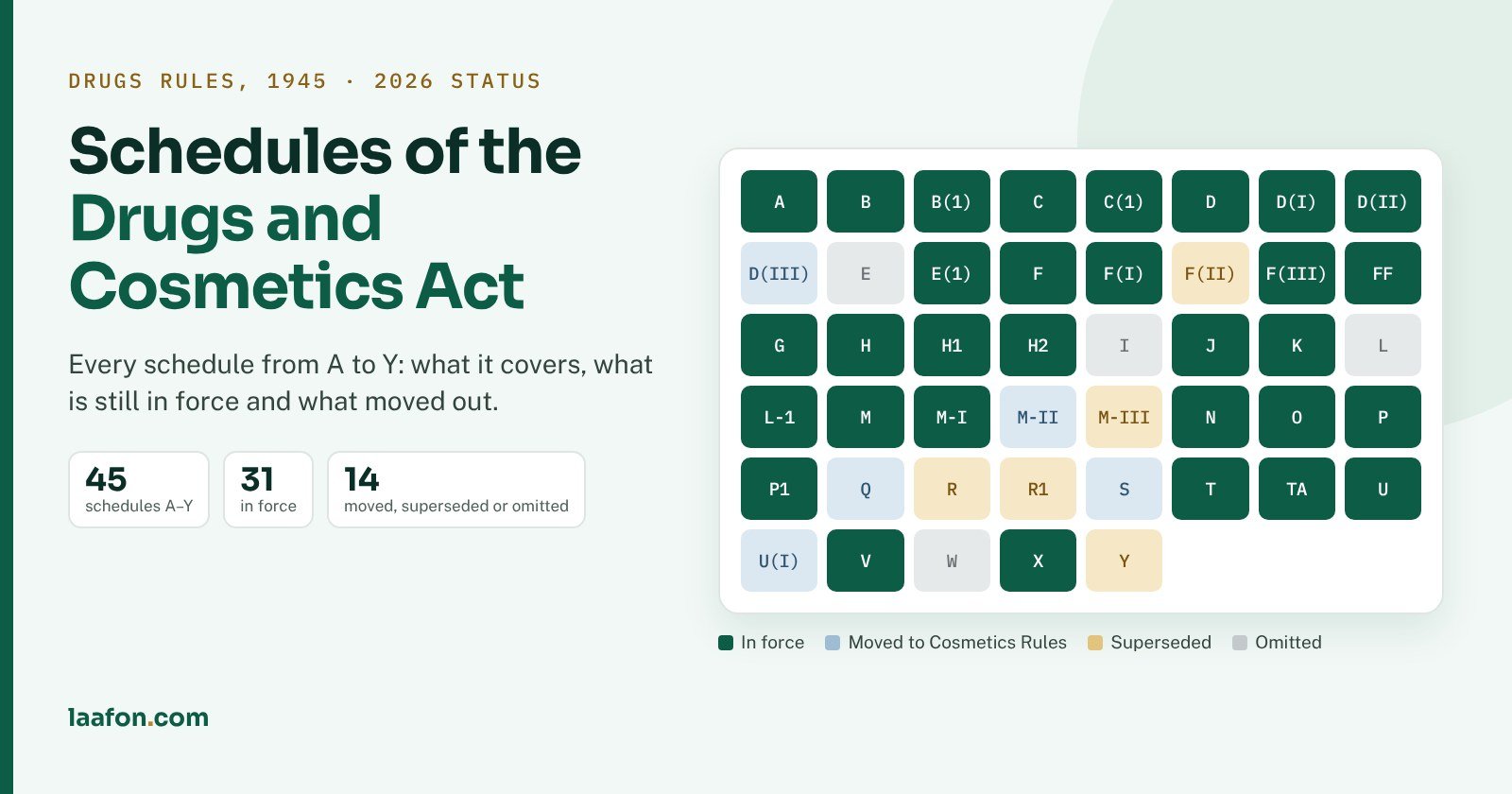
Schedules of Drugs and Cosmetics Act, in short: most sit in the Drugs Rules, 1945, which carry 45 lettered headings from A to Y. As of 25 November 2026, 31 are in force, 5 moved to the Cosmetics Rules 2020, 5 are superseded by newer rules (Schedule Y and device-related schedules) and 4 were omitted.[1][2]
For sale and labelling, five matter most: G (caution label), H (prescription), H1 (prescription plus register), X (narcotic and psychotropic) and H2 (QR code). For manufacturing, Schedule M has been binding on every unit since 1 January 2026.[3]
Reviewed by Darshan Singh, 23+ years in pharmaceutical QA, QC and regulatory affairs.
Schedules of Drugs and Cosmetics Act: the A-to-Y finder
Every lettered schedule of the Drugs Rules, 1945, with its current status and the rule that brings it into play. Filter by status or by the area of your business, type a schedule code such as “H1” or “M-I” to jump straight to it, or search a word such as “GMP” or “label”.
Showing all 45 schedules.
| Schedule | What it covers | Status | Rule and latest position | Our guide |
|---|---|---|---|---|
| A | Forms for applications, licences and certificates (sale, manufacture, loan licence, import, test licences) | In force | Includes the loan-licence forms 25A and 28A: see loan licence facilitation.[1] | – |
| B | Fees for test or analysis by the Central or State Drugs Laboratories | In force | Rules 7 and 48. Testing fees revised by G.S.R. 407(E), 22 May 2026.[1][4] | – |
| B(1) | Fees for test or analysis by the Pharmacopoeial Laboratory for Indian Medicine or a Government Analyst | In force | Rule 163F; Ayurvedic, Siddha and Unani samples. Fees revised with Schedule B in 2026.[1][4] | – |
| C | Biological and special products (sera, vaccines, antigens, insulin and similar) | In force | Rules 23, 61, 76 and Part X. Drives the separate C and C(1) licence forms.[1] | – |
| C(1) | Other special products | In force | Rules 23, 61 and 76.[1] | – |
| D | Classes of drugs exempted from the import provisions, with conditions | In force | Rule 43.[1] | – |
| D(I) | Information and undertaking with an application for an import Registration Certificate | In force | Rules 21(d) and 24A; inserted 2001.[1] | – |
| D(II) | Information for registration of an imported bulk drug, formulation or special product | In force | Rules 21(d) and 24A.[1] | – |
| D(III) | Information and undertaking for cosmetics imports | Moved to Cosmetics Rules | Omitted by the Cosmetics Rules, 2020 (import undertaking now in their Sixth Schedule).[2] | – |
| E | Former schedule of poisonous substances | Omitted | Omitted by G.S.R. 462(E), 22 June 1982, the notification that also substituted Schedule G and inserted Schedule X. E(1) is a separate schedule for Ayurvedic, Siddha and Unani poisons.[1] | – |
| E(1) | Poisonous substances under the Ayurvedic (including Siddha) and Unani systems | In force | Rule 161(2): internal-use medicines containing them carry “Caution: to be taken under medical supervision”.[1][5] | – |
| F | Blood centres (Part XII-B) and blood products (Part XII-C) | In force | Parts I to XII-A omitted in 1992. “Blood bank” became “blood centre” by G.S.R. 166(E), 2020.[1][6] | – |
| F(I) | Standards for vaccines, antisera and diagnostic antigens | In force | Parts I to III.[1] | – |
| F(II) | Standards for surgical dressings | Superseded for devices | Rule 124-C. Surgical dressings are named in rule 2 of the Medical Devices Rules, 2017, which override the 1945 Rules for them.[1][7] | – |
| F(III) | Standards for umbilical tapes | In force | Rule 124-D. Umbilical tapes are not named in rule 2 of the Medical Devices Rules, 2017; check whether a device notification now covers your product.[1][7] | – |
| FF | Standards for ophthalmic preparations | In force | Rule 126-A.[1] | – |
| G | Drugs to be taken under medical supervision (a labelling schedule) | In force | Rule 97(1)(a): “Schedule G Prescription Drug – Caution” box. Not listed in Rule 65(9)(a), so G alone does not make a drug prescription-only.[5] | Schedule G guide |
| H | Prescription drugs | In force | Rule 65(9)(a): retail sale only on prescription. Rule 97: Rx symbol and caution box.[1][5] | Schedule H list |
| H1 | Antibiotics, anti-TB and habit-forming drugs under extra sale controls | In force | Inserted 2013 (G.S.R. 588(E)). Prescription plus a separate register kept three years (Rule 65(3)). Pregabalin added by G.S.R. 377(E), in force from about 16 Nov 2026.[1][5][8] | Schedule H1 list |
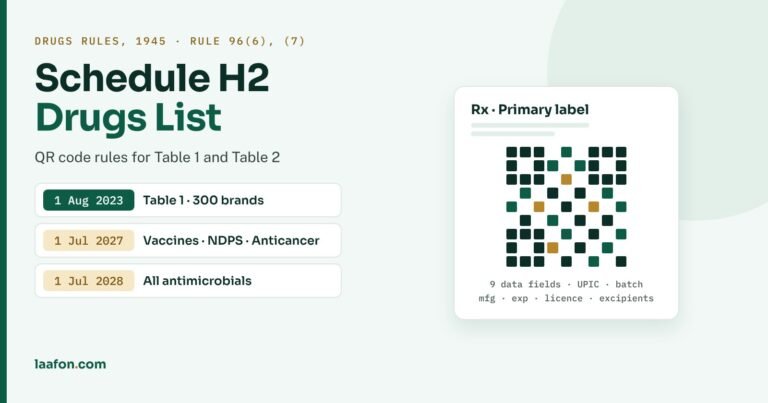
| H2 | QR code or barcode on the label of specified formulations | In force | Table 1: 300 brands from 1 Aug 2023. Table 2: all vaccines, NDPS and anticancer drugs from 1 Jul 2027, antimicrobials from 1 Jul 2028. Separate from the API QR-code rule (G.S.R. 20(E), 2022).[9][10][11] | – |
| I | Former schedule I | Omitted | Omitted by G.S.R. 462(E), 22 June 1982.[1] | – |
| J | Diseases and ailments a drug may not claim to prevent or cure | In force | Rule 106. Advertising claims are also restricted by the Drugs and Magic Remedies (Objectionable Advertisements) Act, 1954.[1][5] | – |
| K | Drugs exempted from certain provisions of the Rules, on conditions | In force | Rule 123. Serial 13 lets a Form 20-A licensee sell listed household remedies in villages of up to 1,000 people; G.S.R. 477(E), 9 Jun 2026, removed “Syrups” from its cough-remedy item (7).[1][12] | – |
| L | Former schedule L | Omitted | Omitted by G.S.R. 462(E), 22 June 1982.[1] | – |
| L-1 | Good laboratory practices and requirements of premises and equipment (QC laboratories) | In force | Rules 74, 78 and 150E; inserted by G.S.R. 780(E), 2008.[1] | – |
| M | GMP and requirements of premises, plant and equipment for pharmaceutical products | In force | Revised by G.S.R. 922(E), 28 Dec 2023; binding on all units from 1 Jan 2026, inspections under way.[3][13] | Schedule M dashboard |
| M-I | GMP and requirements of premises, plant and equipment for homoeopathic medicines | In force | Rule 85E(2); substituted 2006.[1] | – |
| M-II | Factory premises for manufacture of cosmetics | Moved to Cosmetics Rules | Omitted by the Cosmetics Rules, 2020 (premises now in their Seventh Schedule).[2] | – |
| M-III | Quality management system for notified medical devices and IVDs | Superseded | Devices now regulated under the Medical Devices Rules, 2017, which override the 1945 Rules for them.[1][7] | – |
| N | Minimum equipment for the efficient running of a pharmacy | In force | Rule 64(1).[1] | – |
| O | Standards for disinfectant fluids | In force | Parts I and II.[1] | – |
| P | Life period (shelf life) of drugs | In force | Rule 96(1)(vii): drugs not in P carry an expiry no later than 60 months from manufacture.[1][5] | – |
| P1 | Pack sizes of drugs | In force | Heading cites Rule 109; pack sizes also tie to Rule 105. Inserted 1992.[1][14] | – |
| Q | Dyes, colours and pigments permitted in cosmetics and soaps | Moved to Cosmetics Rules | Omitted by the Cosmetics Rules, 2020 (now their Tenth Schedule).[2] | – |
| R | Standards for condoms and other mechanical contraceptives | Superseded | Mechanical contraceptives fall under the Medical Devices Rules, 2017.[1][7] | – |
| R1 | Medical devices to conform to BIS or other standards | Superseded | Superseded in practice by the Medical Devices Rules, 2017.[1][7] | – |
| S | Standards for cosmetics | Moved to Cosmetics Rules | Omitted by the Cosmetics Rules, 2020 (now their Ninth Schedule).[2] | – |
| T | GMP for Ayurvedic, Siddha and Unani medicines | In force | Rule 157; substituted 2003.[1][5] | – |
| TA | Record of raw-material utilisation by Ayurveda, Siddha and Unani manufacturers | In force | Rule 157A; inserted 2008.[1] | – |
| U | Particulars to be shown in manufacturing records | In force | Rules 74, 74A, 74B, 78 and 78A.[1] | – |
| U(I) | Particulars in cosmetics manufacturing records | Moved to Cosmetics Rules | Omitted by the Cosmetics Rules, 2020 (now their Eighth Schedule).[2] | – |
| V | Standards for patent or proprietary medicines | In force | Rule 124B; includes the vitamin and mineral table. Folic acid unit amended by G.S.R. 444(E), 1 Jun 2026.[1][4] | – |
| W | Former schedule W | Omitted | Omitted by G.S.R. 94(E) in 2000.[1] | – |
| X | Narcotic and psychotropic drugs under the tightest sale controls | In force | Separate licence; prescription in duplicate, one copy kept two years (Rule 65(9)(a)); XRx label in red (Rule 97).[1][5] | Schedule X list |
| Y | Requirements for new drugs and clinical trials | Superseded for human use | Not applicable to new drugs for human use since the NDCT Rules, 2019; still governs veterinary new drugs.[15][16] | – |
No schedule matches. Clear the search or choose “All”.
Schedules of the Act itself. The Drugs and Cosmetics Act, 1940 has two: the First Schedule lists the authoritative Ayurvedic, Siddha and Unani books (section 3(a)), and the Second Schedule sets the standards a drug must meet to be of “standard quality” (sections 8 and 16).[17]
Schedule G vs H vs H1 vs X vs H2: the sale and label schedules
These five are the schedules a pharmacist, distributor or packaging team meets every day. Four of them (G, H, H1 and X) have detailed guides on Laafon; Schedule H2 does not have one yet.
| Schedule | What it controls | Retail prescription | Label marking (Rule 97) | Records |
|---|---|---|---|---|
| G | Medical-supervision caution | Not required by Rule 65(9)(a) alone | “Schedule G Prescription Drug – Caution” and “It is dangerous to take this preparation except under medical supervision”, in a red box (97(1)(a)) | No schedule-specific register |
| H | Prescription-only sale | Yes, Rule 65(9)(a) | Rx at top left, “Schedule H Prescription Drug – Caution”, red box (97(1)(b)); NRx in red if also under the NDPS Act (97(1)(c)) | Prescription register entry at the time of supply, Rule 65(3)(1), kept at least two years, Rule 65(7); signed orders from practitioners and hospitals kept two years, Rule 65(9)(b) |
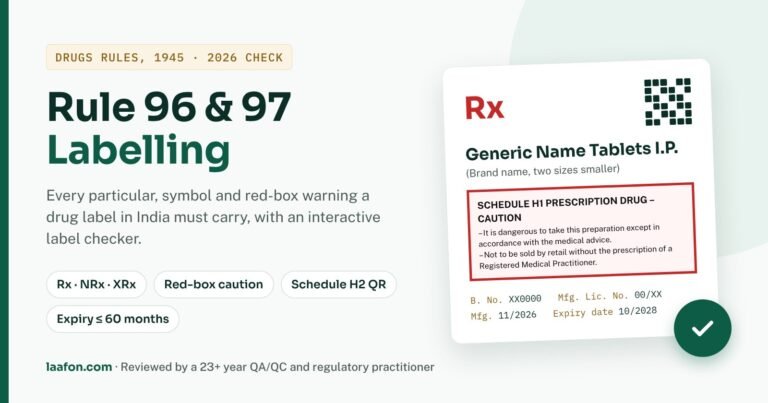
| H1 | Antibiotics, anti-TB and habit-forming drugs | Yes, Rule 65(9)(a) | Rx in red at top left, “Schedule H1 Prescription Drug – Caution” with two warnings, red box (97(1)(e)); NRx in red if also under the NDPS Act (97(1)(f)) | Prescription register plus a separate H1 register at the time of supply, kept three years, Rule 65(3) |
| X | Narcotic and psychotropic drugs | Yes, prescription in duplicate | XRx in red at top left, “Schedule X Prescription Drug – Warning”, red box (97(1)(d)) | Duplicate kept two years, Rule 65(9)(a); supply register under Rule 65(21) |
| H2 | Traceability, not sale | No change to sale status | QR code or barcode on the primary (or secondary) label | Product identification data behind the code |
Sources: Rules 65 and 97 of the Drugs Rules, 1945[5]; Schedule H2 as amended in 2022 and 2026[9][10]. In every case the label words are printed in black inside a completely red rectangular box.
Which drug schedules apply to your business?
Retail and wholesale sale licences are issued on forms in Schedule A. Day to day, five schedules decide what you may sell and what you must record.
- H, H1 and X: prescription-only sale under Rule 65(9)(a); H1 needs a separate register kept three years; X needs a separate licence and a duplicate prescription kept two years[5].
- G: check the red caution box on the strip; it does not by itself require a prescription.
- K: exemptions for listed classes. Serial 13 lets Form 20-A licensees in villages of up to 1,000 people sell listed household remedies; cough syrups were taken out of it in June 2026[1][12].
- N: minimum equipment for a pharmacy; P: expiry limits printed under Rule 96.
Start with the searchable Schedule H list and the Schedule H1 register rules.
- M: revised GMP, binding on every unit since 1 January 2026[3]; see the Schedule M compliance dashboard and plant area requirements under Schedule M.
- L-1 for the QC laboratory and U for batch manufacturing records.
- G, H, H1, X (Rule 97 label boxes), H2 (QR codes; Table 2 from 1 July 2027), P and P1 (shelf life and pack sizes) and J (claims you may not make).
- C and C(1) if you make biologicals or special products; V for vitamin and mineral formulations.
- A: manufacturing and loan-licence forms (25A, 28A).
- T: GMP for Ayurvedic, Siddha and Unani medicines under Rule 157, with TA for the annual raw-material utilisation record.
- E(1): poisonous substances; internal-use products containing them carry “Caution: to be taken under medical supervision” under Rule 161(2)[5].
- B(1): testing fees at the Pharmacopoeial Laboratory for Indian Medicine.
- The Act’s First Schedule lists the authoritative books that define a classical formulation[17].
- Homoeopathic units follow M-I instead.
- D: classes exempted from the import provisions; D(I) and D(II): dossier content for a Registration Certificate.
- Imported drugs must meet the standards in the Act’s Second Schedule, the same test that defines “standard quality”[17].
- Y no longer governs human new drugs: use the NDCT Rules, 2019[15].
- Cosmetics follow the Cosmetics Rules, 2020, and medical devices the Medical Devices Rules, 2017.
- L-1: good laboratory practice, premises and equipment for QC laboratories.
- Standards schedules: F(I) vaccines, antisera and diagnostic antigens; F(II) surgical dressings; F(III) umbilical tapes; FF ophthalmic preparations; O disinfectant fluids; V proprietary medicines.
- F: Part XII-B for blood centres and Part XII-C for blood products[6].
- B: fees for government laboratory testing, revised in May 2026.
What changed in the drug schedules in 2026
Newest first. Drafts are proposals until a final Gazette notification is published.
- 28 Oct 2026 G.S.R. 951(E) finalised rationalised shelf life under Rule 31, the import rule that sets the minimum residual shelf life of imported drugs (a rule change, not a schedule change).[5] Drafts published the same day: tighter Grade A microbial limits under Schedule M (G.S.R. 953(E)), an authorised person for batch release (G.S.R. 955(E)) and suspension of product permission for NSQ drugs until CAPA is done (G.S.R. 956(E)).[18]
- 22 Jun 2026 Schedule H2 Table 2 notified (G.S.R. 506(E)): vaccines, NDPS and anticancer drugs from 1 Jul 2027, antimicrobials from 1 Jul 2028.[10] The same day, S.O. 3286(E) fixed 30 Jun 2027 for the Jan Vishwas amendments to the Drugs and Cosmetics Act.[19]
- 9 Jun 2026 “Syrups” removed from item (7) of serial 13 in Schedule K (G.S.R. 477(E)), in force on publication.[12]
- 22 May – 1 Jun 2026 Testing fees in Schedules B and B(1) revised (G.S.R. 407(E)); folic acid unit in Schedule V amended (G.S.R. 444(E)).[4]
- 13 May 2026 G.S.R. 377(E) moved pregabalin from Schedule H to Schedule H1 as serial 51. It was published in the Gazette on 20 May 2026 and takes effect 180 days after publication, around 16 November 2026, so it is now in force.[8][20][21] See our Schedule H1 list.
- 1 Jan 2026 Revised Schedule M binding on all units, including MSMEs that had extensions; CDSCO had ordered state inspections on 7 Nov 2025.[3][22]
Why the Rules are now called the “Drugs Rules, 1945”
Three later rule sets took whole subjects out of the 1945 Rules. Knowing which one now governs saves citing a schedule that no longer applies.
Cosmetics left in 2020
The Cosmetics Rules, 2020 omitted “and cosmetics” from rule 1(1) of the 1945 Rules and deleted Schedules M-II, Q, S, U(I) and D(III) in full.[2] That is why 2026 Gazette notices amend the “Drugs Rules, 1945”.
New drugs left in 2019
Rule 97 of the NDCT Rules, 2019 made Part XA and Schedule Y inapplicable to new drugs and investigational new drugs for human use.[15] Veterinary new drugs still follow Part XA.[16]
Devices left in 2018
The Medical Devices Rules, 2017 took effect on 1 January 2018, cover mechanical contraceptives and override the 1945 Rules for devices, which is why M-III, R and R1 are dormant for notified devices.[7]
Drug schedules: frequently asked questions
The Drugs Rules, 1945 carry 45 lettered schedule headings from A to Y, counting sub-schedules such as C(1), H1, L-1 and M-I. As of 25 November 2026, 31 are in force, 5 were moved to the Cosmetics Rules 2020, 5 are superseded by newer rules and 4 were omitted outright. The Act itself has two more: the First Schedule (Ayurvedic, Siddha and Unani books) and the Second Schedule (standards of quality).
Both names refer to the same 1945 rules. The Cosmetics Rules, 2020 (G.S.R. 763(E)) omitted the words “and cosmetics” from rule 1(1) and moved all cosmetics provisions out, so Gazette notifications since then amend the “Drugs Rules, 1945”. The parent law is still the Drugs and Cosmetics Act, 1940.
Rule 65(9)(a) names Schedules H, H1 and X: they are sold by retail only on the prescription of a registered medical practitioner. Schedule H1 adds a separate register kept for three years, and Schedule X needs the prescription in duplicate with one copy kept for two years. Schedule G is a labelling schedule and is not named in that sub-rule. Schedule H or H1 drugs that also fall under the NDPS Act carry NRx in red instead of Rx.
Not for medicines meant for humans. Since the New Drugs and Clinical Trials Rules, 2019, Part XA and Schedule Y do not apply to new drugs and investigational new drugs for human use. CDSCO states that new drugs for veterinary use continue to follow Part XA of the 1945 Rules.
Schedule H2 requires a QR code or barcode on the primary label, or the secondary label where space is short, of listed formulations. Table 1 covers 300 brands. G.S.R. 506(E) of 22 June 2026 added Table 2: all vaccines, NDPS drugs and anticancer drugs from 1 July 2027, and all antimicrobials from 1 July 2028.
Schedule M covers GMP for pharmaceutical products and has been binding on every unit since 1 January 2026 under the revised text. Schedule M-I covers homoeopathic medicines, Schedule T covers Ayurvedic, Siddha and Unani medicines, and Schedule L-1 sets good laboratory practice for quality control laboratories.
Folding Schedule G into Schedule H has been discussed by the Drugs Technical Advisory Board, but we found no final Gazette notification making the change as of 25 November 2026. Until one is published, Schedule G remains a separate labelling schedule with its own caution box under Rule 97.
References
- Government of India. The Drugs and Cosmetics Rules, 1945, as amended up to 30 September 2020 (Schedules A to Y with amendment footnotes). Agartala: High Court of Tripura, legislation library. Available from: https://www.thc.nic.in/Tripura%20State%20Lagislation%20Rules/Drugs%20and%20Cosmetics%20Rules,%201945.pdf (opens in a new tab). Accessed November 2026.
- Ministry of Health and Family Welfare. Cosmetics Rules, 2020. G.S.R. 763(E), 15 December 2020; rule 71 and Thirteenth Schedule. New Delhi: CDSCO. Available from: https://cdsco.gov.in/opencms/resources/UploadCDSCOWeb/2022/cos_rules/Cosmetics%20Rules%202020.pdf (opens in a new tab). Accessed November 2026.
- Business Standard. Over 8.5K MSME pharma units get 1-yr breather to adopt Schedule M standards (trade press). New Delhi; 12 February 2025. Available from: https://www.business-standard.com/health/small-pharma-companies-get-1-year-breather-to-implement-schedule-m-125021201111_1.html (opens in a new tab). Accessed November 2026.
- Central Drugs Standard Control Organisation. Gazette Notifications (entries for G.S.R. 407(E) of 22 May 2026 and G.S.R. 444(E) of 1 June 2026). New Delhi: CDSCO. Available from: https://cdsco.gov.in/opencms/opencms/hi/Notifications/Gazette-Notifications/ (opens in a new tab). Accessed November 2026.
- Central Drugs Standard Control Organisation. Drugs Rules, 1945 (consolidated text, rules 65, 96, 97, 106, 161). New Delhi: CDSCO, Ministry of Health and Family Welfare. Available from: https://cdsco.gov.in/opencms/resources/UploadCDSCOWeb/2022/drug_rules/Drugs%20Rules,%201945.pdf (opens in a new tab). Accessed November 2026.
- Ministry of Health and Family Welfare. Drugs and Cosmetics (Second Amendment) Rules, 2020. G.S.R. 166(E), 11 March 2020 (Gazette copy). Available from: https://compfie.aparajitha.com/wp-content/uploads/2020/03/12032020_ILS_01.pdf (opens in a new tab). Accessed November 2026.
- Ministry of Health and Family Welfare. Medical Devices Rules, 2017. G.S.R. 78(E), 31 January 2017, in force 1 January 2018; rules 2, 96 and 97. New Delhi: CDSCO. Available from: https://cdsco.gov.in/opencms/resources/UploadCDSCOWeb/2022/m_device/mdr,%202017%20(1).pdf (opens in a new tab). Accessed November 2026.
- Ministry of Health and Family Welfare. Drugs (Second Amendment) Rules, 2026. G.S.R. 377(E), 13 May 2026; Gazette of India, Extraordinary No. 342, 20 May 2026 (Gazette copy). Available from: https://www.taxheal.com/wp-content/uploads/2026/05/272775.pdf (opens in a new tab). Accessed November 2026.
- Ministry of Health and Family Welfare. Drugs Rules, 1945, as amended vide G.S.R. 823(E) dated 17 November 2022 (w.e.f. 1 August 2023): Schedule H2. Rome: FAO FAOLEX database (consolidated copy). Available from: https://faolex.fao.org/docs/pdf/ind157231.pdf (opens in a new tab). Accessed November 2026.
- Ministry of Health and Family Welfare. Drugs (Seventh Amendment) Rules, 2026. G.S.R. 506(E), 22 June 2026 (Gazette copy). Available from: https://simpliance.in/download/file/dXBsb2Fkcy9nb3Z0bm90aWZpY2F0aW9uL05vdGlmaWNhdGlvbiB0aGUgRHJ1Z3MgKFNldmVudGggQW1lbmRtZW50KSBSdWxlcywgMjAyNi5wZGY= (opens in a new tab). Accessed November 2026.
- Central Drugs Standard Control Organisation. Drugs Rules: list of final notifications (entry for G.S.R. 20(E), 18 January 2022: QR code for active pharmaceutical ingredients). New Delhi: CDSCO. Available from: https://cdsco.gov.in/opencms/en/Acts-and-rules/Drugs-Rules/ (opens in a new tab). Accessed November 2026.
- Ministry of Health and Family Welfare. Drugs (Fifth Amendment) Rules, 2026. G.S.R. 477(E), 9 June 2026. Gazette of India, Extraordinary. Available from: https://egazette.gov.in/WriteReadData/2026/273467.pdf (opens in a new tab). Accessed November 2026.
- Chandrashekar R, Central Drugs Standard Control Organisation. Update on Drugs and Cosmetics Act and Revised Schedule M (G.S.R. 922(E) dated 28.12.2023). Presentation, 28 June 2024. Mumbai: Indian Pharmaceutical Alliance. Available from: https://www.ipa-india.org/wp-content/uploads/2024/06/Regulatory-Reforms-in-India-Ranga-Chandresekhar-Joint-Drugs-Controller-India-CDSCO-GoI.pdf (opens in a new tab). Accessed November 2026.
- Central Drugs Standard Control Organisation. Draft Notifications (entry for draft G.S.R. 687(E), 25 September 2023: Schedule P1 and Rule 105). New Delhi: CDSCO. Available from: https://cdsco.gov.in/opencms/opencms/en/Acts-and-rules/Draft-Notifications (opens in a new tab). Accessed November 2026.
- Ministry of Health and Family Welfare. New Drugs and Clinical Trials Rules, 2019. G.S.R. 227(E), 19 March 2019; rule 97 (inserting rule 122DAA in the Drugs Rules). New Delhi: CDSCO. Available from: https://cdsco.gov.in/opencms/resources/UploadCDSCOWeb/2022/new_DC_rules/NEW%20DRUGS%20ANDctrS%20RULE,%202019.pdf (opens in a new tab). Accessed November 2026.
- Central Drugs Standard Control Organisation. FAQs on New Drugs and Clinical Trials (Q1: veterinary new drugs remain under Part XA). New Delhi: CDSCO. Available from: https://cdsco.gov.in/opencms/resources/UploadCDSCOWeb/2018/UploadPublic_NoticesFiles/faqnd.pdf (opens in a new tab). Accessed November 2026.
- Government of India. The Drugs and Cosmetics Act, 1940 (23 of 1940), sections 3(a), 16 and the First and Second Schedules (consolidated text). New Delhi: PRS Legislative Research. Available from: https://prsindia.org/files/bills_acts/bills_parliament/2007/Drugs_and_Cosmetics_Act_1940_and_rules.pdf (opens in a new tab). Accessed November 2026.
- Central Drugs Standard Control Organisation. Gazette Notifications (entries for G.S.R. 951(E), 953(E), 955(E) and 956(E) of 28 October 2026). New Delhi: CDSCO. Available from: https://www.cdsco.gov.in/opencms/opencms/en/Notifications/Gazette-Notifications (opens in a new tab). Accessed November 2026.
- Ministry of Health and Family Welfare. Notification S.O. 3286(E), 22 June 2026, appointing 30 June 2027 for the Jan Vishwas (Amendment of Provisions) Act, 2026 provisions relating to the Drugs and Cosmetics Act, 1940. Gazette of India, Extraordinary. Available from: https://egazette.gov.in/WriteReadData/2026/273711.pdf (opens in a new tab). Accessed November 2026.
- The Statesman. Union Health Ministry brings Pregabalin drug under Schedule H1 to prevent misuse (quoting the Ministry statement on G.S.R. 377(E)). New Delhi; May 2026. Available from: https://www.thestatesman.com/india/union-health-ministry-brings-pregabalin-drug-under-schedule-h1-to-prevent-misuse-1503596924.html (opens in a new tab). Accessed November 2026.
- CliniExperts. G.S.R. 377(E): amendment in Schedule H1 for inclusion of pregabalin (commencement 180 days after publication; secondary source). Available from: https://cliniexperts.com/regulatory-update/2026-05-13-g-s-r-377e_notification-for-amendment-in-schedule-h1-for-inclusion-of-pregabalin-and-its-drug-formulations/ (opens in a new tab). Accessed November 2026.
- KNN India. CDSCO orders immediate inspections to enforce revised Schedule-M GMP rules (trade press). New Delhi; 8 November 2025. Available from: https://knnindia.co.in/news/newsdetails/sectors/cdsco-orders-immediate-inspections-to-enforce-revised-schedule-m-gmp-rules (opens in a new tab). Accessed November 2026.
Last verified 25 November 2026 against the Gazette and CDSCO texts cited above. Statuses change with every Gazette notification; check the latest instrument before acting. This page is technical and educational content, not legal or medical advice.