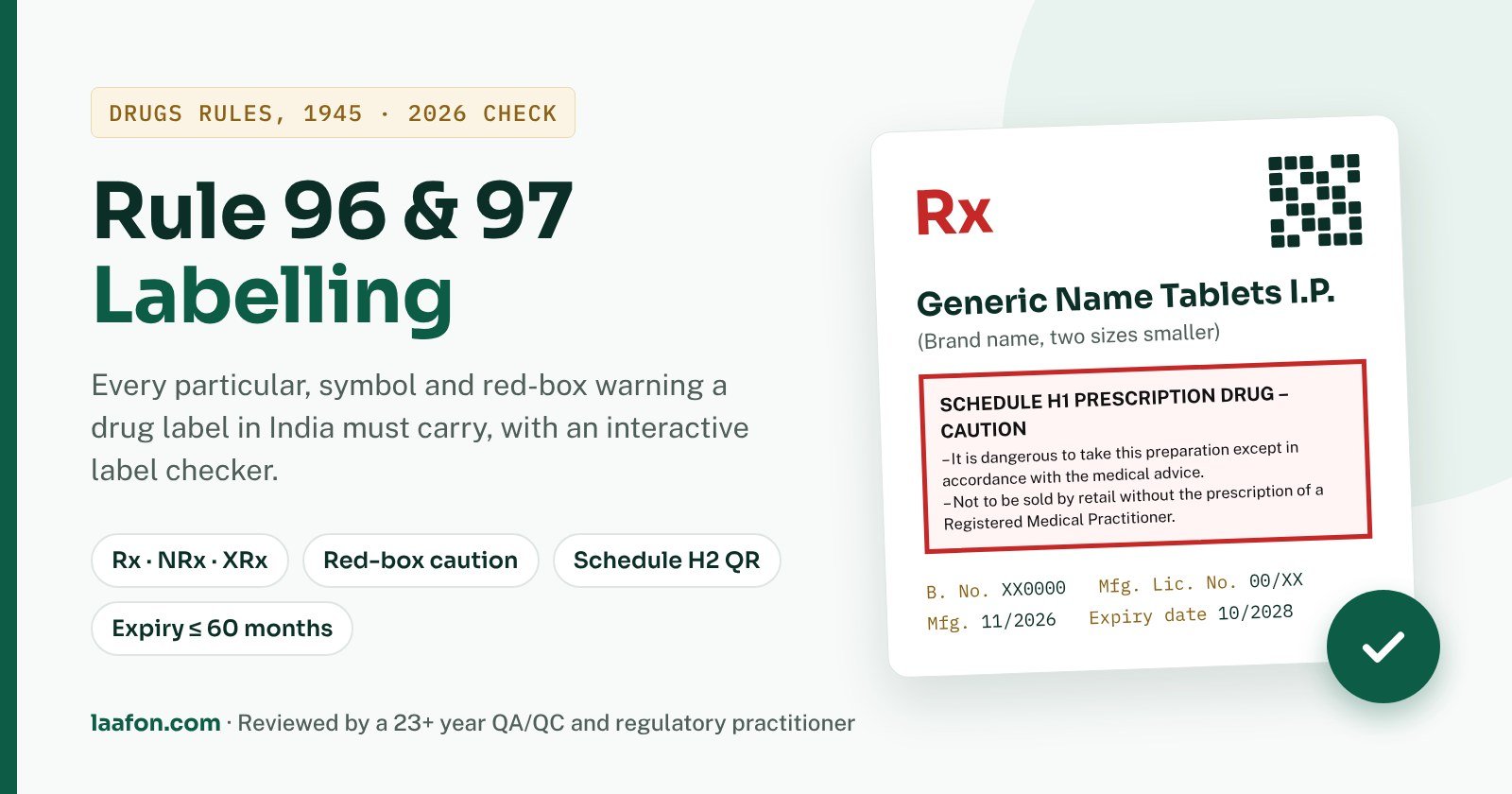

Rule 96 and 97 labelling is the labelling code for drugs in India. Rule 96 of the Drugs Rules, 1945 (formerly the Drugs and Cosmetics Rules, 1945) lists what must be on the label of the innermost container and every outer covering. That means the proper name, net contents, active content, manufacturer and address, batch number, manufacturing licence number, dates of manufacture and expiry, and, where they apply, the red-box caution, import and marketer details.[1] Rule 97 adds the schedule-specific symbol and warning: Rx, NRx or XRx, and the red-box caption for Schedule G, H, H1 and X drugs. It also covers the words for external-use and veterinary products.[1],[2]
Rule 96 manner of labelling: the particulars in sub-rule (1)
Rule 96(1) requires each particular to be printed or written in indelible ink, in a conspicuous manner. It must appear on the label of the innermost container and on every other covering in which the container is packed. A strip, the carton and a shipper’s inner box are all in scope. Transparent wrappers used only for packing, transport or delivery are exempt.[1]
Swipe the table sideways to see every column.
| Clause | What the label must show | Artwork point to check |
|---|---|---|
| 96(1)(i) | Name of the drug: the Schedule F, pharmacopoeial (with “I.P.” or the recognised abbreviation), N.F.I. or WHO INN name | The proper name is at least two font sizes larger than the brand name, with the brand name below or after it. Fixed-dose combinations of vitamins, and combinations of three or more drugs, are exempt. |
| 96(1)(ii) | Net contents in metric terms: weight, measure, volume, number of units or units of activity | “10 tablets” or “100 mL”. Do not use imperial units. |
| 96(1)(iii) | Content of active ingredients | Oral liquids per 5 mL. Use per 1 mL if the dose is under 5 mL, and per minimum approved dose if it is above. Tablets and capsules per unit. Liquid parenterals per mL, as % v/v, or per dose. Other preparations as % w/w or w/v, or per g or mL. |
| 96(1)(iv) | Name of the manufacturer and address of the premises of manufacture | The address of the plant where it was made, not a corporate office. Ampoules and similar small containers may show the name and principal place of manufacture only. |
| 96(1)(v) | Distinctive batch number | Prefix it with “Batch No.”, “B. No.”, “Batch”, “Lot No.” or “Lot”. |
| 96(1)(vi) | Manufacturing licence number | Applies to drugs manufactured in India. Prefix it with “Mfg. Lic. No.” or “M.L.”. A further proviso bars any reference to a licence number granted outside India, so imported drugs show the import licence under (xii) instead. |
| 96(1)(vii) | Date of manufacture and date of expiry | Schedule P drugs follow Schedule P. Other drugs: no more than 60 months from manufacture, unless the licensing authority has extended it. |
| 96(1)(viii) | Schedule C(1) drugs: date of manufacture and expiry of potency fixed by the manufacturer | Bulk C(1) drugs that are not ready for use and not in Schedule P may omit the expiry. |
| 96(1)(ix) | Physician’s samples | Overprint “Physician’s sample – Not to be sold”. |
| 96(1)(x) | Alcohol content | If the preparation contains 3% v/v alcohol or more, state the average percentage of absolute alcohol by volume. |
| 96(1)(xi) | Red-box caution or warning | This applies to the listed categories (narcotic analgesics, hypnotics, sedatives, tranquillisers, corticosteroids, hormones, hypoglycaemics, antimicrobials, antiepileptics, antidepressants, anticoagulants, anti-cancer drugs) and to all Schedule G, H, H1 and X drugs. |
| 96(1)(xii) | Imported drugs | The import licence number, prefixed “Import Licence”, plus the importer’s name and address. |
| 96(1)(xiii) | Marketed drugs | The marketer’s name and address, in addition to the manufacturer’s. Ampoules and similar small containers may show the marketer’s name only. G.S.R. 101(E) of 13 Feb 2020 defined the marketer and set out its responsibilities and labelling requirements. |
Clauses as in the CDSCO consolidated text.[1] Clause (xi) is older than 2018. For these categories it used to require a conspicuous red vertical line, at least 1 mm wide, down the left side of the label.[3] G.S.R. 408(E) replaced the line with the red-box caution and added Schedule H1 to the clause.[2] If your artwork still carries the red line in place of the box, it is out of date. The proper-name rule came from G.S.R. 222(E) of 13 March 2018. It was voluntary until 31 March 2019 and mandatory after that.[1] G.S.R. 222(E) originally required the same font as the brand name. G.S.R. 1161(E) of 3 Dec 2018 removed that, so any font is allowed if it is at least two sizes larger. G.S.R. 205(E) of 8 March 2019 then dropped the brackets around the brand name.[4],[5]
Exempt from the red box, not from the rest: Rule 96(1)(xi) does not apply to animal preparations, external preparations, eye and ear drops, or sterile preparations such as sutures, dressings and parenterals. All the other Rule 96 particulars still apply to them.[1] If a drug falls in a listed category but under no schedule (an unscheduled antimicrobial, for example), the proviso requires the Schedule H caution.[2]
Rule 96 sub-rules (2) to (7): expiry format, etching and QR codes
- Contraceptives (96(2)): mechanical contraceptives follow Schedule R. Other contraceptives also show the date of manufacture, the date until which they keep their properties, and storage conditions. Oral contraceptives need show only the date of manufacture.[1]
- Where the label goes (96(3), (4)): on the container, or on a label or wrapper fixed to the sale pack. Particulars may be etched, painted or indelibly marked on the container. The drug name may not be etched on glass other than ampoules.[1]
- Exports (Rule 94): drugs made only for export follow the shorter export labelling in Rule 94, not the full Rule 96 and 97 set described here.[1]
- Expiry format: give the month and year, after the words “Expiry date”. The drug is then recommended until the last day of that month. “Expiry date 03/2028” therefore means use up to 31 March 2028.[1]
- APIs (96(5)): every active pharmaceutical ingredient made or imported in India carries a QR code at each level of packaging. This has applied since 1 January 2023 (G.S.R. 20(E)).[6]
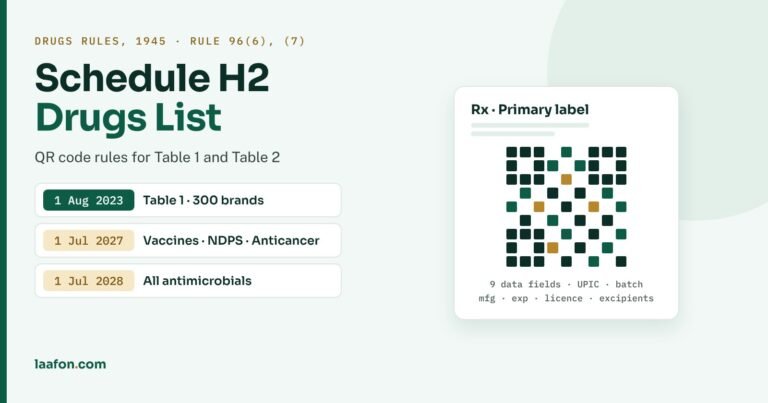
- Formulations (96(6), (7)): Schedule H2 products carry a bar code or QR code on the primary label, or on the secondary label if the primary label lacks space. Table 1 lists 300 brands, from 1 August 2023 (G.S.R. 823(E)).[6],[7] Table 2 adds all vaccines, NDPS drugs and anticancer drugs from 1 July 2027, and all antimicrobials from 1 July 2028 (G.S.R. 506(E), 22 June 2026).[8] Full detail is in our Schedule H2 QR code guide.
Excipients: a QR field, not a new printed line. G.S.R. 554(E) of 18 August 2025, in force 1 March 2026, adds “qualitative details of excipients” as clause (ix) of Rule 96(7). Rule 96(7) is the list of data held in the Schedule H2 code. CDSCO’s file title mentions “every strip”, but the amendment sits in sub-rule (7), not in the Rule 96(1) list of printed particulars.[9],[8]
Rule 97 labelling: symbol and red-box wording by schedule
Rule 97(1) applies to the container of a medicine for internal use. Clauses (a) to (f) were substituted by the Drugs and Cosmetics (Fifth Amendment) Rules, 2018, which came into force on 1 November 2018. Rule 97A, inserted by the Drugs and Cosmetics (Ninth Amendment) Rules, 2019, kept the new wording voluntary until 31 March 2019, and it has been mandatory since.[1],[2],[10] Every caption below is printed in legible black type inside a completely red rectangular box. The rule does not define “completely red” further, and black type on a solid red such as #c62828 gives only about 3.7:1 contrast, so follow the reading accepted on your approved label. The samples below show the wording, not a colour specification.
Swipe the buttons sideways for all schedules.
Rule 97(1)(a)[2]
- The caption says “prescription drug”, but Schedule G products are not listed for prescription-only sale in Rule 65(9)(a). Check sale status separately from the label.[1]
- Product lists and uses are in our Schedule G drugs list.
Rule 97(1)(b)[2]
- Rule 97(1)(b) sets no colour for the Schedule H “Rx”. Red is required for NRx, XRx and the Schedule H1 Rx.
- The pre-2018 wording, “Schedule H drug – Warning: To be sold by retail on the prescription of a Registered Medical Practitioner only”, is superseded. Replace it on old artwork.
- Check a molecule in our Schedule H drugs list.
Rule 97(1)(c)[2]
- This applies to a Schedule H drug that also comes under the Narcotic Drugs and Psychotropic Substances Act, 1985.
- The caption changes from CAUTION to WARNING, and the sentence changes to the “only” form.
Rule 97(1)(e); NRx under 97(1)(f)[2]
- The 2013 text (“SCHEDULE H1 DRUG – WARNING” in a box with a red border) was replaced in 2018 by the caption above, inside a completely red box.
- When a molecule moves into Schedule H1, its artwork must change to this box. Check current entries in our Schedule H1 drug list.
- Bulk Schedule X substances must also show the symbol, conspicuously, in red letters (Rule 97(5)).
- Substance list in our Schedule X drugs list.
FOR EXTERNAL USE ONLY
Embrocations, liniments, lotions, ointments, antiseptic creams and liquid antiseptics[1]
- Industrial methylated spirit (97(4)): state that the medicine contains it, and add “FOR EXTERNAL USE ONLY”.
- Veterinary (97(3)): print “Not for human use; for animal treatment only” and a symbol of a domestic animal’s head.
- Food-producing animals (97(3A)): state the withdrawal period for each species. Without validated data, use 7 days for eggs or milk, 28 days for poultry and mammal meat, and 500 degree-days for fish meat.[1]
Label checker: what your Rule 96 and 97 label must show
Pick your product type to get its symbol, red-box text and full list of particulars. Then tick each one off against your artwork proof.
1. Schedule or category
2. Dosage form and route
3. Who puts it on the market
4. Is this pack a physician’s sample?
Choose options above to see your label requirements.
The checker needs JavaScript. Without it, use the tables above.
All particulars ticked. Now check the font sizes, box colour and indelibility on the printed proof, not only on the PDF, plus MRP and any approval-specific statements.
The checker reflects Rules 96 and 97 as checked on 26 Nov 2026. It does not cover product-specific conditions in your licence or approval (package-insert text, storage statements, FDC warnings ordered under Section 26A), or MRP and other declarations required outside the Drugs Rules, such as under DPCO 2013 and Legal Metrology. Use it as a first pass, not as a label approval.
Six Rule 96 and 97 label errors that still reach the market
1. Pre-2018 Schedule H wording
Seen: “Schedule H drug – Warning: To be sold by retail on the prescription…”
Required: “SCHEDULE H PRESCRIPTION DRUG – CAUTION”, in a red box.[2]
2. The 2013 H1 caption
Seen: “SCHEDULE H1 DRUG – WARNING”, from the pre-2018 text that asked for a box with a red border.
Required: “SCHEDULE H1 PRESCRIPTION DRUG – CAUTION” with both warning lines, in legible black type in a completely red rectangular box, with Rx in red.[2]
3. Brand name dominating the generic
Seen: a large brand name, with the generic in small print or brackets.
Required: the proper name at least two font sizes larger. Brackets have not been required since 2019.[1],[4]
4. Unscheduled antimicrobial with no caution
Seen: no box, because “it is not in Schedule H”.
Required: the Rule 96(1)(xi) proviso applies the Schedule H caution to any drug in a listed category.[2]
5. Marketer printed, manufacturer missing
Seen: only the marketing company’s name on the carton.
Required: the manufacturer’s name and premises address (iv), the licence number (vi), and the marketer under (xiii).[1] This matters for loan-licence and third-party products.
6. Expiry written as a day, or beyond 60 months
Seen: “Exp. 15/03/2031” on a batch made in 01/2026, which is a calendar day and 62 months.
Required: month and year after “Expiry date”, no more than 60 months from manufacture unless Schedule P or an approved extension applies.[1]
Proposed, not yet in the rule: the blue strip for antimicrobials
Draft G.S.R. 51(E) of 21 January 2026 proposes a new clause (xiv) in Rule 96(1). Under it, antimicrobial drugs and their preparations would carry a conspicuous blue vertical strip down the left side of the label.[11] CDSCO’s gazette list still files it as a draft, and we found no final notification as of 26 Nov 2026. A Business Standard report of 19 Nov 2026 describes it as already amended.[12] Until a final notification appears, the strip is not a Rule 96 requirement. Plan the artwork change, but do not treat it as in force.
Why a label error becomes a misbranding case
Under Section 17(b) of the Drugs and Cosmetics Act, 1940, a drug that is not labelled in the prescribed manner is misbranded. Section 18(a)(i) bars making, stocking or selling it, and the residual penalty in Section 27(d) is imprisonment of one to two years and a fine of at least ₹20,000. A court may impose less than one year for reasons it records.[13] Since 31 Dec 2024, the Jan Vishwas (Amendment of Provisions) Act, 2023 has made Section 27(d) offences compoundable under Section 32B. The punishment itself was not reduced.[14] For imports, misbranding is defined in Section 9 and import is barred by Section 10, with penalties in Section 13. Stocking or selling a misbranded drug in India still falls under Section 18.[13] In practice, a missing caution box or a wrong manufacturer address is cited at inspection or on a Drugs Inspector’s sample. That is why artwork change control belongs in the same quality system that Revised Schedule M inspections now examine. See the Revised Schedule M compliance dashboard.
Have your artwork checked before the print run
Send us the strip, carton and insert proofs. We check them against Rules 96 and 97, the schedule status of each ingredient and the Schedule H2 timeline, and return a marked-up list of corrections.
Request a label compliance reviewRule 96 and 97 labelling: frequently asked questions
Rule 96 is the “manner of labelling” rule for drugs other than homoeopathic medicines. Sub-rule (1) lists the particulars every label must carry: proper name, net contents, active content, manufacturer and address, batch number, manufacturing licence number, manufacture and expiry dates, and, where they apply, physician’s sample, alcohol, red-box caution, import and marketer details. Sub-rules (5) to (7) add QR codes for APIs and Schedule H2 formulations.
Rule 97 sets the schedule-specific marking for medicines for internal use. Schedule G gets a red-box caution with no symbol. Schedule H gets Rx and a red-box caution. Schedule H1 gets a red Rx and a two-line red-box caution. Schedule X gets a red XRx and a warning. NDPS-controlled Schedule H and H1 drugs get a red NRx. Rule 97 also requires “For external use only” on external preparations and animal-use wording on veterinary medicines.
Rule 97(1)(b) requires Rx at the top left corner of the label but sets no colour for Schedule H. Red is prescribed for the Schedule H1 Rx, for NRx and for XRx. The Schedule H caution itself must be in black type inside a completely red rectangular box.
G.S.R. 554(E), in force from 1 March 2026, adds qualitative details of excipients to Rule 96(7). That sub-rule lists the data stored in the Schedule H2 bar code or QR code. It does not add a printed particular to the Rule 96(1) list, so it affects products covered by Schedule H2.
Not as of 26 Nov 2026. Draft G.S.R. 51(E) of 21 January 2026 proposed a blue vertical strip on antimicrobial labels as Rule 96(1)(xiv), but CDSCO’s gazette list still shows it as a draft and no final notification was found. Some press reports describe it as final, so check the CDSCO gazette page before your next artwork revision.
For drugs not covered by Schedule P, the expiry date may not be more than 60 months from the date of manufacture, unless the licensing authority extends it for a specified drug on satisfactory evidence. Schedule P drugs follow the period in Schedule P. The expiry is written as month and year, and the drug is recommended until the last day of that month.
Yes. Rule 96(1) applies to the label of the innermost container and to every other covering in which that container is packed. Only transparent covers and wrappers used purely for packing, transport or delivery are exempt. For ampoules and similar small containers, the rule allows a shorter manufacturer and marketer entry.
Related on laafon.com
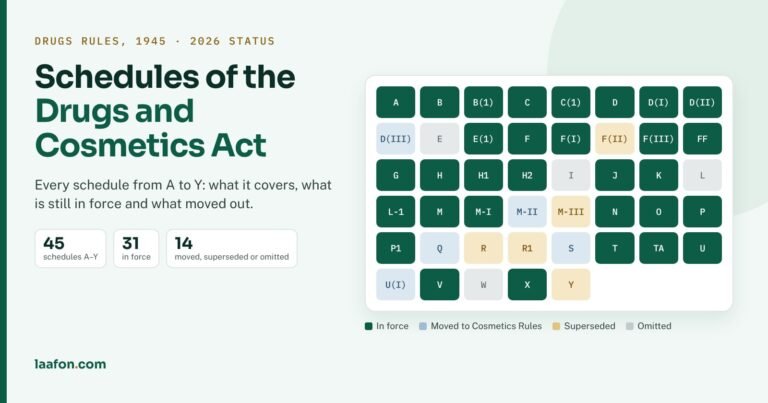
- Schedules A to Y explained
What every schedule covers, including the ones that drive Rule 97. - Schedule H2 QR code rules
The 300 brands, the 2027 to 2028 categories and the nine data fields. - Schedule H1 drug list
The molecules that need the red Rx and the two-line H1 box. - Schedule G warning labels
Products that carry the medical-supervision caution. - Schedule X drugs list
Substances that need XRx in red, including in bulk. - Third-party manufacturing
For marketers who need cartons that name both manufacturer and marketer.
References
- Central Drugs Standard Control Organisation. The Drugs Rules, 1945 (consolidated text), rules 96, 97 and 97A. New Delhi: CDSCO. Available from: cdsco.gov.in. Accessed November 2026.
- Ministry of Health and Family Welfare. G.S.R. 408(E): Drugs and Cosmetics (Fifth Amendment) Rules, 2018 (rule 96(1)(xi) and rule 97(1)(a) to (f)). Gazette of India, Extraordinary; 26 April 2018. Available from: cdsco.gov.in. Accessed November 2026.
- Indian Kanoon. Drugs and Cosmetics Rules, 1945: rule 96(1)(xi) as it stood before G.S.R. 408(E) (red vertical line). Available from: indiankanoon.org. Accessed November 2026.
- Central Drugs Standard Control Organisation. Drugs Rules: final notifications (entry for G.S.R. 205(E), 8 March 2019, omission of brackets for brand name in rule 96). New Delhi: CDSCO. Available from: cdsco.gov.in. Accessed November 2026.
- Lexplosion. Drugs and Cosmetics (Eighth Amendment) Rules, 2018 (G.S.R. 1161(E), 3 December 2018): same-font requirement removed. Available from: lexplosion.in. Accessed November 2026.
- Central Drugs Standard Control Organisation. Guidance for identification and verification of spurious drugs (summarising G.S.R. 20(E), 18 January 2022, and G.S.R. 823(E), 17 November 2022). New Delhi: CDSCO. Available from: cdsco.gov.in. Accessed November 2026.
- Central Drugs Standard Control Organisation. FAQs on implementation of G.S.R. 823(E) dated 17 November 2022 (bar code or QR code on top 300 brands). New Delhi: CDSCO; 21 July 2023. Available from: cdsco.gov.in. Accessed November 2026.
- Ministry of Health and Family Welfare. G.S.R. 506(E): Drugs (Seventh Amendment) Rules, 2026 (Schedule H2, Table 2). Gazette of India, Extraordinary; 22 June 2026. Available from: cdsco.gov.in. Accessed November 2026.
- Ministry of Health and Family Welfare. G.S.R. 554(E): Drugs (Second Amendment) Rules, 2025 (rule 96(7)(ix), excipients; in force 1 March 2026). Gazette of India, Extraordinary; 18 August 2025. Available from: cdsco.gov.in. Accessed November 2026.
- Ministry of Health and Family Welfare. Drugs and Cosmetics (Ninth Amendment) Rules, 2019 (insertion of rule 97A). 20 March 2019. Summary available from: manupatra.com. Accessed November 2026.
- Central Drugs Standard Control Organisation. Gazette notifications (entry for G.S.R. 51(E), 21 January 2026: draft notification regarding blue line on label of antimicrobial). New Delhi: CDSCO. Available from: cdsco.gov.in. Accessed November 2026.
- Business Standard. Centre proposes central approval for antimicrobials amid AMR concerns. New Delhi: Business Standard; 19 November 2026. Available from: business-standard.com. Accessed November 2026.
- Government of India. The Drugs and Cosmetics Act, 1940 (23 of 1940), sections 17, 18 and 27. India Code. Available from: indiacode.nic.in. Accessed November 2026.
- PharmaTutor. The new penal provisions in the Drugs and Cosmetics Act (Jan Vishwas (Amendment of Provisions) Act, 2023; amendments in force from 31 December 2024). 2024. Available from: pharmatutor.org. Accessed November 2026.
This page is technical and educational. It is not legal, regulatory or medical advice. Indian statutory instruments and schedules change often. Confirm the current text in the Gazette of India or on cdsco.gov.in, and with your State Licensing Authority, before approving artwork. Last checked 26 Nov 2026.