
Schedule H2 drugs list in one paragraph
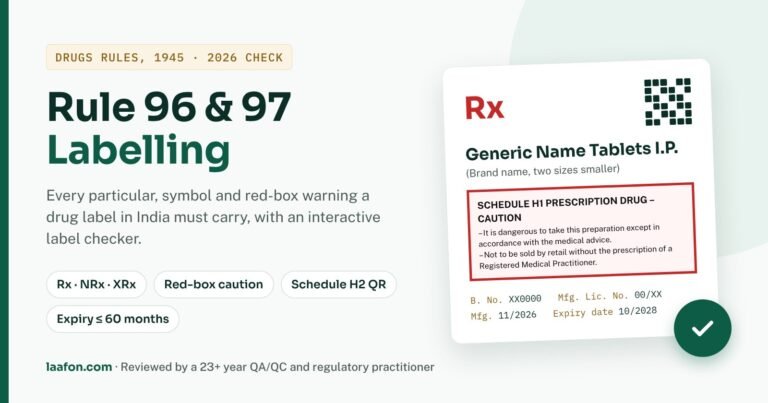
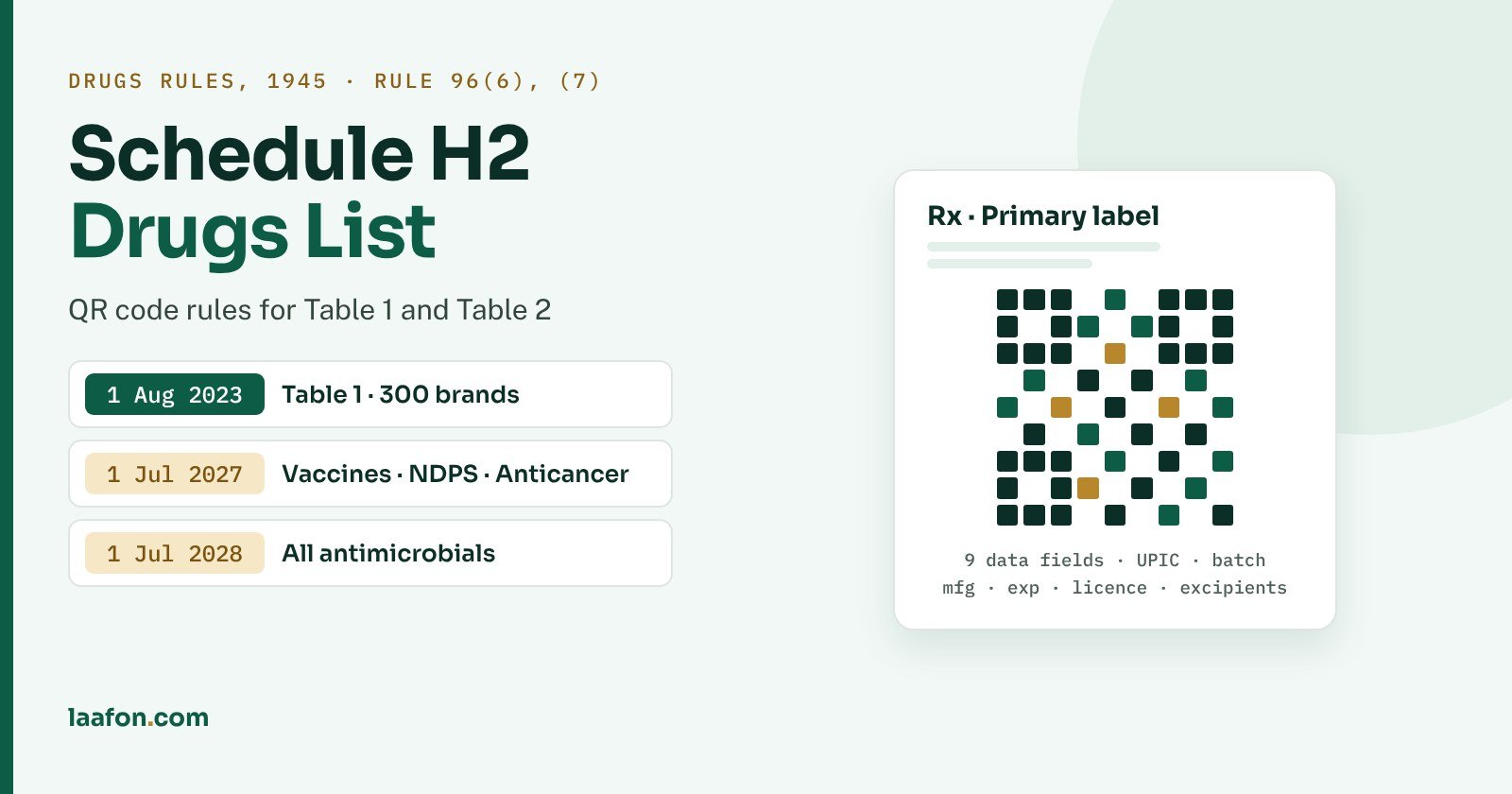
The Schedule H2 drugs list is the part of the Drugs Rules, 1945 that decides which medicines must carry a bar code or QR code on their label. It now has two tables. Table 1 names 300 brands that have needed a code since 1 August 2023.[1] Table 2 was added by G.S.R. 506(E) on 22 June 2026. It covers whole drug classes: all vaccines, all NDPS drugs and all anticancer drugs from 1 July 2027, and all antimicrobials from 1 July 2028.[2] The code must store nine data fields and go on the primary label, or on the secondary label if the primary label has no room.[3]
Schedule H2 does not change who can buy a medicine. It is a traceability rule for manufacturers, not a prescription schedule.
- Table 1: 300 brandsIn force since 1 Aug 2023
- Vaccines, NDPS, anticancerFrom 1 Jul 2027 · see date
- All antimicrobialsFrom 1 Jul 2028 · see date
Status checked against the gazette notifications and CDSCO on 26 November 2026. Reviewed by Darshan Singh, 23+ years in pharmaceutical QA, QC and regulatory affairs.
The Schedule H2 drug list: Table 1 and Table 2
G.S.R. 823(E), the Drugs (Eighth Amendment) Rules, 2022, created Schedule H2 on 17 November 2022. It inserted sub-rules (6) and (7) into rule 96 and placed a table of 300 brands after Schedule H1.[1] The 2026 amendment renumbered that table as Table 1 and added Table 2. Table 2 lists therapeutic categories instead of brand names.[2]
| Table and entry | What it covers | Code required from | Notification |
|---|---|---|---|
| Table 1, entries 1 to 300 | 300 named brands of drug formulations, listed with strength and pack. Reported examples include Dolo, Allegra, Saridon and Corex.[4] | 1 Aug 2023 | G.S.R. 823(E), 17 Nov 2022 |
| Table 2, entry 1 | All vaccines | 1 Jul 2027 | G.S.R. 506(E), 22 Jun 2026 |
| Table 2, entry 2 | All antimicrobials | 1 Jul 2028 | G.S.R. 506(E), 22 Jun 2026 |
| Table 2, entry 3 | All narcotic drugs and psychotropic substances listed under the NDPS Act, 1985 and the rules made under it | 1 Jul 2027 | G.S.R. 506(E), 22 Jun 2026 |
| Table 2, entry 4 | All anticancer drugs | 1 Jul 2027 | G.S.R. 506(E), 22 Jun 2026 |
Looking for the Schedule H2 drug list PDF? Download the official 300-brand Table 1 from CDSCO: G.S.R. 823(E) PDF.[1] Table 2 is in the G.S.R. 506(E) PDF.[2] Both are also listed on CDSCO’s Gazette Notifications page. Use the gazette, not a re-typed list: each brand entry is tied to a specific strength and pack.
Before the final rule, the Ministry published the Table 2 proposal as draft G.S.R. 757(E) on 16 October 2025. The final table kept the same four categories.[5] For the complete map of schedules, see our A to Y guide to the schedules of the Drugs and Cosmetics Act.
Does Schedule H2 apply to your product?
Answer three questions. The result names the rule and the date that applies.
Choose one answer in each row
The result appears here. It is a first screen, not a legal opinion.
Rule basis will show here.
What the Schedule H2 QR code must store
Rule 96(7) sets the minimum data the bar code or QR code must store for every Schedule H2 formulation.[1] Field 9 was added by G.S.R. 554(E) from 1 March 2026.[6]
- Unique product identification code
- Proper and generic name of the drug
- Brand name
- Name and address of the manufacturer
- Batch number
- Date of manufacturing
- Date of expiry
- Manufacturing licence number
- Qualitative details of excipients (since 1 Mar 2026)
The rule does not prescribe the code format. CDSCO’s FAQ says the manufacturer decides the unique product identification code under its own SOP.[7]
APIs follow a separate rule. Since 1 January 2023, rule 96(5) requires every active pharmaceutical ingredient manufactured or imported in India to carry a QR code on its label at each level of packaging.[8] The minimum data is:
- Unique product identification code
- Name of the API
- Brand name (if any)
- Name and address of the manufacturer
- Batch number
- Batch size
- Date of manufacturing
- Date of expiry or retesting
- Serial shipping container code
- Manufacturing licence number or import licence number
- Special storage conditions (if any)
The API rule is not part of Schedule H2. It applies to every API, whatever its therapeutic class.
- Where: on the primary packaging label. The code moves to the secondary package label only if the primary label does not have enough space.[1]
- Readable by software: the stored data must be readable by a software application so the pack can be authenticated.[1]
- Which batches: for Table 1, CDSCO applied the rule to batches manufactured on or after 1 August 2023, wherever the site is.[7]
- Imports: imported packs should preferably arrive coded. Otherwise the code may be affixed in India with permission from the licensing authority.[7]
- Beyond the list: manufacturers may code other brands voluntarily.[7]
Correction: the excipient amendment is a QR rule, not an every-label rule. When G.S.R. 554(E) was notified in August 2025, some news reports said every drug label must now print excipient details.[9] The gazette text does something narrower. It amends rule 96 sub-rule (7), the list of data stored in the Schedule H2 code, and adds clause (ix), “qualitative details of excipients”.[6] PIB’s June 2026 release confirms that the code now holds nine fields, excipient details included.[3] Even CDSCO’s own file title for the notification mentions “every strip of medicines”, but it names sub-rule (7) too. Some summaries still show eight fields. Update your artwork and master-data templates to nine.
Timeline of QR code rules for medicines in India
- 18 Jan 2022G.S.R. 20(E) inserts rule 96(5): QR code on APIs at every packaging level, in force 1 Jan 2023.[8]
- 17 Nov 2022G.S.R. 823(E) inserts rule 96(6) and (7) and creates Schedule H2 with 300 brands.[1]
- 21 Jul 2023CDSCO publishes FAQs on implementing G.S.R. 823(E).[7]
- 1 Aug 2023Table 1 in force for batches made on or after this date.[7]
- 31 Jan 2025DGFT withdraws the export track-and-trace paragraph (Para 2.76, Handbook of Procedures 2023). Authentication of exported formulations moves to the Health Ministry.[10]
- 18 Aug 2025G.S.R. 554(E) adds excipient details as the ninth QR field, in force 1 Mar 2026.[6]
- 16 Oct 2025Draft G.S.R. 757(E) proposes Table 2.[5]
- 22 Jun 2026G.S.R. 506(E), the Drugs (Seventh Amendment) Rules, 2026, notifies Table 2.[2]
- 1 Jul 2027All vaccines, NDPS drugs and anticancer drugs must carry the code.[2]
- 1 Jul 2028All antimicrobials must carry the code.[2]
Difference between Schedule H, H1 and H2
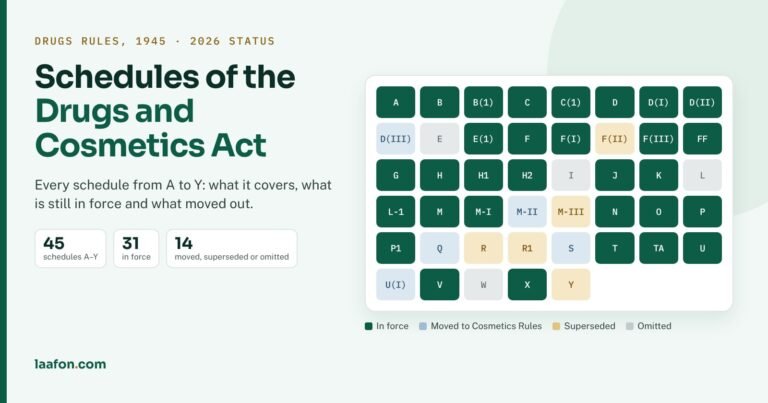
The names are similar, but the schedules do different jobs. H and H1 control how a medicine is sold. H2 controls how a pack is labelled and traced. One product can sit in more than one schedule. An antimicrobial that is also in Schedule H1 will need the H1 sale controls and, from 1 July 2028, the H2 code.
| Point | Schedule H | Schedule H1 | Schedule H2 |
|---|---|---|---|
| Purpose | Prescription-only retail sale | Stricter sale control, with a separate record of each sale | Pack authentication and traceability |
| Who acts | Pharmacist and prescriber | Pharmacist and prescriber | Manufacturer (and importer) |
| Changes sale status? | Yes | Yes | No |
| What is on the label | Rx symbol and the Schedule H warning | Rx symbol and the Schedule H1 warning in a box | Bar code or QR code storing the rule 96(7) data |
| Our guide | Schedule H drugs list | Schedule H1 drug list | This page |
The same applies to the other sale schedules. Any Schedule X drug that is also listed under the NDPS Act falls in Table 2 from 1 July 2027, so check each one against the NDPS schedules. The red-box Schedule G warning sits on the label separately from any H2 code.
Six questions G.S.R. 506(E) does not answer
The Table 2 notification is four lines long. It names categories but defines none of them. When we checked on 26 November 2026, we found no CDSCO FAQ for Table 2. Until one is published, plan on the cautious reading and ask your licensing authority in writing.
- What counts as an “antimicrobial”? The term is not defined in the notification. Antibacterials are clearly covered. Antifungals, antivirals, anti-TB and antiprotozoal drugs plausibly are too. Plan for the broad reading, and treat a fixed-dose combination with any antimicrobial ingredient as in scope.
- What counts as “anticancer”? Cytotoxics and targeted oncology drugs are clear. Hormonal agents and supportive-care drugs used mainly in oncology are not addressed.
- Which batches? For Table 1, CDSCO applied the rule to batches made on or after the start date.[7] The same approach is likely for Table 2, but it has not been stated. Do not count on selling uncoded stock made after 1 July 2027 (or 1 July 2028 for antimicrobials).
- Export-only batches? CDSCO’s 2023 FAQ describes Table 1 as applying to brands made for sale in India.[7] Export packs follow the importing country’s rules. Authentication of exported formulations now sits with the Health Ministry, not DGFT.[10]
- Loan licence and third-party manufacturing? The rule places the duty on the “manufacturers” of Schedule H2 formulations.[1] It does not say who generates or hosts the code when one firm makes the product for another. Write it into the quality agreement. Our loan licence consulting page covers how those arrangements are set up.
- Veterinary products? The entries read “All Vaccines” and “All Antimicrobials” with no limit to human use,[2] and the Drugs Rules also govern veterinary drugs. Treat veterinary vaccines and antimicrobials as in scope unless CDSCO says otherwise.
A Schedule H2 readiness plan for 2027 and 2028
In our experience of small and mid-sized plants, antibiotics are often among the largest product groups, so 1 July 2028 is likely to be the date that matters most. The steps below come from practice, not from the rule. Start them at least a year before your deadline.
- Map every SKU against Table 2. Include FDCs, own brands and products you make for others. Mark borderline items (antivirals, antifungals, hormonal oncology) for a written view from your licensing authority.
- Write the unique product identification code logic into an SOP. CDSCO leaves the code design to you.[7] The SOP also needs to cover code generation, verification at the line, rejects and reconciliation. If you need one written or gap-checked for your site, see our pharma SOP writing and review service.
- Decide where the data lives. The government has described no central database. The code is read by mobile applications, and State Licensing Authorities enforce the rule.[11] Choose who hosts the resolver, and keep the hosting under change control.
- Re-qualify the packaging line. A printer plus a vision camera on blister, strip or carton lines changes qualified equipment and adds a computerised system. Handle it under change control and validation. Our Revised Schedule M compliance dashboard tracks the current enforcement status.
- Build the nine-field master data. Draw excipients from the approved formula, and batch data from the batch record. Lock the mapping so artwork, the code and the BMR cannot drift apart.
- Rework artwork early. Place the code on the primary label wherever there is space. The secondary label is allowed only when space on the primary label is inadequate.[1] Small ampoule and vial labels need checking first.
- Plan the stock cut-over by manufacturing date. Run coded validation batches before the deadline so that no uncoded batch is made after it.
What happens if a Schedule H2 pack has no code?
Rule 96 sets out the prescribed manner of labelling. Under section 17(b) of the Drugs and Cosmetics Act, 1940, a drug that is not labelled in the prescribed manner is deemed misbranded. Section 18(a)(i) prohibits manufacturing or selling misbranded drugs.[12] The penalty sits in section 27(d): imprisonment of at least one year and up to two years, plus a fine of at least ₹20,000. The court may go below one year for adequate and special reasons recorded in the judgment.[12] Since the Jan Vishwas amendments took effect on 31 December 2024, a section 27(d) offence can be compounded under section 32B, but the penalty itself was not reduced.[13] In practice, a Drugs Inspector who finds an uncoded Schedule H2 batch dated after the start date has grounds to act under the misbranding provisions. The code also serves the regulator’s own checks: CDSCO’s guidance on spotting spurious drugs includes verifying a pack by reading its bar code or QR code.[14]
Not sure which of your products fall in Table 2?
We review your product list against Table 1 and Table 2. We flag borderline molecules and FDCs, then set out the SOP, artwork, line and master-data gaps to close before 1 July 2027 or 1 July 2028.
Request a Schedule H2 QR code compliance reviewReviewed by a 23+ year QA/QC/regulatory practitioner. Pharma plants for sale, due diligence and Schedule M advisory.
Schedule H2 FAQs
Schedule H2 drugs are formulations that must carry a bar code or QR code on the label under rule 96(6) of the Drugs Rules, 1945. Table 1 lists 300 named brands, coded since 1 August 2023. Table 2 adds all vaccines, NDPS drugs and anticancer drugs from 1 July 2027, and all antimicrobials from 1 July 2028.
No. Schedule H and H1 control retail sale. Schedule H2 only requires the manufacturer to put a bar code or QR code on the pack for authentication and traceability. A drug can be in Schedule H or H1 and also in Schedule H2.
From 1 July 2028. G.S.R. 506(E) brings serial number 2 of Table 2, all antimicrobials, into force a year after the other Table 2 categories, which start on 1 July 2027. Antimicrobial brands already in the 300-brand Table 1 have needed a code since 1 August 2023.
Yes, since 1 March 2026. G.S.R. 554(E) added qualitative details of excipients as clause (ix) of rule 96(7), the data stored in the Schedule H2 code. That brings the code to nine fields. The amendment sits in the stored-data list, not in the printed-label particulars.
On the primary packaging label. The rule allows the secondary package label only when the primary label does not have enough space. The code must store data that a software application can read to authenticate the pack.
The manufacturer. CDSCO’s FAQ on G.S.R. 823(E) says the unique product identification code is decided by the manufacturer under its own SOP. The rule names no single coding standard.
Yes. CDSCO’s FAQ applies the rule to Indian and foreign manufacturers of the listed products for sale in India. Imports should preferably arrive coded. Otherwise the code may be affixed in India with permission from the licensing authority.
From the CDSCO website, under Notifications and then Gazette Notifications. The 300-brand Table 1 is in G.S.R. 823(E), dated 17 November 2022. Table 2 is in G.S.R. 506(E), dated 22 June 2026. This page links the official CDSCO PDF of each.
Related on laafon.com
References
- Ministry of Health and Family Welfare. G.S.R. 823(E): Drugs (Eighth Amendment) Rules, 2022 (rule 96(6), (7) and Schedule H2). Gazette of India, Extraordinary. New Delhi; 17 Nov 2022. Available from: cdsco.gov.in (PDF). Accessed Nov 2026.
- Ministry of Health and Family Welfare. G.S.R. 506(E): Drugs (Seventh Amendment) Rules, 2026 (Schedule H2, Table 2). Gazette of India, Extraordinary. New Delhi; 22 Jun 2026. Available from: cdsco.gov.in (PDF). Accessed Nov 2026.
- Press Information Bureau. Union Health Ministry expands QR code-based drug traceability framework to vaccines, antimicrobials and anti-cancer medicines. New Delhi: PIB; 25 Jun 2026. Available from: pib.gov.in. Accessed Nov 2026.
- Nasim F. Union Health Ministry notifies 300 drug brands under Schedule H2, details. Medical Dialogues; 21 Nov 2022. Available from: medicaldialogues.in. Accessed Nov 2026. (Trade press, used for reported examples only.)
- Ministry of Health and Family Welfare. G.S.R. 757(E): draft rules to include more categories under Schedule H2. Gazette of India, Extraordinary. New Delhi; 16 Oct 2025. Available from: cdsco.gov.in (PDF). Accessed Nov 2026.
- Ministry of Health and Family Welfare. G.S.R. 554(E): Drugs (2nd Amendment) Rules, 2025 (rule 96(7)(ix), qualitative details of excipients; in force 1 Mar 2026). Gazette of India, Extraordinary. New Delhi; 18 Aug 2025. Available from: cdsco.gov.in (PDF). Accessed Nov 2026.
- Central Drugs Standard Control Organisation. FAQs on implementation of GSR 823(E) dated 17th November, 2022 with respect to bar code or QR code on top 300 brands. New Delhi: CDSCO; 21 Jul 2023. Available from: cdsco.gov.in. Accessed Nov 2026.
- Ministry of Health and Family Welfare. G.S.R. 20(E): Drugs (Amendment) Rules, 2022 (rule 96(5), QR code on active pharmaceutical ingredients; in force 1 Jan 2023). Gazette of India, Extraordinary. New Delhi; 18 Jan 2022. Available from: cdsco.gov.in (PDF). Accessed Nov 2026.
- Medical Dialogues. Mandatory excipients disclosure on drug labels from March 2026: Health Ministry. 24 Aug 2025. Available from: medicaldialogues.in. Accessed Nov 2026. (Cited as an example of the broader reading; see reference 6 for the operative text.)
- Pharmaceuticals Export Promotion Council of India. Circular PXL/HO/Cir-078/2024-25: DGFT Public Notice 44/2024-25, withdrawal of Para 2.76 of HBP 2023 (track and trace for export of drug formulations). Hyderabad: Pharmexcil; 31 Jan 2025. Available from: pharmexcil.com. Accessed Nov 2026.
- MediaNama. Government on QR codes for top 300 pharma brands (Lok Sabha unstarred question, reply dated 1 Aug 2025). Aug 2025. Available from: medianama.com. Accessed Nov 2026. (Trade press summary of the parliamentary reply.)
- Government of India. The Drugs and Cosmetics Act, 1940 (23 of 1940), sections 17, 18, 27 and 32B. Available from: indiacode.nic.in. Accessed Nov 2026.
- Cyril Amarchand Mangaldas. Synapse newsletter, January to March 2024: S.O. 1577(E) of 28 Mar 2024 brings the Jan Vishwas (Amendment of Provisions) Act, 2023 amendments to the Drugs and Cosmetics Act into force from 31 Dec 2024. Available from: cyrilshroff.com (PDF). Accessed Nov 2026. (Law-firm summary.)
- Central Drugs Standard Control Organisation. Guidance for identification and verification of spurious drugs. New Delhi: CDSCO. Available from: cdsco.gov.in. Accessed Nov 2026.
This page is technical and educational. It is not legal, medical or investment advice. Indian statutory instruments and their interpretation change often. Confirm the current gazette text and your licensing authority’s position before you change artwork or packaging lines. Written and reviewed by Darshan Singh, M.Sc. (Organic Chemistry), 23+ years in pharmaceutical QA, QC and regulatory affairs. Status verified 26 November 2026.