Investment Brief · Baddi, Himachal Pradesh
A running WHO-GMP pharma unit in Baddi, at ₹51 crore.
Not a brochure — a due-diligence brief for a serious buyer. A working, compliant plant in India’s largest pharma cluster: what you are buying, why the timing works, and exactly what to check before you sign.
Snapshot
The unit at a glance
The deal math
What the unit should earn
The number that matters most is the return. Switch between the conservative and optimised cases and watch the cash yield change — these are the figures to test in diligence.
Return scenario
EBITDA multiple at the ₹18 Cr midpoint — below the 3–4× comparable units usually fetch. The discount reflects a motivated relocation sale, not a stretched ask.
Returns are unlevered (all-equity) and exclude tax and working-capital movements. Add your own debt structure separately. Indicative only — not investment advice.
Baddi — part of the Baddi–Barotiwala–Nalagarh (BBN) belt in Himachal Pradesh — is India’s largest pharmaceutical manufacturing cluster. Buying an established, compliant unit here means taking over a working plant, a trained workforce, and a live client book inside that cluster, instead of spending 18–24 months building one from scratch.
Location
Why Baddi — the location is the asset
For a manufacturing purchase, the postcode is not a detail; it is a large part of the value. Baddi removes the problems a tier-2 industrial zone would create on day one:
- A concentrated supply chain. Bulk-drug and excipient suppliers, packaging vendors, and pharma equipment service centres are all local, so lead times and machine downtime stay short.
- A GMP-trained talent pool. Three decades of pharma manufacturing in the BBN belt means operators, QA/QC analysts, and documentation staff are available without a long hiring-and-training runway.
- Regulatory familiarity. Local consultants and the state licensing authority handle CDSCO and Himachal drug-control work routinely, which shortens transfers and approvals.
- Connectivity. Baddi sits roughly 45 minutes from Chandigarh, 30 minutes from Panchkula, and about 4.5 hours from Delhi — practical for inbound raw material and outbound distribution.
The same unit in a non-cluster location usually means slower buying, higher compliance cost, and a longer recruitment cycle. In Baddi, everything you need is already close by.
The asset
The Baddi unit in detail
Physical asset
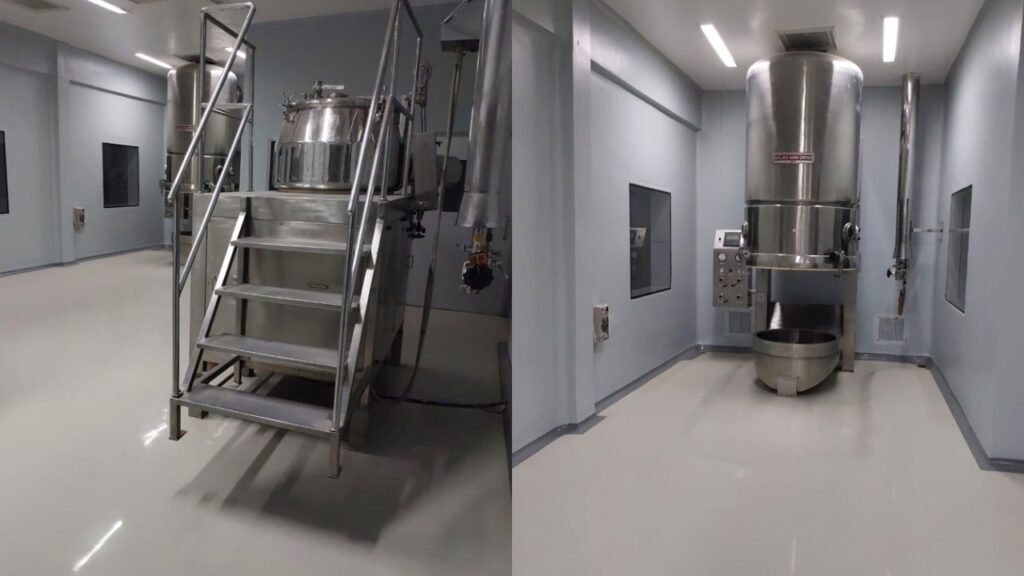
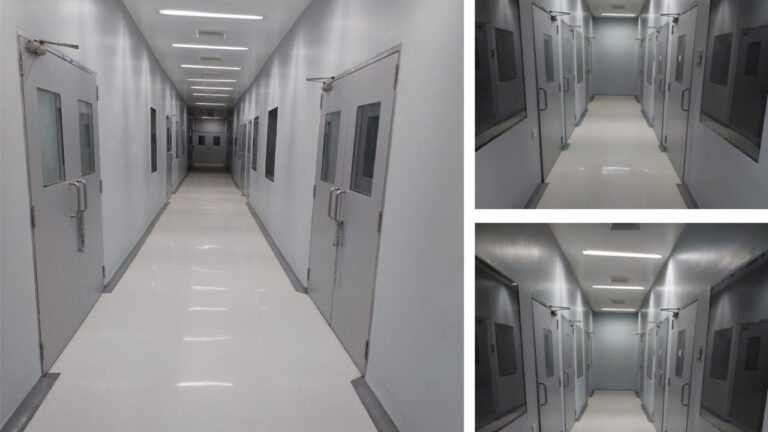
Freehold ownership matters here. As larger players buy up land across Baddi, clear-title freehold plots are getting scarcer, and the land carries its own appreciation potential. The 78,000 sq ft built-up area on a 3,000 sq m plot is sized for efficient operation with room to add lines — you are not paying for idle space.
Manufacturing capacity
Over 1,000 formulations across four dosage forms. Output per 8-hour shift:
| Dosage form | Daily (1 shift) | Weekly | Annual (250 days) |
|---|---|---|---|
| Tablets | 20 lakh | 168 lakh | 5 crore |
| Capsules | 10 lakh | 84 lakh | 2.5 crore |
| Liquid orals (syrups / suspensions) | 2.5 lakh bottles | 21 lakh bottles | 62.5 lakh bottles |
| Ointments & topicals | 1 lakh tubes | 8.4 lakh tubes | 25 lakh tubes |
Multi-form flexibility is a real commercial advantage: if a client shifts from tablets to capsules, or a segment softens, output can be re-mixed without changing the facility. For a third-party manufacturer, that is revenue diversification and client retention in one.
Certifications — and the markets each one opens
| Certification | What it enables | Realistic market access |
|---|---|---|
| WHO-GMP | Recognised GMP standard for exports | RoW / semi-regulated markets accepting WHO-GMP + CoPP (much of Africa, parts of Asia, CIS, Latin America); basis for WHO prequalification and donor/tender business |
| Revised Schedule M (CDSCO) | Current Indian GMP compliance | Domestic manufacture & distribution; protects the unit against ongoing CDSCO inspections |
| ISO 9001:2015 | Quality-management system | Shows a systematic QMS; valued by international customers |
| DCGI / CDSCO product approvals | Product-level regulatory recognition | Legal manufacture & distribution of approved formulations |
WHO-GMP does not, on its own, open the US, EU, Japan, or Australia — those markets need their own approvals (USFDA, EU-GMP/EDQM, PMDA, TGA). What WHO-GMP actually gives you is access to the large set of RoW / semi-regulated markets, plus the WHO-prequalification and tender routes. That is still a substantial, higher-margin step beyond commodity domestic supply — it is simply worth stating accurately, because a serious buyer will know the difference.
Performance
Business performance (seller-represented)
The figures below are as represented by the seller and must be checked in diligence:
- Revenue: ₹100+ crore/year. At 350 staff, that is about ₹28.6 lakh revenue per employee — inside the normal ₹25–35 lakh band for Indian pharma manufacturing, so the unit is properly staffed, not overstaffed.
- EBITDA margin: 15–25%. Listed third-party manufacturers usually run mid-teens to low-twenties, so this range is competitive rather than exceptional. The spread reflects seasonal utilisation and product mix.
- 400+ third-party clients. This is the real advantage. Third-party relationships are sticky because moving a product to a new site means re-validation — usually 6–12 months and ₹20–50 lakh for the customer — which protects both retention and modest pricing power.
Timing
Why now
1. Third-party manufacturing demand is structural. India is a global hub for generics and APIs, and outsourcing keeps rising — startups avoid ₹2–5 crore of capex by using contract manufacturers, and larger firms hand off commoditised products to free up capital. A ready Baddi unit serves that demand at once; a greenfield build sits out the first 18–24 months while competitors take it. (See the loan-licence and third-party manufacturing models for how buyers use spare capacity.)
2. Schedule M compliance is now enforced — and that favours a compliant unit. The revised Schedule M was notified in December 2023 and took effect on 1 January 2025. The extension window for smaller manufacturers closed on 31 December 2025, and CDSCO is now running risk-based inspections with no further blanket extensions signalled. Non-compliant units face retrofits of roughly ₹0.5–1.5 crore per line plus downtime; this facility is already compliant, so that cost and disruption do not apply. As enforcement tightens across Baddi, compliant capacity gains share.
3. Export room through the WHO-GMP route. The unit exports to a handful of RoW markets today — a small share of what WHO-GMP-accepting markets allow. Moving into more RoW / semi-regulated markets, applying for WHO prequalification on suitable products, and entering tender/donor supply are all realistic growth options on the existing certifications. (Pricing varies widely by market and product; treat any per-unit figures as indicative only.)
Economics
The economics, in plain terms
At the conservative case — ₹100 crore revenue, 15% EBITDA, ₹0.75 crore maintenance & compliance — the unit produces about ₹14.25 crore of unlevered operating cash flow, roughly a 28% cash yield on ₹51 crore before any debt.
Add debt and the return on your equity changes — model it with a proper amortising EMI, not a flat estimate. A fully-amortising ₹51 crore loan at 8% over 5 years costs about ₹12.4 crore/year, with year-one interest alone around ₹4.1 crore. Use the pharma plant cost calculator to compare this against a greenfield build.
On valuation: at ₹18 crore EBITDA (an 18% midpoint), ₹51 crore is about 2.8× EBITDA — below the 3–4× comparable units usually fetch. That discount fits a motivated relocation sale rather than a stretched ask, which is part of what makes it worth moving on.
These figures are illustrative, exclude tax and working-capital movements, and do not constitute investment advice. Check all inputs independently.
Diligence
Strengths and risks — an honest read
Working in your favour: a proven, diversified client base with high switching costs; multi-dosage flexibility; certifications already in place; a trained workforce you take over rather than build; and a brownfield asset with no construction or environmental-cleanup unknowns.
What you are taking on:
| Risk | Likelihood | Impact | Mitigation |
|---|---|---|---|
| Top-5 customer loss (≈15–25% of revenue) | Medium | ₹3–4 cr/yr | Retention audit + transition agreements pre-close; active account management post-close |
| Major equipment breakdown | Low–Med | ₹2–5 cr/qtr in downtime | Independent equipment audit pre-buy; ₹1.5–2 cr preventive-maintenance budget over 5 yrs; keep spares |
| Regulatory inspection finding | Low | ₹0.5–1 cr + reputation | Already compliant; budget ₹25–50 lakh/yr for ongoing audits & training |
| Capacity under-utilisation | Medium | Growth stalls at flat revenue | Named acquisition plan (10–15 targets); export expansion; competitive pricing |
| Working-capital spike | Medium | ₹2–3 cr tied up | Tight receivables/inventory terms; ₹3–5 cr cash buffer |
| Skilled-staff attrition | Low–Med | ₹25–50 lakh/hire | Retention bonuses for key staff; competitive Baddi-market wages |
| Raw-material supplier dependency | Low | 10–15% input-cost swings | Multiple local suppliers; escalation-capped contracts; buffer stock |
None of these is fatal with active management — but this is an operating business, not a passive holding.
Due diligence workstreams
Before committing capital, check the fundamentals across five workstreams. Budget roughly ₹20–35 lakh in advisory costs and 4–5 months end to end.
- Financial (weeks 3–5): 3 years’ audited P&L reconciled against GST filings and bank statements; cost structure (raw material usually 40–50% of revenue); working-capital ageing; contingent liabilities. Red flag: a P&L that does not tie to GST.
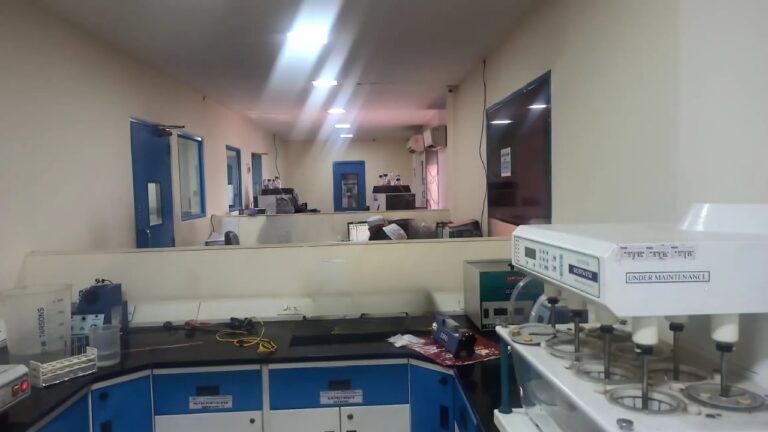
- Operational (weeks 4–6): independent equipment audit (age, condition, service history — relevant given the 2016 build); capacity validation against actual batch records; QC lab adequacy (HPLC, dissolution, method validation per USP/BP); OOS history. Red flag: OOS >2%, or nameplate capacity that demonstrated runs don’t support.
- Regulatory (week 5): WHO-GMP scope, validity and inspection history; CDSCO licence status and scope; DCGI product approvals; environmental clearances (ETP, hazardous-waste disposal). Red flag: expired certs or open observations.
- Customer (weeks 6–7): top-10 concentration (ideally no single cluster >50%); contract terms and renewals; 5–10 quiet client interviews on quality, reliability, and intent to continue post-sale; churn history. Red flag: >15% annual churn, or churn tied to quality.
- Legal & ownership (weeks 5–8): title verification (freehold, no encumbrances); authority to sell; change-of-control clauses in customer, supplier, and financing contracts; pending litigation. Red flag: material contracts that terminate on change of control.
Deal timeline
- Week 1 — Initial review of financials and information memorandum
- Week 2 — Site visit & management meetings
- Weeks 3–8 — The five diligence workstreams, run in parallel
- Weeks 8–10 — Valuation & negotiation
- Weeks 10–12 — Documentation (SPA, disclosures, escrow)
- Weeks 12–16 — Licence transfer, property transfer & transition
A 30–90 day handover with the outgoing team and key-customer introductions is standard.
The decision
Buy this Baddi unit, or build new?
| Factor | Acquire this unit | Greenfield build |
|---|---|---|
| Capital | ₹51 crore | ₹60–80 crore |
| Time to first production | 3–6 months (transition) | 18–24 months |
| Regulatory approvals | Already held | 6–12 months CDSCO; WHO-GMP 2–3 yrs |
| Workforce | 350 trained, day one | Hire & train over 6–12 months |
| Customer base | 400+, day one | Build over 12–18 months |
| Execution risk | Lower | Higher |
| Resale flexibility | Higher (operating business) | Lower until commissioned |
Acquisition fits if you want returns inside 3–4 years, cannot wait ~2 years for a build, and value taking over a working team and client book. Greenfield fits only if you need IP-specific manufacturing, want to design the plant from scratch, and have deep pharma-operations experience plus a long horizon. For most buyers, acquisition is the lower-risk path.
Fit
Is this right for you?
A fit if you…
have (or will hire) pharma-manufacturing operating capability, can commit ₹51 crore for 5+ years, understand the sector well enough to hold a realistic growth plan, and are comfortable with solid-but-not-spectacular returns that improve with active management.
Not a fit if you…
want a passive holding, have no route to operating expertise, need capital liquid across sectors, or expect guaranteed returns — manufacturing offers none.
Next steps
How to proceed
A site visit is essential; you cannot judge a facility from documents alone. Plan a full day — 3–4 hours on the floor (all production areas, QC lab, warehouse, utilities) and 2 hours with senior management — and bring an operations advisor and an accountant.
When you make contact, ask for: audited financials (3 years); WHO-GMP certificate (scope + expiry); CDSCO manufacturing licence (scope + status); top-20 client list with revenue contribution; equipment schedule; a capacity study backed by batch records; environmental-compliance documents; and a proposed transition timeline.
Related
More from Laafon
Request the due-diligence pack
Serious enquiries only. We will share the information memorandum, certificates, and a proposed site-visit date.
About the listing
This brief is built from seller-represented data and independent sector context. It is meant to help a genuine buyer scope diligence, not to replace it. For a guided site visit or licence-transfer support, reach out through the contact options above.
FAQ
Frequently asked questions
What certifications does the Baddi unit hold?
WHO-GMP, compliance with the revised Schedule M (CDSCO), and ISO 9001:2015. It is a non-beta-lactam facility.
What is the asking price?
₹51 crore, negotiable subject to due diligence — approximately 2.8× EBITDA on seller-represented figures.
When was the unit established?
2016. Equipment vintage should be confirmed during the operational audit.
Why is it being sold?
The owner is relocating abroad — a clean, motivated exit rather than a distressed one.
What is the production capacity?
Over 1,000 formulations. Per 8-hour shift: 20 lakh tablets, 10 lakh capsules, 2.5 lakh bottles of liquid orals, and 1 lakh ointment tubes.
What markets can it export to?
Several RoW markets today and, on its WHO-GMP basis, other WHO-GMP-accepting markets plus the WHO-prequalification and tender routes. Access to the US, EU, Japan, or Australia would need those regulators’ own approvals.
Figures on this page relating to revenue, EBITDA, and returns are indicative, are as represented by the seller where noted, and are subject to independent verification. Nothing here is an offer, a valuation, or investment or financial advice. Returns shown are unlevered; model your own debt structure and tax position separately.
© Laafon Galaxy Pharmaceuticals · Baddi, Himachal Pradesh · contact@laafon.com · +91 98124 46733